
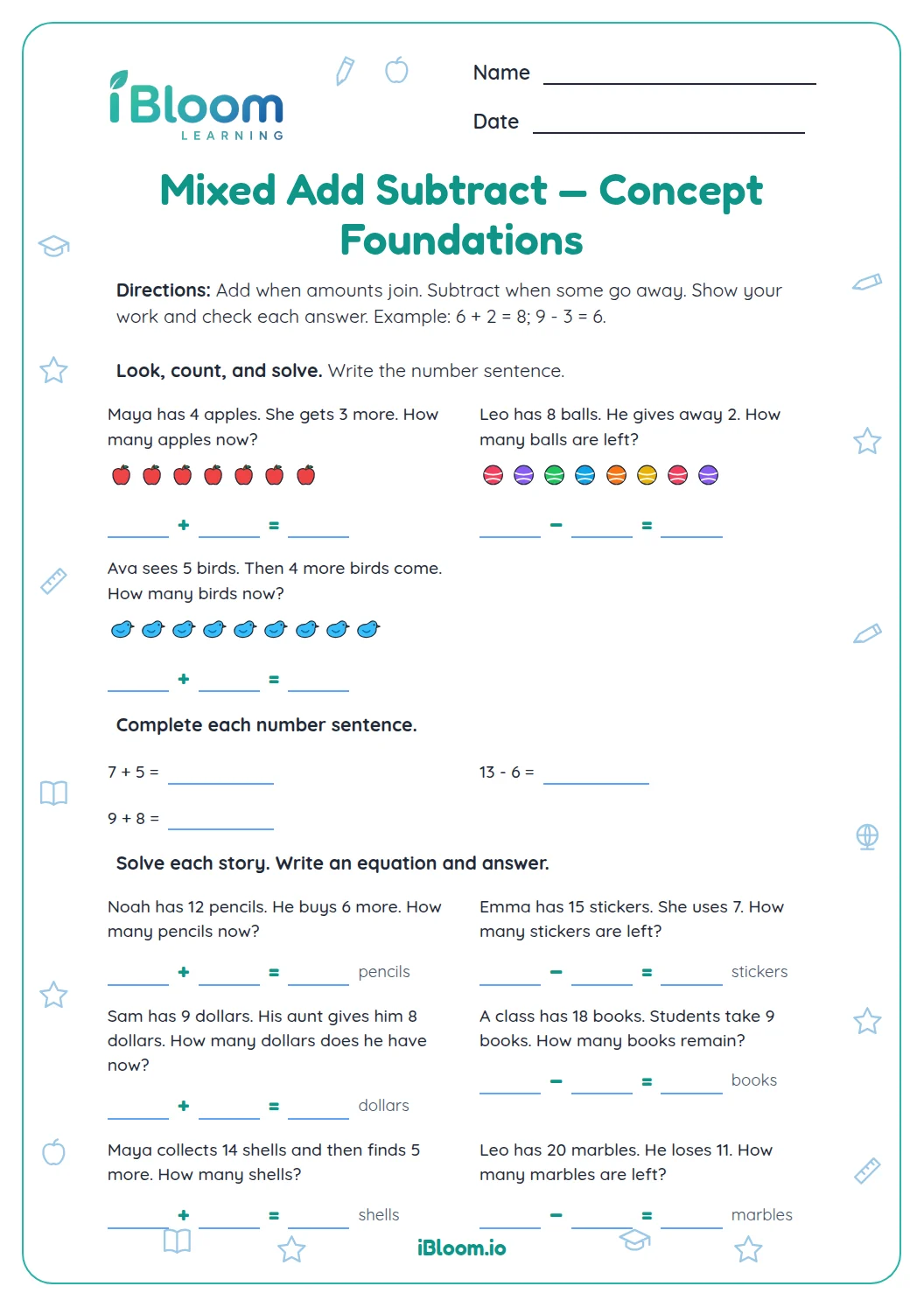
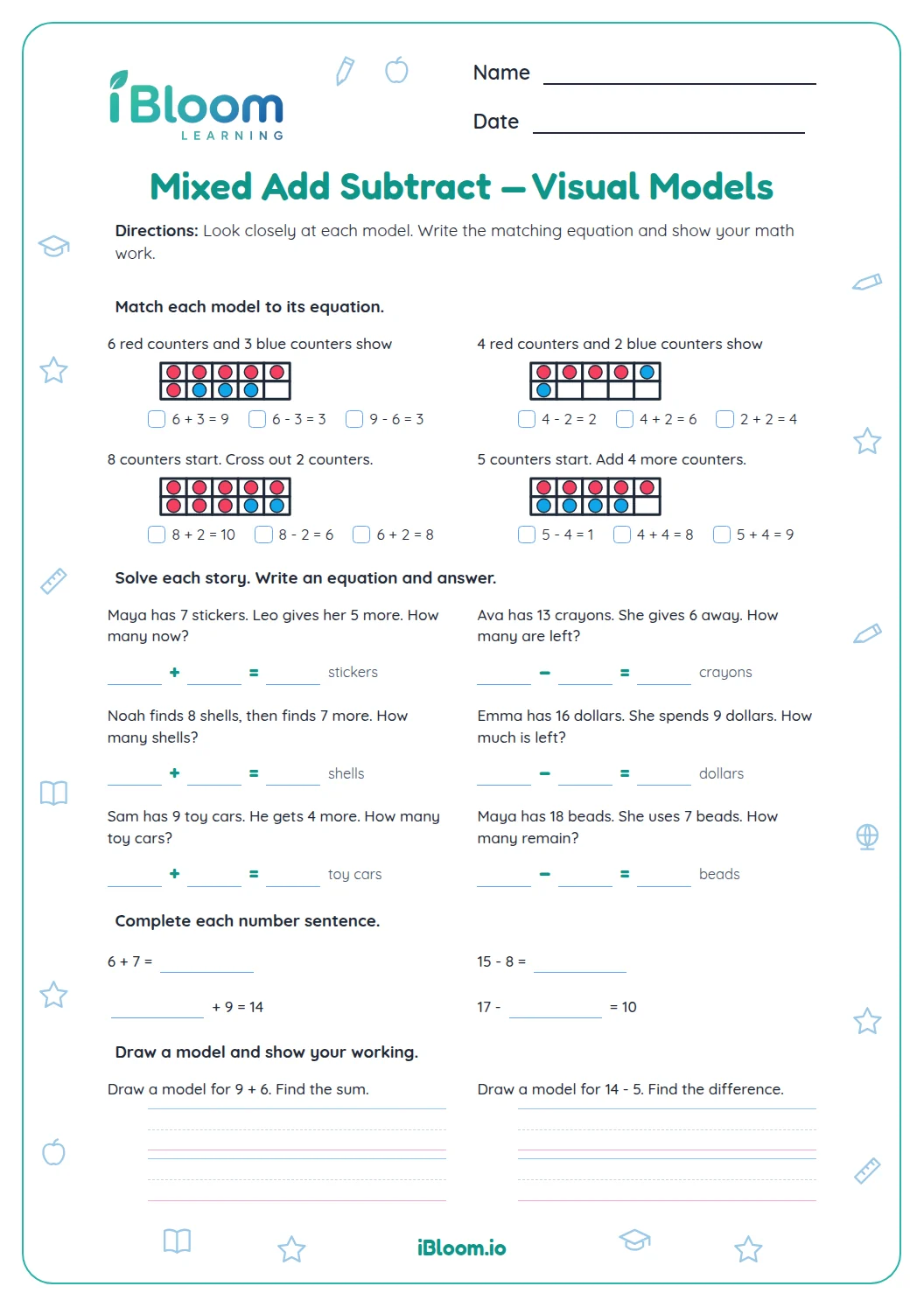
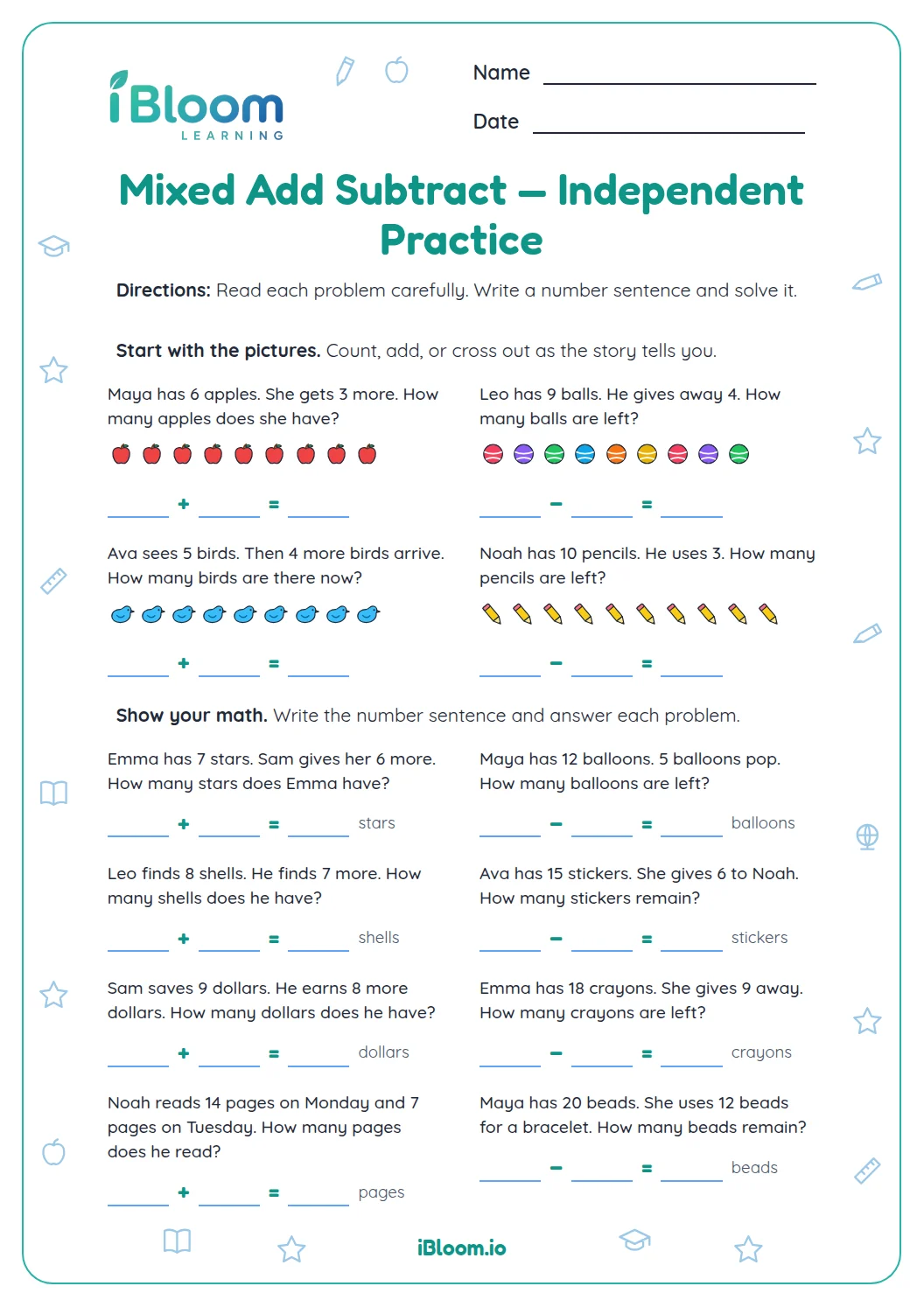
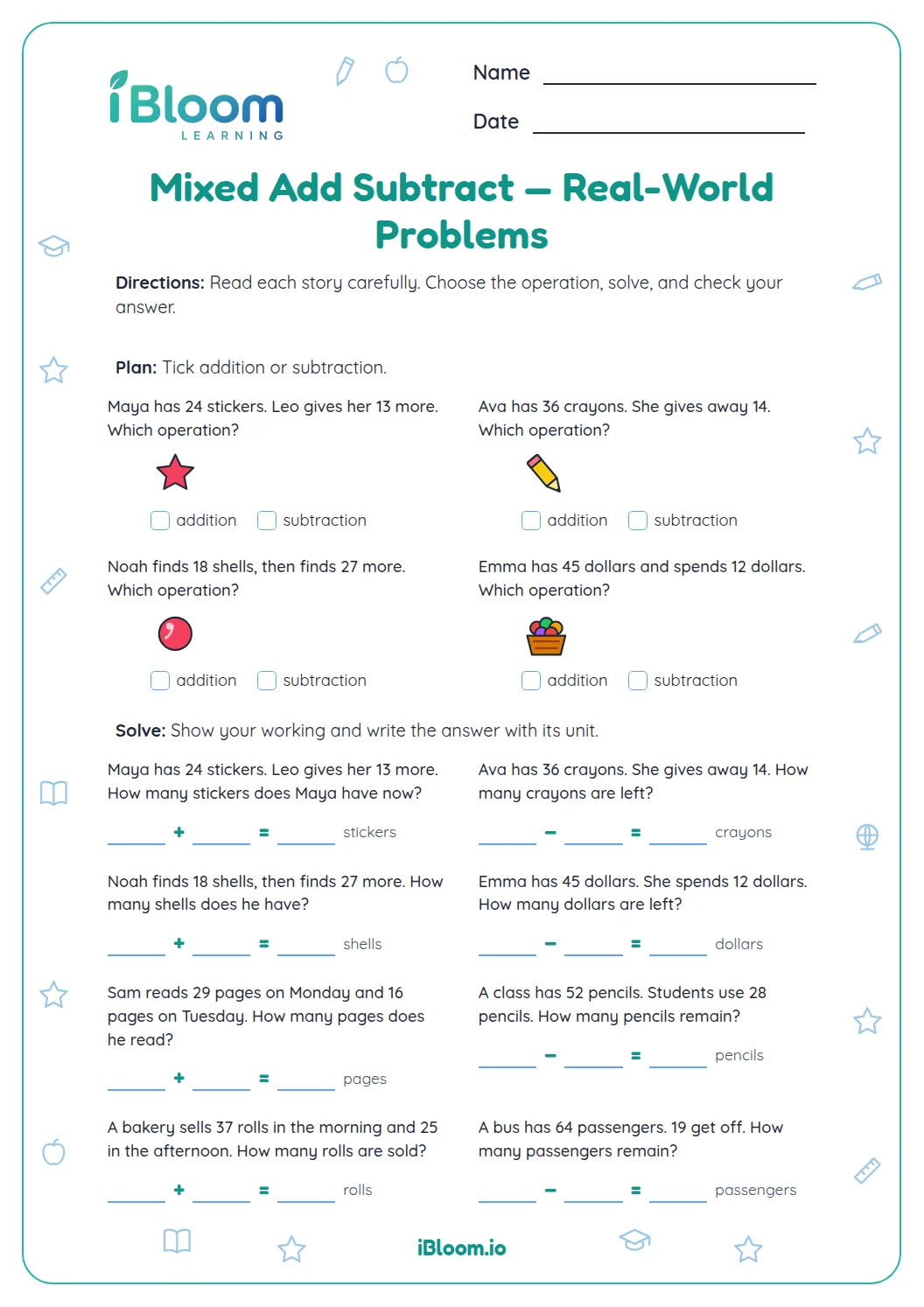

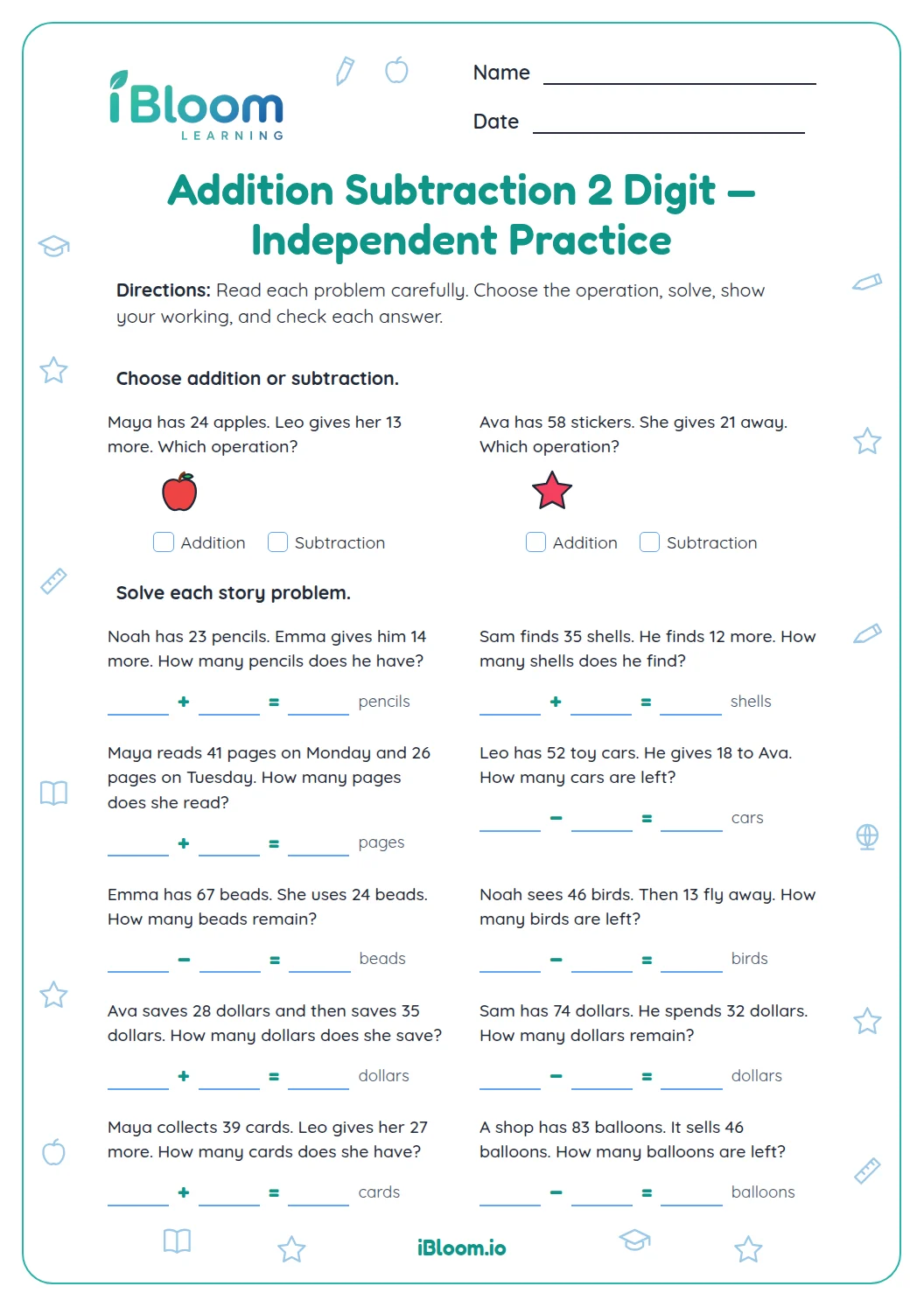
About this worksheet
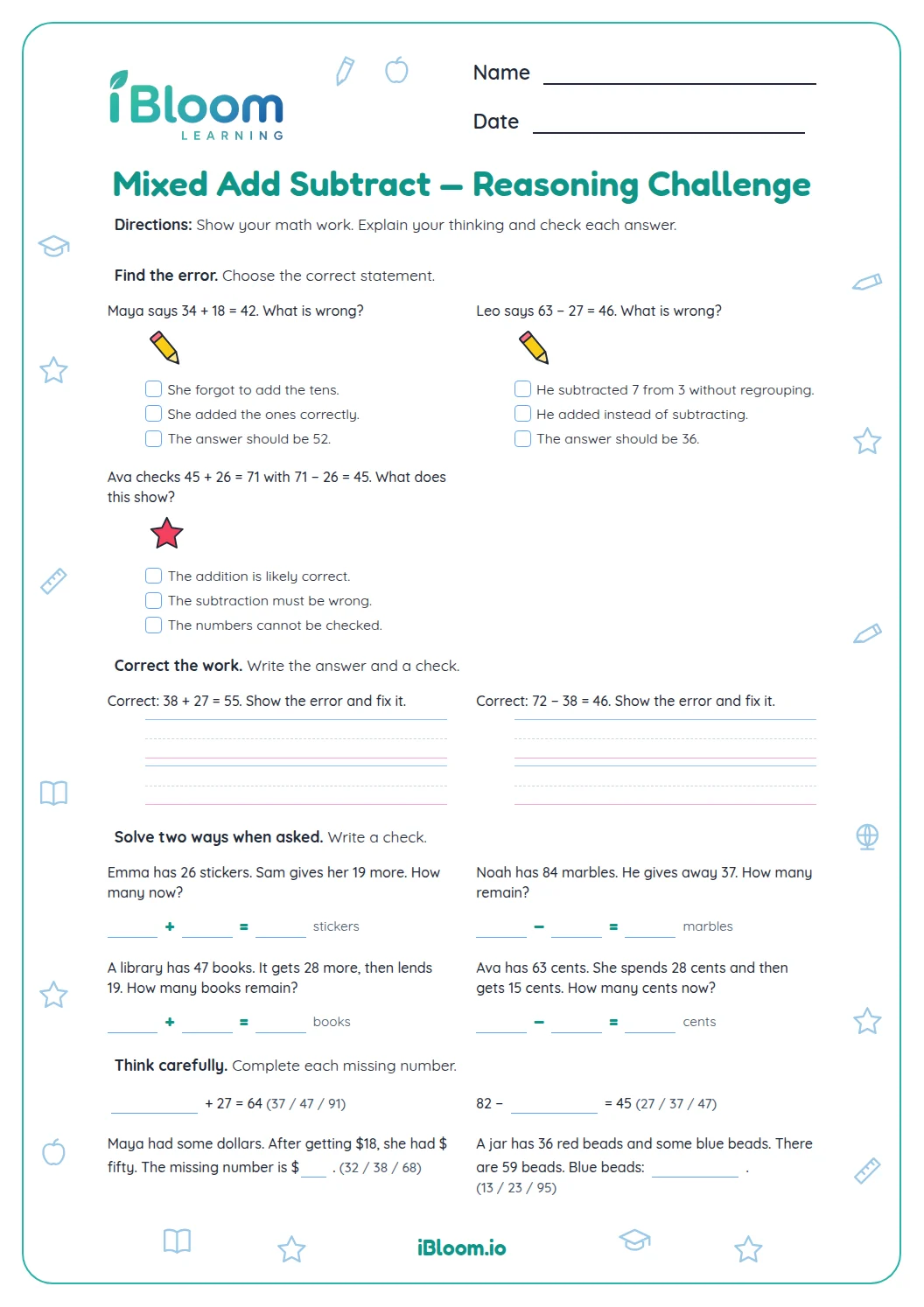
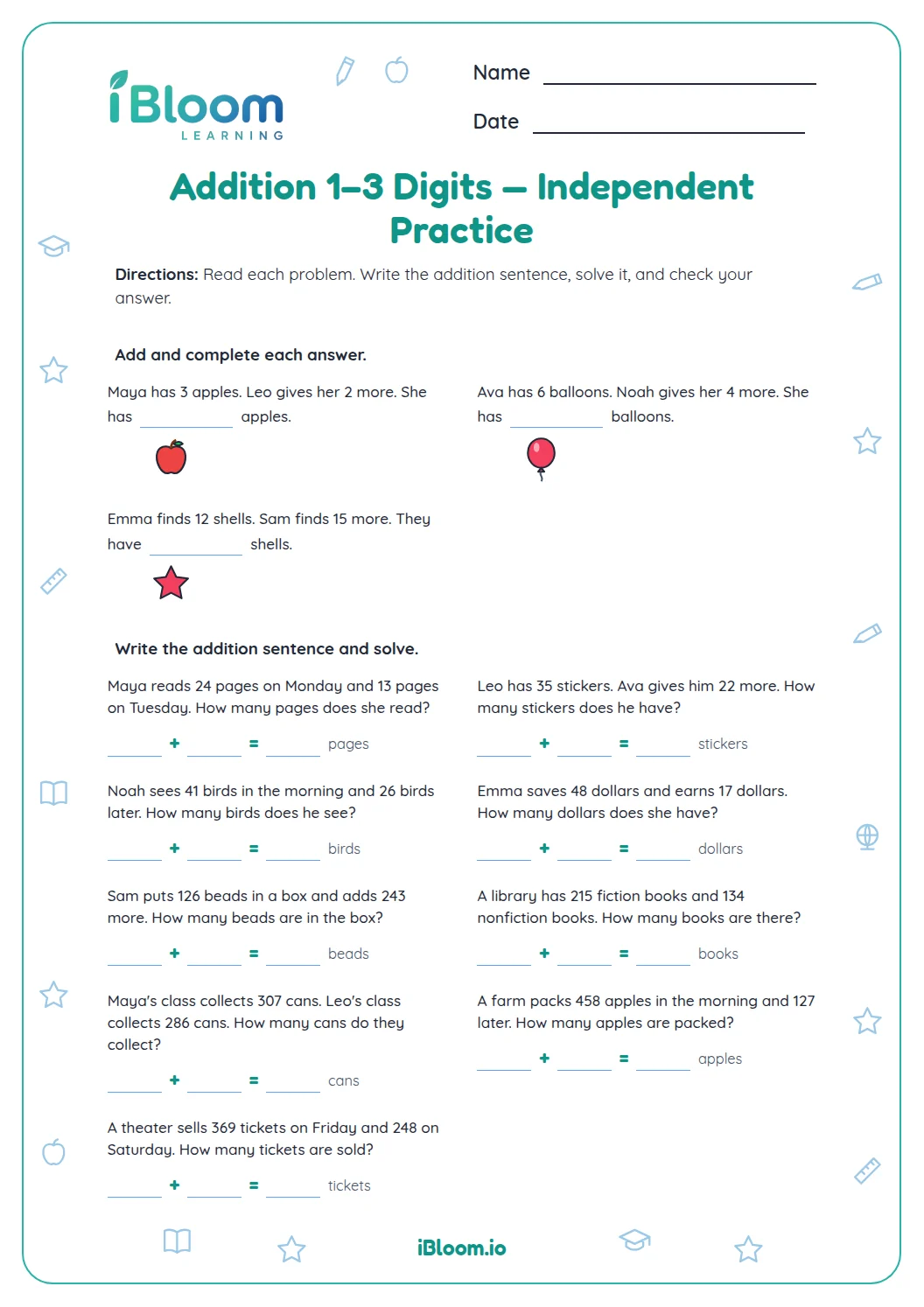
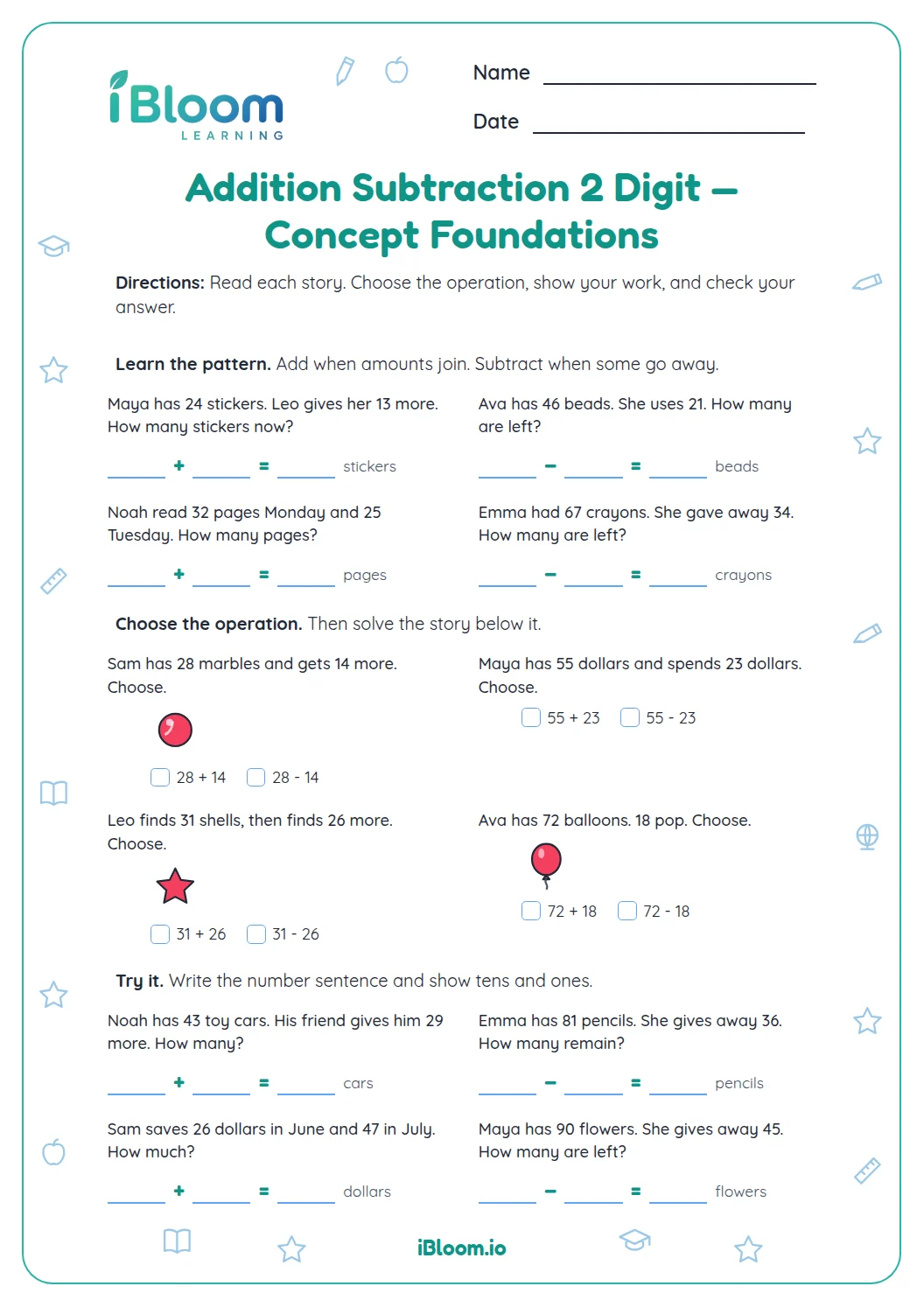
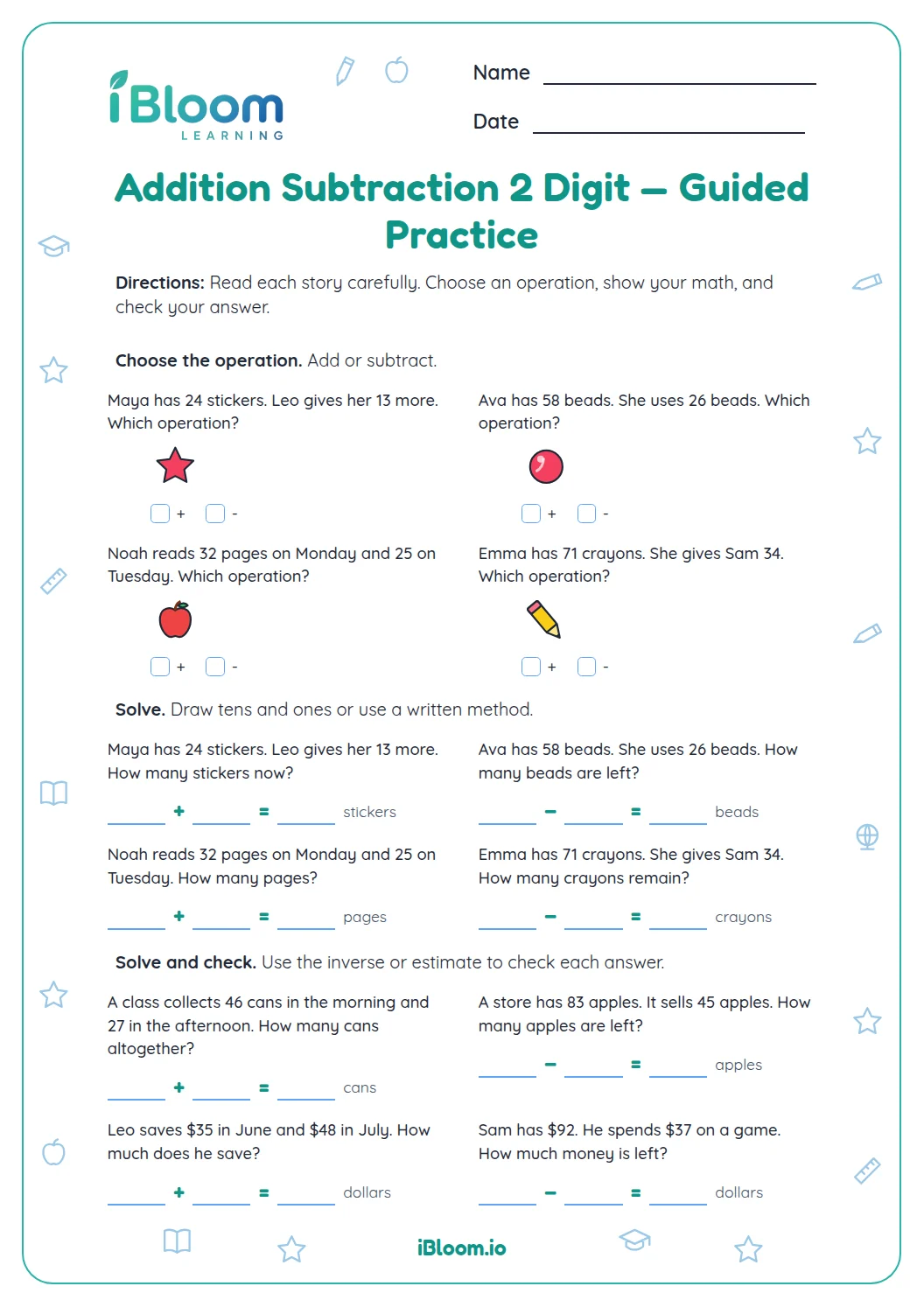
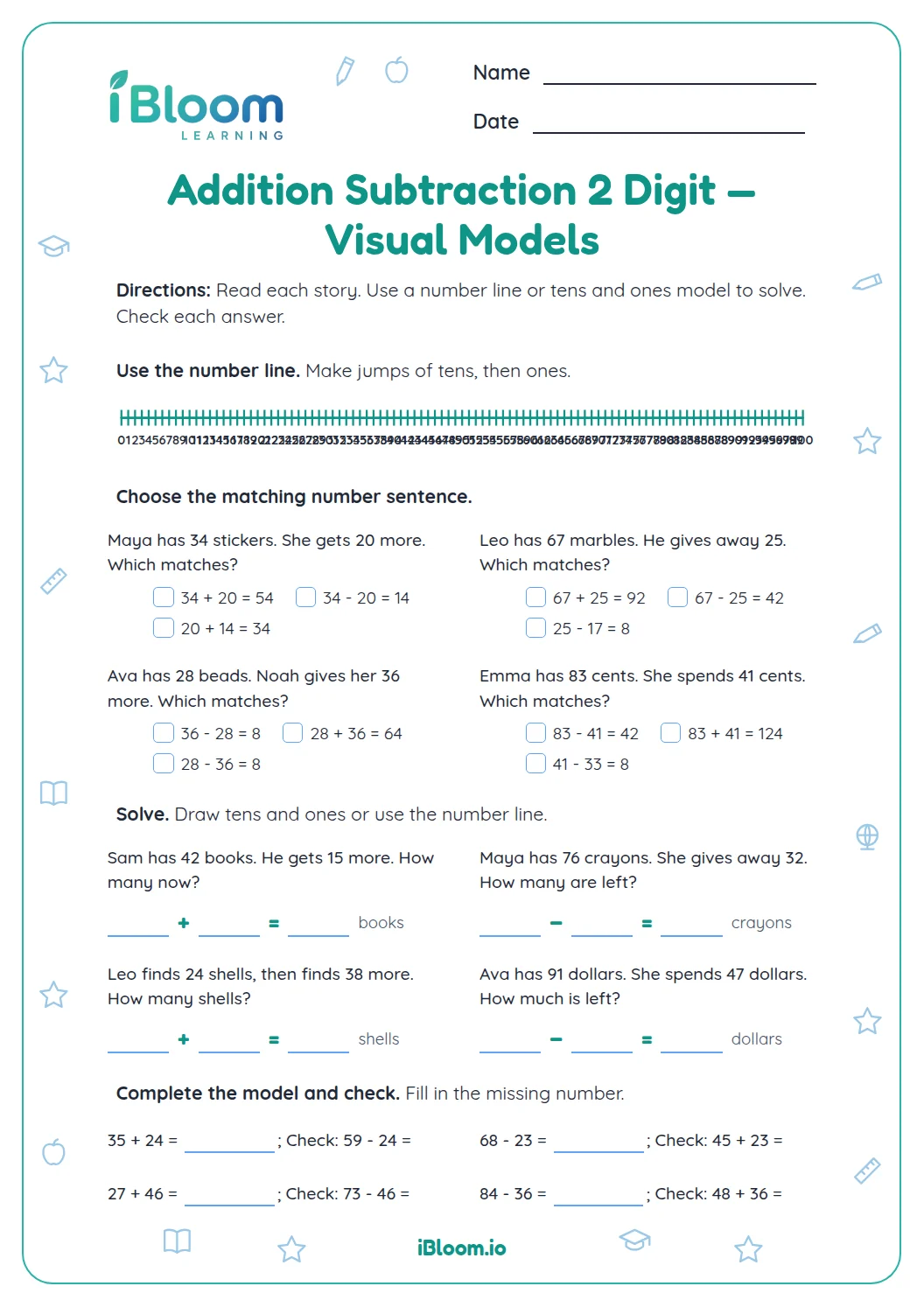
Grade 2 learners solve 15 mixed addition and subtraction stories with totals and differences within 1,000. A separate answer key supports checking. The varied contexts ask learners to join, take away, compare, and find a missing amount. Students can record their equations on scratch paper.
Aligned to 2.OA.A.1
What does solve mixed addition and subtraction stories mean?
Fifteen two-digit and three-digit word problems ask students to choose addition or subtraction and record a solution. Includes an answer key.
Work through the parts in order. Each section adds a new way to use the same skill.
- 1Mia has 28 stickers. Her friend gives her 17 more.
- 228 + 17 = 45 stickers
How is the practice organized?
There are 15 questions across three parts, followed by a separate answer key. The prompts move from recognizing the idea to using it in context.
- Part A: guided recognition and first examples
- Part B: apply the skill to new examples
- Part C: explain, solve, or write independently
How can an adult support the learner?
Read each direction aloud if needed, then ask the learner to explain one choice or step. Use the key to check the final response and revisit any item that needs another look.
How to use this worksheet
- 1Read the direction for the first part together.
- 2Model one item by thinking aloud.
- 3Let the learner complete the next items independently.
- 4Ask the learner to explain one answer.
- 5Check work with the separate answer key.
Common mistakes and quick fixes
The mistake
Rushing past an important clue in the prompt.
The fix
Underline the key word or detail before answering.
The mistake
Choosing an answer that does not fit the full question.
The fix
Reread the prompt and check that the response addresses it.
The mistake
Leaving a response unchecked.
The fix
Use the answer key and correct the work in a different color.
Common Core alignment
This worksheet practices the standard below.
Solve one- and two-step addition and subtraction word problems within 100.
On this sheet: Fifteen two-digit and three-digit word problems ask students to choose addition or subtraction and record a solution. Includes an answer key.
Show the official wordingHide the official wording
Use addition and subtraction within 100 to solve one- and two-step word problems involving situations of adding to, taking from, putting together, taking apart, and comparing, with unknowns in all positions, e.g., by using drawings and equations with a symbol for the unknown number to represent the problem.
What to practice next
Make more practice
Further reading
Questions parents and teachers ask
What skill does this page practice?
The problems ask students to decide whether quantities join, separate, or need comparing. Each story is solved with addition or subtraction, and answers stay within 1,000 so the focus remains on understanding the situation and writing an equation. The answer key lets learners check both the operation they selected and their computation.
How many questions are included?
There are 15 story problems arranged in three parts. The stories include adding quantities, taking away, comparing amounts, and finding how many more are needed. Each item provides work space, and the answer key gives the result. The answer key lets learners check both the operation they selected and their computation.
Can an adult read the directions aloud?
Yes. Have the learner identify what is known and what the question asks. Then choose addition or subtraction, write a number sentence, solve it, and label the answer with the story’s unit or object. The answer key lets learners check both the operation they selected and their computation.
How should mistakes be reviewed?
A comparison question may ask how many more one group has. That calls for finding the difference, not adding both amounts. Underline the two quantities and check that the answer makes the groups equal. The answer key lets learners check both the operation they selected and their computation.
Is the answer key included?
Yes. The separate answer key lists each answer, including cents for the money question. Students can check their equations and final results, then correct a missed operation or computation. The answer key lets learners check both the operation they selected and their computation.