

About this worksheet
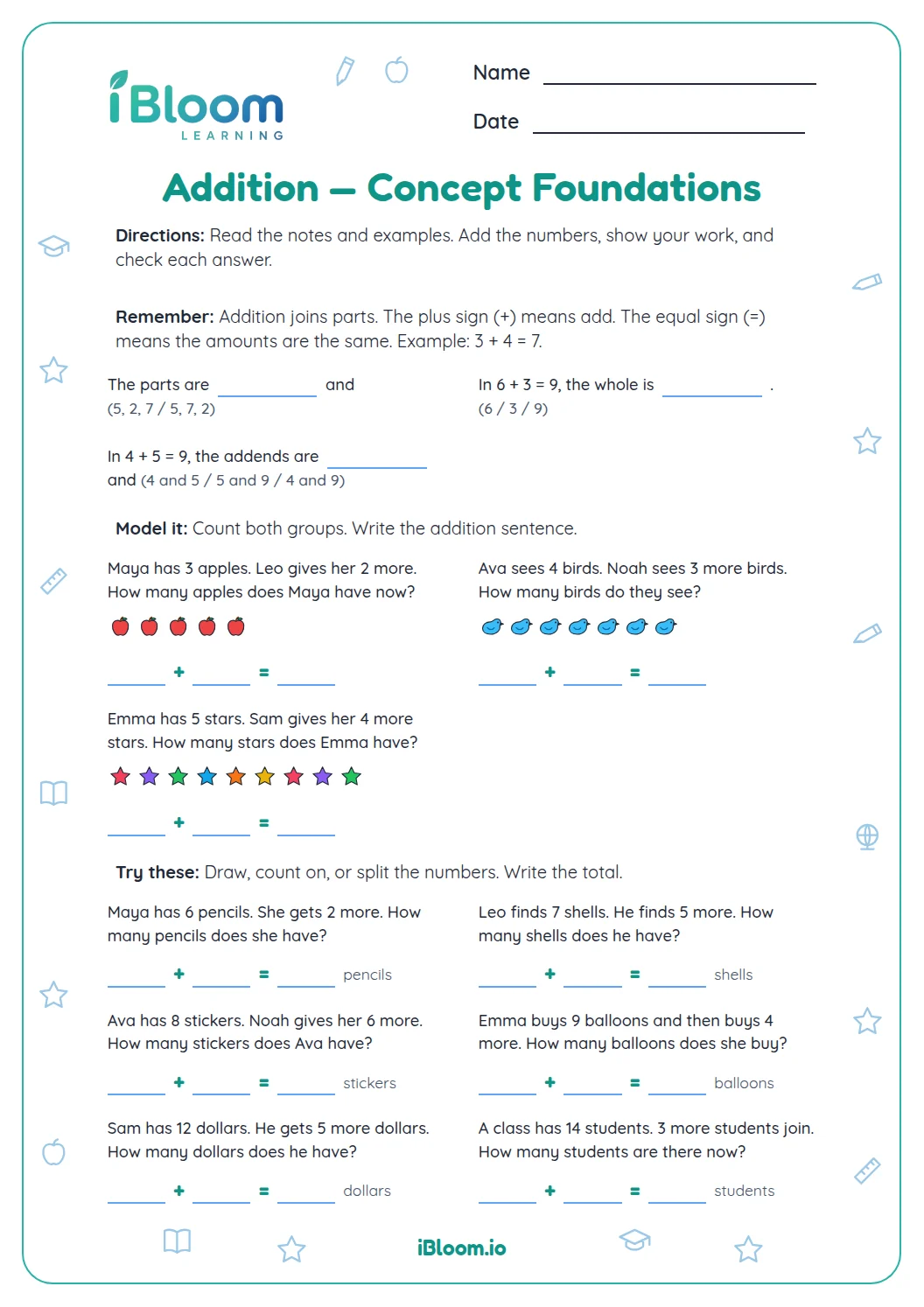
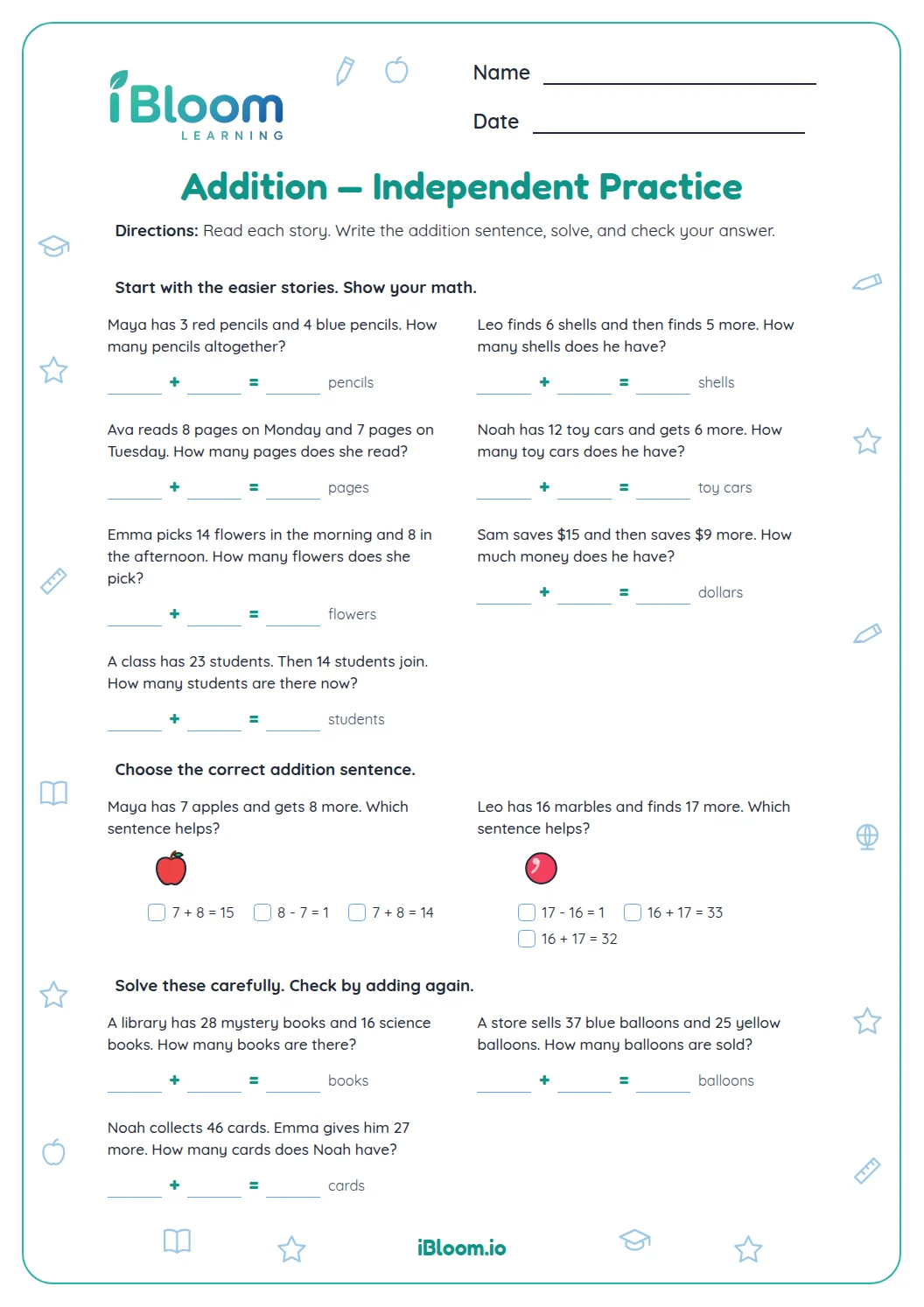
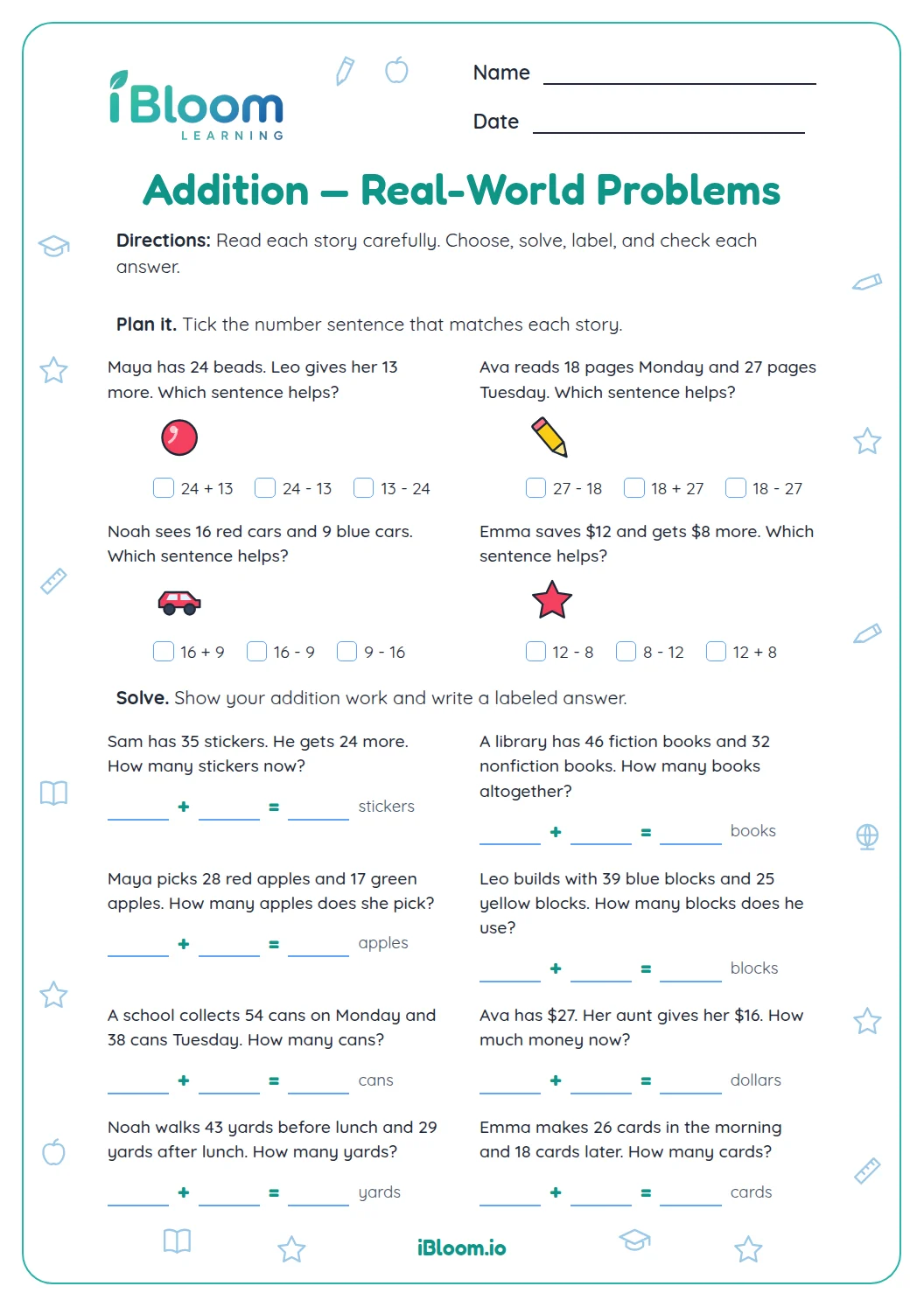
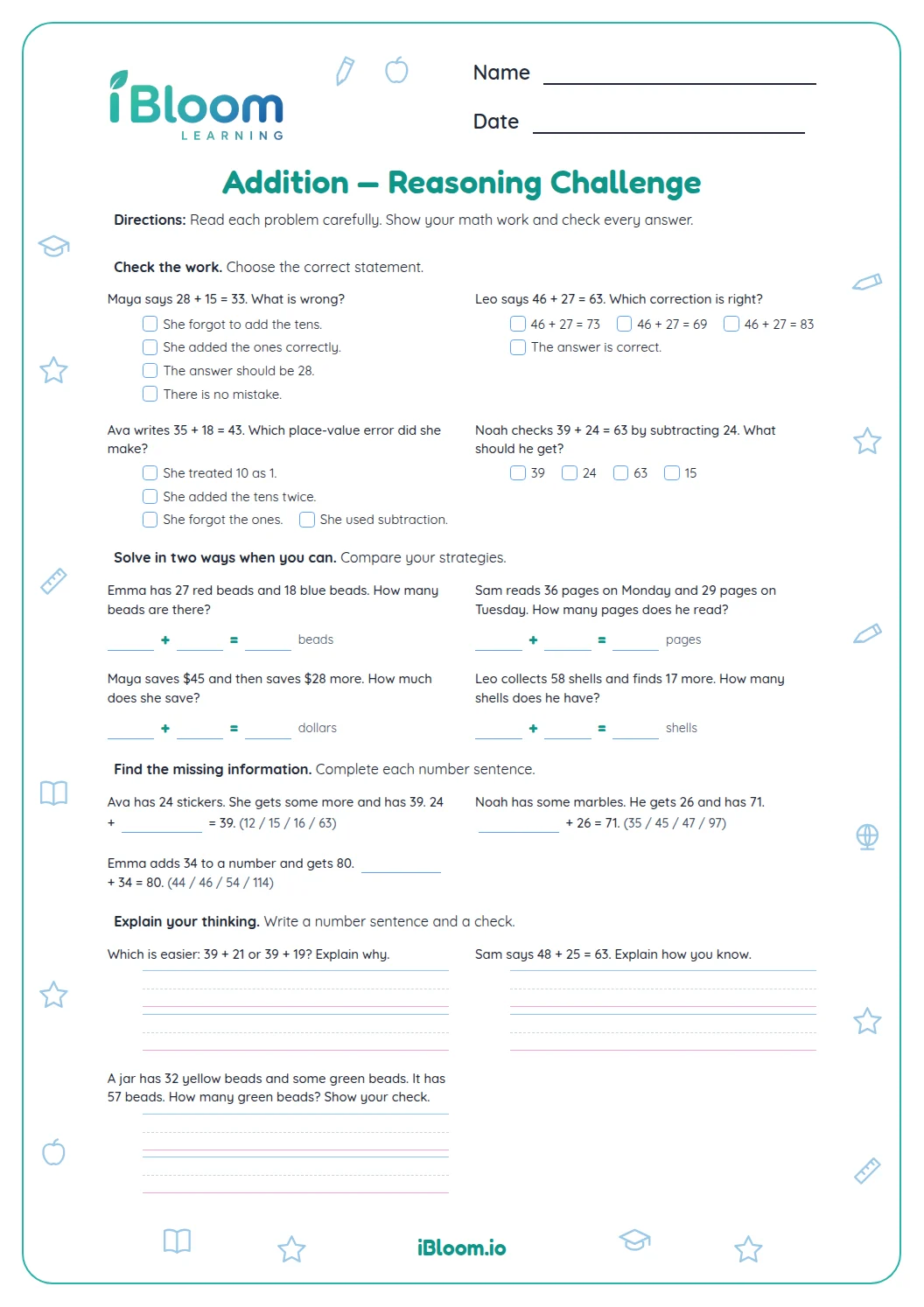
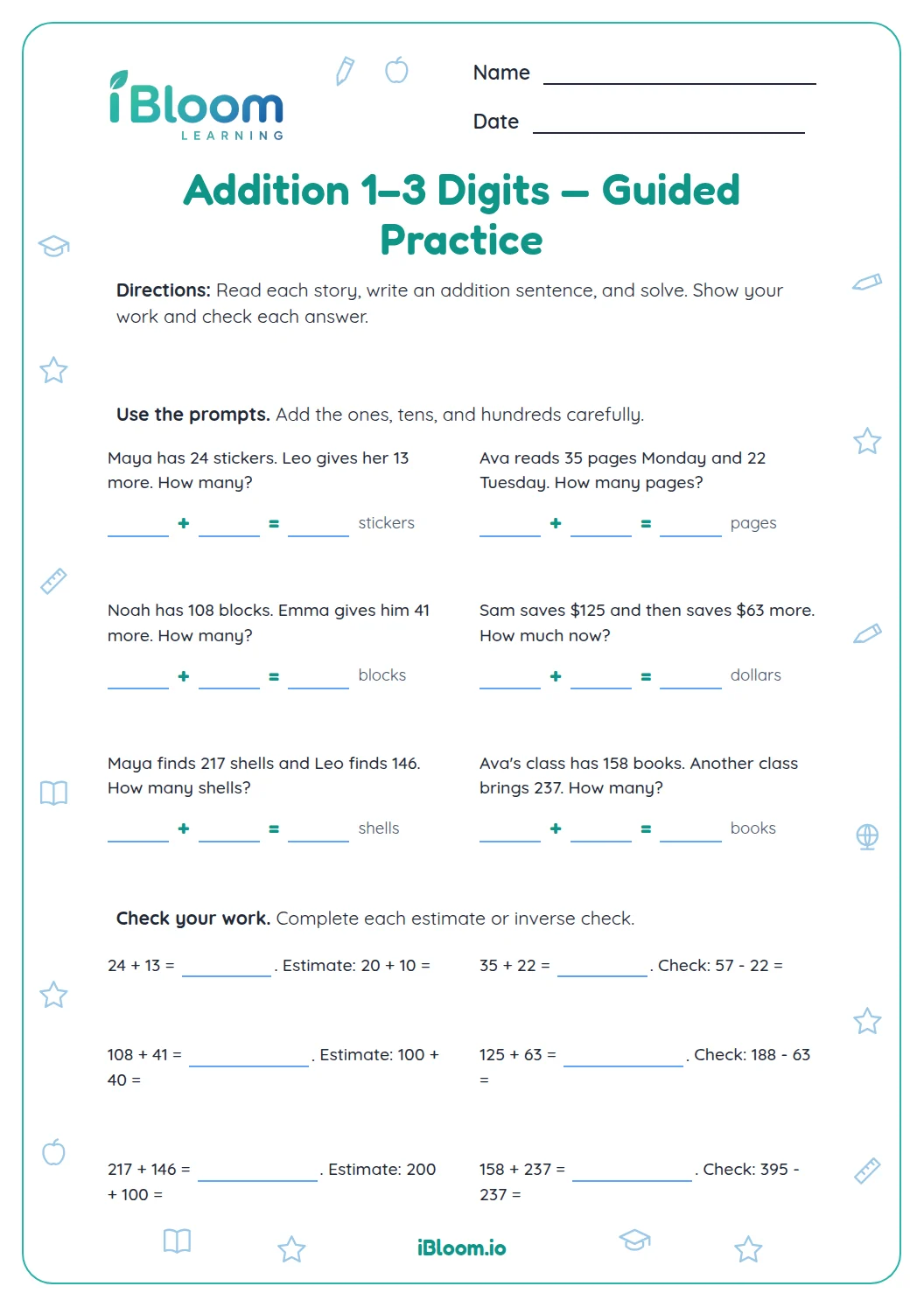
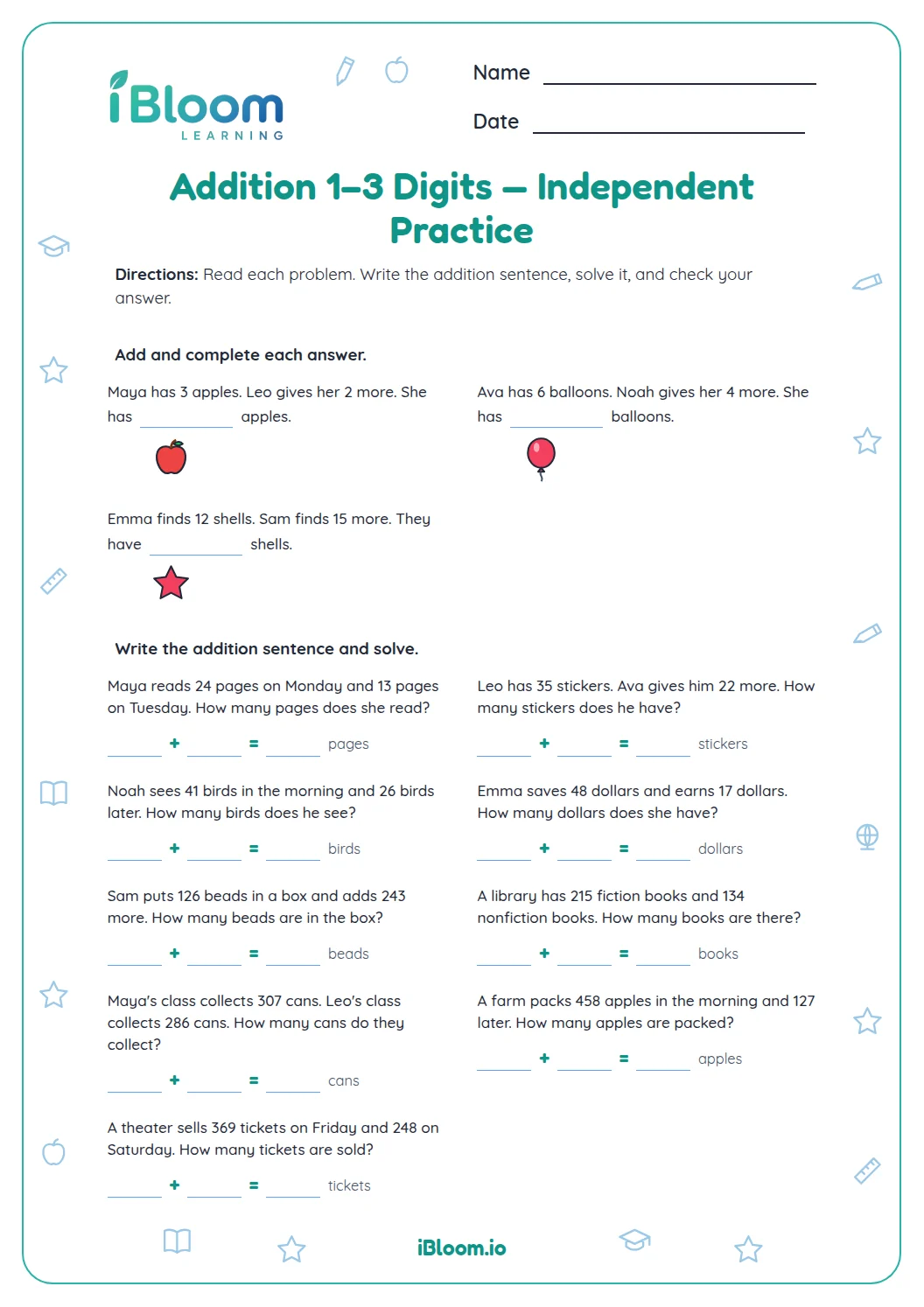
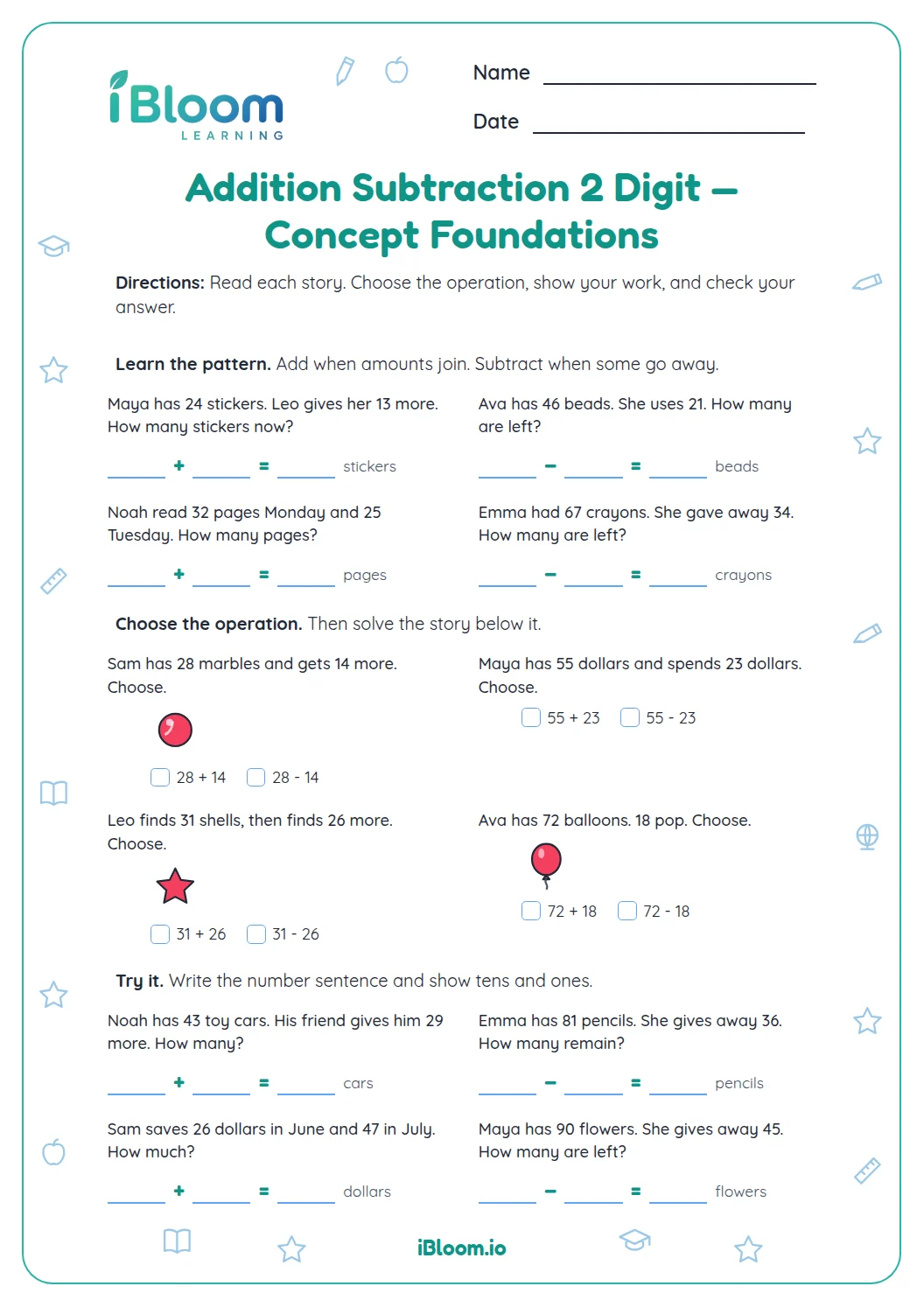
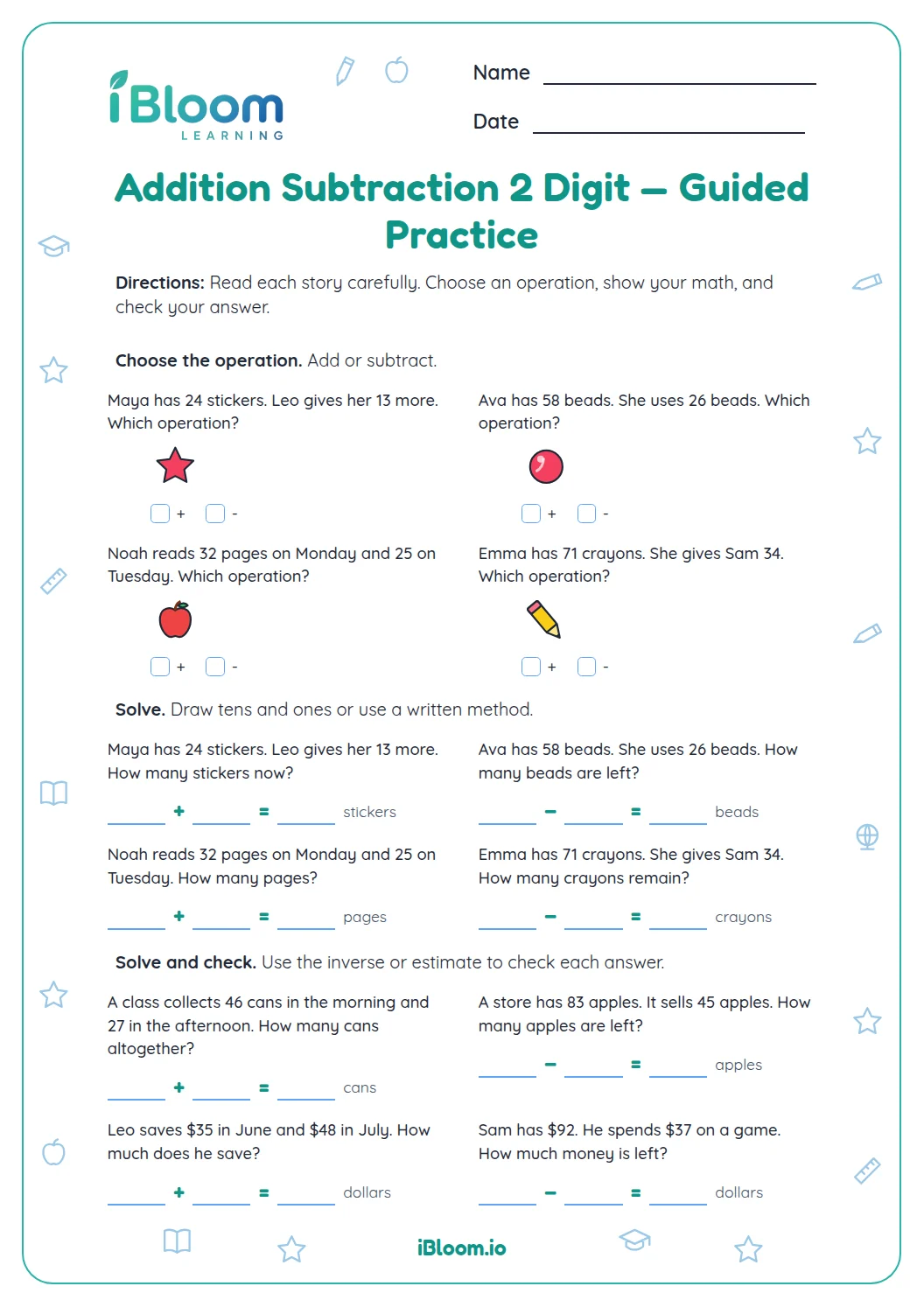
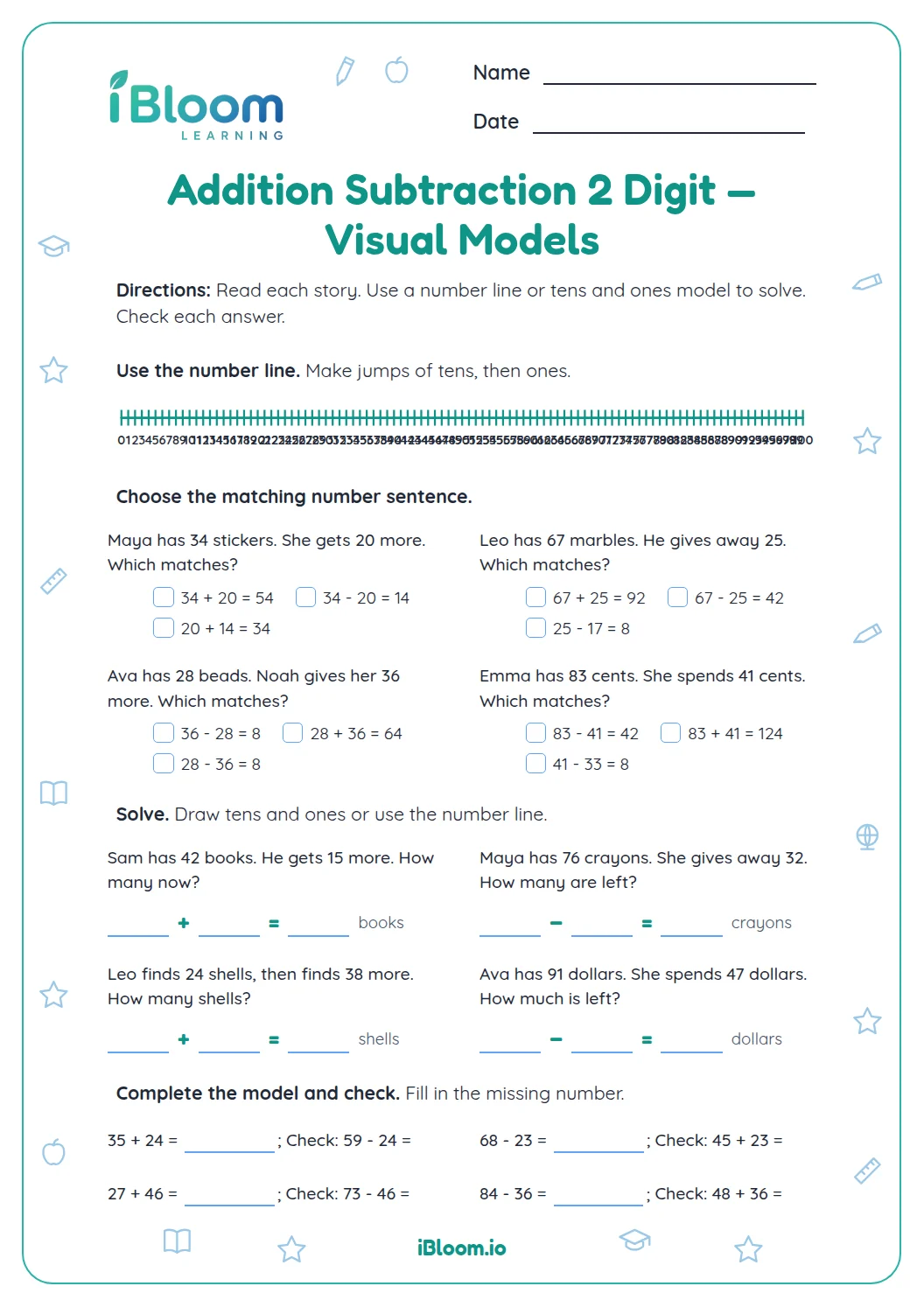
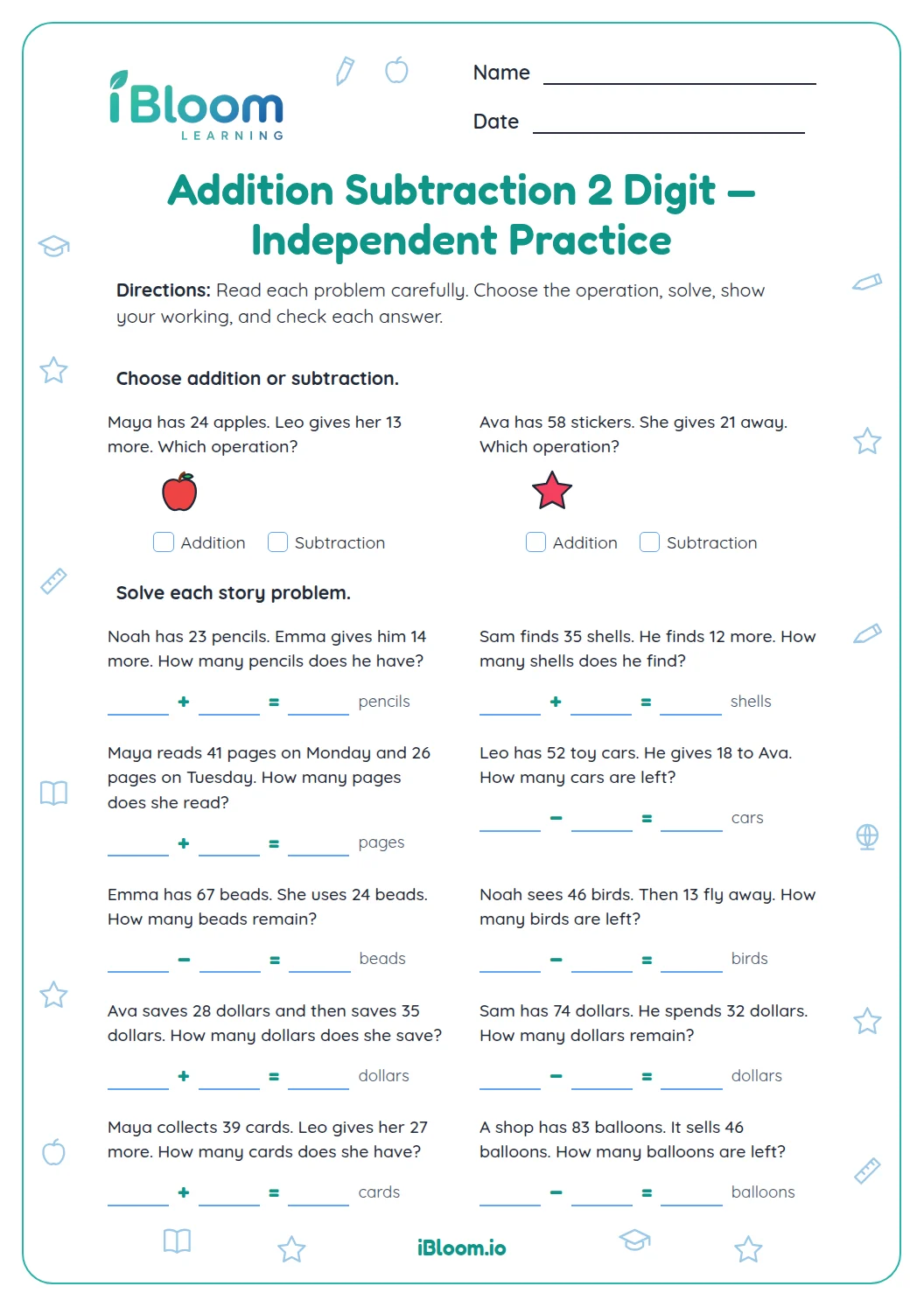
This Grade 2 printable gives students guided practice solving addition stories within 100. The 14 questions use familiar situations such as stickers, pages, cans, and books, with two missing-addend prompts to vary the unknown. Students can use place-value strategies to find totals and check their answers against the separate key. The sheet practices CCSS 2.OA.A.1.
Aligned to 2.OA.A.1
How do you represent amounts being joined?
The stories ask students to combine two amounts or find an unknown addend. Write the total or missing number, then check that it answers the story.
Question 1 joins 12 stickers and 7 more, giving Maya 19 stickers.
- 112 stickers and 7 more stickers
- 212 + 7 = 19
- 3Maya has 19 stickers.
What addition strategy can help within 100?
Add tens and ones or make the next ten first. For 27 + 16, move 3 from 16 to make 30, then add 13: 30 + 13 = 43.
How do you find a missing addend?
When the total is known but one addend is missing, subtract the known addend from the total. For 34 + ___ = 62, 62 − 34 = 28.
How can a student solve each addition story?
- 1Read the story and identify the two amounts being combined.
- 2Underline the question so you know what the total represents.
- 3Use an addition strategy to find the total or missing addend.
- 4Write the answer and include what it counts.
- 5For a missing addend, count on or subtract from the total.
- 6Check that the answer is reasonable in the story.
Common addition mistakes
The mistake
Adding the digits in the ones place but forgetting a new ten.
The fix
Regroup ten ones as one ten, then add the tens.
The mistake
Using the known total as an addend.
The fix
For a missing addend, find the difference between the total and the amount you know.
The mistake
Writing a number without saying what it counts.
The fix
Label the answer with the story unit, such as pages or cans.
Common Core alignment
The story problems ask students to represent and solve addition situations within 100.
Represent one- and two-step addition stories with equations.
On this sheet: Addition stories ask children to represent and solve one-step situations within 100.
Show the official wordingHide the official wording
Use addition and subtraction within 100 to solve one- and two-step word problems involving situations of adding to, taking from, putting together, taking apart, and comparing, with unknowns in all positions, e.g., by using drawings and equations with a symbol for the unknown number to represent the problem.
What to practice next
Make more practice
Further reading
Questions parents and teachers ask
How many problems are on the worksheet?
There are 14 questions across two worksheet pages: 12 addition stories and 2 missing-addend problems. Students write a short answer for each. The separate key lists the totals and missing numbers so families can check the work after each section.
What is the answer to the sticker story?
Maya has 19 stickers after Ava gives her 7 more: 12 + 7 = 19. The written page works through this first problem as an example of identifying the starting amount, the amount added, and the total. This gives the student a way to record both the addition and its result.
Are the addition problems within 100?
Yes. Each addition total is 100 or less. Students can combine tens and ones or make a ten before adding; for example, 27 + 16 can become 30 + 13. The story context helps them check that the answer counts the right objects or amount.
How can my child solve a missing-addend problem?
Find how much the known addend needs to reach the total. In question 11, 31 needs 39 more to make 70, so the missing addend is 39. A student can check by adding 39 + 31 and confirming that the sum is 70.
Do students need to write equations?
The printed items provide a short answer line for each result. Students can work out an equation on scrap paper or say it aloud, then write the total or missing addend and check that the number fits the story.