
About this worksheet
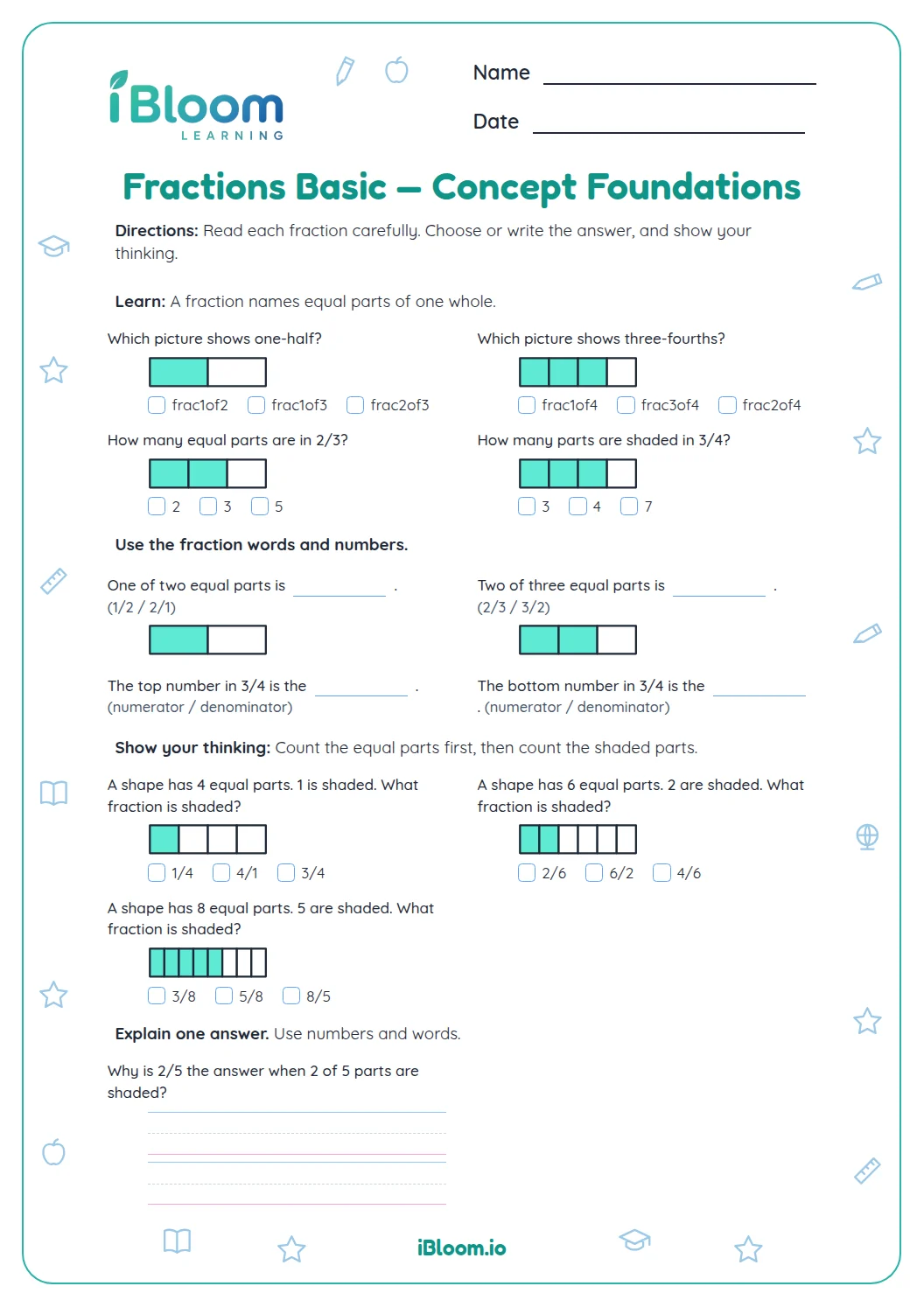
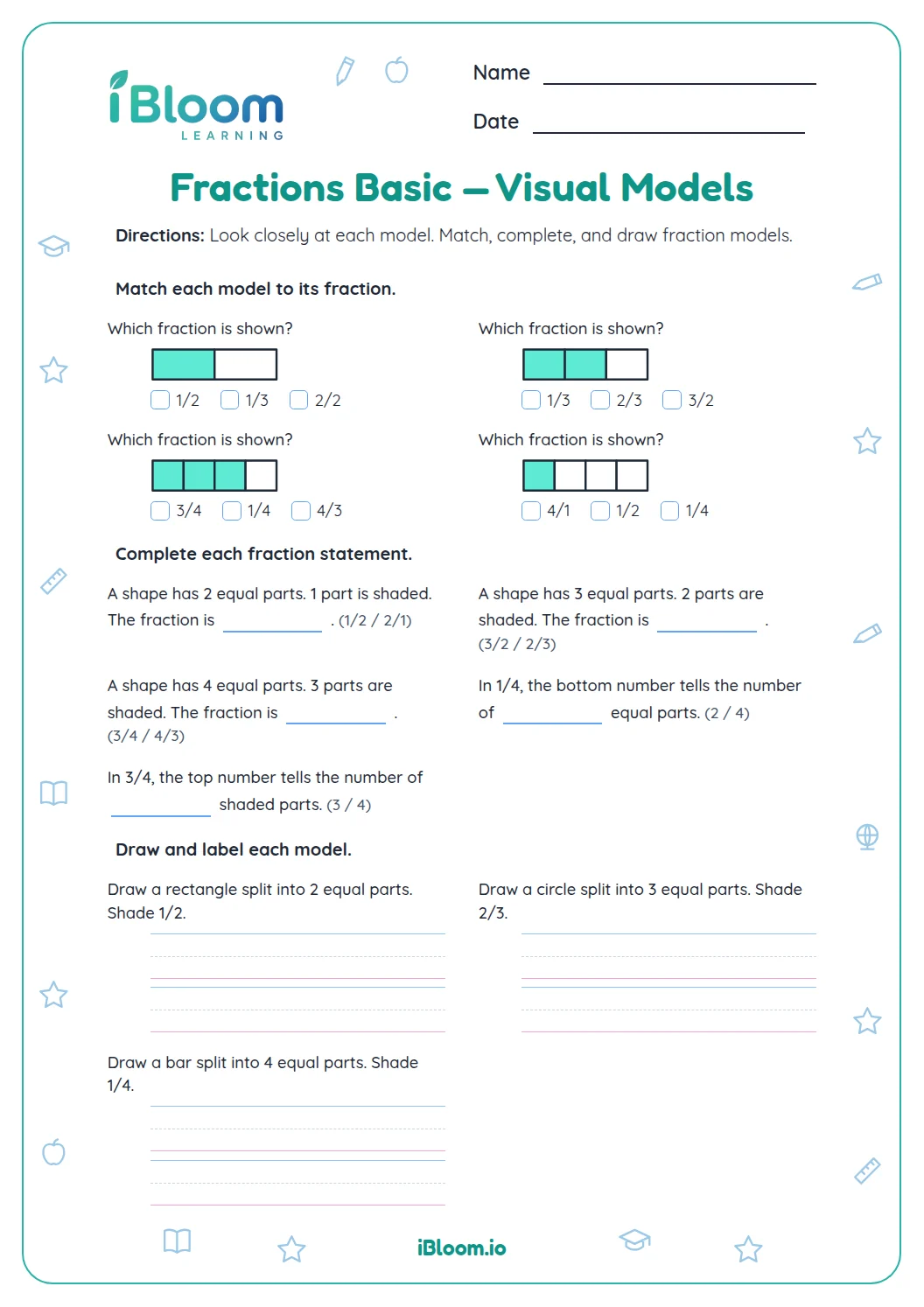
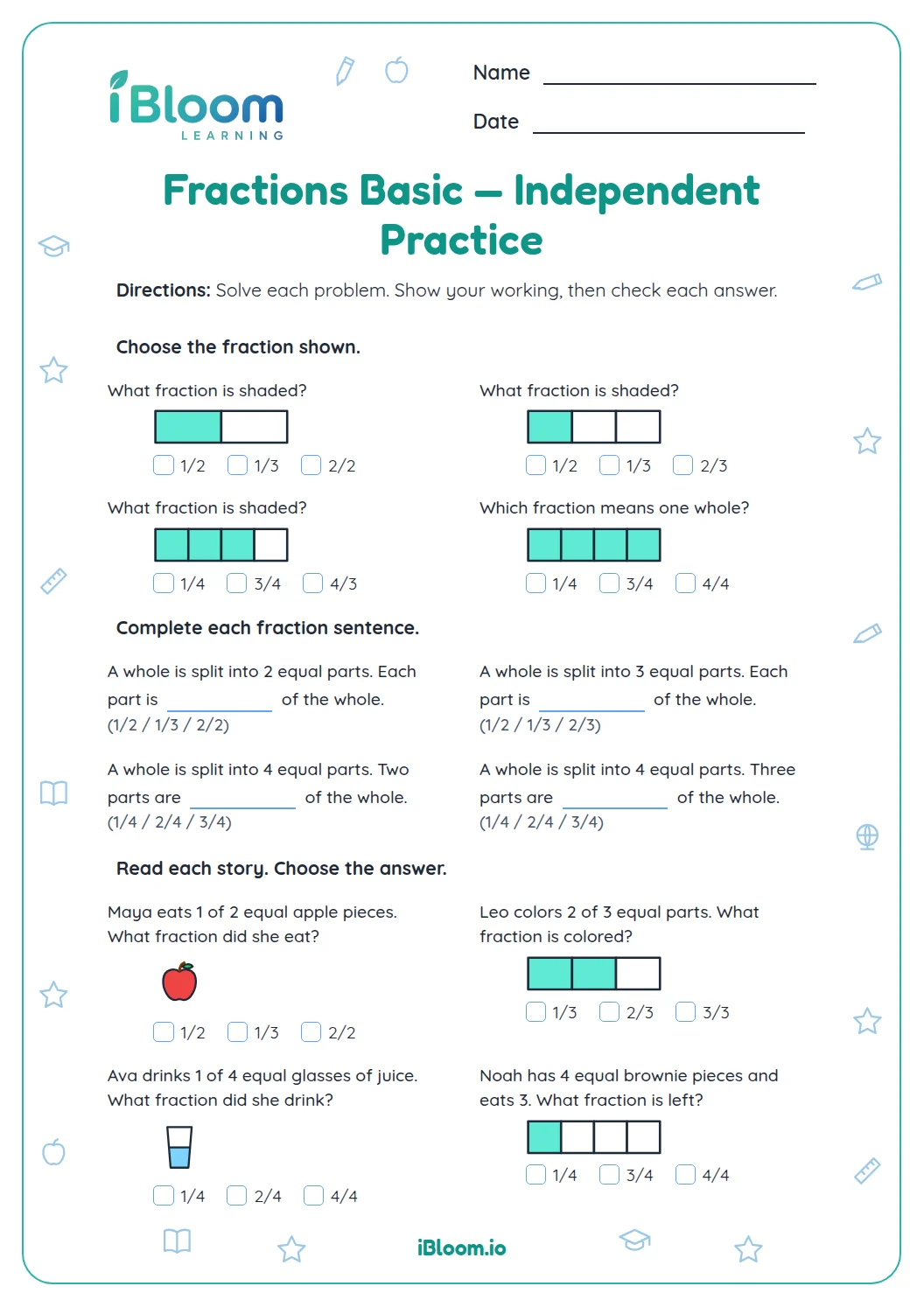
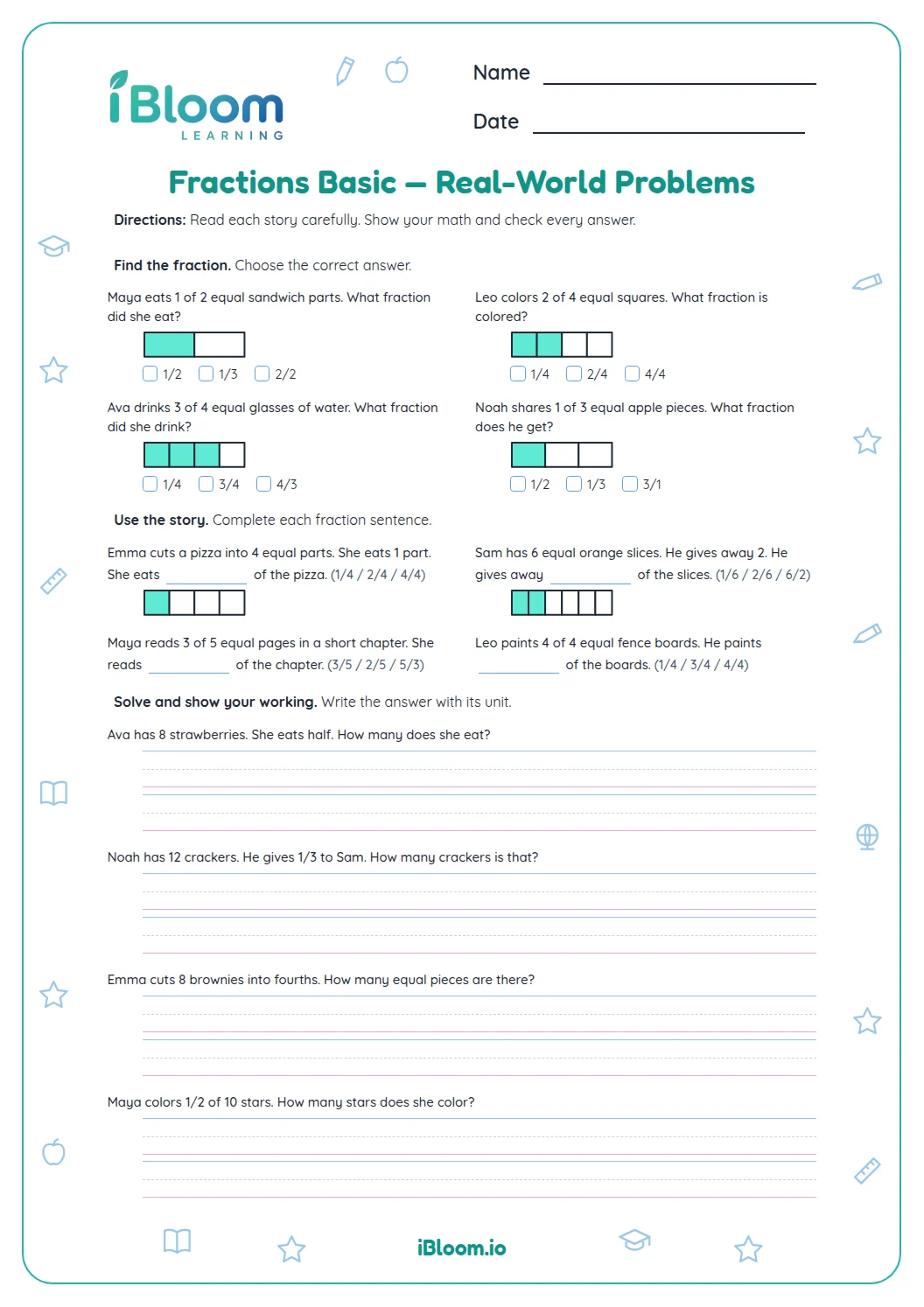
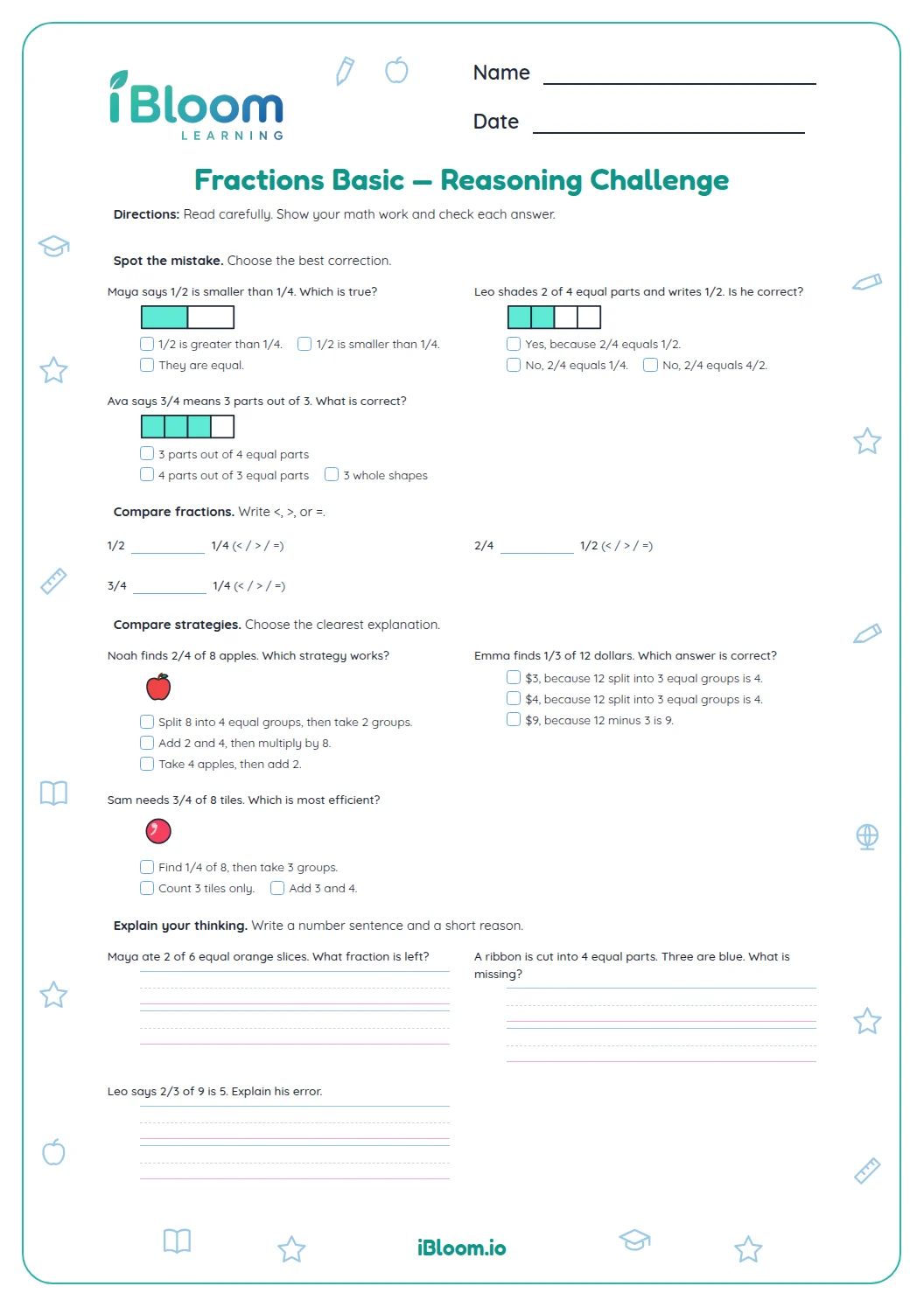
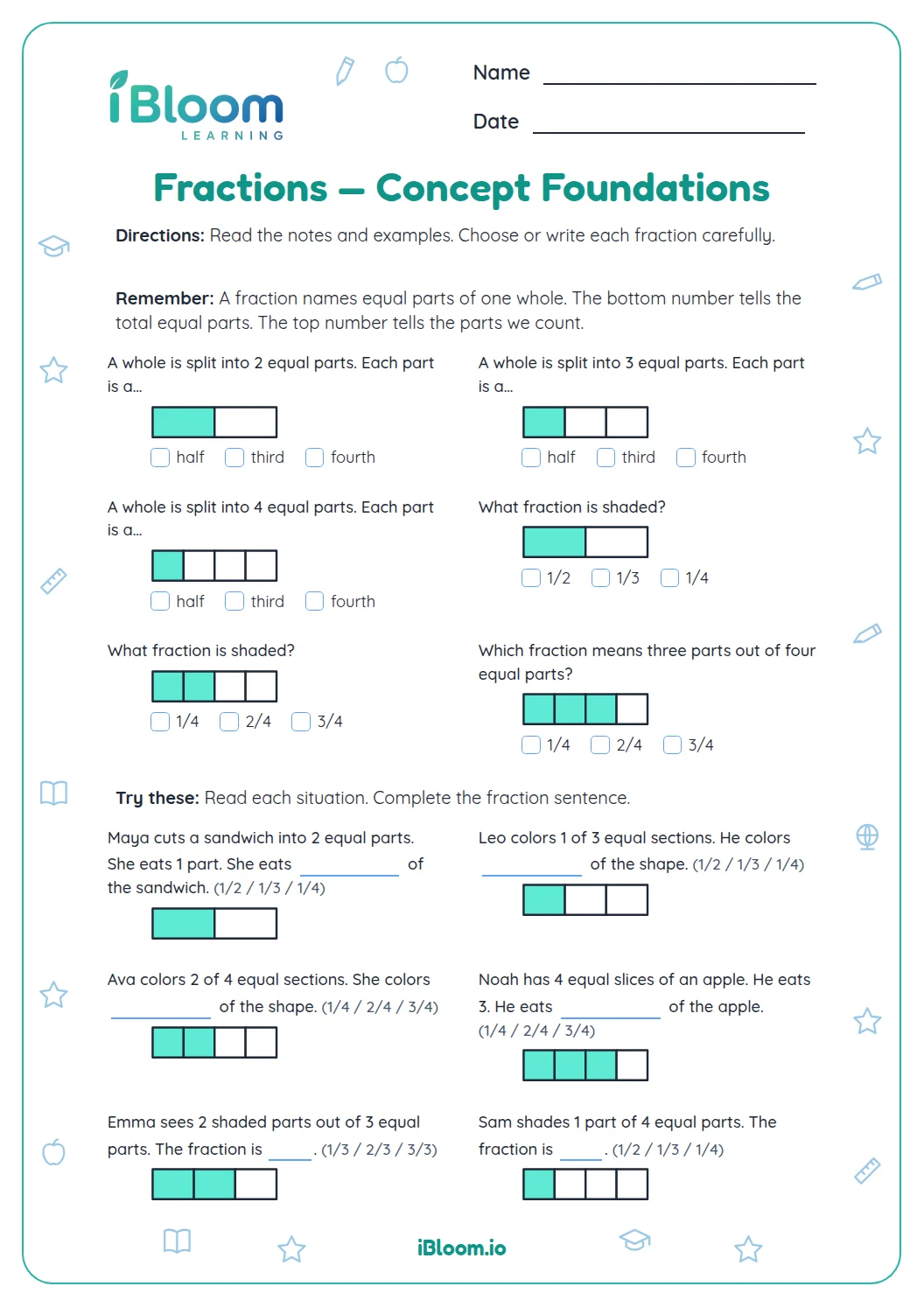
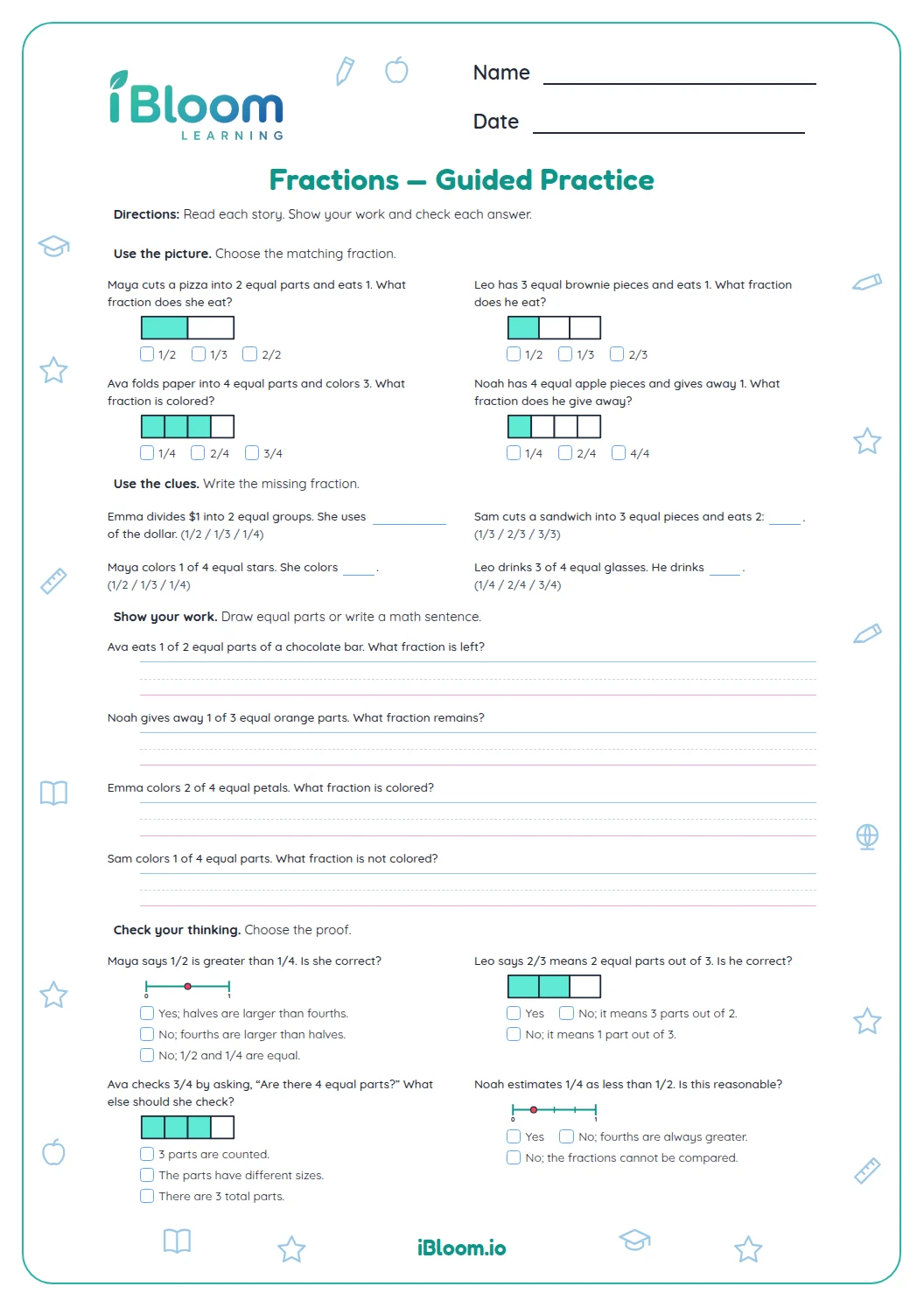
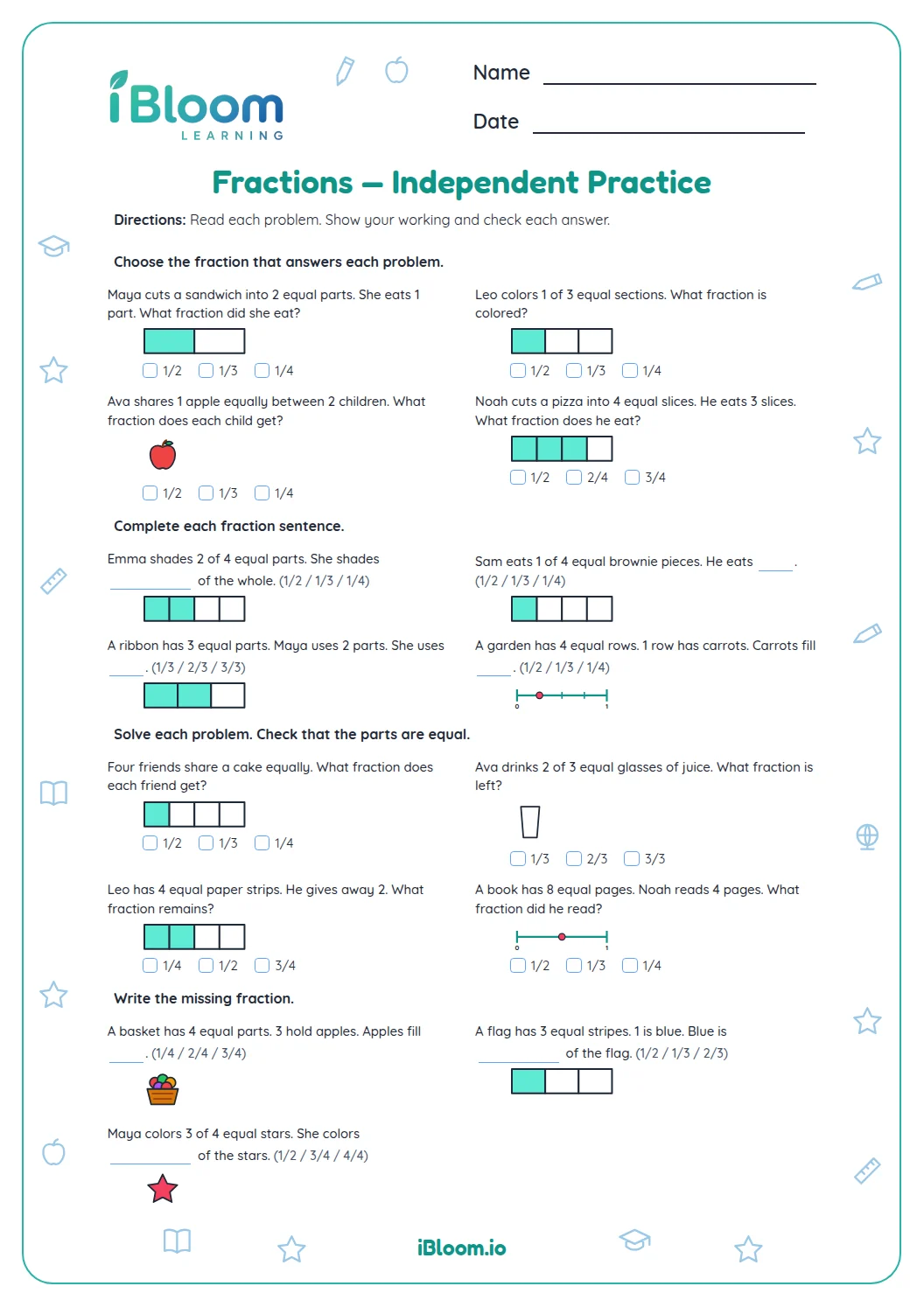
This free Grade 2 worksheet gives fourteen fraction problems in four parts. Part A pairs four food stories with equal-part models. Part B asks for fractions of sets of apples, balls, flowers, and fish. Part C has four blanks about shares used, shares left, and shares that make a whole. In Part D, children draw and partition two rectangles. Naming and drawing equal shares practices Common Core 2.G.A.3. Children may use fraction words or equivalent numerals. A separate answer key gives the fractions and describes what each drawing should show.
Aligned to 2.G.A.3
Why must the parts be equal?
A fraction name depends on equal shares of the same whole. Two pieces are halves when each is half of that whole. A tiny corner and a large remaining piece do not make two halves.
The models in Part A show equal sections. Encourage children to name the whole object first, then count all its equal parts and the shaded share.
- 1Mia cuts one sandwich into 3 equal parts and eats the shaded part.
- 2There are 3 equal parts; 1 is shaded.
- 3Mia eats one third, or 1/3, of the sandwich.
How do children find a fraction of a set?
Part B treats the whole collection as one set. For Maya’s eight apples, children can make two equal groups of four. The four red apples are one of those two groups, so one half of the set is red. Four eighths names the same share.
Part C returns to one object. When Ana eats one of four equal sandwich pieces, three pieces remain. Each is still a fourth, so three fourths of the sandwich are left.
What should the two sharing drawings show?
In Part D, children draw a rectangle for a sandwich shared by two children and a brownie shared by four children. They add dividing lines so each child receives one equal part.
A fourths drawing may use four equal strips or a two-by-two arrangement. Check that the pieces have equal area and together make the original rectangle.
How to work through this sheet
- 1Use a paper rectangle to talk about one whole and equal shares.
- 2Read question 1 together and identify the shaded share.
- 3Finish Part A by counting all equal parts before naming shaded parts.
- 4In Part B, group each set equally; in Part C, identify the whole before naming a share.
- 5Check the two drawings by counting equal shares and naming one share.
Mistakes to discuss
The mistake
Naming one of three equal parts a half.
The fix
Count all three parts of the whole; one part is one third.
The mistake
Calling the three pieces left after eating one fourth “three thirds.”
The fix
The size of each piece stays a fourth. Three of those pieces are three fourths.
The mistake
Dividing a sandwich into two unequal pieces for two children.
The fix
Move the dividing line so each child receives the same amount.
Common Core alignment
Partition rectangles and name equal shares as halves, thirds, and fourths.
On this sheet: Children read equal-part models, name shares and wholes, and partition rectangles for sharing stories.
Show the official wordingHide the official wording
Partition circles and rectangles into two, three, or four equal shares, describe the shares using the words halves, thirds, half of, a third of, etc., and describe the whole as two halves, three thirds, four fourths. Recognize that equal shares of identical wholes need not have the same shape.
What to practice next
Make more practice
Further reading
Questions parents and teachers ask
Which fractions appear in these Grade 2 stories?
The fourteen problems use halves, thirds, and fourths. Children read four shape models, find fractions of four sets, and answer four questions about shares and wholes. The final two tasks ask them to draw rectangles and divide them equally between two children or among four children.
Should children write fraction words or fraction numbers?
Either words or equivalent fraction numerals are appropriate when naming a share. For example, four eighths and one half both describe Maya’s four red apples out of eight. Ask the child to explain the whole set and its equal groups so the fraction stays connected to the story.
How can I help with the sandwich question about what remains?
Start with four equal pieces representing the whole sandwich. Set one piece aside because it was eaten, then count the three pieces left. Each piece is still one fourth of the original sandwich, so the remaining amount is three fourths. Children can act this out with scrap paper.
Must every correct fourths drawing look the same?
No, different partitions can make four equal shares. Four equal strips and a two-by-two arrangement both work for the rectangular brownie. Check that the shares are equal in area and fill the original rectangle. A different shape or direction of dividing line can still give each child the same amount.
What does the answer key show for drawing questions?
The key describes the required whole and equal shares for each drawing. The sandwich needs a rectangle divided into two equal parts, while the brownie needs a rectangle divided into four equal parts. Use those criteria to check the child’s drawing and ask them to name each share.