
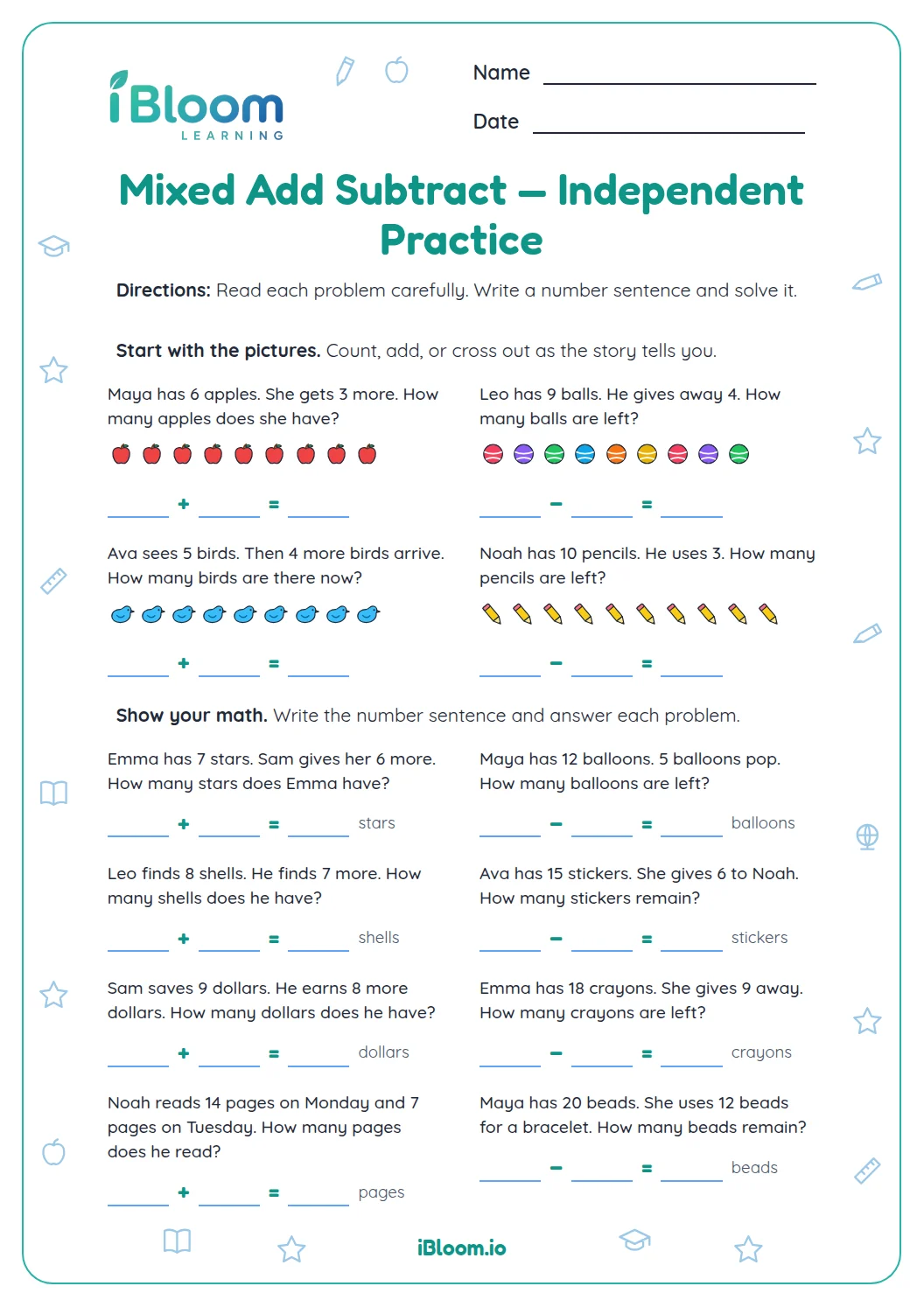
About this worksheet
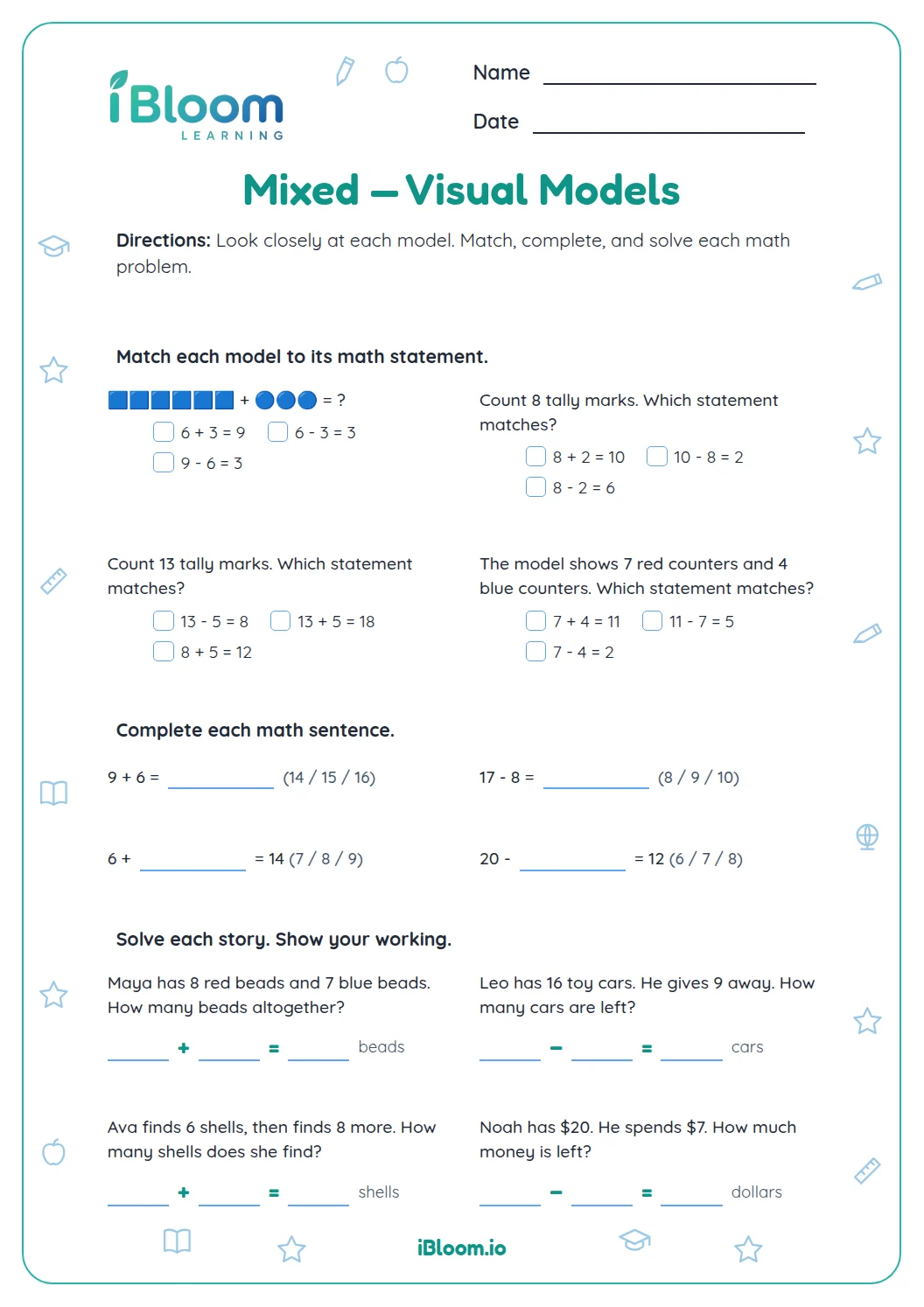
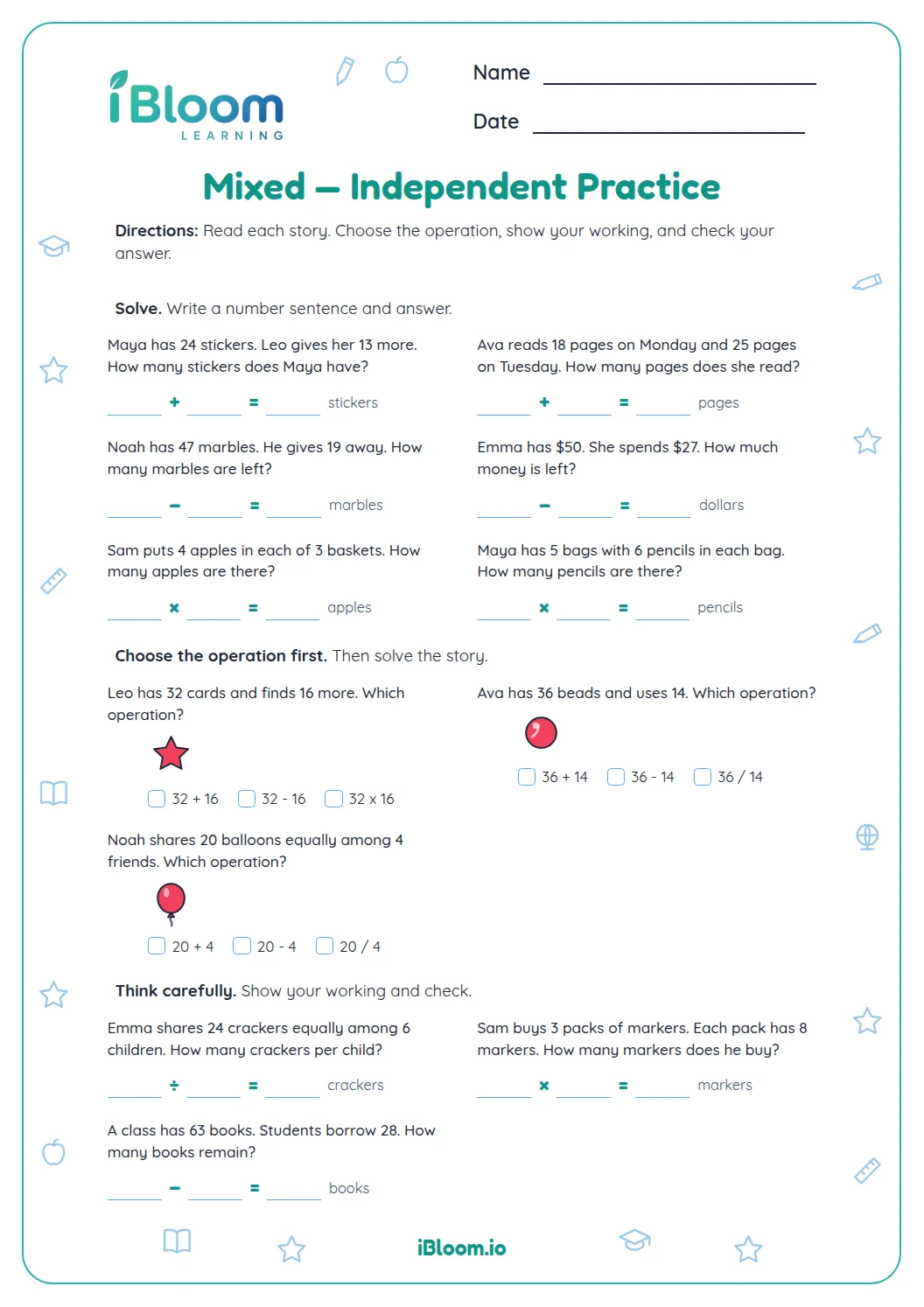
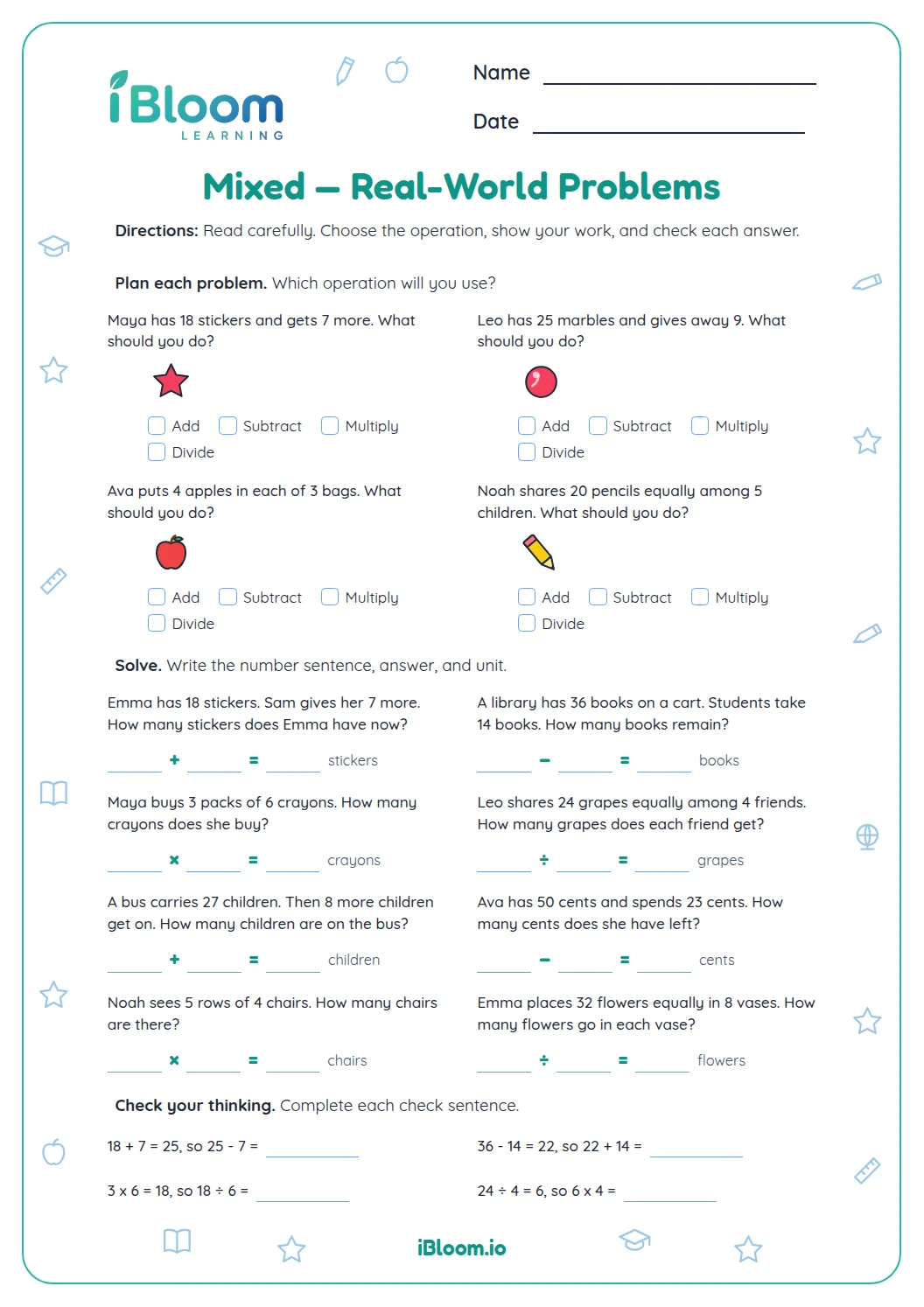
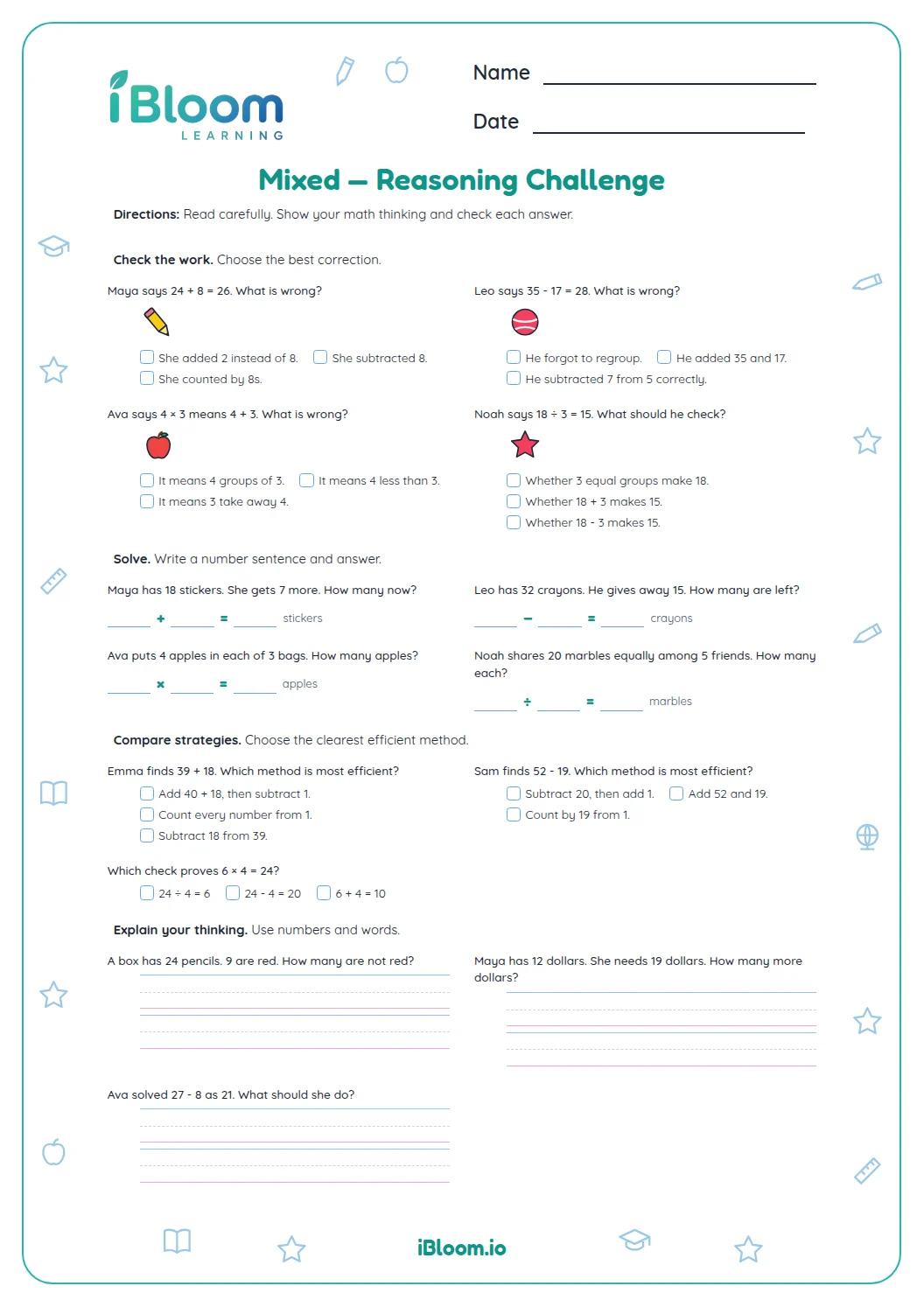
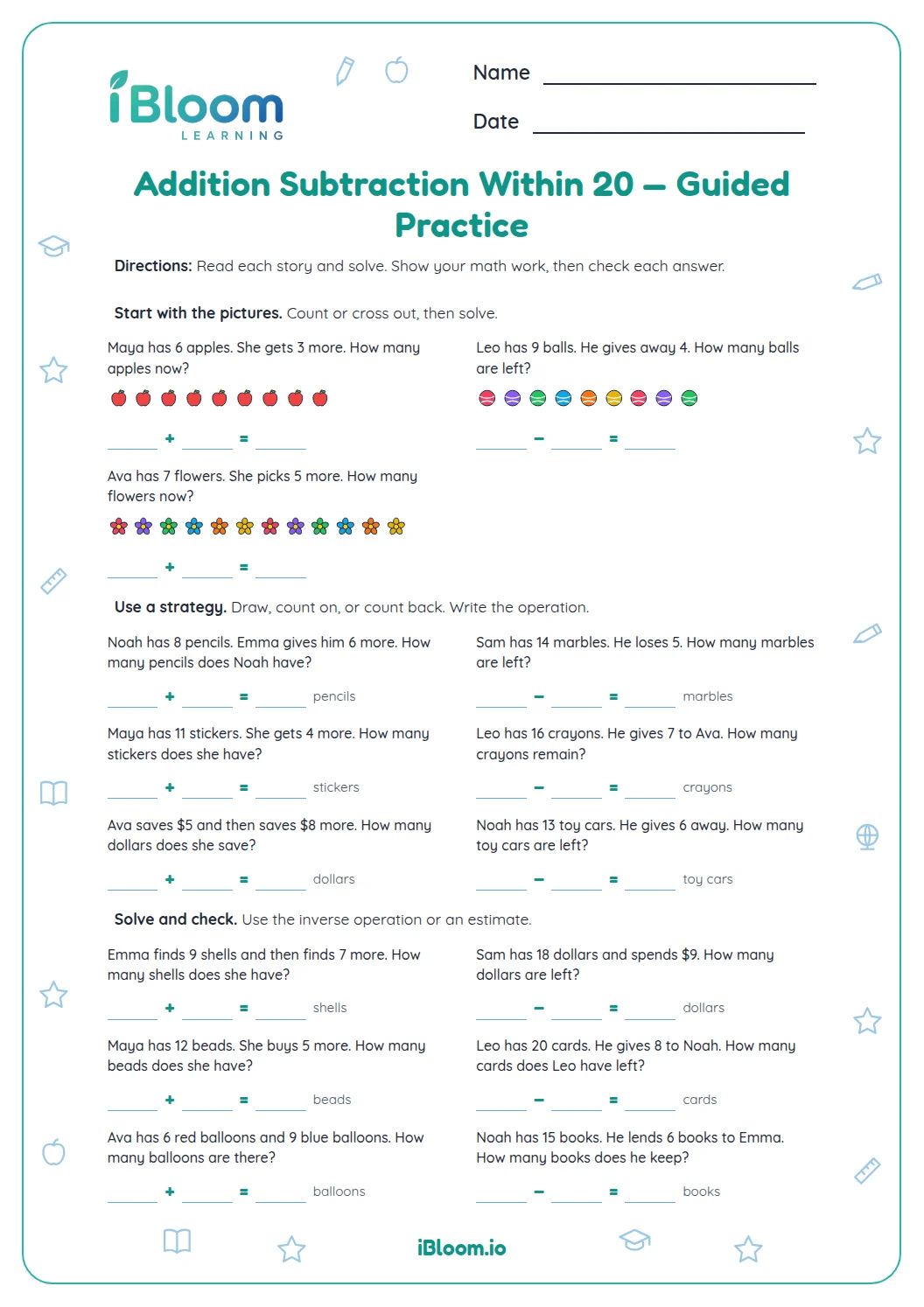
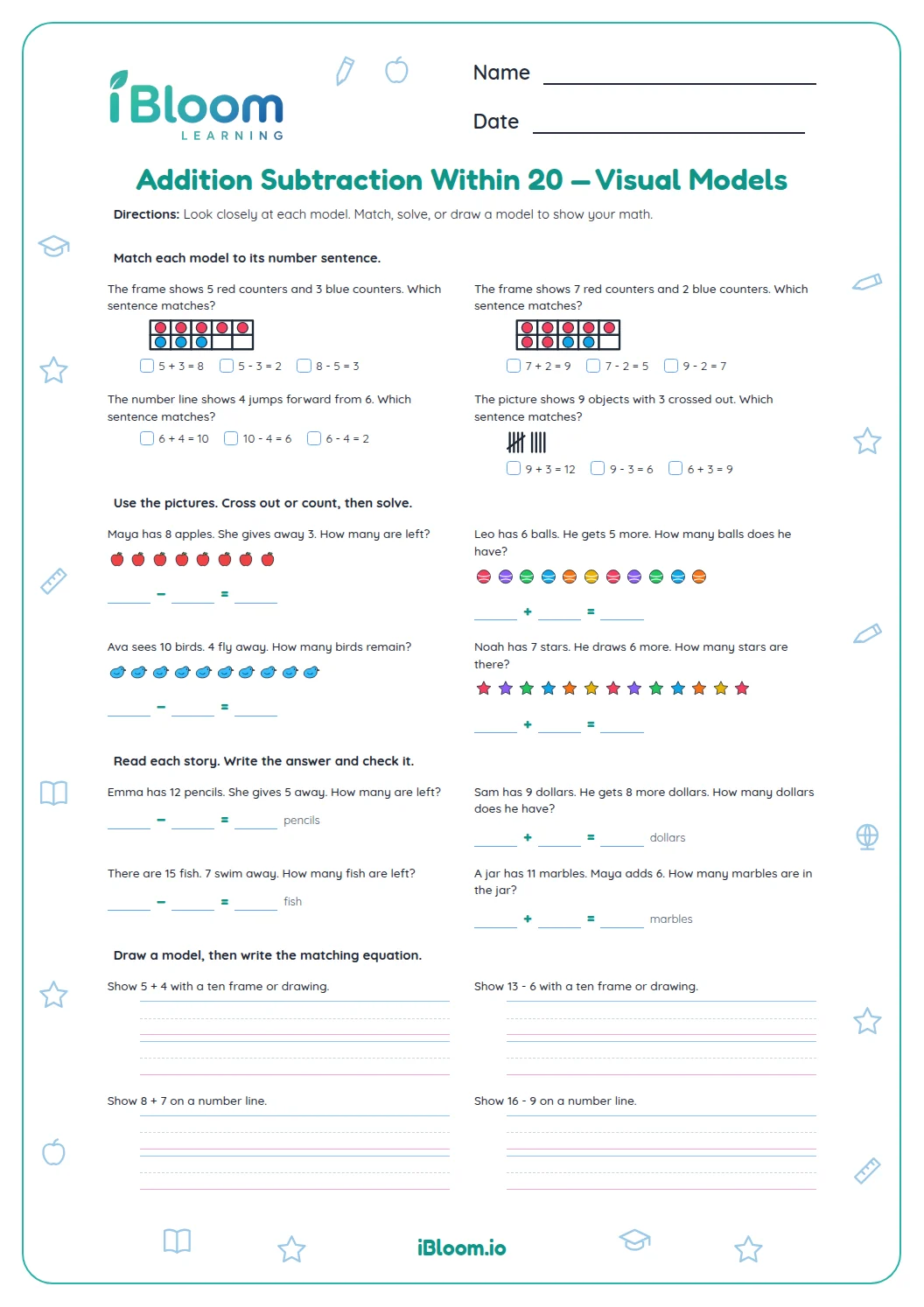
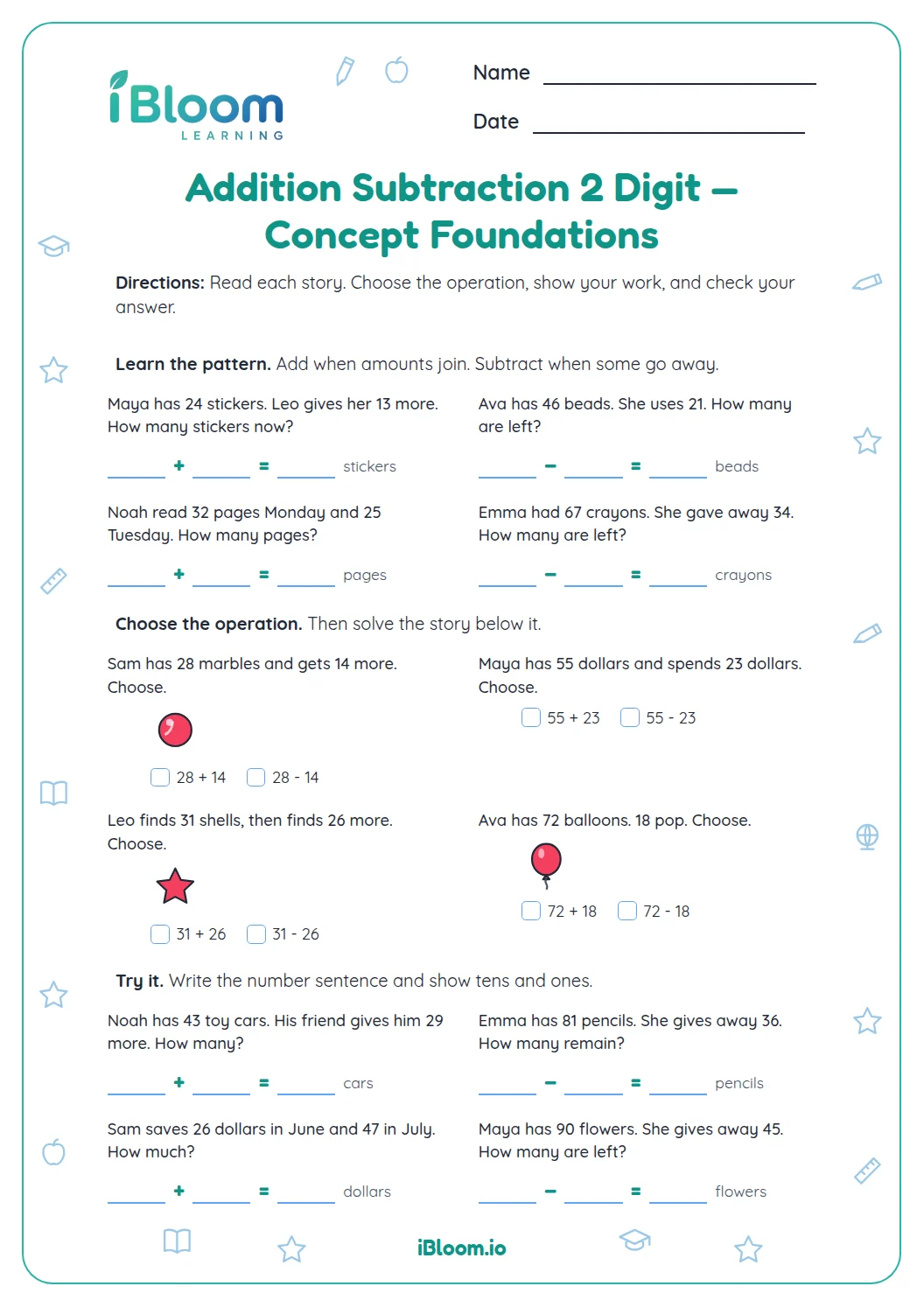
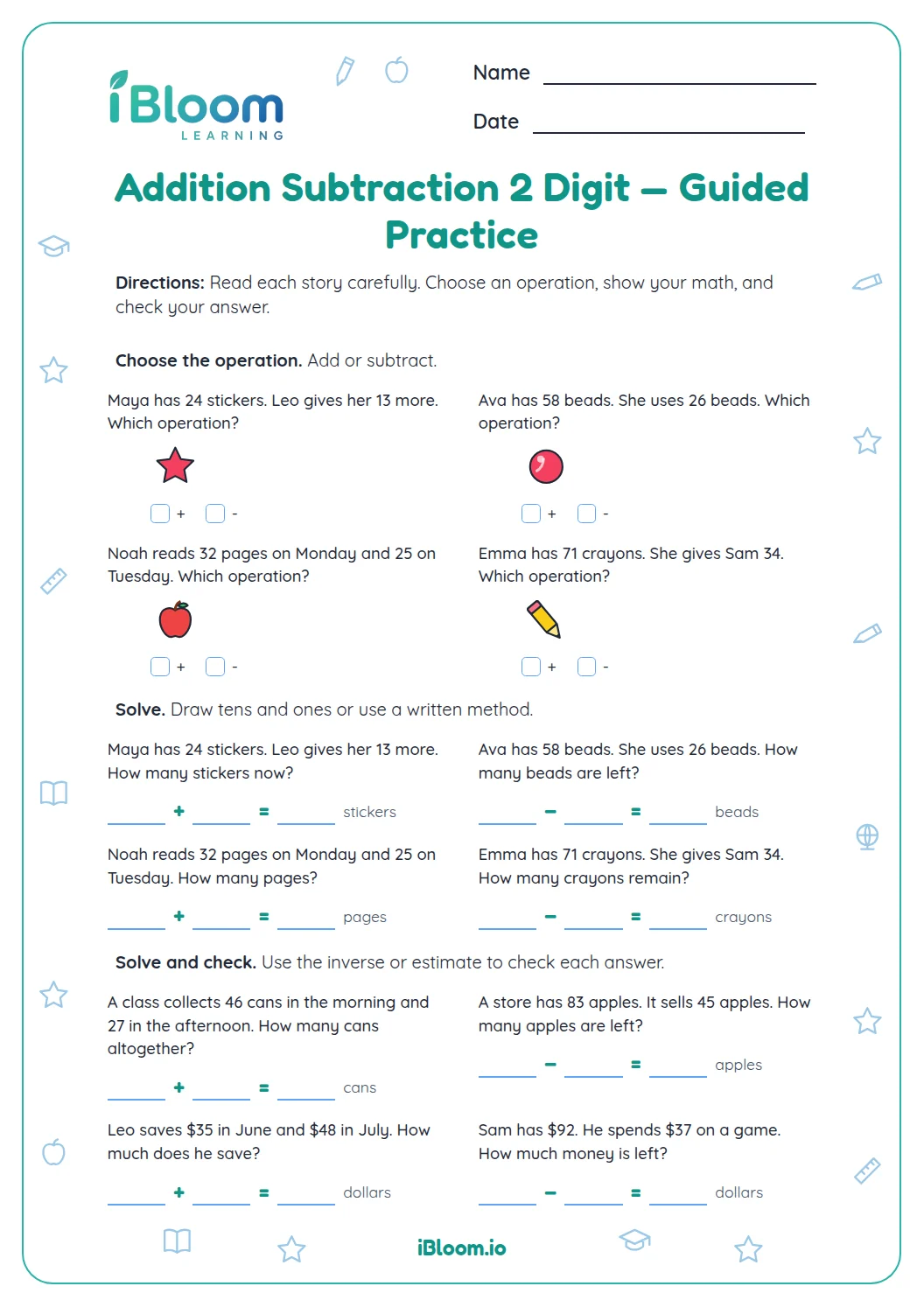
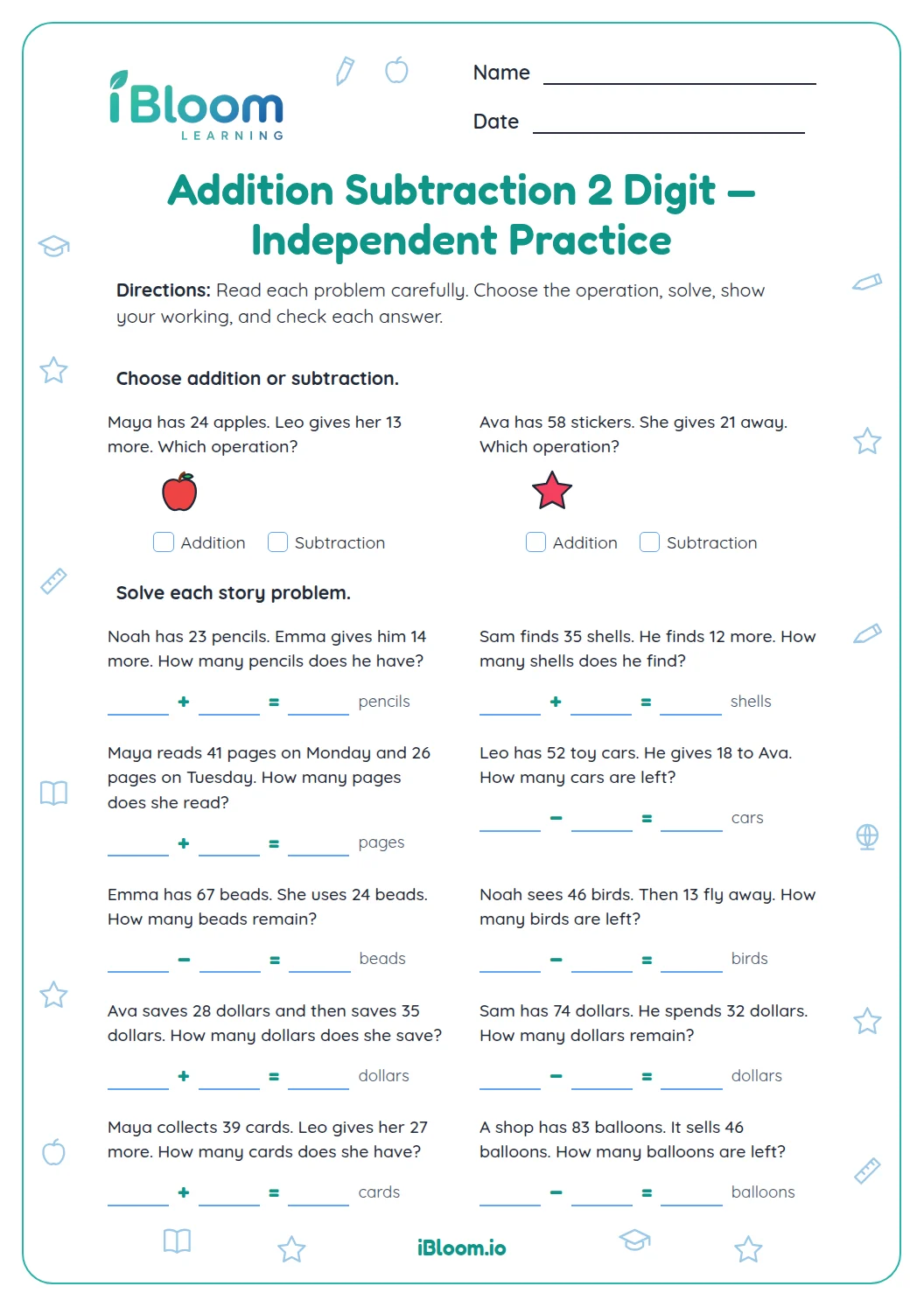
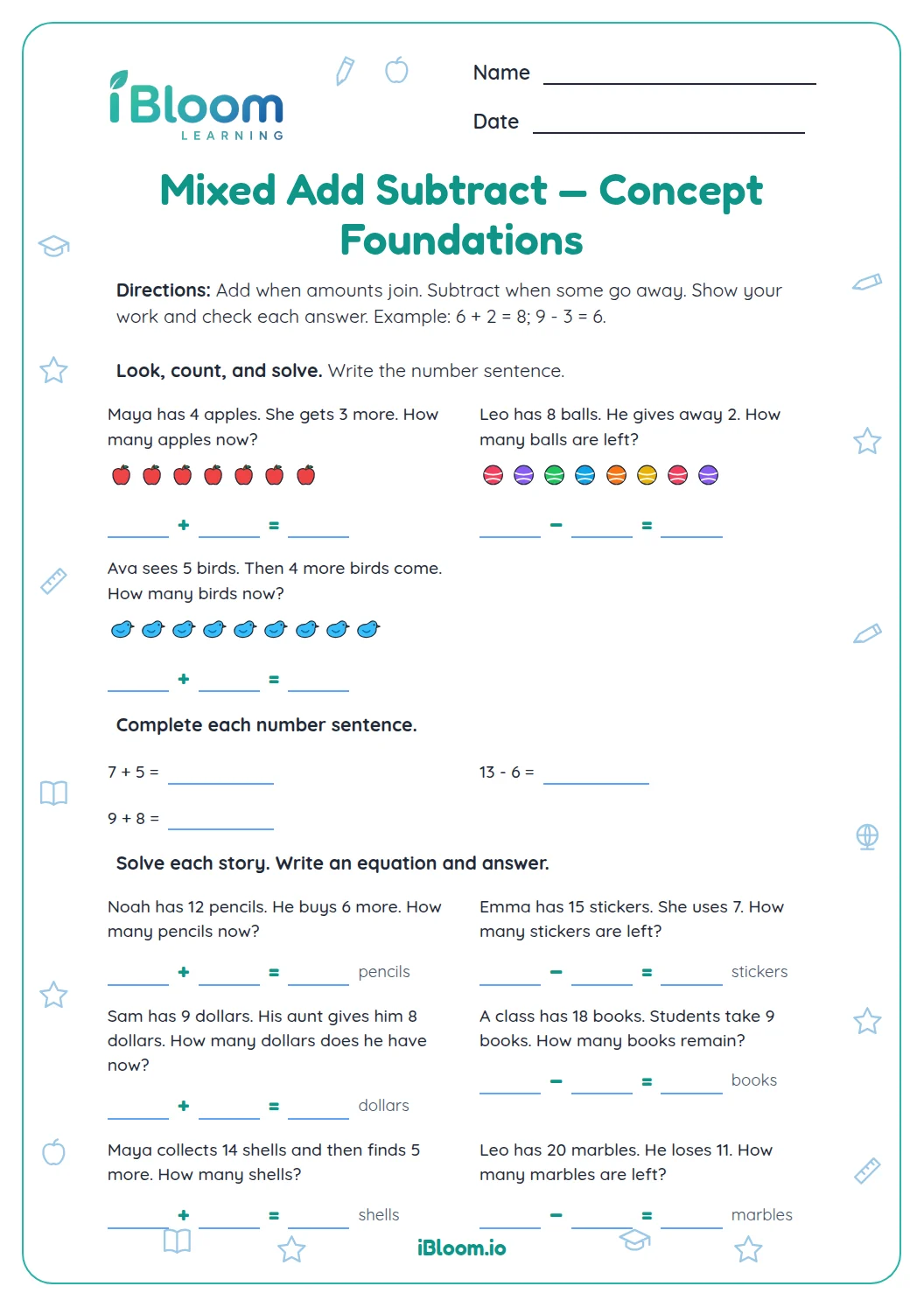
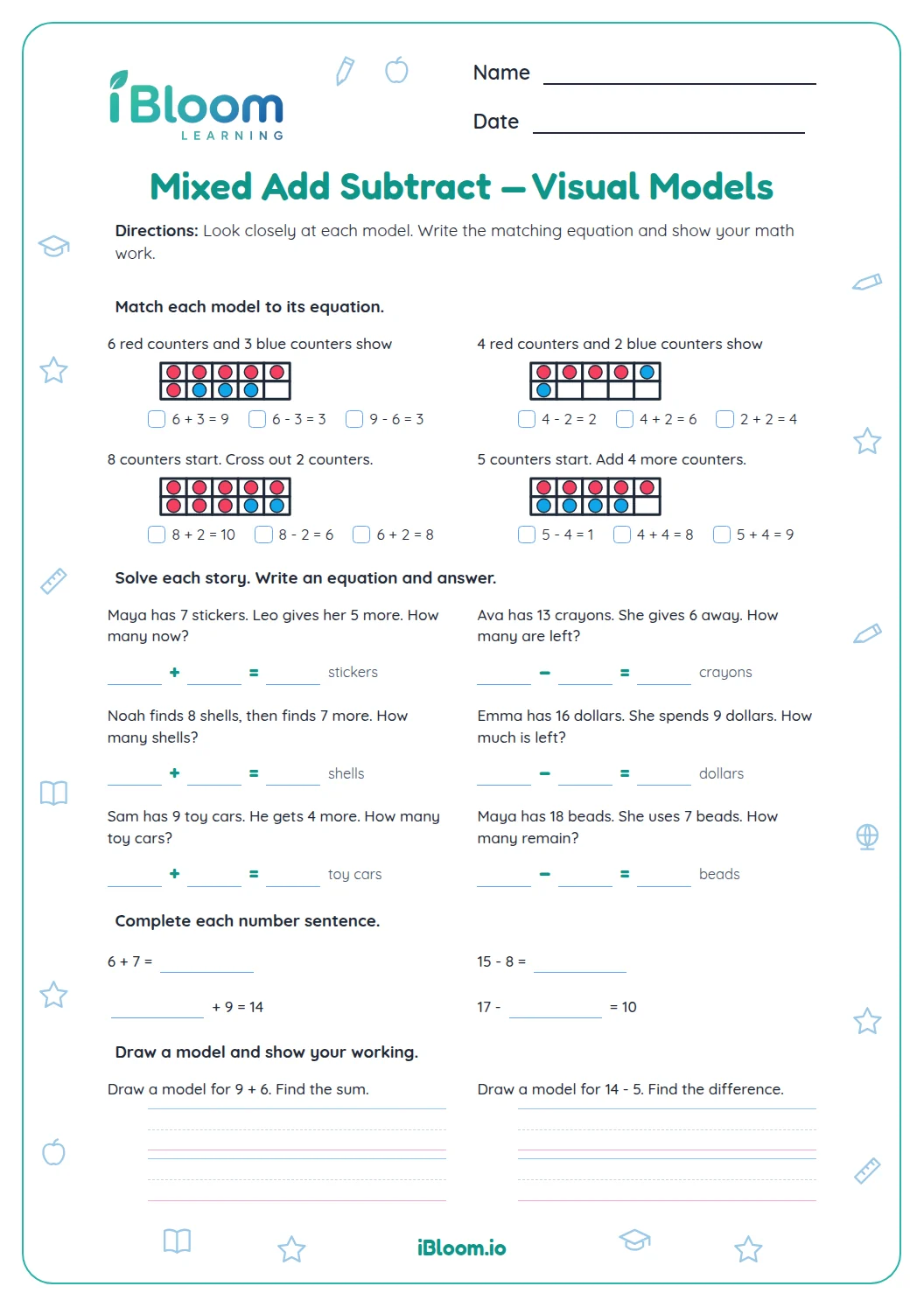
This Grade 2 printable offers 16 mixed word problems like the original guided-practice sheet. Children solve addition and subtraction stories, equal-group and sharing situations, and money questions. Each item gives space to write an equation and answer; a separate key includes the results and units.
Aligned to 2.OA.A.1
How do you choose addition or subtraction?
Read for the action and the unknown. Joining amounts may call for addition, while equal groups use multiplication and equal sharing uses division. In question 3, 4 books on each of 5 shelves gives 4 × 5 = 20 books.
How do the stories show equal groups or money?
Repeated equal groups can be represented with multiplication, and sharing a total equally can be represented with division. For a money story, keep the units consistent: 62 cents − 27 cents = 35 cents.
How can I check a word-problem answer?
Put the answer back into the story and check whether it fits. For the 18 grapes shared among 3 friends, 6 each works because 6 × 3 = 18. For a money total, check that the amount paid or spent matches the change.
How to use this worksheet
- 1Read the story and name the quantities.
- 2Decide whether the story joins, separates, or compares.
- 3Write an equation with a box if a number is unknown.
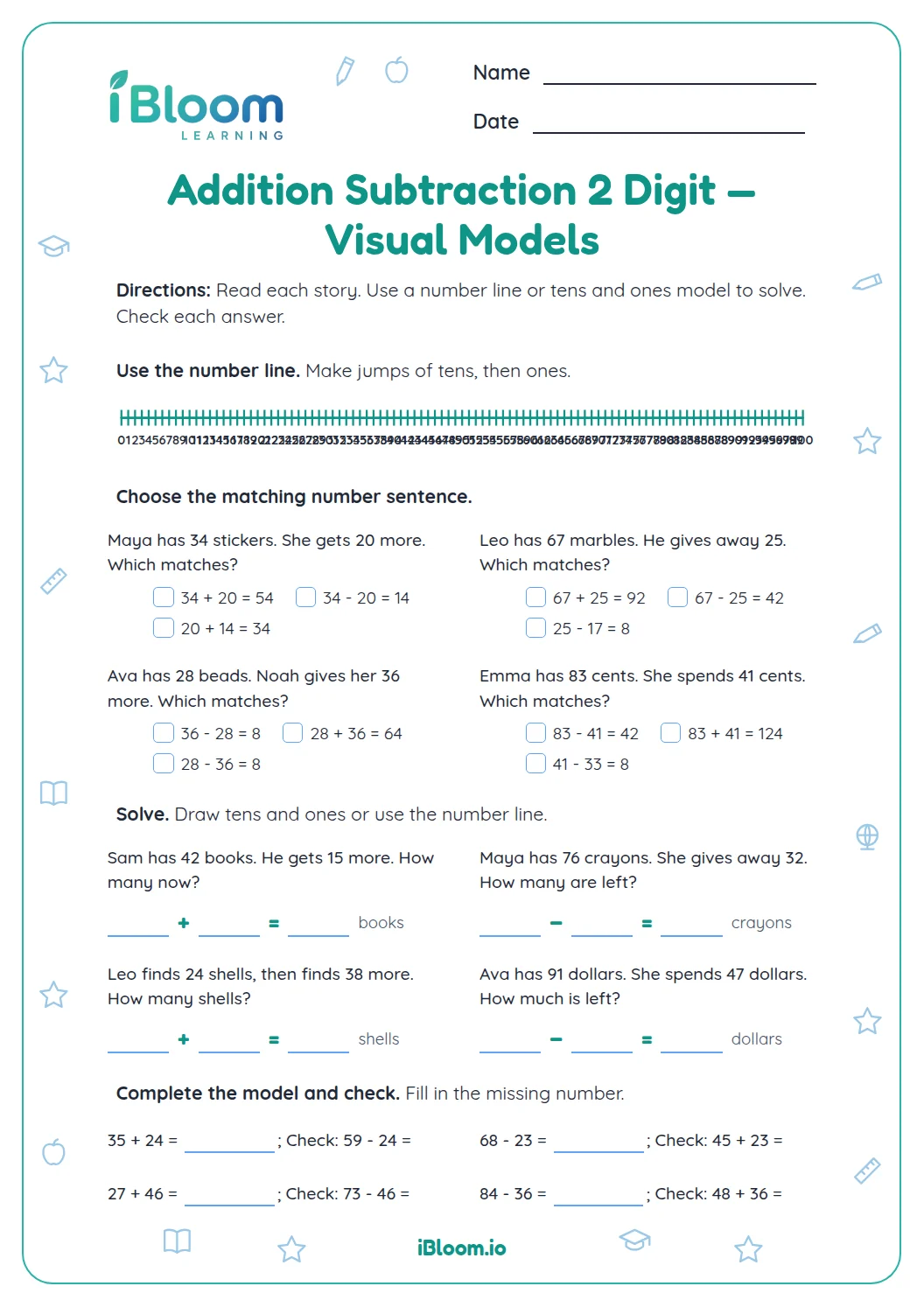
- 4Solve using a strategy such as place-value drawings or regrouping.
- 5Add or subtract to check the result in the story.
Common mistakes and quick fixes
The mistake
Adding whenever a story says “more.”
The fix
Identify which quantity is unknown and how the amounts relate.
The mistake
Subtracting the smaller number from the larger without reading the question.
The fix
Use the question to decide which amount you need to find.
The mistake
Writing a number answer without its unit or context.
The fix
Finish with what the number represents, such as 42 beads.
Common Core alignment
This sheet gives practice with the Common Core skill named below.
Solve one- and two-step addition and subtraction stories within 100.
On this sheet: The questions include joining, taking from, comparing, and unknown amounts represented by equations.
Show the official wordingHide the official wording
Use addition and subtraction within 100 to solve one- and two-step word problems involving situations of adding to, taking from, putting together, taking apart, and comparing, with unknowns in all positions, e.g., by using drawings and equations with a symbol for the unknown number to represent the problem.
What to practice next
Make more practice
Further reading
Questions parents and teachers ask
What kinds of problems are on the sheet?
The 16 stories mix addition, subtraction, multiplication, division, and money. Children find totals and differences, work with equal groups and sharing, and solve questions about cents and dollars. Each item gives space to record the equation and the answer with its unit.
How can my child choose an operation?
Identify what is happening and what the question asks for. Joining amounts often uses addition, removing an amount uses subtraction, equal groups can use multiplication, and sharing equally can use division. Then write an equation that represents the story. Children can draw groups or use known facts to support a calculation.
How do equal-group problems work?
Multiply when the story gives the number in each group and the number of groups. In the shelf problem, 5 shelves with 4 books each gives 5 × 4 = 20 books. Divide when the total is shared into equal groups. The answer key helps check both the operation and the quantity found.
How should children solve the money questions?
Keep the amounts in matching units before calculating. For example, subtract cents from cents or add dollars and cents by aligning the decimal places. Include the unit in the final answer, such as 35 cents or $2.25. Keep cents and dollars clear when recording money amounts.
Should children show an equation?
Yes. An equation connects the story to the operation and makes the answer easier to check. A child can use a box for an unknown amount, draw equal groups, or use a known fact to solve. Reading the final question again helps verify that the answer fits.
Does this worksheet include an answer key?
Yes. The separate key lists the answers with their units or money amounts. Ask the child to explain how the equation matches the story, then check whether the answer fits the quantities given. The stories use familiar quantities so attention can stay on the operation.