

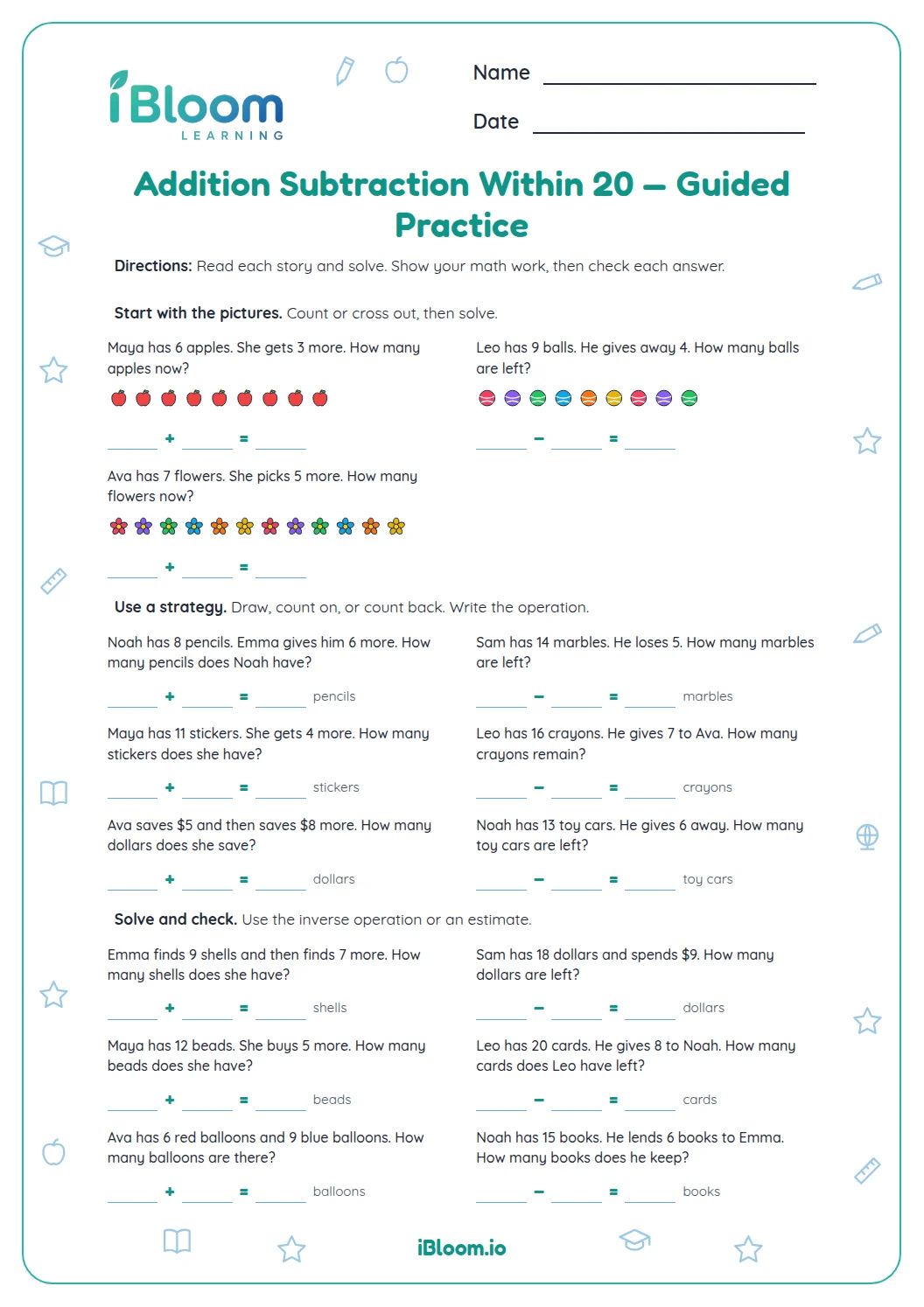
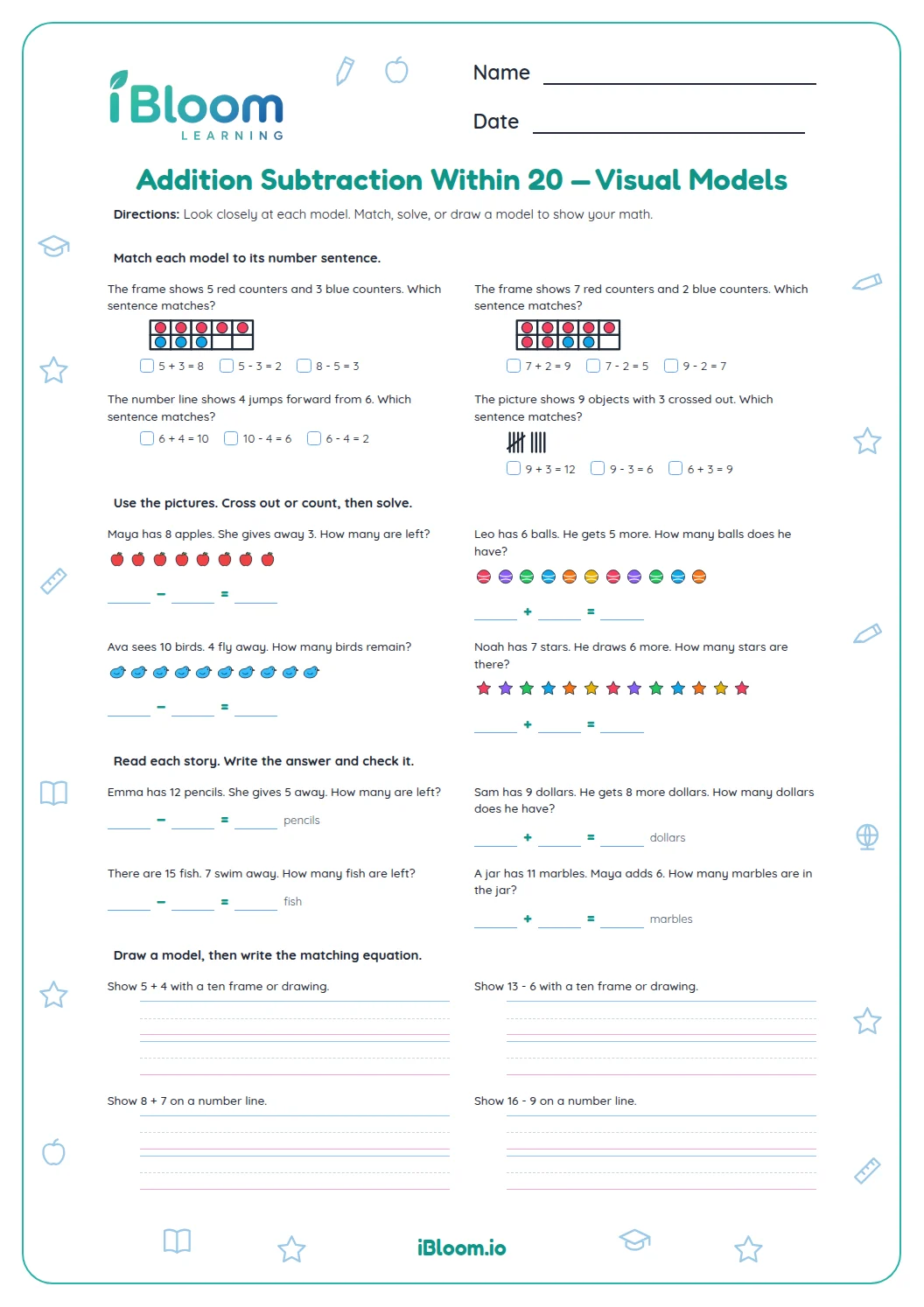
About this worksheet
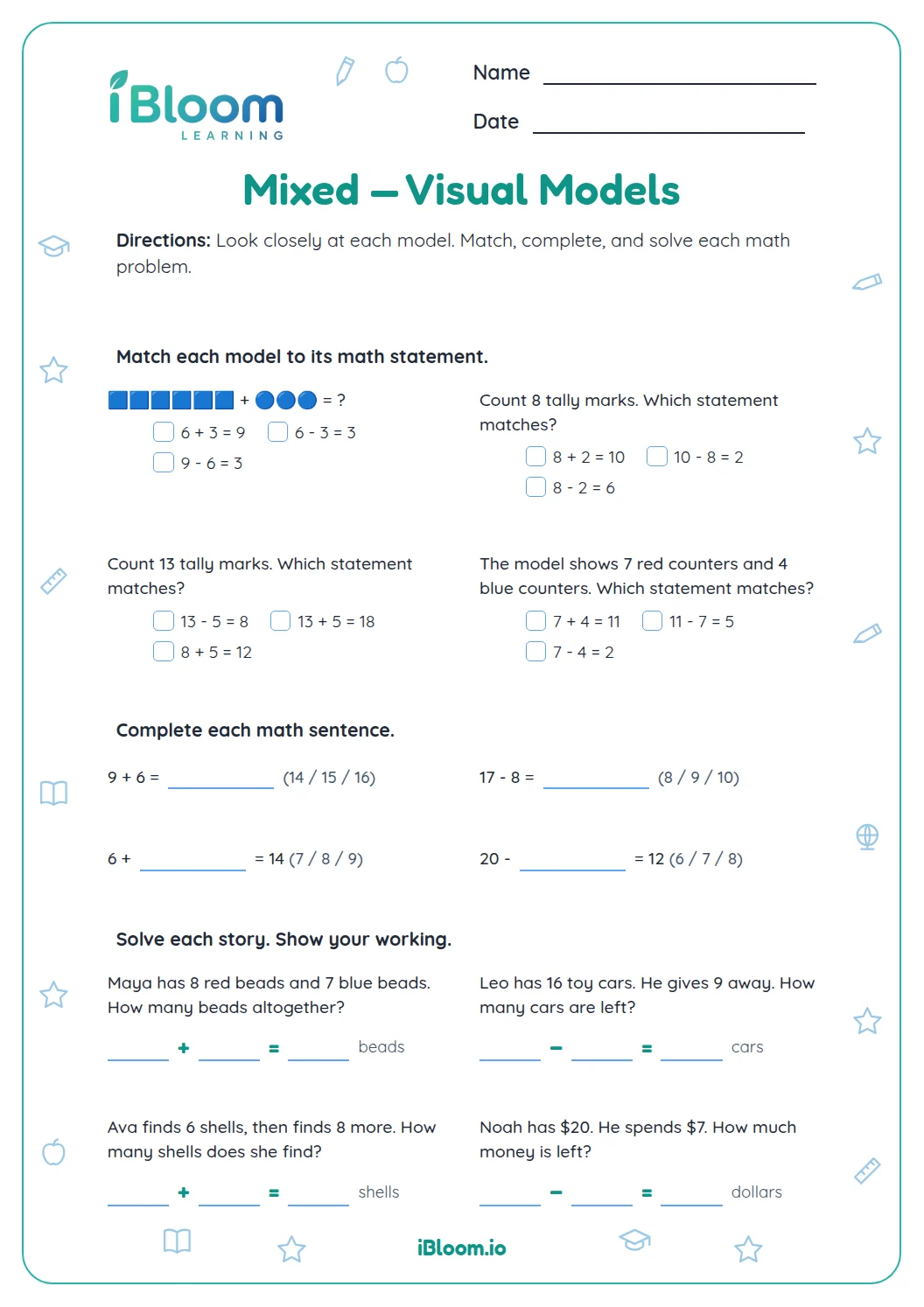
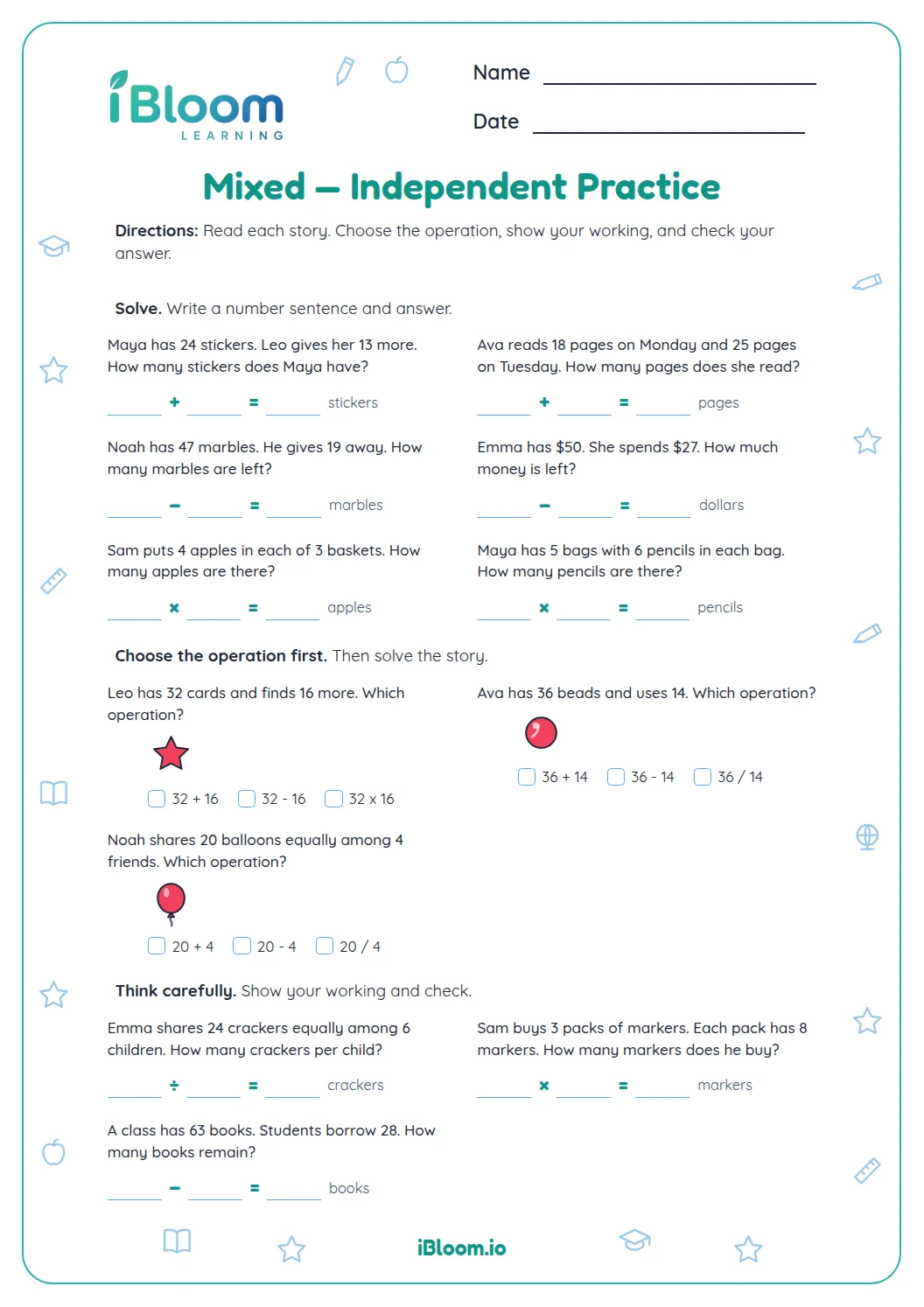
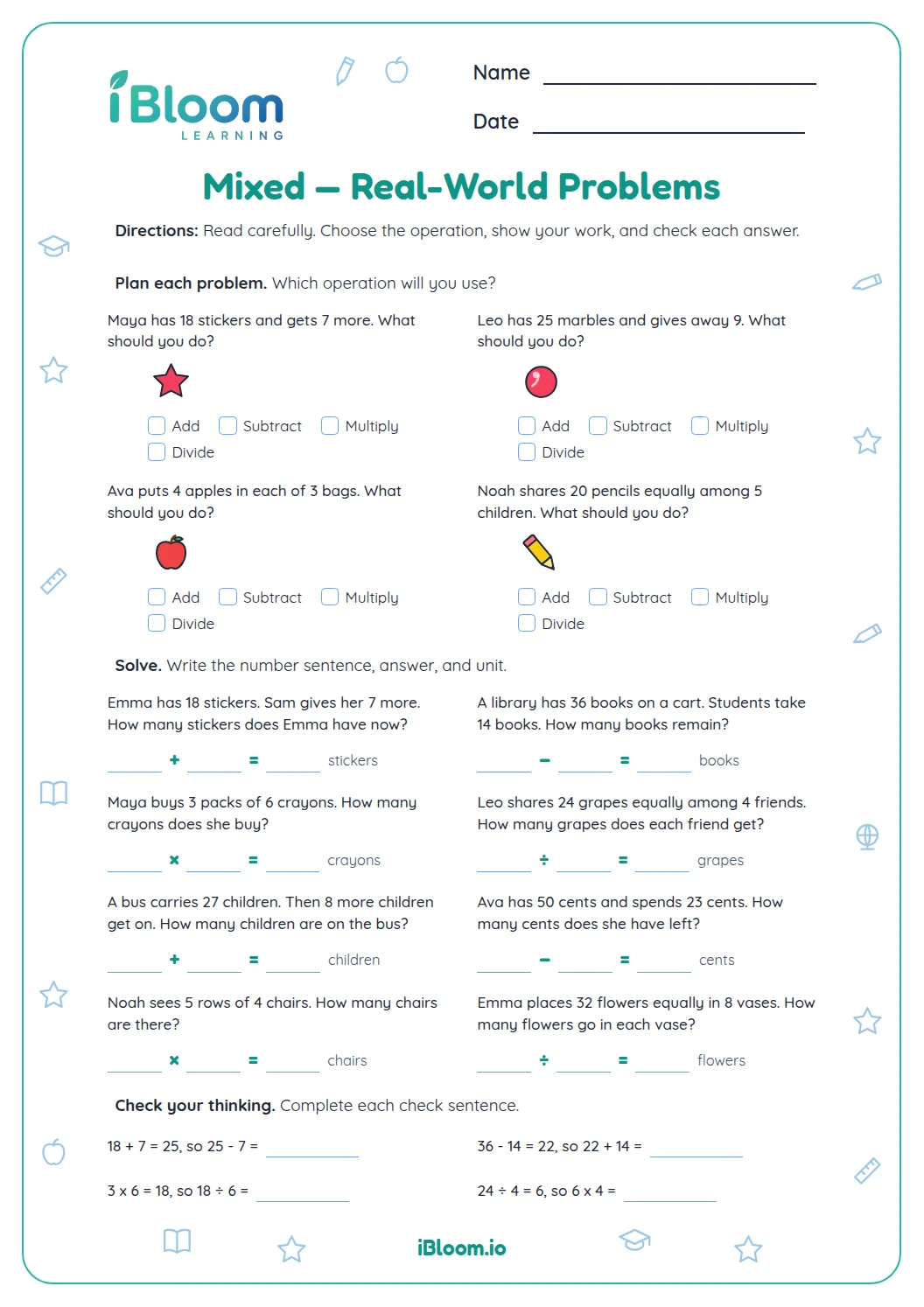
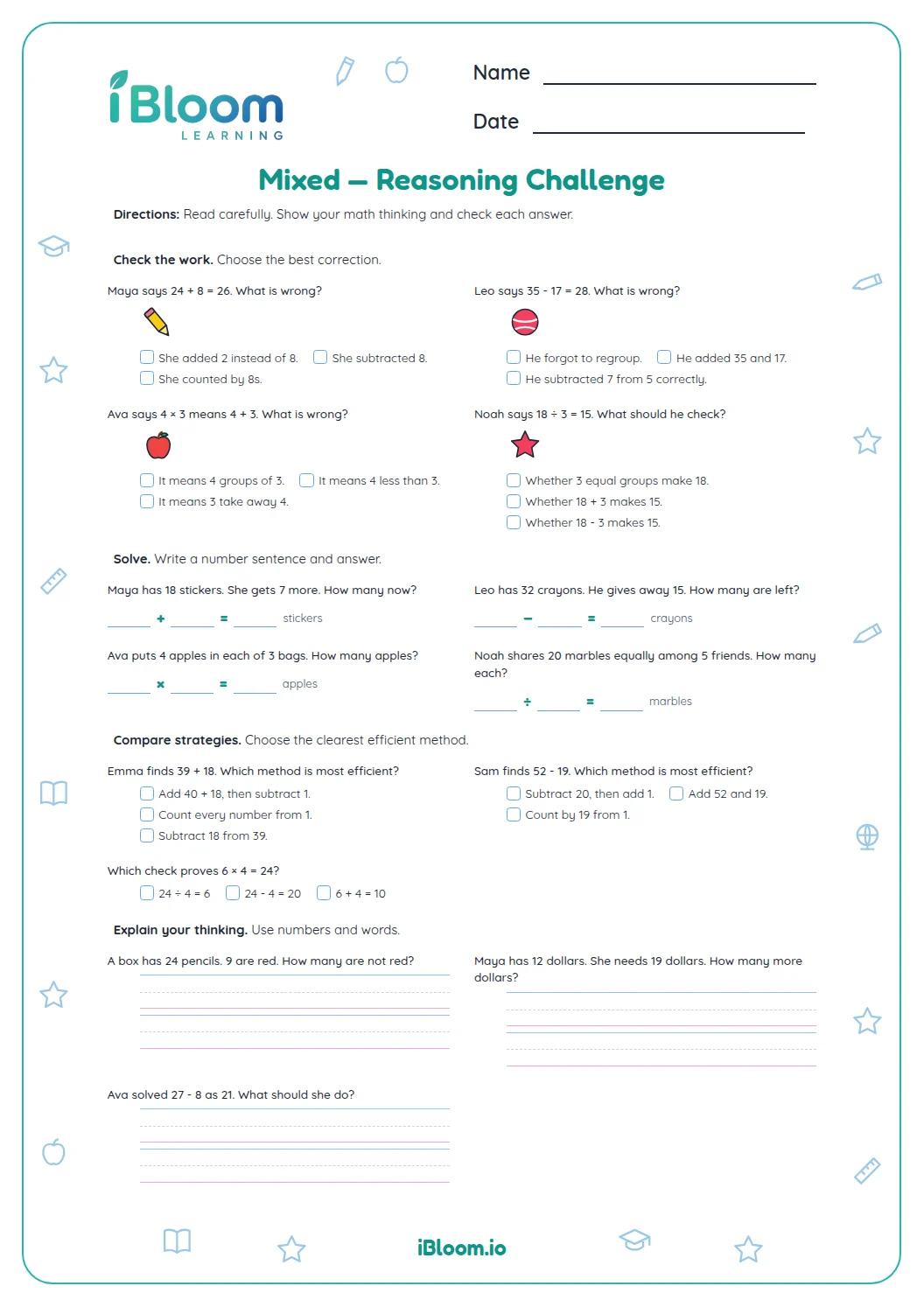
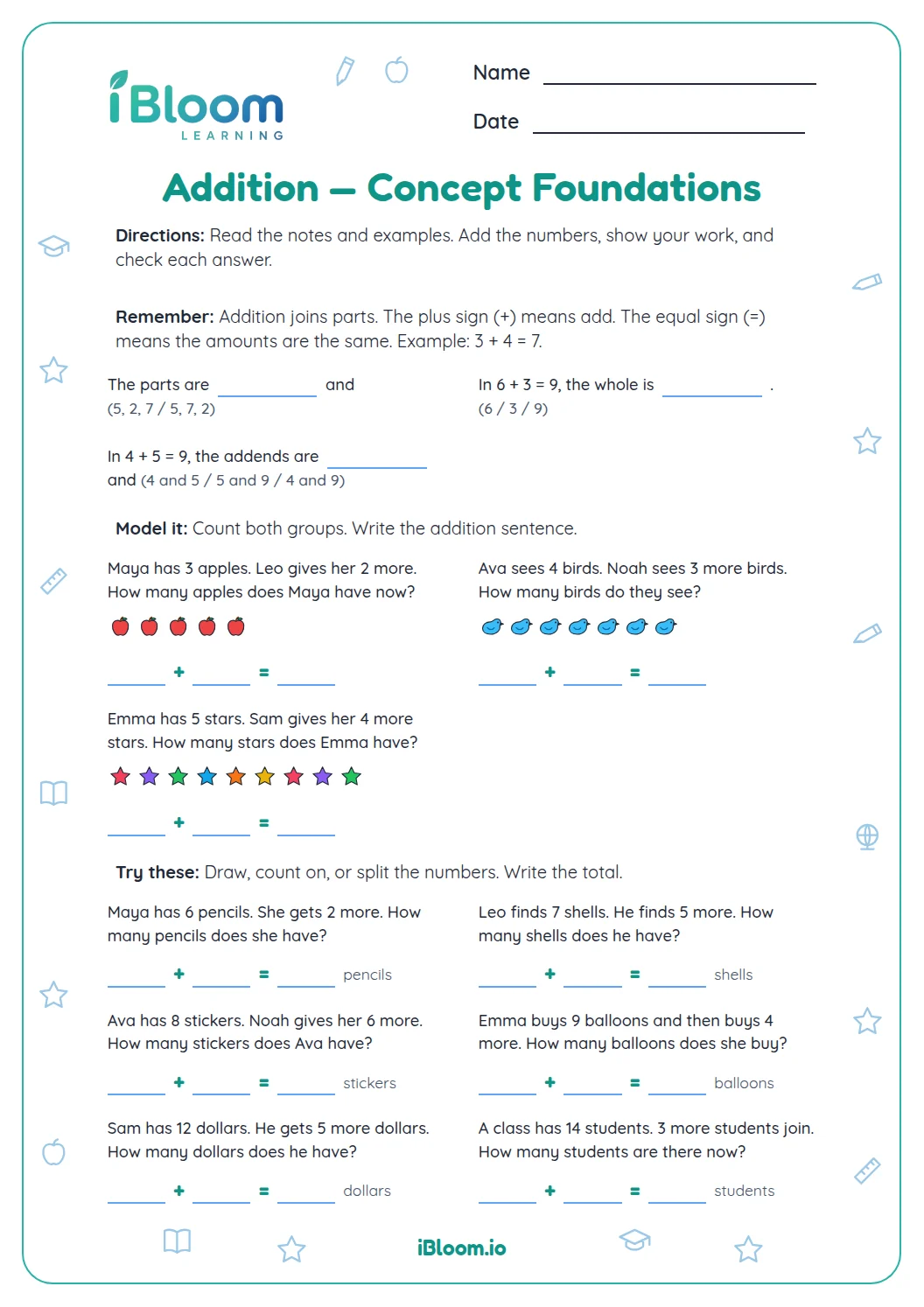
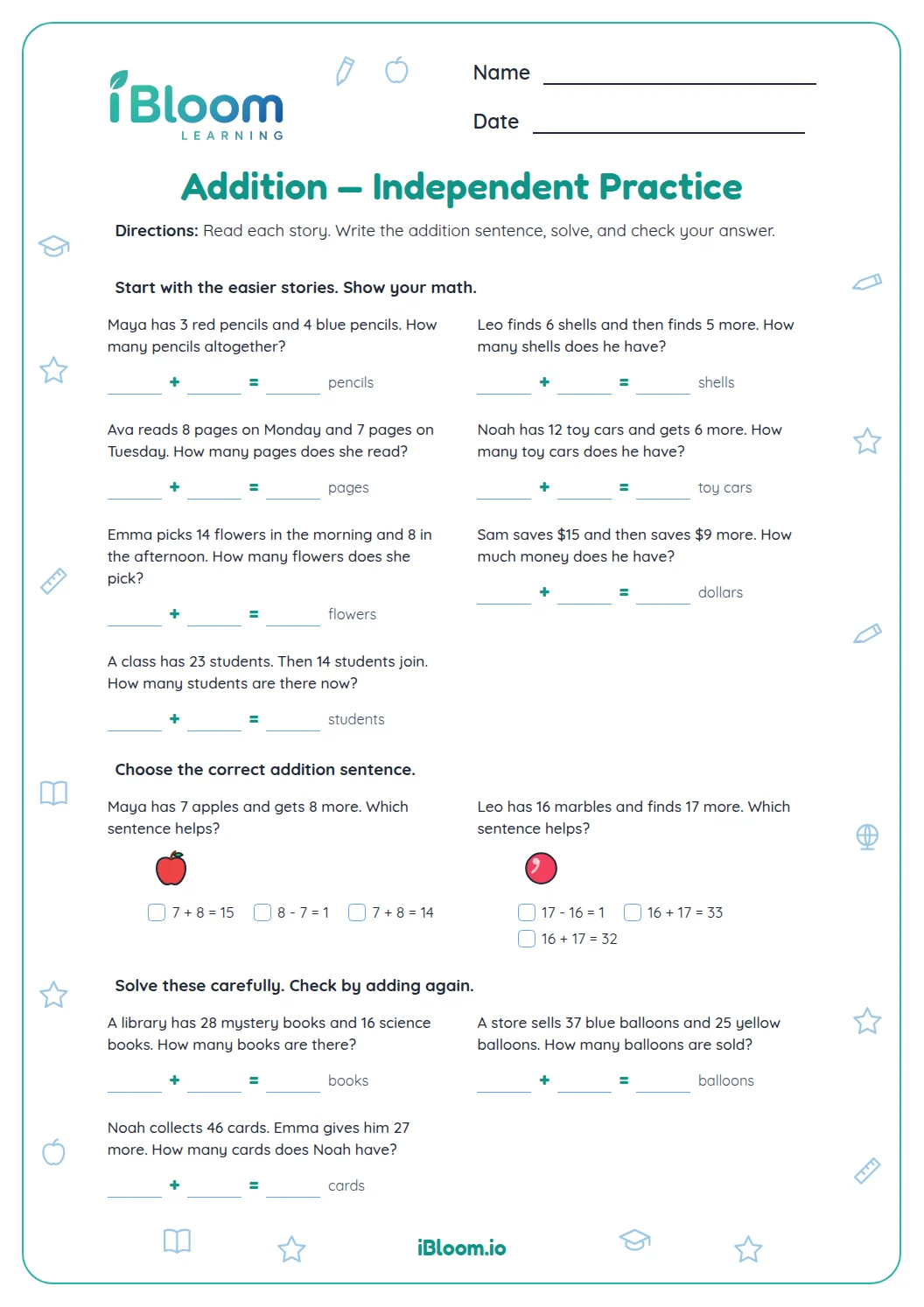
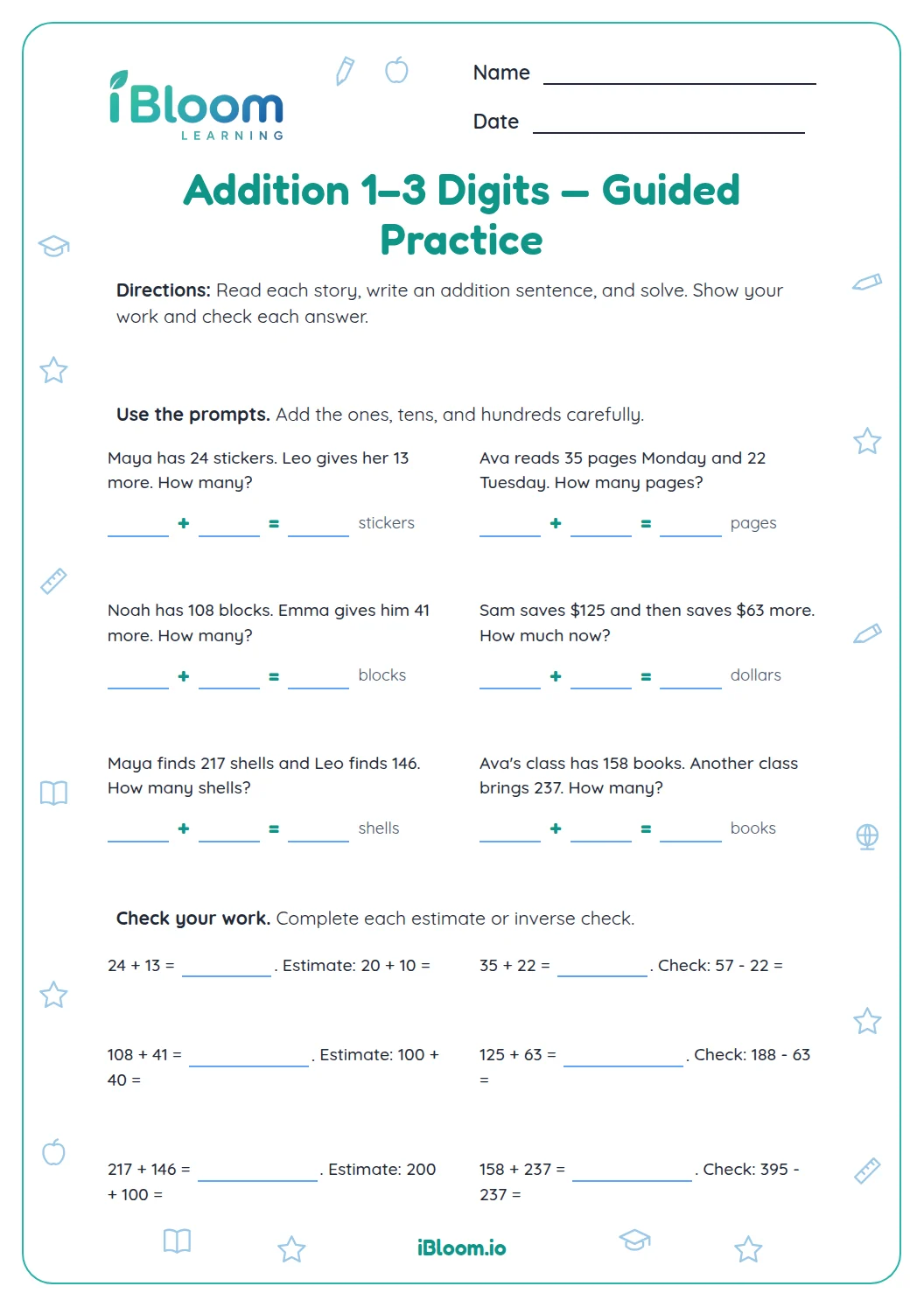
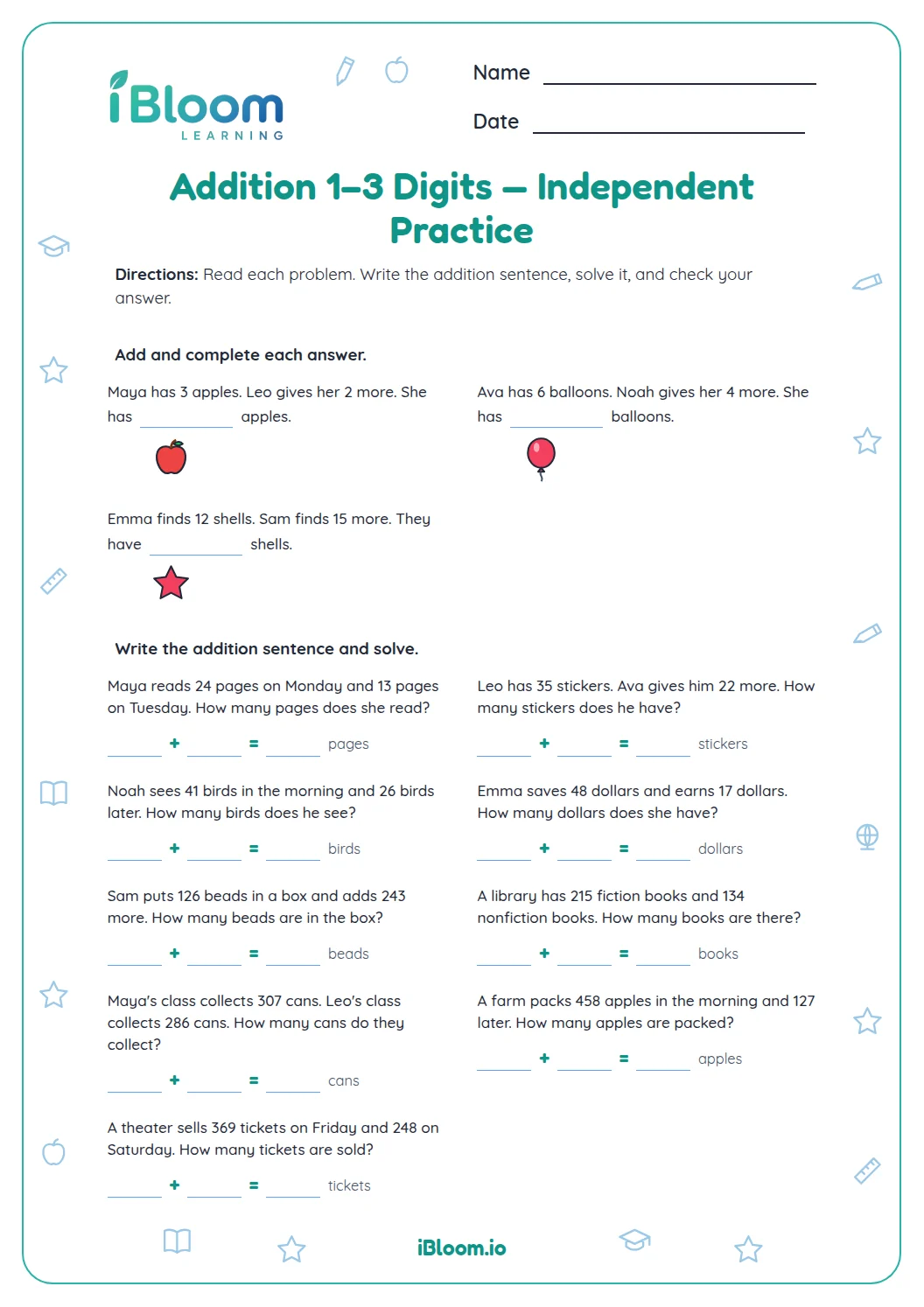
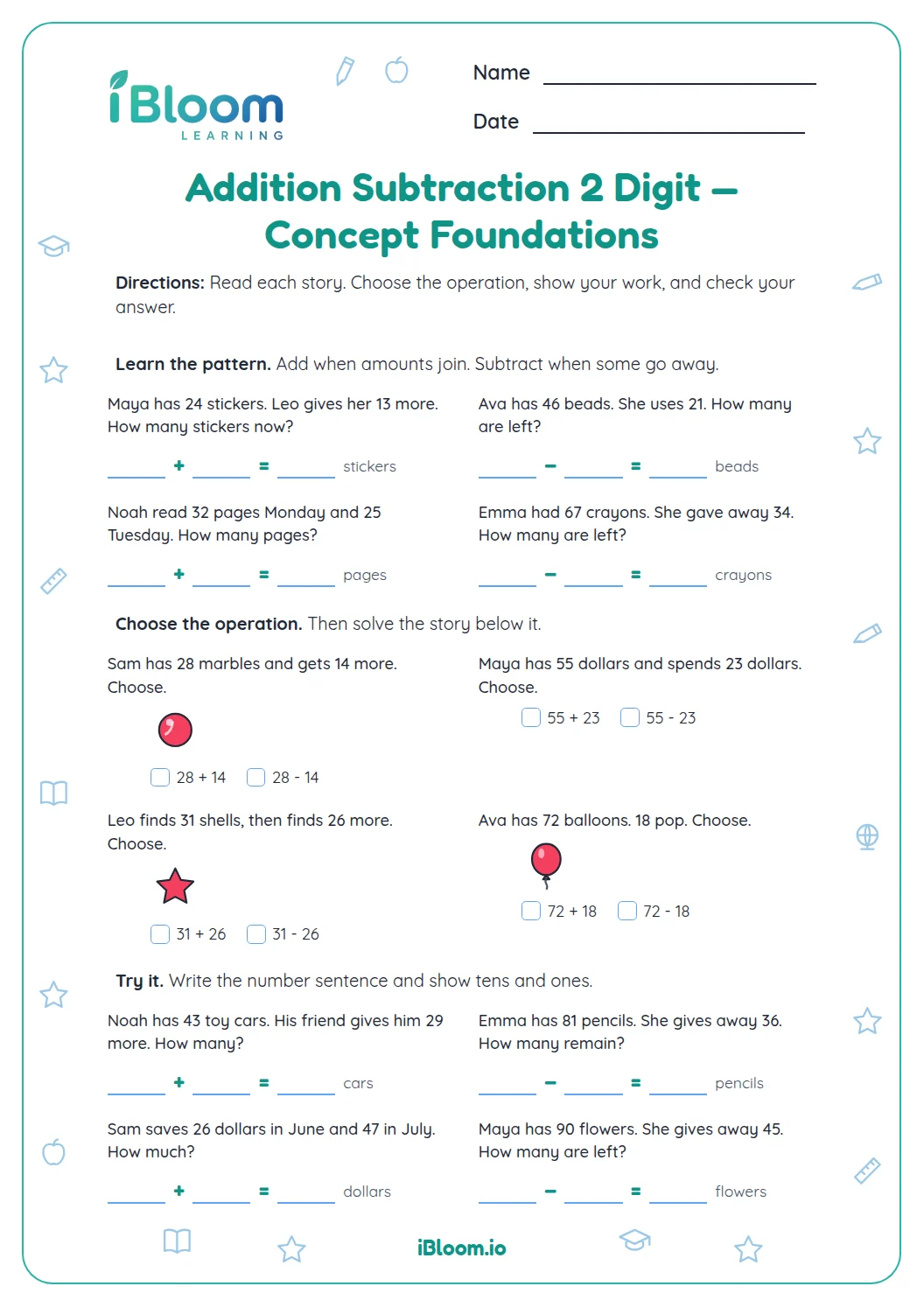
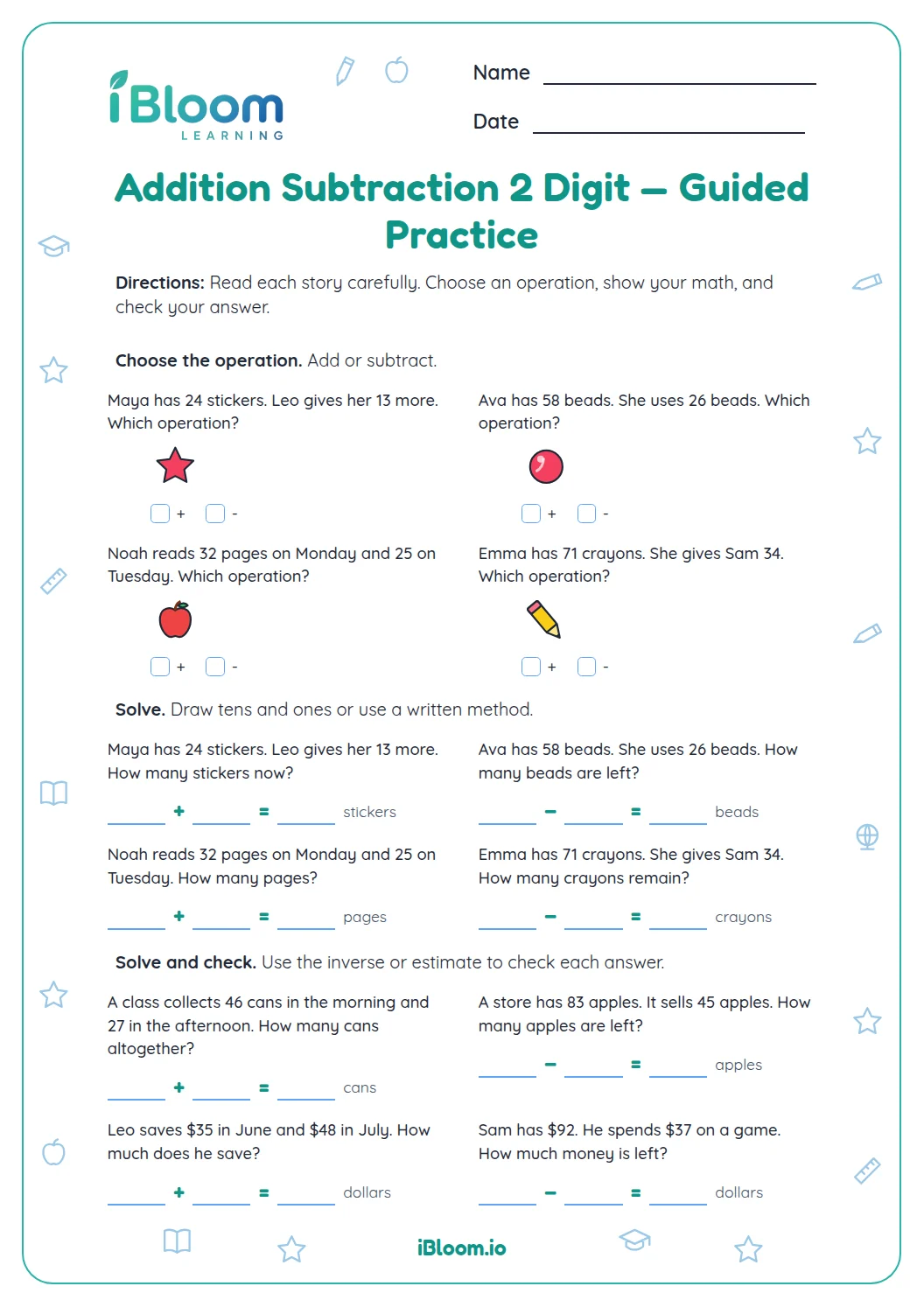
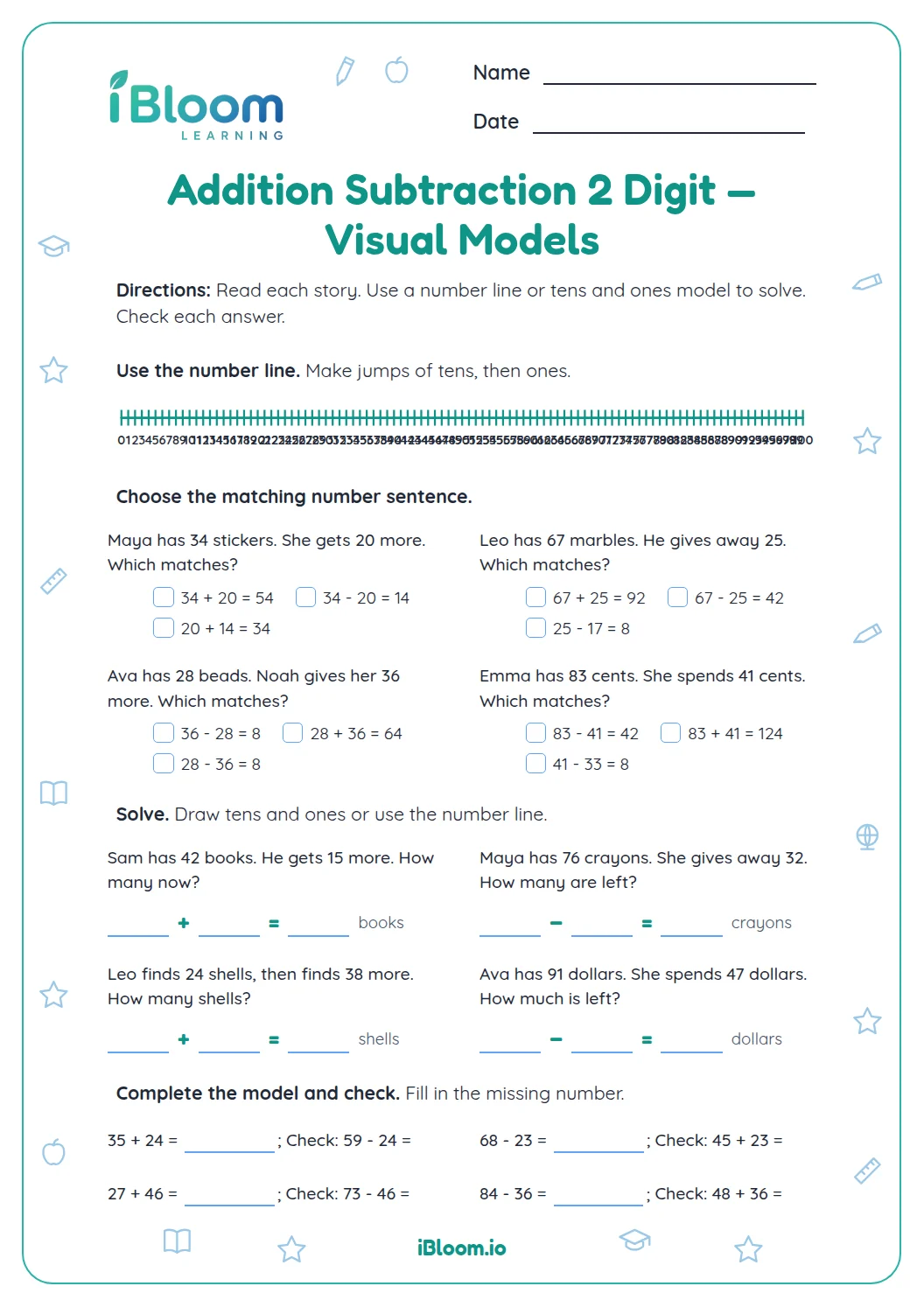
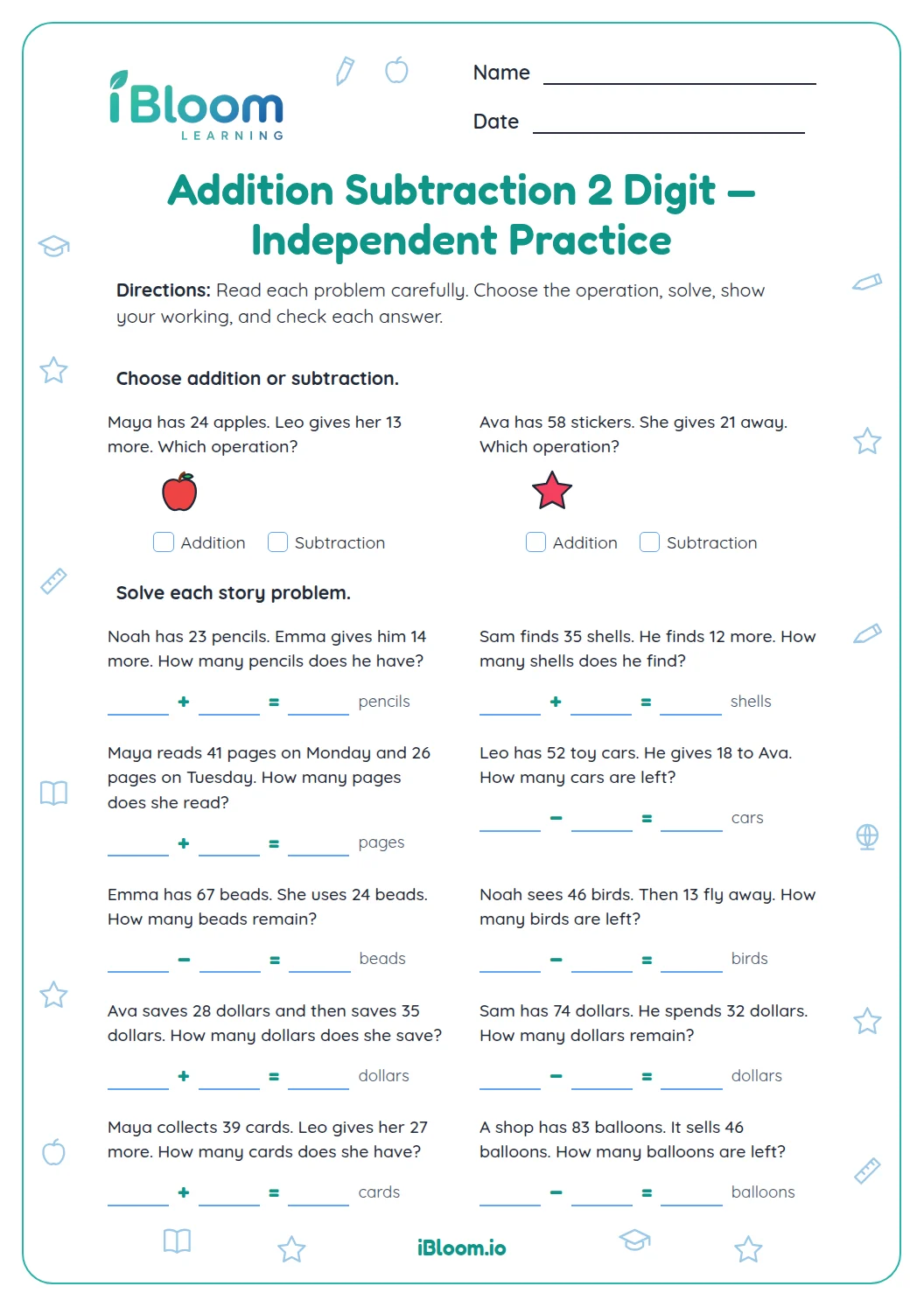
This free Grade 2 worksheet helps children decide whether a story calls for addition or subtraction. Sixteen situations use classroom supplies, books, games and everyday quantities within 100. Part A includes a number bond and base-ten model; the later parts mix one-step and two-step stories with answer choices. The page practices Common Core 2.OA.A.1, solving one- and two-step addition and subtraction word problems.
Aligned to 2.OA.A.1
How do you turn a story into an equation?
Name the starting amount, the change and what the question asks. If a class has 28 books and gets 48 more, the total is 28 + 48. If 48 books are borrowed, the number left is 28 − 48 only when there are enough books to begin with.
Question 1 asks for the total after 28 red and 35 blue folders are combined: 28 + 35 = 63 folders.
- 128 red folders + 35 blue folders
- 228 + 35 = 63
- 3Answer: 63 folders
When do the pictures and bonds help?
Questions 1 and 2 include visual models. The remaining questions ask children to interpret the story and choose an answer. Part B mixes one-step joining, separating and comparison situations; Part C includes stories with two changes or an unknown amount.
How can an answer be checked?
For addition, subtract one addend from the total. For subtraction, add the difference to the amount taken away. Check that the answer is reasonable for the story.
How to use this worksheet
- 1Underline the question being asked.
- 2Mark the starting amount and what changes.
- 3Choose addition for joining or increasing and subtraction for taking away or finding a difference.
- 4Write an equation before solving.
- 5Add the label and check with the opposite operation.
Common slips and quick fixes
The mistake
Adding when a story describes taking some away.
The fix
Track whether the amount increases or decreases before choosing an operation.
The mistake
Subtracting the smaller amount from the larger in every comparison.
The fix
Keep the two amounts in story order and find how much greater one is.
The mistake
Stopping after the first operation in a two-step story.
The fix
Read the final question again and account for both changes.
Represent mixed joining, separating and comparison stories with equations and solve them.
On this sheet:
Show the official wordingHide the official wording
Use addition and subtraction within 100 to solve one- and two-step word problems involving situations of adding to, taking from, putting together, taking apart, and comparing, with unknowns in all positions, e.g., by using drawings and equations with a symbol for the unknown number to represent the problem.
What to practice next
Make more practice
Further reading
Questions parents and teachers ask
How many problems are included?
There are 16 problems in three parts. The first two include a number bond or base-ten blocks, while the later items ask children to interpret mixed addition and subtraction stories. A separate key provides the answer to each story, making it easy to check the selected operation and result.
What operations are practiced?
The page practices addition and subtraction within 100. Stories include joining amounts, taking some away, comparing two amounts, and finding what is missing. The last part also includes situations with two changes to track, so children must keep the story events in order before calculating.
Are the numbers appropriate for Grade 2?
Yes. The questions use two-digit amounts and keep each calculation within 100. Children can use place-value strategies, equations or the provided visual models to work out the story before selecting an answer. The problems include both one-step and two-step thinking.
Should children write an equation?
An equation records the relationship in the story, such as 28 + 35 = 63 for the folder question. Children can write or say the equation before selecting the matching answer. The two model questions also show quantities visually. Encourage children to connect the numbers in the equation to the story details.
Is an answer key provided?
Yes. The answer key follows the three worksheet pages and lists all 16 answers. Children can compare their choices with the key and revisit the story if an answer does not fit the quantities. It can also prompt a conversation about why addition or subtraction was chosen.