
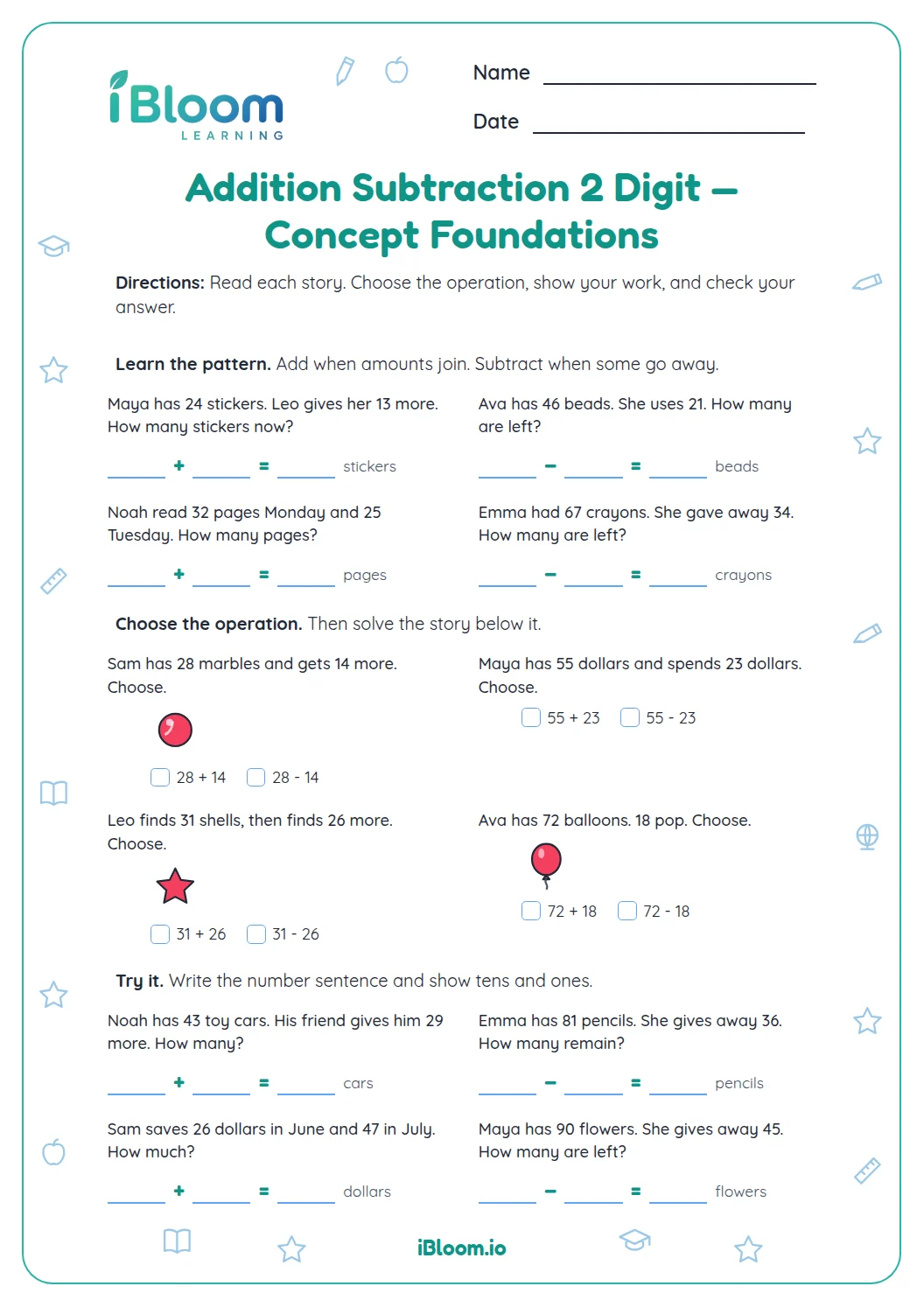
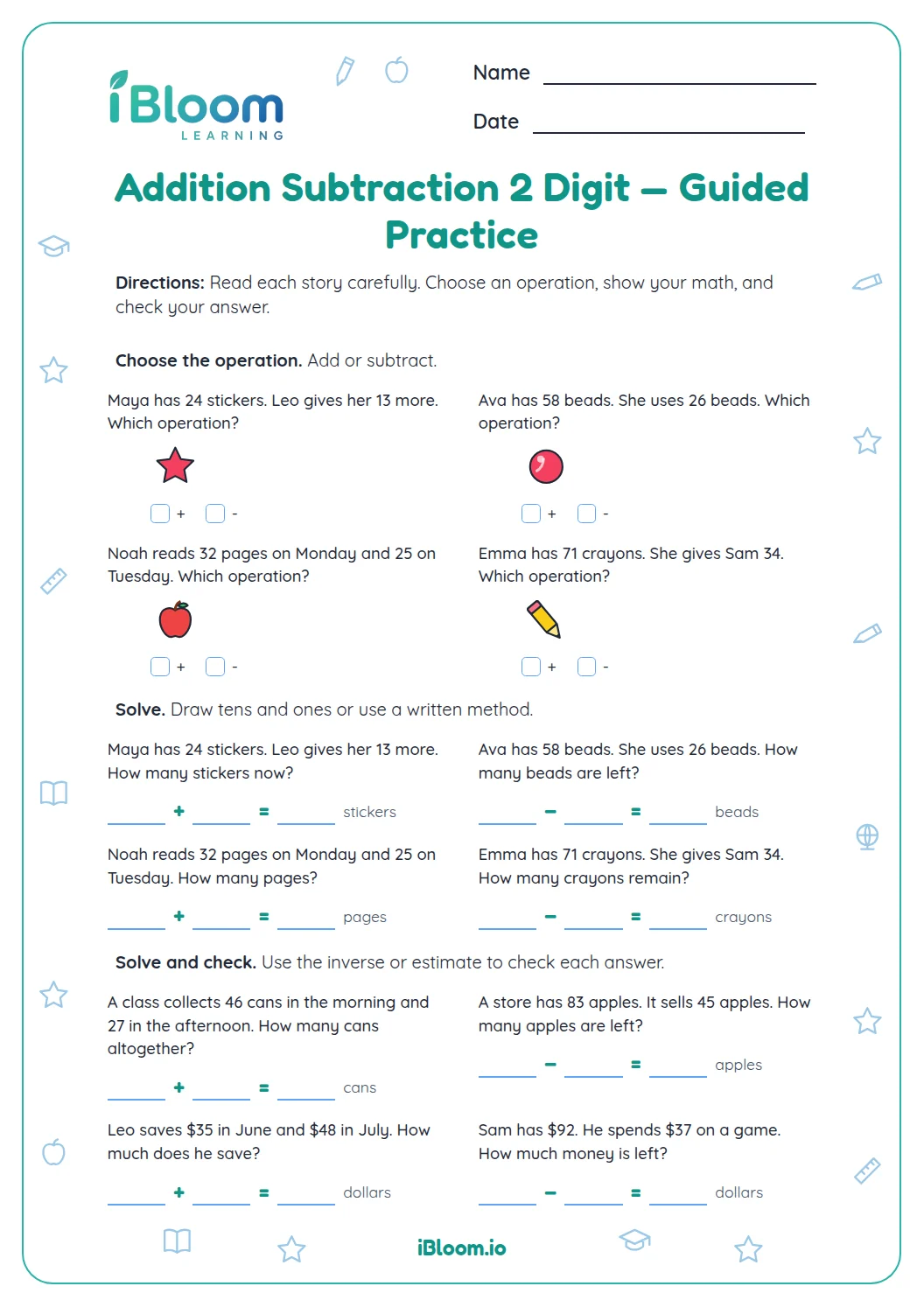
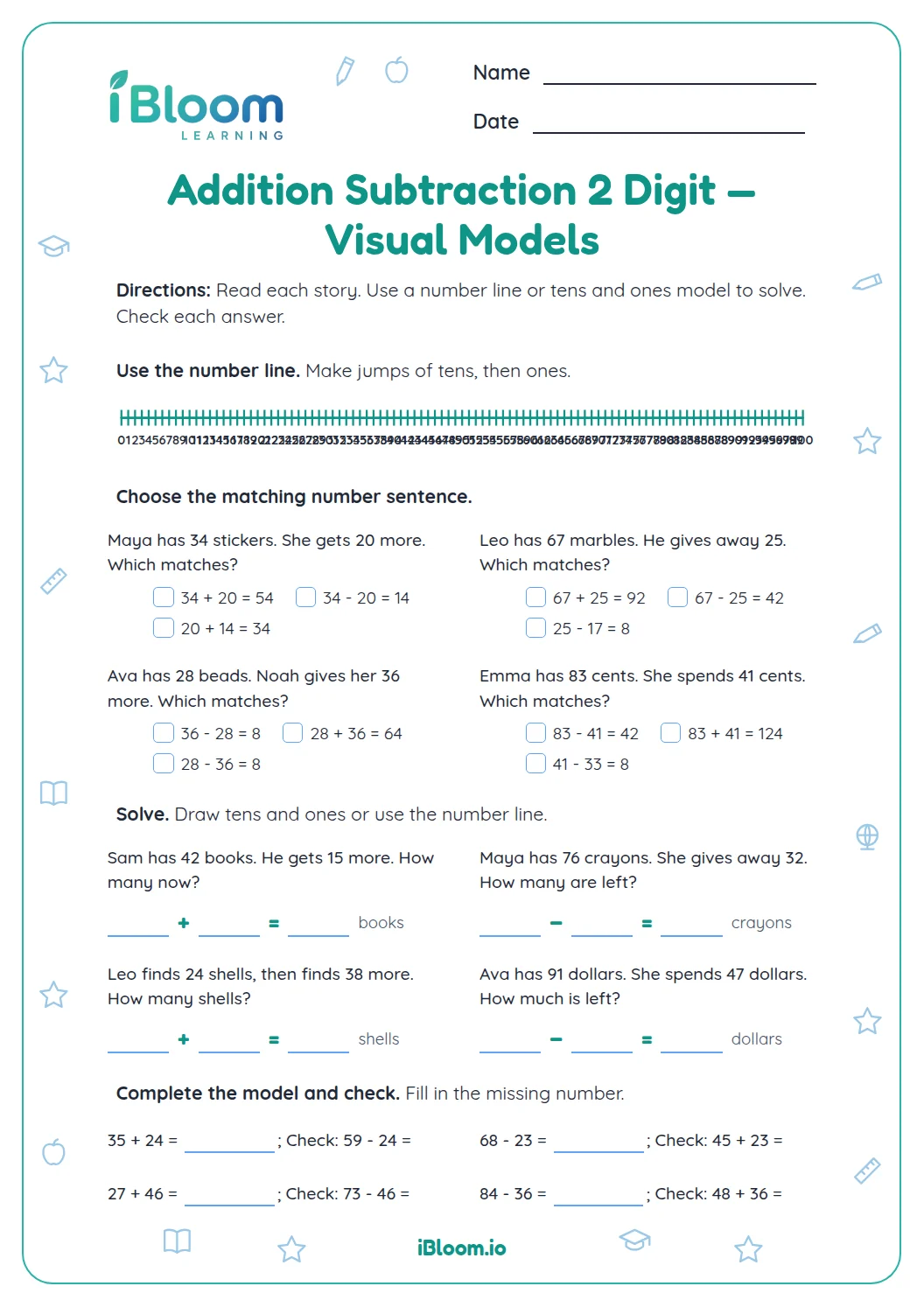
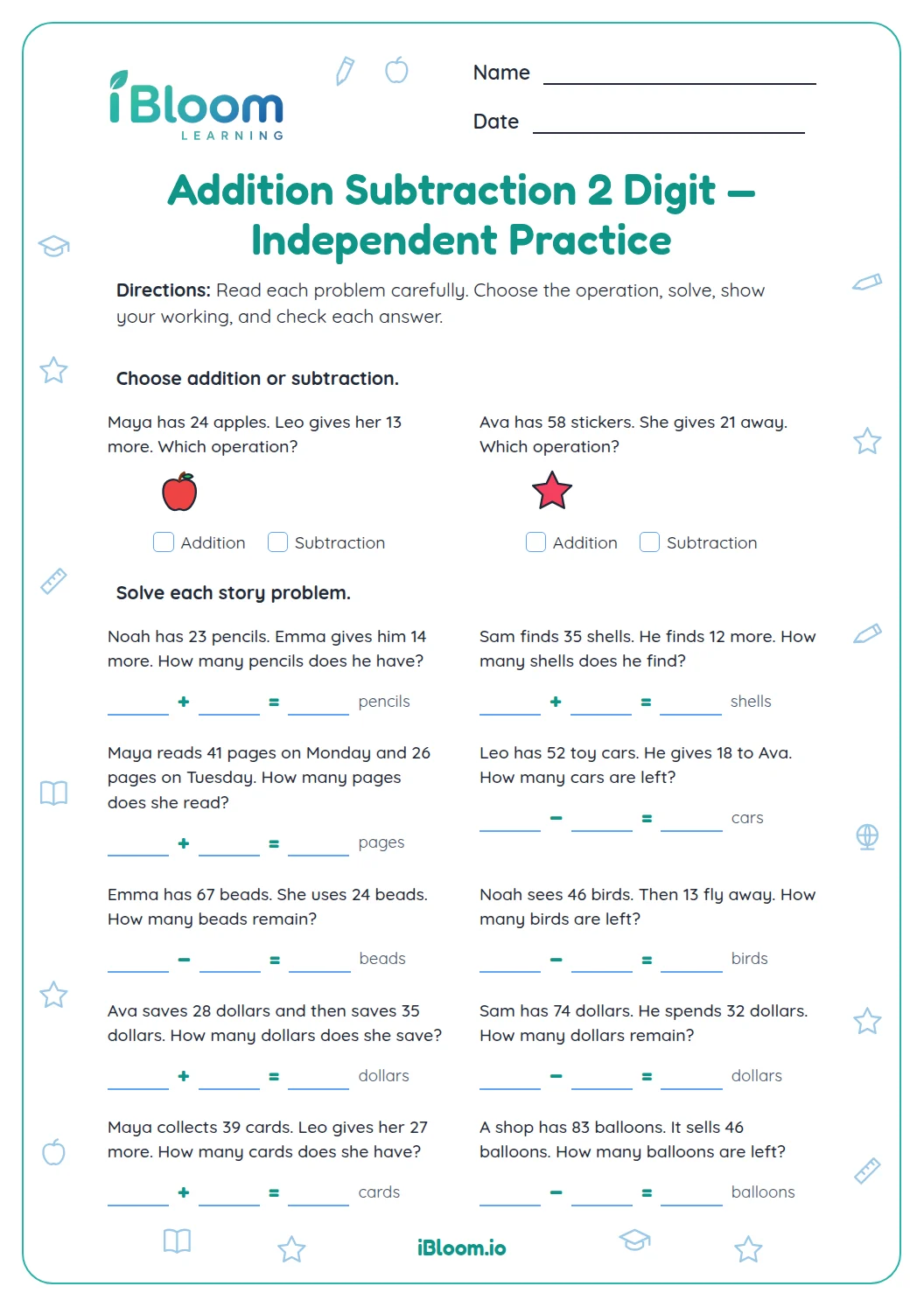
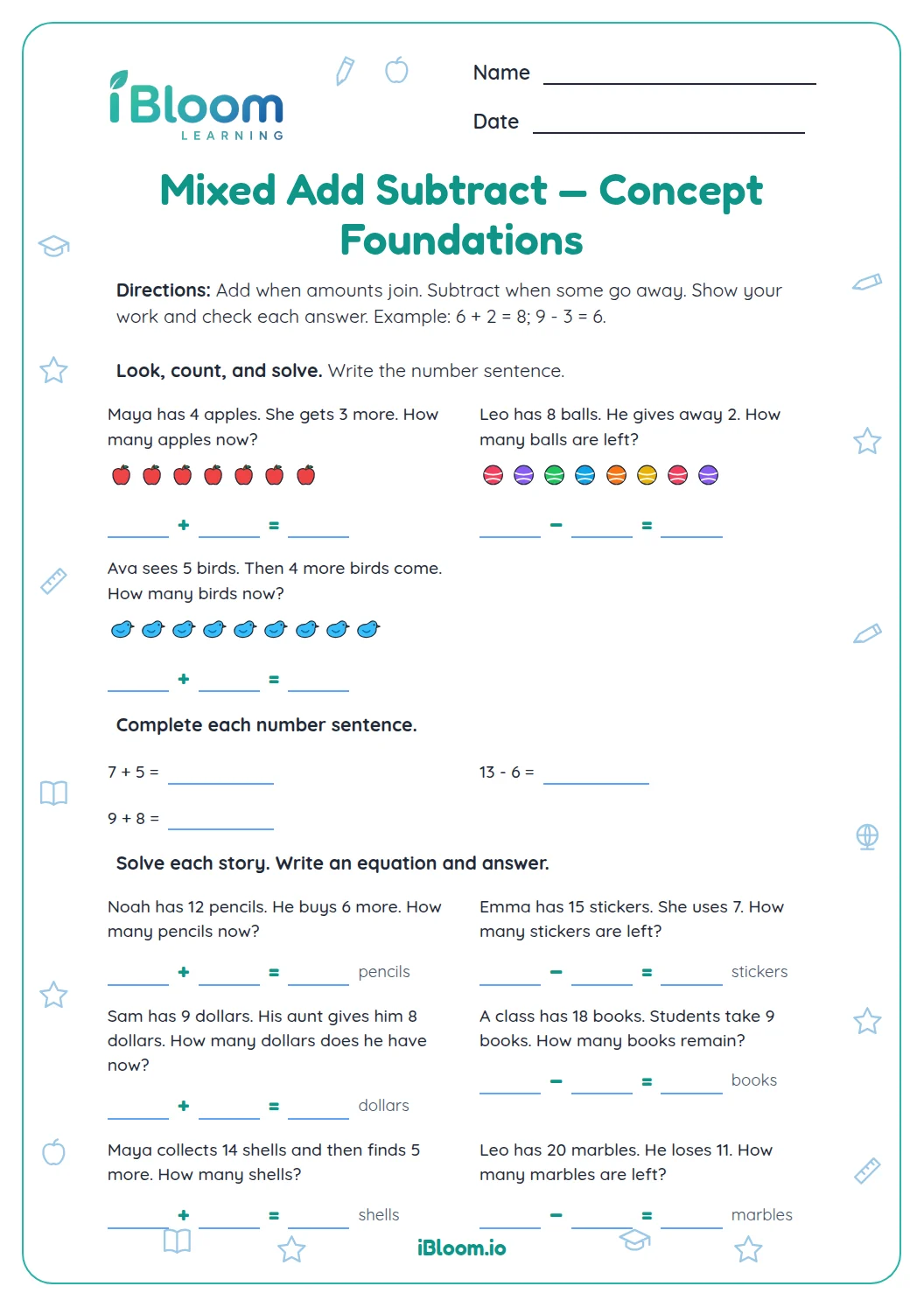
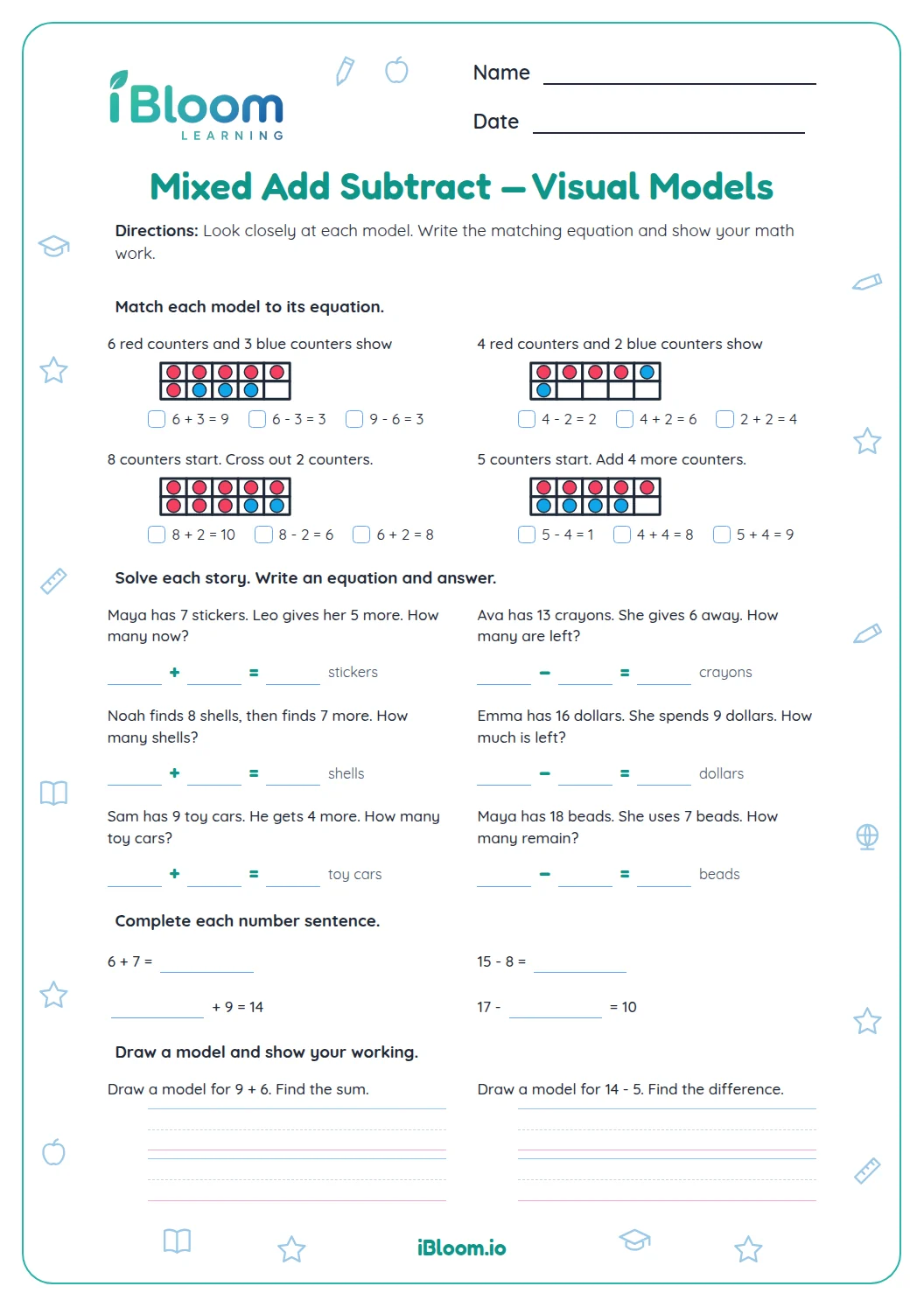
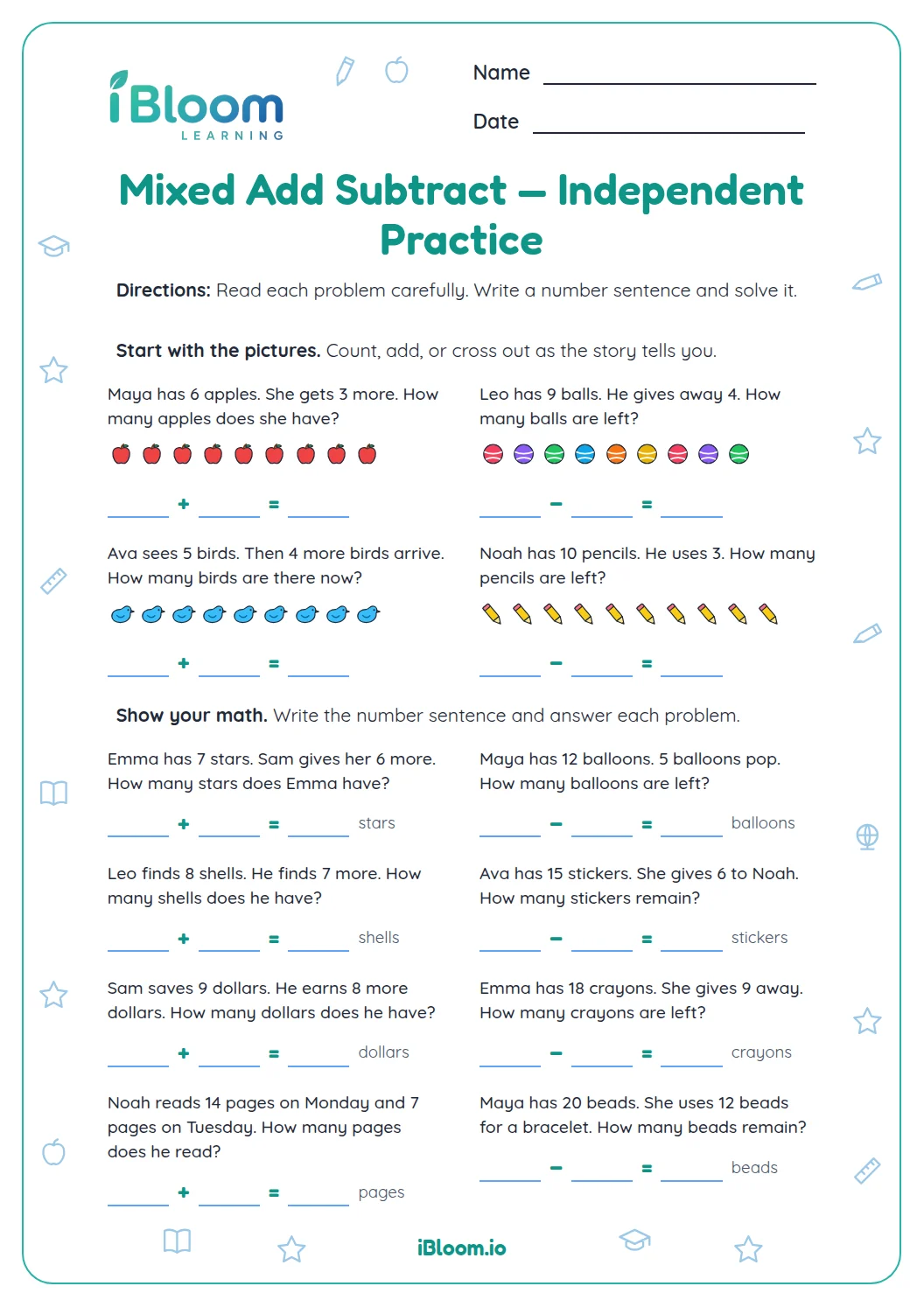
About this worksheet
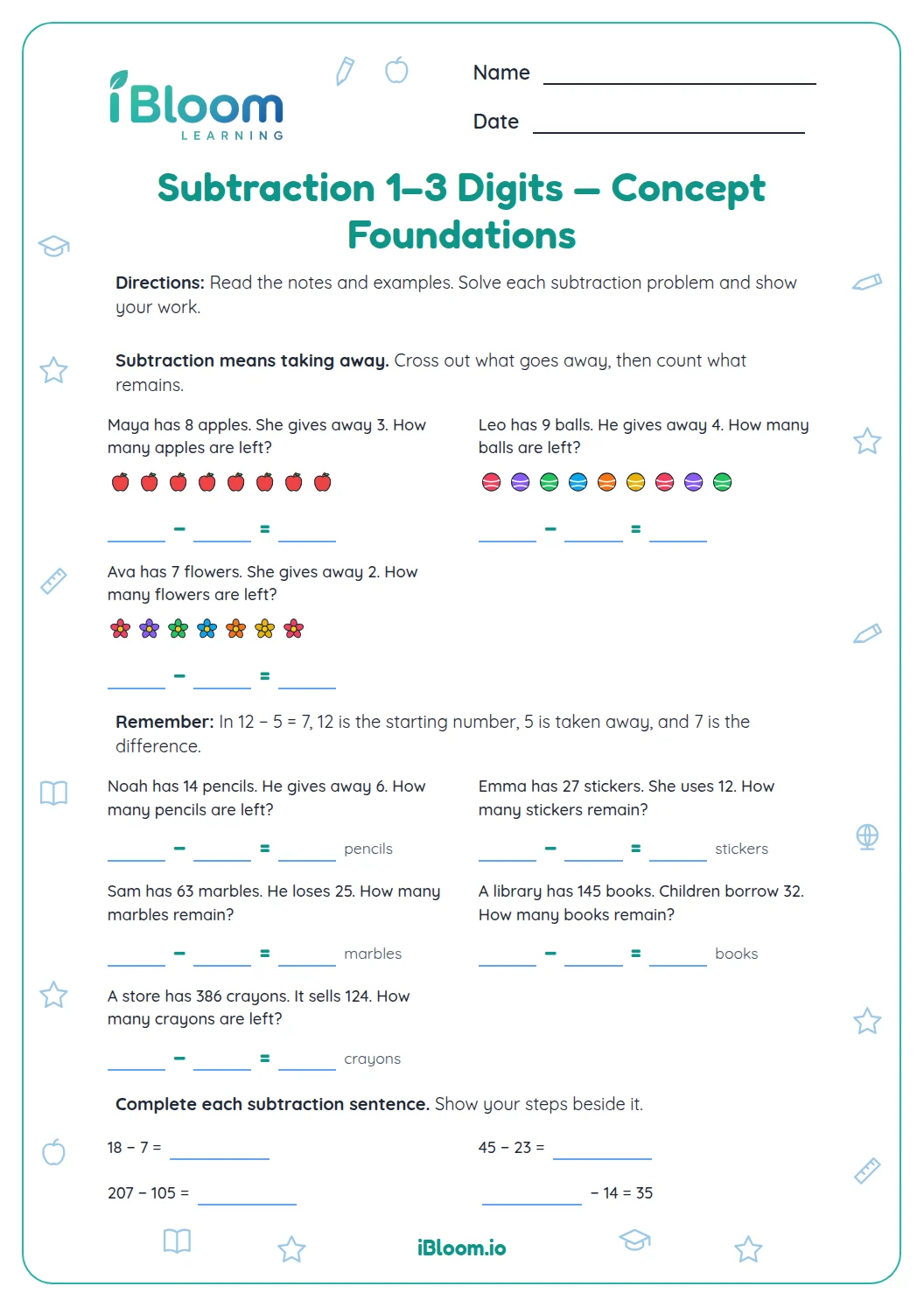
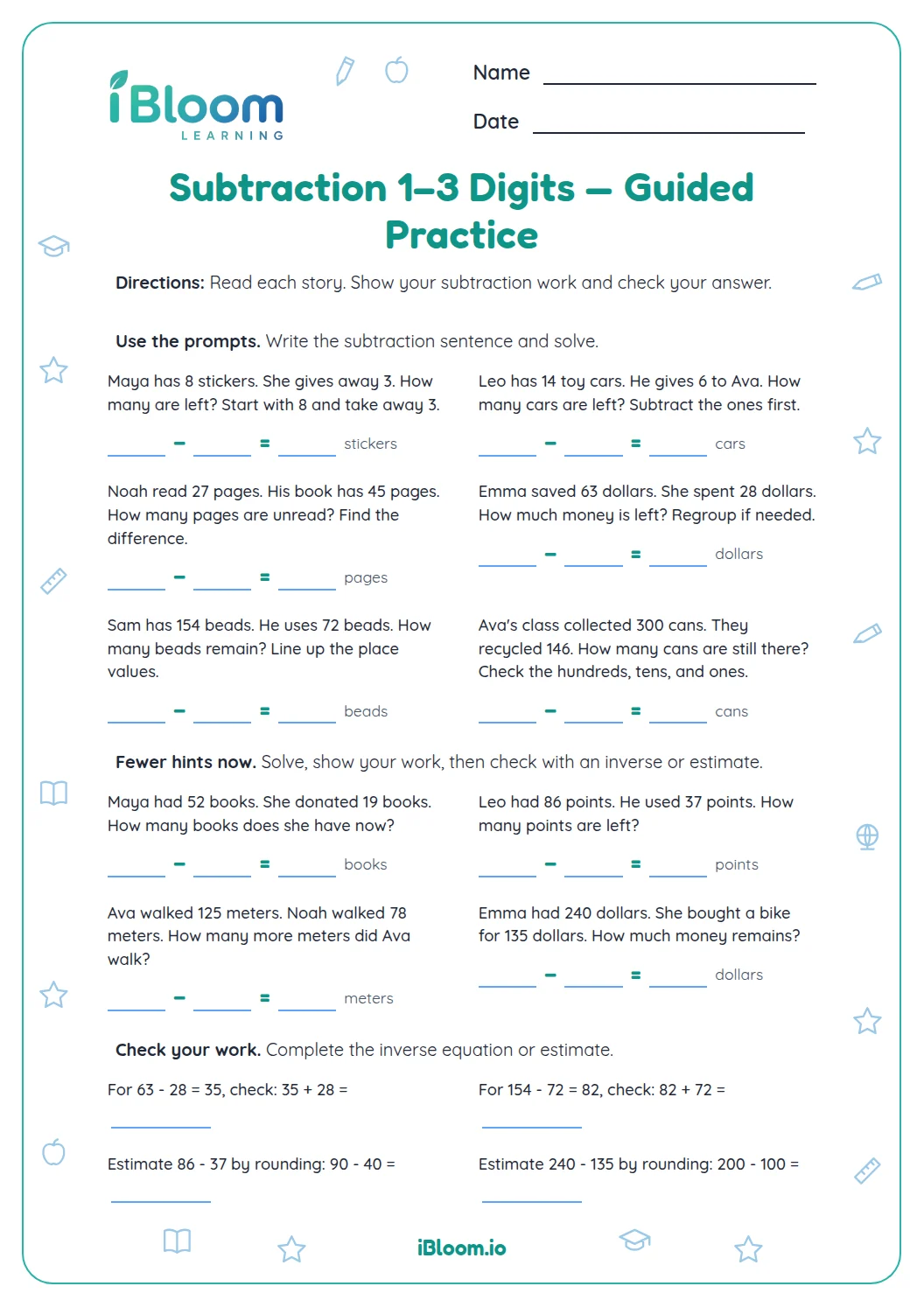
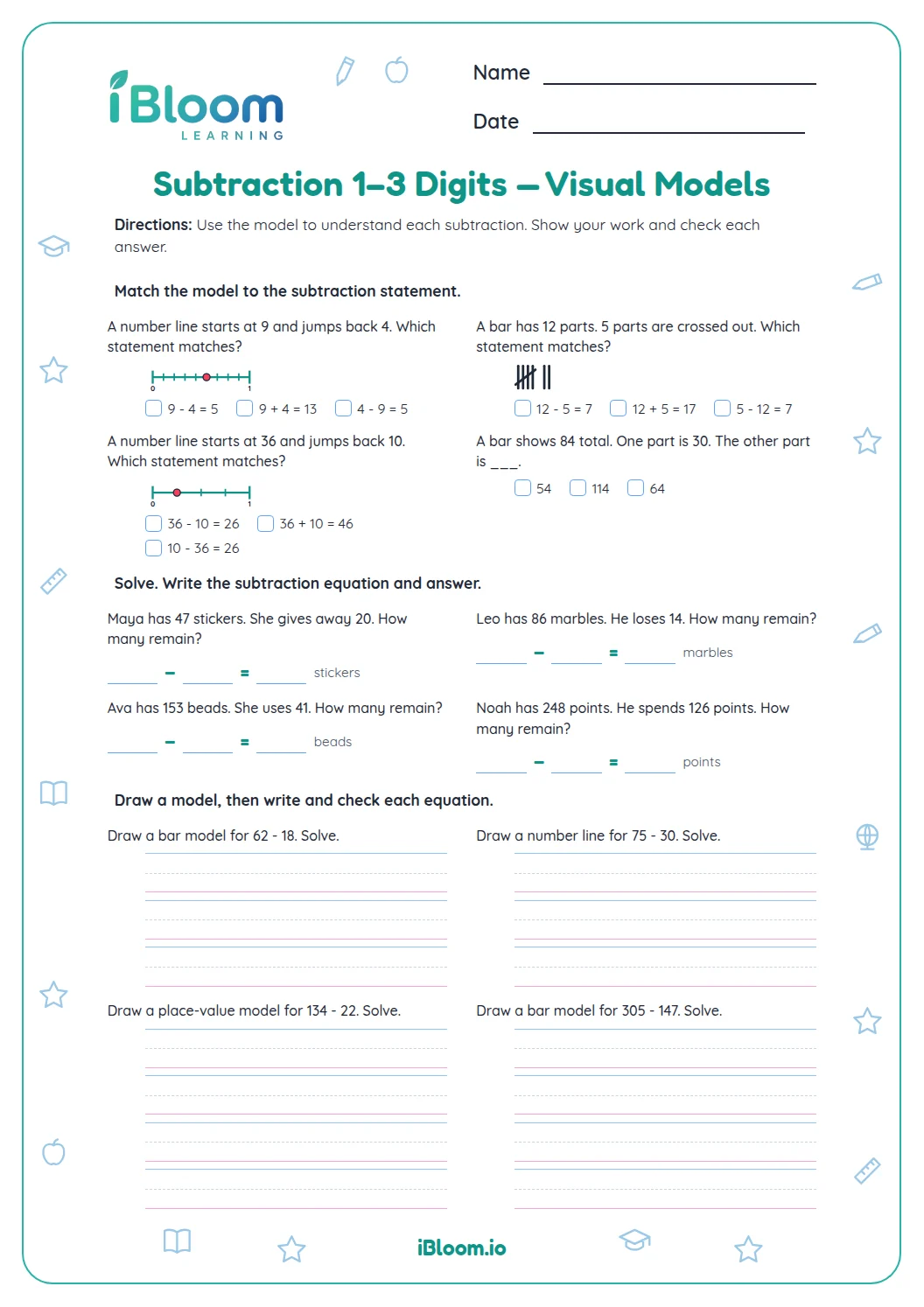
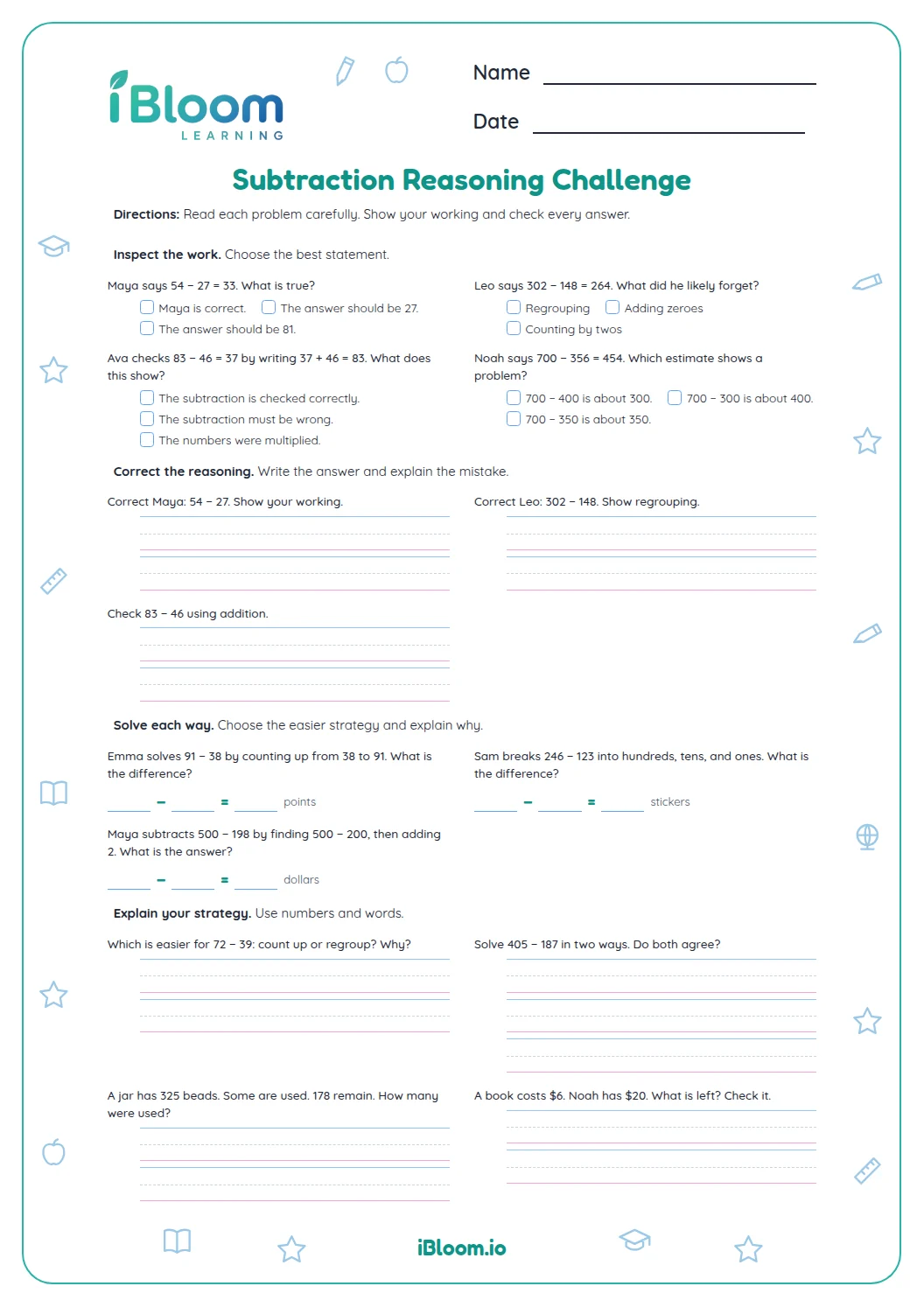
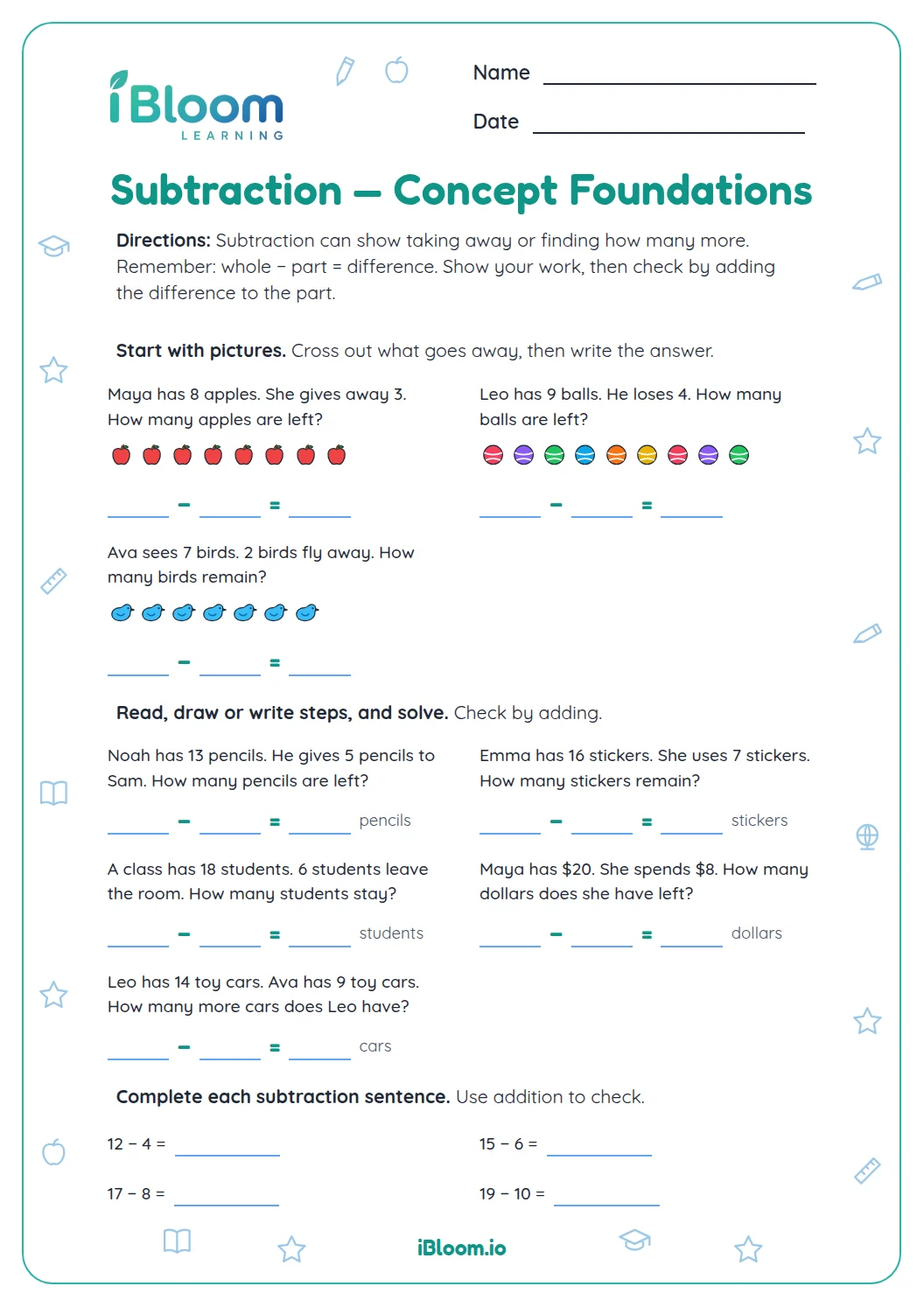
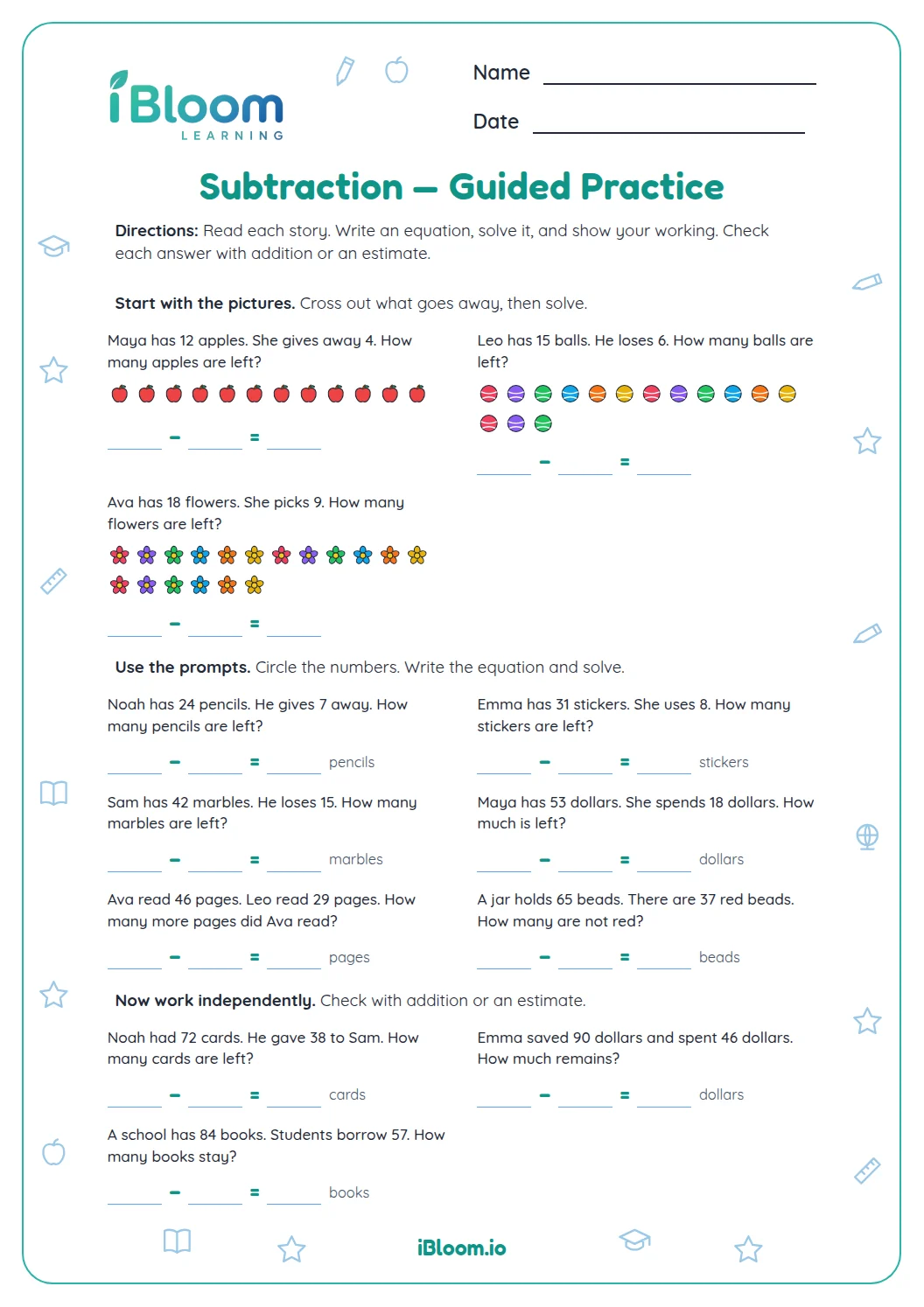
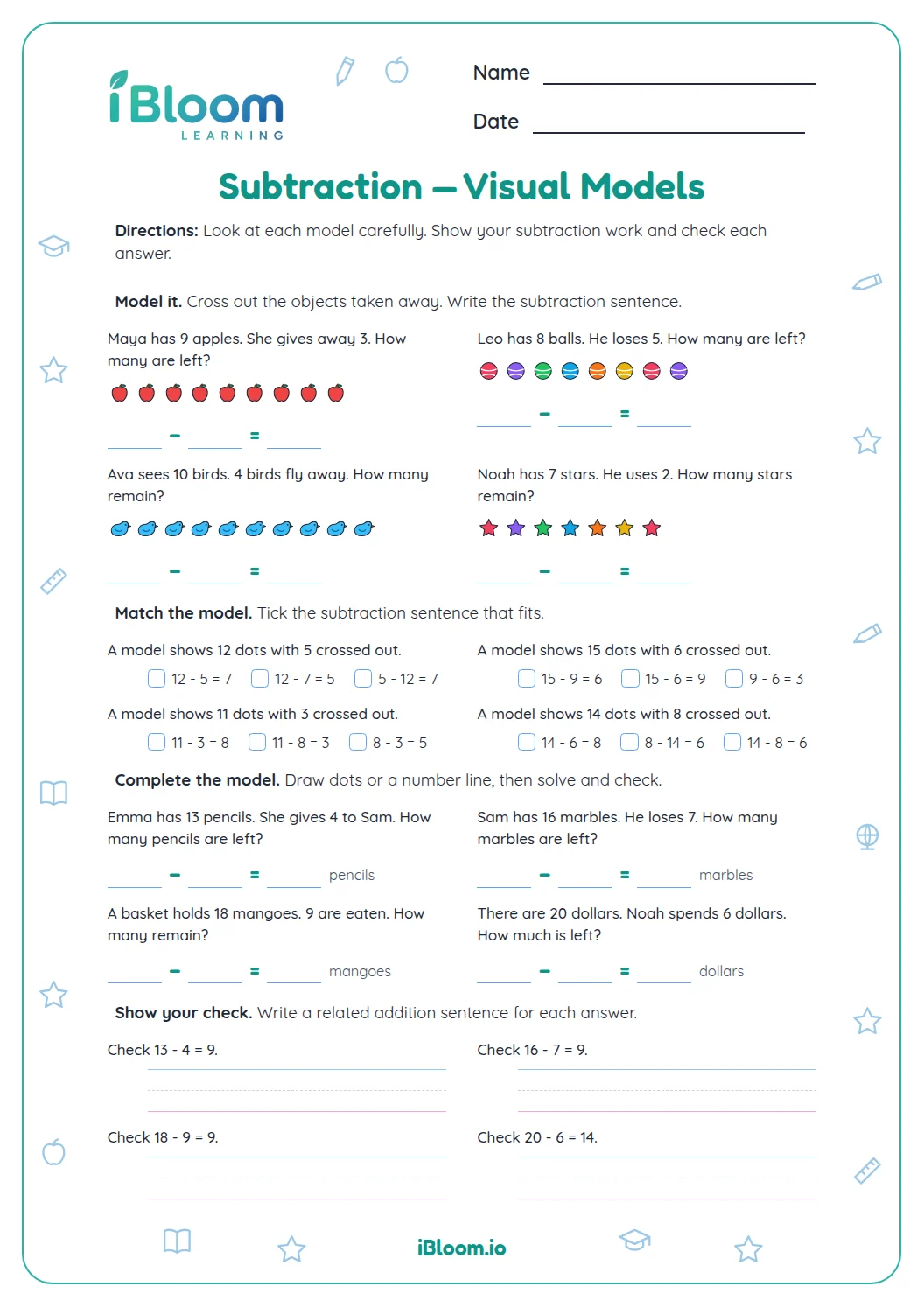
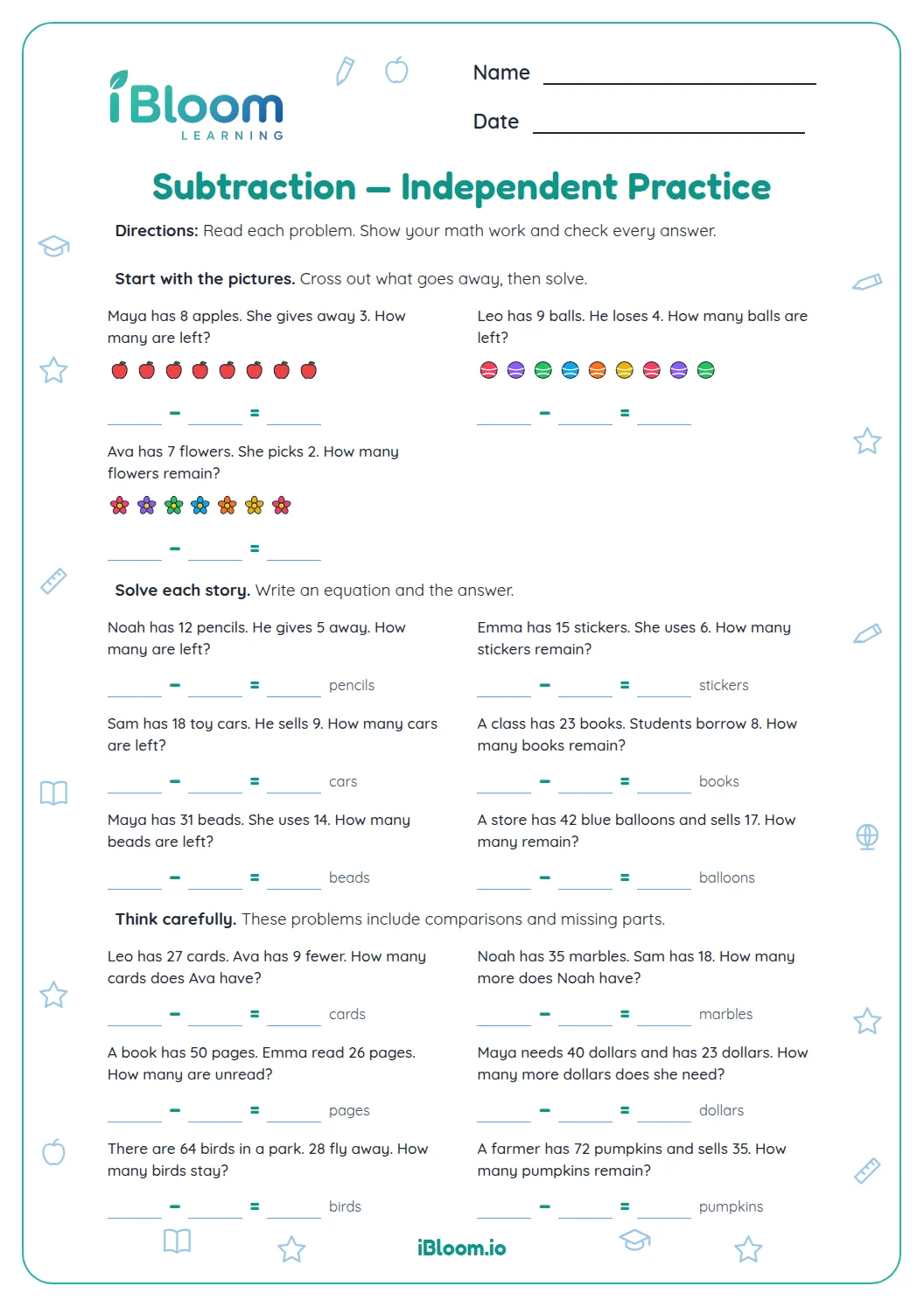
This Grade 2 printable turns everyday situations into subtraction problems, from apples given away to packages shipped. The 16 stories begin with one- and two-digit amounts and build to three-digit subtraction, including regrouping. Students find the amount that remains or the difference between amounts, then complete a labeled answer. The place-value work aligns with Common Core 2.NBT.B.7, and the first problems also practice Grade 2 subtraction stories within 100.
Aligned to 2.NBT.B.7 and 2.OA.A.1
How do students find the subtraction action?
Read the whole story and locate the starting quantity. Words such as gives away, sells, spends, and ships describe an amount that is no longer in the starting group. A comparison question asks for the difference between two quantities.
How does an equation represent a story?
Write the starting amount first, then subtract the amount removed or the smaller amount in a comparison. Include a label so the answer makes sense in the story.
- 1Ava has 64 stickers and uses 19.
- 264 − 19 = 45
- 3Answer: 45 stickers remain.
What can help with larger subtraction?
The stories use one-, two-, and three-digit amounts. Line up hundreds, tens, and ones when needed. If a place has too few units to subtract, regroup from the next place and keep track of the new value. Check by adding the difference to the amount subtracted.
What is on the practice pages?
The 16 short stories move from one- and two-digit subtraction to three-digit amounts, with everyday contexts such as books, cans, and boxes. Each prompt has a blank for a labeled answer.
How to use this worksheet
- 1Read the story twice and find the starting amount.
- 2Underline what is taken away or what two amounts are compared.
- 3Subtract the amount removed or find the difference between the two amounts.
- 4Regroup by place value when needed.
- 5Label the answer and check by addition.
Common mistakes and quick fixes
The mistake
Subtracting the starting amount from the amount removed.
The fix
Begin with the larger starting quantity in the story.
The mistake
Forgetting to regroup when the top digit is smaller.
The fix
Trade one ten or hundred and update that place value.
The mistake
Writing a number without its unit.
The fix
Add the story label, such as 45 stickers.
Common Core alignment
These story problems connect place-value subtraction with everyday situations.
Add and subtract within 1,000 using place-value strategies.
On this sheet: The three-digit story problems practice subtraction using place-value reasoning.
Show the official wordingHide the official wording
Add and subtract within 1000, using concrete models or drawings and strategies based on place value, properties of operations, and/or the relationship between addition and subtraction; relate the strategy to a written method. Understand that in adding or subtracting three-digit numbers, one adds or subtracts hundreds and hundreds, tens and tens, ones and ones; and sometimes it is necessary to compose or decompose tens or hundreds.
Solve one- and two-step addition and subtraction word problems.
On this sheet: The first story problems use take-from and comparison situations within 100.
Show the official wordingHide the official wording
Use addition and subtraction within 100 to solve one- and two-step word problems involving situations of adding to, taking from, putting together, taking apart, and comparing, with unknowns in all positions.
What to practice next
Make more practice
Further reading
Questions parents and teachers ask
How do students know when a story calls for subtraction?
Look for a starting amount and a smaller amount removed, spent, sold, or left over. A comparison story asks how many more or fewer one amount is than another. The story details tell which quantities belong in the subtraction sentence.
What number sizes appear on this worksheet?
The problems use one-, two-, and three-digit values, all below 1,000. Students begin with smaller amounts and work toward larger problems that may require regrouping across hundreds, tens, and ones. Several stories use three-digit quantities, including 804 visitors and 586 visitors.
Do students need to write an equation?
Each item asks students to solve an everyday subtraction story and fill in the answer blank with the quantity that remains or differs. They can show calculations on scratch paper, then check that the labeled answer fits the story.
How can students check a subtraction answer?
Add the difference to the amount taken away. The sum should equal the starting amount. For a comparison problem, check that the smaller quantity plus the difference equals the larger quantity. This quick inverse-operation check can reveal a missed regrouping step.
How can students check a subtraction story answer?
Add the difference to the amount removed. The sum should equal the starting amount. For a comparison story, add the difference to the smaller amount and check that it reaches the larger amount. Then reread the story to confirm the answer label.