
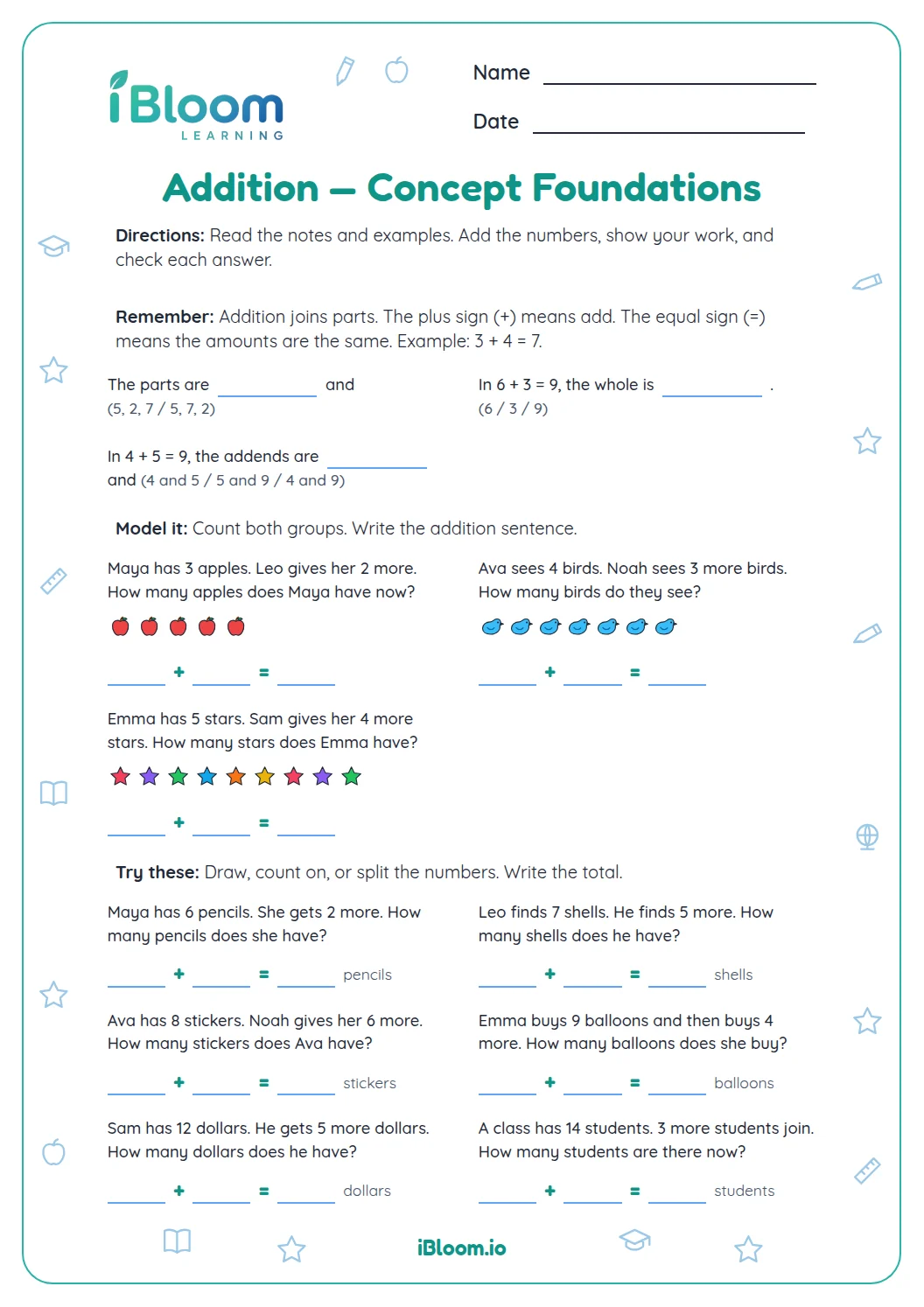
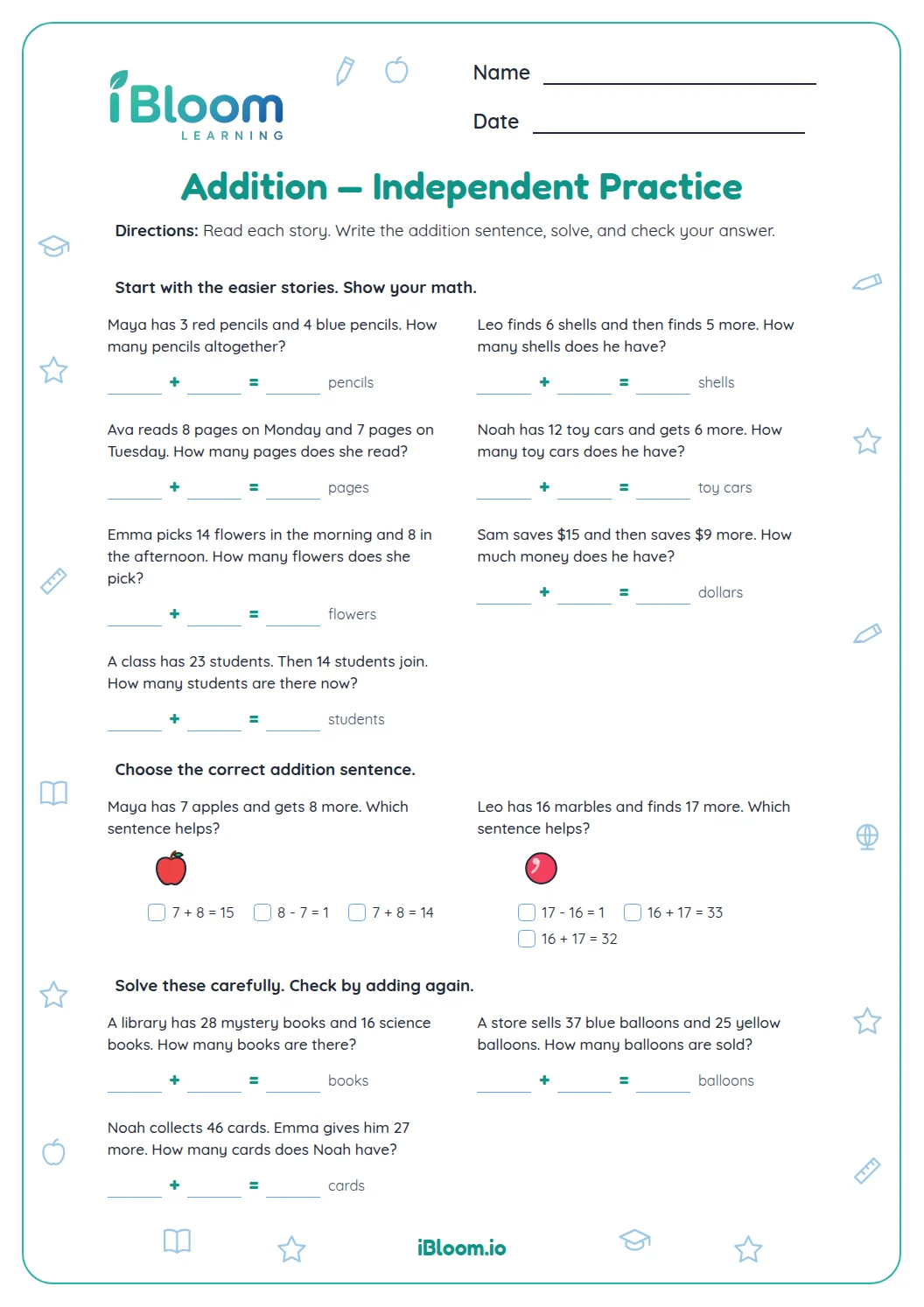

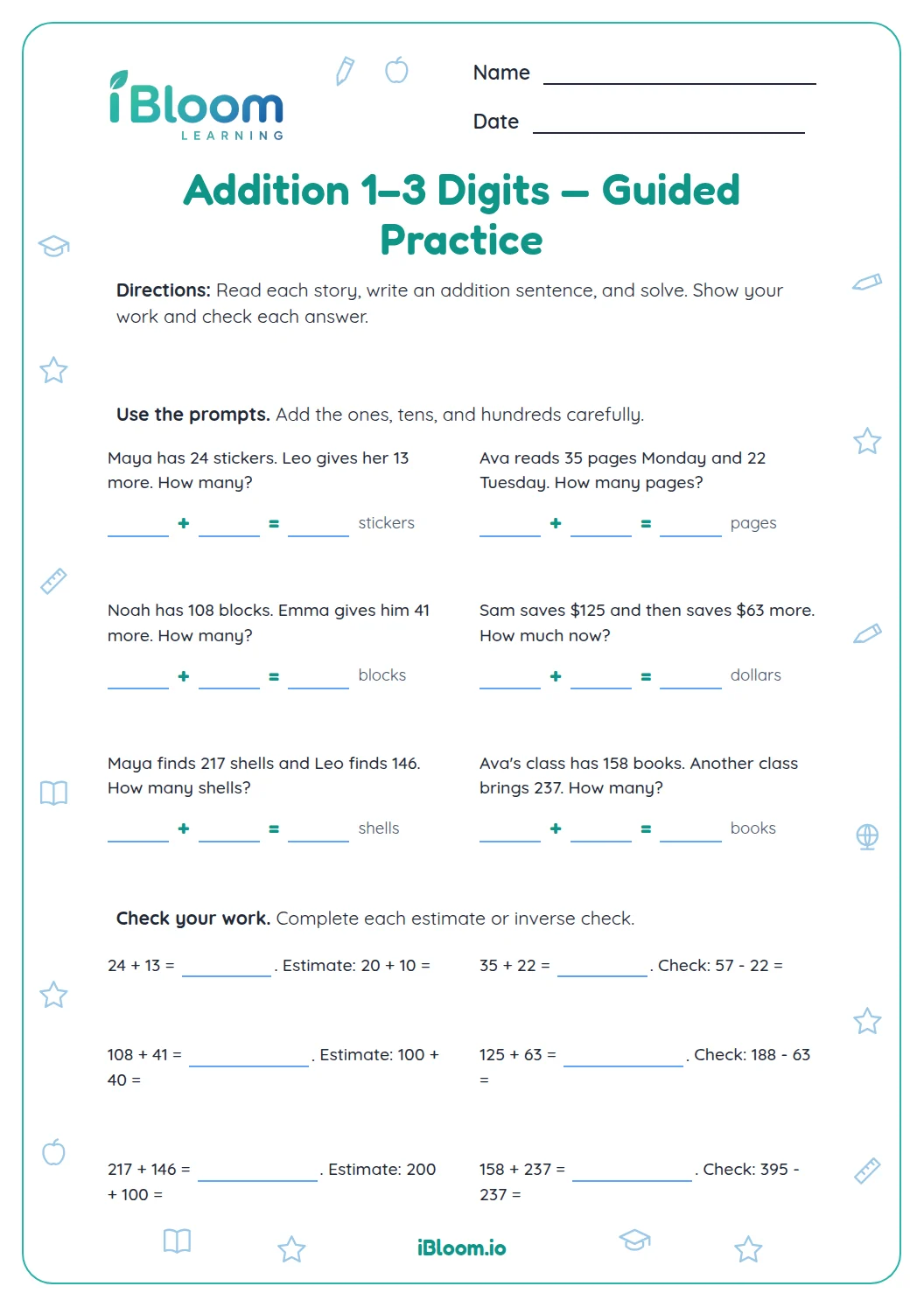
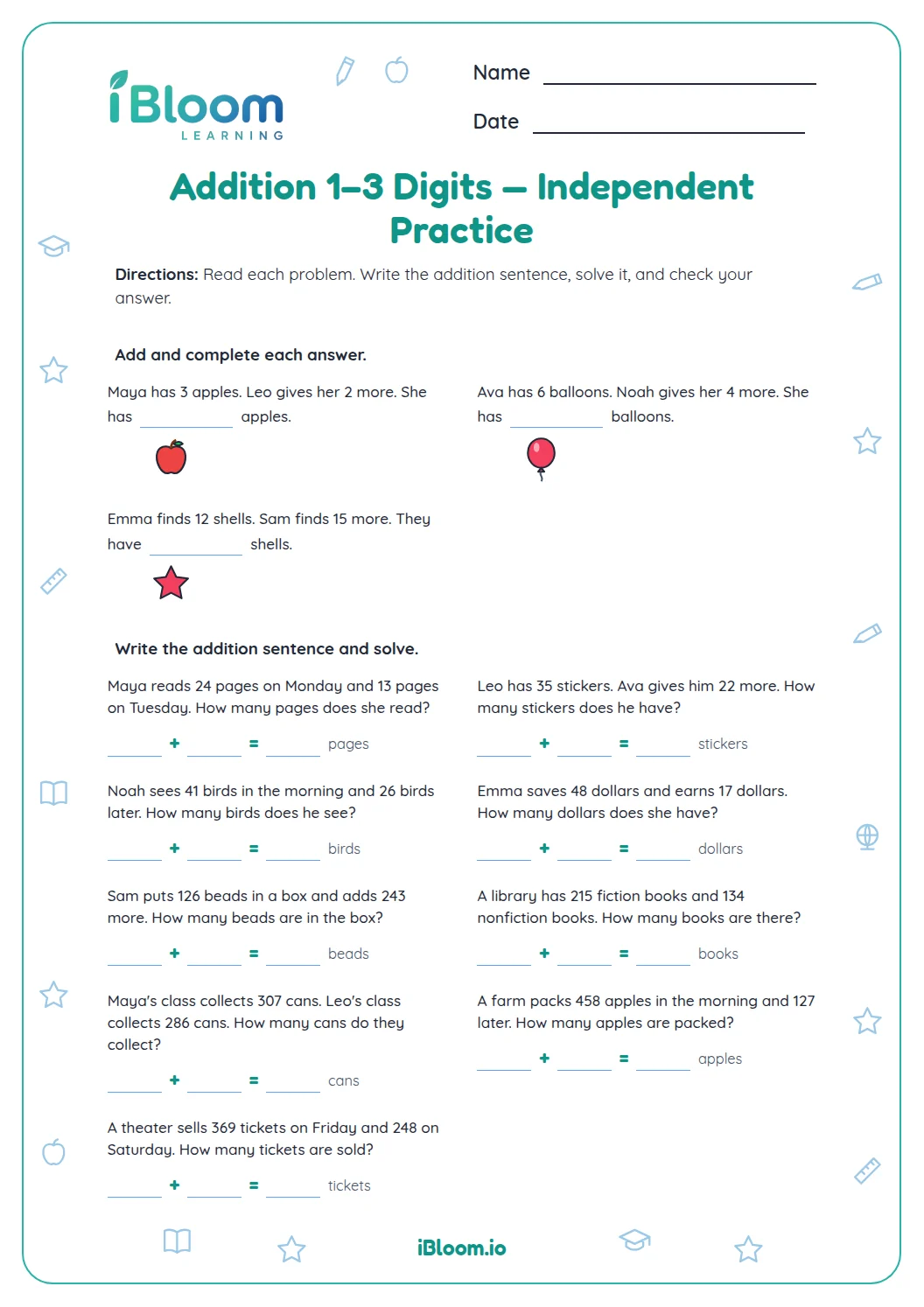
About this worksheet
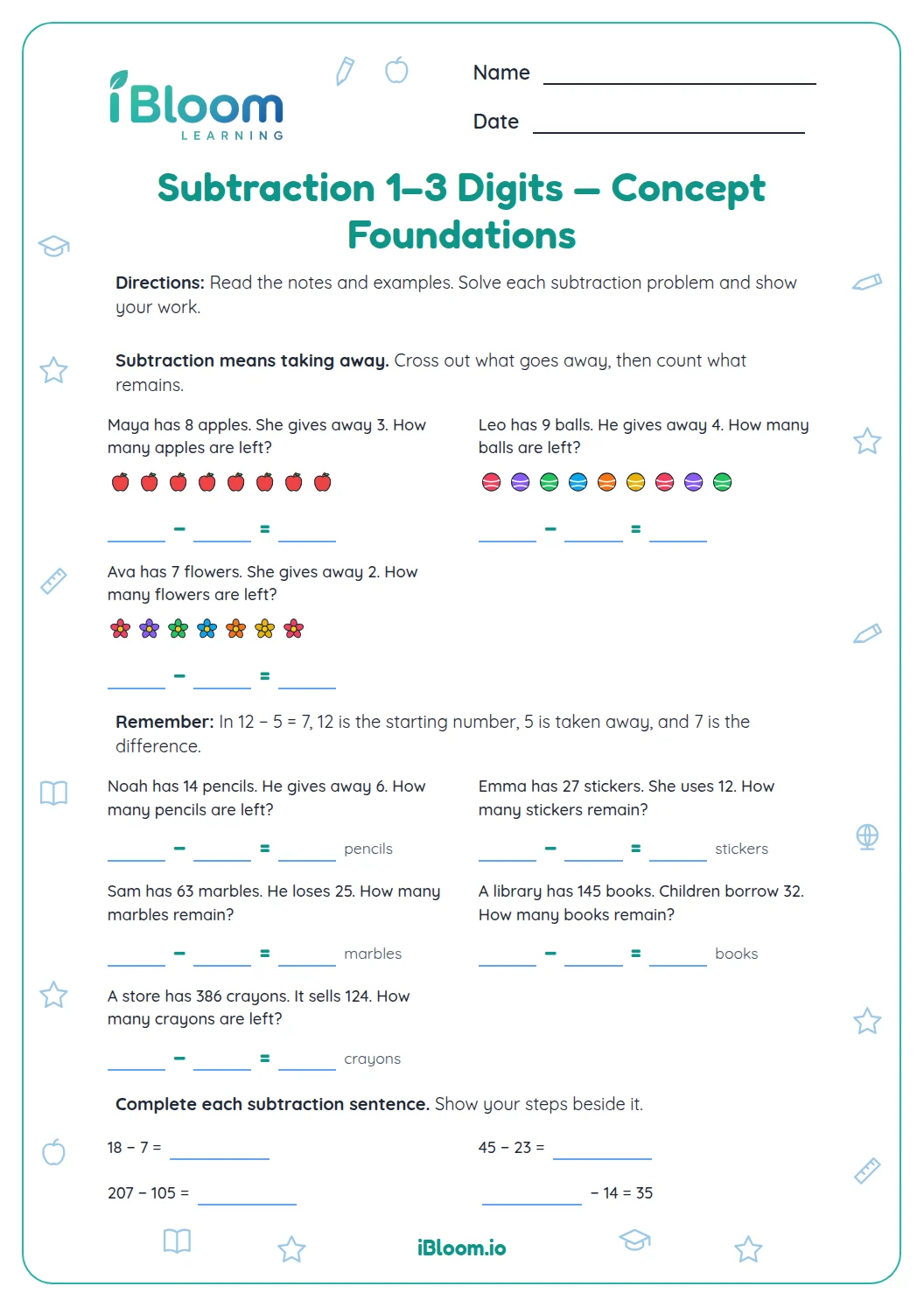
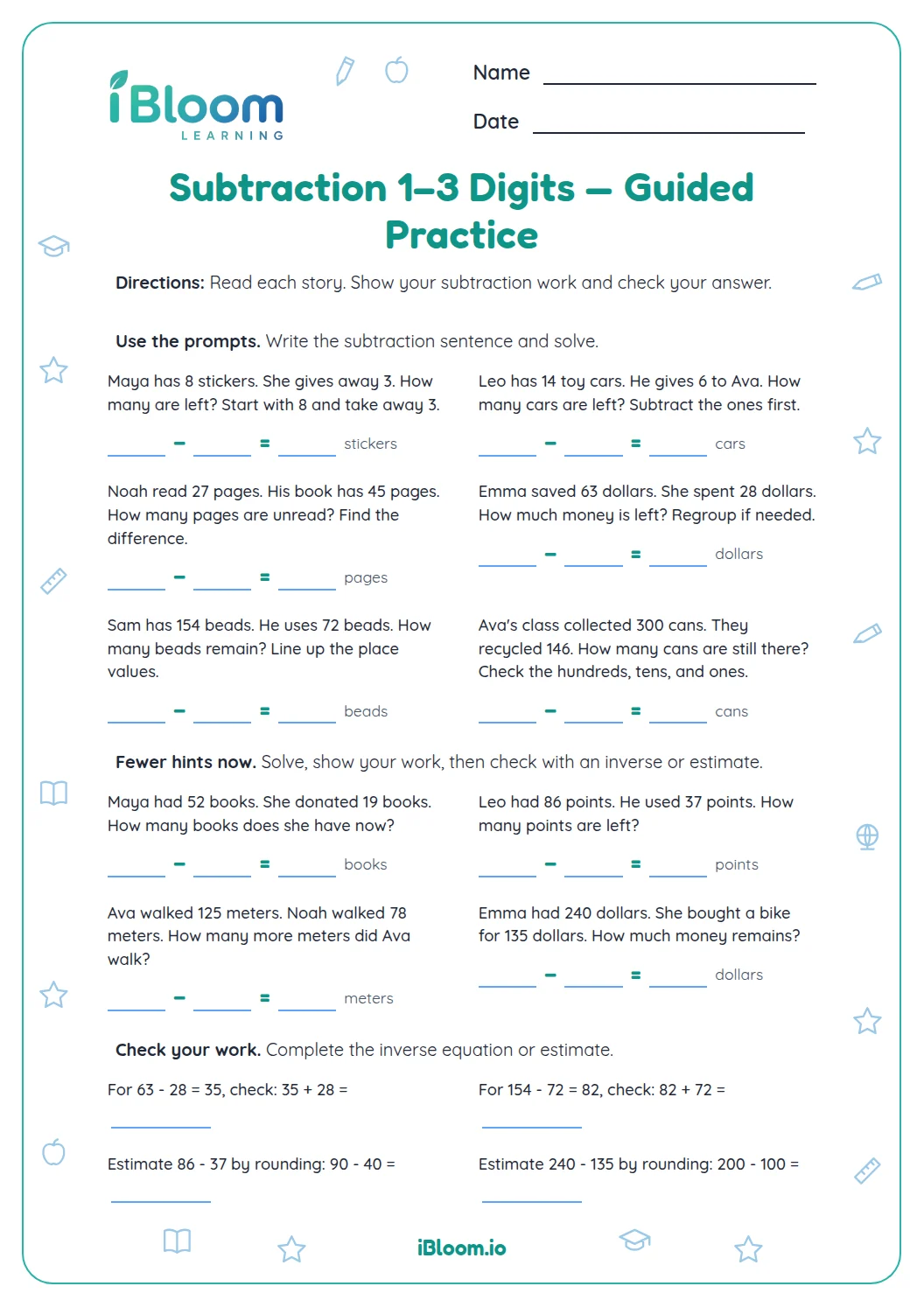
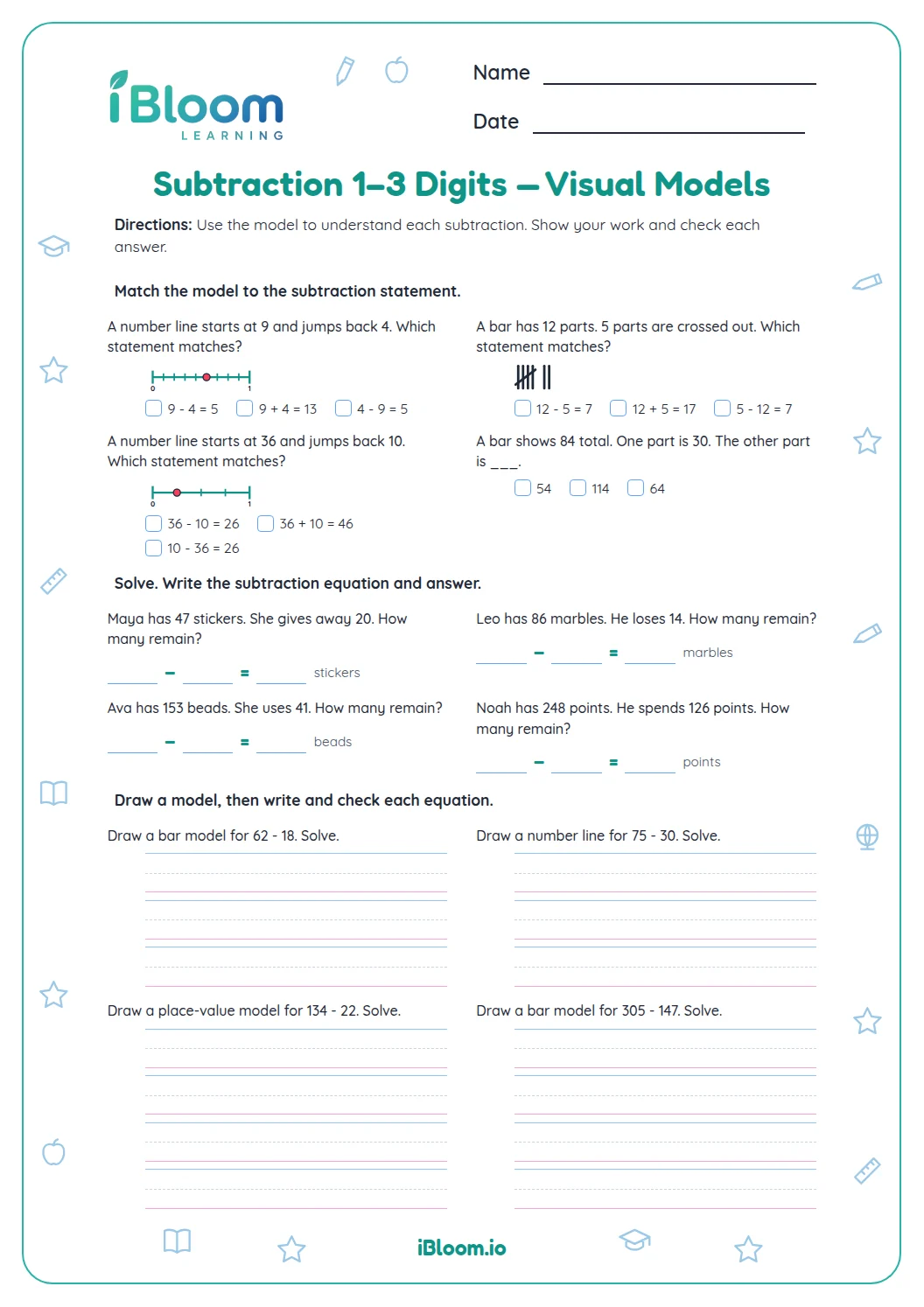
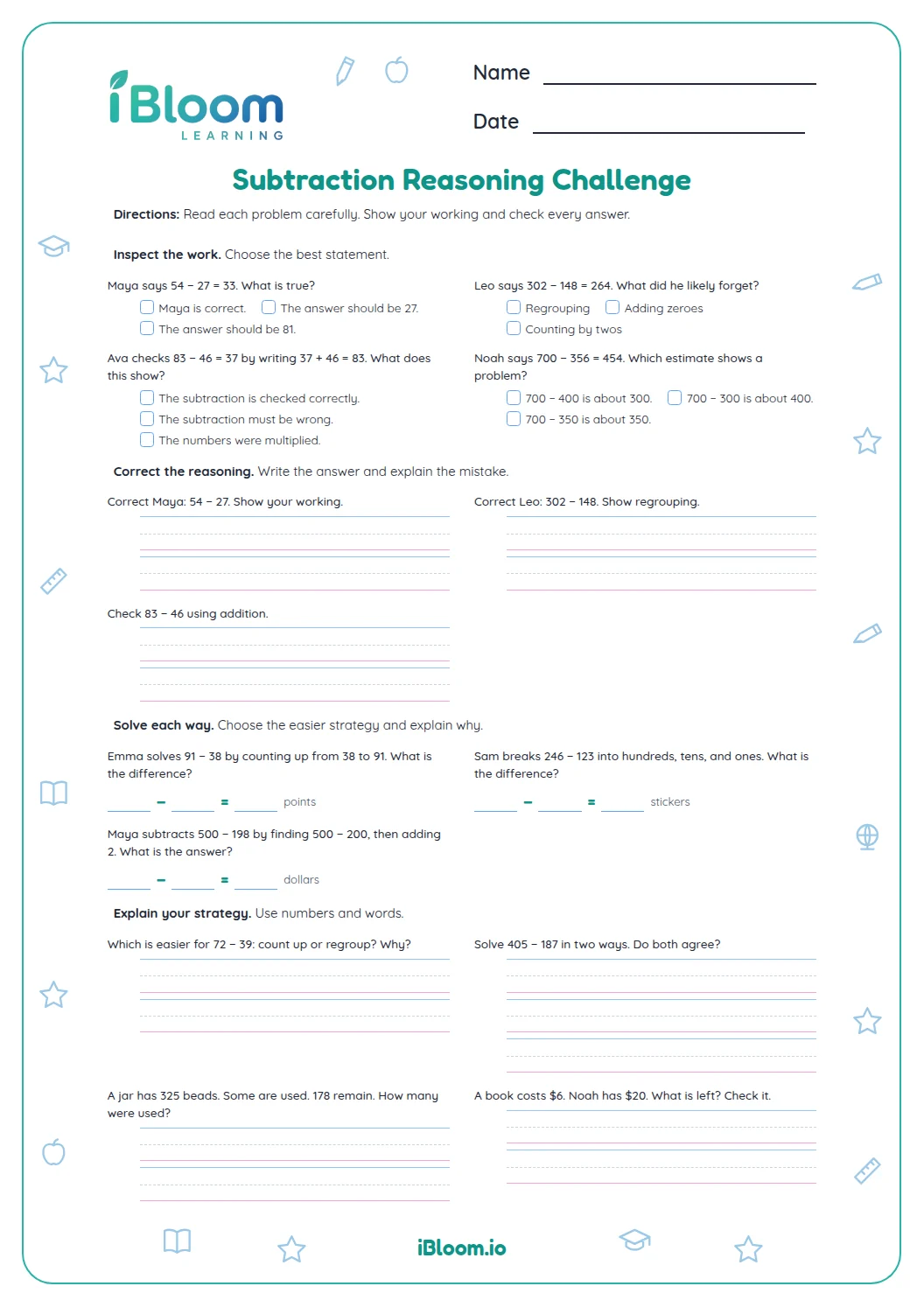
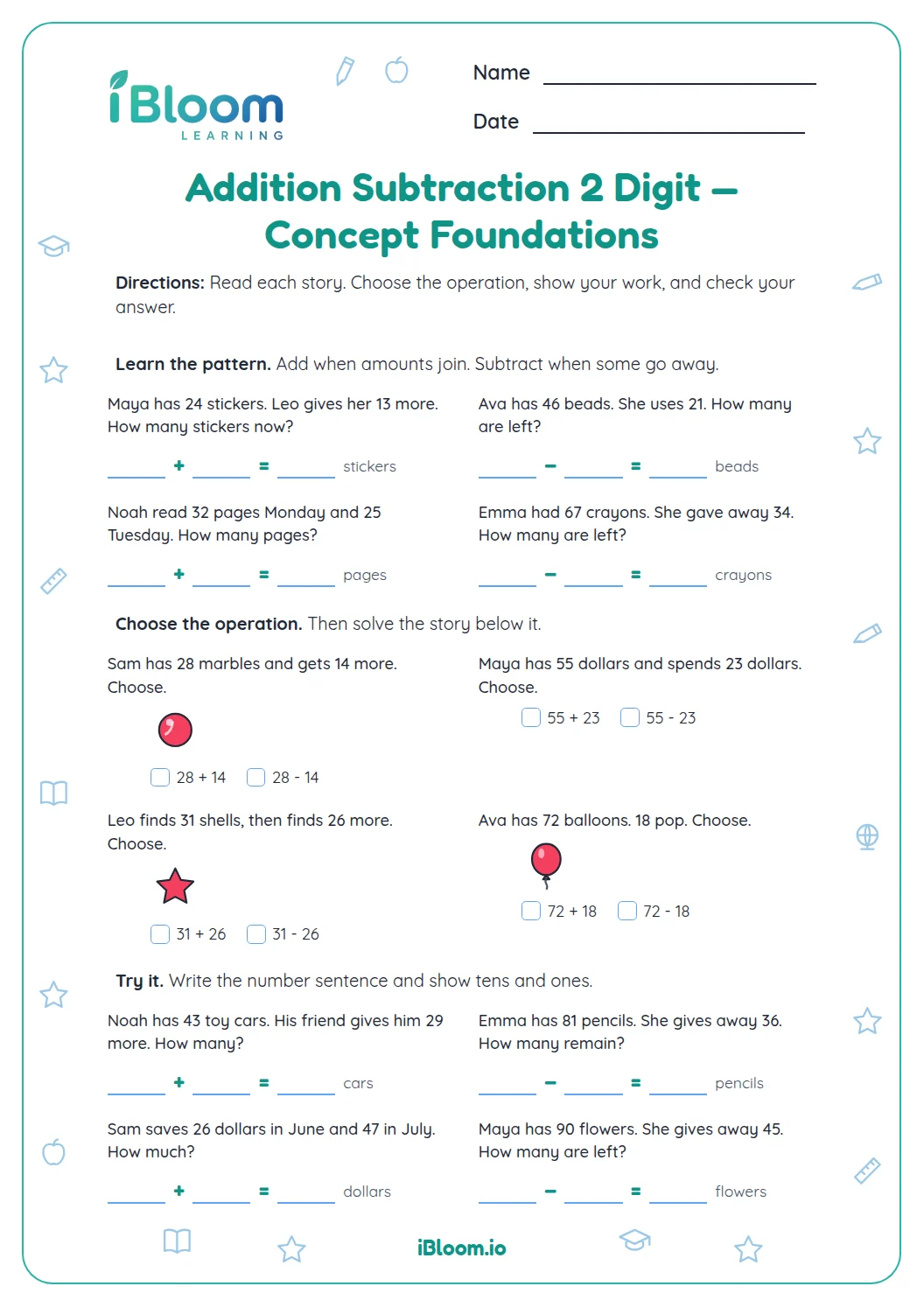
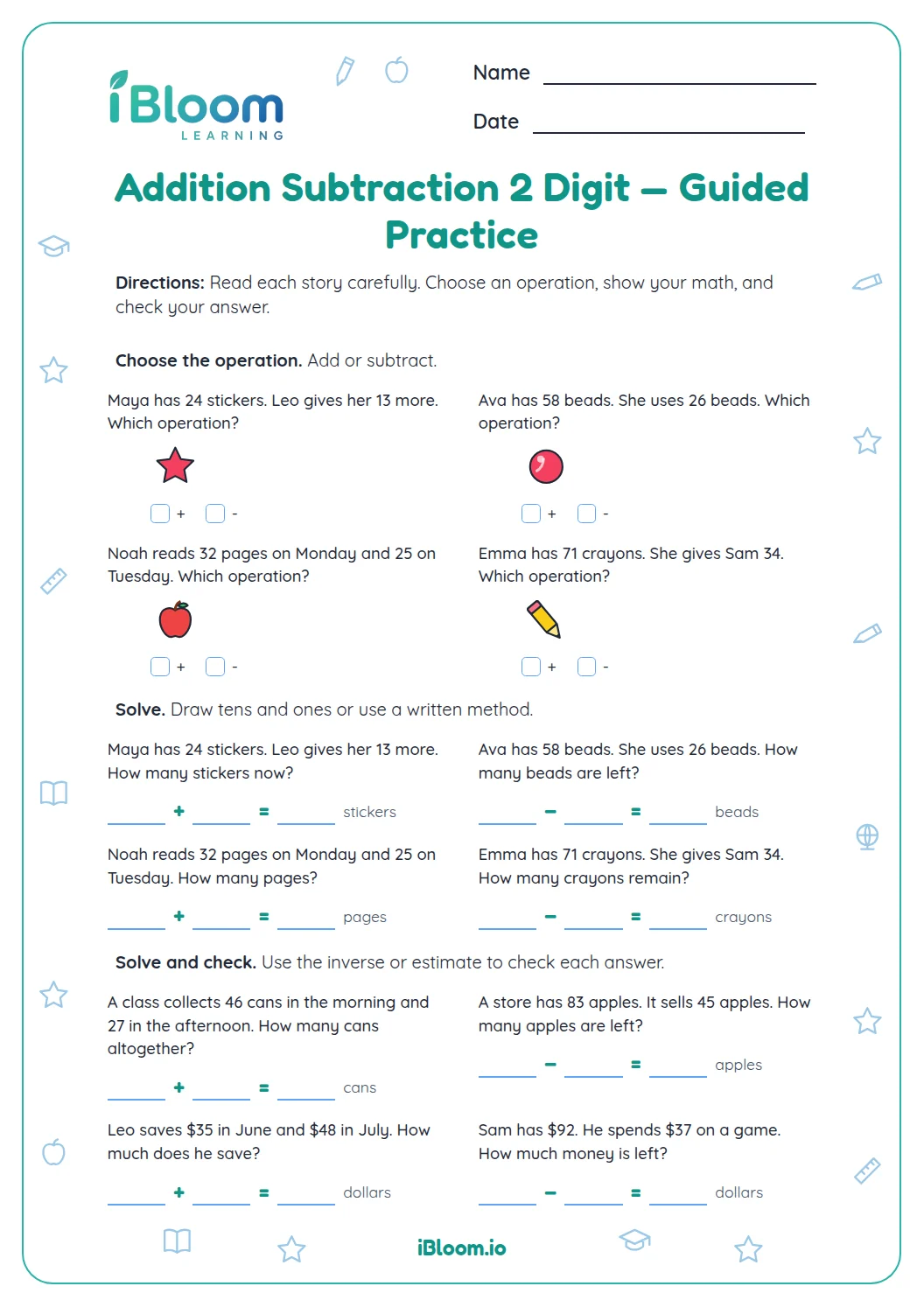
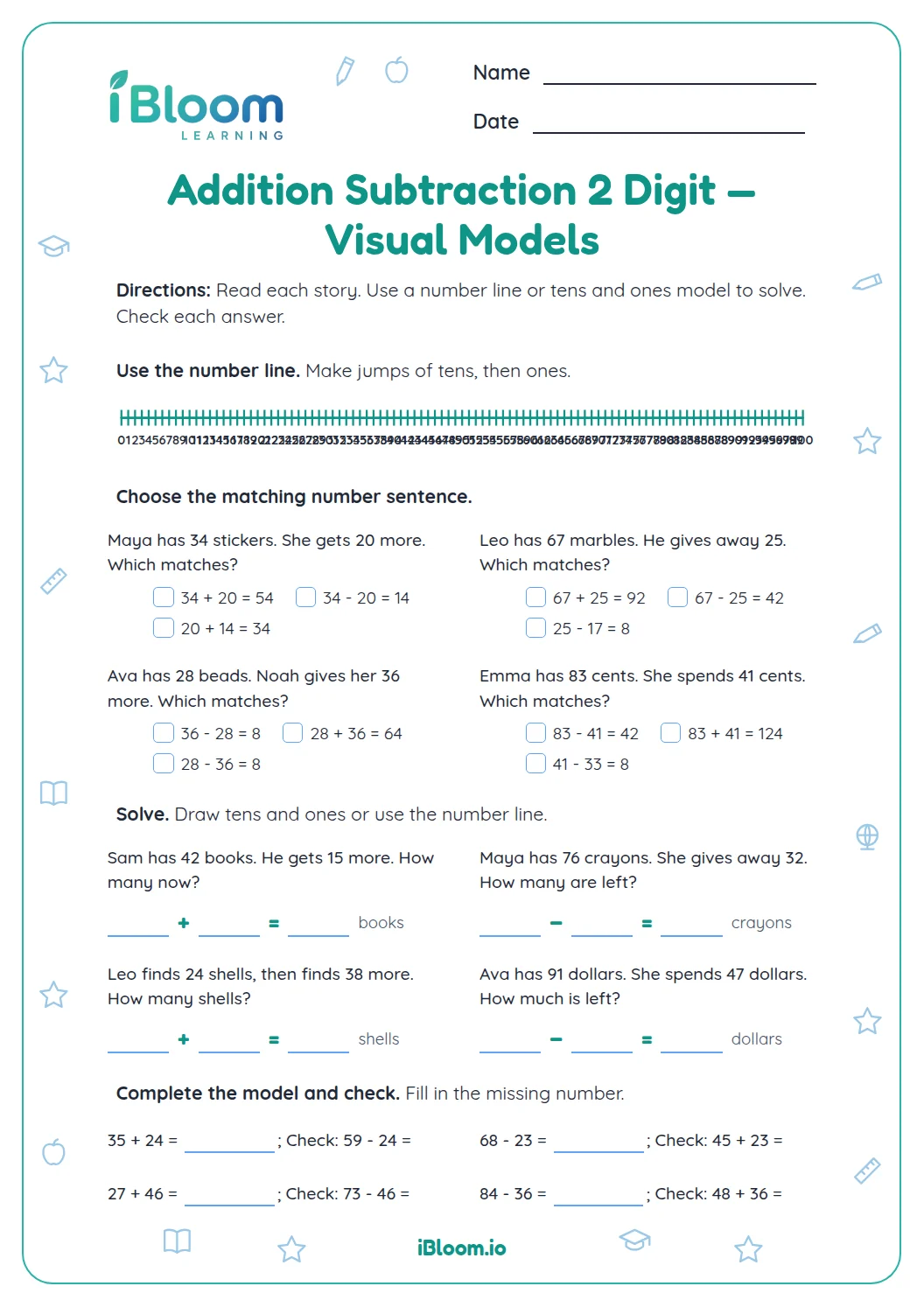
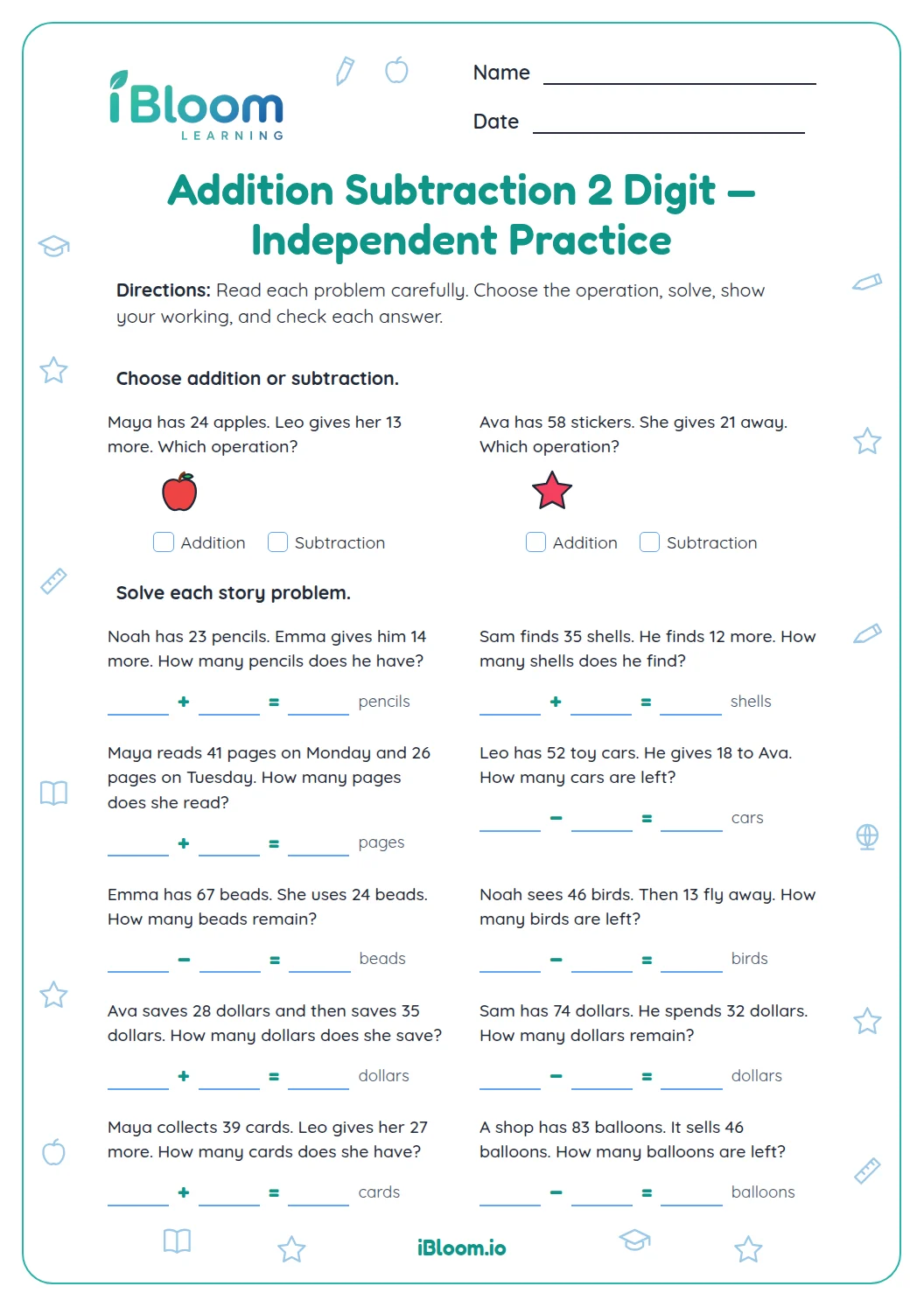
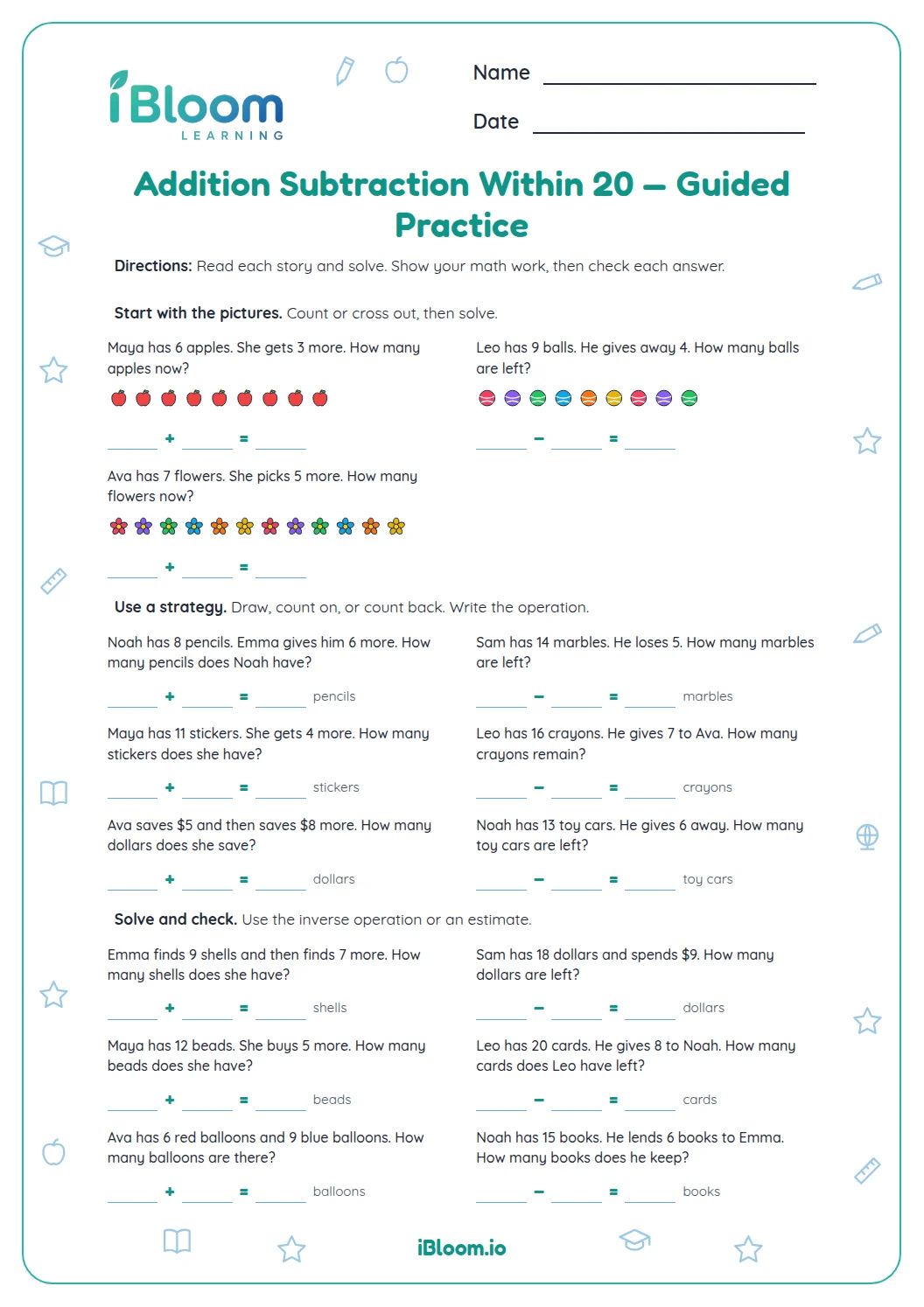
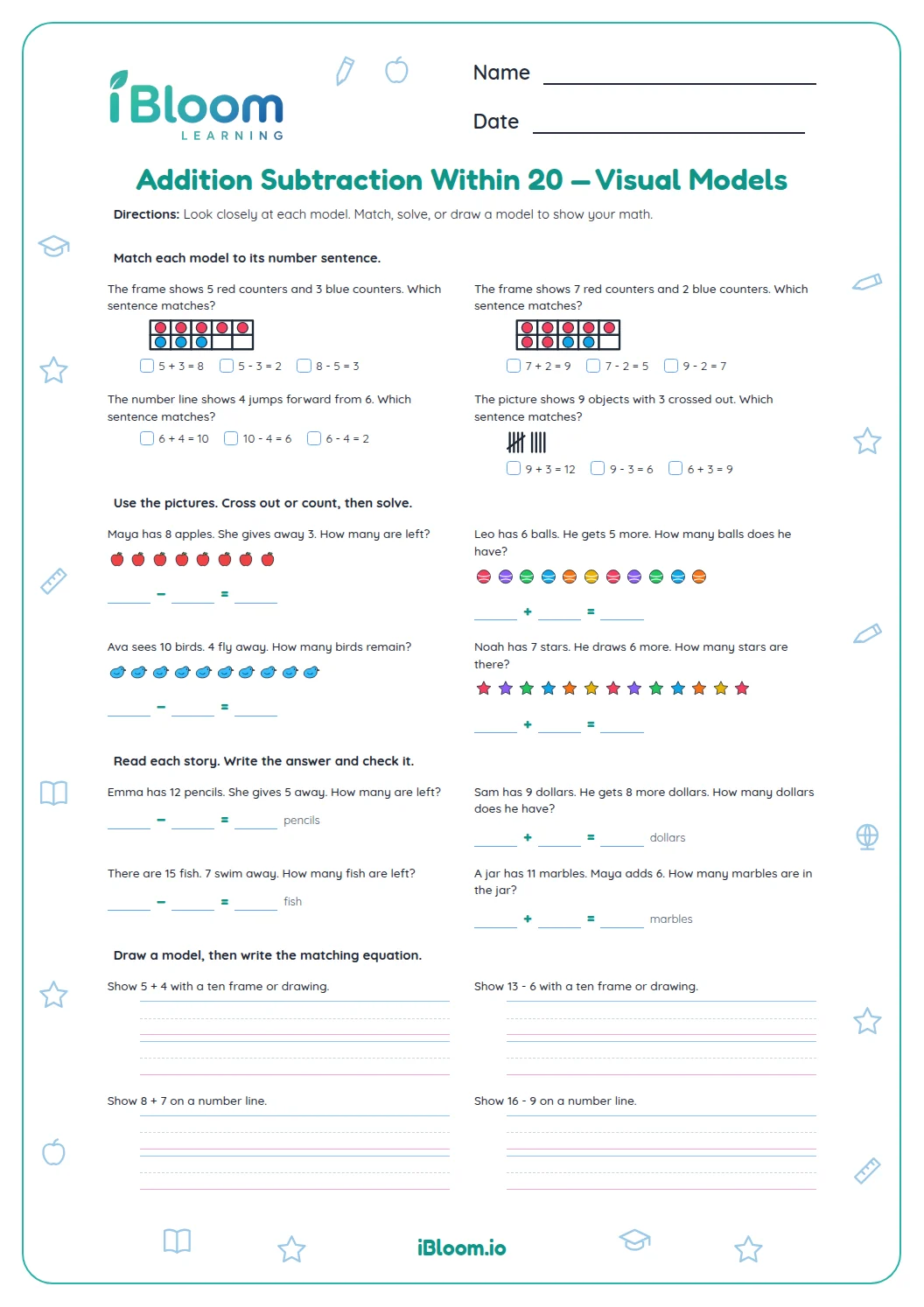
This free Grade 2 worksheet has 16 subtraction word problems grouped by one-, two-, and three-digit numbers. Students translate each story into a subtraction equation, solve, and check the answer with the separate key. The two- and three-digit items build place-value subtraction within 1,000. The practice aligns with Common Core standards 2.NBT.B.5 and 2.NBT.B.7.
Aligned to CCSS.Math.Content.2.NBT.B.5 and CCSS.Math.Content.2.NBT.B.7
How do you turn a story into subtraction?
Find the starting amount and the amount taken away. Write the starting amount first, subtract what was borrowed, used, sold, or given away, and label the result with the story’s unit.
- 1A jar held 8 marbles. Sam took 3.
- 2Equation: 8 − 3 = 5 marbles
How can place value help with larger numbers?
For two- and three-digit stories, subtract ones, tens, and hundreds carefully. When a place does not have enough, regroup from the next place and check the result with addition.
How can students check a result?
Add the number left to the amount taken away. The sum should match the starting amount in the story. Also reread the question to make sure the answer names what remains.
How to solve each story
- 1Identify the starting amount and the amount removed.
- 2Choose subtraction because the story describes a take-away change.
- 3Write the subtraction equation in the same order as the story.
- 4Subtract by place value, regrouping when needed.
- 5Label the answer and check by adding the removed amount back.
Common subtraction mistakes
The mistake
Subtracting the starting amount from the amount taken away.
The fix
Start with the larger collection described before anything is removed.
The mistake
Forgetting to regroup when a place has too few units.
The fix
Regroup one ten or hundred, then subtract each place.
The mistake
Leaving off the story unit.
The fix
Reread the question and label the answer in books, apples, or the named item.
Common Core alignment
Subtract within 100 using place value and related addition.
On this sheet: The two-digit word problems require subtraction within 100.
Show the official wordingHide the official wording
Fluently add and subtract within 100 using strategies based on place value, properties of operations, and/or the relationship between addition and subtraction.
Subtract within 1,000 by composing or decomposing place-value units.
On this sheet: The three-digit story problems call for written subtraction using place-value strategies.
Show the official wordingHide the official wording
Add and subtract within 1000, using concrete models or drawings and strategies based on place value, properties of operations, and/or the relationship between addition and subtraction; relate the strategy to a written method. Understand that in adding or subtracting three-digit numbers, one adds or subtracts hundreds and hundreds, tens and tens, ones and ones; and sometimes it is necessary to compose or decompose tens or hundreds.
What to practice next
Make more practice
Further reading
Questions parents and teachers ask
Are one-digit problems included?
Yes. Part A has four one-digit subtraction stories. Part B uses two-digit amounts, and Part C uses three-digit amounts, so the 16 questions cover each number length named in the worksheet title. The stories use familiar take-away situations.
Do students write equations?
Yes. Each prompt is a word problem with room to show the subtraction equation and solution. Students should write the starting amount minus the amount removed, then include the item named in the story with the final amount.
Does the worksheet include regrouping?
Several two- and three-digit examples require regrouping, while others allow students to subtract without it. This mix gives students practice choosing a place-value strategy that fits the numbers in each story and checking the result with addition. The key shows each result.
Is an answer key included?
Yes. The printable includes a separate answer key for all 16 stories. Students can compare both the number and unit, then check a solution by adding the amount removed back to the amount remaining in the story. This verifies the subtraction result.
How long does this worksheet take?
Plan for about 25 minutes to read and solve 16 stories, write equations, and check the work. Students can complete one number range at a time, take a brief pause, and use the answer key after finishing each group.