



About this worksheet
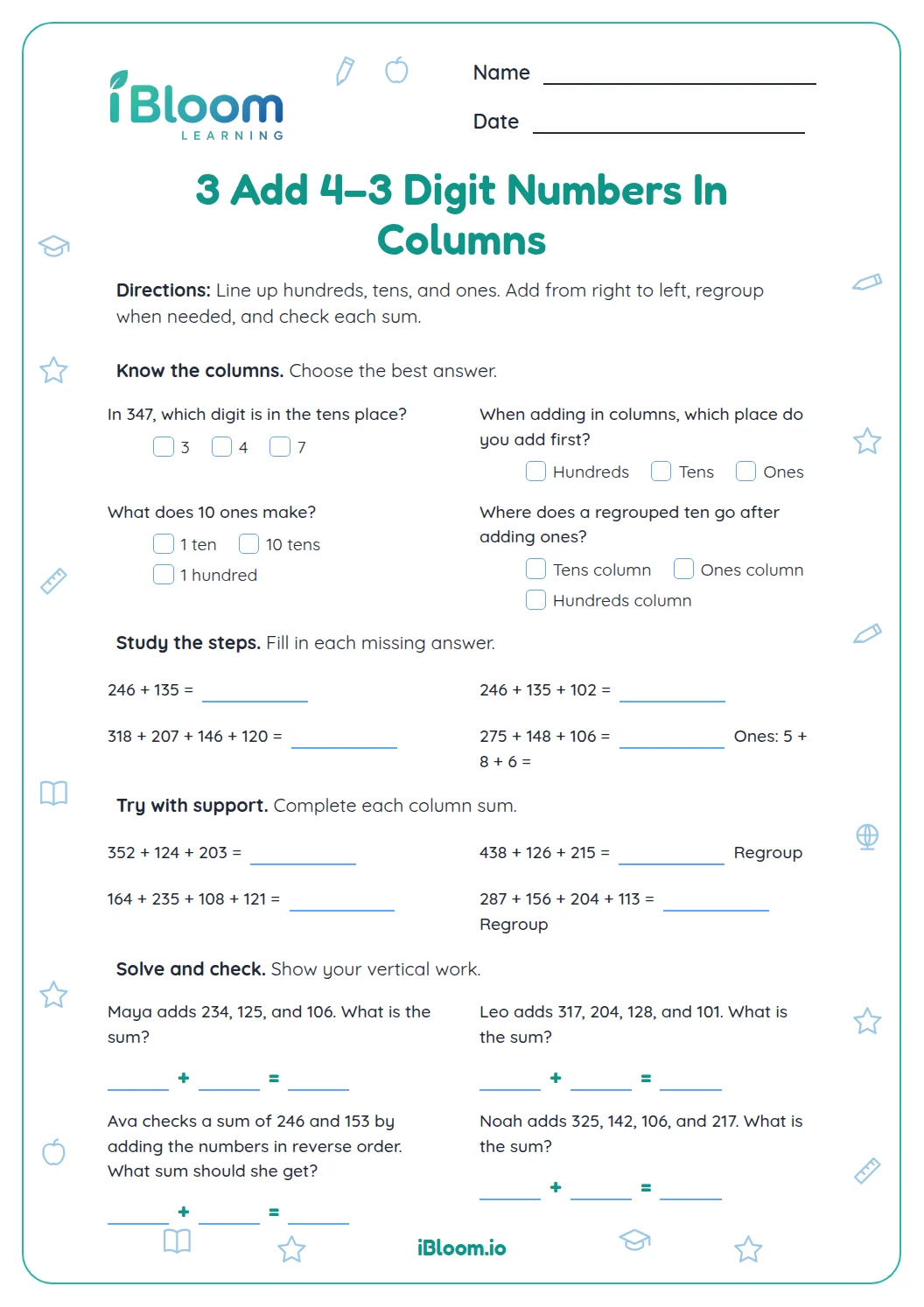
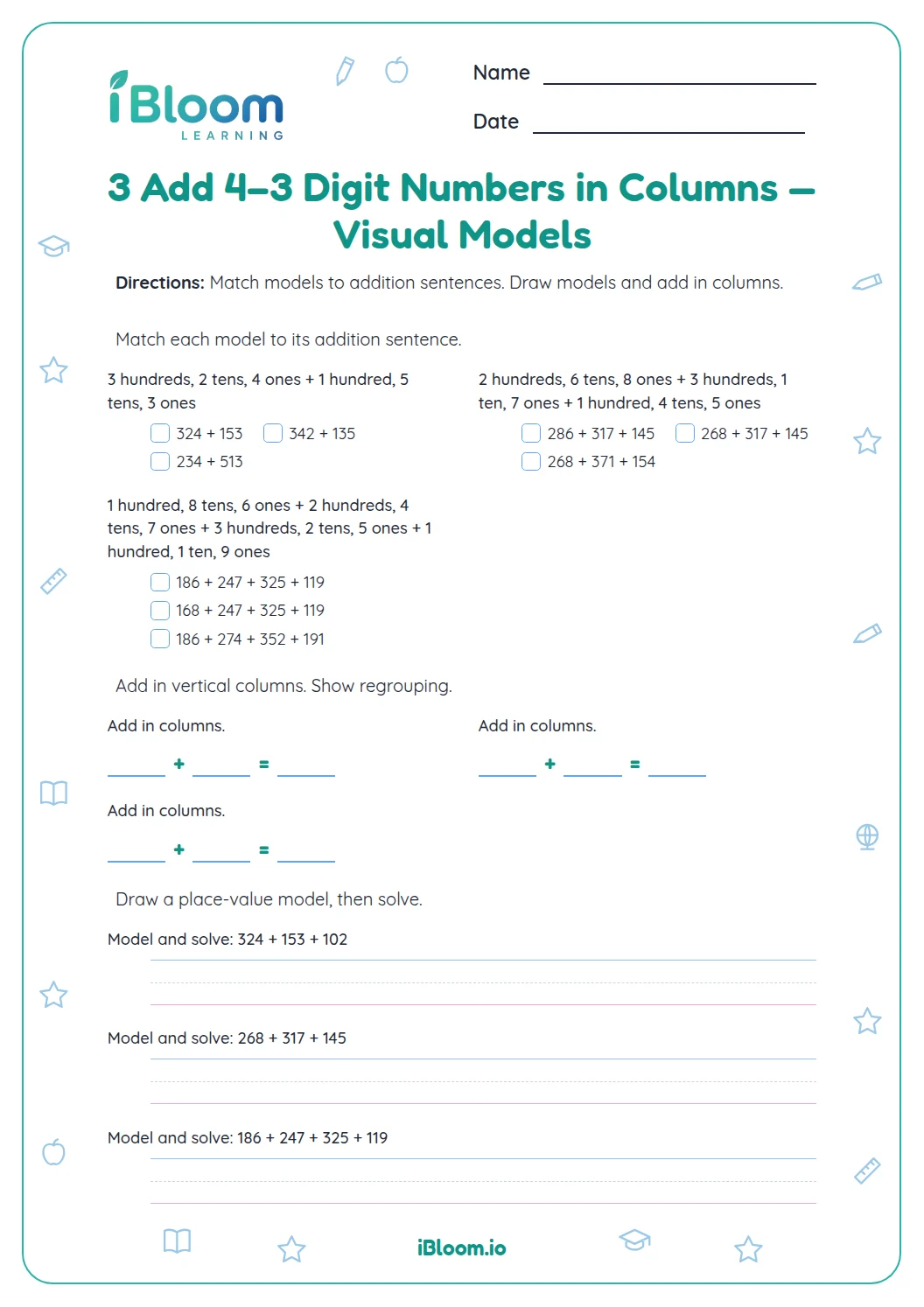
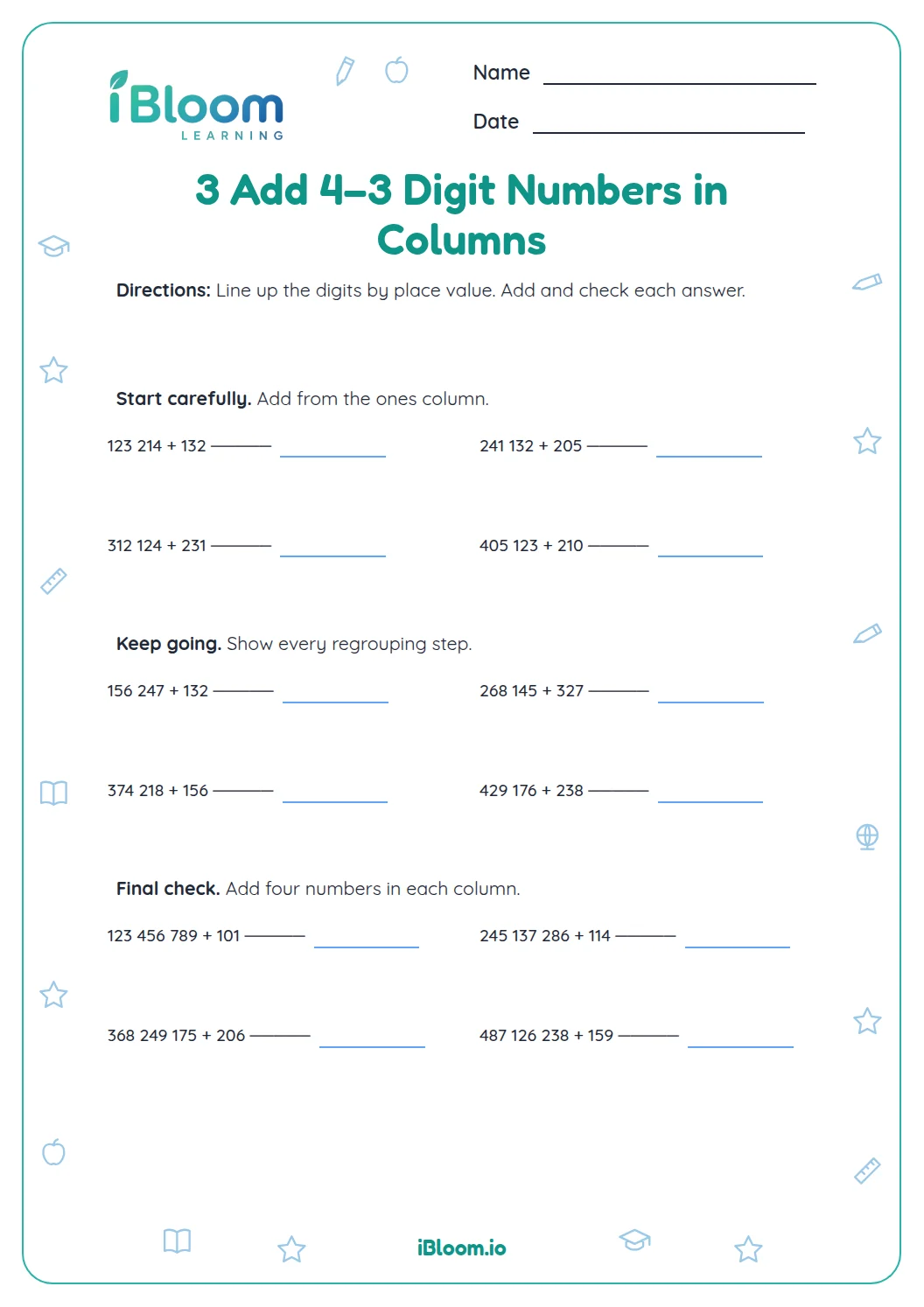
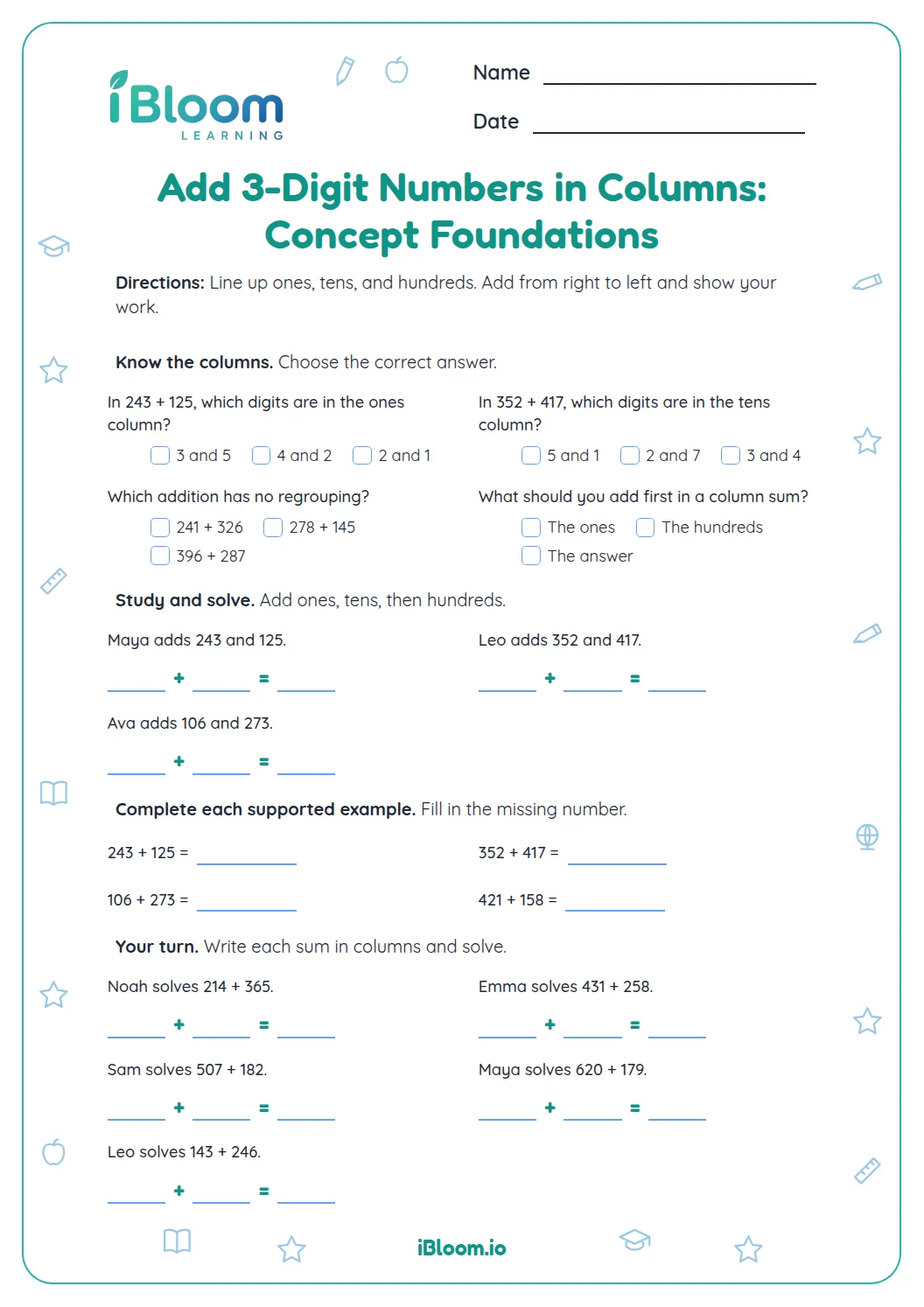
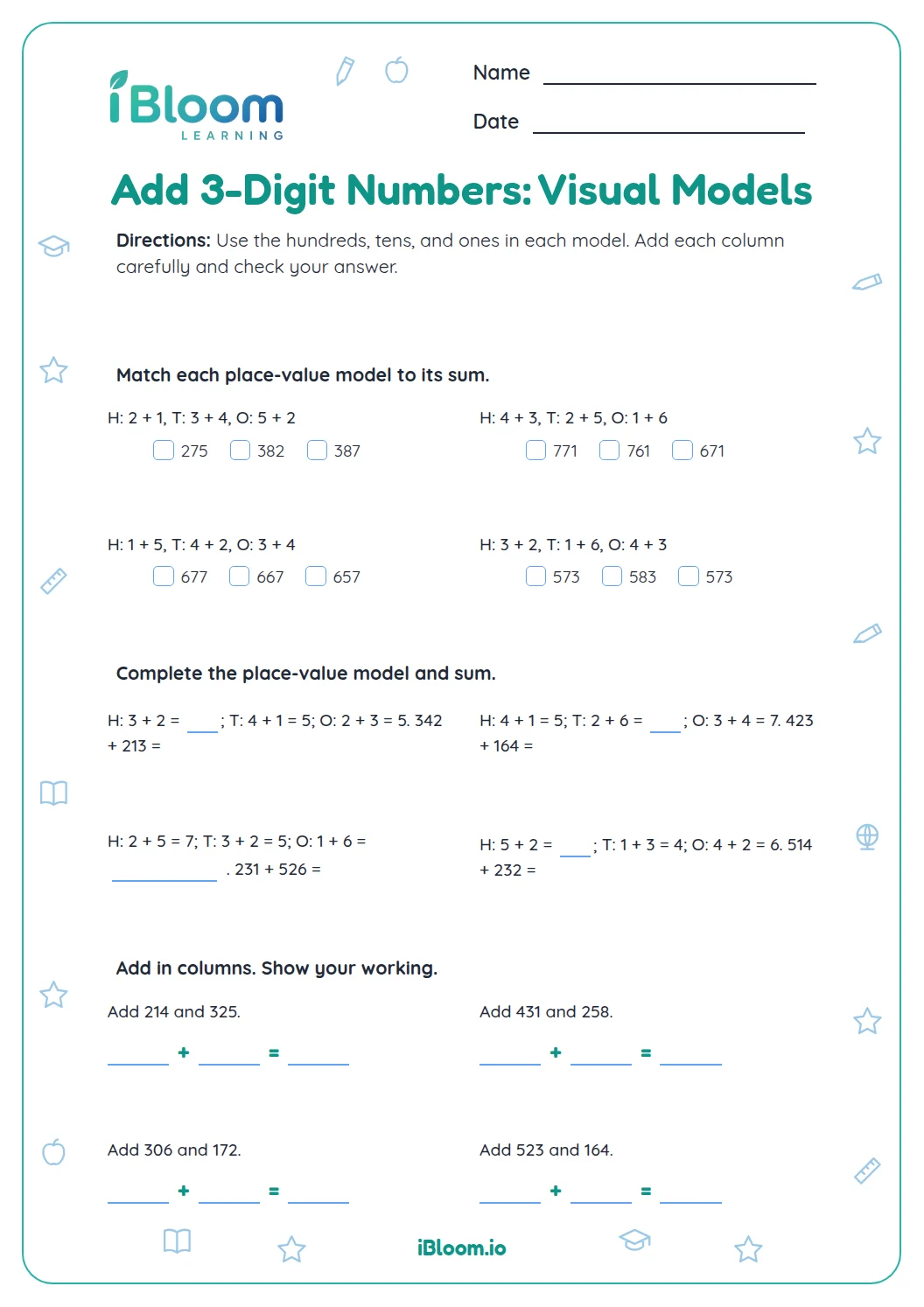
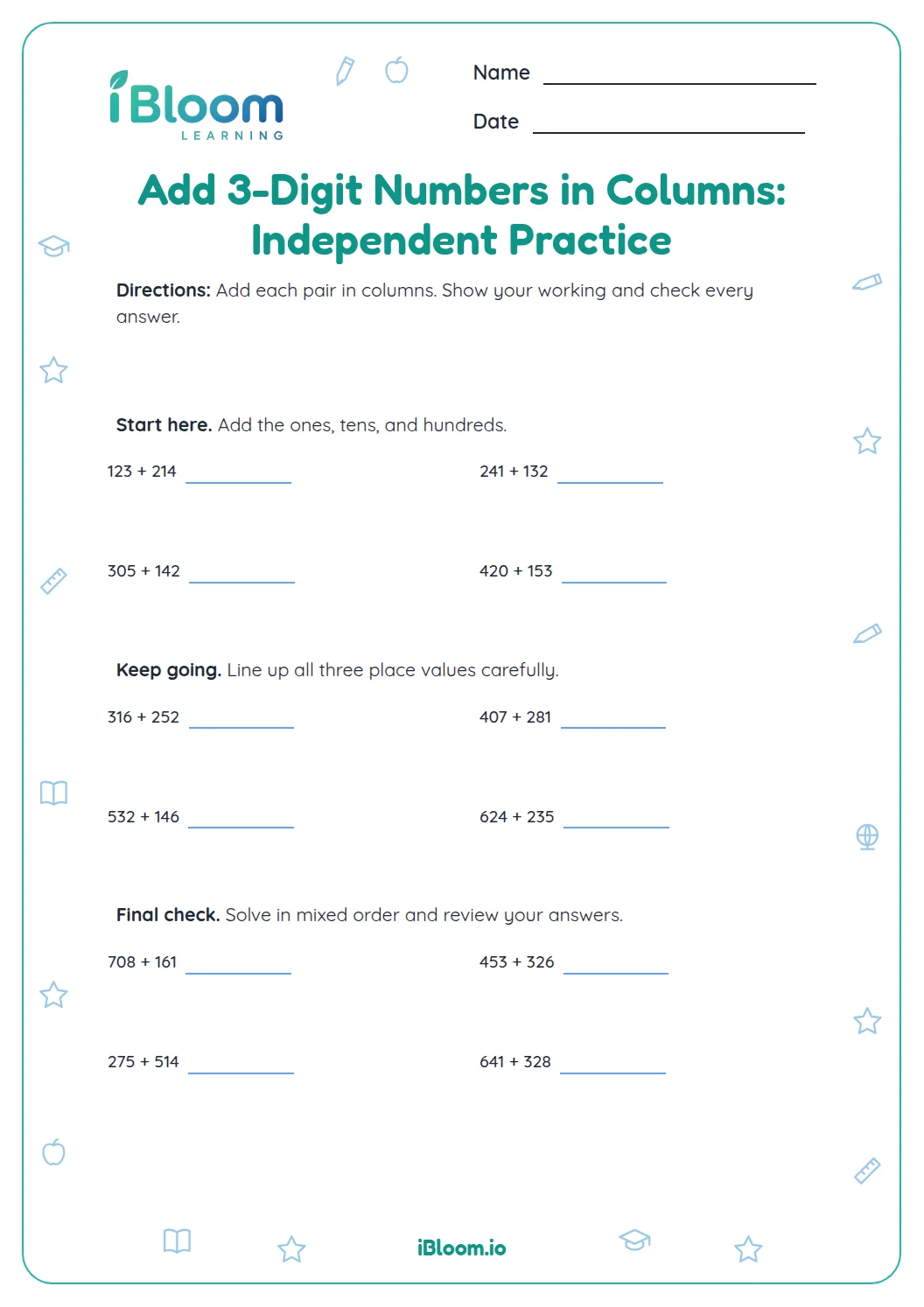
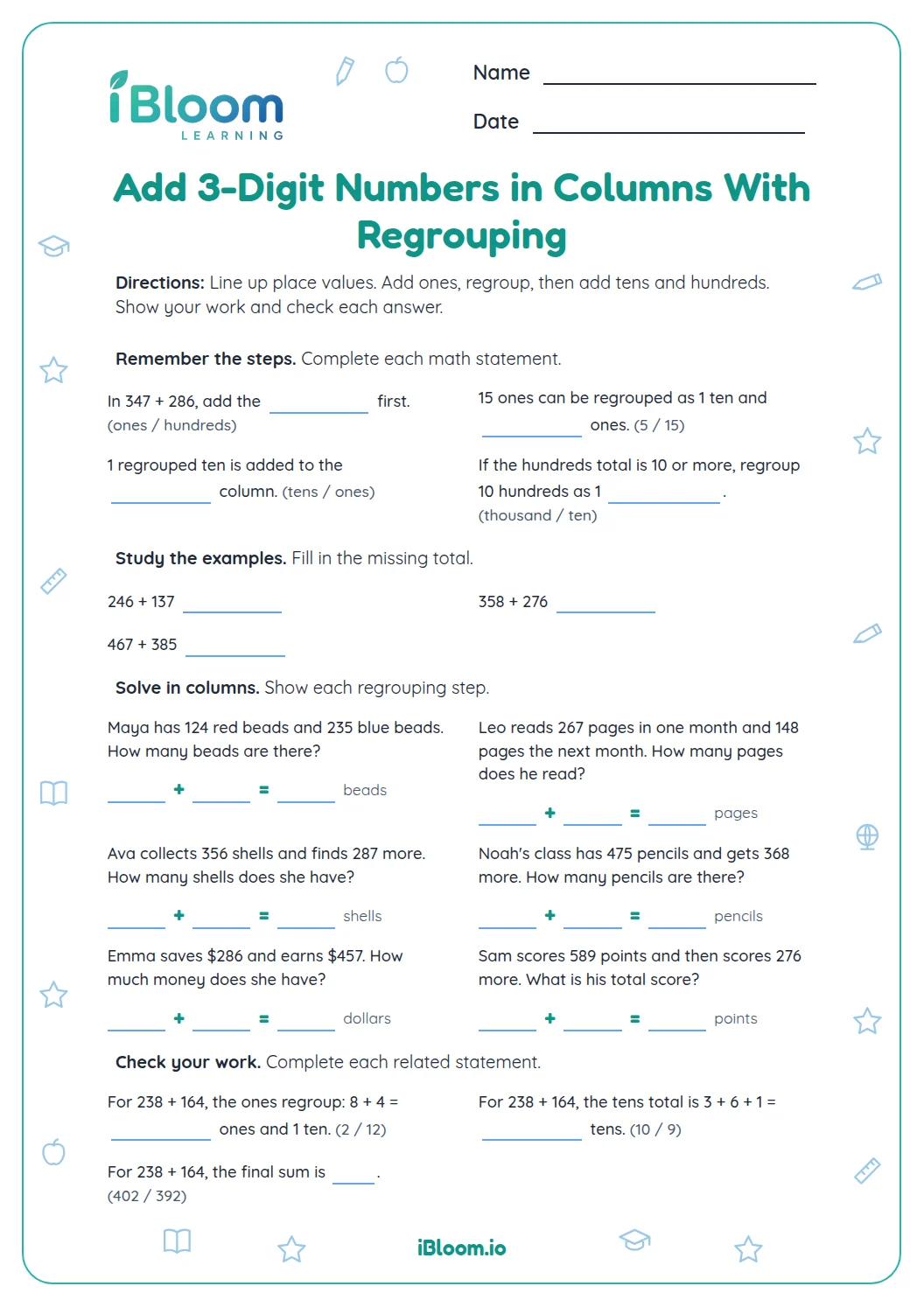
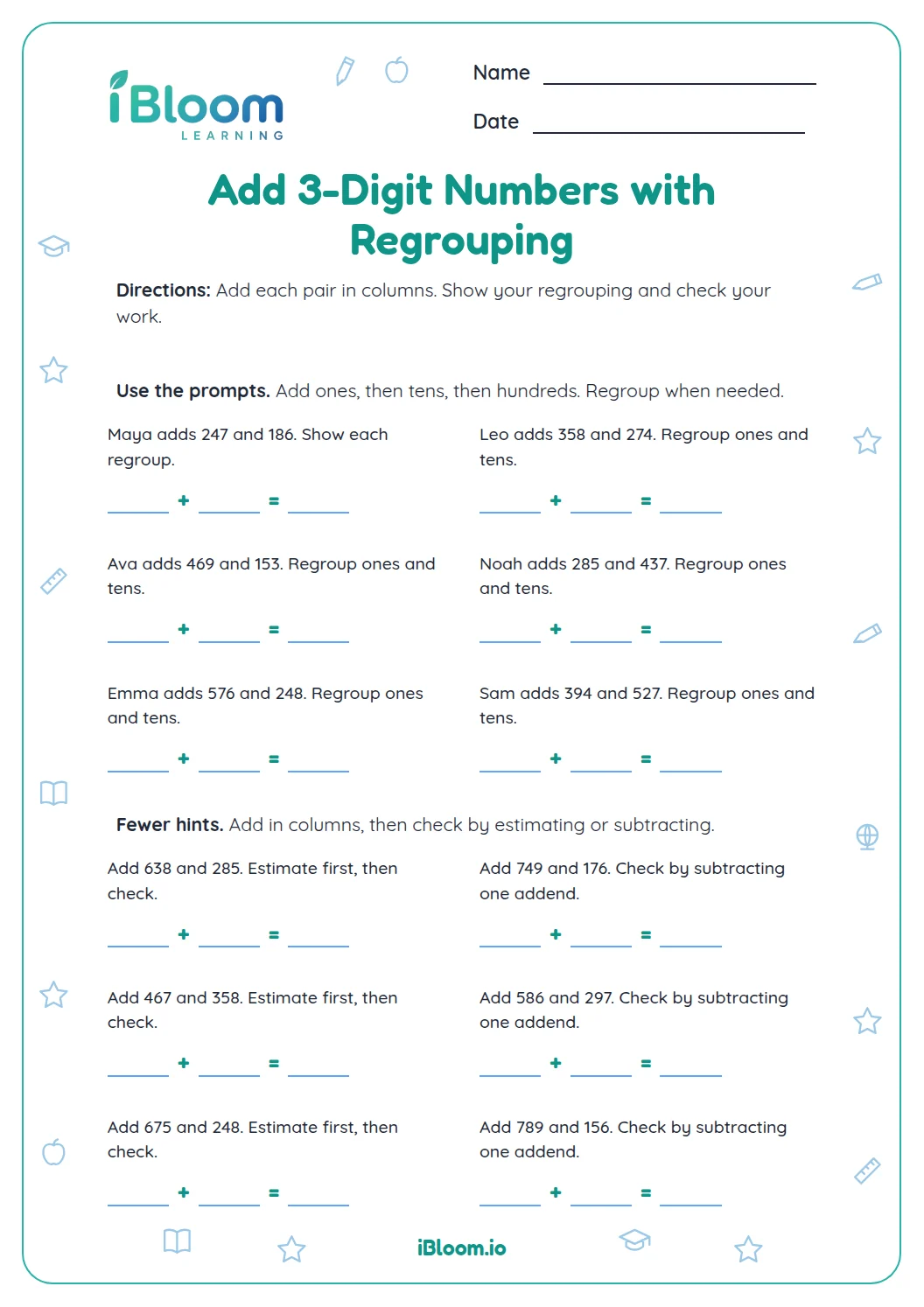
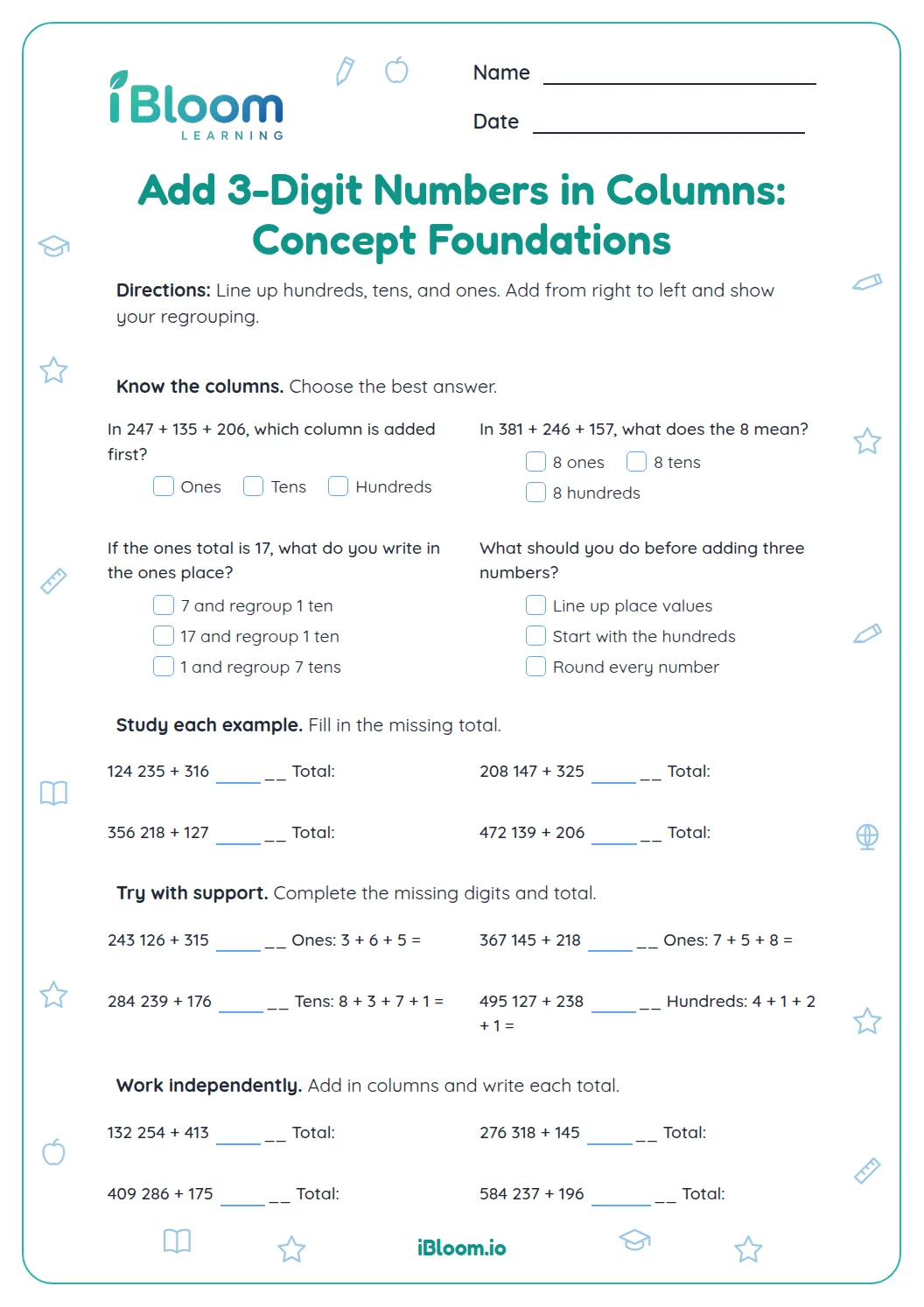
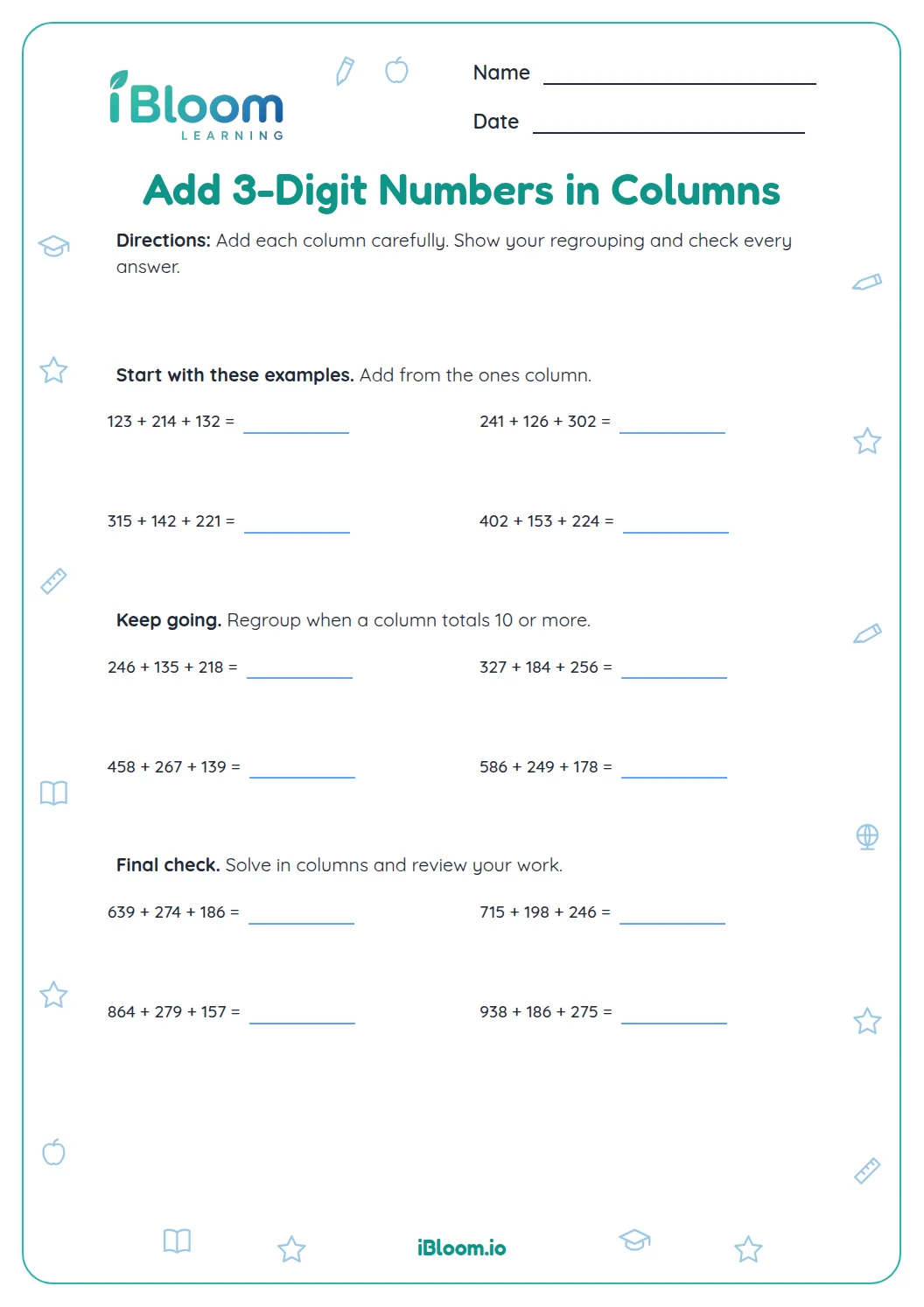
This free Grade 3 worksheet guides children through adding three or four three-digit numbers in columns. Part A checks what to carry when a ones column makes 11 or 24. Parts B and C provide twelve sums and squared working spaces for stacking the addends: six sums with three numbers and six with four. All totals stay within 1000, supporting Common Core 3.NBT.A.2. The separate answer key gives both carry choices and every sum. Align the first set together, then let children set up the remaining sums themselves.
Aligned to 3.NBT.A.2
What does a carried digit mean?
A carried digit names groups in the next place. Eleven ones become 1 ten and 1 one; 24 ones become 2 tens and 4 ones. Adding several numbers can produce a carry greater than 1.
Use the first two questions to talk about the value of the carried digit before solving the full sums.
- 1158 + 167 + 129
- 28 + 7 + 9 = 24 ones
- 3Write 4 in the ones column; carry 2 tens.
- 45 + 6 + 2 + 2 = 15 tens; write 5 and carry 1 hundred.
- 51 + 1 + 1 + 1 = 4 hundreds. Total: 454.
How should children set up the column sums?
Write each three-digit addend on its own row in the squared working space. Keep the ones in one vertical line, with tens and hundreds immediately to their left. Put a plus sign beside the last addend and a line underneath.
Part B has six sums with three addends. Part C has six sums with four addends. Leave room above the top number for carries, and include every row when adding each column.
How can children check a carried amount?
If a child gets 481 for question 4, check the ones in 146 + 127 + 218. They make 21, so 2 tens must join the tens column. Carrying only 1 ten loses 10. The correct total is 491.
Question 11 uses 158 + 167 + 129 + 236. Its ones total is 30, so write 0 ones and carry 3 tens. Ask the child to name the value of each carry before comparing the final sum with the key.
How to use this worksheet
- 1Read Part A together and say each carry as tens, not just as a digit.
- 2For question 3, help align 123, 214, and 132 in the working grid.
- 3Complete Part B, adding ones, tens, and hundreds in that order.
- 4In Part C, count four addends before starting each column.
- 5Before checking the twelve sums against the key, name the value of each carry and confirm that every addend was included.
Mistakes to notice and fix
The mistake
Writing 24 in the ones column.
The fix
Keep 4 ones in that column and record 2 tens above the tens column.
The mistake
Skipping an addend when four numbers are stacked.
The fix
Point to each row once as you add down a column.
The mistake
Carrying 1 whenever regrouping is needed.
The fix
Count the groups of ten: 30 ones contain 3 tens, so the carry is 3.
Common Core alignment
Add three or four three-digit numbers using place value and regrouping.
On this sheet: Students align place values and regroup to find sums within 1000.
Show the official wordingHide the official wording
Fluently add and subtract within 1000 using strategies and algorithms based on place value, properties of operations, and/or the relationship between addition and subtraction.
What to practice next
Make more practice
Further reading
Questions parents and teachers ask
Are the addends already stacked?
Children stack the twelve sums themselves in the squared working spaces. Ask them to put each three-digit number on its own row, keeping ones under ones and tens under tens. This setup is part of the practice, so check alignment before checking the total.
Why can a carry be 2 or 3?
A carry counts groups of ten in the column total. In question 2, 8 + 7 + 9 makes 24 ones, which contains 2 tens. In question 11, four ones digits make 30, so the child must carry 3 tens and write 0 ones.
How are the three-addend and four-addend parts different?
Part B asks children to add three numbers, and Part C asks them to add four. The place-value method stays the same. The extra row makes it especially useful to point to every digit in a column before recording the total and any carried amount.
What is wrong with 146 + 127 + 218 = 481?
The total should be 491 because the ones column contributes 2 carried tens. The ones add to 21, so write 1 and carry 2. The tens then add to 4 + 2 + 1 + 2 = 9. Carrying only 1 ten gives the incorrect total of 481.
How can I check more than the final answer?
Look at the column setup and the carried amounts as well as the total. Each addend should have its own row, with matching place values aligned. Ask the child to explain one carry aloud, such as why 30 ones in question 11 sends 3 tens to the next column.