





About this worksheet
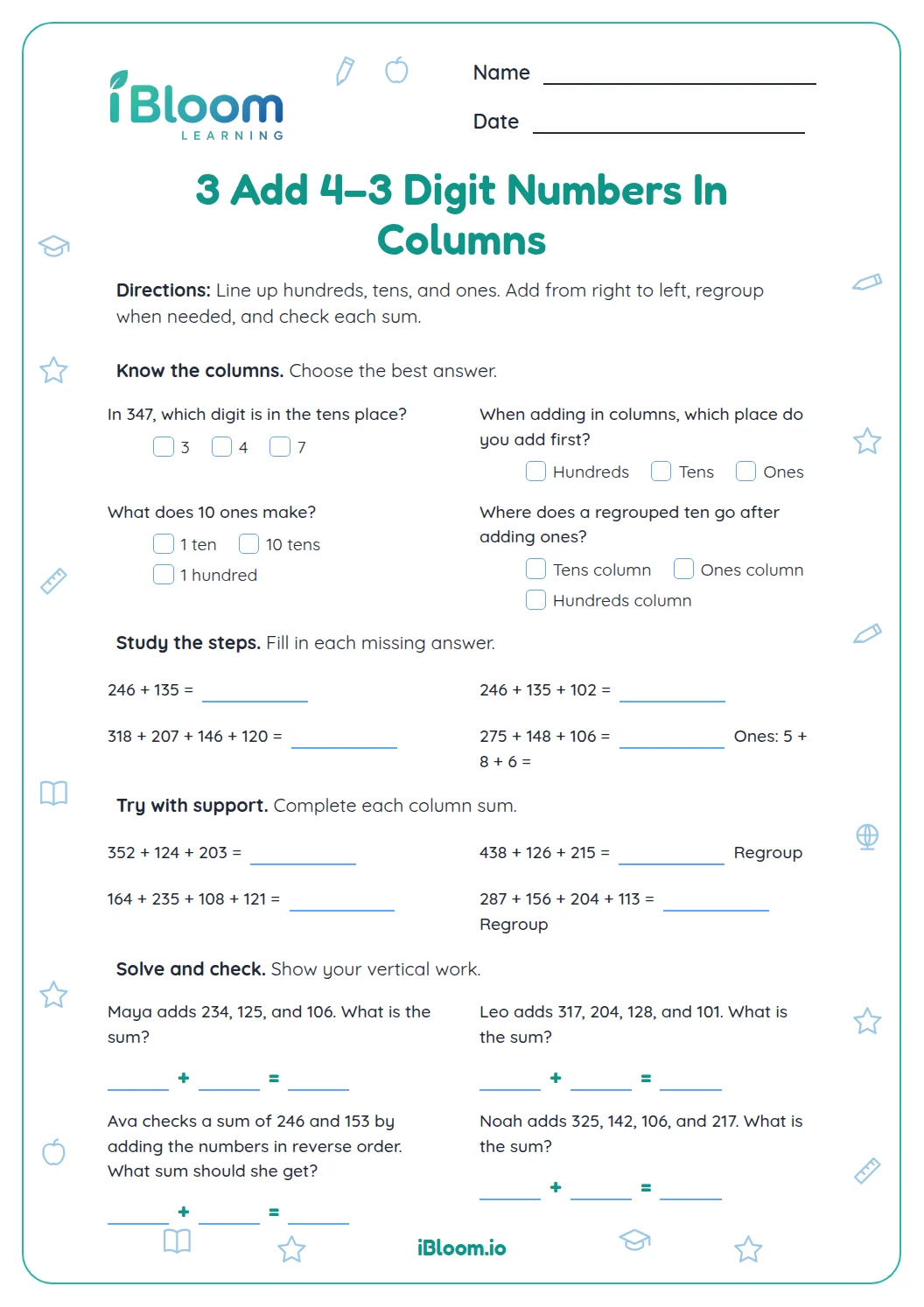
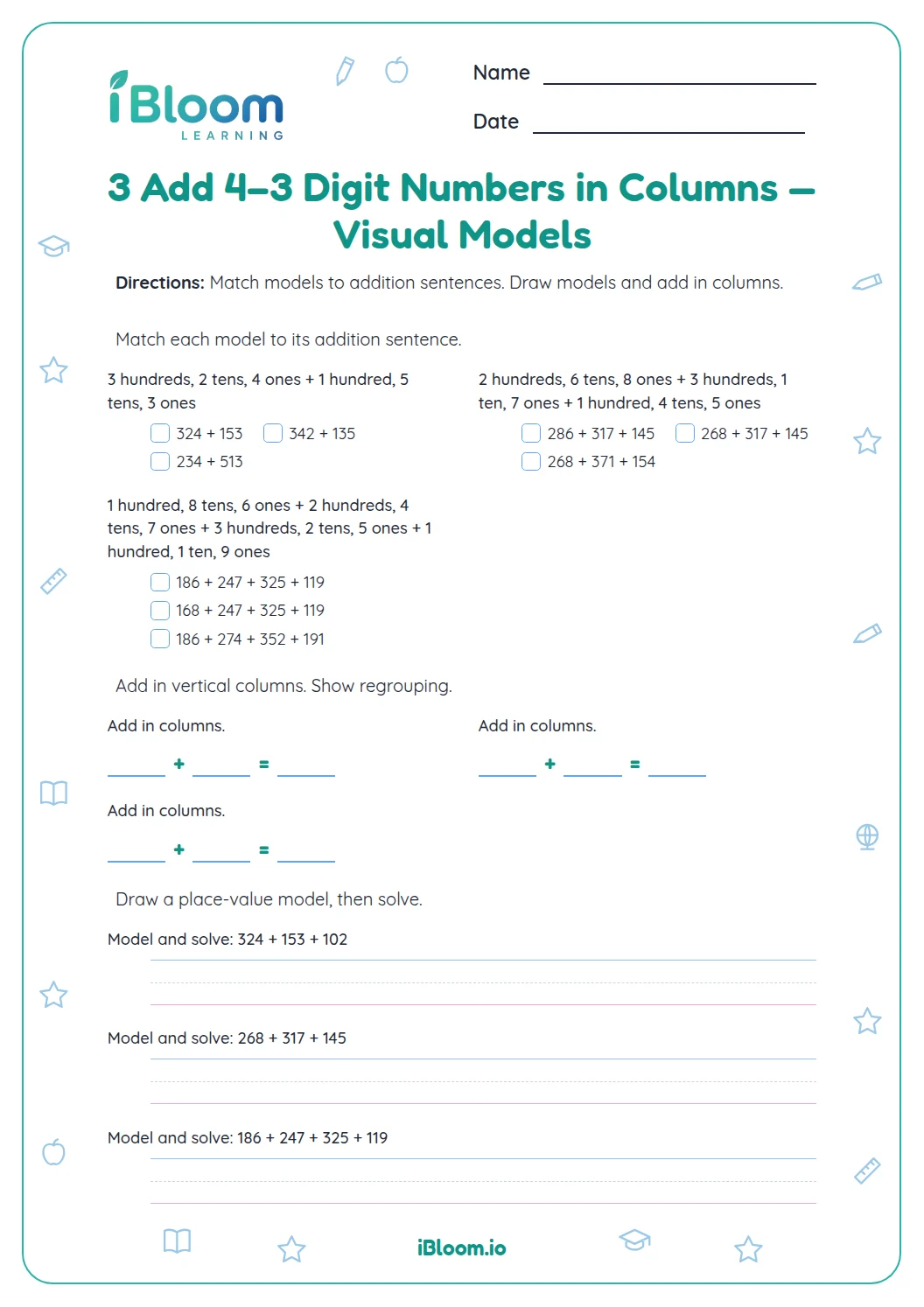
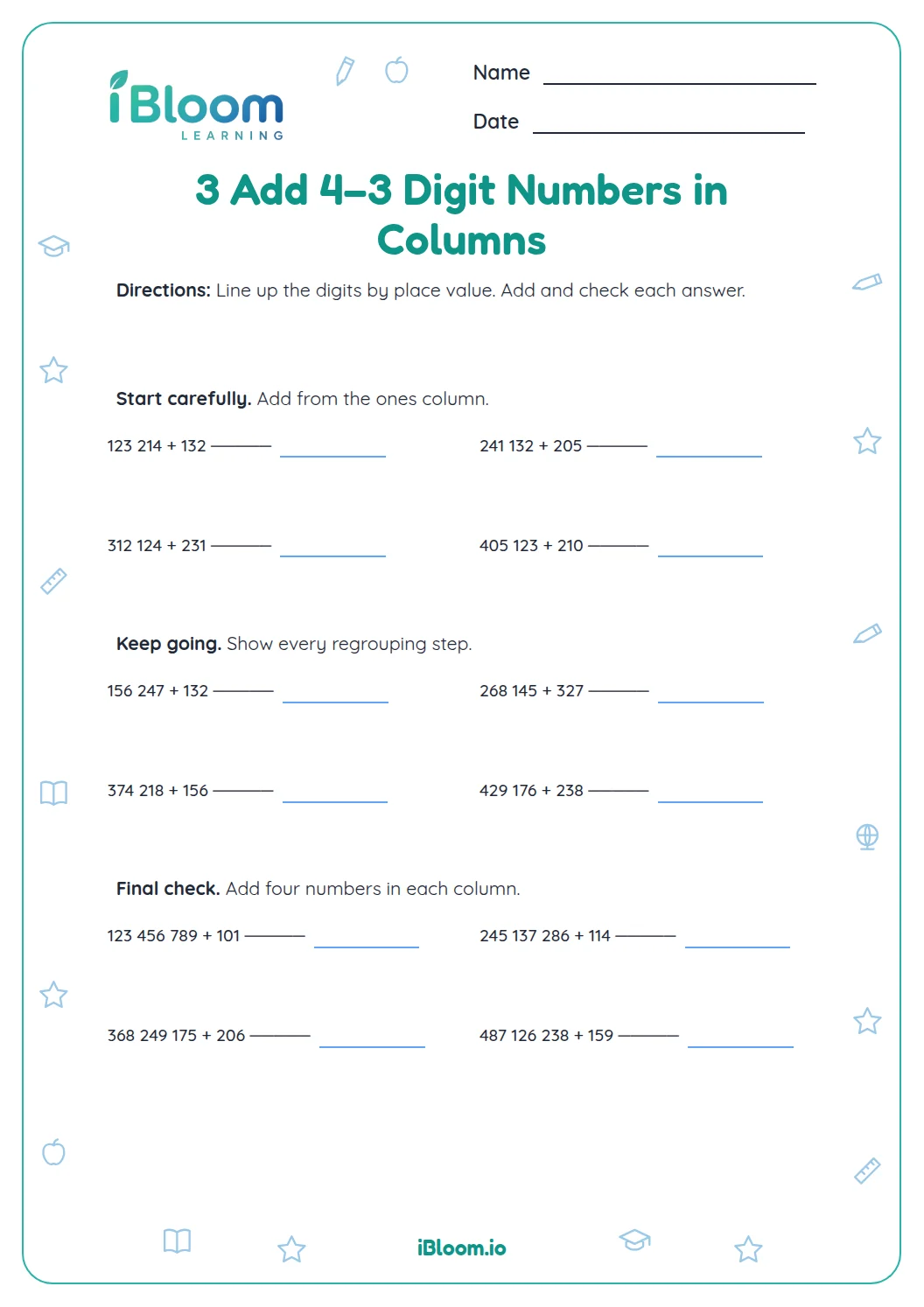
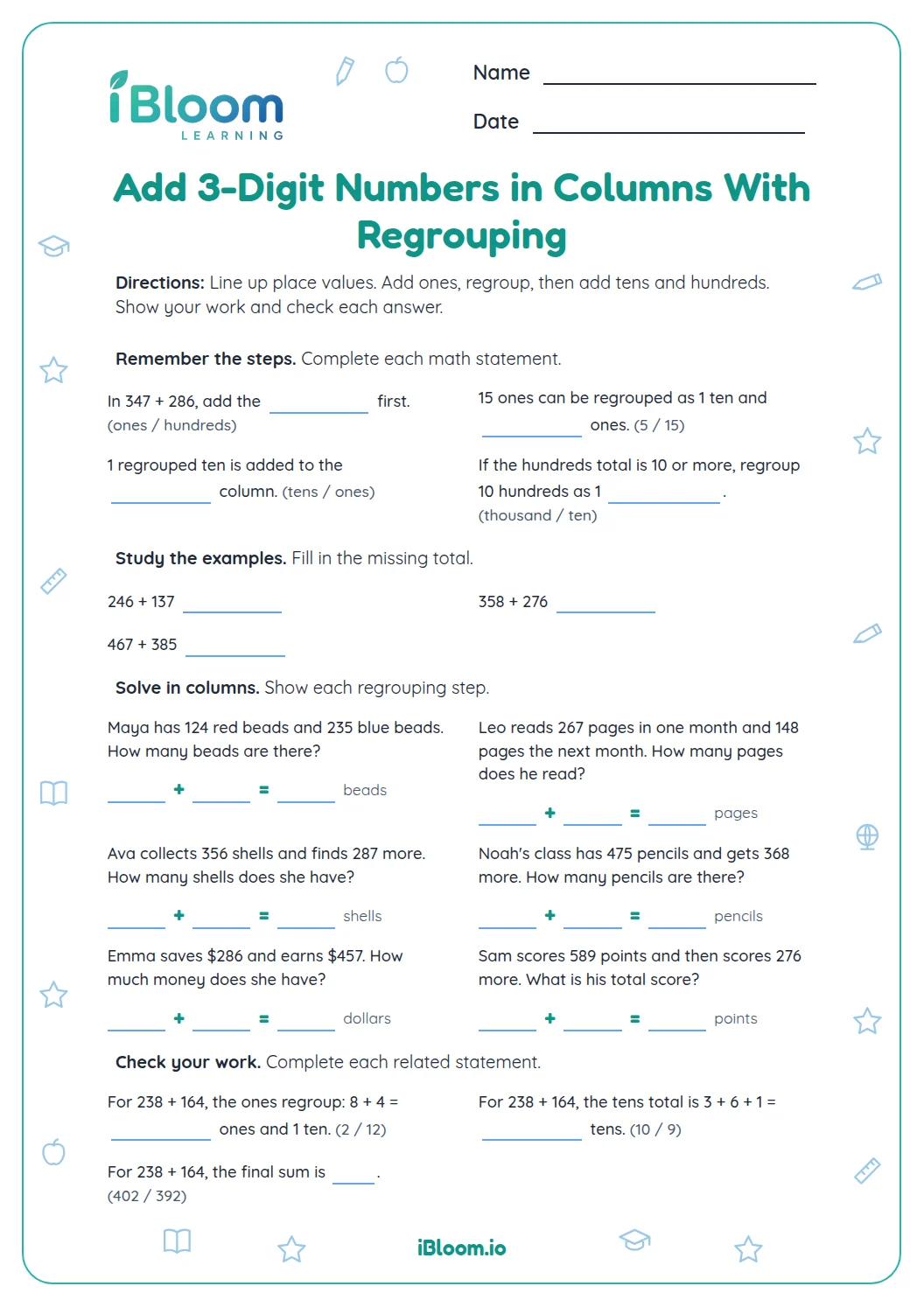
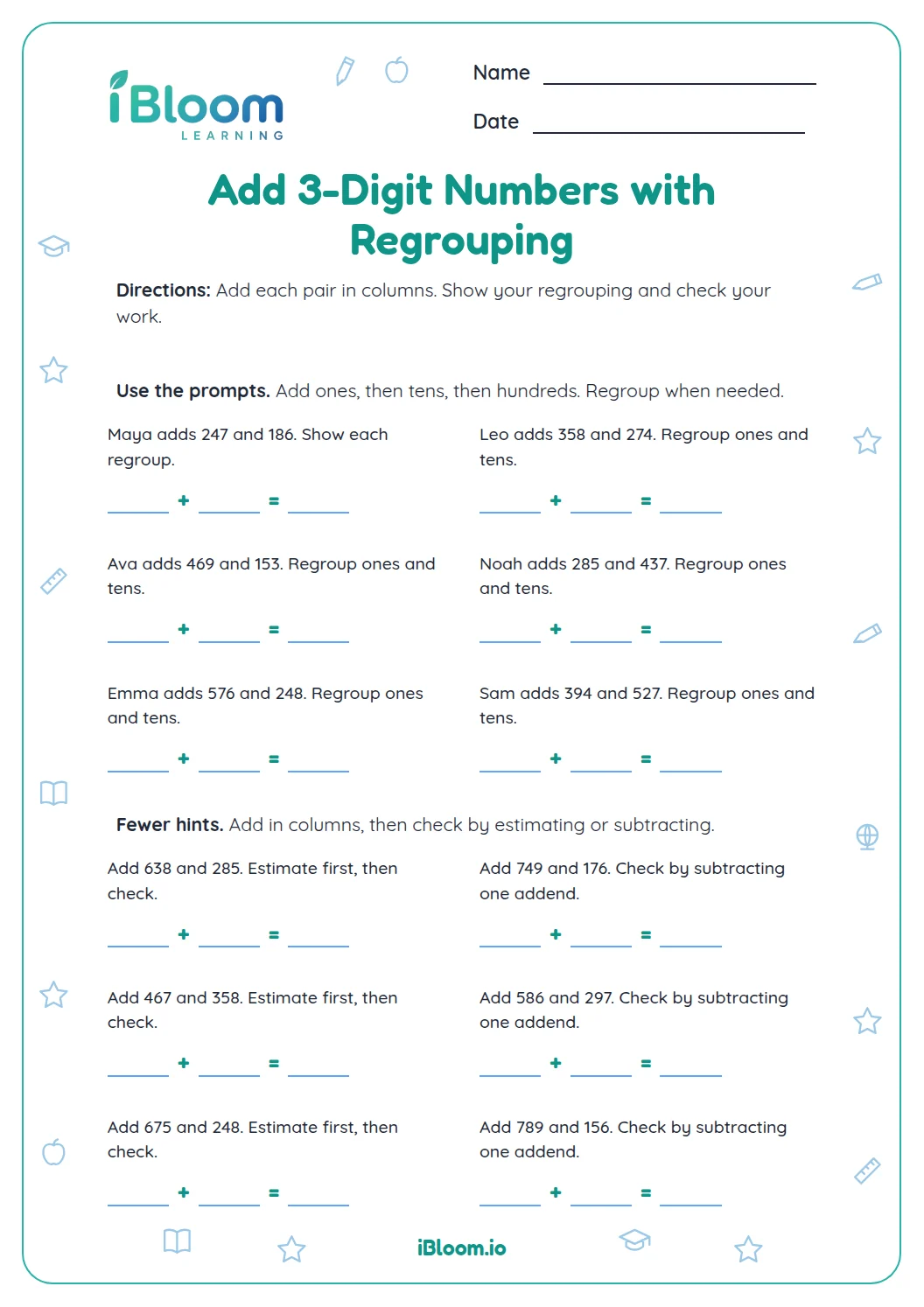
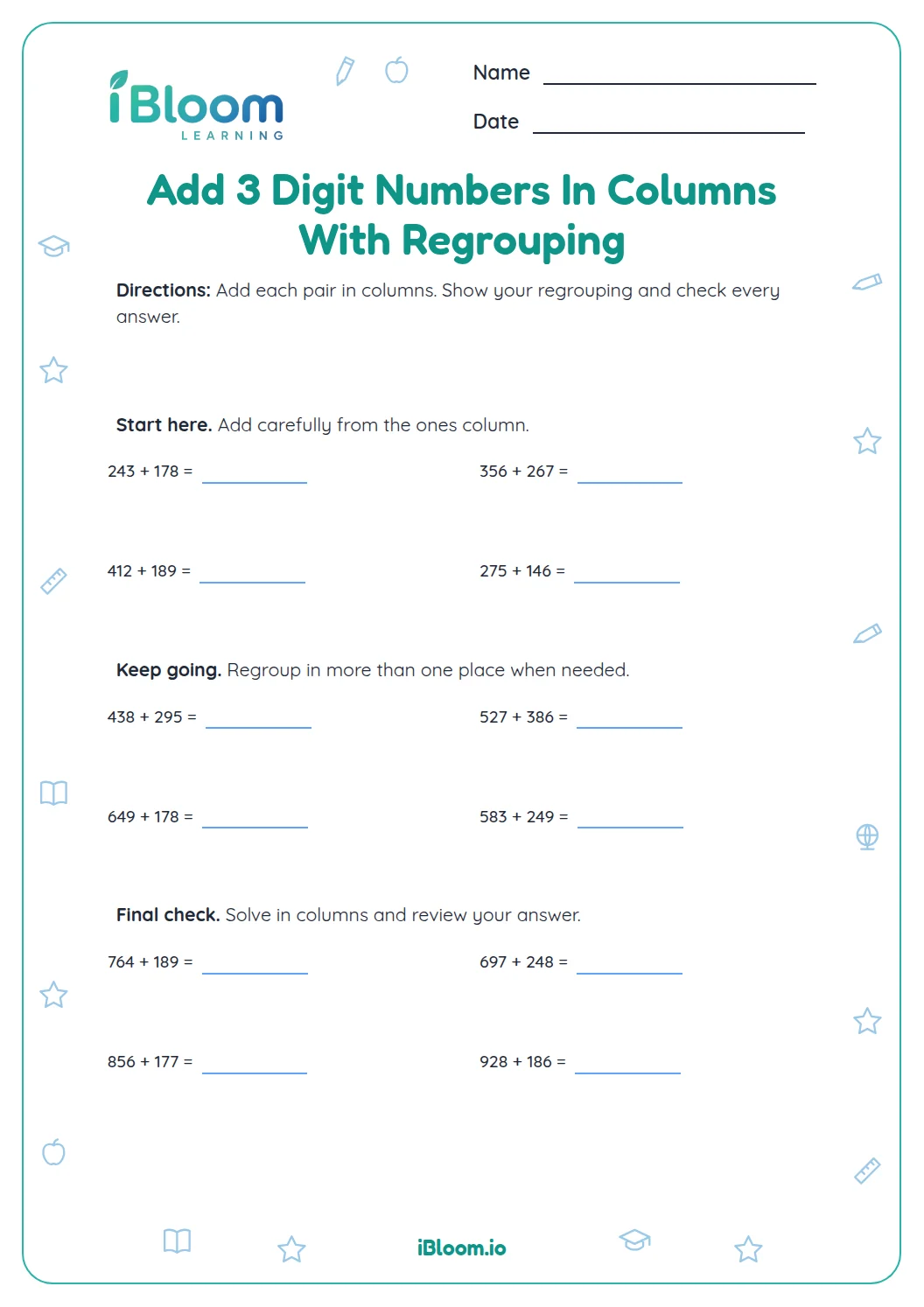
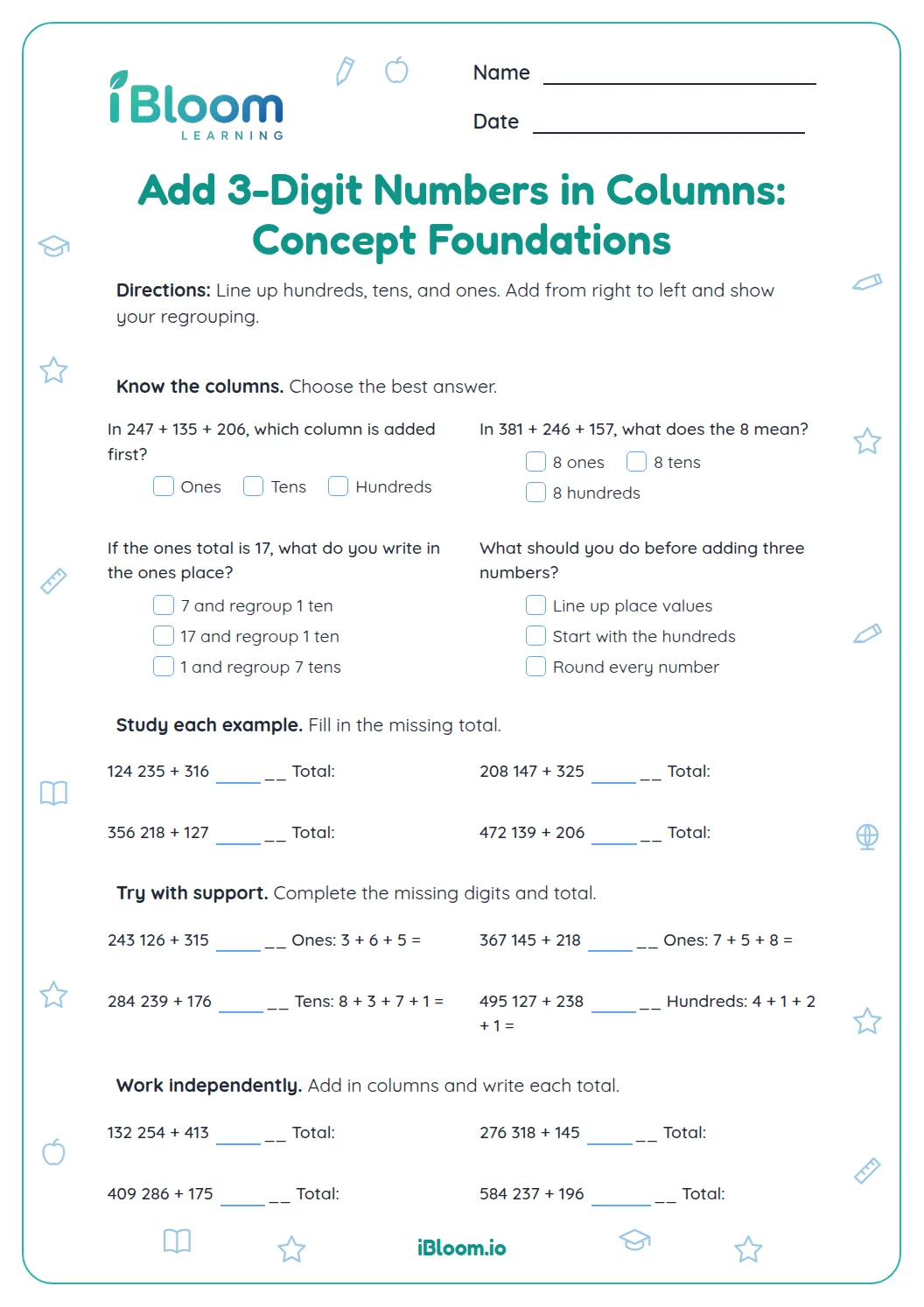
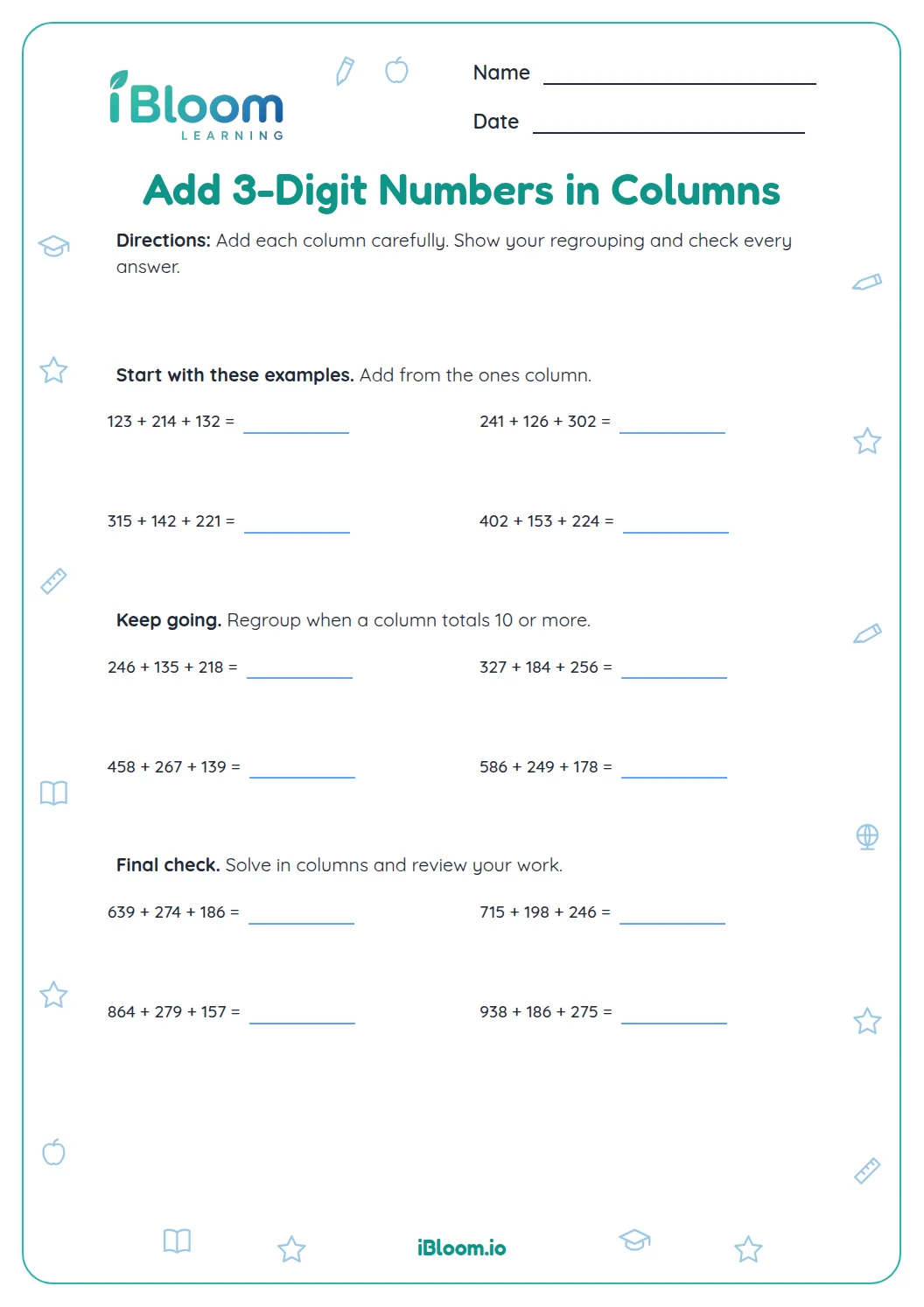
This free printable Grade 3 worksheet turns column addition into a reasoning task. Children add three or four three-digit numbers, find missing addends, choose how many tens to carry, and explain a mistake and a useful grouping strategy. The 12 questions progress through four parts, with grid space for column work and lines for the final explanations. All completed sums stay within 1,000. The practice supports Common Core 3.NBT.A.2, using place value and properties of operations to add accurately. A separate answer key gives totals and model explanations.
Aligned to 3.NBT.A.2
How does adding more rows change the work?
The places stay the same, but a column total can be larger. Keep every ones digit under the other ones digits and use a small carry above the next column. Part A gives four sums, including two with four addends.
A carry records a quantity: 24 ones becomes 2 tens and 4 ones. Saying the place name makes it easier to include the full carry in the next column.
How can a child find a missing addend?
In Part B, first add the numbers that are present. Subtract that subtotal from the target total, then put the missing addend back into the original sum. Use scratch paper to line up the addition and subtraction in columns.
- 1125 + ___ + 214 = 600
- 2125 + 214 = 339
- 3600 − 339 = 261
- 4Check: 125 + 261 + 214 = 600.
What makes this a reasoning challenge?
Part C asks children to inspect only the ones column and choose the number of tens to carry: two tens in question 9 and three in question 10. Part D asks children to explain a lost ten and use two convenient pairs to check a four-addend sum.
For the final question, pairing 125 with 175 makes 300, while 238 with 162 makes 400. The two pairs give a clear check on the column total of 700.
How to use this worksheet
- 1Label the grid columns H, T, and O before arranging the first set of addends.
- 2Work through the four Part A sums, recording each carry above its new place.
- 3For Part B, use scratch paper to add the known addends in columns, subtract from the total, and check by addition.
- 4For Part C, total just the ones digits and name the tens they make.
- 5Read the Part D explanations against the key, accepting different wording that gives the same reasoning.
Mistakes to check together
The mistake
Carrying only 1 when the ones total is 24.
The fix
Separate 24 into 2 tens and 4 ones; carry the 2.
The mistake
Subtracting just one known addend from the target total.
The fix
Add all the known addends first, then subtract their subtotal.
The mistake
Writing 691 for 156 + 227 + 318.
The fix
The ones total is 21, so the tens column must include both carried tens; the total is 701.
Common Core alignment
Add three or four three-digit numbers using place value and regrouping.
On this sheet: Students align addends, regroup, recover missing addends, and explain sums within 1,000.
Show the official wordingHide the official wording
Fluently add and subtract within 1000 using strategies and algorithms based on place value, properties of operations, and/or the relationship between addition and subtraction.
What to practice next
Make more practice
Further reading
Questions parents and teachers ask
How many addends are in each sum?
Each sum has three or four three-digit addends. Part A includes both sizes, and Part B leaves one addend missing from each sum. Encourage your child to count the rows before calculating so that no addend disappears while the numbers are copied into columns.
Why can the carry be 2?
The carry is 2 when a column makes two groups of ten. In question 9, the ones digits are 8, 7, and 9, which total 24. Children keep 4 in the ones place and add 2 tens to the tens column.
Should children use columns for the missing-addend questions?
Yes, use scratch paper to arrange the known addends and subtract their subtotal from the target; write the missing number in its answer box. For question 5, the known addends total 339, so 600 minus 339 gives 261. Check by adding all three numbers.
What should the final written answers include?
Each final response should include an accurate result and a reason. Question 11 needs the corrected total of 701 and an explanation of the lost ten. Question 12 needs the total of 700 and a pairing strategy, such as making 300 and 400 before combining them.
How should I use the answer key?
Use the key after your child has checked each sum once. Compare the totals first, then ask your child to point to the carries or missing-addend calculation. For the written responses, accept another clear explanation when it agrees with the arithmetic and answers the question.