






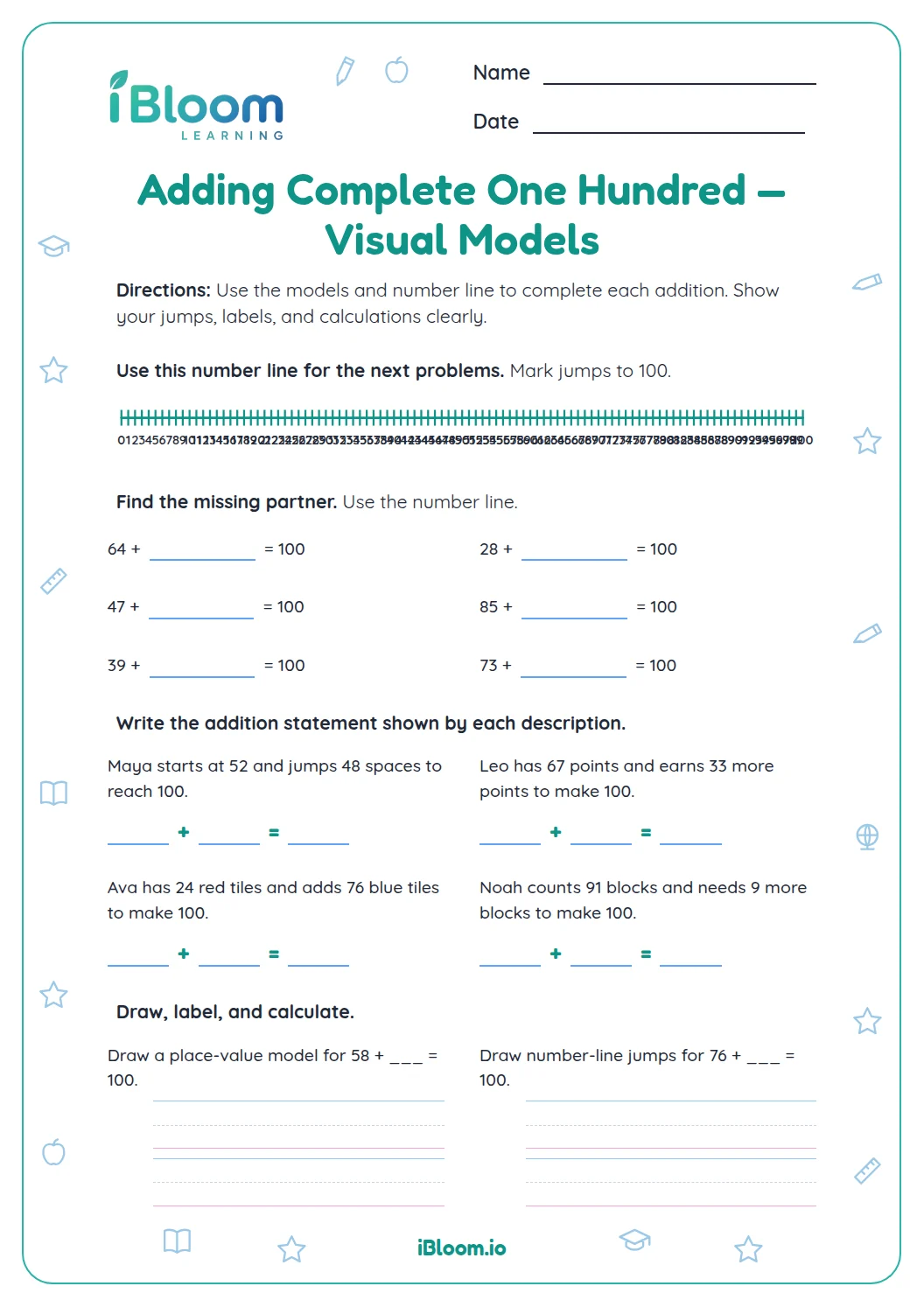
About this worksheet
This Grade 3 worksheet builds missing-addend reasoning with whole hundreds. Children read total models, choose equations that match a total, and solve short stories by finding the unknown group. The printable has 14 questions in three parts and a separate answer key. The equations use place-value strategies to add and subtract whole hundreds within 1,000.
Aligned to 3.NBT.A.2
How does a number line show a missing addend?
A number line can show a start and total in hundreds. In q1, count four 100-jumps from 300 to 700, so the missing addend is 400. The line helps connect the distance between the two amounts with the unknown addend.
- 1Start at 300; total 700
- 2Count four jumps of 100
- 3Missing addend: 400
What kinds of practice are on the page?
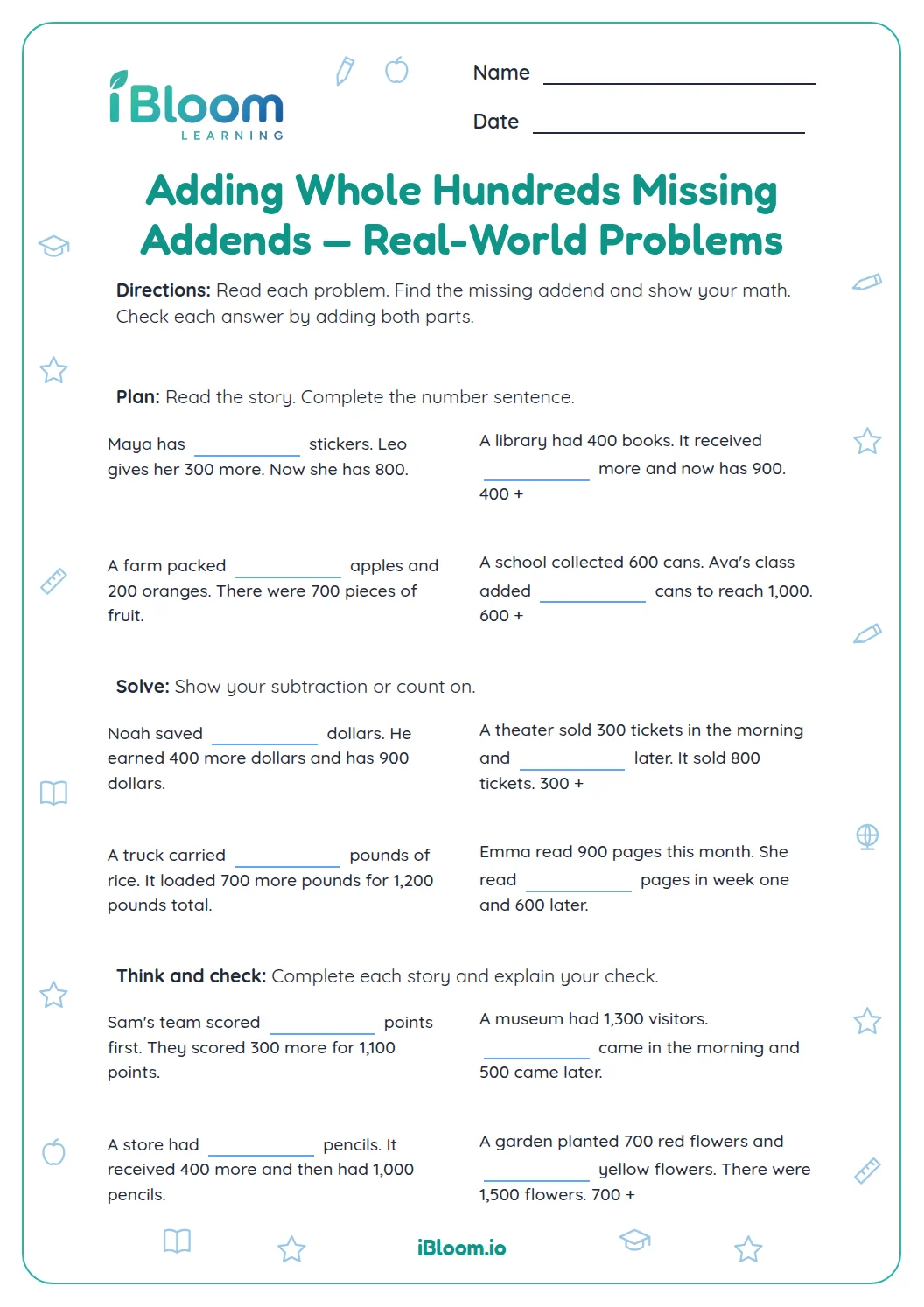
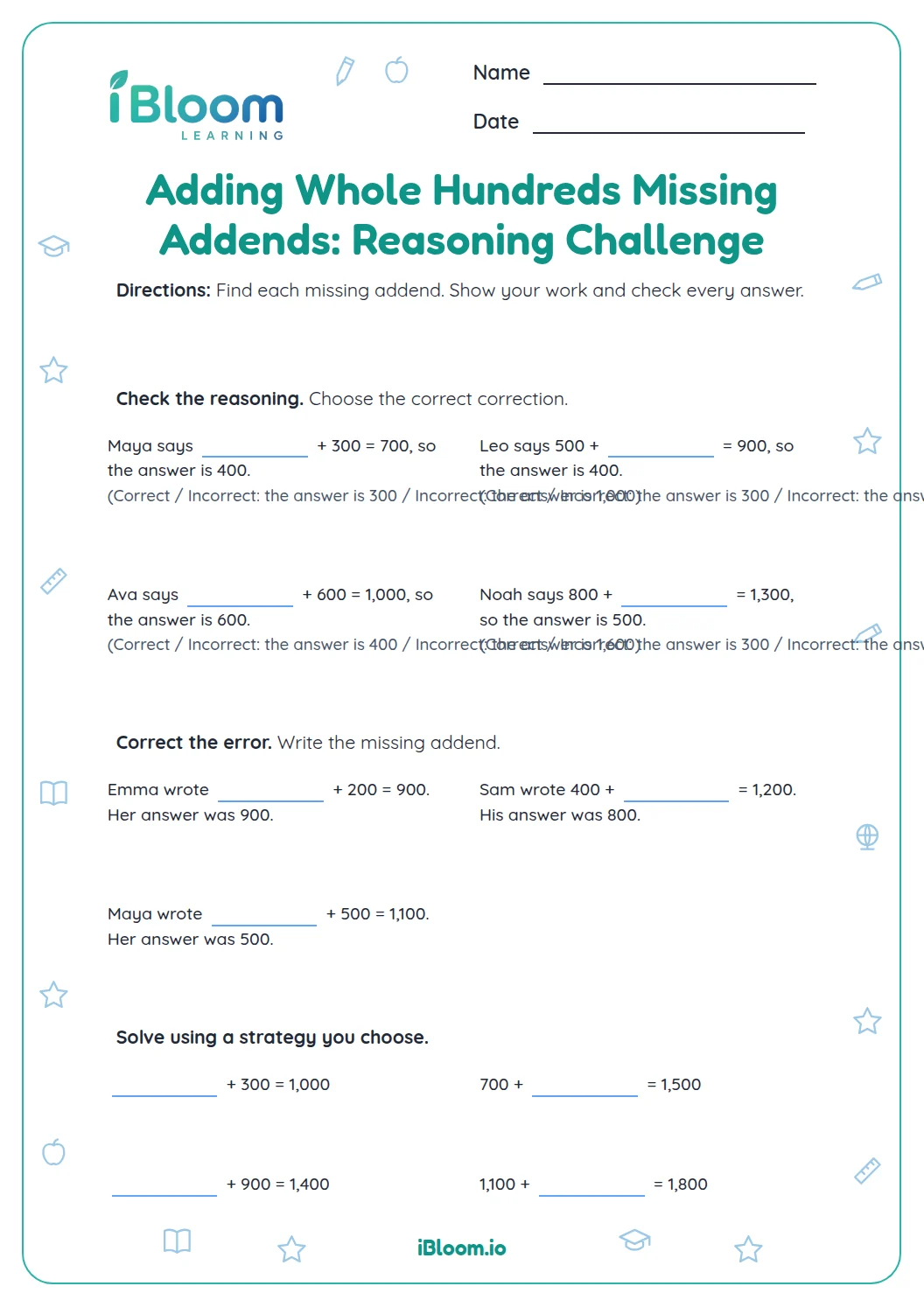
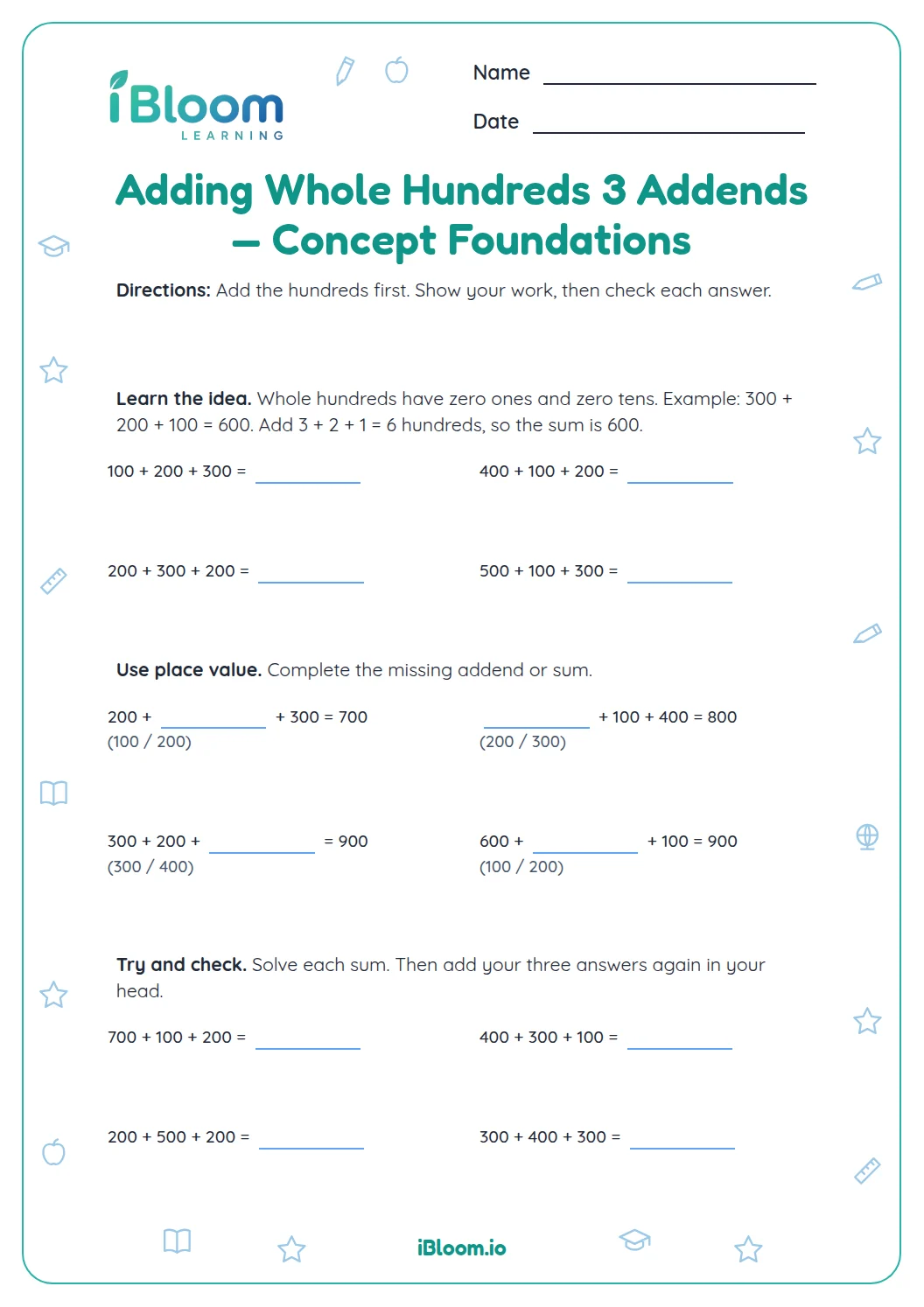
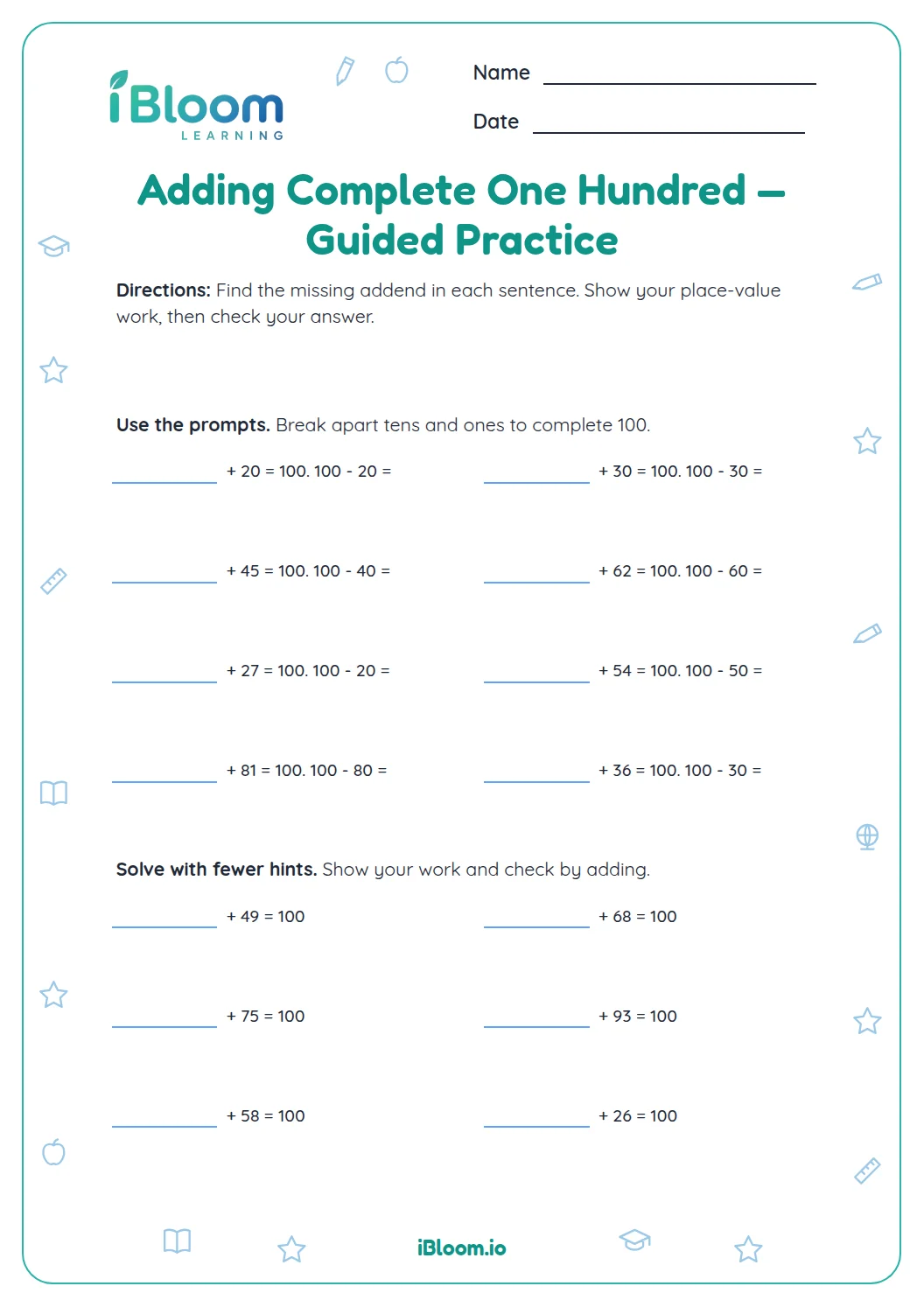
Part A reads whole-hundreds number lines. Part B completes missing-addend equations. Part C uses short stories and equations to find an unknown part.
Why use addition to solve a missing part?
In a story, identify the total and the known group. Subtract the known group from the total, then add the two parts to check the result.
How to use this worksheet
- 1Read the total and the known addend in the equation.
- 2On a number line, count each 100-jump from the start to the total.
- 3Subtract the known addend from the total to find the missing part.
- 4In a story, identify the total and the known group before solving.
- 5Add the two parts to check that they make the total.
Common mistakes and quick fixes
The mistake
Subtracting the total from the known addend.
The fix
Start with the total, then take away the known group.
The mistake
Writing the total as the missing addend.
The fix
Check that both addends together equal the total.
The mistake
Counting a number-line tick as a jump.
The fix
Count the spaces between the start and total; each space is one 100-jump.
Common Core alignment
This worksheet practices the following Common Core math skills.
Add and subtract whole hundreds within 1,000 using place-value reasoning.
On this sheet: Each item adds or subtracts whole hundreds within 1,000 to find an unknown addend.
Show the official wordingHide the official wording
Fluently add and subtract within 1000 using strategies and algorithms based on place value, properties of operations, and/or the relationship between addition and subtraction.
What to practice next
Make more practice
Further reading
Questions parents and teachers ask
What does a missing addend mean?
A missing addend is the unknown part in an addition equation. In question 3, ___ + 300 = 700, so the missing number is 400. Add 400 and 300 to check that the total is 700. The same total-and-part relationship appears in the number-line models and short stories.
How does a number line show missing hundreds?
A number line can show the known amount and the total. Count equal jumps between them to find the missing addend. In question 1, four jumps of 100 take the line from 300 to 700, so the missing amount is 400. Adding 300 and 400 checks the total.
Why should children add the missing number back?
Add the missing part to the known addend to check. If the sum matches the total, the number fits the equation. For the first item, 400 + 300 = 700. In a story, the check also confirms that the answer names the group asked for, such as books before the new shipment.
How can I check a missing addend?
Add the number you found to the known addend. If the sum matches the stated total, the equation is correct. For a story, reread it and make sure the answer describes the group asked for, such as books before or points from another round.
Does this worksheet include an answer key?
Yes. A separate key gives the missing addends in the equations and short stories. Story answers include the requested unit where one is part of the question, so an adult can check the amount as well as the relationship between both parts and the total.