






About this worksheet
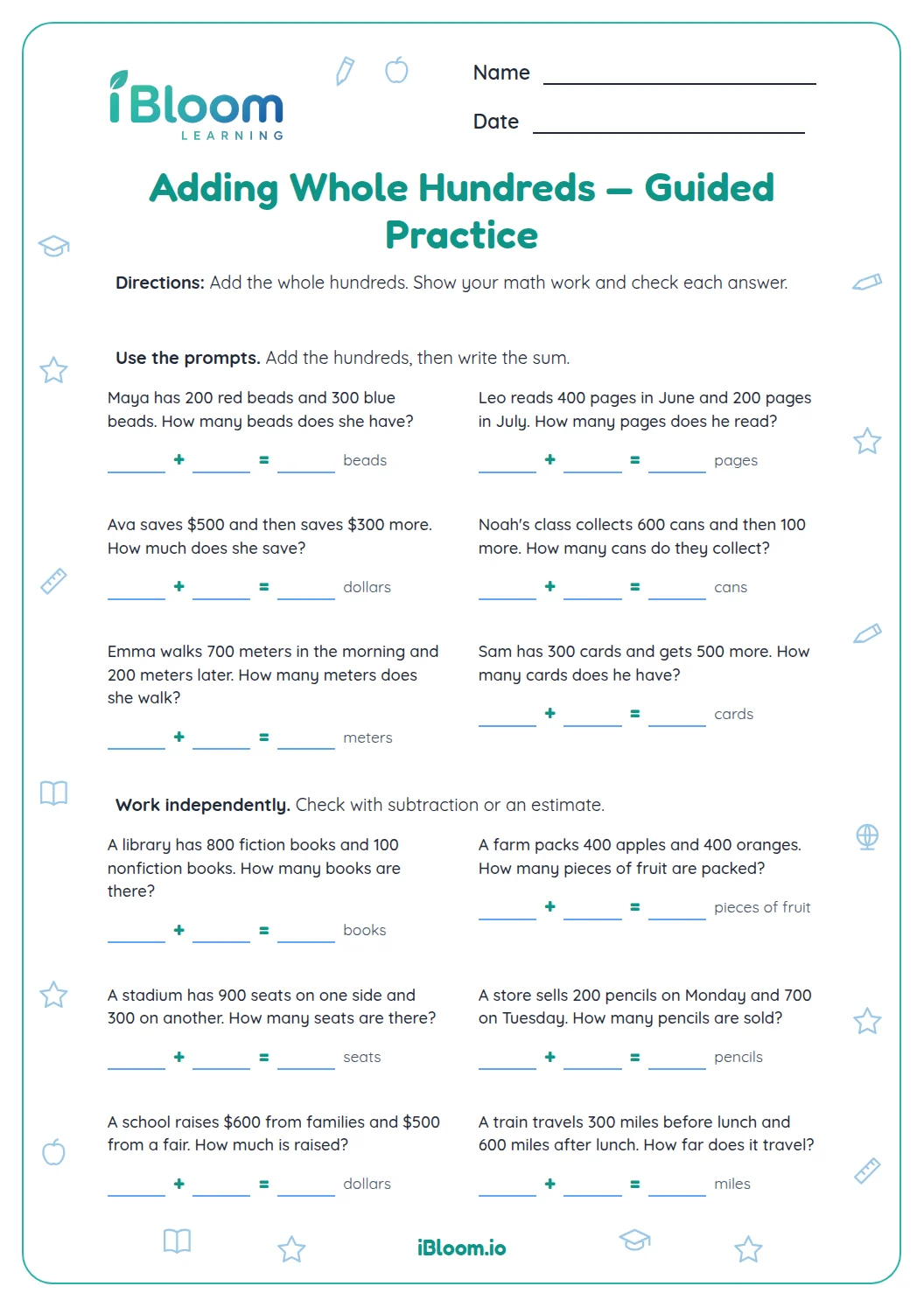
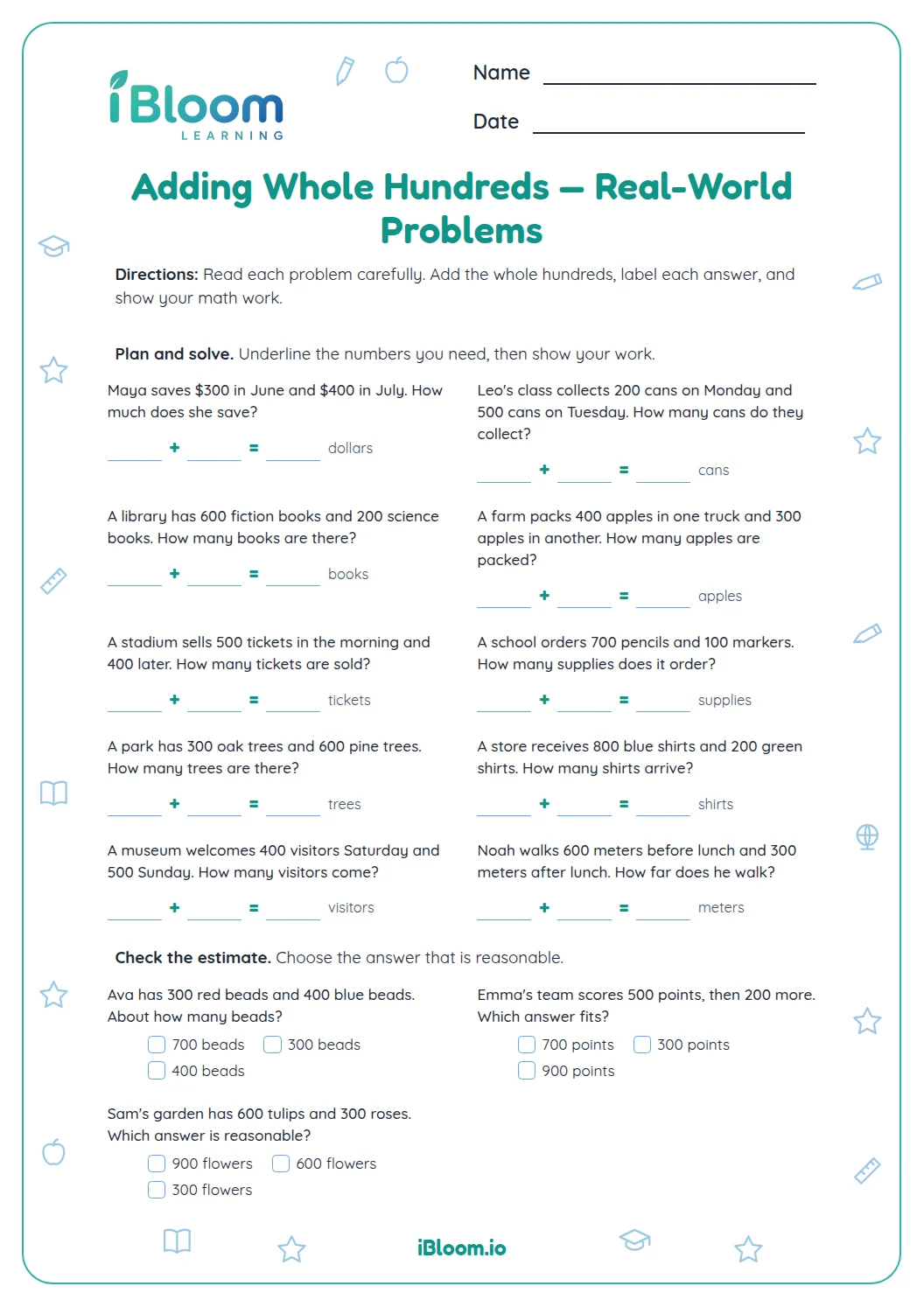
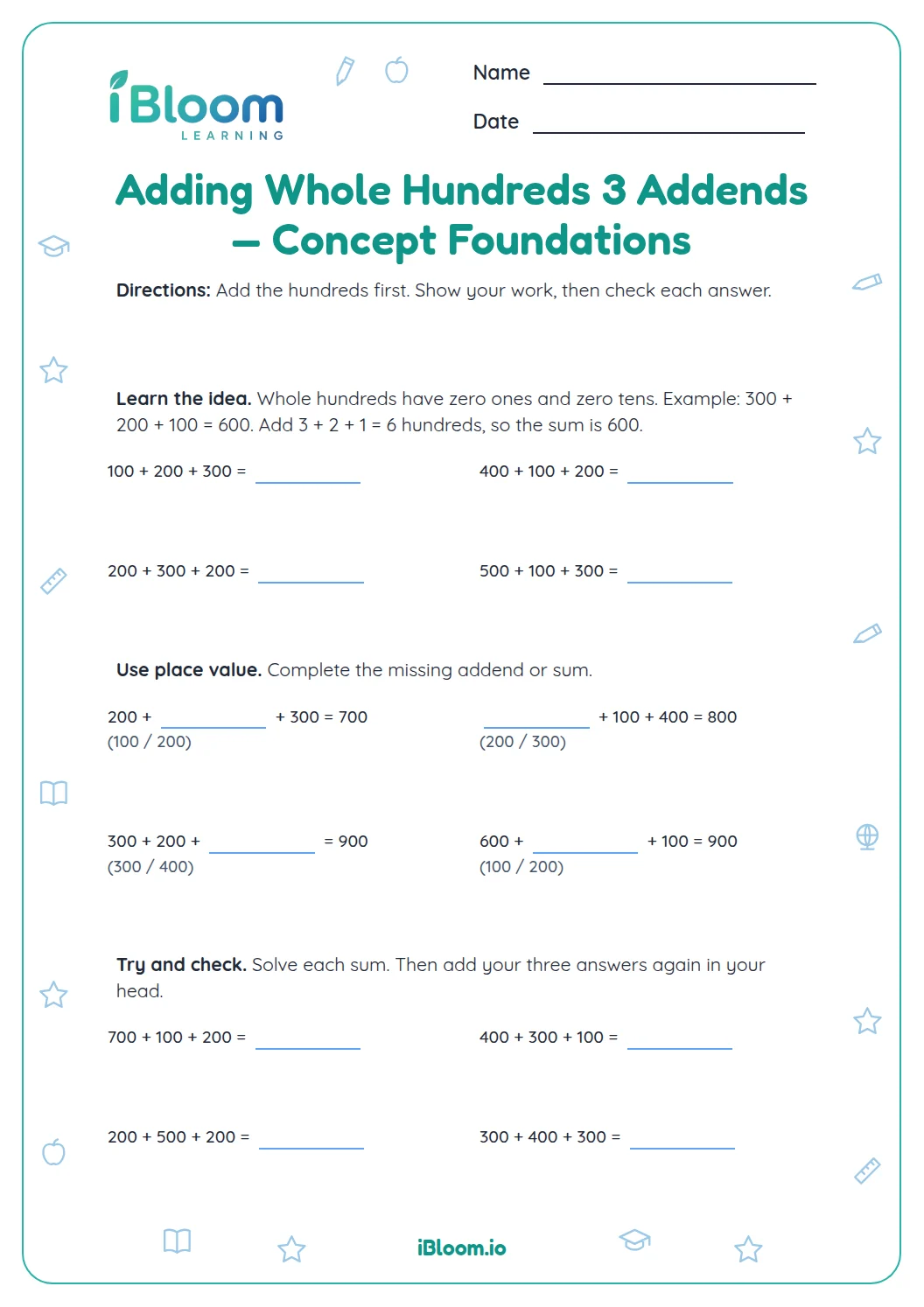
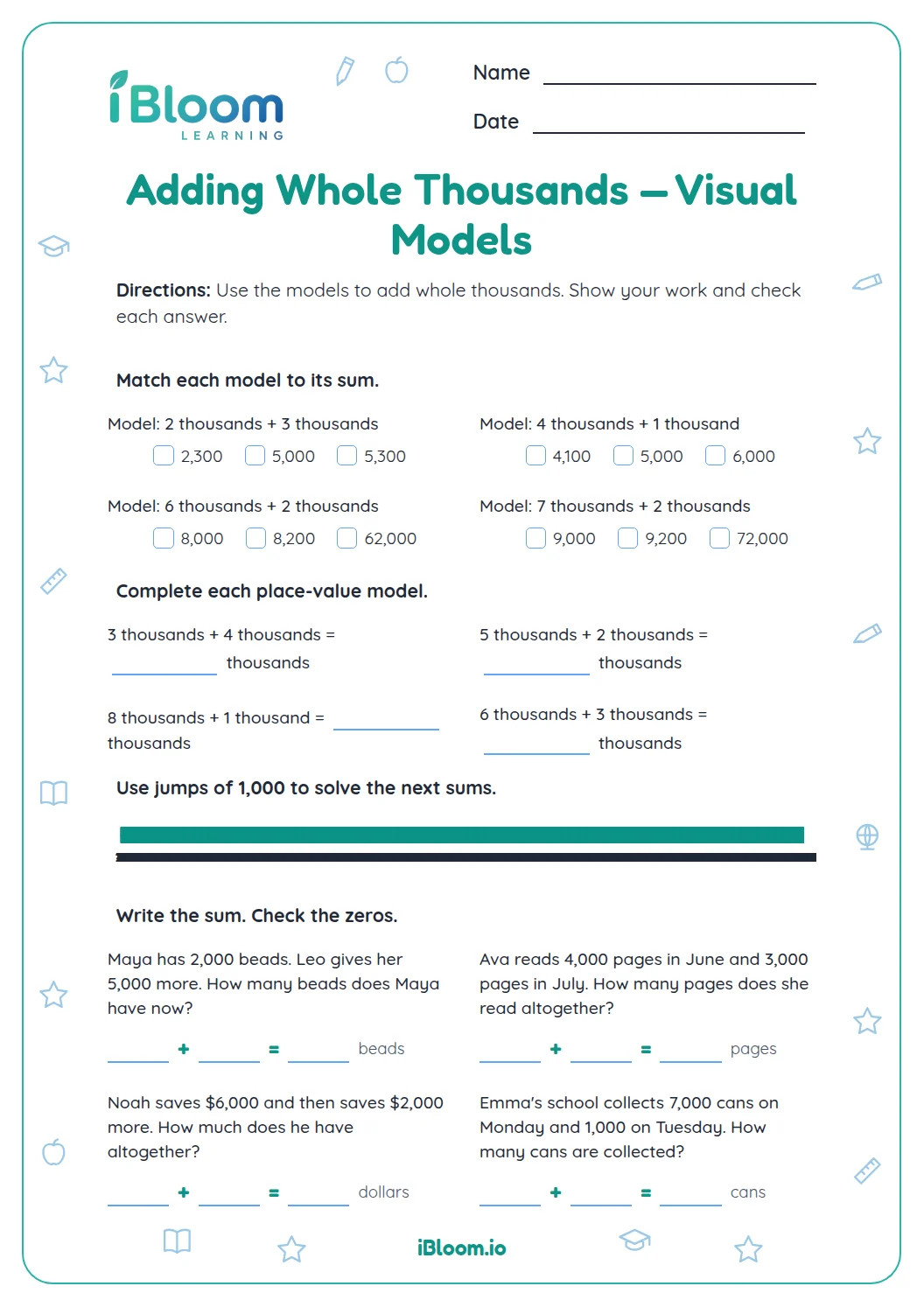
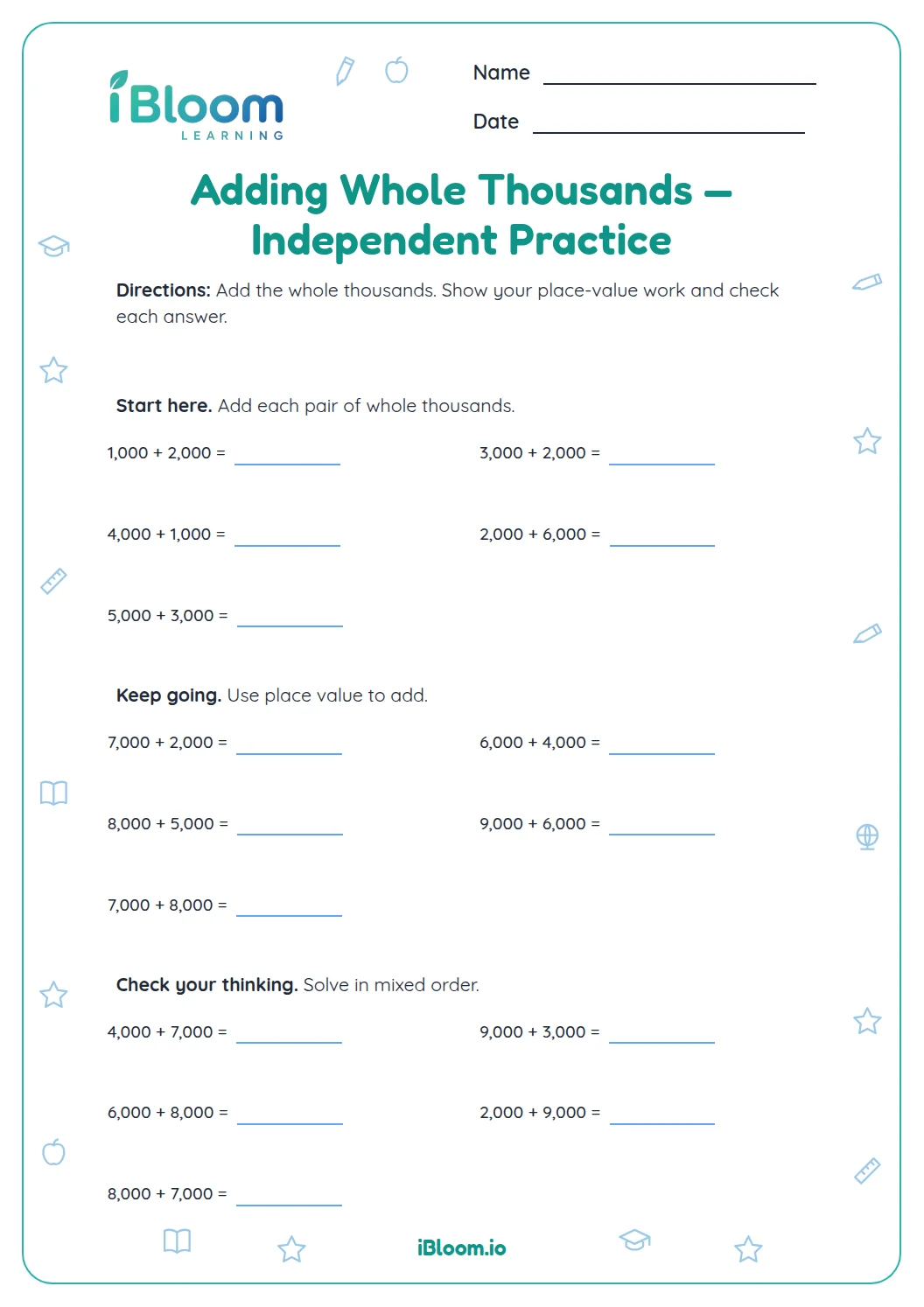
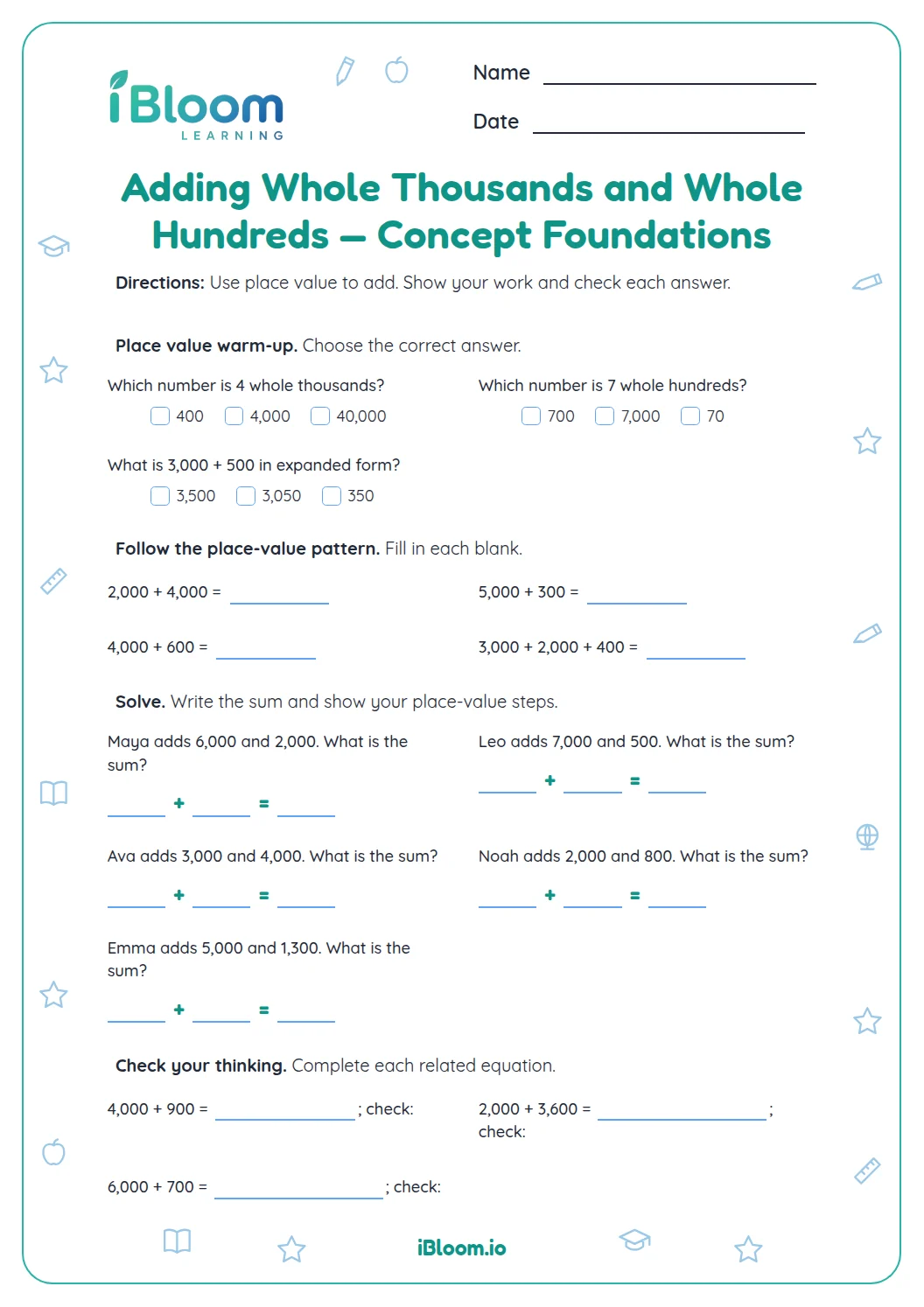
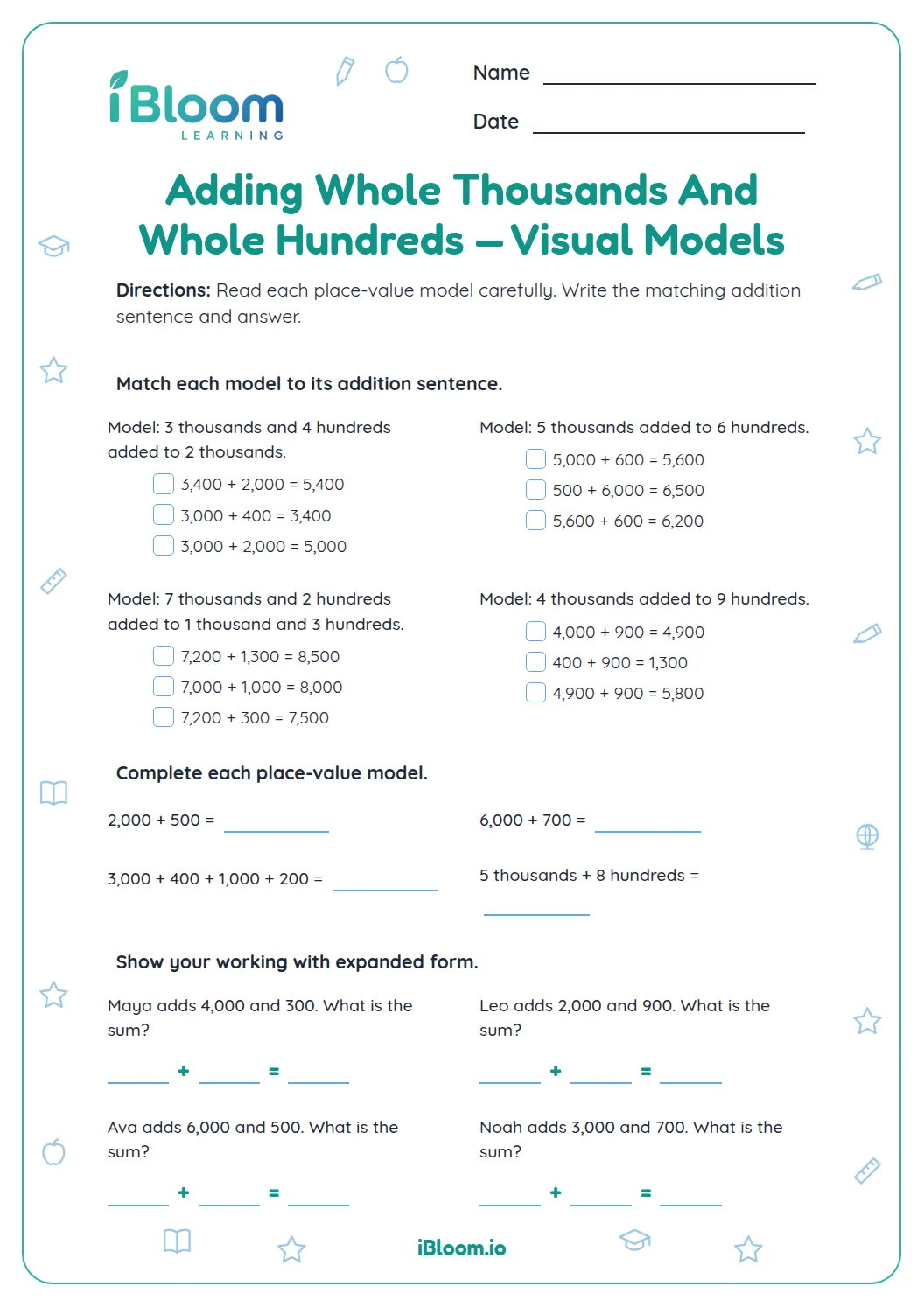
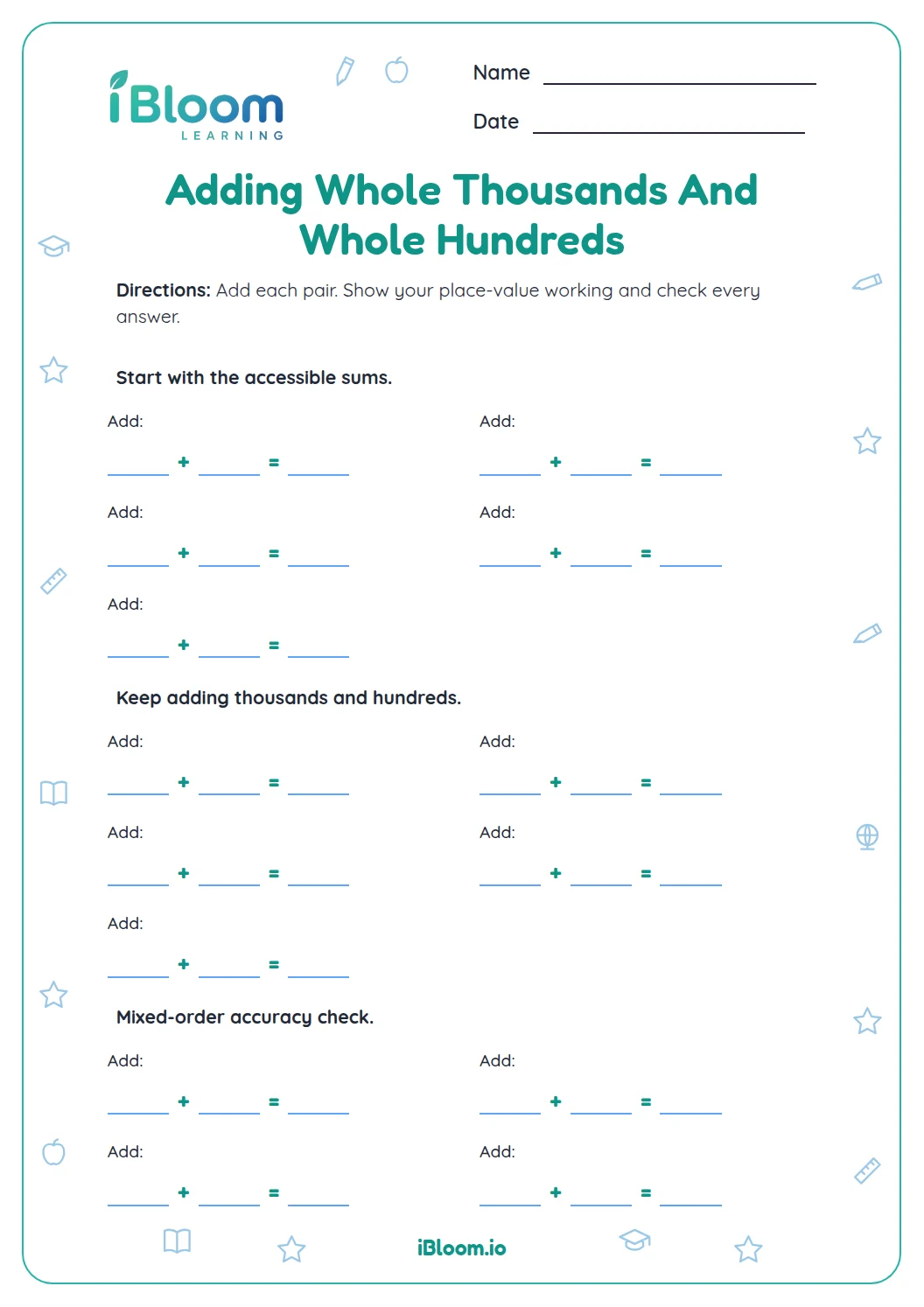
This free Grade 3 printable practices adding whole hundreds through place value. Children identify hundreds, add sums, find missing addends, and solve three short stories within 1,000. The questions build from reading a hundreds digit to combining amounts. It practices CCSS 3.NBT.A.2, adding within 1,000 with place-value strategies, and includes a separate answer key.
Aligned to 3.NBT.A.2
How do whole hundreds work?
A whole hundred has zero tens and zero ones: 300 means 3 hundreds. When two whole hundreds are added, combine the hundreds and keep both zero places. For example, 200 + 300 is 2 hundreds + 3 hundreds, or 5 hundreds.
The first part connects an amount in hundreds to its written number and checks which addends make a target sum. Later parts move to sums, missing addends, and short stories.
- 1200 + 300
- 22 hundreds + 3 hundreds = 5 hundreds
- 3200 + 300 = 500
How can you find a missing addend?
Think of the target as a number of hundreds. For 800 + ___ = 1,000, ask how many hundreds must join 8 hundreds to make 10 hundreds. The missing amount is 2 hundreds, or 200.
How do the stories use whole hundreds?
Each story gives two amounts to combine. Underline both amounts, write an addition equation, and add the hundreds. Read the total as hundreds to check that its place value makes sense.
How to use this worksheet at home or in class
- 1Read each number aloud in hundreds: 800 is 8 hundreds.
- 2For the first four questions, compare the hundreds and choose the matching value.
- 3Add the hundreds in each sum, keeping the tens and ones at zero.
- 4For a missing addend, count from the known hundreds to the total.
- 5In each story, underline the two amounts, write an addition equation, and check the total.
Common mistakes and quick fixes
The mistake
Writing 50 for 5 hundreds.
The fix
Say “5 hundreds” and write 500, with zero tens and ones.
The mistake
Adding the digits but dropping a place.
The fix
Name the units first: 3 hundreds plus 4 hundreds is 7 hundreds, or 700.
The mistake
Subtracting when a story gives two amounts to combine.
The fix
Mark both amounts and ask whether the question wants their total.
Common Core alignment
Add within 1,000 with strategies based on place value.
On this sheet: Children add whole hundreds within 1,000 and use place value to keep tens and ones at zero.
Show the official wordingHide the official wording
Fluently add and subtract within 1000 using strategies and algorithms based on place value, properties of operations, and/or the relationship between addition and subtraction.
What to practice next
Make more practice
Further reading
Questions parents and teachers ask
What is a whole hundred?
A whole hundred is a number made of one or more hundreds with zero tens and zero ones, such as 300 or 800. In 800, the 8 means eight groups of 100. This worksheet connects that place-value meaning to written numbers and sums.
How do you add 300 and 500?
Think of 300 as 3 hundreds and 500 as 5 hundreds. Three hundreds plus five hundreds makes eight hundreds, so 300 + 500 = 800. The worksheet uses this place-value idea in equations, missing-addend questions, and short situations. Use the same idea to check another total.
What grade is this worksheet for?
The worksheet is written for Grade 3 students practicing addition with whole hundreds. All sums stay within 1,000. Children focus on the value of the hundreds digit and keep the tens and ones places at zero. The answer key helps an adult check each sum after the child finishes.
How many questions are on the worksheet?
There are 14 questions in four parts: four multiple-choice items, five sums, two missing-addend questions, and three short stories. The answer key is separate and includes the correct choice or total for every question. Each question has a matching response in the answer key.
How can I help if my child adds the digits incorrectly?
Ask your child to name each number in hundreds before adding. For 200 + 400, say “2 hundreds plus 4 hundreds.” Once the child gets 6 hundreds, write 600 and check that both zero places remain in the answer. A quick place-value sketch can help show the groups.
Is there an answer key?
Yes. A separate answer key lists the correct choice, missing addend, or sum for all 14 questions. Use it after the worksheet so the child can first explain how the hundreds combine. The key follows the question order so answers are easy to find.