

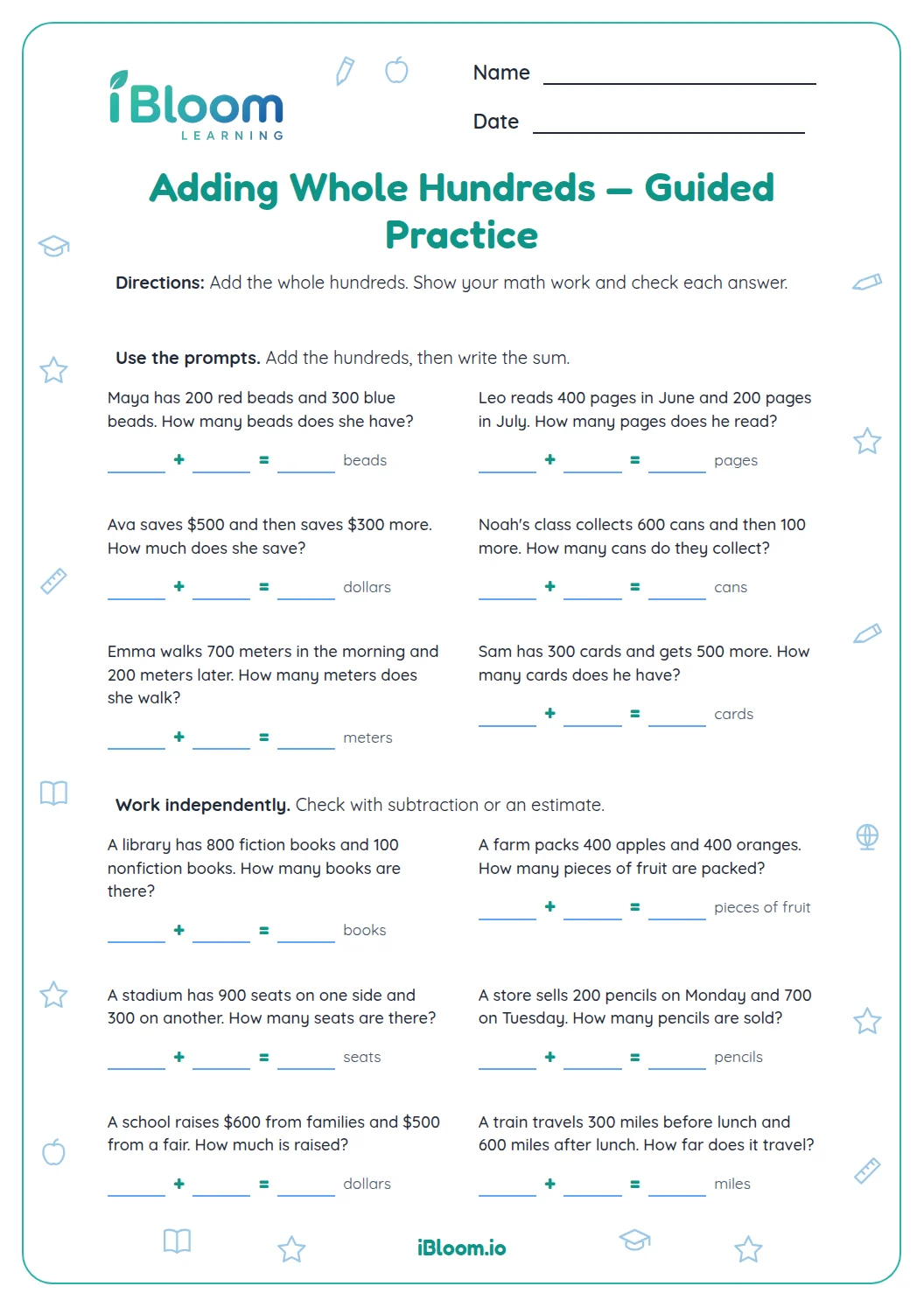


About this worksheet
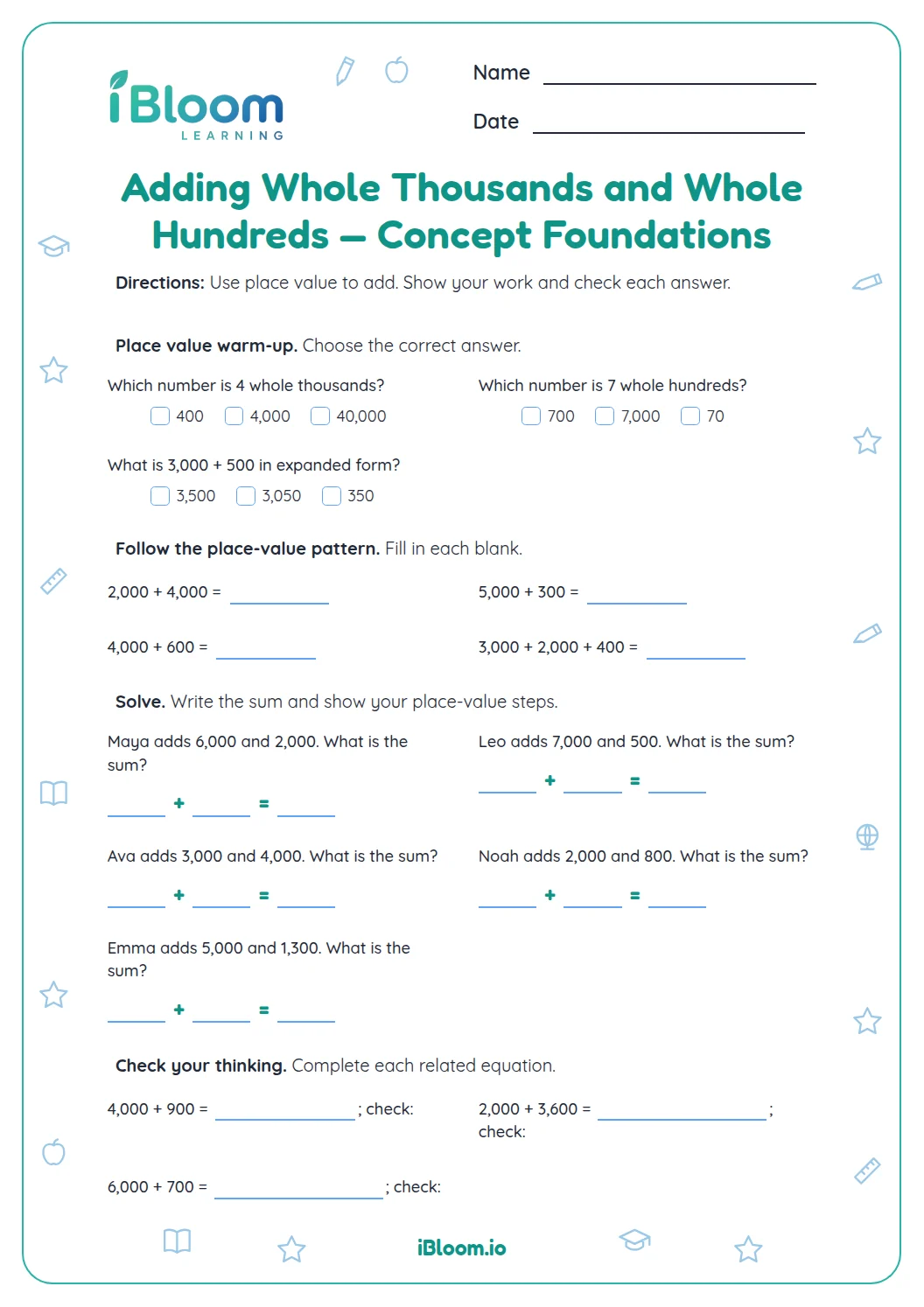
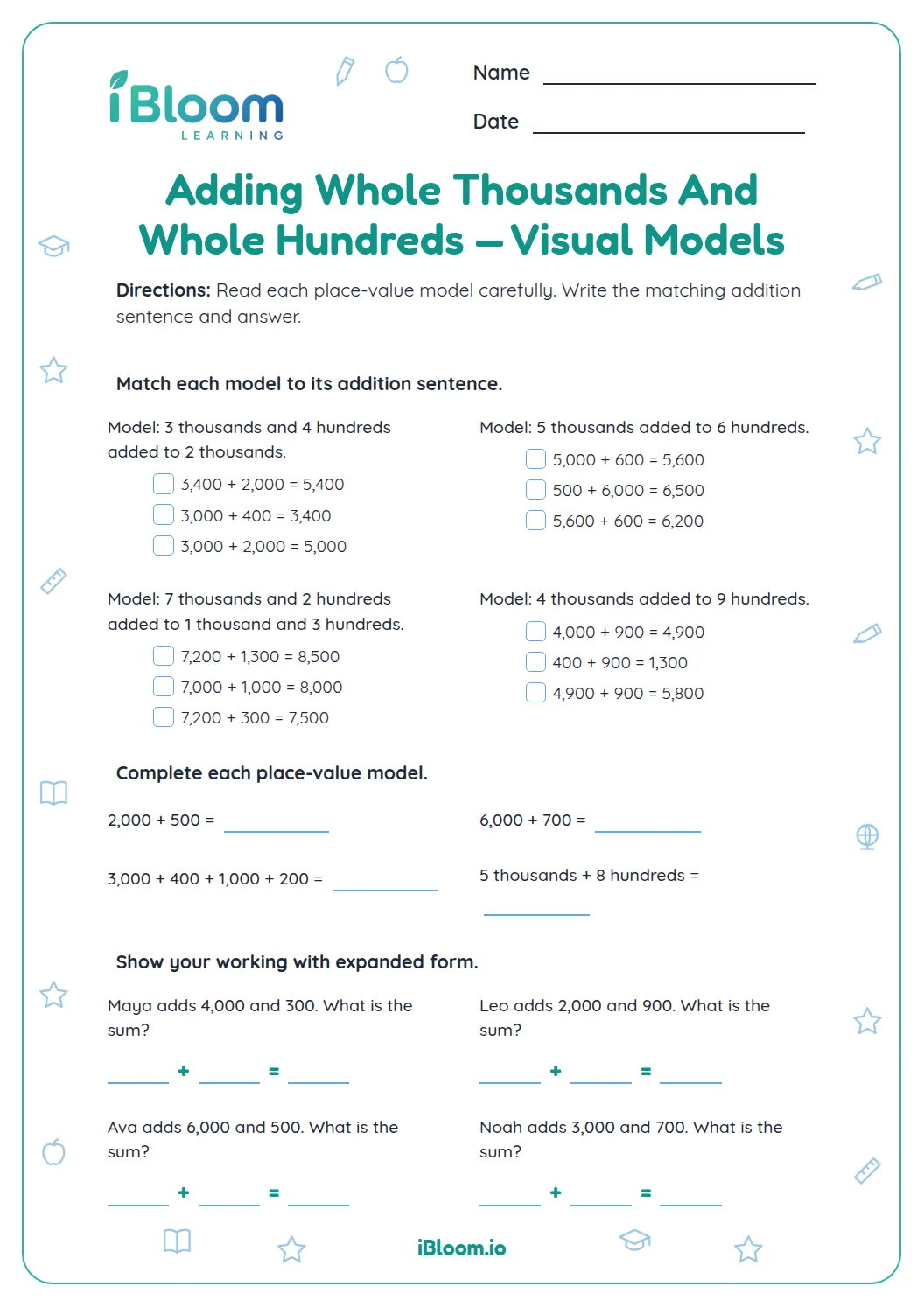
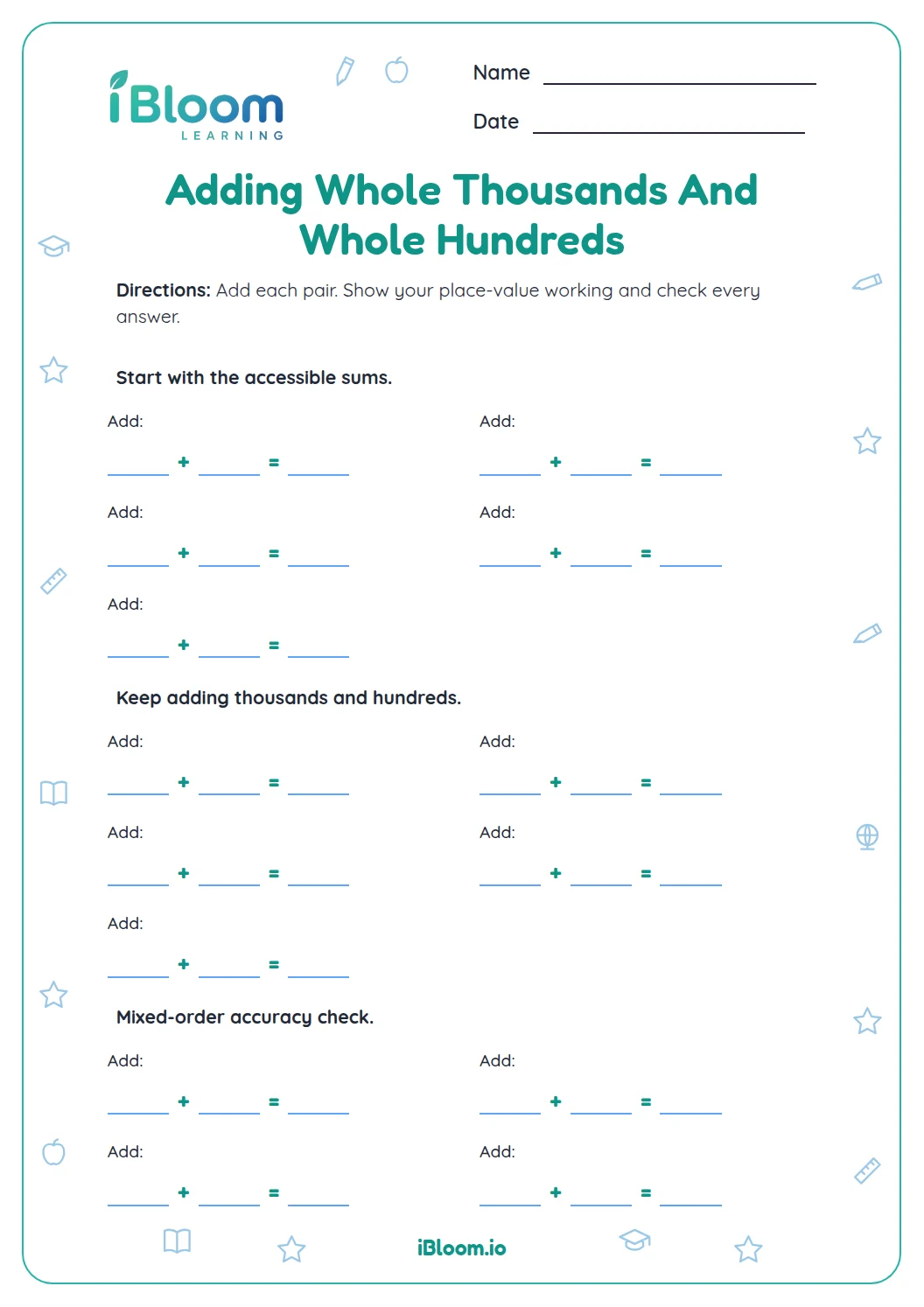
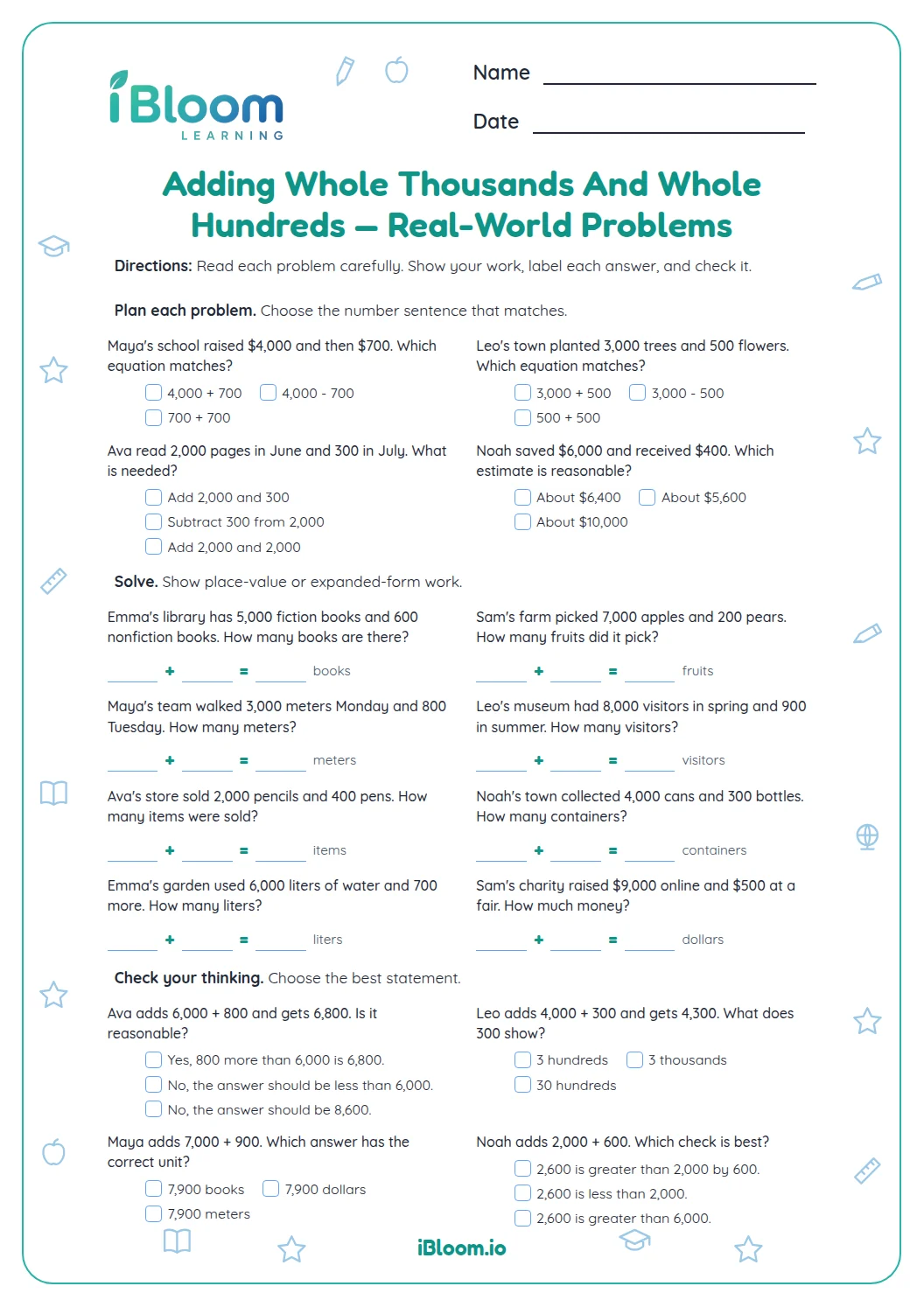
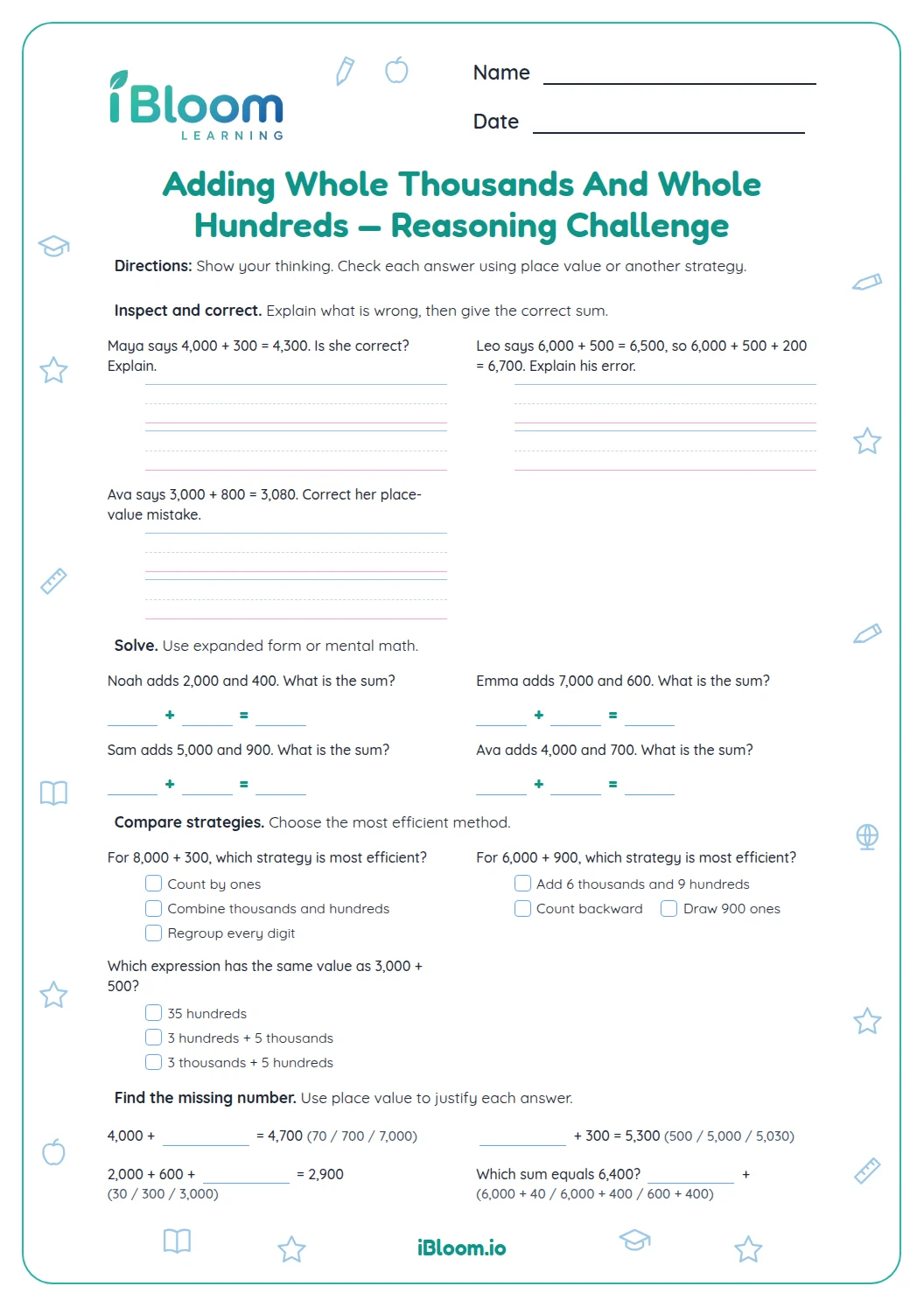
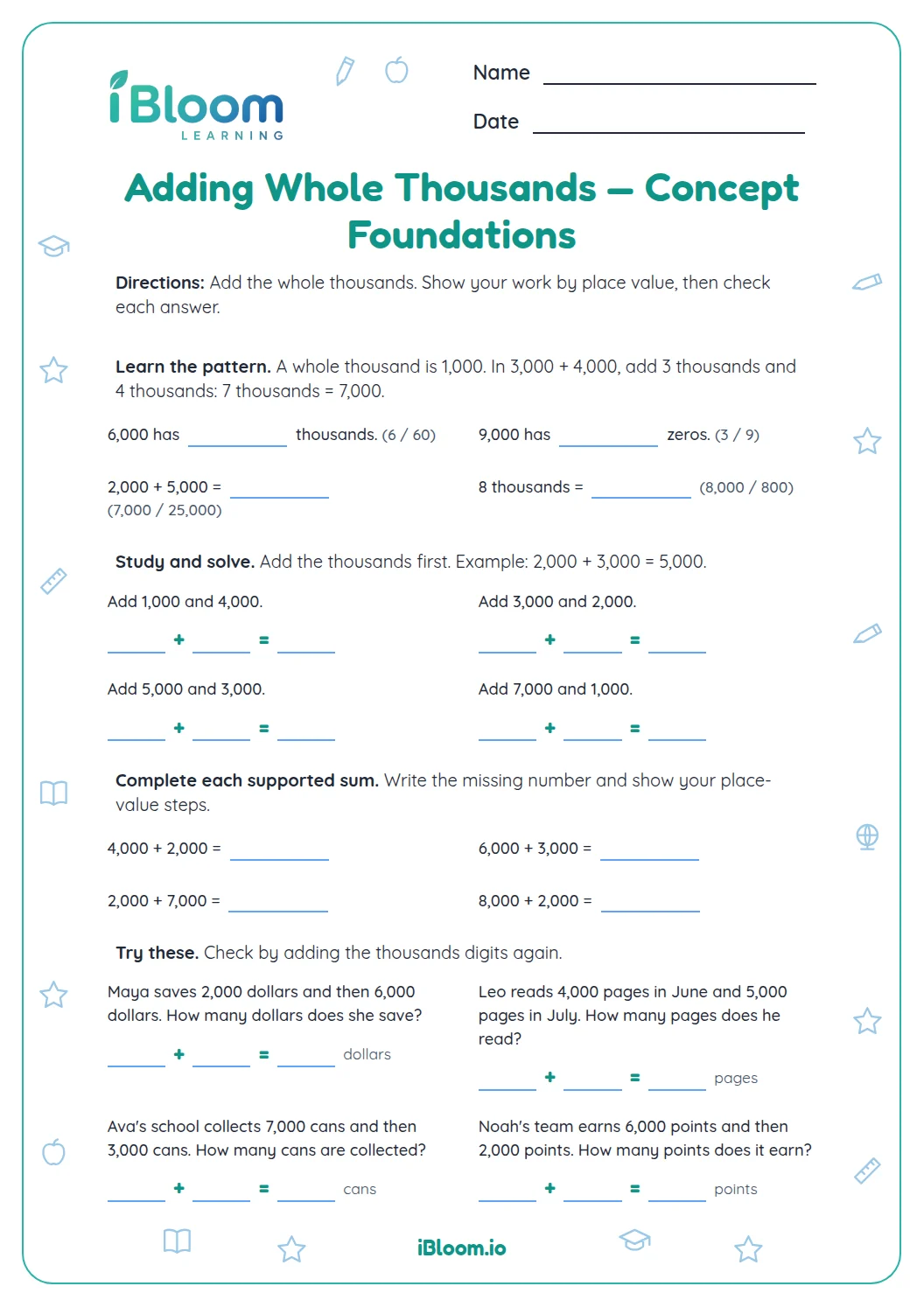
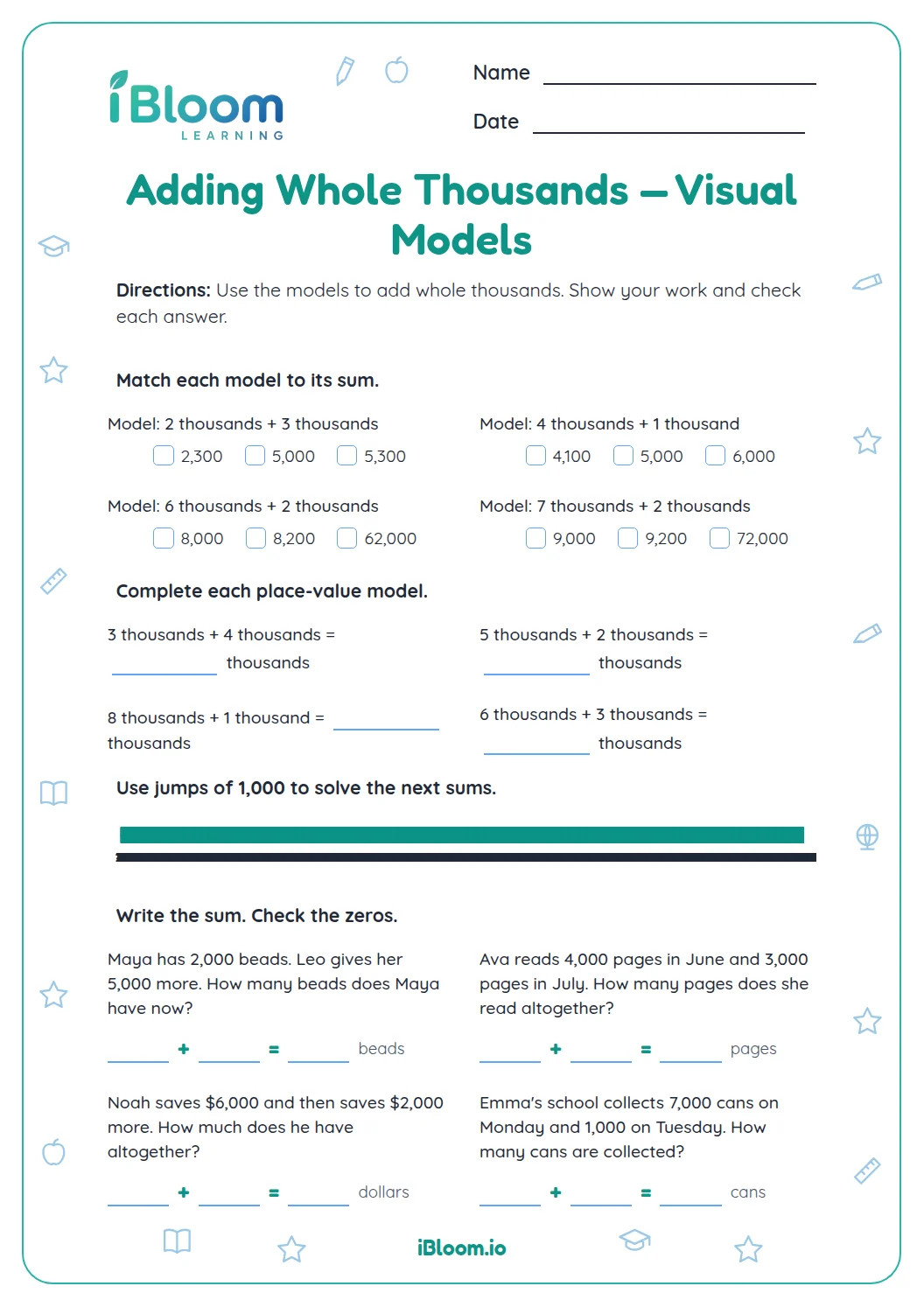
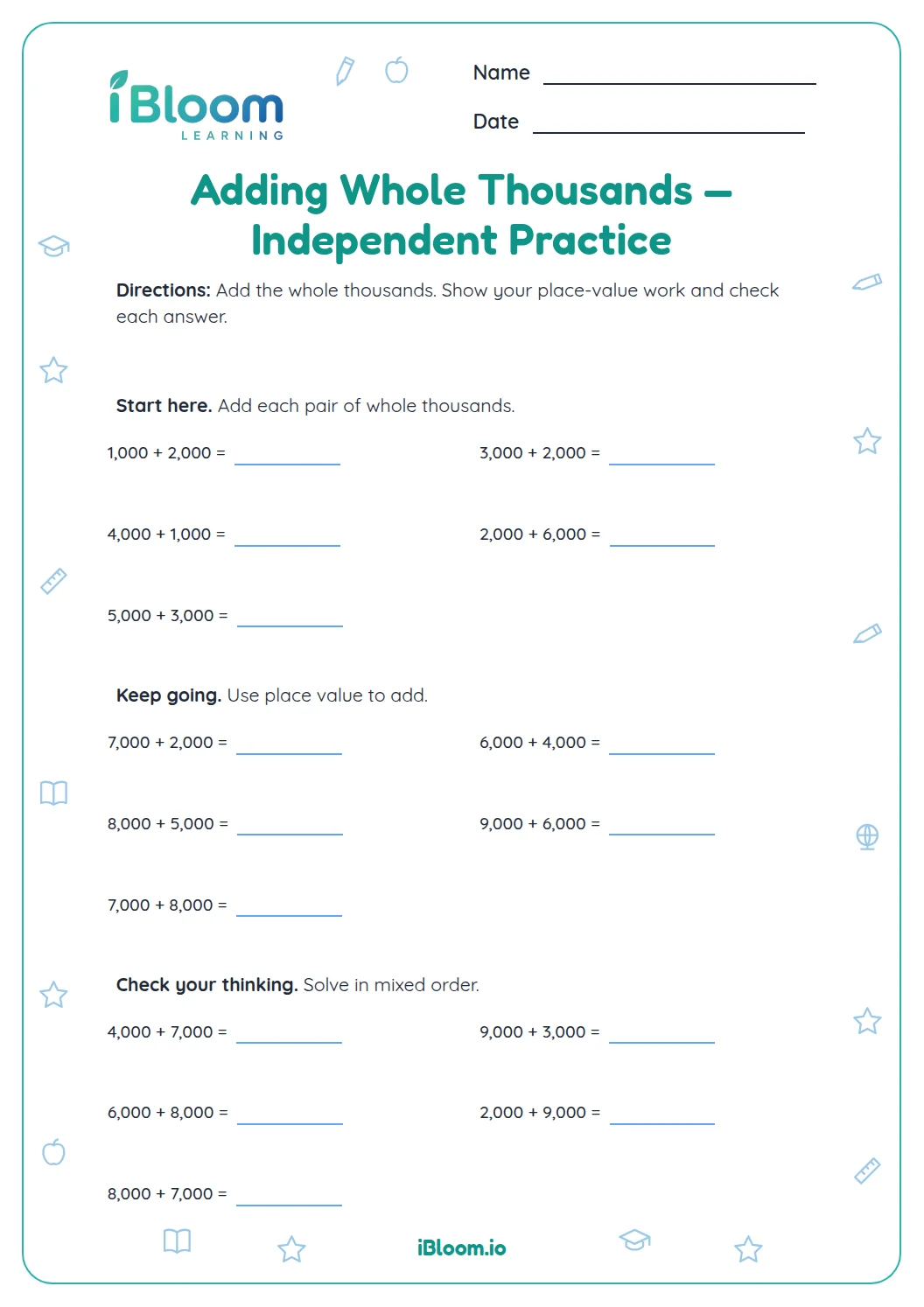
This two-page practice helps Grade 3 students add whole hundreds and thousands using place value and the standard algorithm. Children solve direct sums, apply addition in four short stories, and work backward to find missing addends. The questions use multi-digit addition, the skill described by CCSS 4.NBT.B.4.
Aligned to 4.NBT.B.4
How do you add by place value?
Line up the thousands and hundreds, then add each column. When the hundreds total more than 900, regroup 1,000 as needed.
- 13,400 + 2,000
- 2Line up matching places and add each column.
- 3The sum is 5,400.
How do you use addition in a story?
Identify both amounts, write an addition equation, and label the total with the unit from the question. Question 8 combines 2,400 visitors with 1,000 visitors.
How do you find a missing addend?
Compare the known addend with the total. In 3,000 + ___ = 3,800, the missing amount is 800 because 3,000 + 800 = 3,800.
How to use this worksheet
- 1Read the two addends and notice which place values are nonzero.
- 2Line up the numbers by place value before adding.
- 3Regroup a group of ten hundreds as one thousand when needed.
- 4For a story, write an equation and include the unit in your answer.
- 5For a missing addend, subtract the known addend from the total and check by addition.
Common mistakes and quick fixes
The mistake
Adding digits in different places together, such as 3 thousands and 4 hundreds as 7,000.
The fix
Keep each digit in its own column; 3,000 + 400 = 3,400.
The mistake
Forgetting to regroup 10 hundreds as 1 thousand.
The fix
Write the regrouped thousand in the thousands place before finishing the sum.
The mistake
Giving a number without the story unit.
The fix
Re-read the question and label the total in books, visitors, cans, or flowers.
Common Core alignment
This worksheet practices multi-digit addition with whole hundreds and thousands.
Add multi-digit whole numbers, including regrouping hundreds into thousands.
On this sheet: Students add multi-digit whole numbers and regroup hundreds into thousands.
Show the official wordingHide the official wording
Fluently add and subtract multi-digit whole numbers using the standard algorithm.
What to practice next
Make more practice
Further reading
Questions parents and teachers ask
What is 3,400 + 2,000?
Add the thousands: 3,000 + 2,000 = 5,000. The 400 stays in the hundreds place, so the total is 5,400. This is the same place-value method used in question 4. A quick estimate of about 5,000 also helps confirm that the answer is reasonable.
Do students need to regroup on this worksheet?
Some sums combine enough hundreds to make another thousand. For example, 1,700 + 500 is 2,200: add 7 hundreds and 5 hundreds to make 12 hundreds, or 1,200. Regrouping keeps the hundreds and thousands in the correct places. The place values make the size of the total easy to check.
How do I check a missing addend?
Add the number you found to the known addend. For question 11, 3,000 + 800 = 3,800, so 800 is the missing amount. Subtraction is another way to find it: 3,800 − 3,000 = 800. Check the result in the original equation.
What kinds of problems are on the two pages?
There are 14 questions: six direct sums, four short story problems, and four equations with a missing addend or sum. The separate answer key has two pages. Students can show their steps in the answer spaces for the equation and story items.
Which Common Core standard is listed?
The page lists CCSS 4.NBT.B.4, which addresses adding and subtracting multi-digit whole numbers with the standard algorithm. The questions focus on whole hundreds and thousands, including regrouping hundreds into a thousand. The worksheet record identifies the page for Grade 3.