

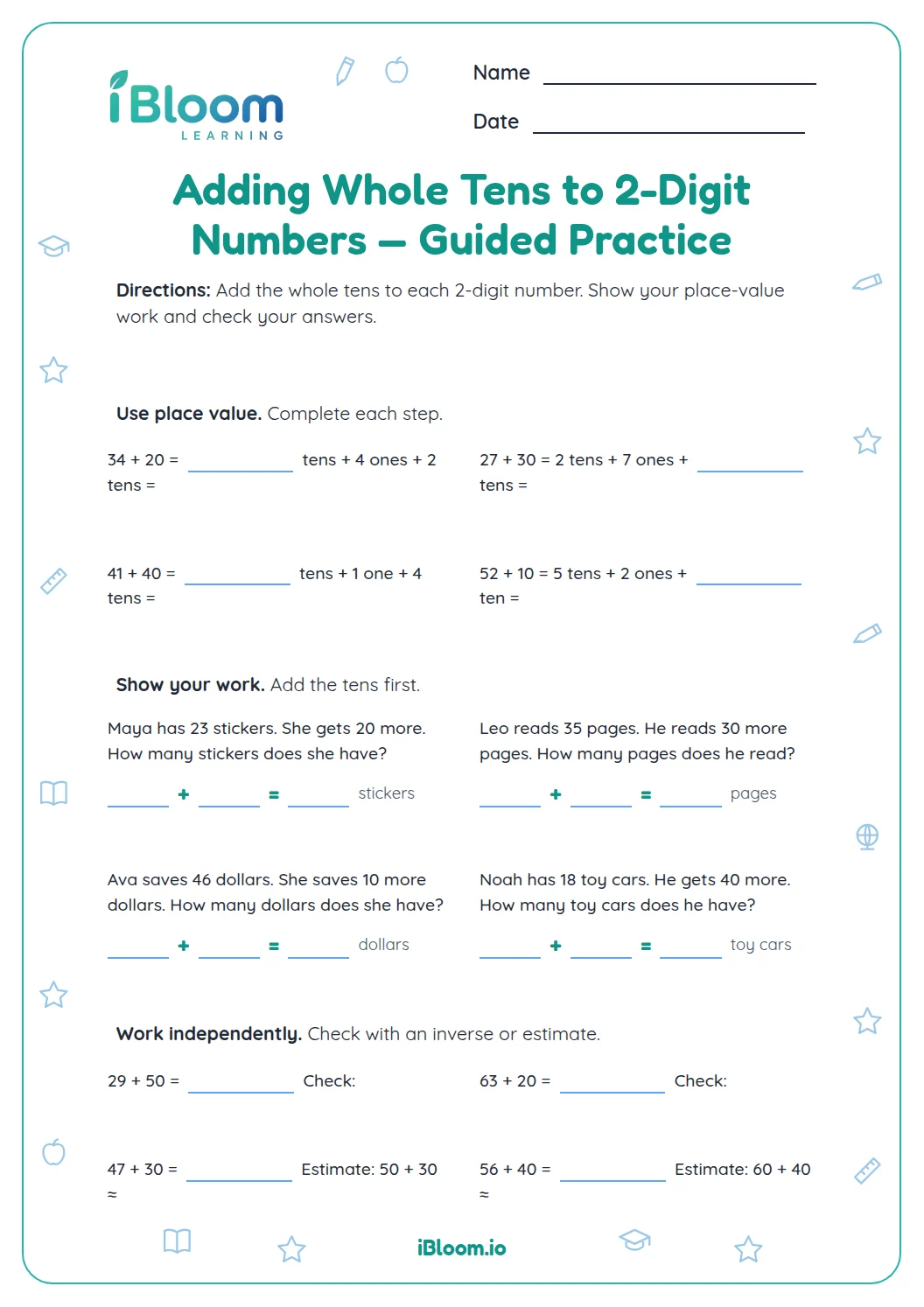


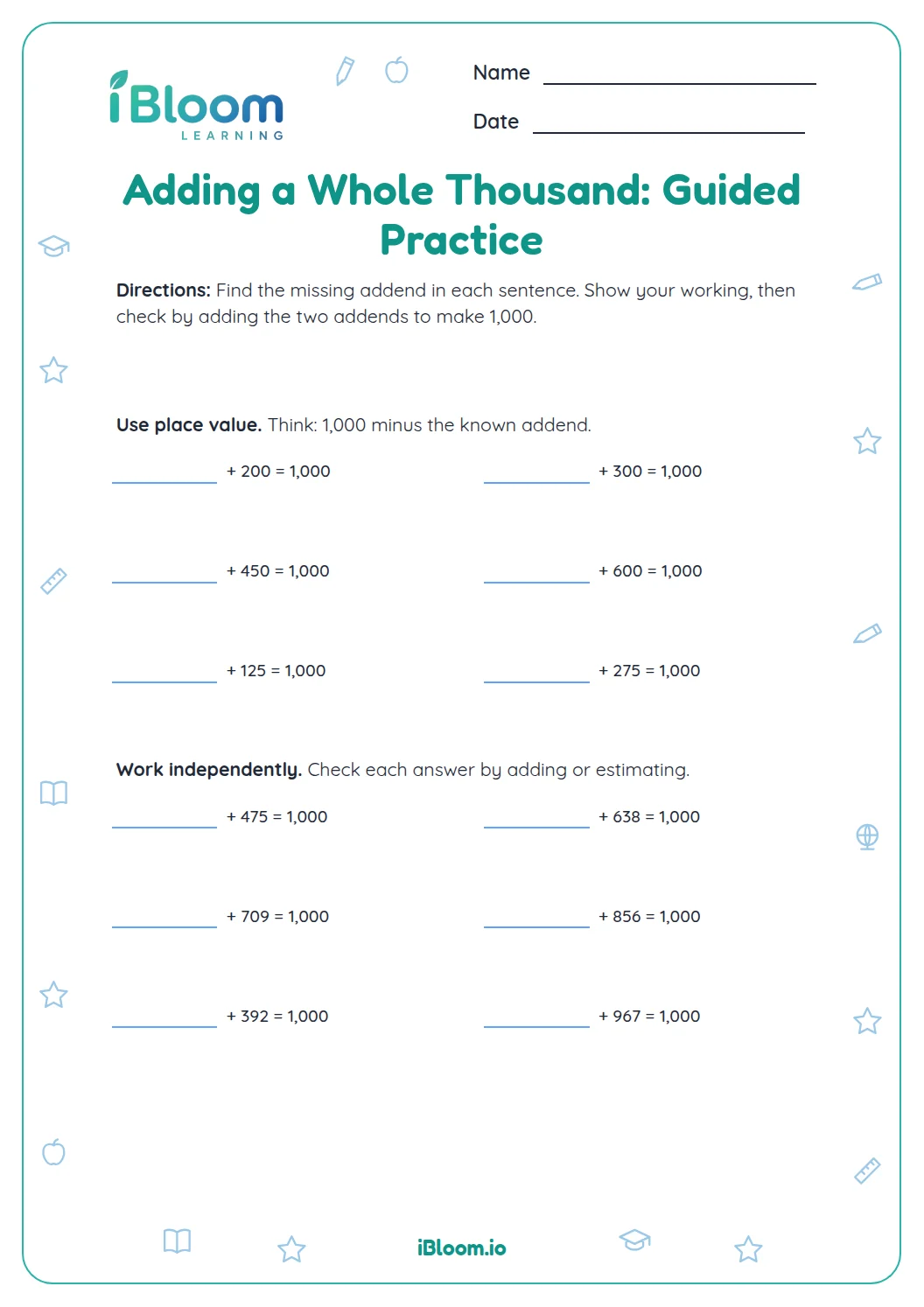
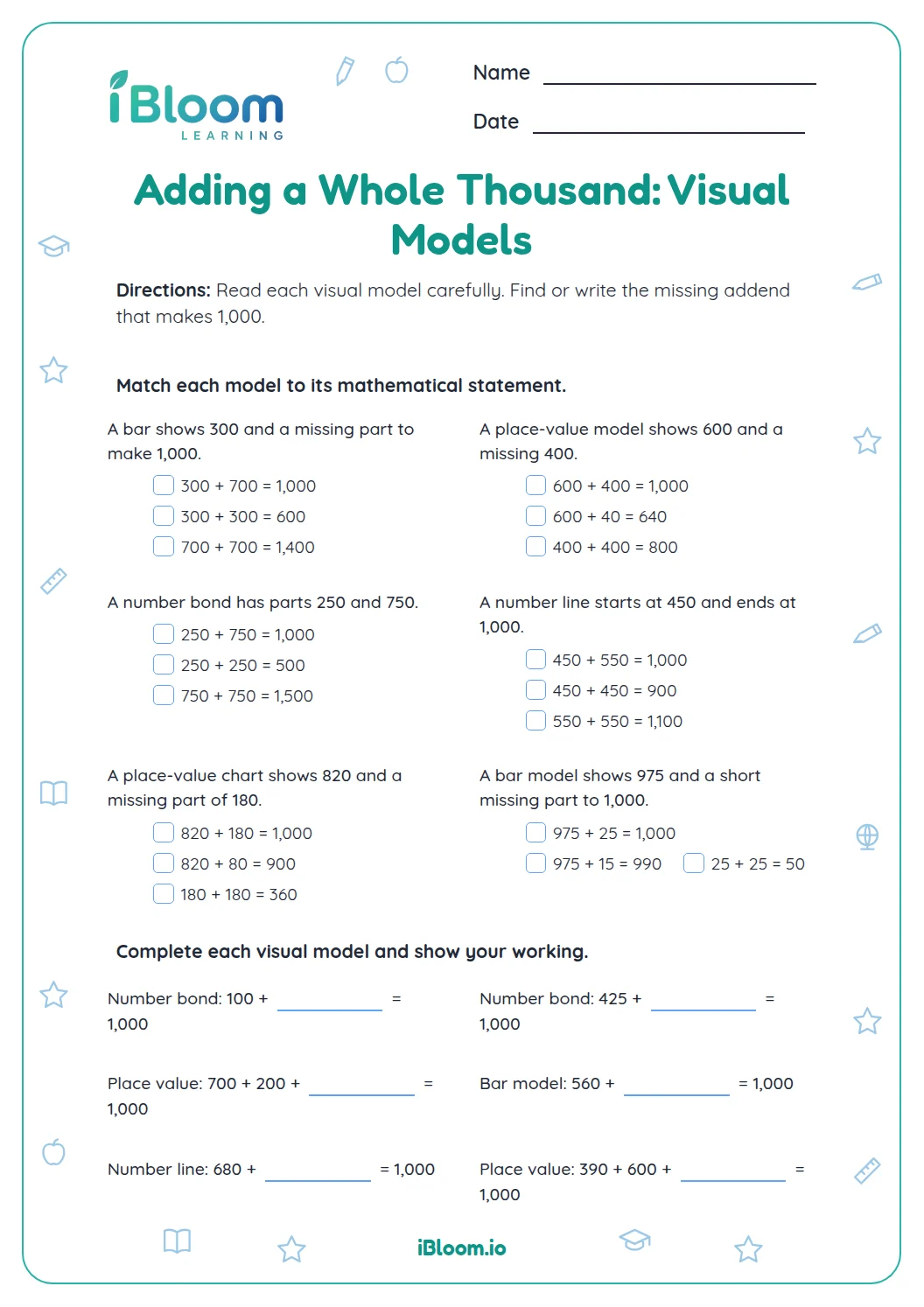
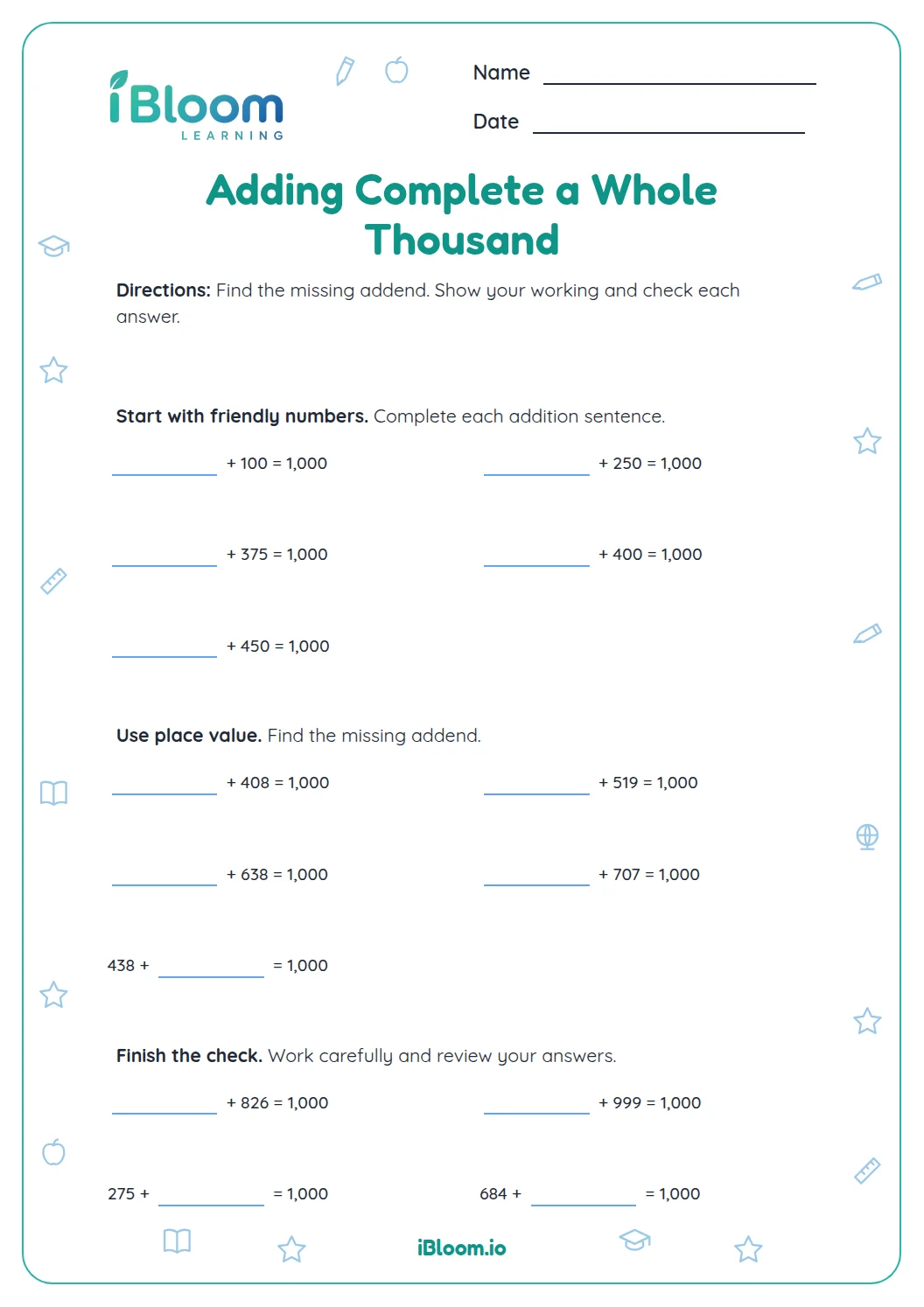
About this worksheet
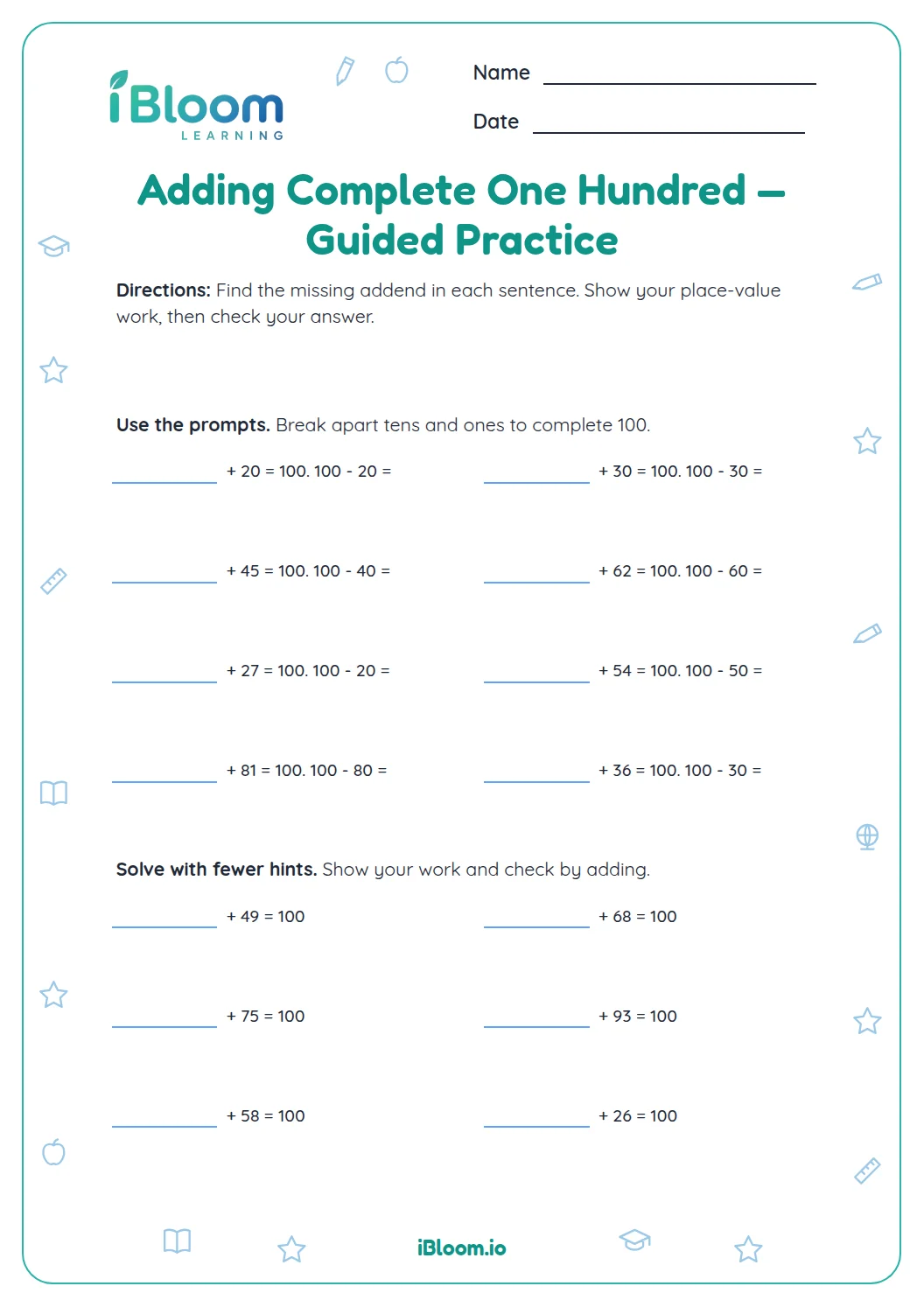
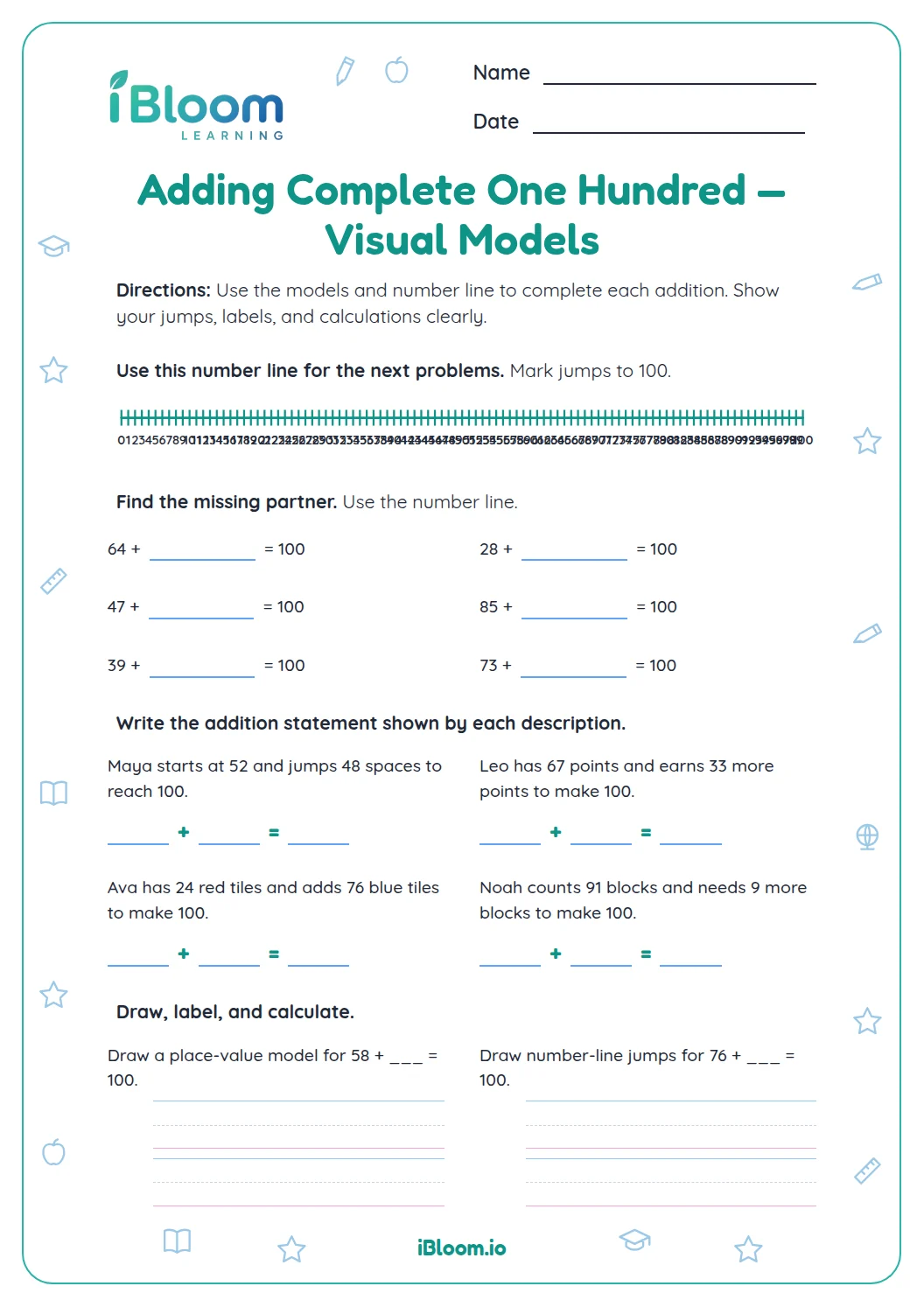
This Grade 3 printable focuses on the distance between a starting number and a target hundred. Learners find missing addends to reach 100, then work with targets such as 200, 400, 500, and 1,000. Four short goal stories connect the number sentences to real quantities. The answer key gives each missing amount.
Aligned to 3.NBT.A.2
How do you find the amount needed to reach 100?
A missing addend tells how much more is needed to reach a target. For 63 + ___ = 100, count from 63 to 70, then from 70 to 100: 7 + 30 = 37. Subtraction gives the same result: 100 − 63 = 37.
Learners can use whichever method helps them keep track of the tens and ones. Adding the answer back to the starting amount checks the result.
- 163 + ___ = 100
- 2100 − 63 = 37
- 3Check: 63 + 37 = 100
How does the strategy work with larger hundreds?
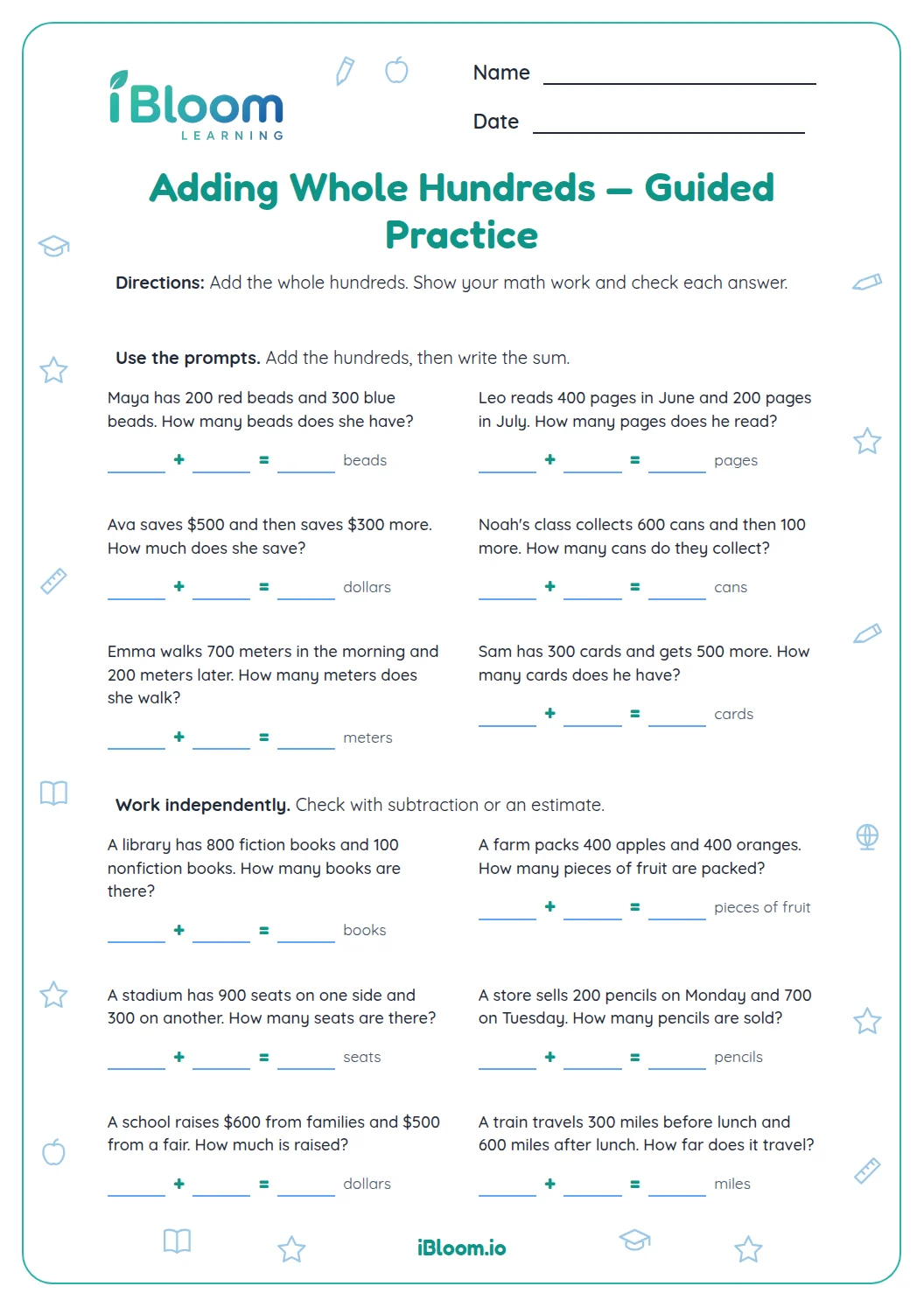
The relationship stays the same when the target changes. For 340 + ___ = 400, the missing addend is the distance from 340 to 400: 60. For 125 + ___ = 200, bridge to 200 by adding 75. The page keeps all arithmetic within whole numbers.
What do the goal stories ask?
Each story gives a current amount and a goal. Learners find the missing addend that reaches the goal, then check by adding the current amount and the missing amount.
- Part A: Complete the hundred — fill missing addends to reach 100.
- Part B: Cross a hundred mark — reach the next target using a bridge through tens.
- Part C: Larger hundreds — apply the same distance idea to higher targets.
- Part D: Solve the goal stories — write an equation for the amount still needed.
A clear routine for each question
- 1Read the target at the end of the equation first.
- 2Find the distance from the starting number to the target, using counting on or subtraction.
- 3For a story, write current amount + amount needed = goal.
- 4Add the missing amount back to the starting amount to check.
- 5Use the key after working through the page and redo any missed distance with a number line.
Common missing-addend mistakes
The mistake
Subtracting the target from the starting number and getting a negative direction.
The fix
The target is the larger amount, so calculate target minus start.
The mistake
Stopping at the next ten but forgetting the rest of the distance to the target hundred.
The fix
Break the distance into two jumps, such as 63 to 70 and 70 to 100.
The mistake
Writing the target itself in the blank.
The fix
Check by adding the start and the blank; their sum must equal the target.
Common Core alignment
This worksheet practices adding within 1,000 through missing-addend reasoning and place-value jumps.
Fluently add and subtract within 1,000 using strategies and algorithms.
On this sheet: Finding the amount needed to reach a target uses place-value jumps and subtraction to check addition.
Show the official wordingHide the official wording
Fluently add and subtract within 1,000 using strategies and algorithms based on place value, properties of operations, and/or the relationship between addition and subtraction.
What to practice next
Make more practice
Questions parents and teachers ask
What does it mean to complete a hundred?
Find the amount that must be added to a starting number to reach a target hundred. For example, 63 + 37 = 100, so 37 is the missing amount. The worksheet begins with targets of 100, then uses larger targets so learners can apply the same distance idea to more place values.
Can subtraction help find a missing addend?
Yes. Subtract the starting amount from the target. For 63 + ___ = 100, calculate 100 − 63 = 37. Then check the result by adding: 63 + 37 = 100. Counting on in jumps is another valid method, especially when a learner wants to bridge first to the next ten.
Why do later questions use targets beyond 100?
They let Grade 3 learners use the same missing-addend idea with larger place values. For example, in 340 + ___ = 400, the missing amount is the distance from 340 to 400. The relationship stays consistent: target minus starting amount equals the addend needed to reach the target.
What should children write for the goal stories?
A short addition equation and the amount still needed. For the jar story, a learner can write 68 + 32 = 100 beads. That equation shows the current amount, the missing amount, and the goal together. The number sentence also provides a quick way to check whether the answer reaches the stated target.
Does the worksheet include an answer key?
Yes. The separate key lists each missing addend and the amount needed in every story. After checking, learners can choose one problem and verify it by adding both parts. If the result does not match the target, count on in tens and ones to find where the distance was missed.