





About this worksheet
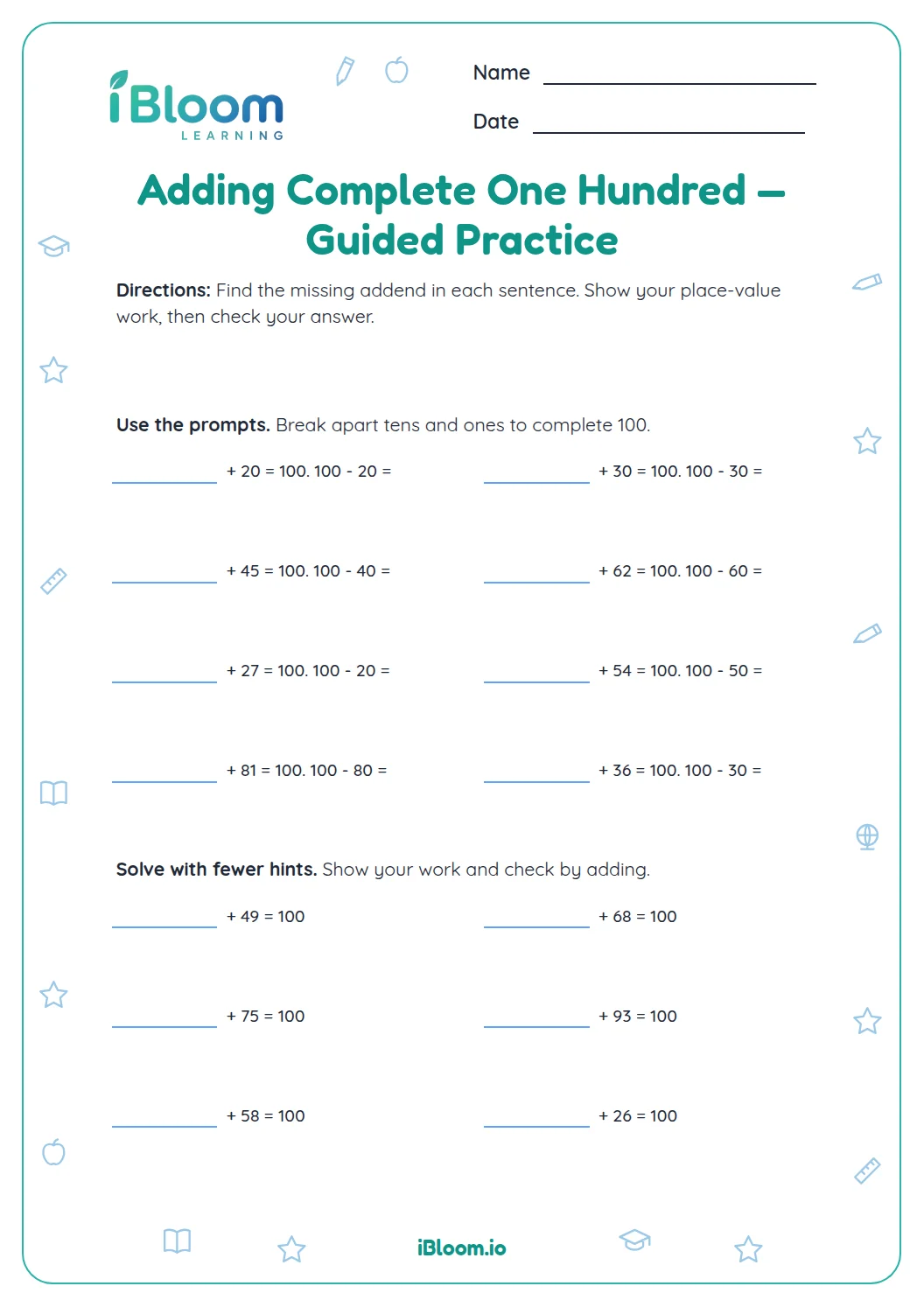
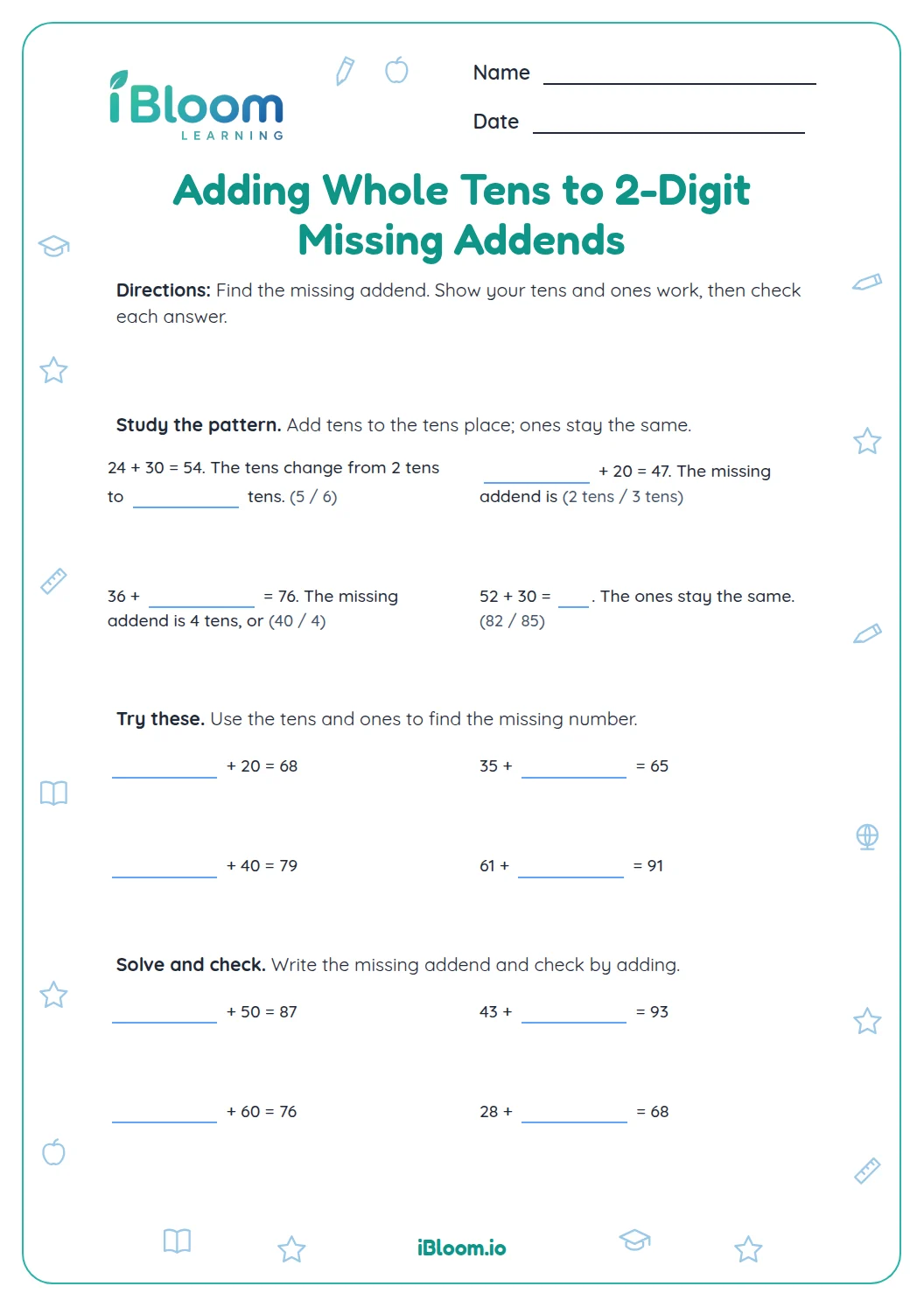
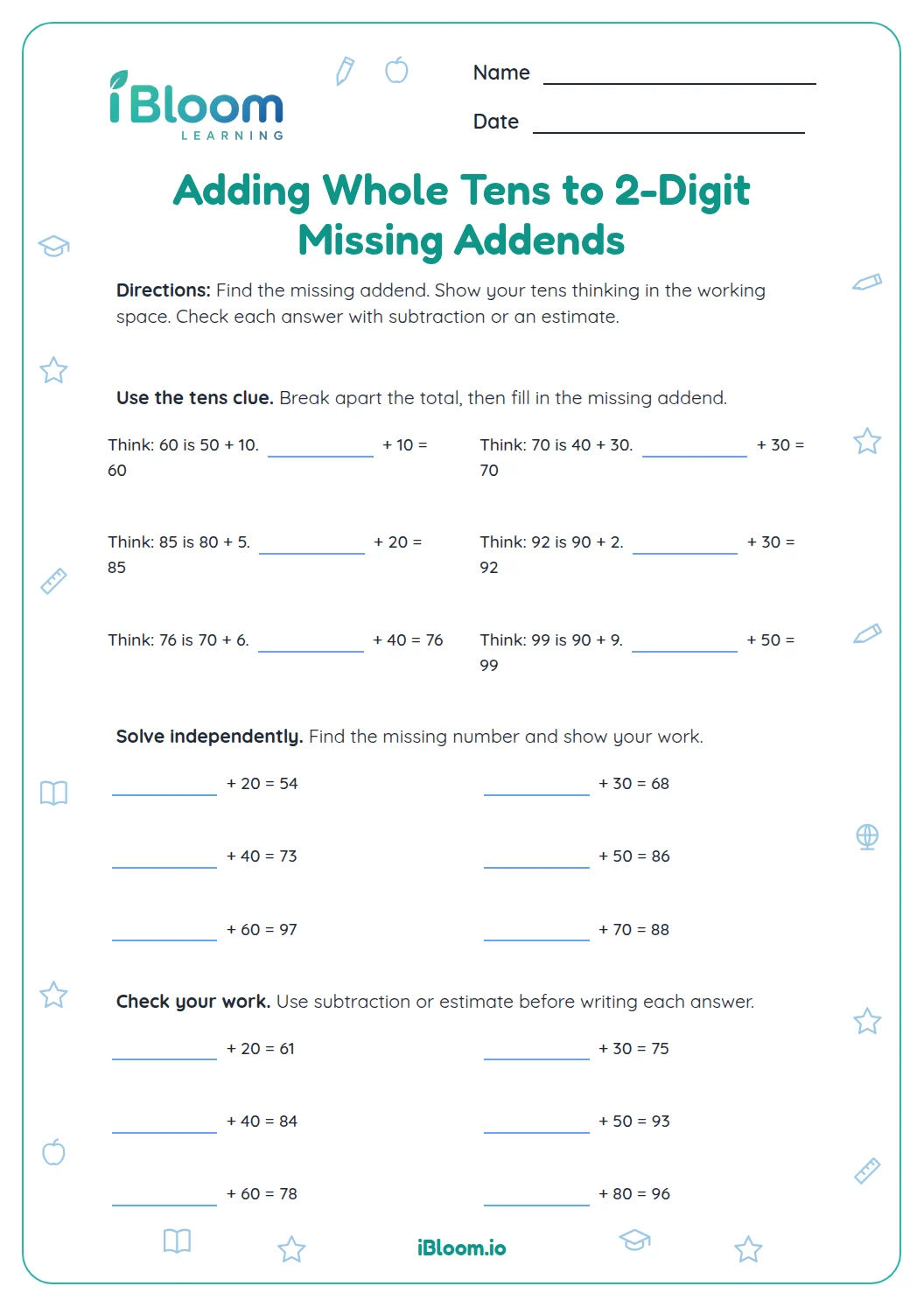
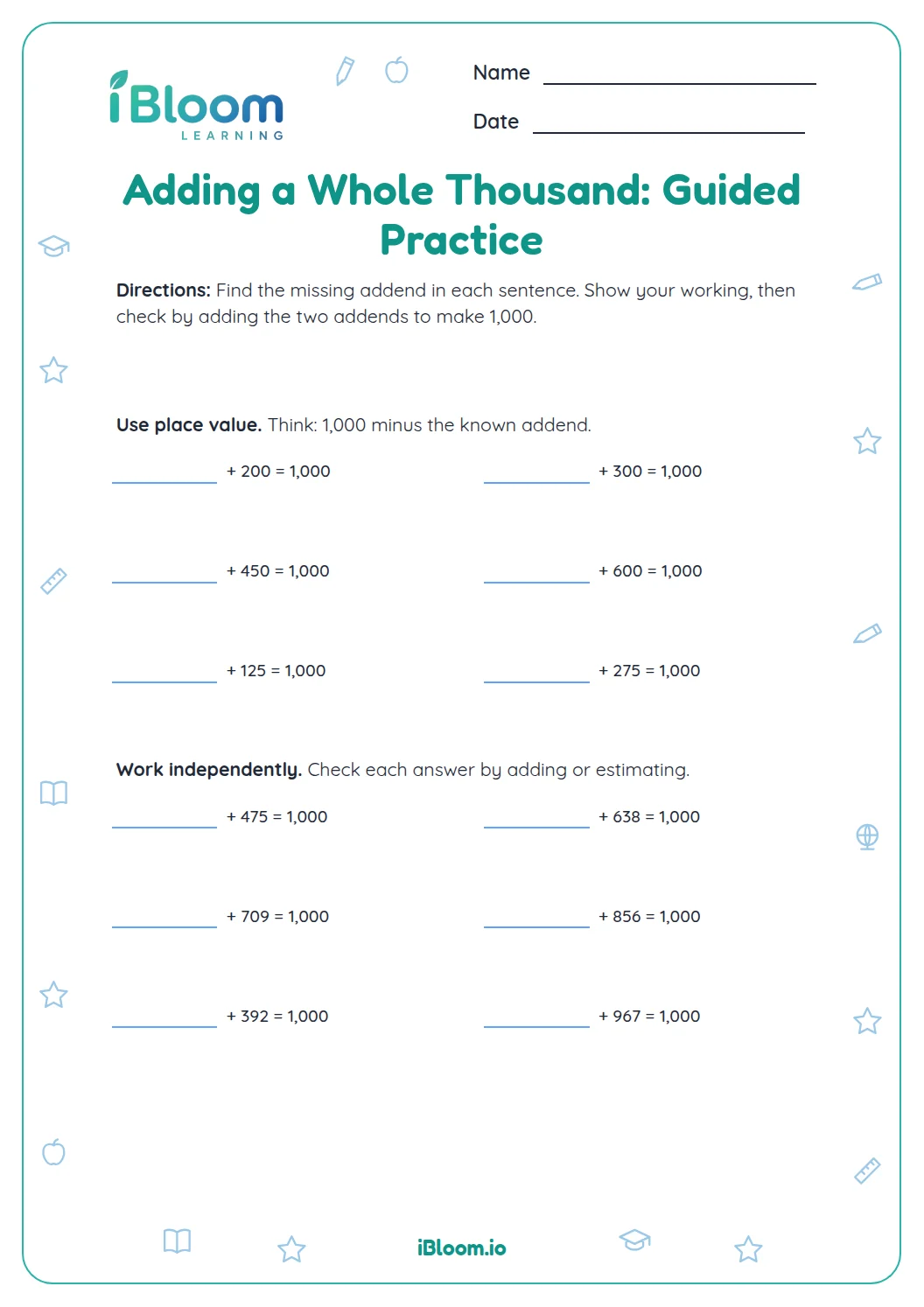
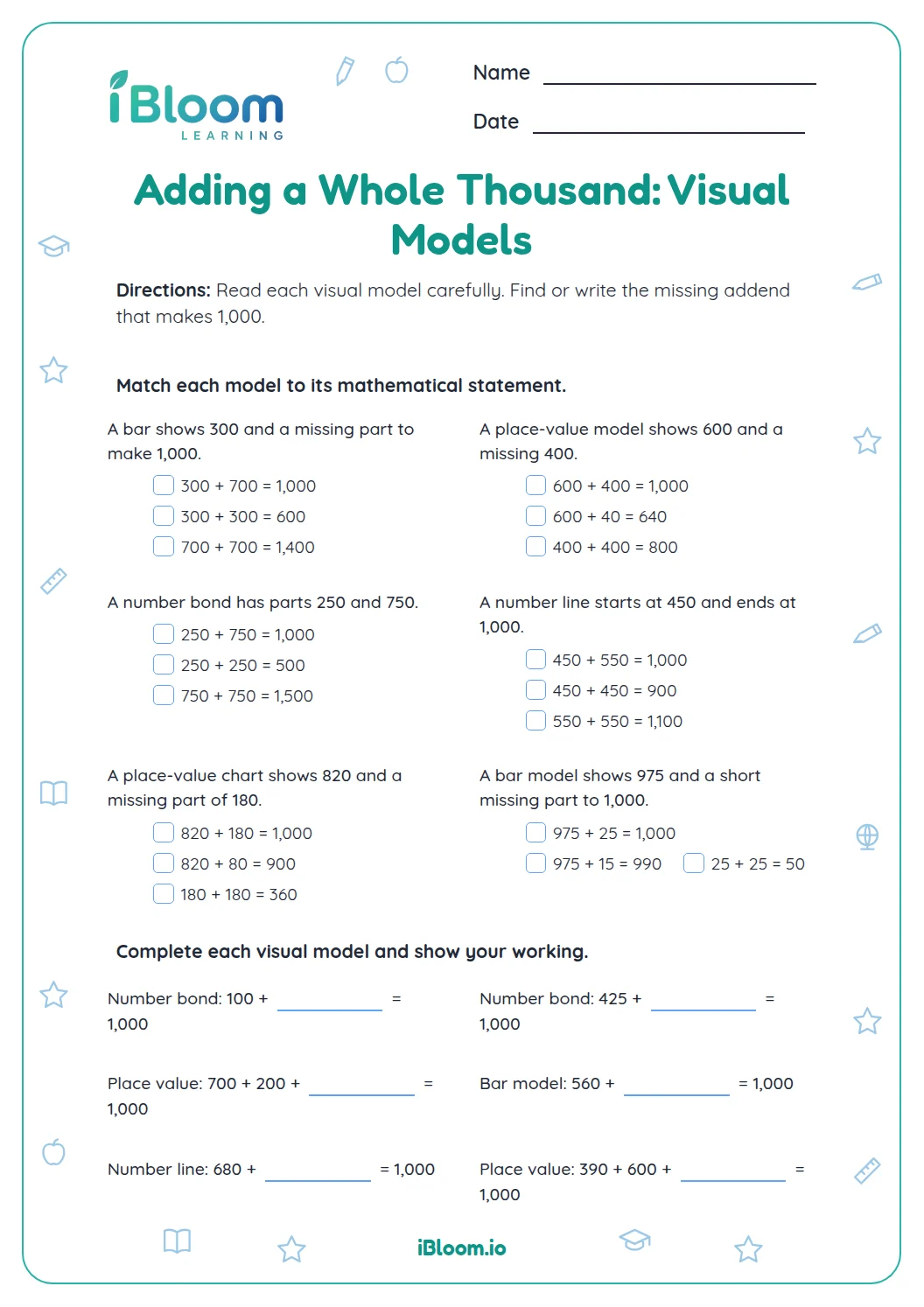
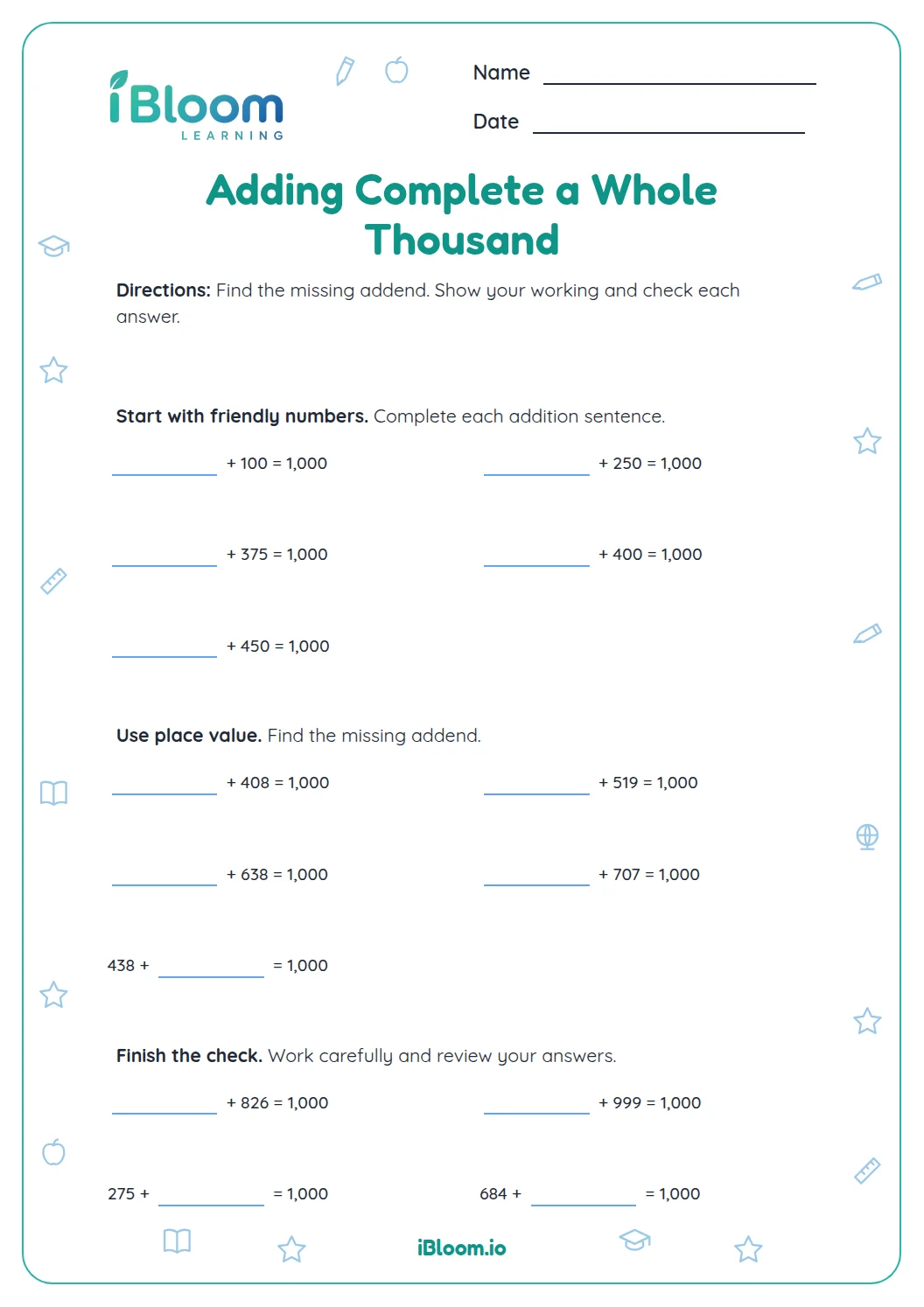
This Grade 3 printable builds reasoning about sums that make a complete hundred. Children find missing addends to 100, select complements, and compare addition claims for totals such as 400 and 600. The separate answer key gives the correct choices and results.
Aligned to 3.NBT.A.2
How do you find an addend that makes 100?
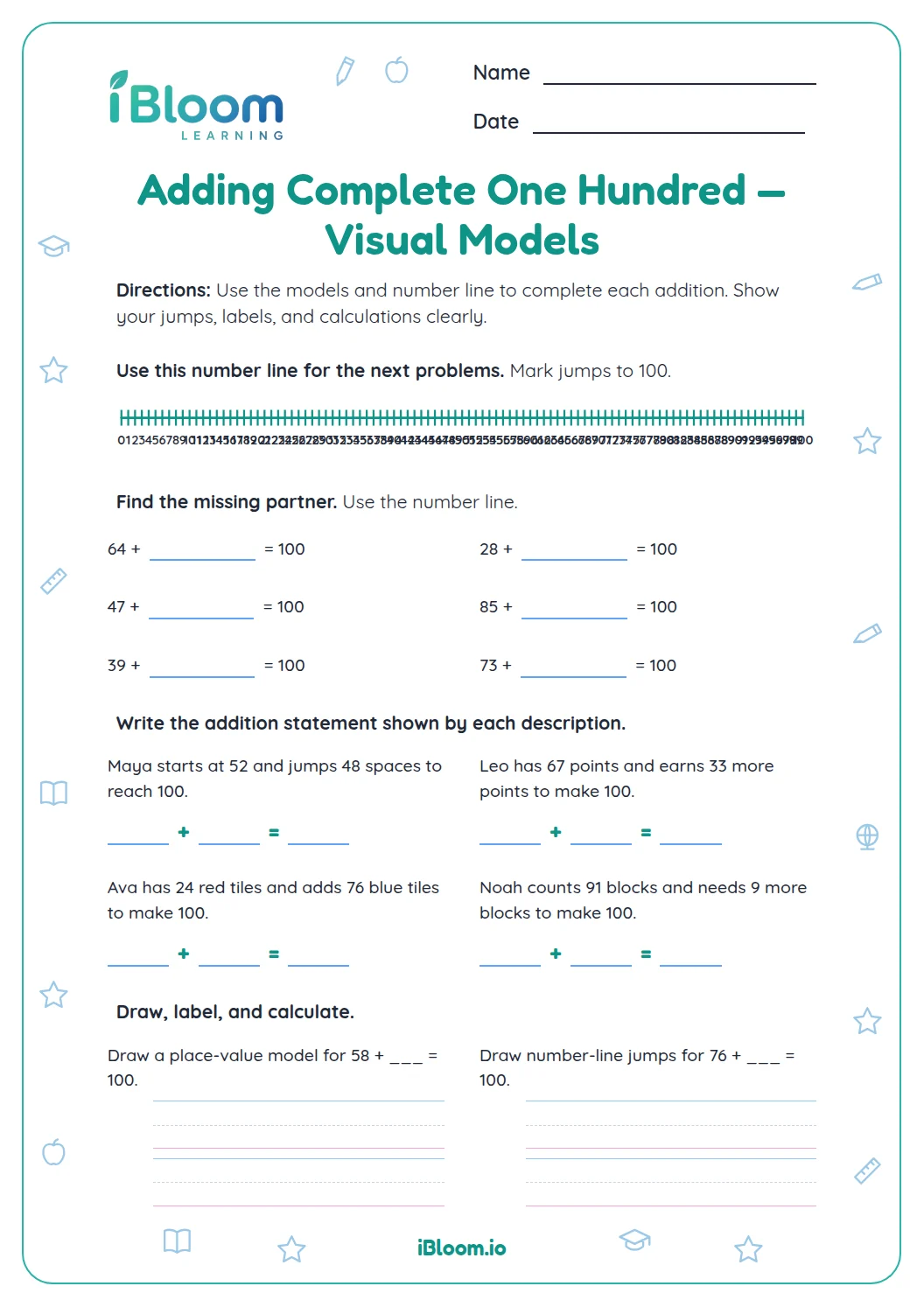
Think about how far the first addend is from 100. For 38 + ___ = 100, count 2 to 40 and 60 more to 100, so the missing addend is 62.
- 138 + ___ = 100
- 238 + 2 = 40
- 340 + 60 = 100
- 4The missing addend is 62.
How can place value help?
Use place value to add larger numbers. For 186 + 214, the hundreds make 300, the tens make 90, and the ones make 10: 300 + 90 + 10 = 400.
How do you check a complete hundred?
A complete hundred ends in 00. First find the sum, then check its tens and ones digits.
How to use this worksheet
- 1Read the target total.
- 2Count from the known addend to a friendly ten.
- 3Continue counting to 100 and combine the jumps.
- 4For larger sums, combine hundreds, tens, and ones.
- 5Check whether the total ends in 00.
Common mistakes and quick fixes
The mistake
Subtracting only the ones digits.
The fix
Use the tens as well: count from the full starting number to 100.
The mistake
Stopping at the next ten instead of 100.
The fix
After reaching that ten, count the remaining tens to 100.
The mistake
Calling any three-digit sum a complete hundred.
The fix
Check that the tens and ones digits are both zero.
Common Core alignment
The questions use place value and addition strategies within 1,000.
Add within 1,000 using place-value strategies.
On this sheet: Children combine addends to reach the next hundred and check totals.
Show the official wordingHide the official wording
Fluently add and subtract within 1000 using strategies and algorithms based on place value, properties of operations, and/or the relationship between addition and subtraction.
What to practice next
Make more practice
Further reading
Questions parents and teachers ask
What does “complete one hundred” mean here?
The first two parts ask for an addend that brings a number to exactly 100. The final part uses larger addends and asks children to add and check whether the total is a multiple of 100. The first two parts target exactly 100, while the final part checks whether larger totals land on a hundred.
How many questions are on the worksheet?
There are 18 questions in three parts: six missing-addend equations, six multiple-choice missing addends, and six addition checks. Children find complements to 100, then add larger pairs and decide whether the total is a complete hundred. The answer key lists each result and check.
What strategy can help find a missing addend?
Break the distance into jumps to a friendly ten and then to 100. For 38, add 2 to reach 40, then 60 to reach 100; combine the jumps to get 62. Counting up by friendly tens is one valid approach; subtracting the known addend from 100 is another.
Why are some addends larger than 100?
The last part extends the same idea to totals such as 400 or 600. Children add the given numbers, then check whether the sum lands exactly on a hundred. A complete hundred has zero in both the tens and ones places.
Does the answer key include the calculations?
The separate key gives the missing addend or sum for each item. Children can compare their work and, when needed, recompute the addition using place-value chunks. The worked reasoning shows how smaller jumps combine into the missing addend.