







About this worksheet
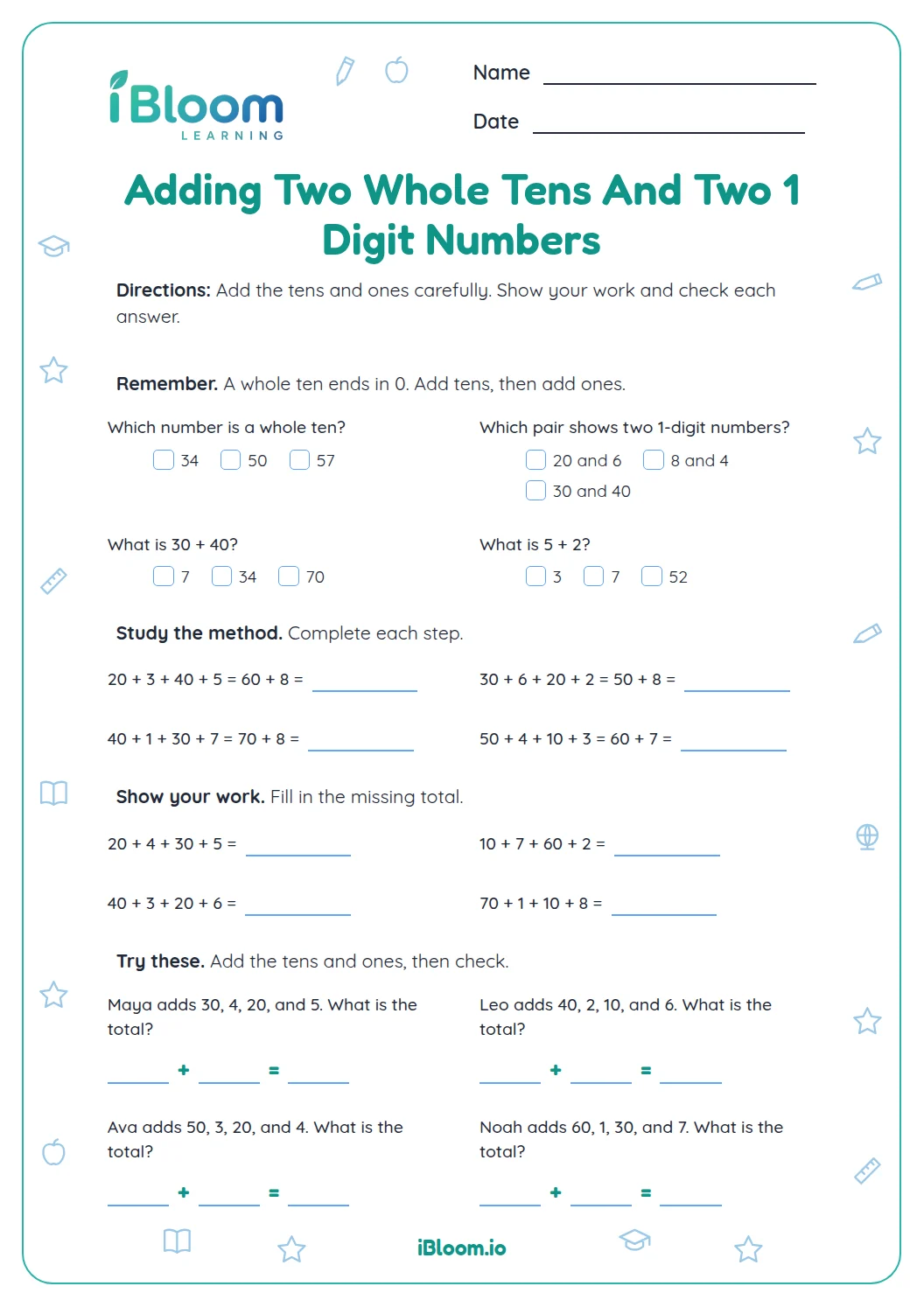
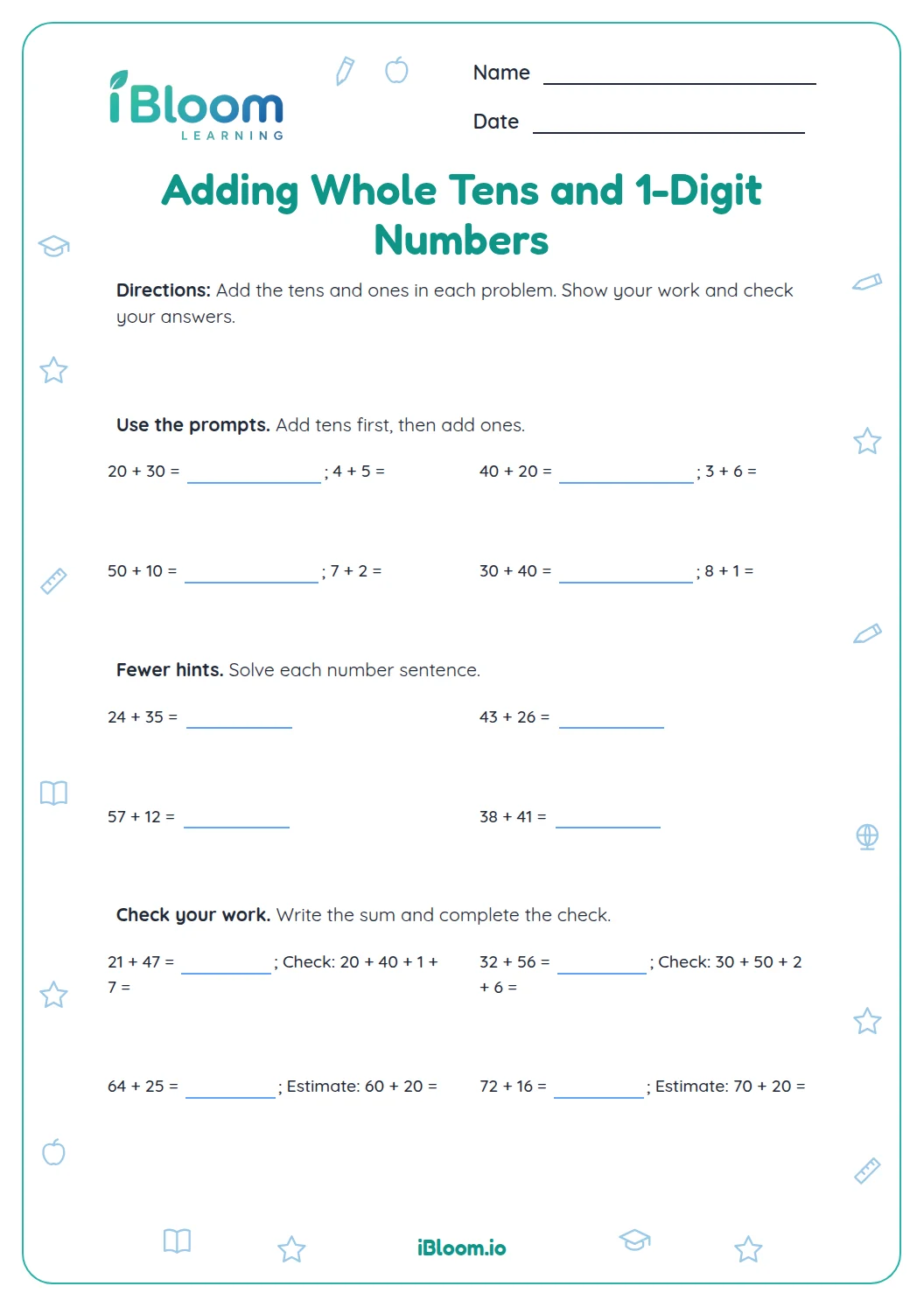
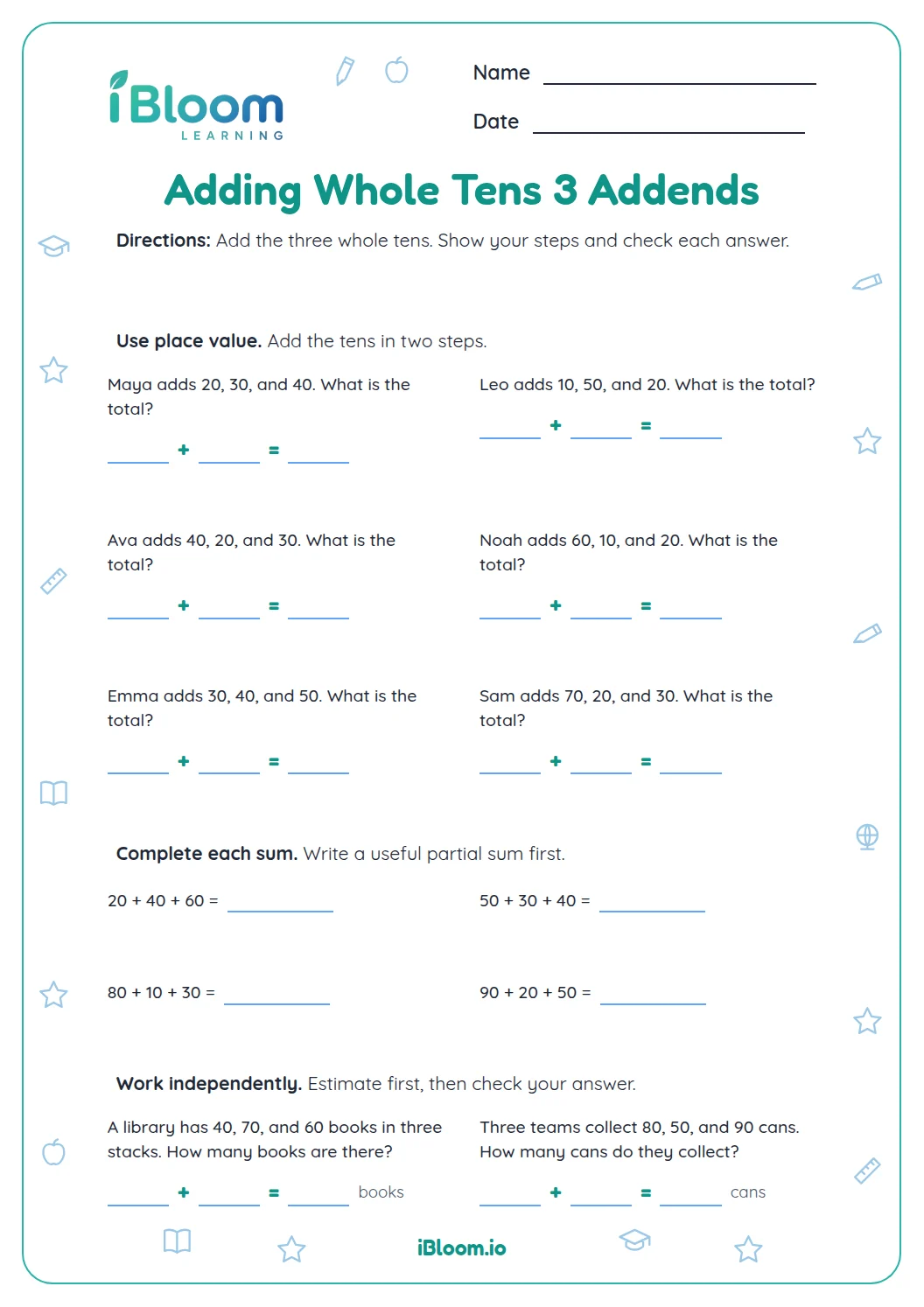
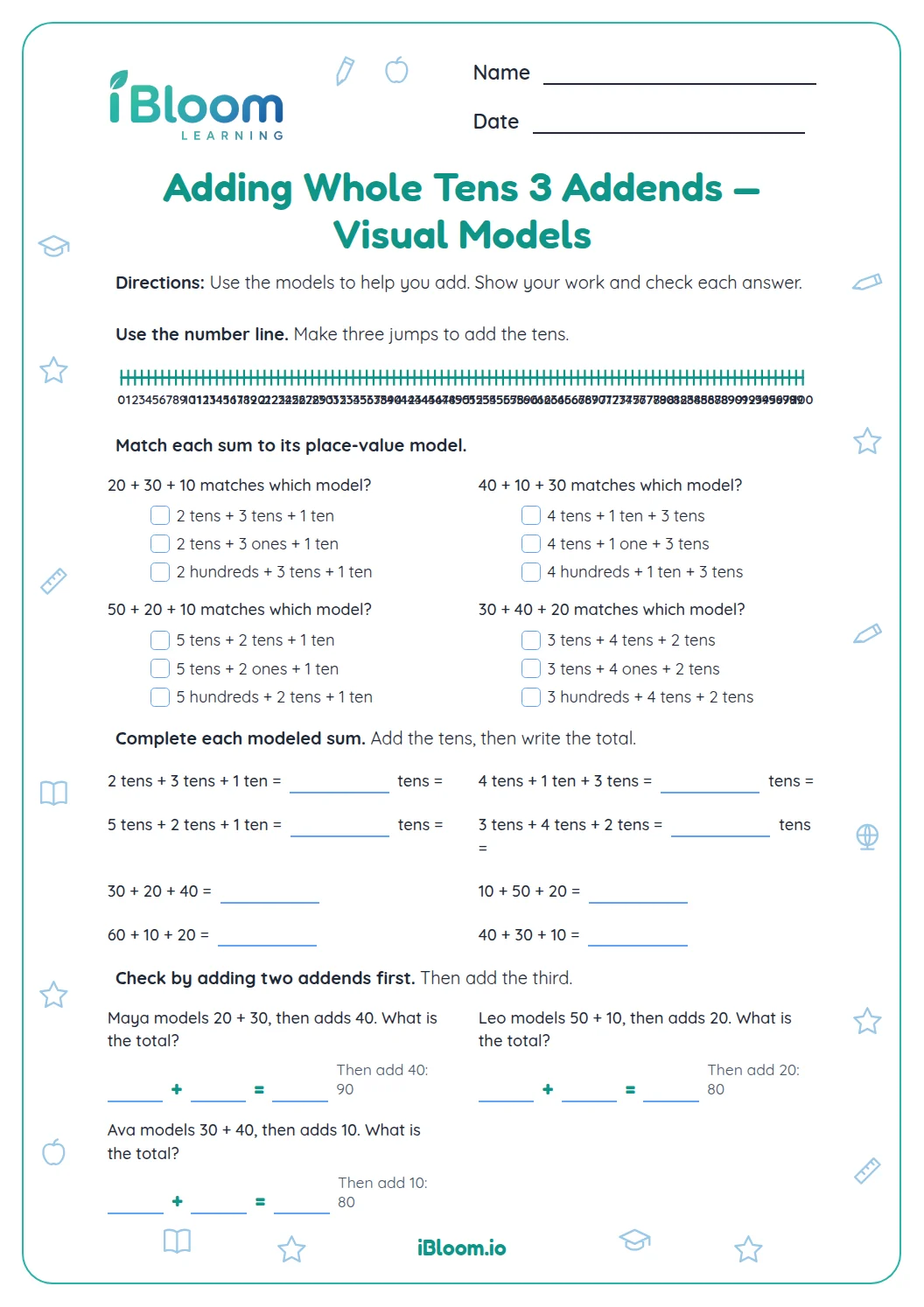
This free printable Grade 3 worksheet gives children independent practice with four-number sums made of two whole tens and two 1-digit numbers, such as 20 + 30 + 4 + 5. Children add the tens, add the ones and put the two results together. Later questions mix the order, hide one number and turn the sum into a short story. It practices Common Core 3.NBT.A.2 and suits third graders who already know their basic addition facts. A matching answer key is included.
Aligned to 3.NBT.A.2 and 2.NBT.B.6
How do you add four numbers with tens and ones?
Four numbers can look like a lot to hold in your head. The trick is to notice that two of them are whole tens (20, 30) and two are ones (4, 5). Tens go with tens and ones go with ones, and each pair is an easy fact.
Writing the groups out helps at first. After a few sums, many children skip the writing and say “fifty and nine.” That is the place-value thinking this sheet is built to strengthen.
- 120 + 30 + 4 + 5 = ___
- 2Tens: 20 + 30 = 50
- 3Ones: 4 + 5 = 9
- 4Together: 50 + 9 = 59
- 520 + 30 + 4 + 5 = 59
What happens when the numbers are mixed up?
In Part B the tens and ones are out of order, as in 7 + 30 + 60 + 4. A child who adds left to right gets 7 + 30 = 37, then 97, then 101, which still works. A child who sorts first sees 30 + 60 = 90 and 7 + 4 = 11, then 90 + 11 = 101. Both routes are fine.
Two sums here go past 100 (question 7 is 101 and question 10 is 109). That is a good moment to ask what 90 and 11 make, because the ones add up to more than ten.
What is on this worksheet?
Sixteen questions on two pages, in four parts that grow harder. Every sum uses two whole tens from 10 to 80 and two 1-digit numbers.
- Part A, Tens first, then ones: six sums with the tens first and the ones last
- Part B, Mixed order: four sums where the tens and ones are mixed up
- Part C, Find the missing number: four sums with one number hidden, such as 40 + ___ + 3 + 6 = 79
- Part D, Word problems: two short stories with working space
- Answer key, two pages, in the same layout
Why include missing numbers?
When a number is hidden, children cannot just run through the numbers in order. For 40 + ___ + 3 + 6 = 79, they find what the known parts make (40 + 3 + 6 = 49) and ask what must be added to reach 79. The answer is 30.
Finding a hidden number links addition and subtraction: the missing number is 79 − 49. In question 14 the hidden number comes first, ___ + 10 + 7 + 2 = 49, so children must look for the missing ten rather than a missing one.
How to use this worksheet at home or in class
- 1Do question 1 together out loud: “Tens first. 20 and 30 make 50. Ones next. 4 and 5 make 9. Now 50 and 9.”
- 2Have your child solve Part A alone, writing the tens total and the ones total beside each sum if that helps.
- 3Before Part B, ask: “Which numbers are tens? Which are ones?” Let your child circle the tens in pencil.
- 4In Part C, ask your child to add the known numbers first, then work out what is missing.
- 5For the word problems, ask for a number sentence before any answer, then check that the sum makes sense.
- 6Mark with the answer key and go back over any missed sum using the tens and ones groups.
Common mistakes and quick fixes
The mistake
Adding the digits and ignoring place value, such as 20 + 30 + 4 + 5 = 14 (from 2 + 3 + 4 + 5).
The fix
Say the numbers aloud. 20 is two tens and 4 is four ones, so they cannot be added as the same size. Tens add with tens: 20 + 30 = 50. Ones add with ones: 4 + 5 = 9.
The mistake
Losing the extra ten when the ones add to more than ten, such as 7 + 30 + 60 + 4 = 91 instead of 101 in question 7.
The fix
Write each total on its own line: tens 30 + 60 = 90, ones 7 + 4 = 11. Eleven ones is one ten and one more, so 90 + 11 = 101.
The mistake
Stopping early on a word problem and adding only two of the four numbers.
The fix
Underline every number in the story first. Four numbers means four amounts to add.
Common Core alignment
Most US states teach place-value addition with the Common Core standards or a close state version. These two standards match what this sheet practices.
Add within 1000 using place value and properties of operations.
On this sheet: Every sum is solved by grouping the tens and the ones, and a missing-number part links addition to subtraction.
Show the official wordingHide the official wording
Fluently add and subtract within 1000 using strategies and algorithms based on place value, properties of operations, and/or the relationship between addition and subtraction.
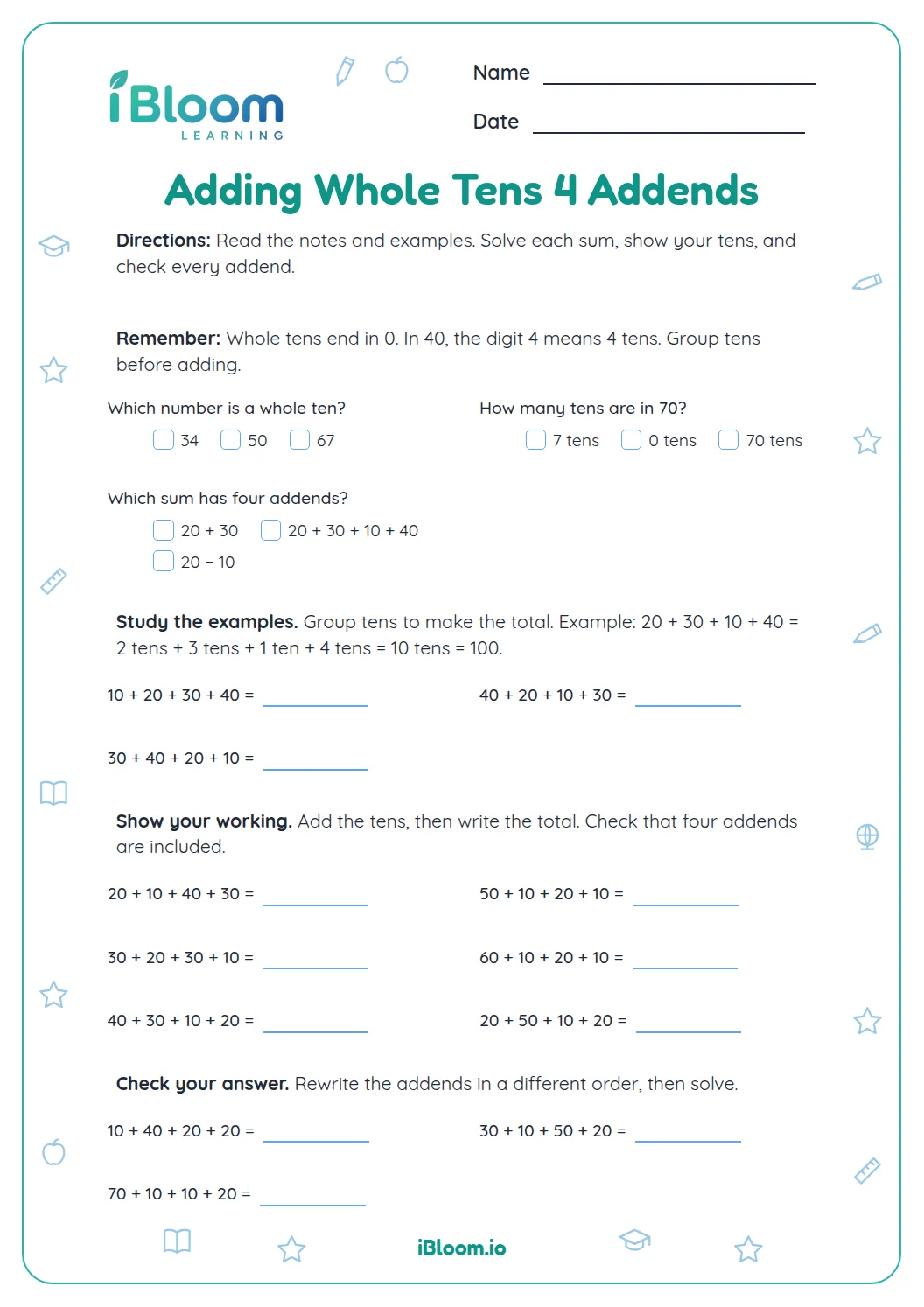
Add up to four numbers using place value.
On this sheet: Each sum on the sheet has four addends that children regroup by place value.
Show the official wordingHide the official wording
Add up to four two-digit numbers using strategies based on place value and properties of operations.
What to practice next
Make more practice
Further reading
Questions parents and teachers ask
What should my child know before this worksheet?
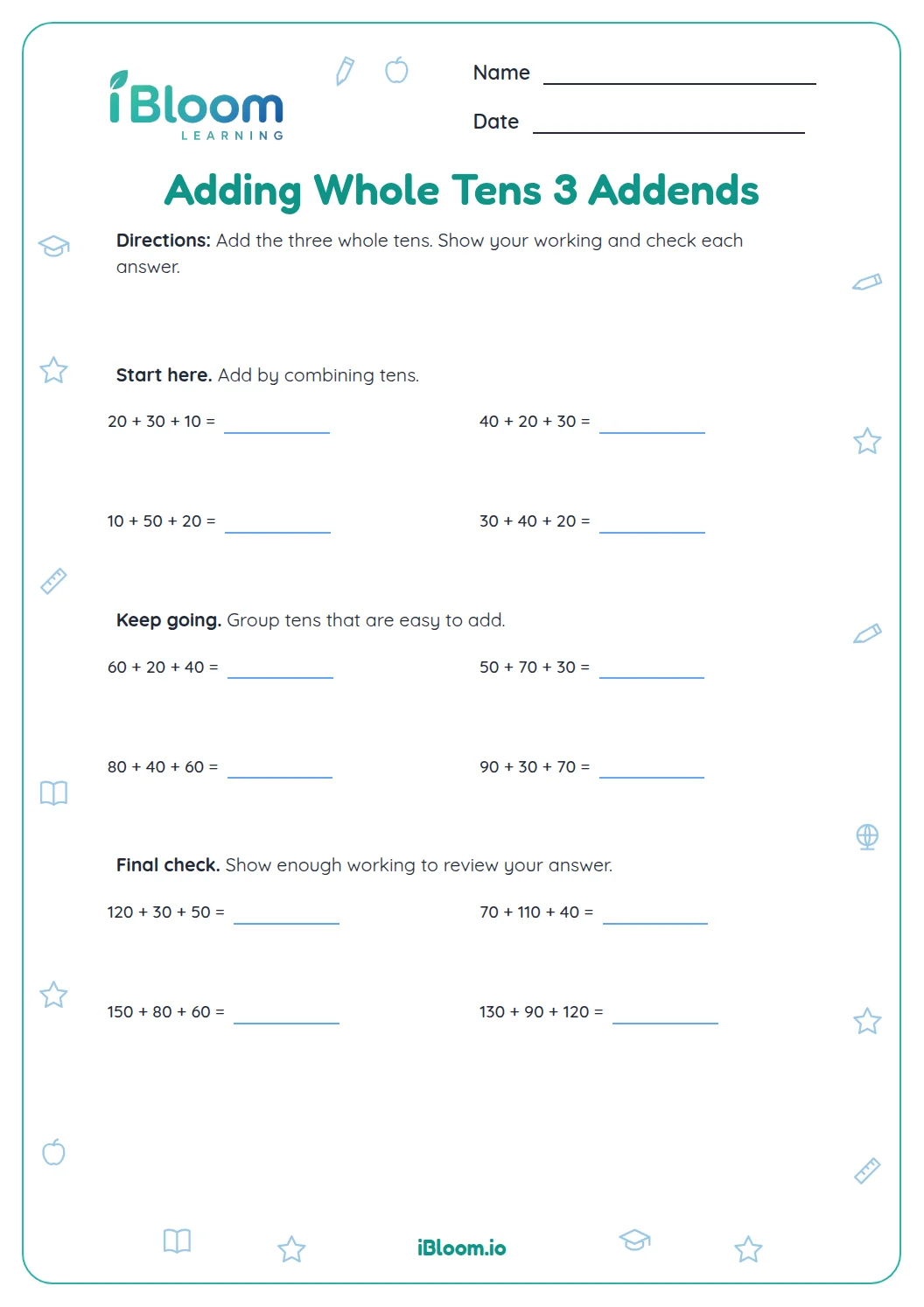
Your child should know basic addition facts within 20 and be able to add multiples of ten, such as 20 + 30 = 50. Knowing that 20 is two tens helps too. If those are shaky, try the Adding Whole Tens worksheets first, then return here for four-number sums.
What is the answer to 20 + 30 + 4 + 5?
The answer is 59. Add the tens first: 20 + 30 = 50. Add the ones: 4 + 5 = 9. Then put them together: 50 + 9 = 59. Question 1 on the sheet is this exact sum, so children can check the method on the very first question.
Does the order of the numbers change the answer?
No. Addition gives the same total in any order, so 7 + 30 + 60 + 4 equals 30 + 60 + 7 + 4. Part B practices this by mixing the tens and ones together. Sorting the numbers into tens and ones first turns each step into an easy fact, such as 30 + 60 and 7 + 4.
How do children solve 40 + ___ + 3 + 6 = 79?
They add what they can see first. 40 + 3 + 6 is 49, so the missing number must close the gap between 49 and 79. That gap is 30. Question 11 on the sheet is this problem, and children can check by adding 40 + 30 + 3 + 6.
Why do some answers go over 100?
Two sums on the sheet go past 100 on purpose. In question 7, 7 + 30 + 60 + 4, the tens make 90 and the ones make 11, so the 11 ones give one more ten and the total is 101. In question 10 the tens alone make 100. Both are good practice before column addition.
Is there an answer key for this worksheet?
Yes. The answer key shows every sum, missing number and word problem answer in the same layout as the worksheet. Download the free PDF from this page, print the worksheet by itself and use the key to check your child's work, then go over any missed sums together.