






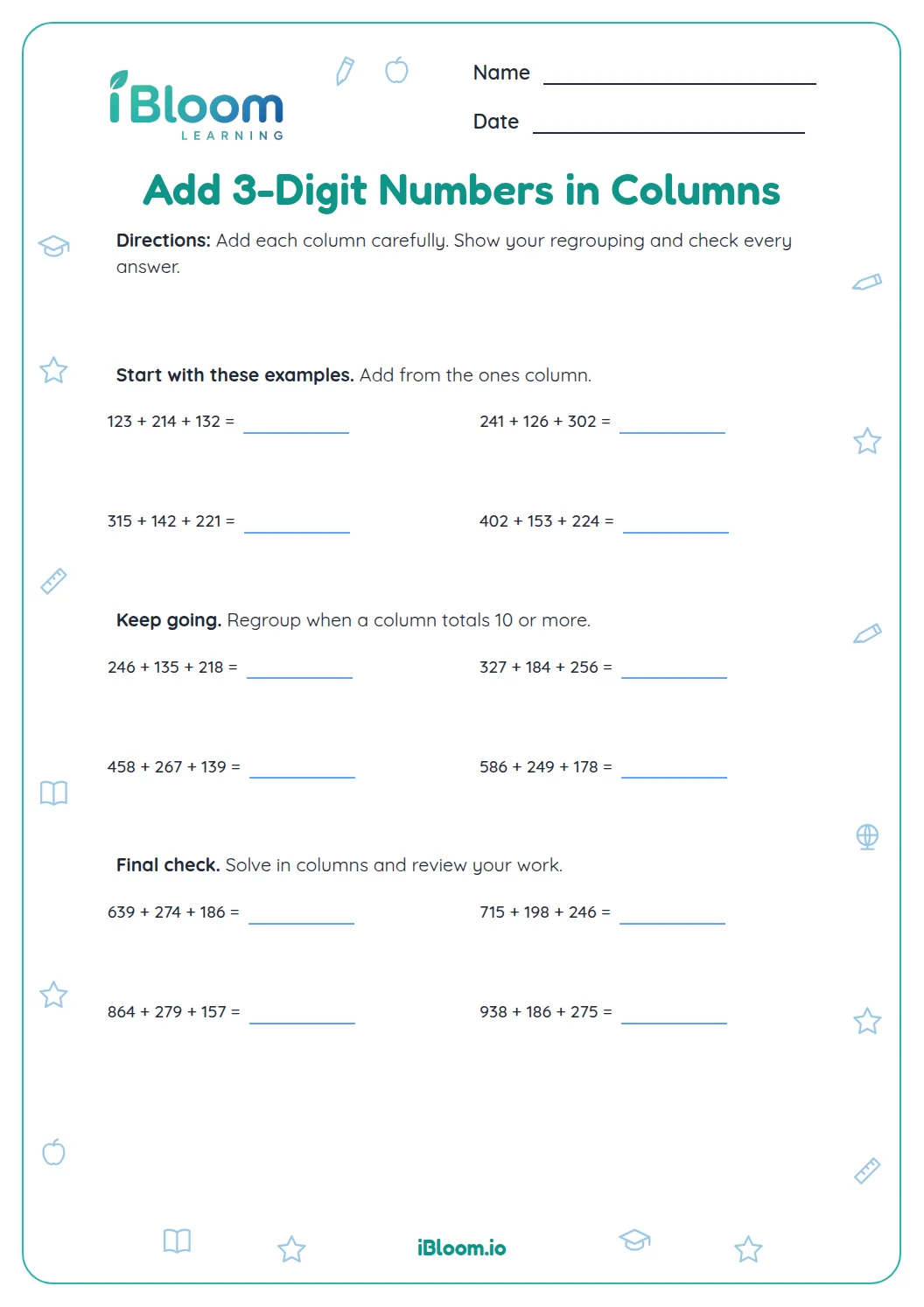
About this worksheet
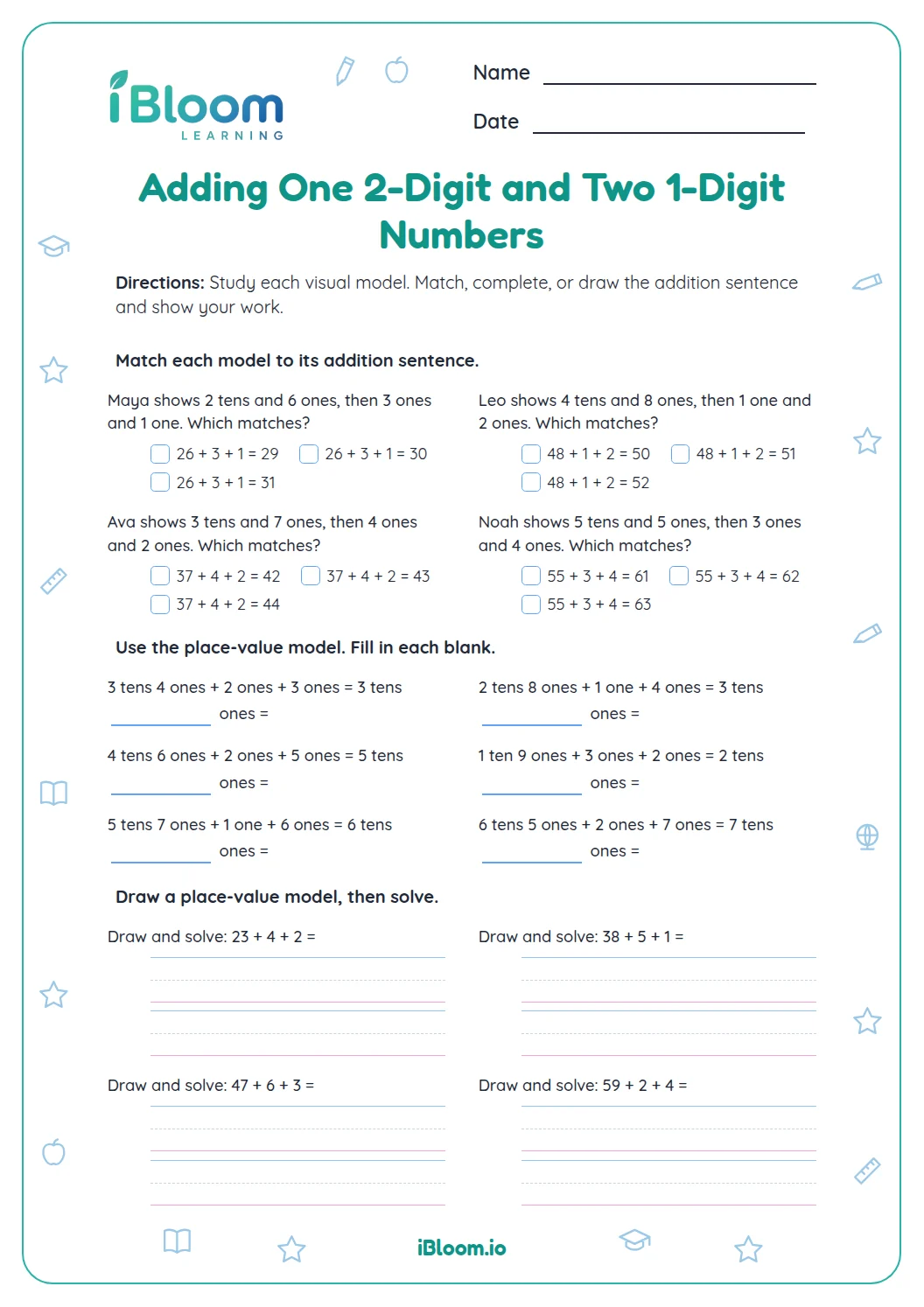
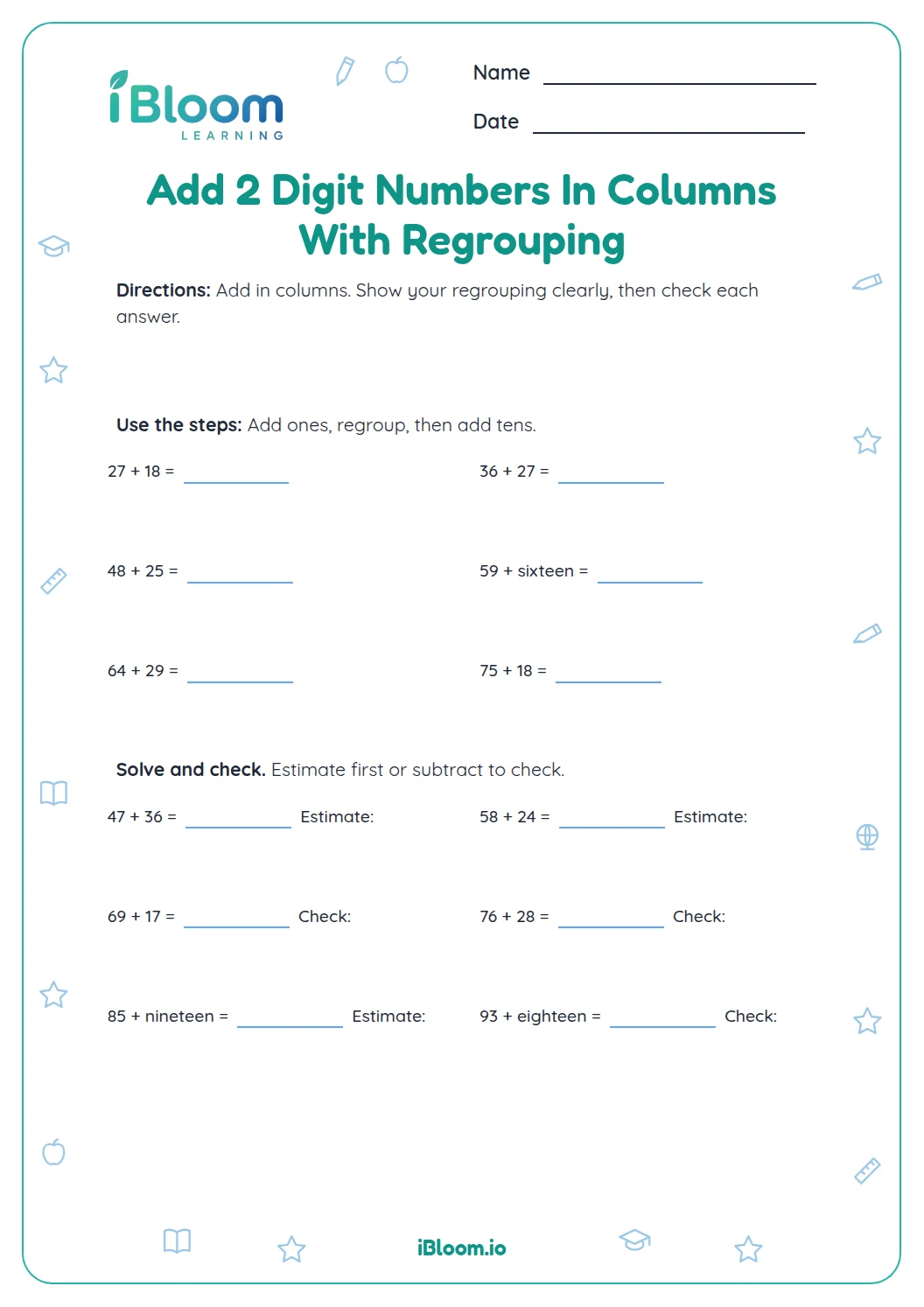
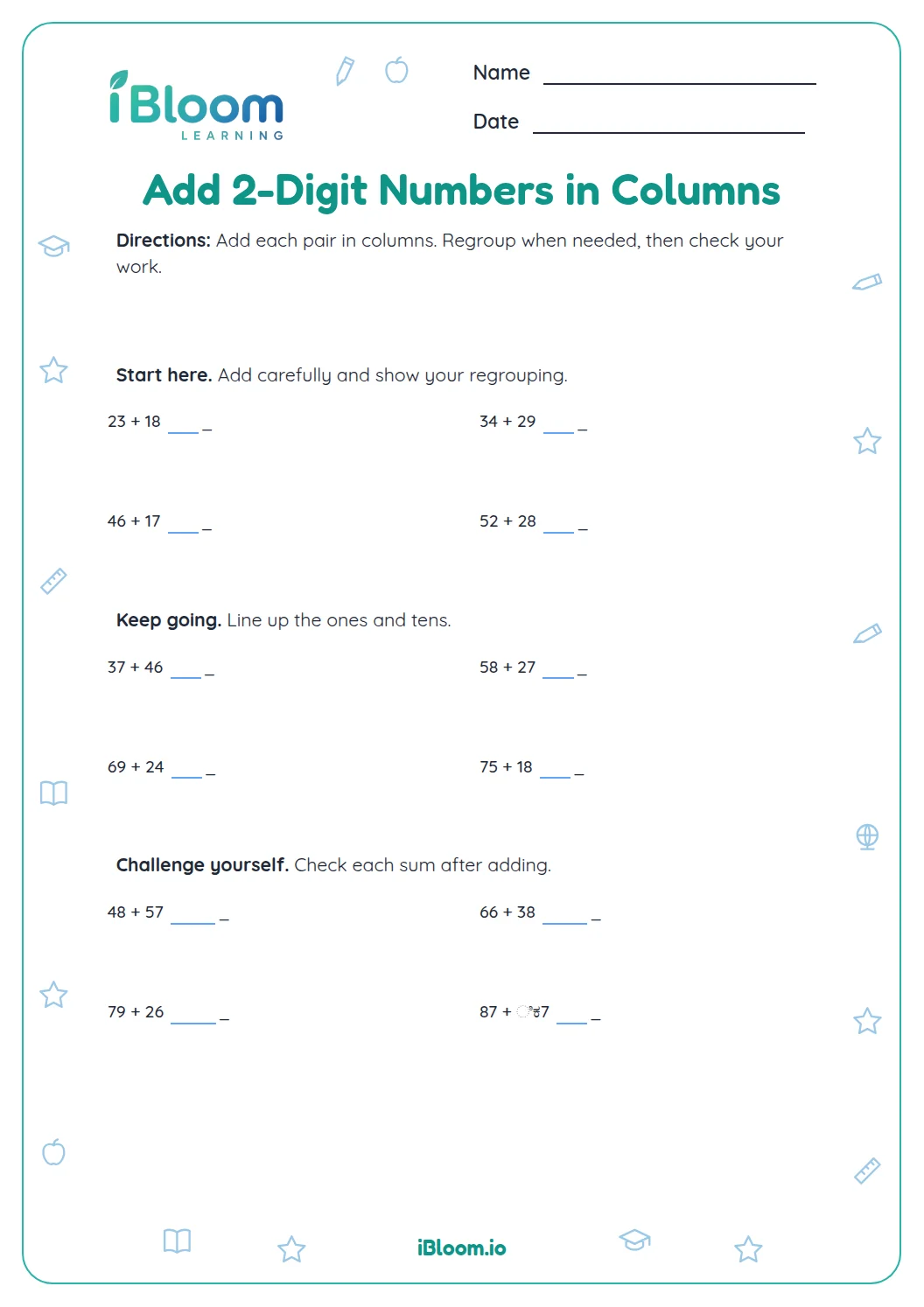
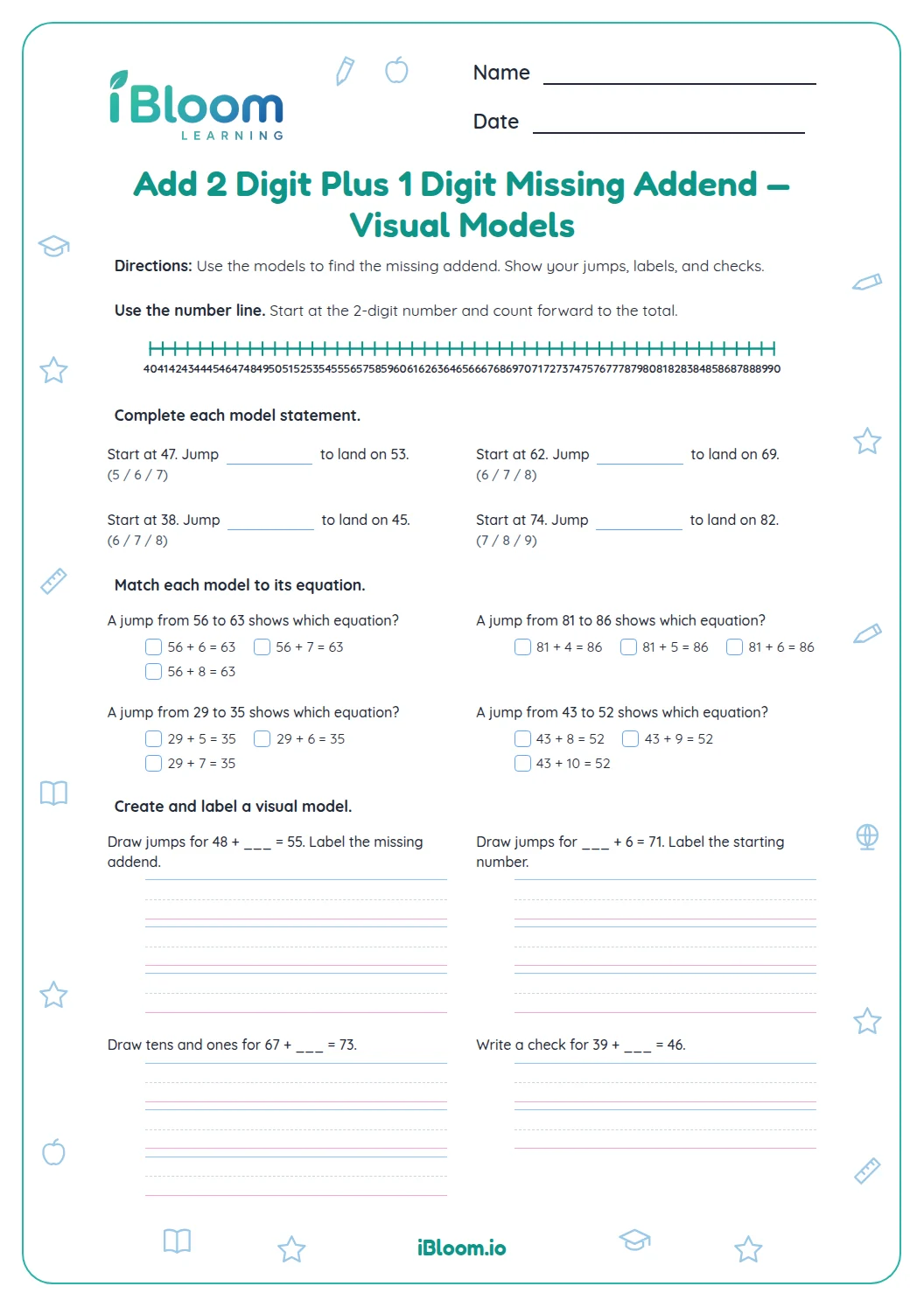
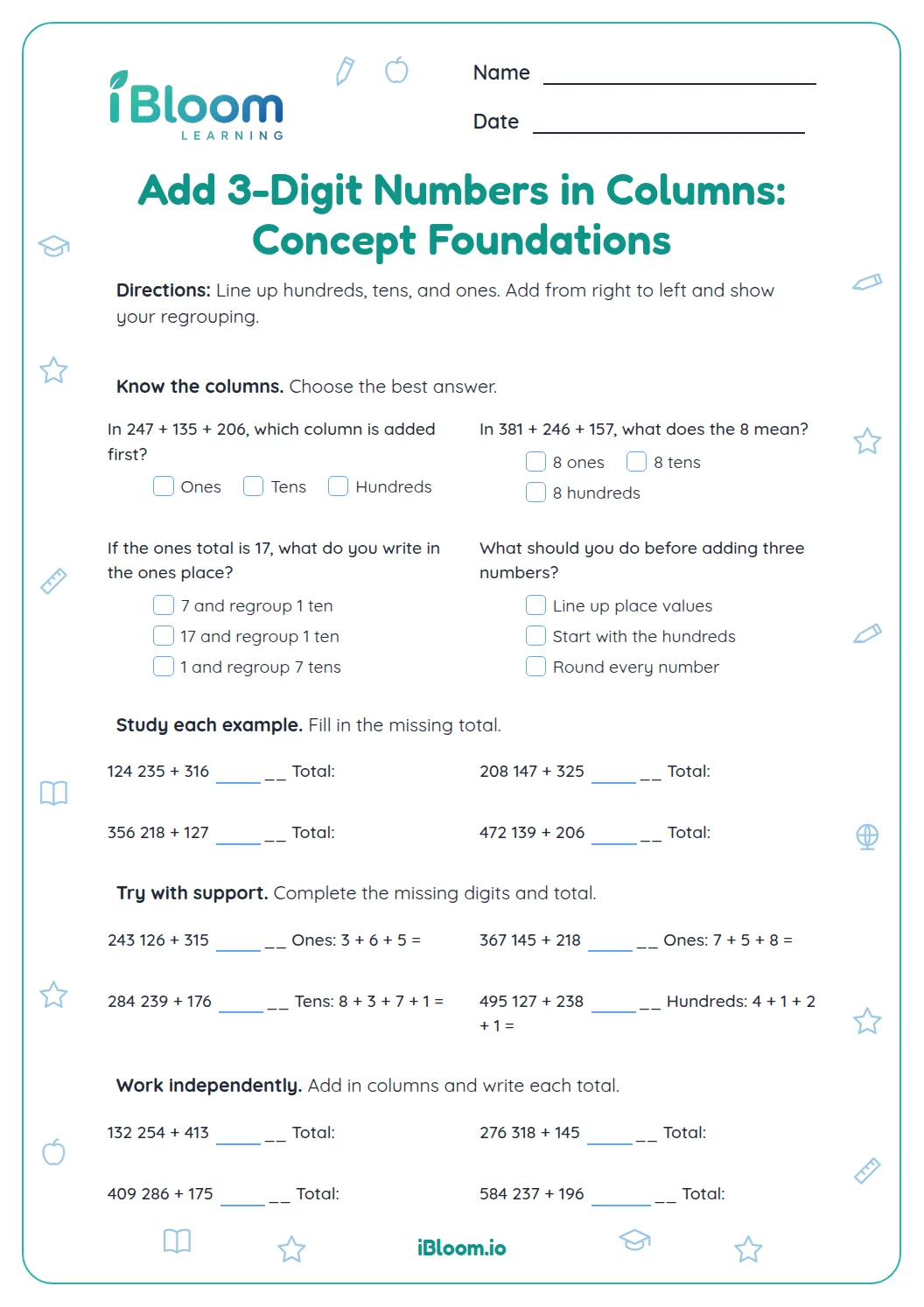
This Grade 3 worksheet gives learners 16 guided problems adding one two-digit number and two one-digit numbers. Early facts invite learners to combine the one-digit addends first; later sums cross a ten and the final questions apply the same structure to short situations and a missing addend. The separate key supports checking each total.
Aligned to 3.NBT.A.2
How can you make a ten first?
Look at the two one-digit addends and combine them. In 24 + 3 + 5, 3 + 5 = 8; then add 8 to 24 to get 32. When the one-digit addends total more than 10, add the ones and regroup as needed.
- 124 + 3 + 5 = ___
- 23 + 5 = 8
- 324 + 8 = 32.
What if the small addends cross a ten?
For 27 + 8 + 6, combine 8 + 6 to make 14. Add 14 to 27 to get 41. Keep track of the extra ten instead of adding only the ones digits.
How does the same method work in a situation?
For the tile question, there are 37 red tiles and two groups of 6 blue tiles: 37 + 6 + 6 = 49. Write the three addends before finding the total.
How to use this worksheet
- 1Read the three addends and identify the two one-digit numbers.
- 2Combine the one-digit addends first when it is helpful.
- 3Add that sum to the two-digit number.
- 4Regroup a ten if the ones total is 10 or more.
- 5Check the total with a quick estimate or a second grouping.
Mistakes to watch for
The mistake
Adding only one of the small addends.
The fix
Rewrite the full expression and account for all three numbers.
The mistake
Losing a ten when the ones add to 10 or more.
The fix
Regroup ten ones as one ten, then finish the sum.
The mistake
Treating two groups of 6 as just 6.
The fix
Represent both groups: 6 + 6, then add the red tiles.
Common Core alignment
This worksheet practices the listed Common Core skill.
Add three addends within 100 using place-value strategies.
On this sheet: The questions directly practice this skill.
Show the official wordingHide the official wording
Fluently add and subtract within 1000 using strategies and algorithms based on place value, properties of operations, and/or the relationship between addition and subtraction.
What to practice next
Make more practice
Further reading
Questions parents and teachers ask
How can a learner add three numbers efficiently?
Try combining the two one-digit addends first. For 24 + 3 + 5, combine 3 + 5 to make 8, then calculate 24 + 8 = 32. If the small addends make more than 10, include that extra ten in the total.
Does the worksheet include regrouping?
Yes. Problems such as 27 + 8 + 6 combine the small addends to make 14, so the total crosses a ten. Learners can keep the extra ten in mind when adding to the two-digit number. Check that the total includes the two-digit addend and both one-digit addends.
How many questions are included?
The worksheet has 16 questions across two practice pages, followed by a separate two-page answer key. It includes number sentences, short situations, and a missing one-digit addend. Check that the total includes the two-digit addend and both one-digit addends.
What does the tile problem mean by two groups of 6?
It means there are 6 blue tiles in each of two groups, for 6 + 6 blue tiles altogether. Add those 12 blue tiles to the 37 red tiles: 37 + 6 + 6 = 49 tiles. Check that the total includes the two-digit addend and both one-digit addends.
Can learners choose a different order for the addends?
Yes. Addition can be grouped in a helpful order, as long as all three addends are included. Combining the two one-digit addends first often makes it easier to see whether the sum crosses a ten. Check that the total includes the two-digit addend and both one-digit addends.