






About this worksheet
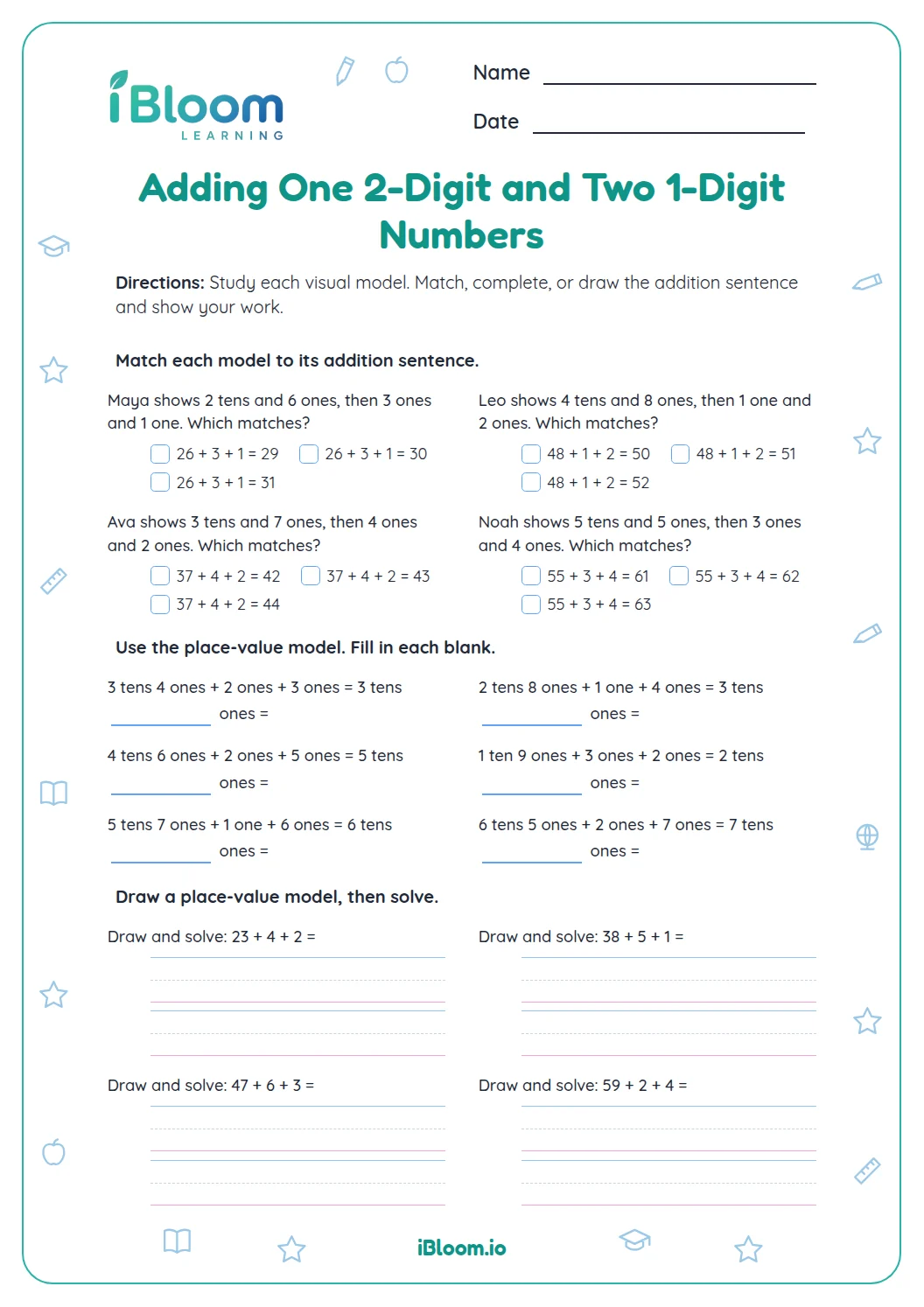
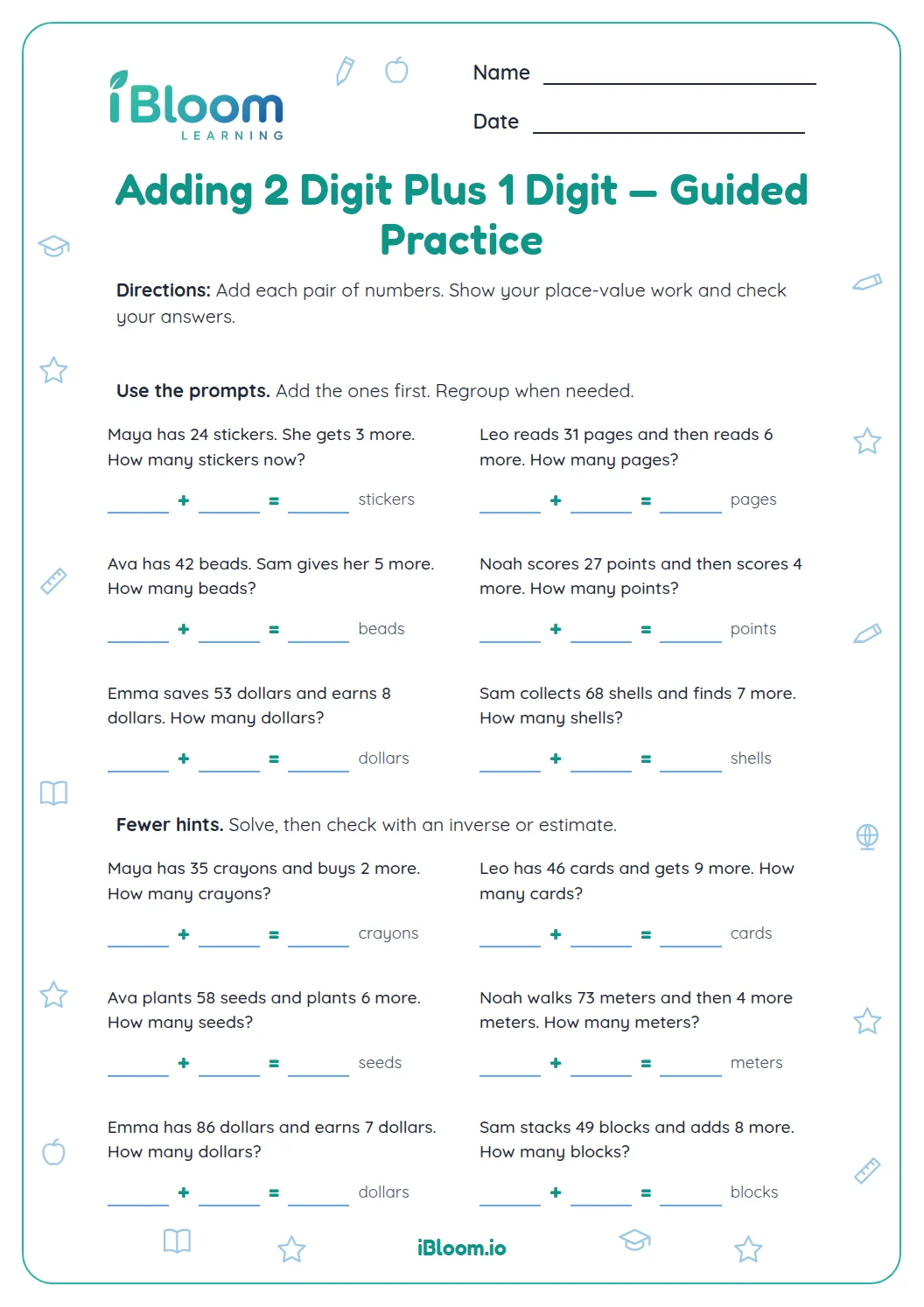
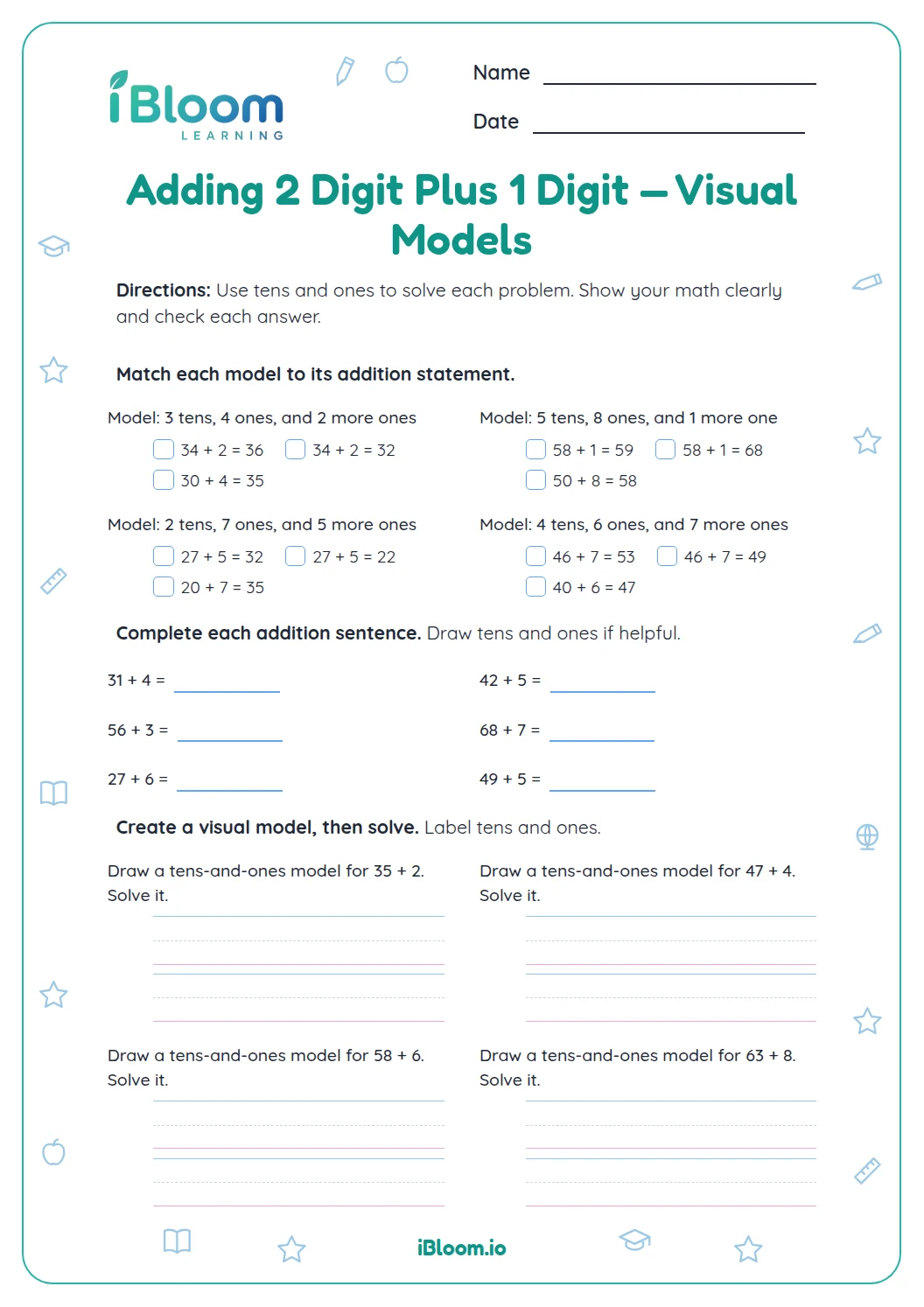
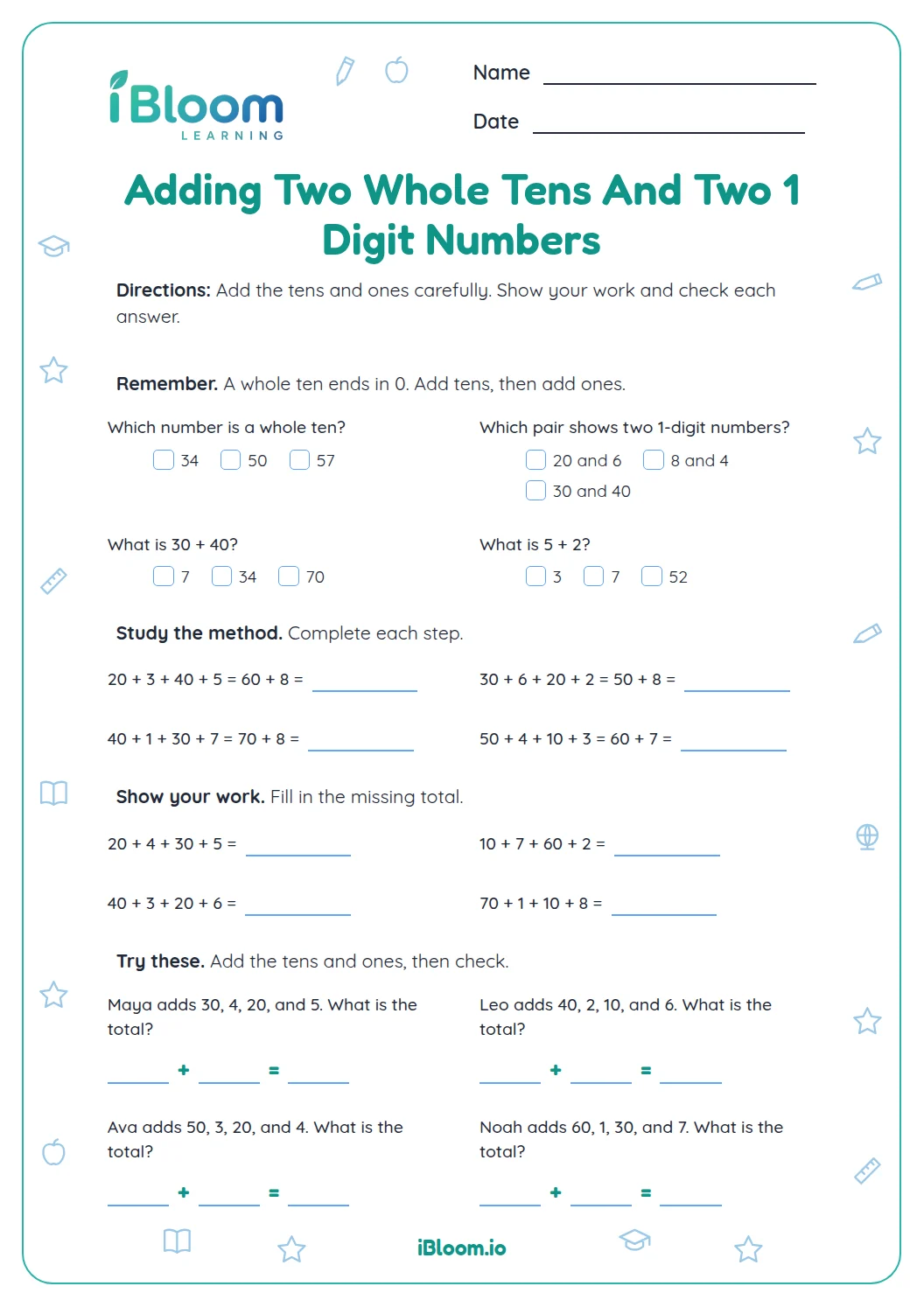
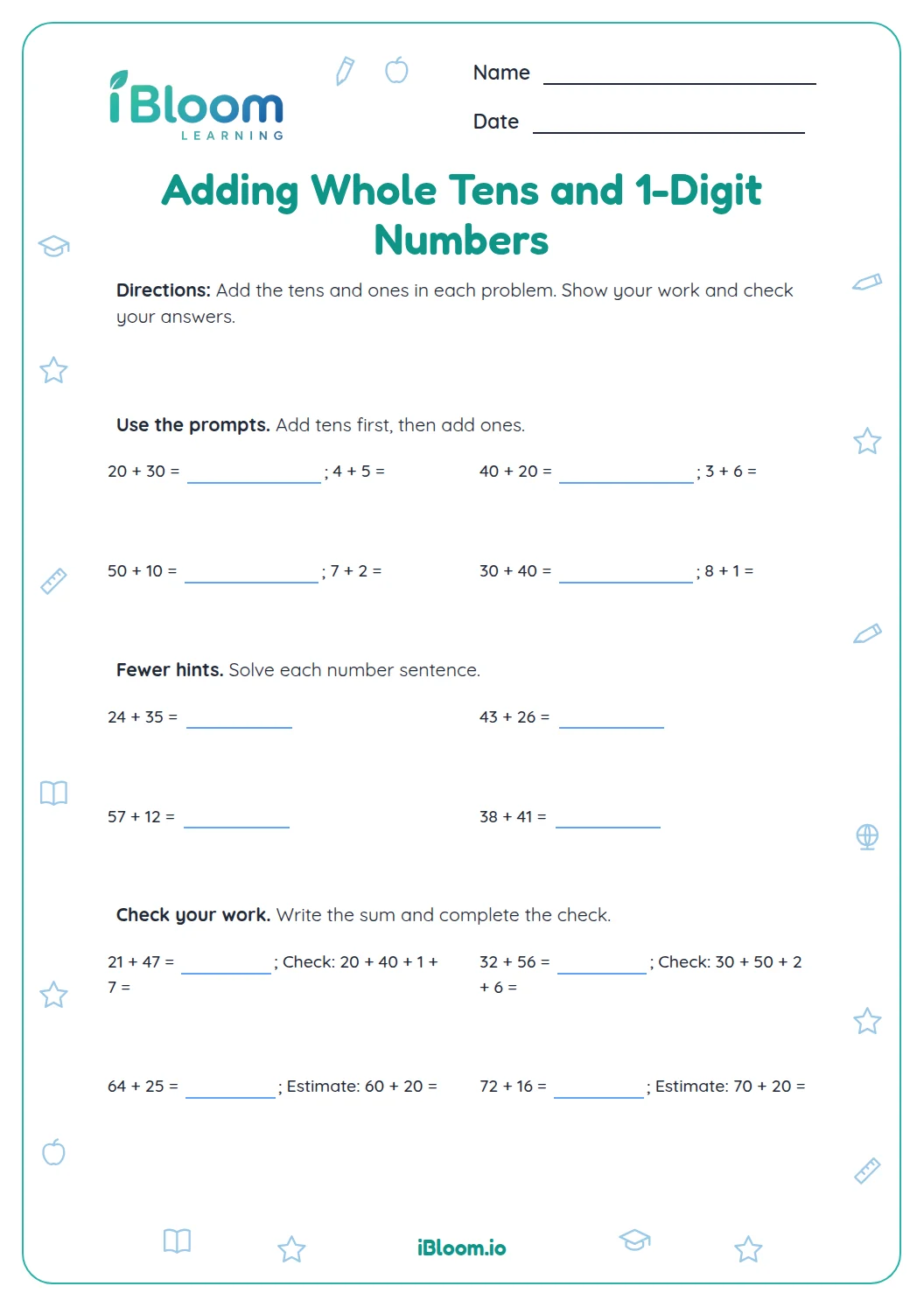
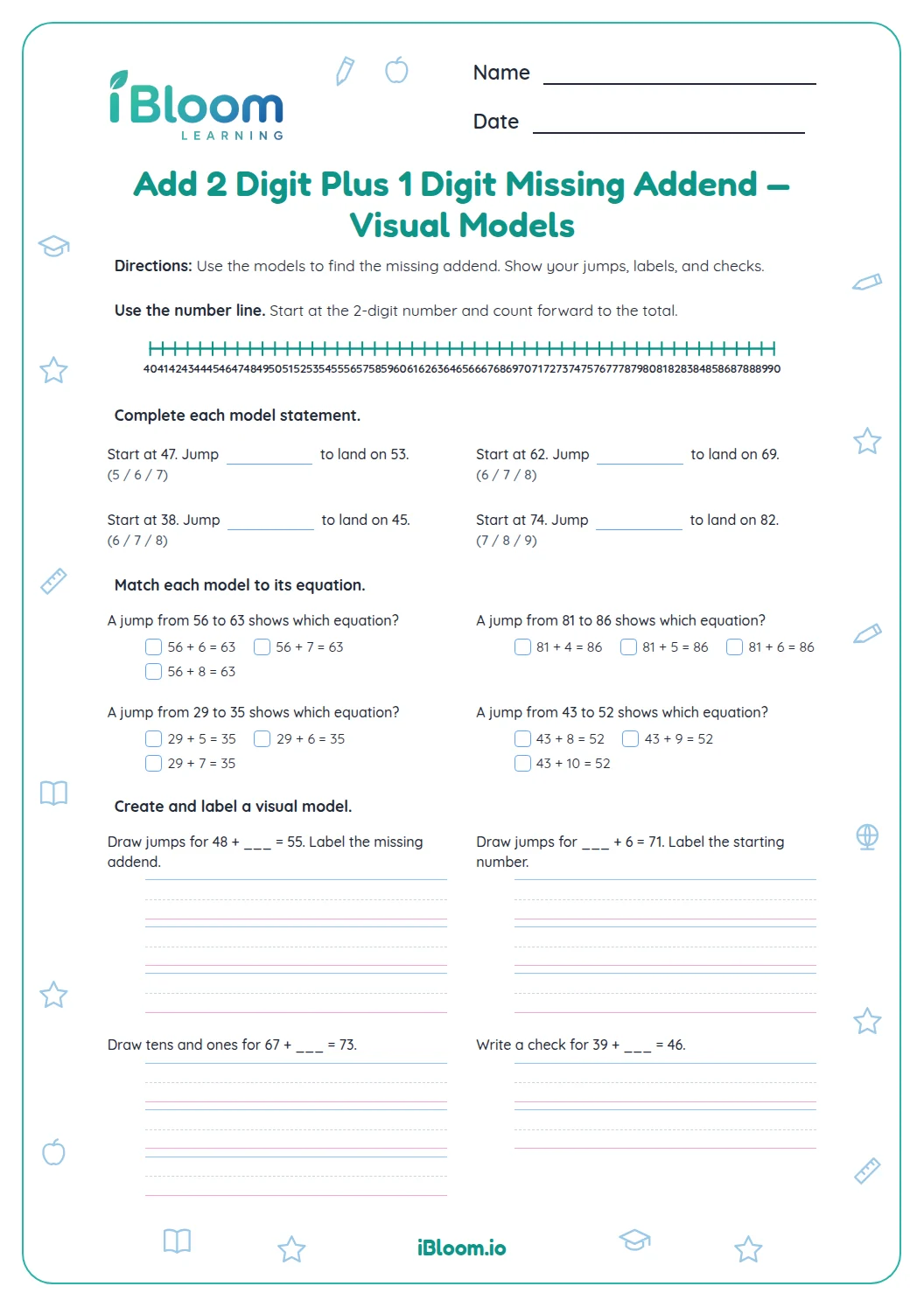
This free Grade 3 addition worksheet focuses on sums with one two-digit addend and two one-digit addends. Children practice friendly pairs that make ten, solve word problems, and find a missing addend. The 18 questions progress from direct number sentences to short contexts and a strategy choice. A separate answer key includes units for the word problems. The skill connects to CCSS 3.NBT.A.2 through place-value strategies for addition.
Aligned to 3.NBT.A.2
Why add the one-digit numbers first?
Two one-digit addends may make a friendly ten. For 34 + 5 + 2, add 5 + 2 = 7, then 34 + 7 = 41. When the pair makes ten, adding that ten is especially quick.
Question 15 uses 54 + 7 + 3. Since 7 + 3 = 10, add ten to 54 to get 64.
- 134 + 5 + 2
- 25 + 2 = 7
- 334 + 7 = 41
How do you turn a story into addition?
Find the starting amount and both amounts being added. In question 9, Ava starts with 32 beads, then gets 4 and 5 more. Write 32 + 4 + 5 = 41 beads.
How can you find a missing addend?
Use the total and subtract the numbers you already know. For 29 + ___ + 6 = 38, subtract 29 and 6 from 38 to find 3. Check by adding all three numbers back together.
How to use this worksheet
- 1Read all three addends before choosing a first step.
- 2Look for a pair of one-digit numbers that makes ten.
- 3Add that ten to the tens and ones in the two-digit number.
- 4For a story problem, write the addition sentence before solving.
- 5Use inverse addition to check a missing addend.
- 6Estimate the total to see if it is reasonable.
Common mistakes and quick fixes
The mistake
Adding only two of the three numbers.
The fix
Circle all three addends, then check that each is used once.
The mistake
Combining digits without making a new ten, such as treating 7 + 3 as 10 ones but forgetting to add it.
The fix
Write 7 + 3 = 10, then add the ten to the two-digit number.
The mistake
Choosing a number too large for a missing addend.
The fix
Subtract the known addends from the total: 38 − 29 − 6 = 3.
Curriculum alignment
This worksheet practices the following standard.
Add within 1,000 using place-value strategies and properties.
On this sheet: Children combine a two-digit addend with two one-digit addends, using place-value thinking and sums to make a ten.
Show the official wordingHide the official wording
Fluently add and subtract within 1000 using strategies and algorithms based on place value, properties of operations, and/or the relationship between addition and subtraction.
What to practice next
Make more practice
Further reading
Questions parents and teachers ask
What does “three addends” mean?
An addend is a number being added. Each number sentence combines one two-digit number with two one-digit numbers, such as 34 + 5 + 2. The 18 questions include sums, a missing addend, and one short story that uses three amounts.
When should my child add the small numbers first?
Try adding the two one-digit addends first when they make a friendly total such as 10. In 54 + 7 + 3, 7 + 3 makes 10, so the sum is 64. If they do not make 10, another order still works.
How can my child check an addition answer?
Add in a different order or break the two-digit number into tens and ones. For 34 + 5 + 2, combine 5 and 2 to make 7, then check that 34 + 7 equals 41. The sheet has direct sums, a missing-addend item, and a bead story.
How do you solve the missing-addend problem?
Subtract the known addends from the total. For 29 + ___ + 6 = 38, first calculate 38 − 29 = 9, then 9 − 6 = 3. Put 3 in the blank and add 29 + 3 + 6 to check that the total is 38.
How many questions and pages are included?
The sheet has 18 questions across two worksheet pages, with a separate two-page answer key. Seventeen are number sentences or a missing-addend equation, and one is a short word problem. The key gives each sum and includes units for the story answer.