





About this worksheet
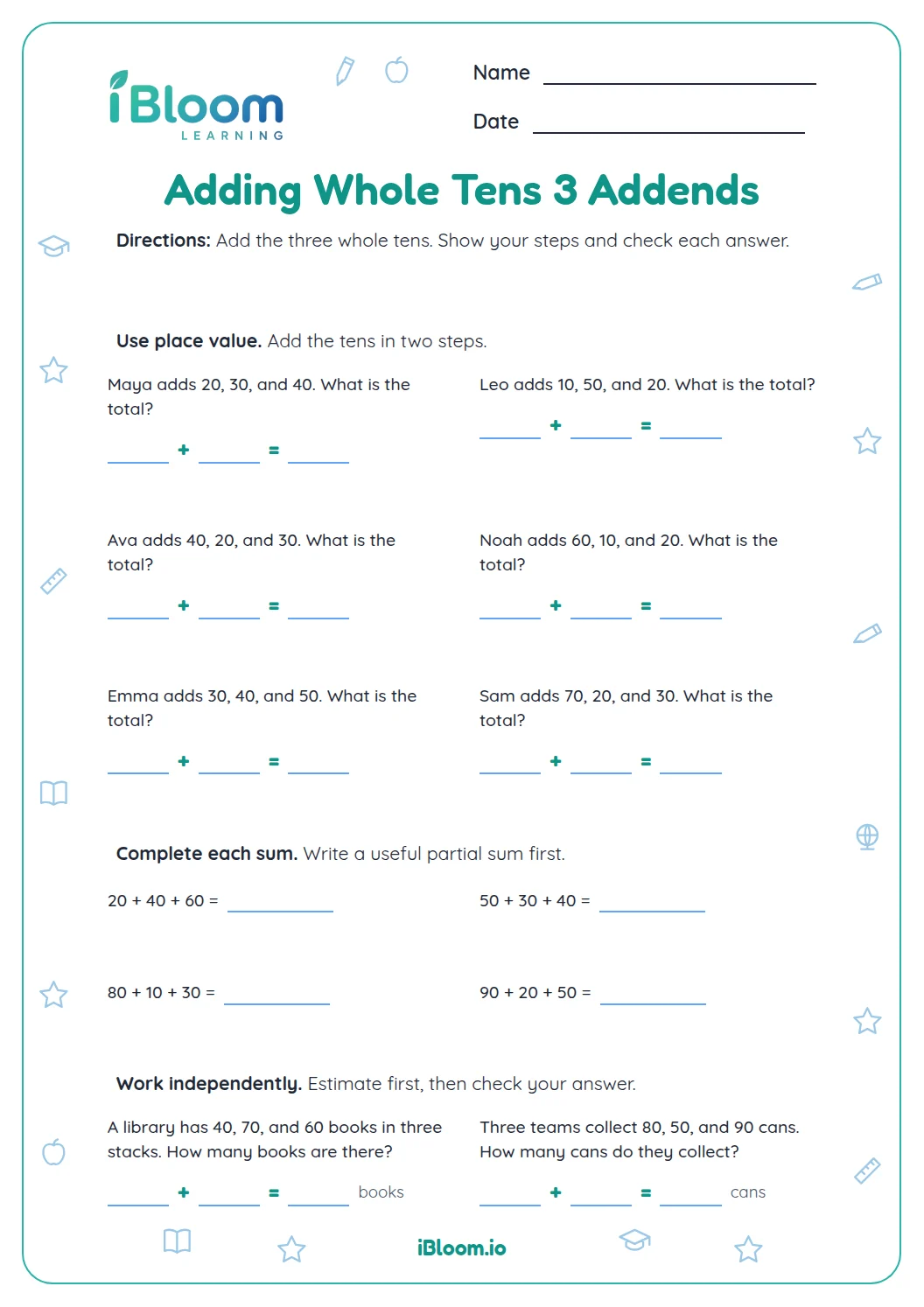
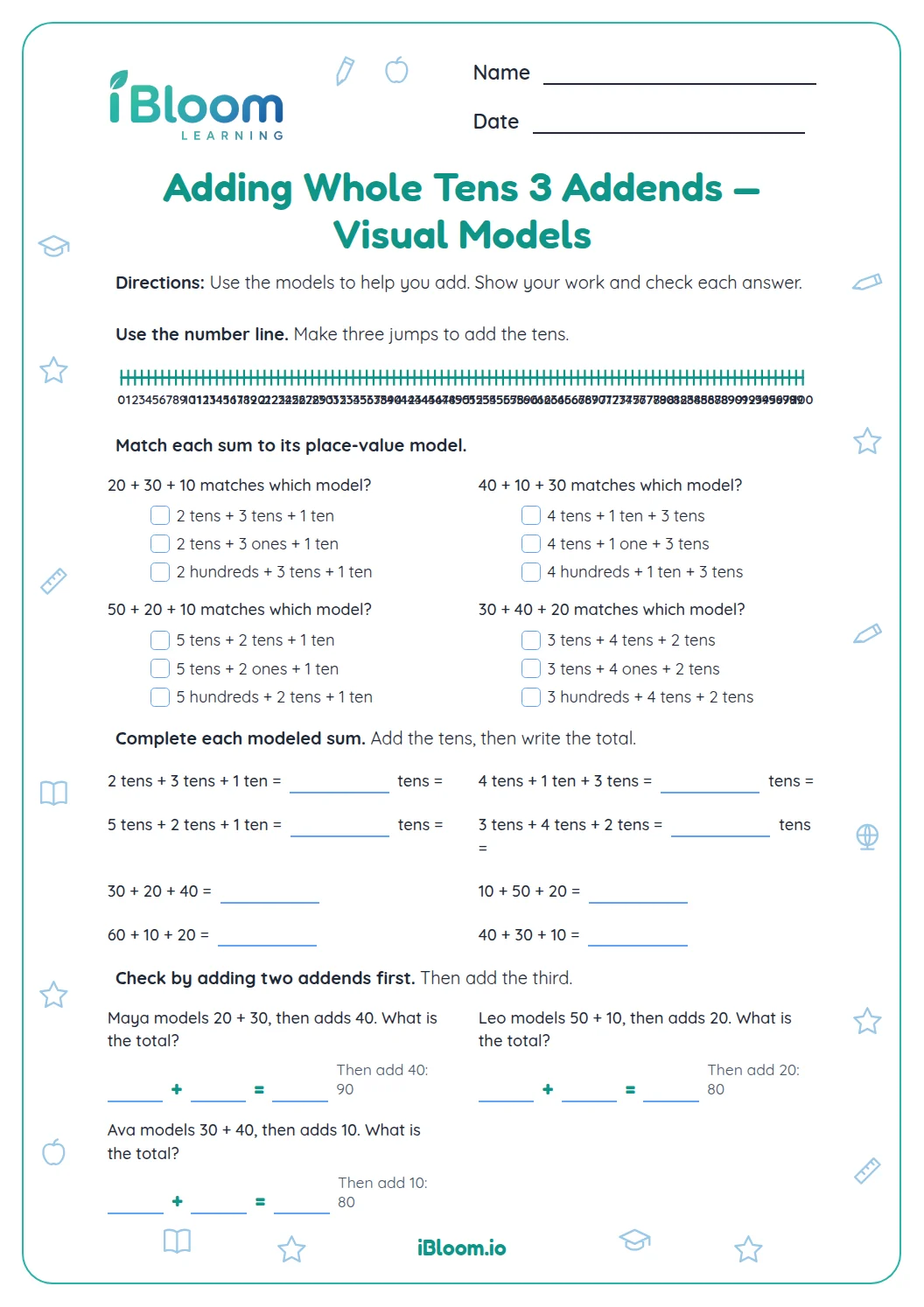
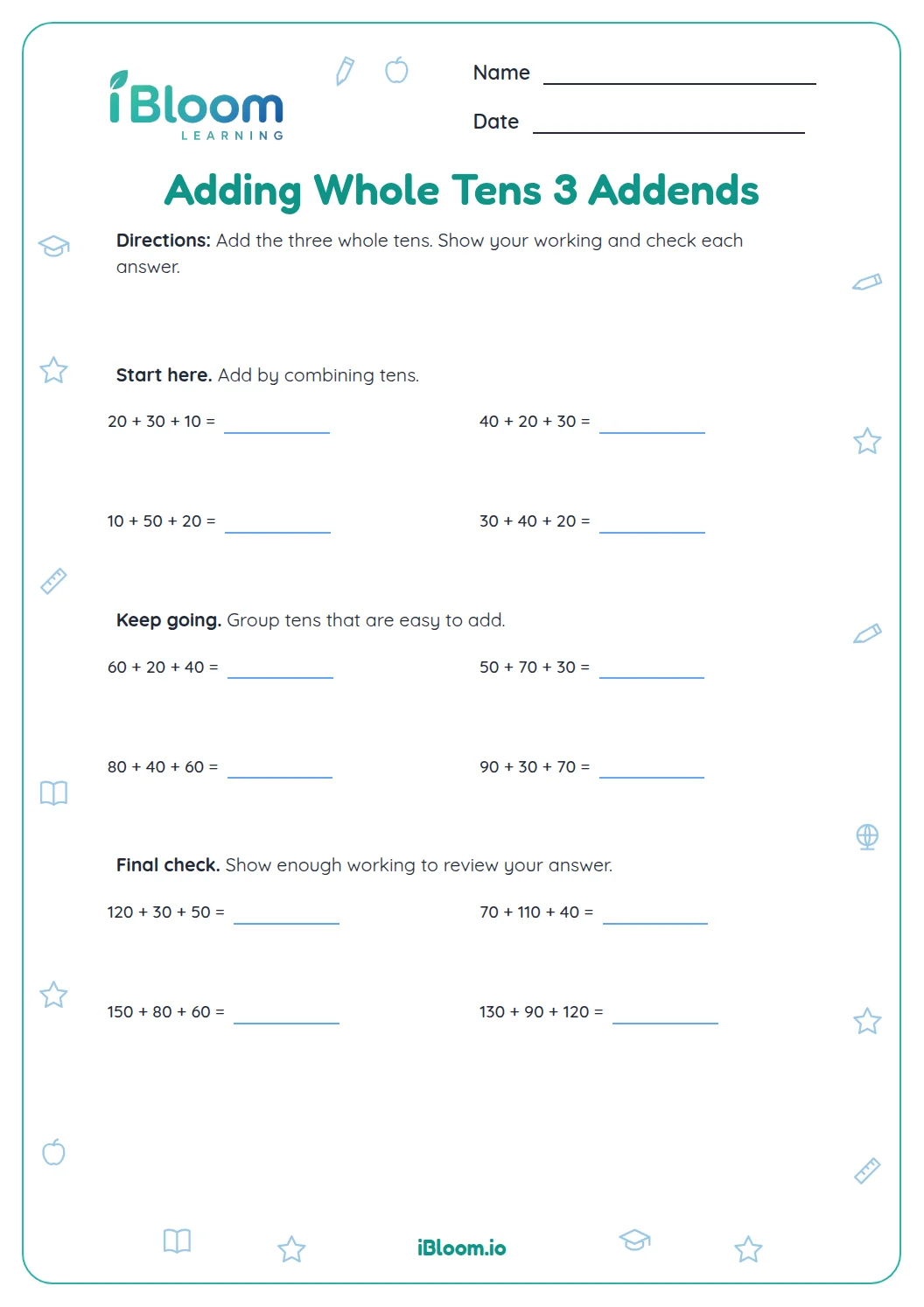
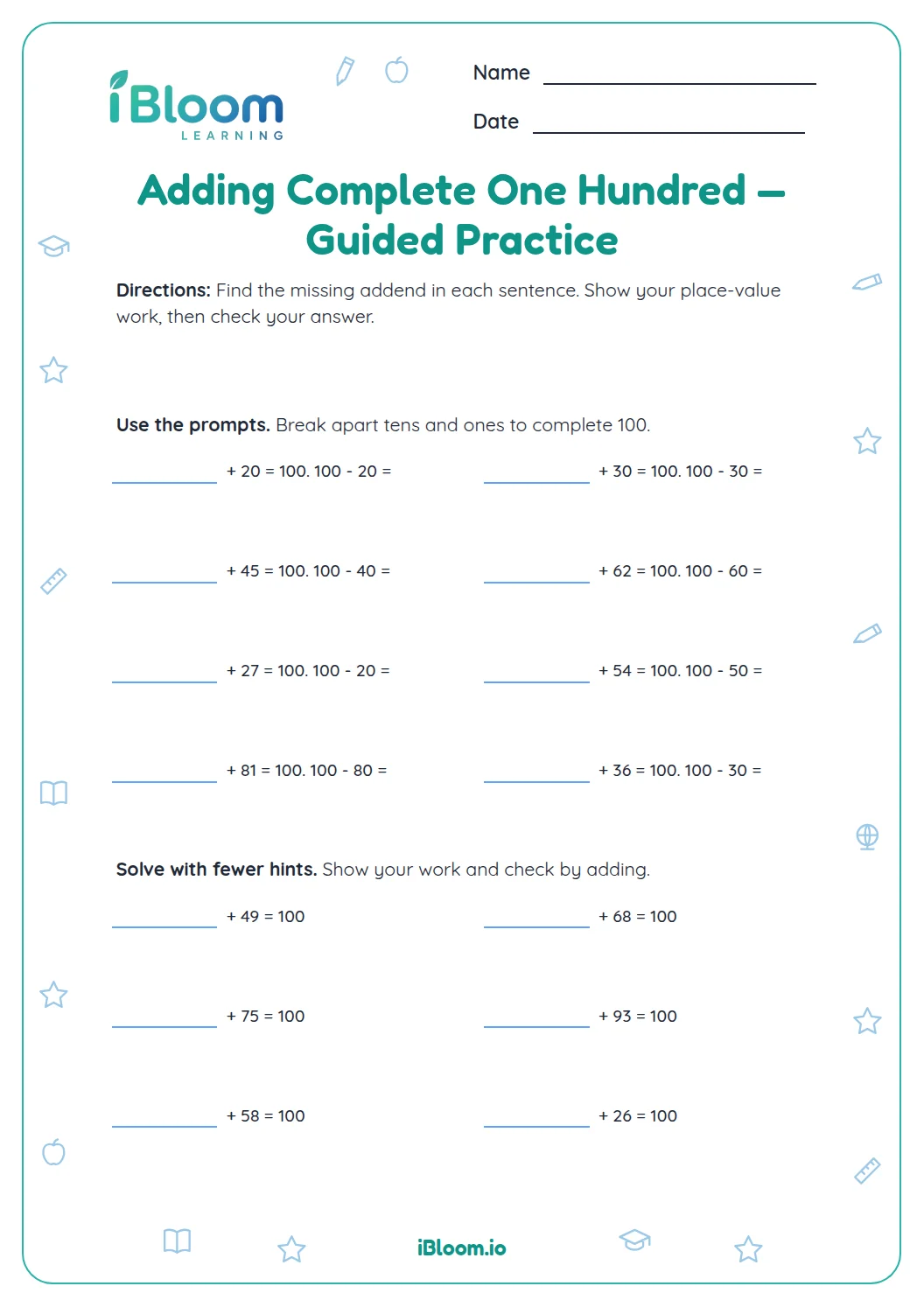
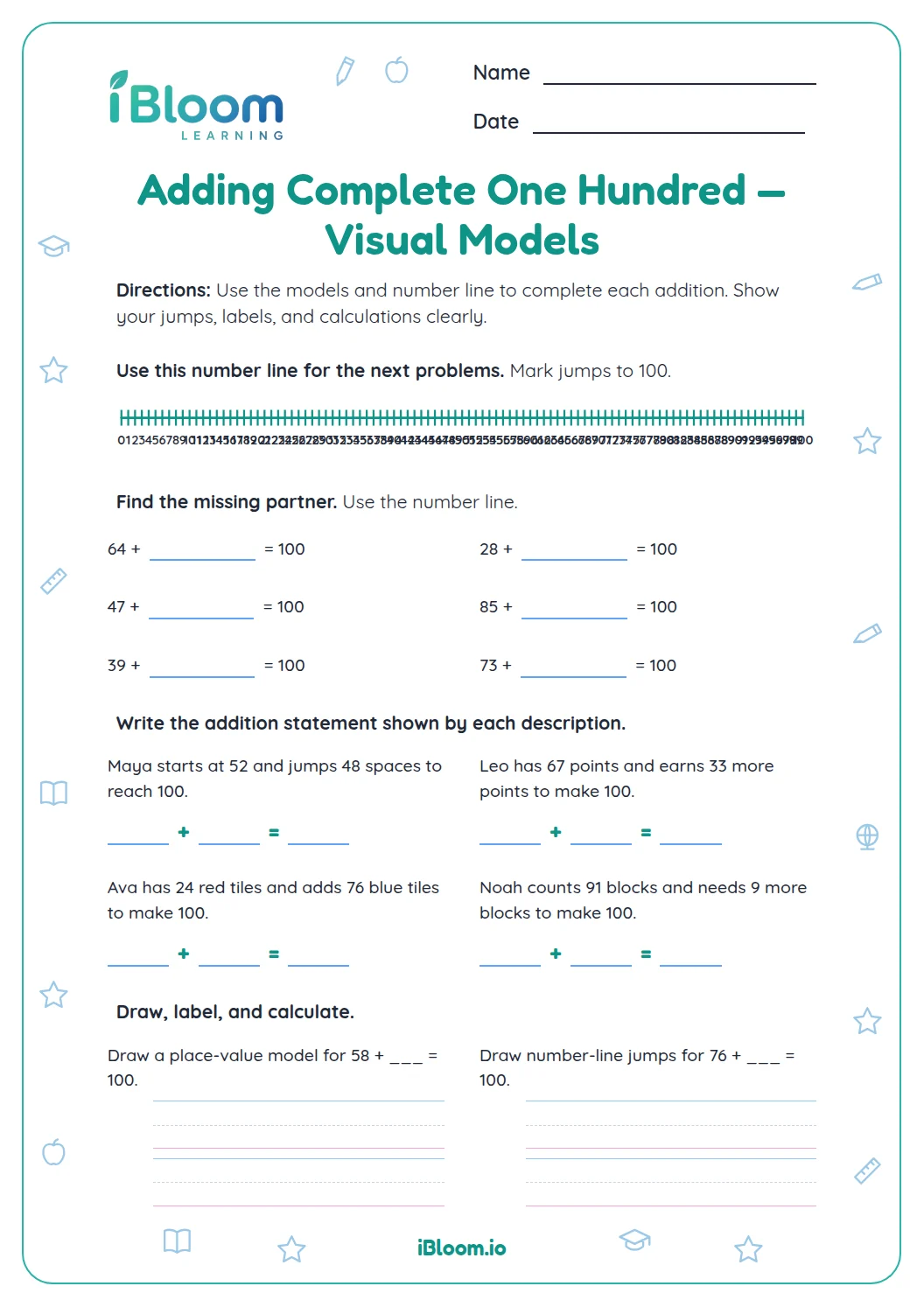
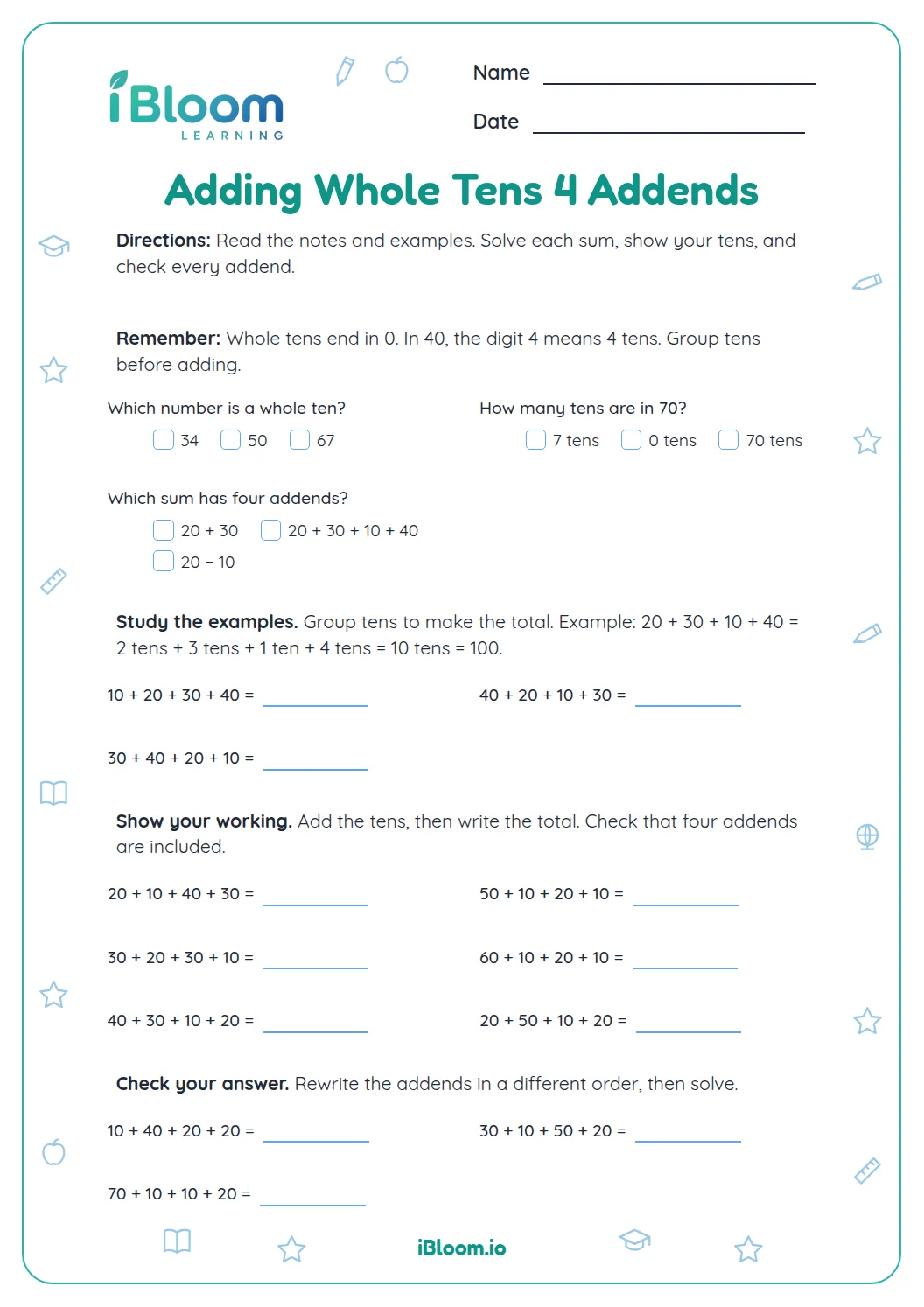
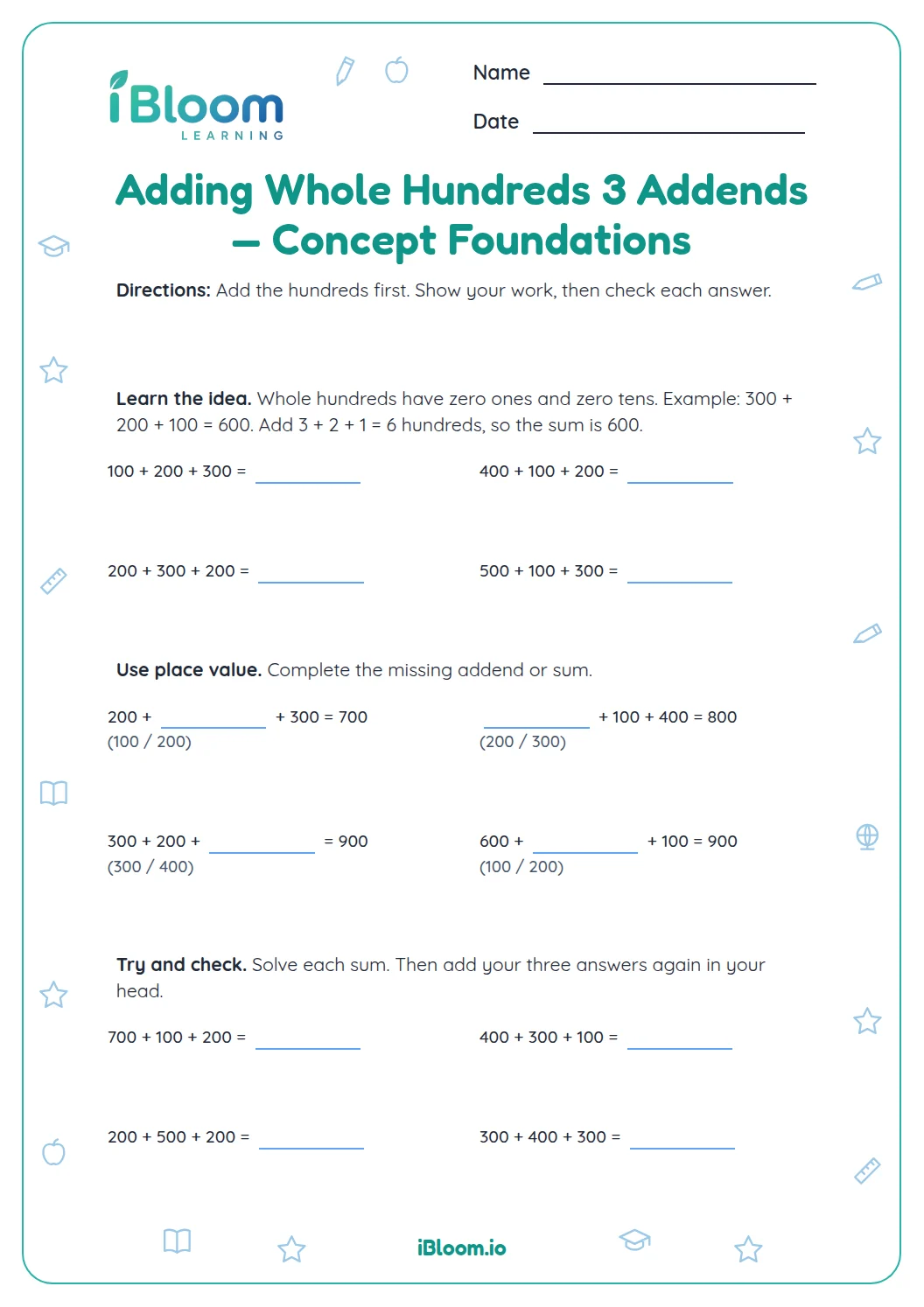
This free Grade 3 worksheet builds three-addend addition around the value of a ten. Part A asks children to add groups of tens; Part B turns those groups into whole-number sums and introduces pairs that make 100. Part C applies the same idea to cans and library books. The 16 questions practice place-value addition within 1,000 under Common Core 3.NBT.A.2. The separate answer key makes it easy to check whether a child has found the number of tens or the value of those tens.
Aligned to 3.NBT.A.2
Why start by counting tens?
Each addend is a multiple of 10, such as 20, 50, or 80. Thinking of 50 as 5 tens makes the numbers small enough to add mentally while keeping track of their place value.
Questions 1–4 ask for a count of tens. Questions 5–8 use the same amounts written as whole numbers. Compare each pair after solving: 6 tens and 60 describe the same amount.
What happens when the total is more than nine tens?
Ten tens make one hundred. A total of 12 tens becomes 1 hundred and 2 tens, or 120. Keep the unit word tens attached until the final conversion.
Question 3 and question 7 make a useful pair. First the child finds how many tens there are; then the child writes their whole-number value.
- 1Question 3: 5 tens + 4 tens + 3 tens = 12 tens.
- 210 tens + 2 tens = 100 + 20.
- 3Question 7: 50 + 40 + 30 = 120.
Which two addends should children combine first?
Choose a pair that is easy to add. In question 9, 70 and 30 make 100, leaving just 20 to add. In question 11, 90 and 10 make 100, even though they are not next to each other.
The two stories ask for the total across three groups. Write all three amounts in an addition sentence, combine a convenient pair, and label the answer with cans or books.
How to use this worksheet
- 1Read question 1 aloud as groups of ten, and find 6 tens together.
- 2Complete Part A, keeping the word tens attached to each answer.
- 3Compare questions 1–4 with questions 5–8 to connect each tens count with its value.
- 4For questions 9–14, underline a convenient pair before adding.
- 5Write a three-addend equation for each story, then check the totals with the key.
Common mistakes and quick fixes
The mistake
Writing 12 for 50 + 40 + 30.
The fix
12 counts the tens; 12 tens equal 120. Add the unit word before converting.
The mistake
Stopping at 100 after combining 70 and 30.
The fix
Check off all three addends. The remaining 20 makes the total 120.
The mistake
Writing 120 for the blank in question 3.
The fix
Read the word after the blank: the question asks for 12 tens, not 120 tens.
Common Core alignment
Use place value and convenient pairs to add three multiples of 10.
On this sheet: The questions connect counts of tens to sums and apply three-addend addition in two stories.
Show the official wordingHide the official wording
Fluently add and subtract within 1000 using strategies and algorithms based on place value, properties of operations, and/or the relationship between addition and subtraction.
What to practice next
Make more practice
Further reading
Questions parents and teachers ask
Why do some answers say 12 and others say 120?
The blank in Part A asks how many tens there are, while Part B asks for their value. Question 3 has an answer of 12 because the unit tens is already printed. The matching whole-number sum in question 7 is 120: twelve groups of ten.
Does my child have to add from left to right?
No, any pair can be added first in these addition problems. For question 11, combine 90 and 10 to make 100, then add 50 for a total of 150. Have your child point to all three addends afterward to check that none was skipped.
How can I explain a total of 21 tens?
Twenty-one tens equal 210 because 20 tens make 200 and one more ten makes 210. This is the total for question 12, 80 + 70 + 60. Ask your child to add 8 + 7 + 6 first, then name the unit before writing the whole-number answer.
What should children write for the can-collection problem?
They should write an addition sentence such as 30 + 50 + 40 = 120 and give the answer as 120 cans. The order of the addends may vary. Check that all three classes are included and that the child labels the total with the correct item.
How can I use the answer key to spot a place-value error?
Compare the first four answers with the next four, since those questions use matching groups. If a child gets 12 tens correctly but writes 12 for 50 + 40 + 30, the addition is sound. Revisit what one ten is worth and convert the unit count to 120.