



About this worksheet
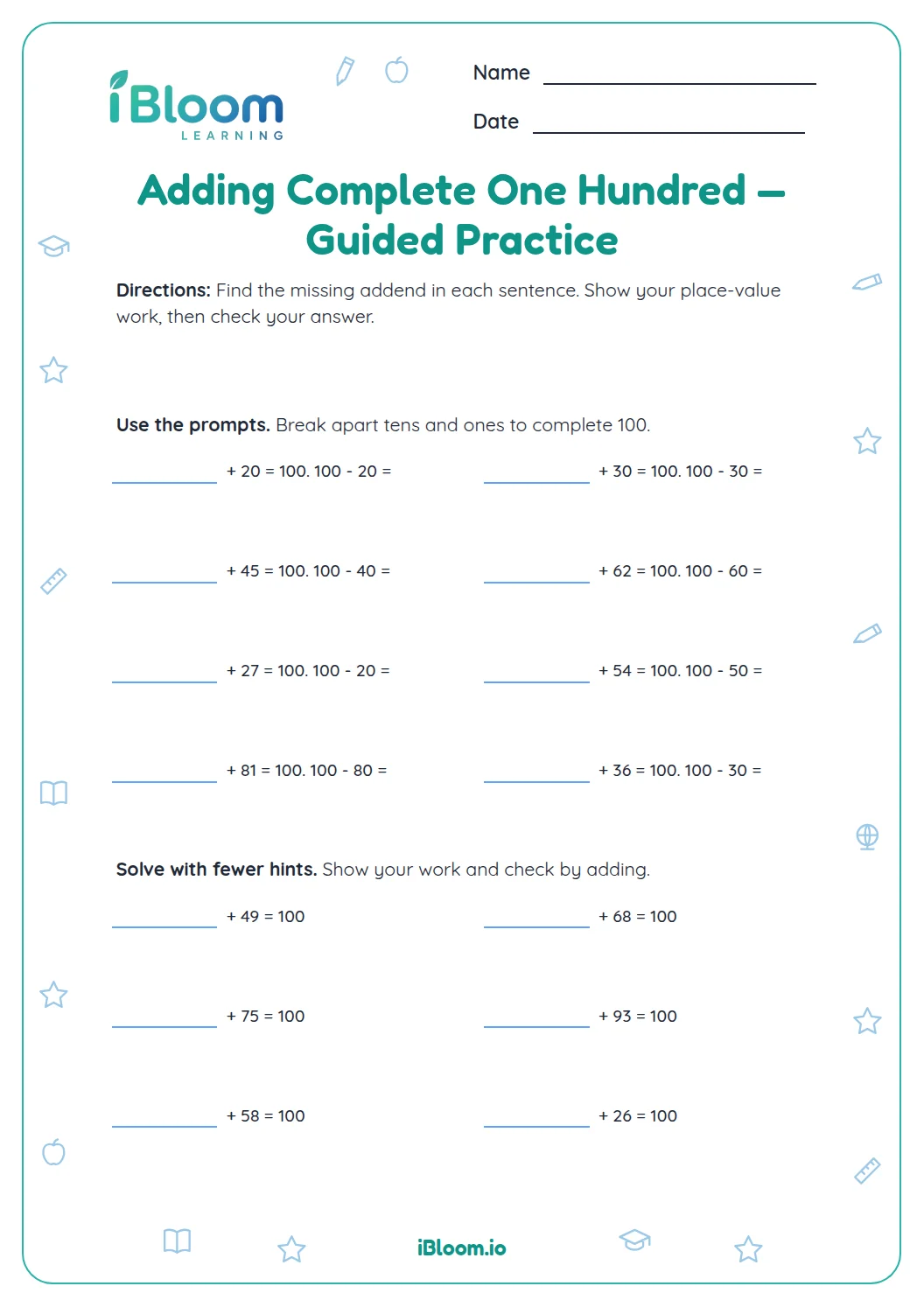
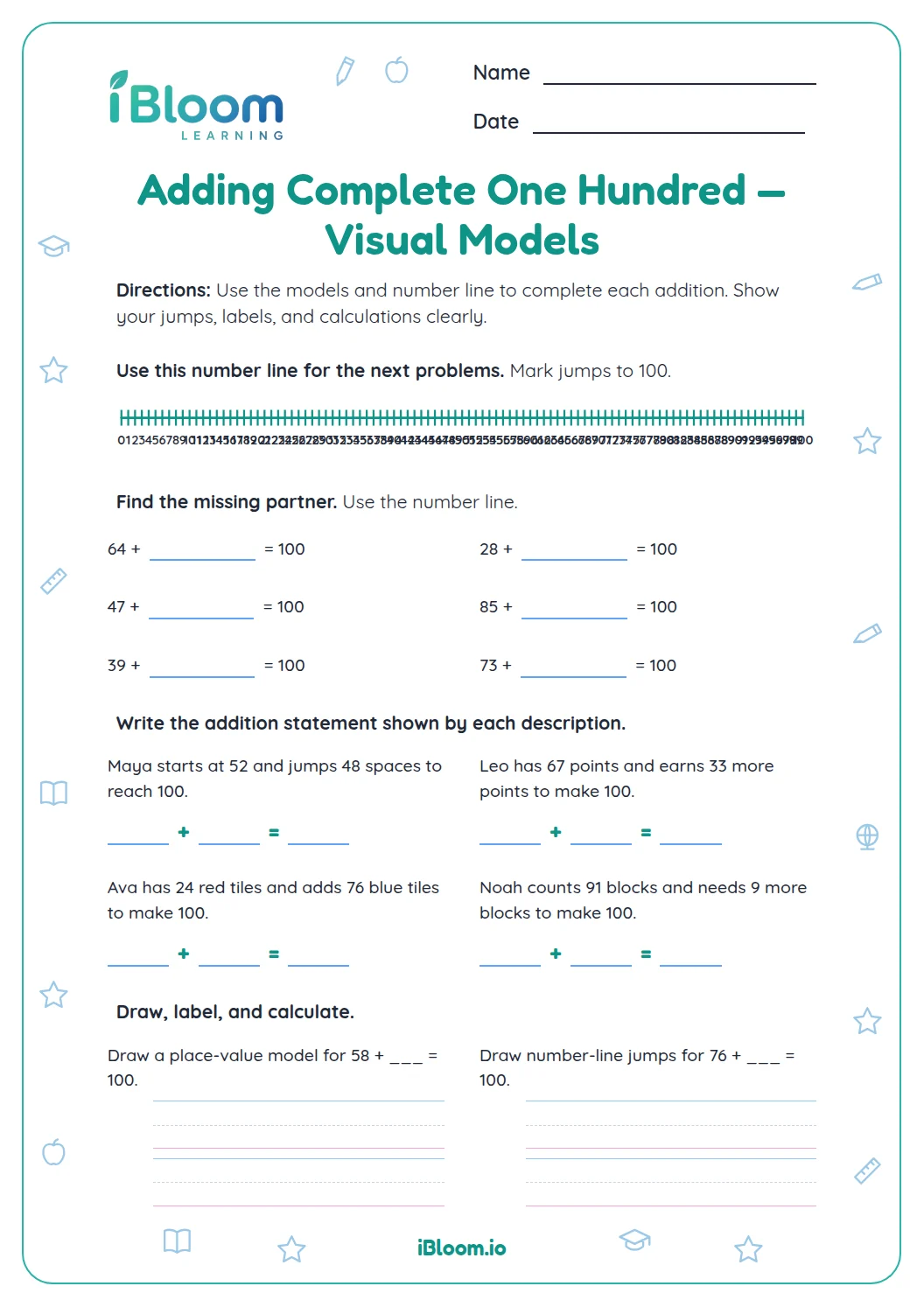
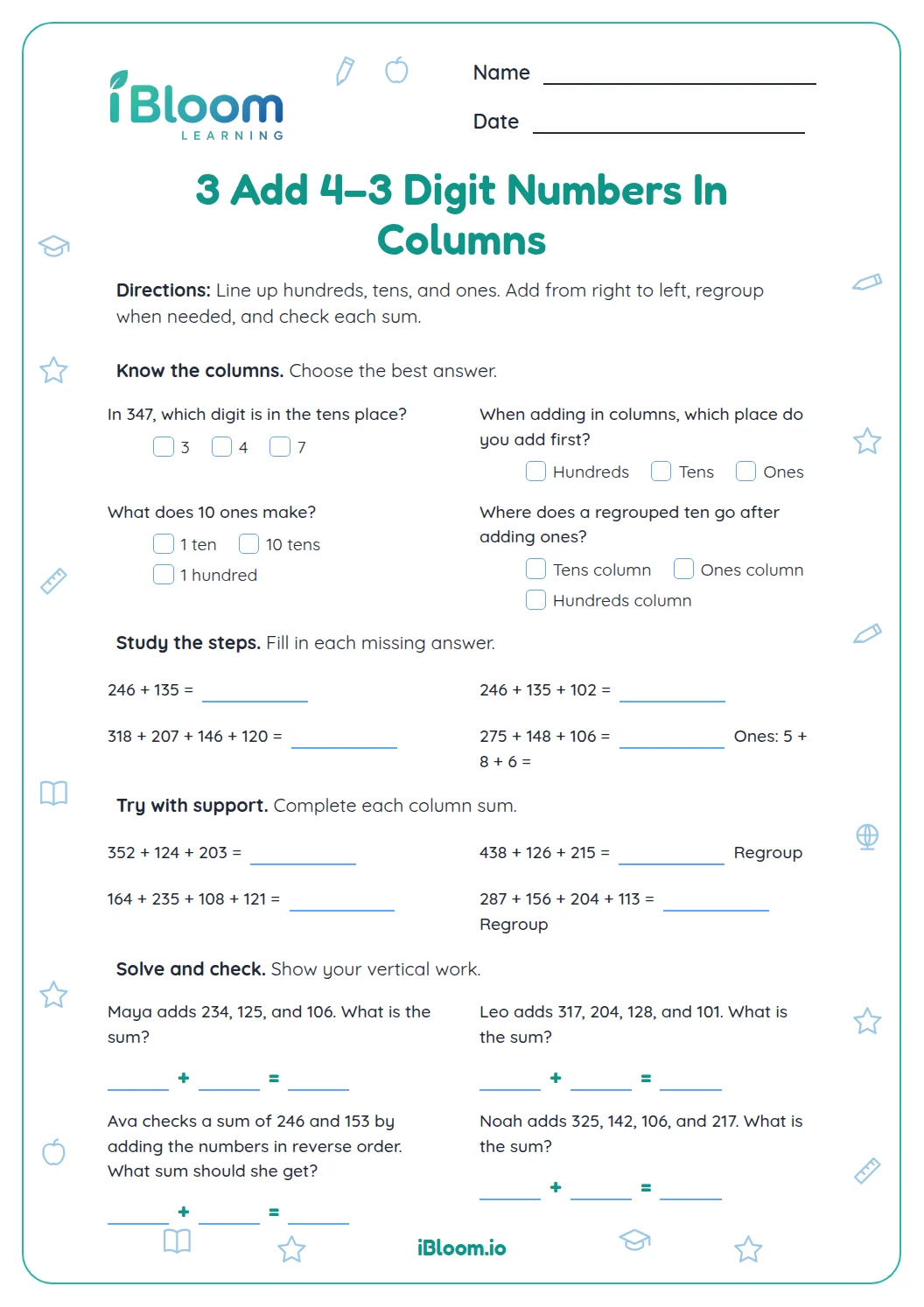
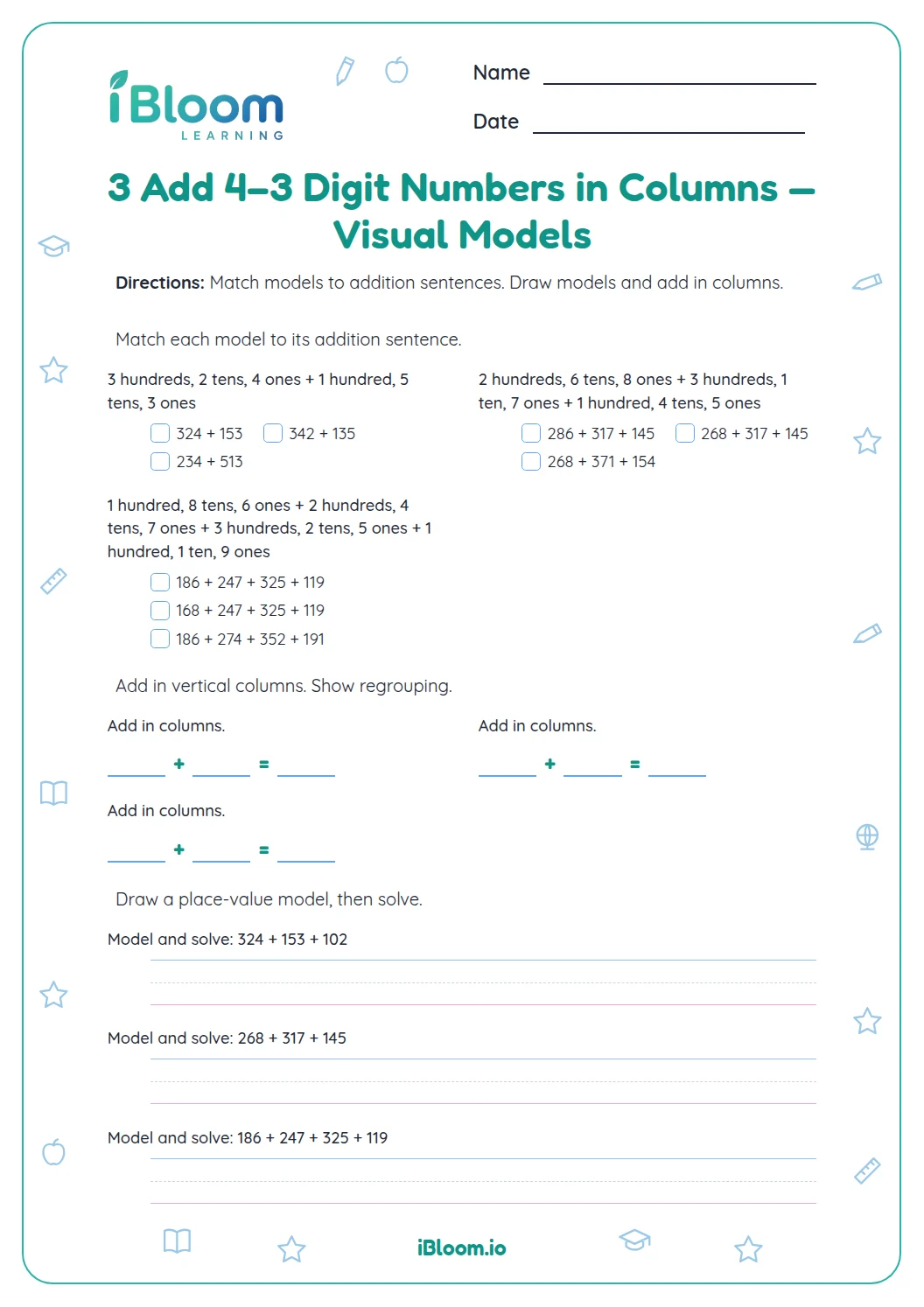
This Grade 3 worksheet practices addition that reaches a complete hundred, from 100 through 1,000. Students solve direct sums, find missing addends, and answer four short story problems. The separate answer key includes all 16 answers and accepts multiple pairs for the final sum.
Aligned to 3.NBT.A.2
How do you make a complete hundred?
Look at the number’s tens and ones. For 38 + 62, 38 needs 2 to reach 40. Then 60 more reaches 100. Splitting one addend can make the sum easier to see.
When the starting number is larger, first find its next hundred. From 315, add 85 to reach 400. The hundred digit changes, while the ones and tens together fill the gap.
- 1315 + 85
- 2315 + 5 = 320
- 3320 + 80 = 400
- 4So 315 + 85 = 400
What does this worksheet practice?
Part A has four direct sums. Part B has four missing-addend problems. Part C contains four story problems, and Part D finishes with four more sums or missing addends. The values stay within 1,000.
- Part A: complete the sum to reach a hundred
- Part B: find the missing addend
- Part C: solve four short stories
- Part D: finish each target hundred
How to use the practice
For Part C, identify the known amounts or target in each story and write an addition sentence in the work area. In Parts A, B, and D, check that the two addends combine to the printed hundred.
A simple practice routine
- 1Read the target hundred in the equation or story.
- 2For a missing addend, subtract the known amount from the target.
- 3For a story, write an addition sentence in the work area.
- 4Break a gap into tens and ones if that helps.
- 5Add the parts back together to check the total.
Common addition slips
The mistake
Adding only the hundreds and ignoring the tens and ones.
The fix
Add the smaller place values first and check that they fill the gap to the target hundred.
The mistake
Treating a missing addend like the total.
The fix
Subtract the known addend from the target; then add the two parts to check.
The mistake
Writing 400 for 327 + 73 without checking the tens.
The fix
327 needs 73 to reach 400: 327 + 3 = 330, then +70 = 400.
Common Core alignment
The problems use addition within 1,000 and emphasize place value and efficient strategies.
Fluently add and subtract within 1,000.
On this sheet: Every item adds within 1,000 and asks students to use place value, missing addends, or a real situation.
Show the official wordingHide the official wording
Fluently add and subtract within 1000 using strategies and algorithms based on place value, properties of operations, and/or the relationship between addition and subtraction.
What to practice next
Make more practice
Further reading
Questions parents and teachers ask
What does it mean to complete a hundred?
A sum completes a hundred when it equals a multiple of 100, such as 200 or 600. Find the gap between the known amount and the target. For 315 + 85, add 5 to reach 320, then 80 to reach 400.
Are there word problems?
Yes. Four questions use totals in familiar settings, including beads, collected cans, books, and points. Each gives two quantities or a target and asks for a total or missing amount. Students can write an addition sentence in the work area before answering.
How can I check a missing addend?
Add the known addend to the number you found. For ___ + 68 = 300, check that 232 + 68 equals 300. Breaking 68 into 60 and 8 can make the check easier to follow. Students can record the known addend and target before finding the gap.
What is included in the answer key?
The separate key gives an answer for each of the 16 questions. It also accepts different addend pairs for the final open-ended item, as long as they total 800. It can help to break 800 into friendly hundreds when choosing two addends.
How can a student find the next hundred?
Look at the hundreds digit and identify the next multiple of 100. From 327, the next hundred is 400. Subtract or count up to find the gap: 327 + 73 = 400. Use the answer key to check each number sentence before moving to the next item.