




About this worksheet
This printable gives students 14 short real-world problems about completing 100. Learners find missing parts, subtract to find what remains, or combine two known amounts before reaching 100. They write a short equation and solve each item. The questions practice addition and subtraction strategies described in Common Core 2.NBT.B.5 and word-problem reasoning in 2.OA.A.1.
Aligned to 2.NBT.B.5 and 2.OA.A.1
What kinds of problems are included?
The 14 items use familiar goals and totals. Some give one amount and ask how much more makes 100; others provide two known groups before asking what is still needed.
- Questions 1–4: combine two quantities
- Questions 5–16: find a missing part or remaining amount
How do you find the missing part of 100?
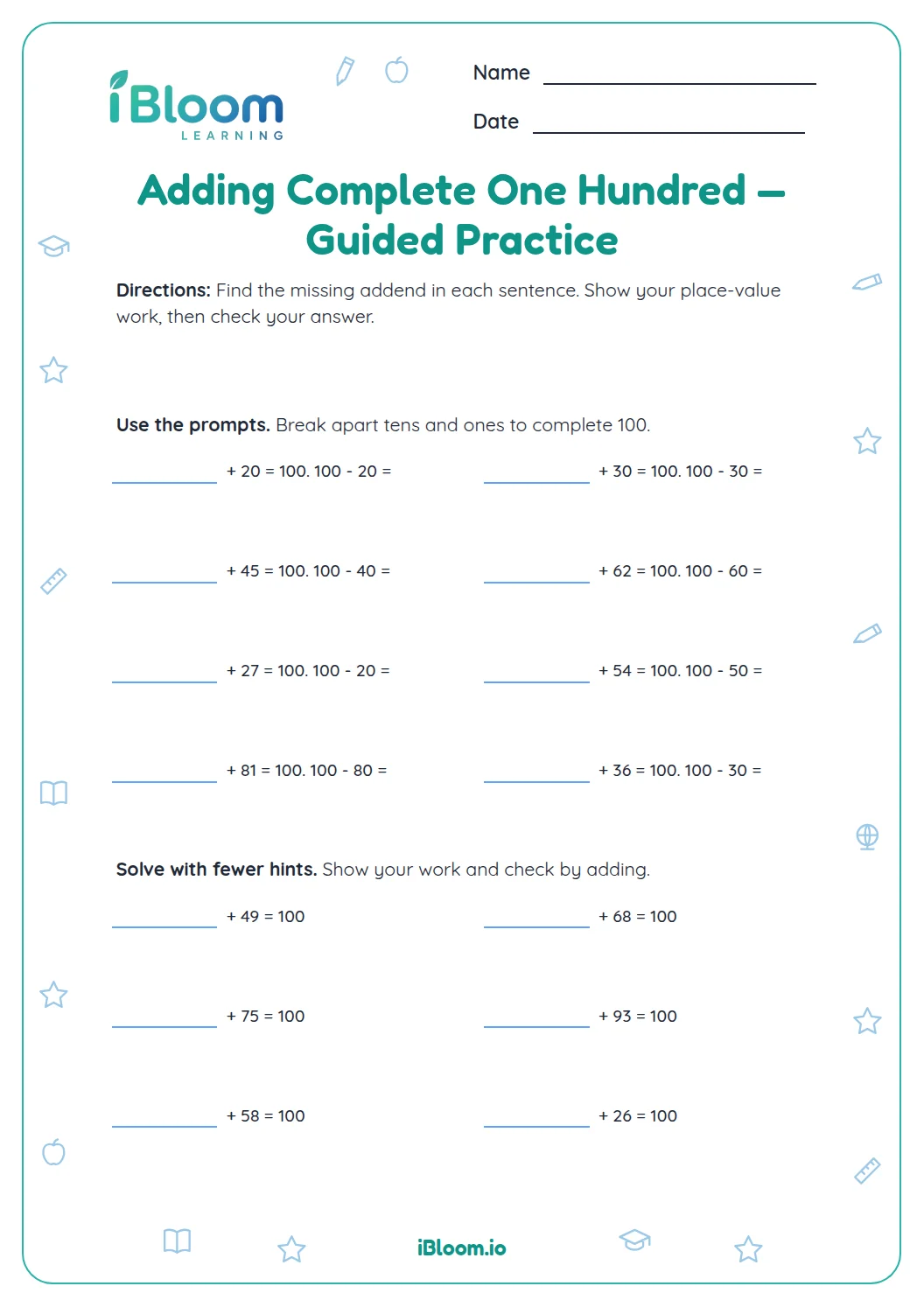
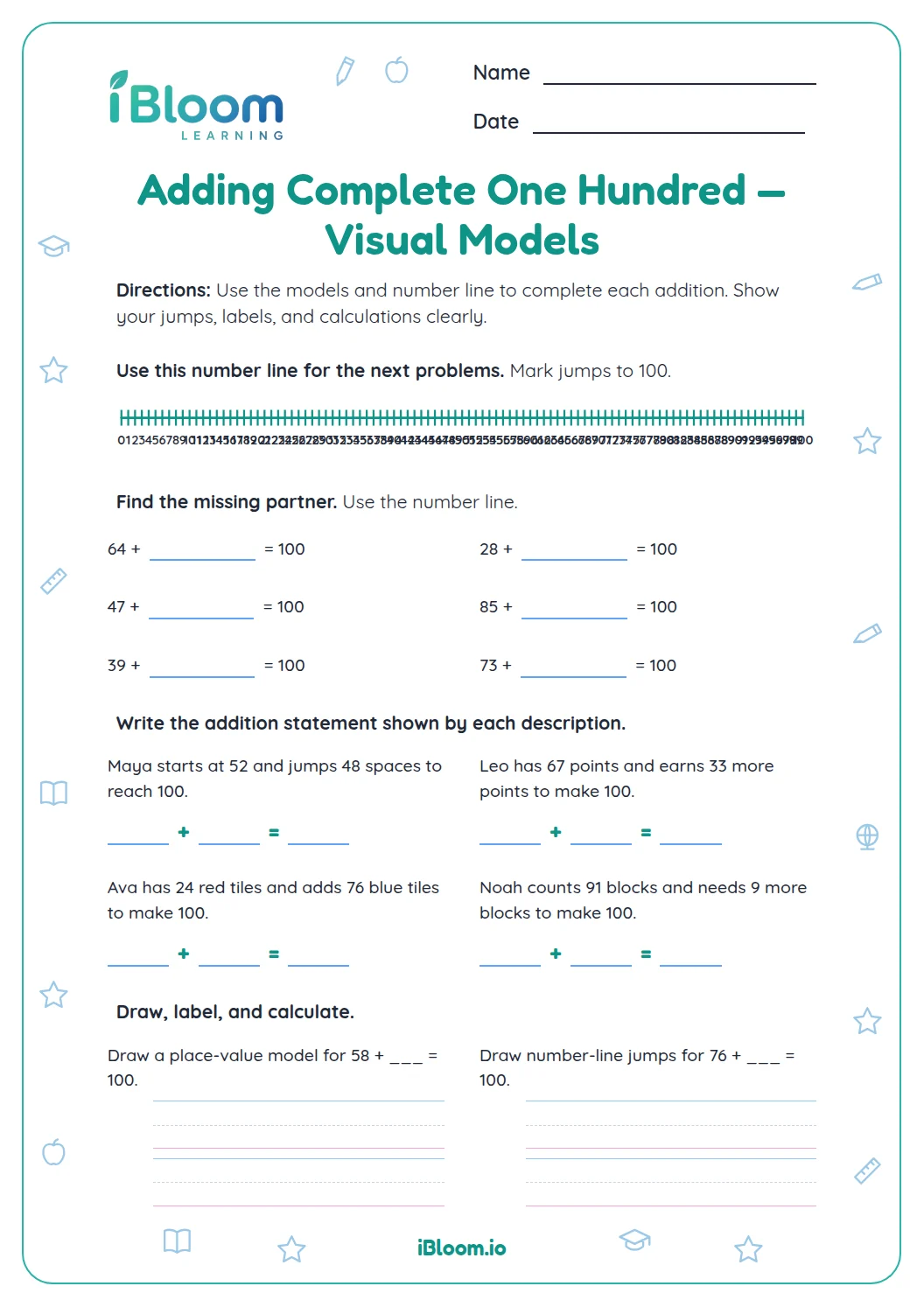
Think of 100 as the whole. If 63 points are already earned, find the gap from 63 to 100 or subtract 100 − 63. For “how many remain,” subtract the used amount from 100.
- 1The team has 63 of 100 points.
- 2100 − 63 = 37
- 3The team needs 37 more points.
How can you check an addition answer?
Subtract the known amount from 100 or count up to the goal. Check the answer by adding the known amount and missing part; they should make exactly 100.
How to use this worksheet
- 1Read the story and name the total or missing part.
- 2Underline the two known amounts.
- 3Choose addition to combine, or subtraction to find what is left or needed.
- 4Write an equation before solving.
- 5Check that the answer makes sense in the story.
Common mistakes and quick fixes
The mistake
Add when the question asks how many are left.
The fix
Treat the starting whole, 100, as the total and subtract the used amount.
The mistake
Forget to regroup in 37 + 28.
The fix
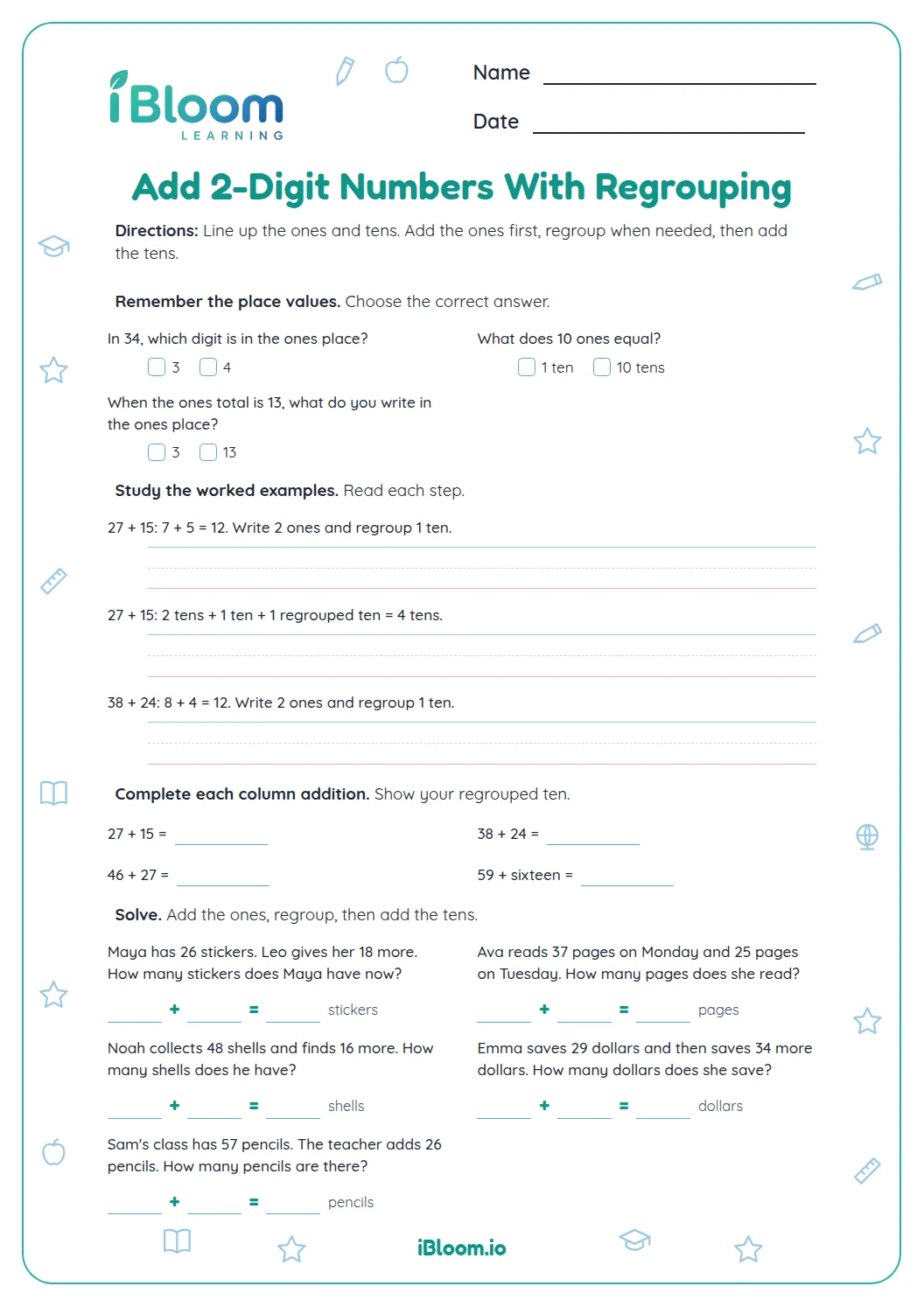
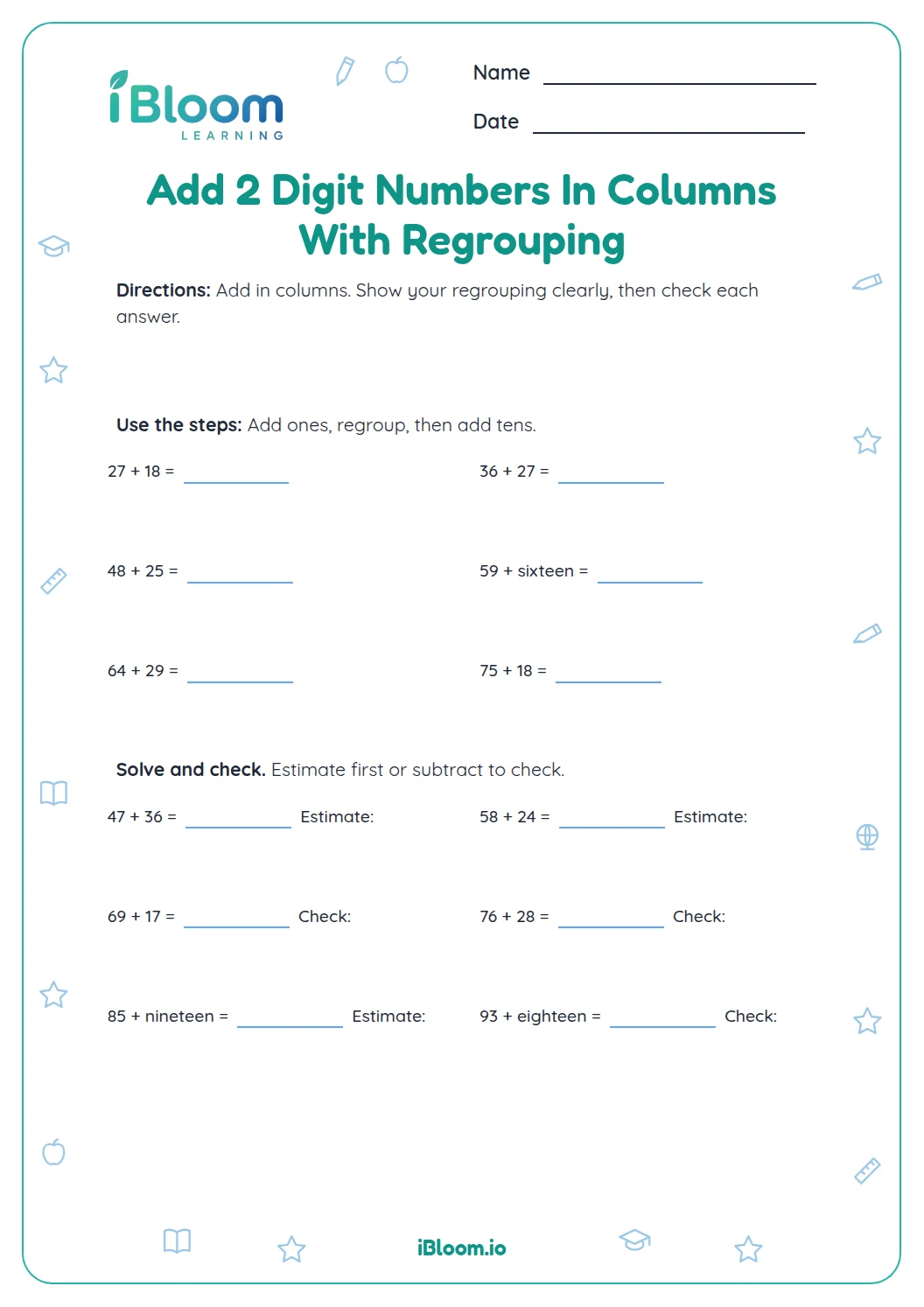
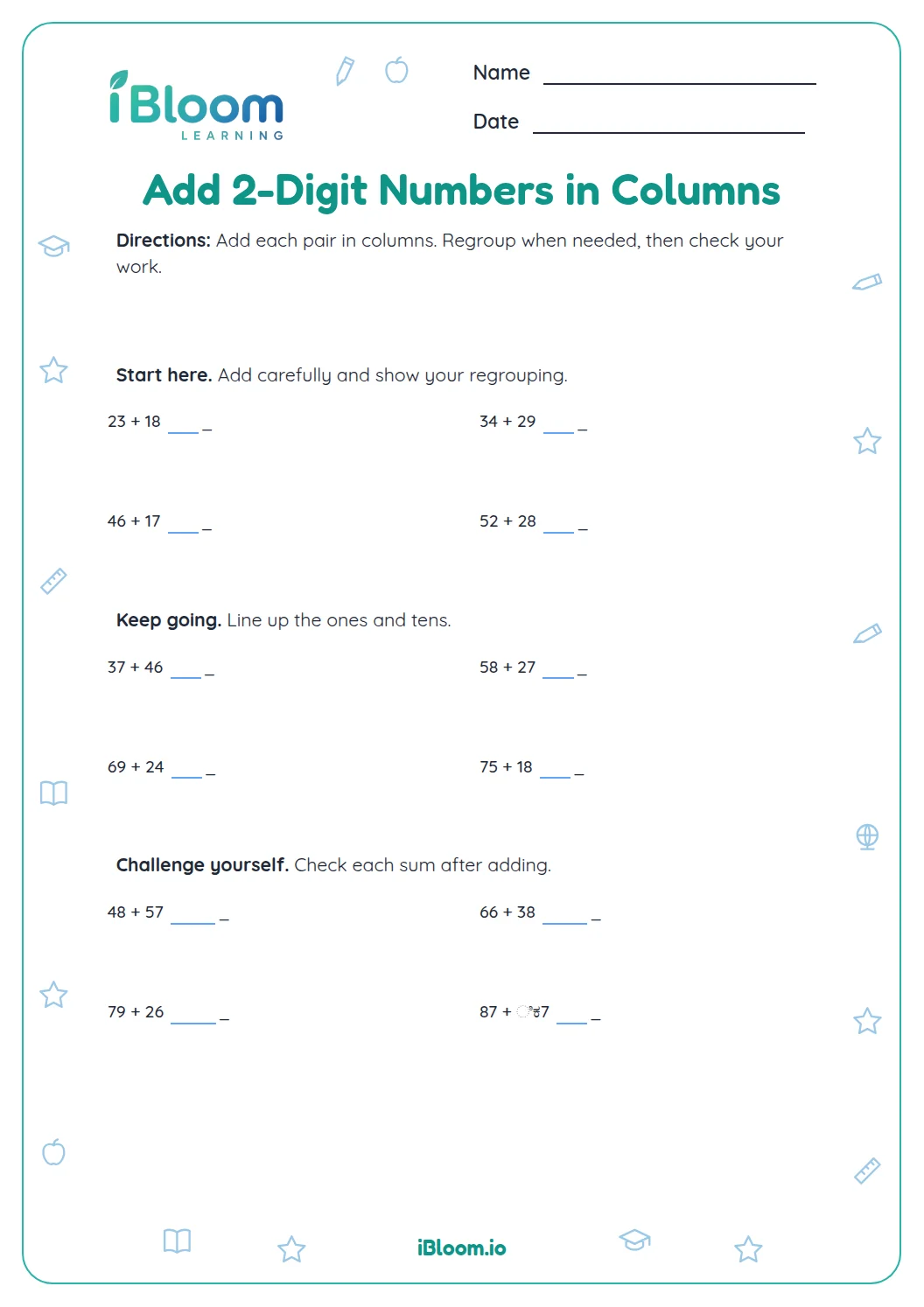
Combine 7 + 8 ones into 15 ones, regroup one ten, then add the tens.
The mistake
Give the total without naming what it counts.
The fix
Use the story noun in the answer, such as 65 cans or $77.
Common Core alignment
This page practices add to and subtract from 100 through short, focused questions.
Add and subtract within 100 using place-value strategies.
On this sheet: Add and subtract within 100 using place-value strategies.
Show the official wordingHide the official wording
Fluently add and subtract within 100 using strategies based on place value, properties of operations, and/or the relationship between addition and subtraction.
Solve addition and subtraction word problems within 100.
On this sheet: Solve addition and subtraction word problems within 100.
Show the official wordingHide the official wording
Use addition and subtraction within 100 to solve one- and two-step word problems involving situations of adding to, taking from, putting together, taking apart, and comparing, with unknowns in all positions, e.g., by using drawings and equations with a symbol for the unknown number to represent the problem.
What to practice next
Make more practice
Further reading
Questions parents and teachers ask
How do you find how many more make 100?
Subtract the amount you already have from 100. If 37 cans are collected, calculate 100 − 37 = 63, so 63 more cans are needed. Check by adding 37 and 63 to make sure the total is 100. Use addition to verify.
Do all questions ask students to add?
No. Some ask for a missing part by subtracting from 100; others combine two amounts before finding what is still needed. Read the situation to see whether 100 is the goal or the total, then write an equation that matches it.
What does “complete one hundred” mean here?
It means finding the amount that completes a total of 100. If a class has 76 leaves toward its goal, subtract 76 from 100 to find that 24 leaves are still needed. The worksheet uses several familiar contexts for this idea.
What grade is this worksheet for?
It is labeled for Grade 3 and gives practice with addition and subtraction in familiar situations. The calculations stay within 100, so students can focus on representing each situation and finding the missing amount with an equation. The 14 items include a mix of single and combined known amounts.
Is an answer key included?
Yes. A separate answer key gives the missing amount or total for all 14 problems. Have the student write an addition or subtraction equation beside each answer, then check whether the known and missing amounts make 100. Check the total once more.