




About this worksheet
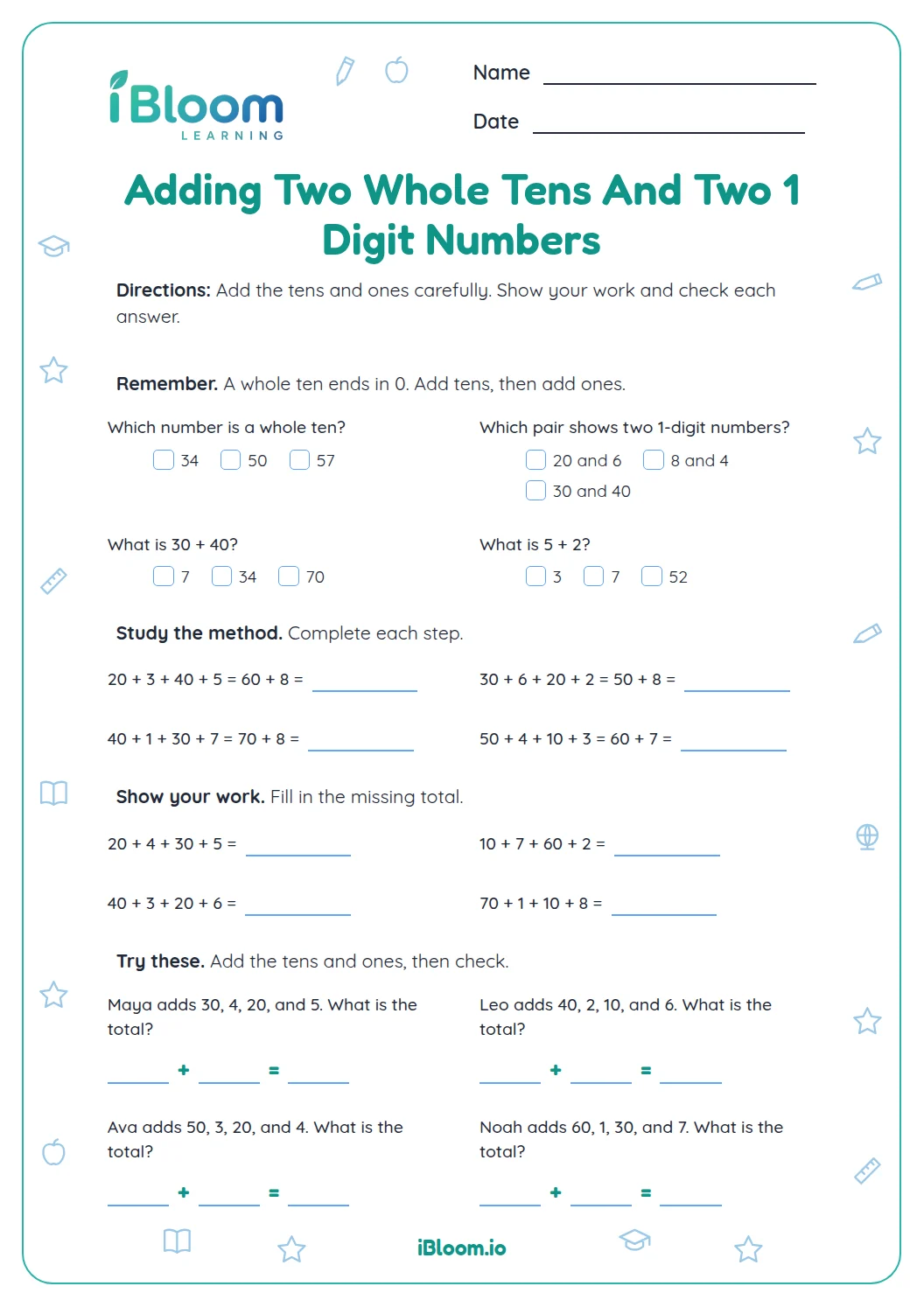
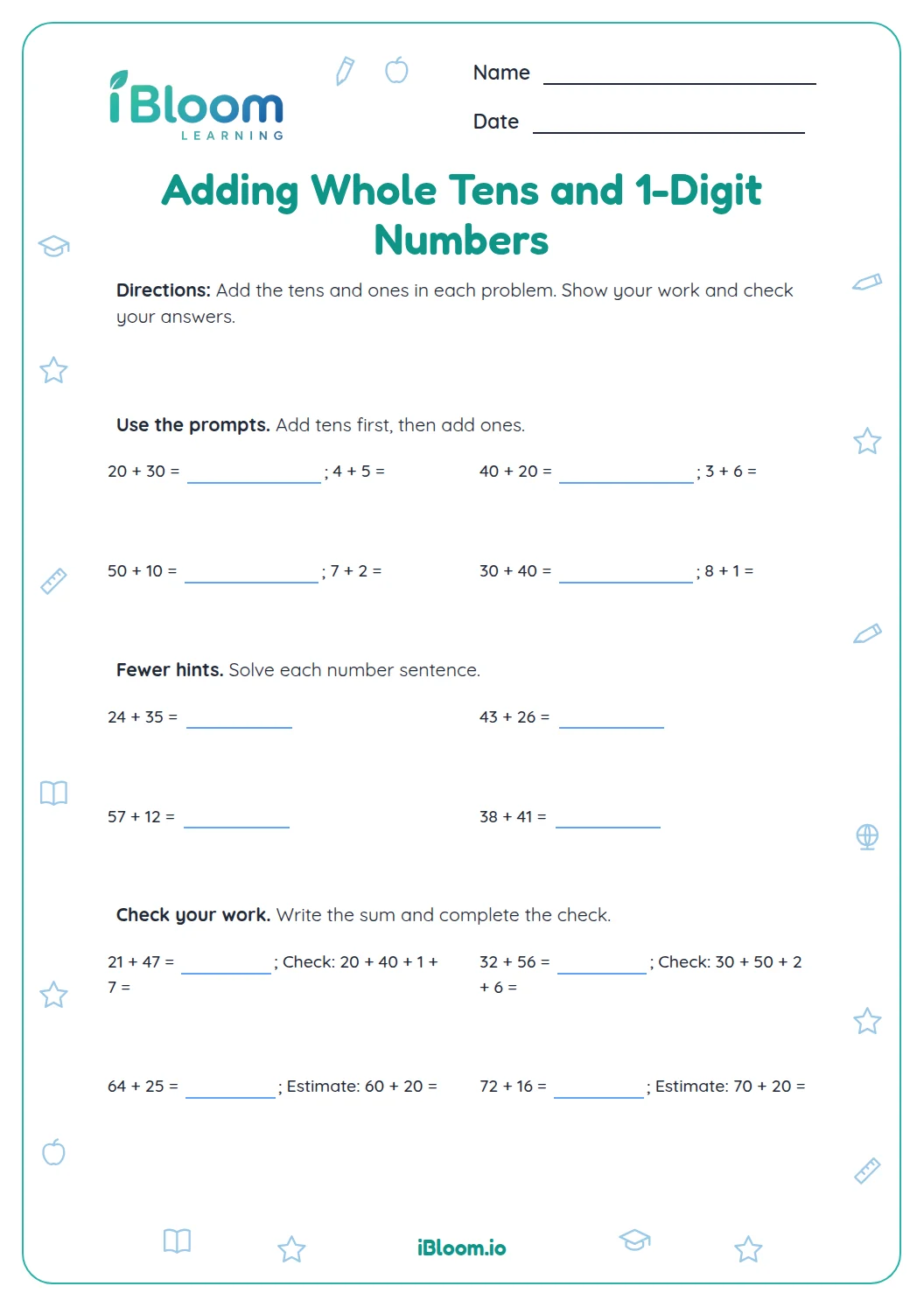
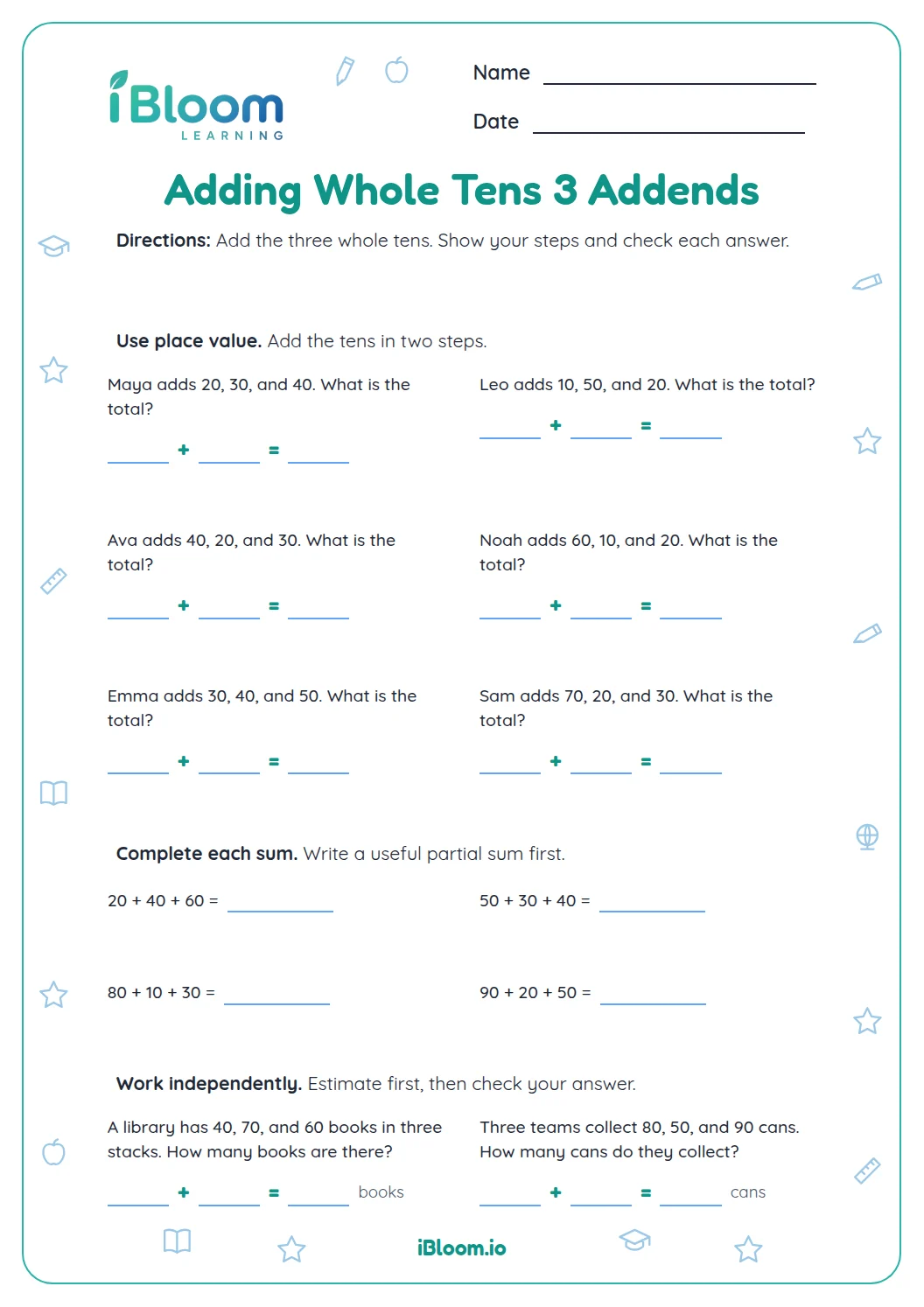
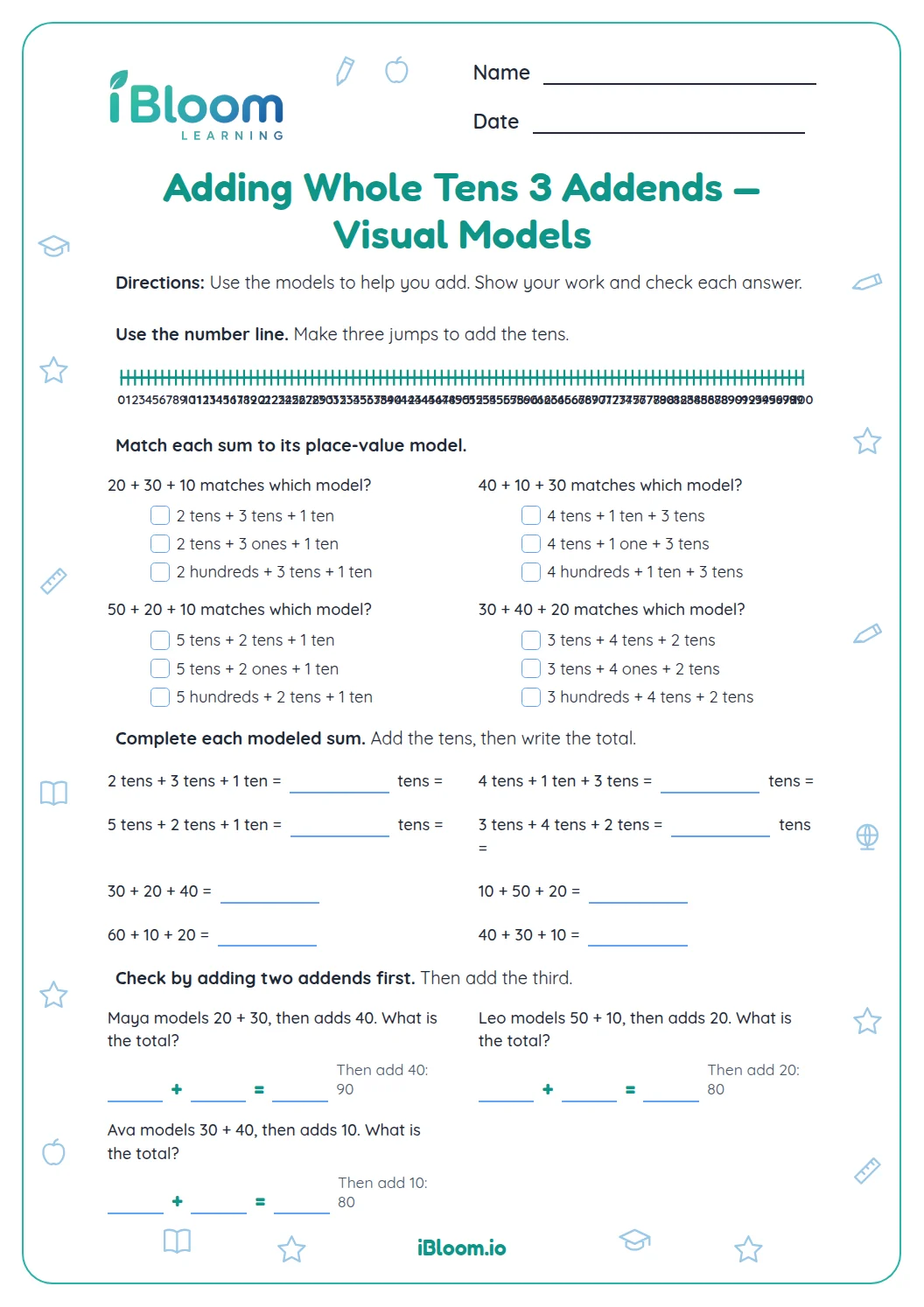
This free printable Grade 3 worksheet practices adding two whole tens and two one-digit numbers in real-world stories. Students identify the four amounts, write an addition equation, and solve for each total. The 14 questions align with Common Core 3.NBT.A.2 and include a separate answer key. Stories use varied settings so learners focus on grouping tens and ones rather than repeating one context.
Aligned to 3.NBT.A.2
How do you turn a story into an addition equation?
Identify each amount the story says to combine. Keep track of all four quantities so none is missed.
- 120 + 30 + 4 + 6 = 60
- 2First group the tens (50) and ones (10).
How can place value make the addition easier?
Add the multiples of ten together, then combine the one-digit addends. If the ones make another ten, add that ten to the tens total.
How can you check the total?
Estimate the tens total, then add the ones. Reread the story and confirm the result answers the question asked.
How to use this worksheet
- 1Underline the two amounts that are tens.
- 2Circle the two one-digit amounts.
- 3Group the tens and ones to find the total.
- 4Group tens and ones to find the total.
- 5Reread the question and check your sum.
Mistakes to catch and correct
The mistake
Forgetting one of the four amounts
The fix
Count the addends in the equation against the story.
The mistake
Adding only the tens
The fix
Add the one-digit quantities too, then combine both totals.
The mistake
Reporting a partial total
The fix
Check that the answer includes all quantities in the story.
Common Core alignment
This worksheet gives focused practice with the skill named in each standard.
Add the tens and ones in each four-addend story.
On this sheet: Every story combines two multiples of ten and two one-digit addends, and asks for their total.
Show the official wordingHide the official wording
Fluently add and subtract within 1000 using strategies and algorithms based on place value, properties of operations, and/or the relationship between addition and subtraction.
What to practice next
Make more practice
Further reading
Questions parents and teachers ask
What number types does this worksheet combine?
Each story combines two multiples of ten with two one-digit addends. For example, a child may add 20, 30, 4, and 6. This structure lets students group the tens and ones while still interpreting a real-world situation. Use the key after the learner tries each item independently.
How many word problems are included?
There are 14 word problems across two worksheet pages. Each story combines two whole tens and two one-digit numbers, then asks for a total. Students complete the printed addition equation, add the tens and ones, and label the sum with the requested unit.
What is a helpful strategy for solving these stories?
There are 14 word problems. Each story combines two whole tens and two one-digit numbers, then asks for a total. Use the four amounts to complete the printed addition equation, add tens and ones, and label the sum with the requested unit.
Why keep track of each amount before solving?
An equation shows which quantities belong in the total and keeps the story’s information organized. Students can then choose a strategy, such as joining tens before ones, and check that the answer matches the question’s unit or object. Use the key after the learner tries each item independently.
What should I check in the answer key?
Check that the completed equation includes all four amounts and that its total matches the story. Every question combines two multiples of ten and two one-digit addends, so the answer key lists the total for each of the 14 problems.
Does this worksheet have an answer key?
Yes. A separate answer key gives the total for all 14 stories. Since the worksheet asks students to find a total, you can also review whether the equation includes all four addends before checking the sum. The worksheet leaves space for each total.