





About this worksheet
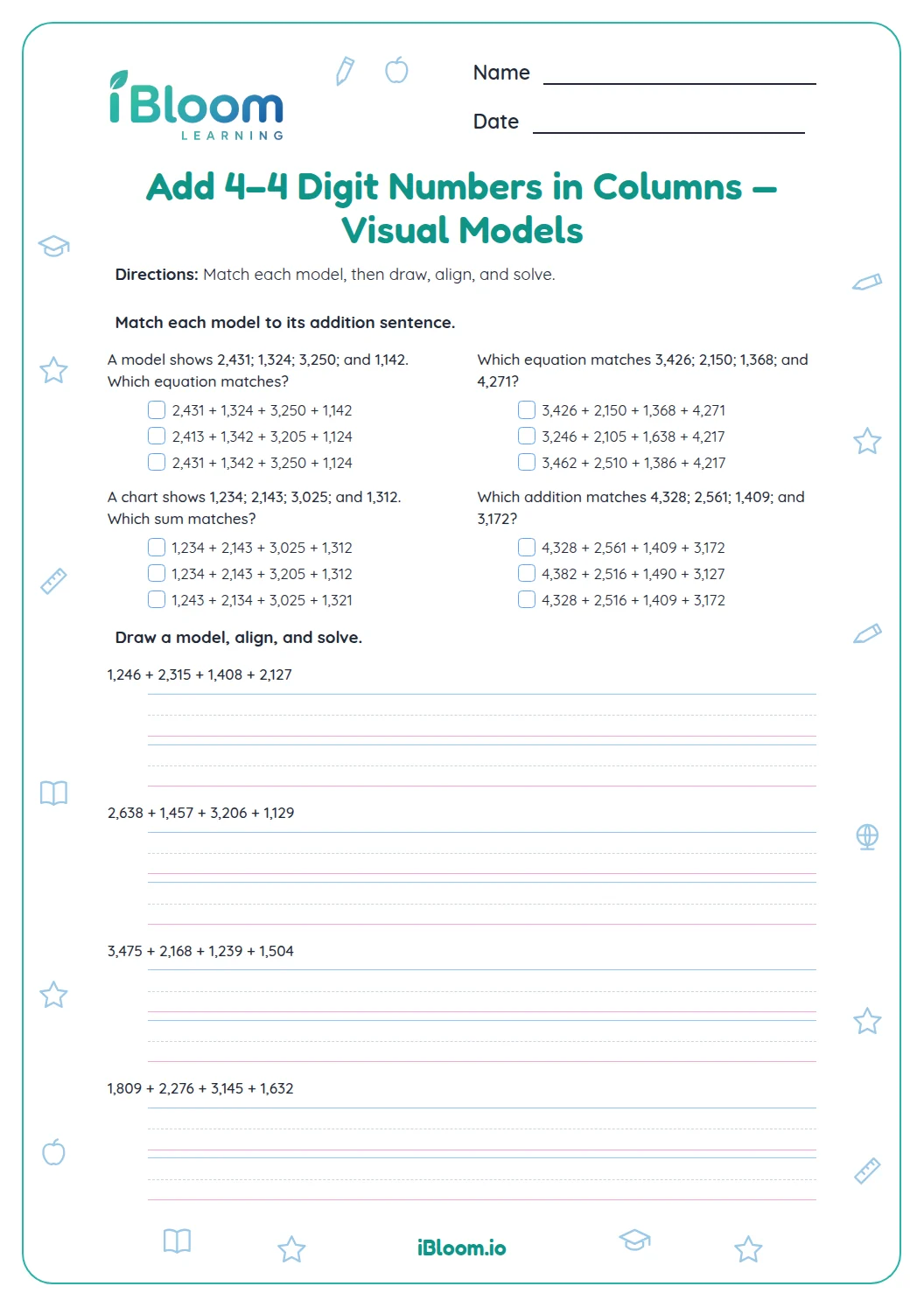
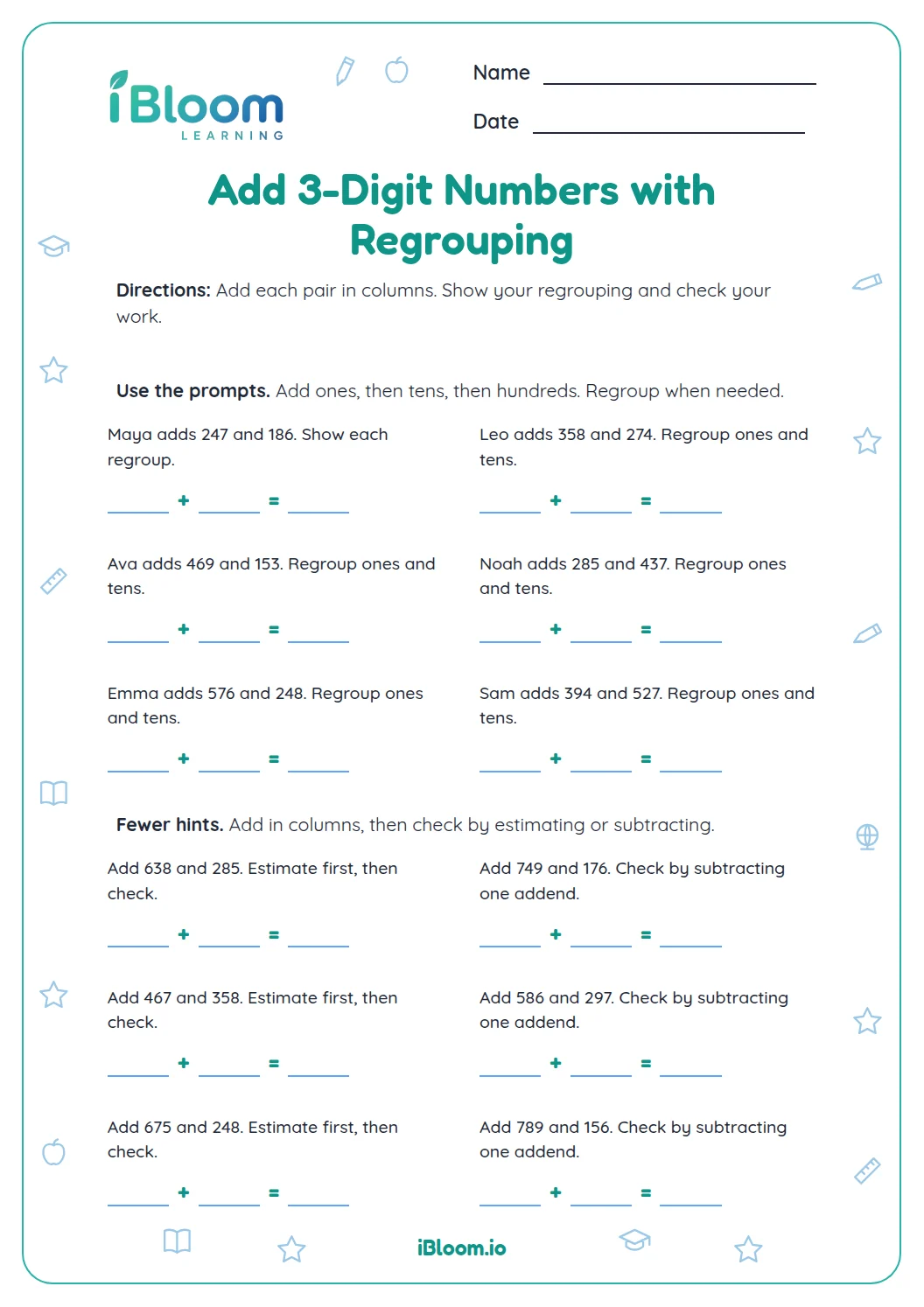
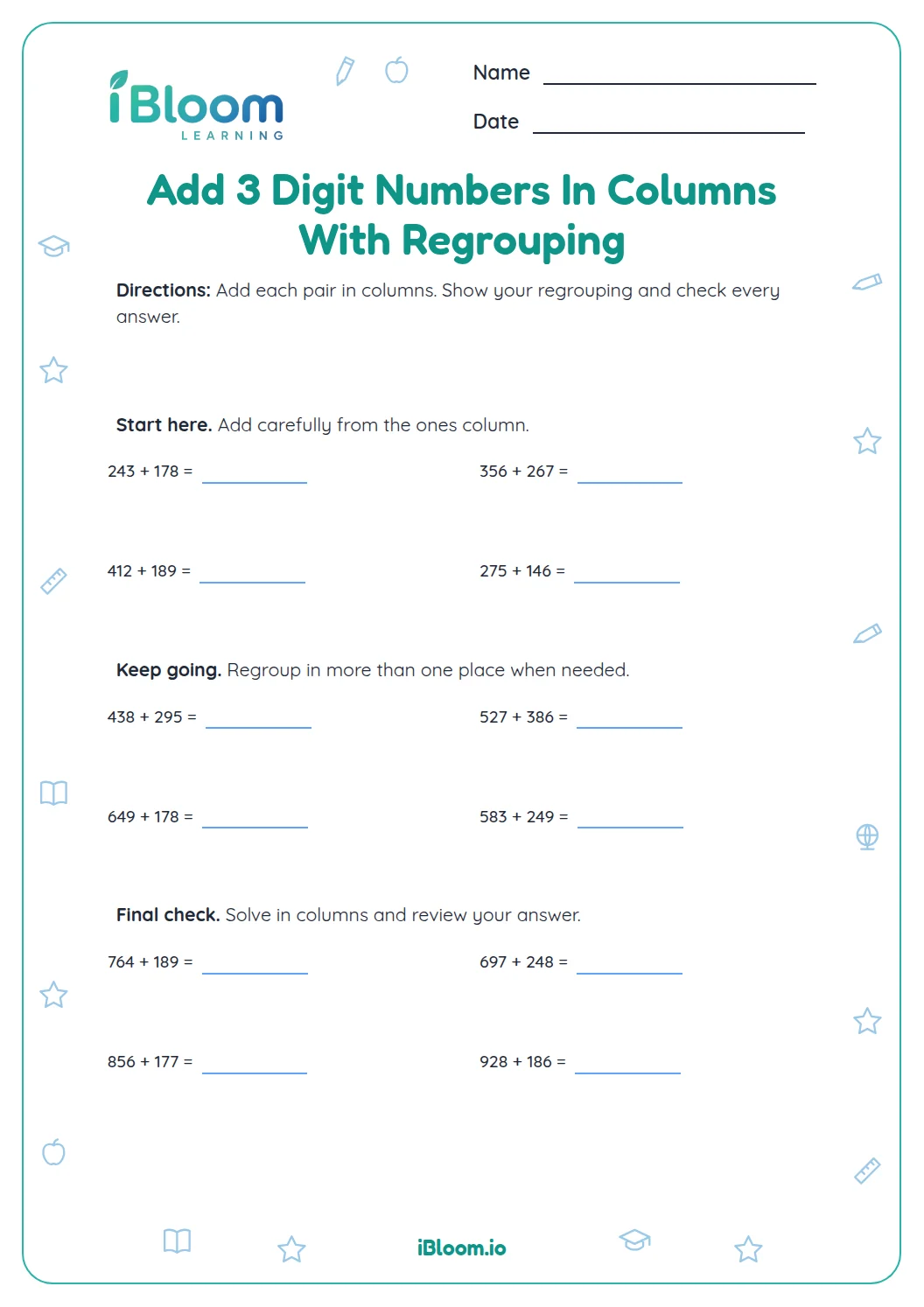
This Grade 3 worksheet applies four-digit addition to distinct everyday situations. Students add book counts, visitors, supplies, distances, money, and more, writing each equation in columns and using the provided working space. Every problem has two four-digit addends and requires regrouping in at least one place. The separate answer key lists each total with its unit.
How do you turn a story into an addition equation?
Find the two quantities the story asks you to combine. Keep track of what each number counts, then write an addition equation before calculating.
In question 1, the two room counts combine, so the equation is 2,438 + 3,176. The answer needs the same unit: books.
- 12,438 + 3,176
- 2Ones: 8 + 6 = 14; write 4, regroup 1 ten
- 3Tens: 3 + 1 + 1 = 5
- 4Hundreds: 4 + 1 = 5; thousands: 2 + 3 = 5
- 5Total: 5,614 books
Why should the digits line up in columns?
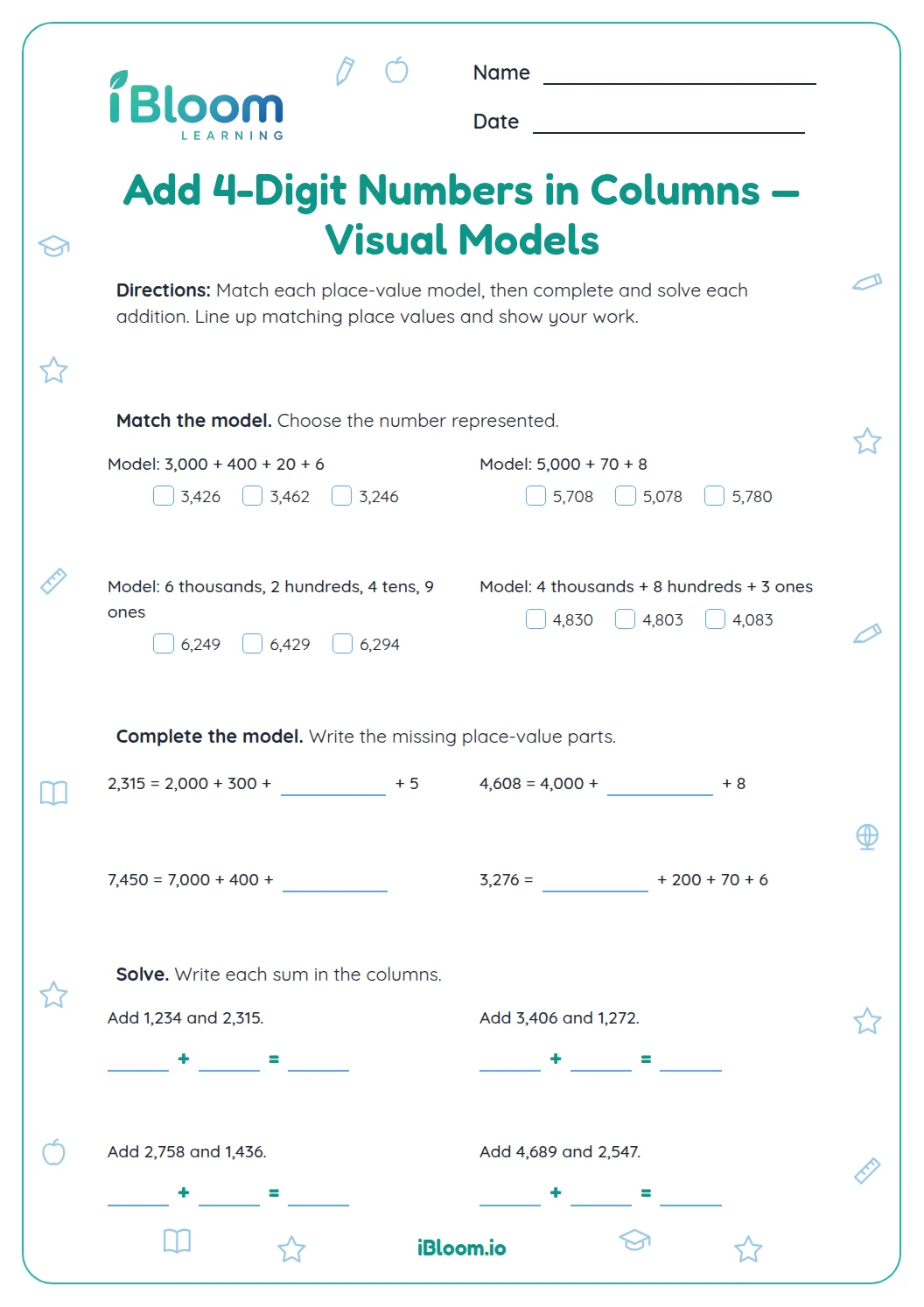
Each column combines the same place value. Ones go under ones, tens under tens, hundreds under hundreds, and thousands under thousands. Regroup ten ones as one ten, ten tens as one hundred, or ten hundreds as one thousand.
Questions 2 and 3 include regrouping across several places, so keeping the columns aligned makes each carry easy to track.
How can an estimate help check a total?
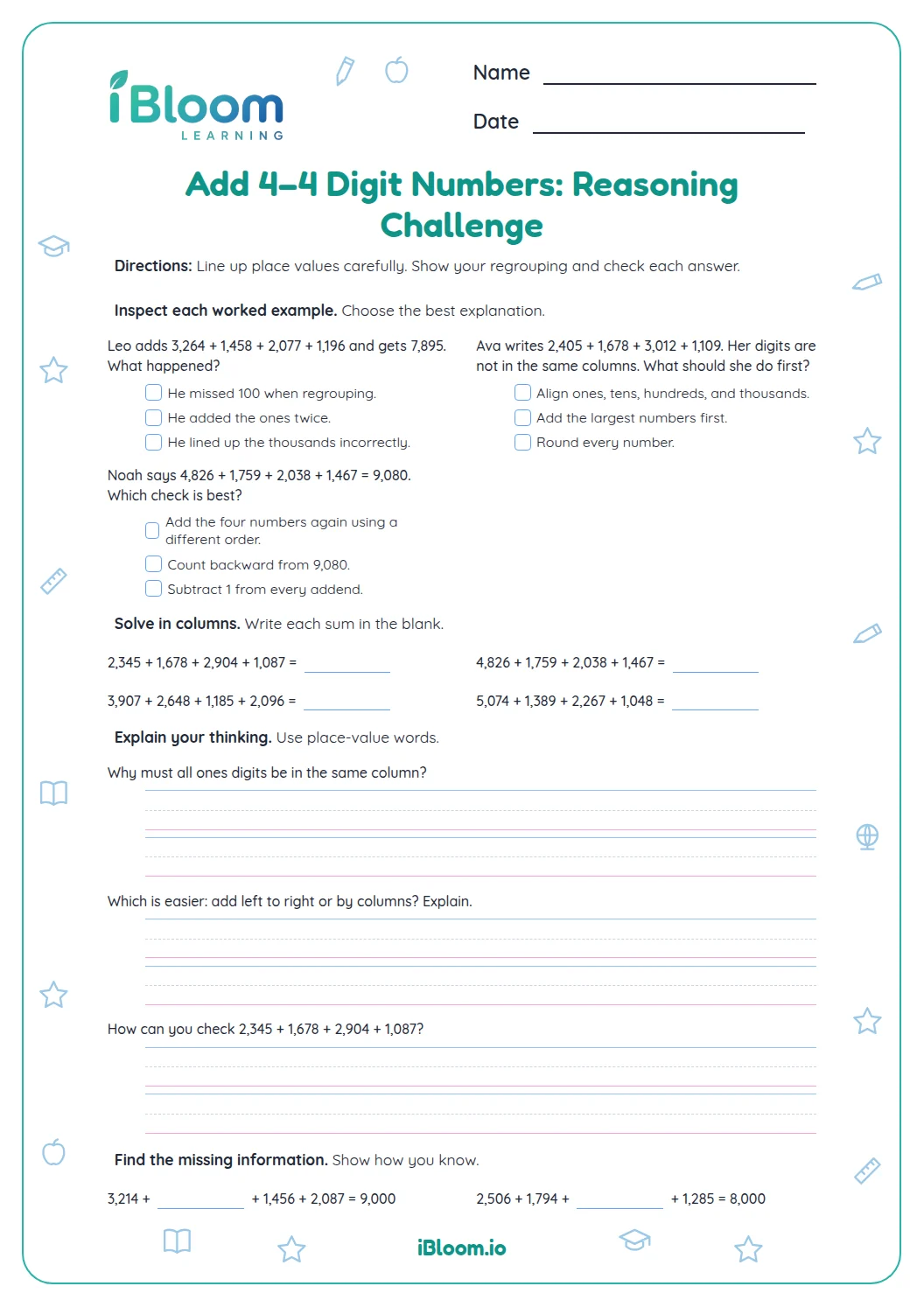
Round each addend to a nearby thousand or hundred, then check whether the exact sum is reasonable. For 4,285 + 2,697, a quick estimate is about 4,000 + 3,000, or 7,000; the exact total 6,982 is close.
A sensible estimate can catch a missed regrouping or a digit written in the wrong column.
How do you report the answer to a story problem?
Write the total with the unit that the story counts, such as visitors, feet, dollars, or meals. Do not leave a bare number when the context tells you what the number means.
Question 11 combines two amounts of money, so its total is written as $8,843.
How to use this worksheet
- 1Underline both amounts in the story and circle what they measure.
- 2Write an equation using the two amounts before doing the column work.
- 3Line up the digits by place value and start with the ones column.
- 4Regroup carefully and record each carry above the next column.
- 5Estimate the total, then write the exact answer with its unit.
Common mistakes and quick fixes
The mistake
Misaligning a digit so that a tens digit is added to a hundreds digit.
The fix
Write place-value headings or line up the rightmost digits before adding.
The mistake
Forgetting a regrouped ten when moving into the next column.
The fix
Mark the carried digit clearly above the next place and include it in that sum.
The mistake
Giving only a number when the story asks for visits, feet, or dollars.
The fix
Reread the question and attach the matching unit to the total.
What to practice next
Make more practice
Further reading
Questions parents and teachers ask
Do students need to add in columns for every problem?
Yes. Each problem asks students to combine two four-digit amounts and includes room to set up the addition vertically. Place-value alignment keeps ones, tens, hundreds, and thousands in their correct columns. The answer key supports a second check after students finish the worksheet.
Why are there two four-digit numbers in every story?
The page practices the named four-digit addition skill through varied real contexts. Students combine visitor counts, supplies, distances, and other amounts, then write a total with the unit that matches the story. The answer key supports a second check after students finish the worksheet.
How can a student check a sum?
Round both addends to nearby thousands or hundreds, then compare the estimate with the exact total. For 4,285 + 2,697, about 4,000 + 3,000 is 7,000, close to the exact answer 6,982. The answer key supports a second check after students finish the worksheet.
What should happen when a column totals more than nine?
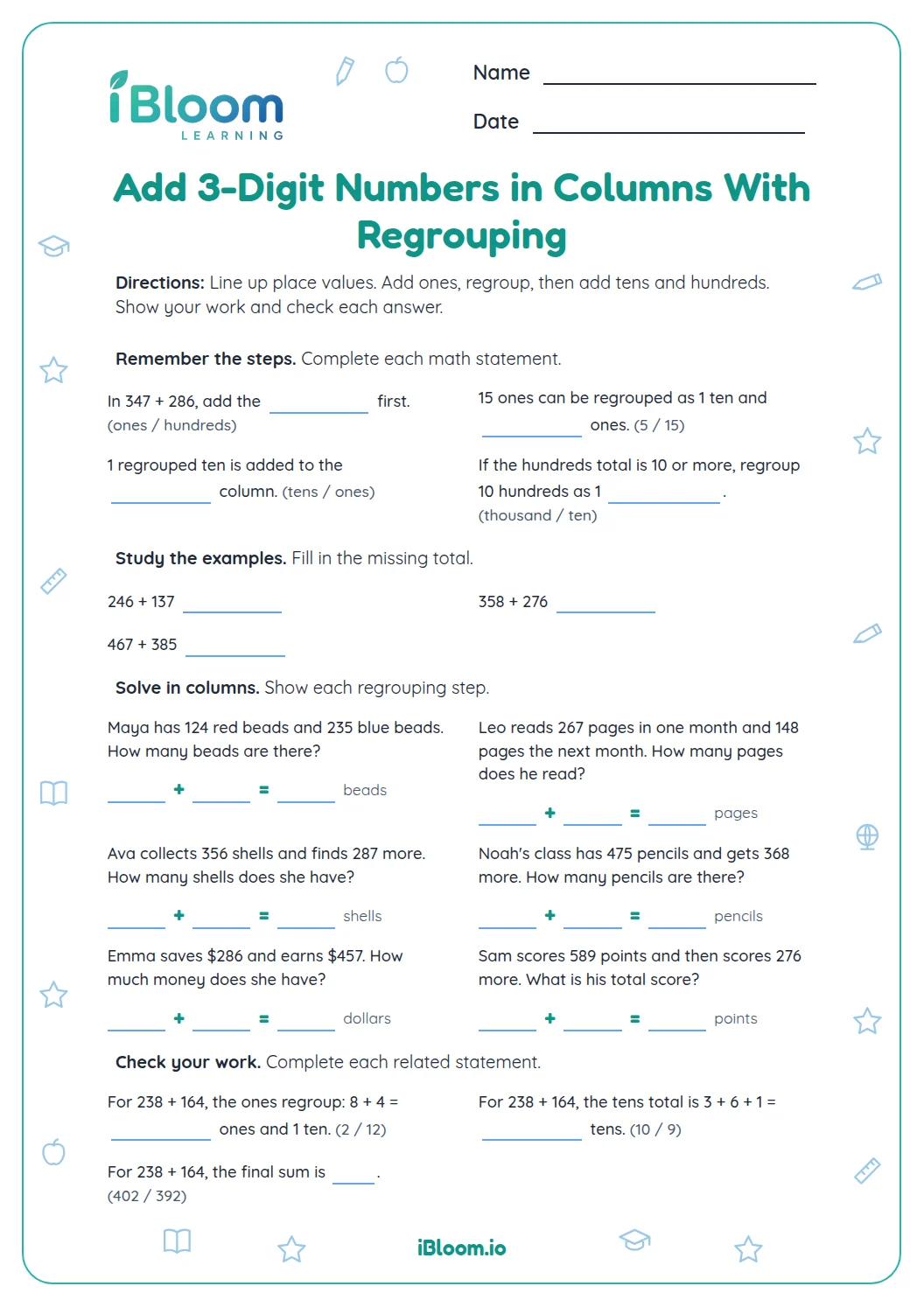
Write the ones digit in that column and regroup the remaining tens into the next place. For example, 8 + 6 = 14 means write 4 ones and carry 1 ten to the tens column. The answer key supports a second check after students finish the worksheet.
Is an answer key included?
Yes. The key gives the total for all sixteen stories, including units when the question counts items or distance. Students can use it after showing their column work to find whether an error came from the equation, alignment, or regrouping.