




About this worksheet
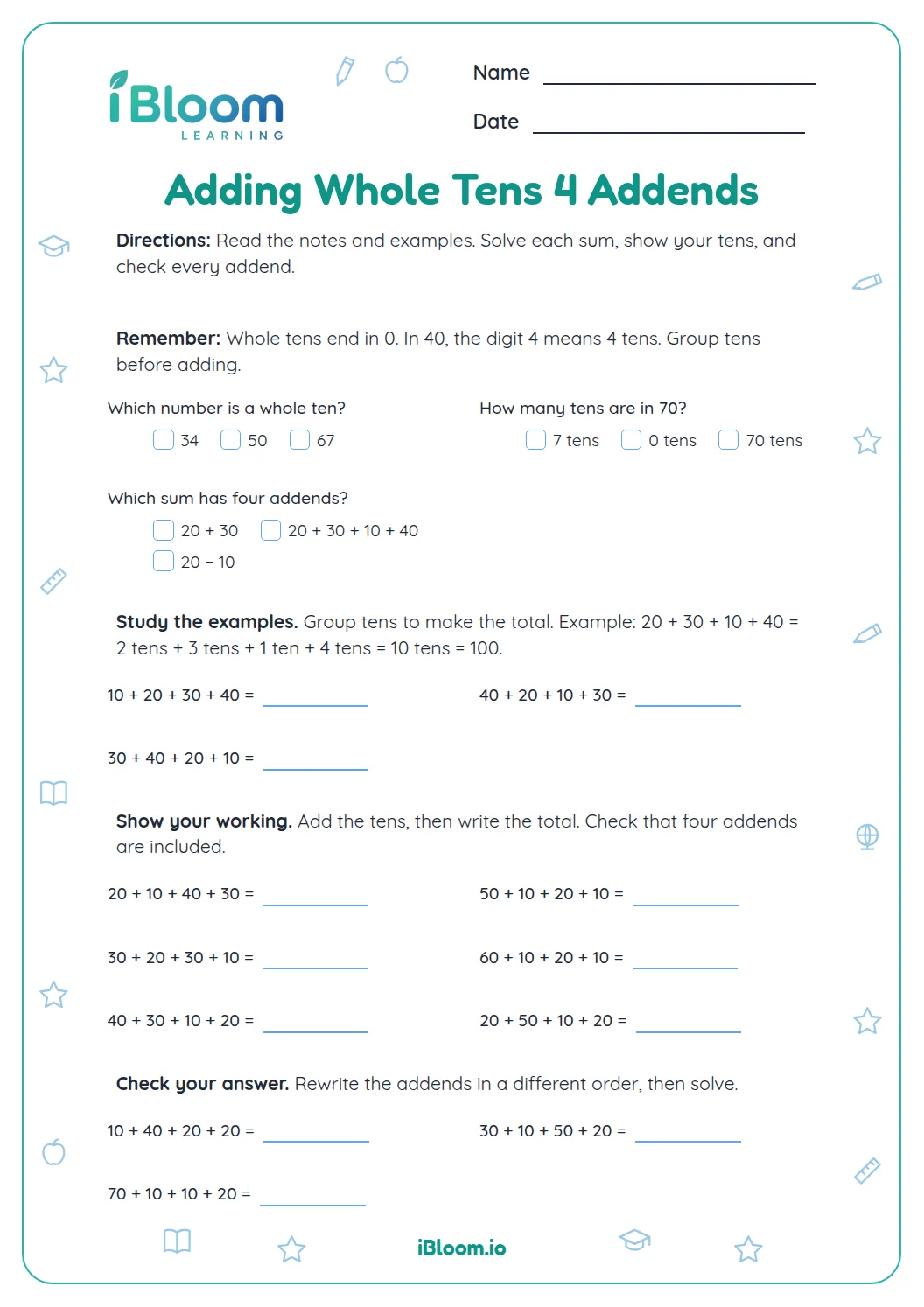
This practice set puts four-addend addition into school, garden, shop, and community situations. Every addend is a whole ten, so learners can focus on organizing and combining all four amounts. Totals stay at or below 1,000.
Aligned to 3.NBT.A.2
How can four whole-ten amounts be added?
Add the four amounts in pairs that make a friendly total, then combine the pair sums. The questions use whole tens so the child can focus on place value and the meaning of the story.
- 1120 + 230 + 150 + 280
- 2(120 + 280) + (230 + 150) = 780
What does this worksheet ask students to do?
Sixteen story problems ask students to total four amounts, from school collections and supplies to garden and event totals.
- Read the whole prompt before writing an answer.
- Use the separate answer key to check completed work.
How can an adult support practice?
Ask the learner to name the four amounts, choose pairs to add, and check that the total fits the context.
How to use this worksheet
- 1Underline the four quantities.
- 2Choose an order that makes friendly totals.
- 3Add all four amounts and check with a second grouping.
Common mistakes and quick fixes
The mistake
Rushing and overlooking a direction or important detail.
The fix
Read the whole item, mark the information you need, then check that the answer fits.
The mistake
Stopping after getting an answer without checking it.
The fix
Use the inverse operation, reread the sentence, or compare the response with the prompt.
Curriculum alignment
This worksheet practices the following Common Core skills.
Fluently add and subtract within 1,000.
On this sheet: Every story combines four whole-ten amounts; the totals do not exceed 1,000.
Show the official wordingHide the official wording
Fluently add and subtract within 1000 using strategies and algorithms based on place value, properties of operations, and/or the relationship between addition and subtraction.
What to practice next
Make more practice
Further reading
Questions parents and teachers ask
What does this worksheet practice?
It gives Grade 3 students practice adding four whole-ten amounts in real-world stories. The 16 questions use totals up to 1,000, so children can focus on combining amounts and checking whether a total makes sense in its context. The examples and separate answer key make it easy to review each response together.
How can a student add four amounts?
One useful approach is to pair amounts that make a round hundred or another easy total. Add each pair, combine the pair sums, and check by adding in a different order. The answer key lists the total for every story.
How many questions are included?
There are 16 story problems across three worksheet pages, followed by an answer key. Students add four amounts in each item and write a total with the unit or context requested. The examples and separate answer key make it easy to review each response together.
What should an adult check?
Check that all four quantities were included and that the final answer uses the right unit, such as books, points, or dollars. For a total near 1,000, an estimate can help catch a missed amount or place-value error. The examples and separate answer key make it easy to review each response together.
What comes next after this practice?
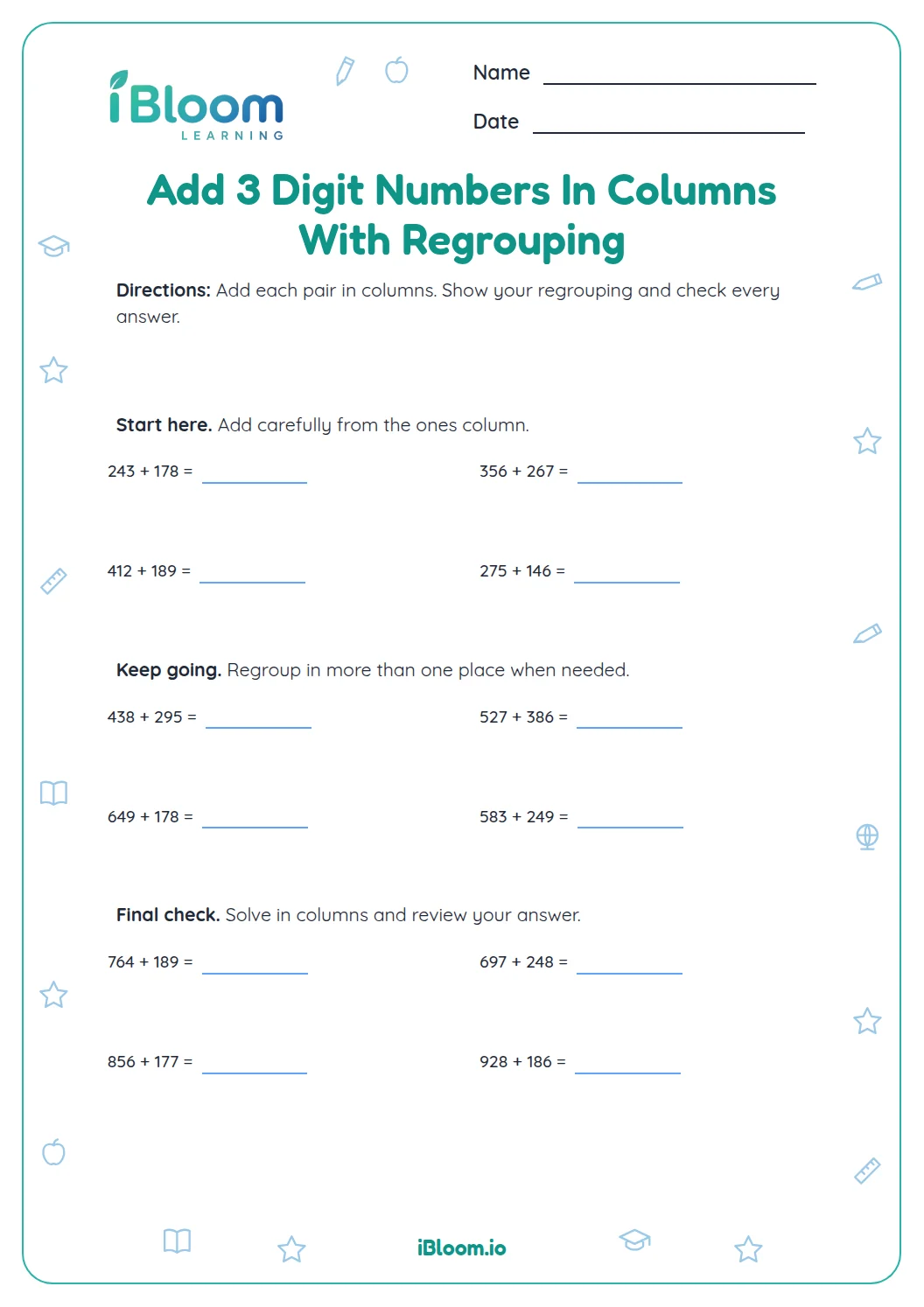
After becoming comfortable adding four whole tens, students can try adding three-digit numbers in columns, including examples that require regrouping. The sibling practice links on this page offer related addition work. The examples and separate answer key make it easy to review each response together.