


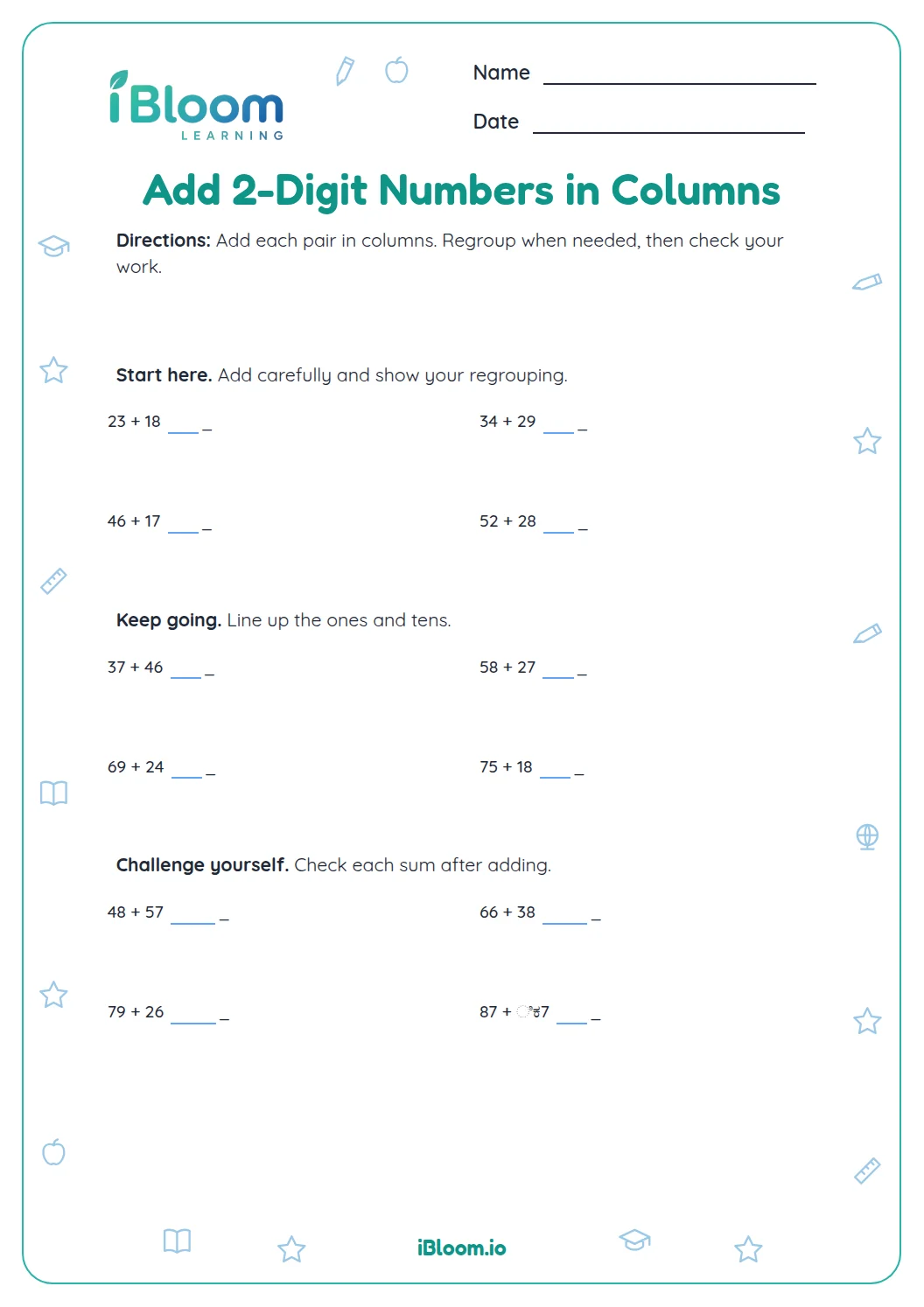
About this worksheet
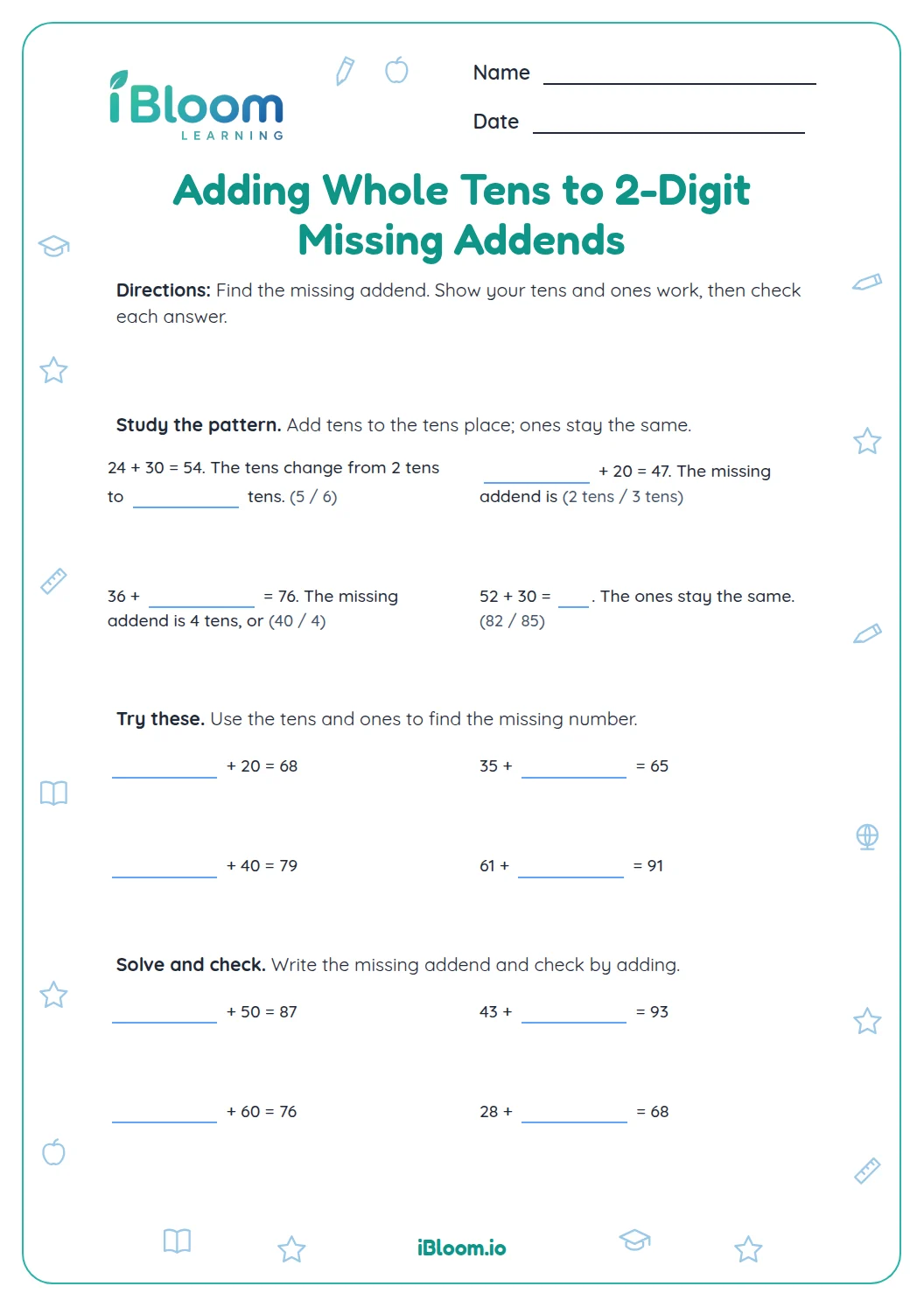
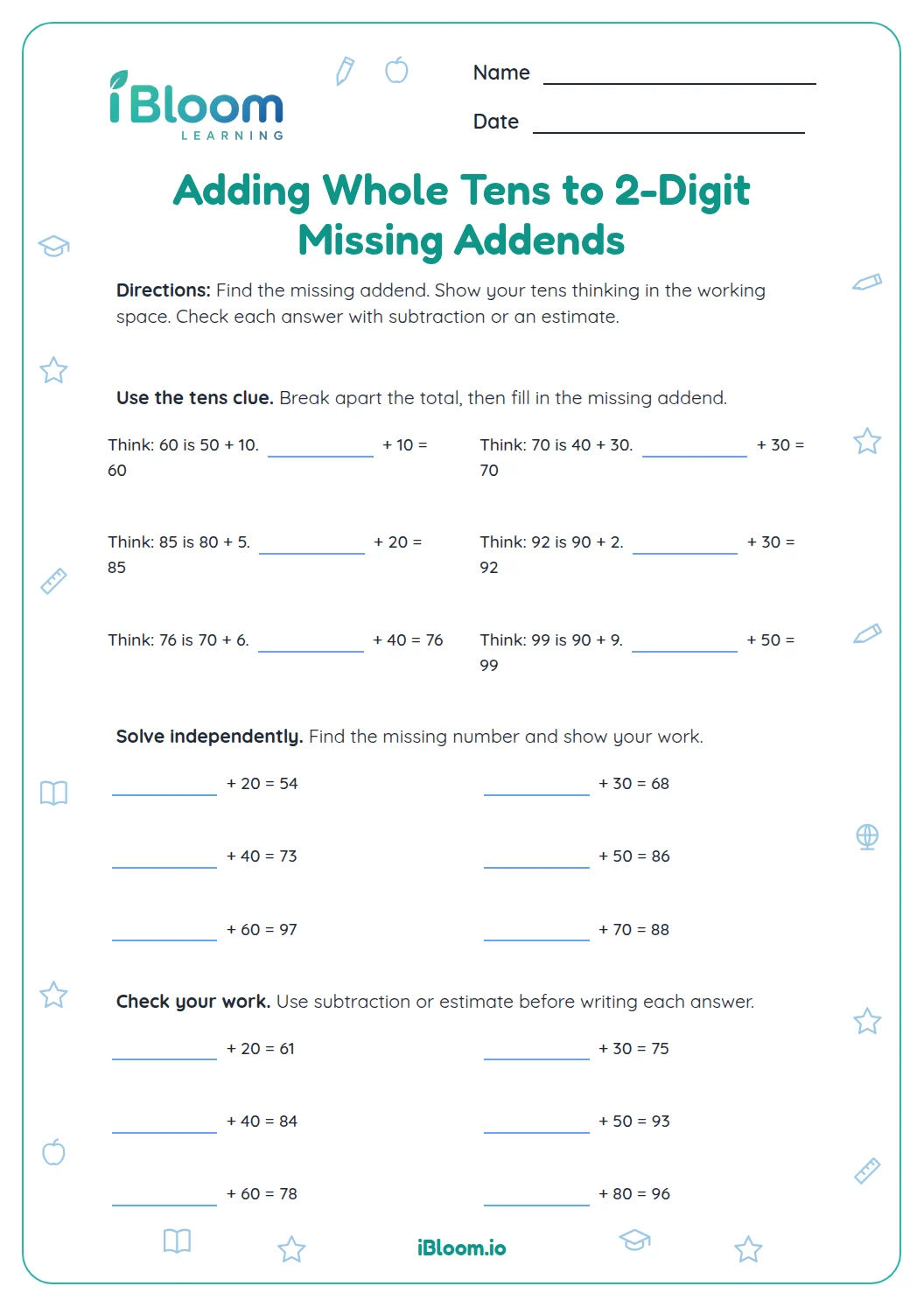
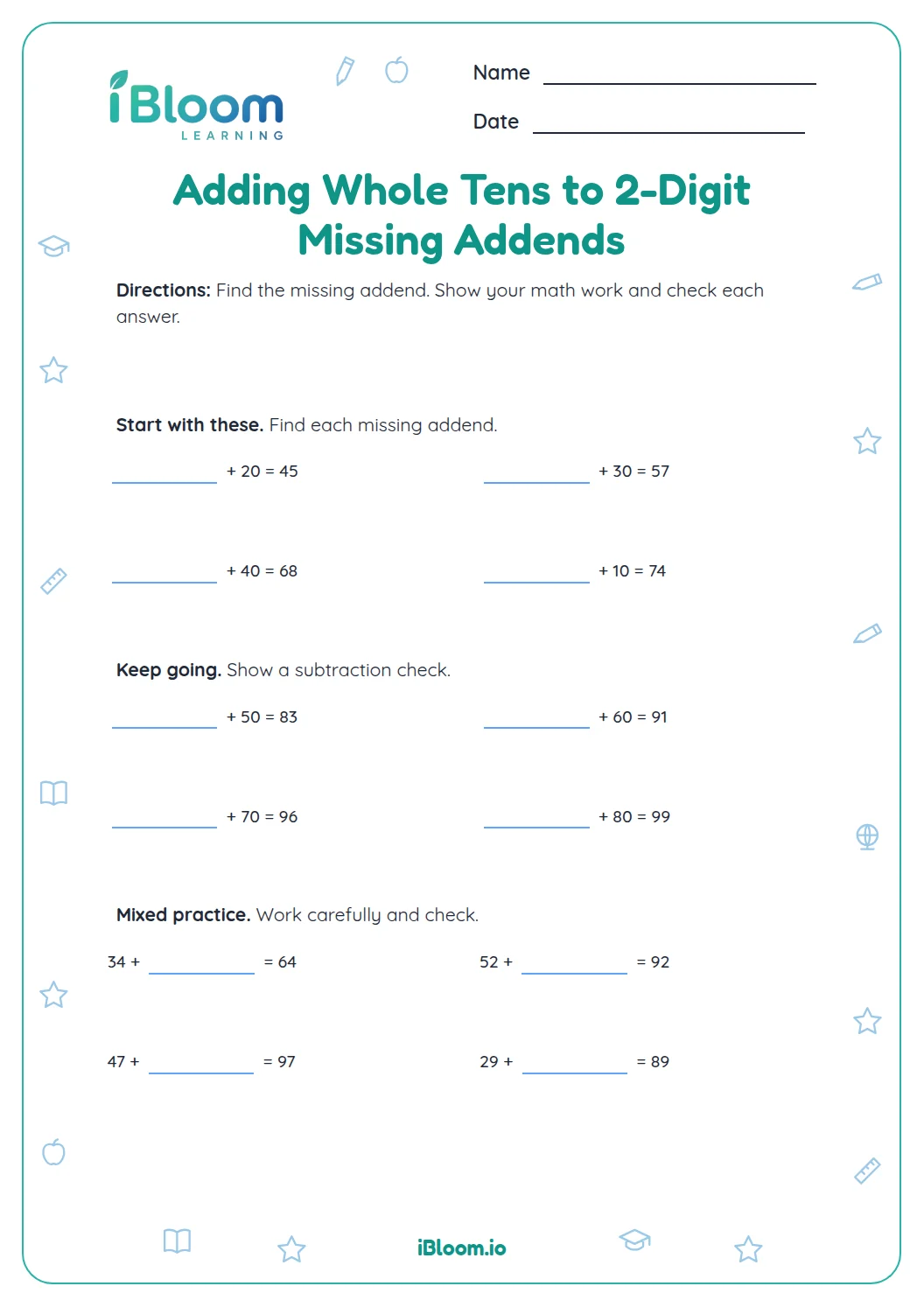
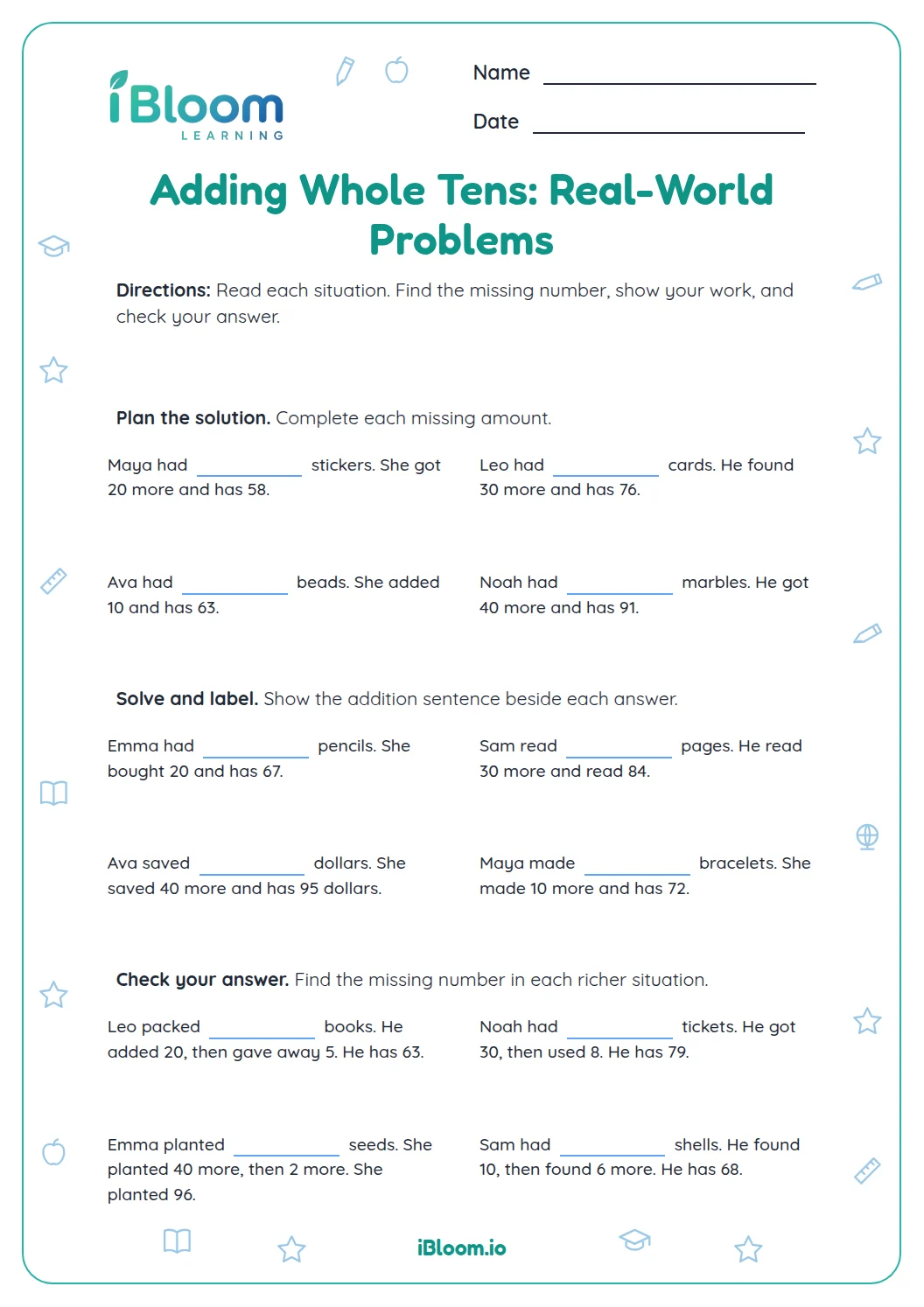
This free Grade 3 worksheet practices finding a missing addend in addition equations with a two-digit number and a whole ten. Students solve sixteen equations, including unknowns before or after the known addend and sums that require attention to the tens and ones. The work supports Common Core 2.NBT.B.5, adding within 100 with strategies based on place value,. A separate key gives each missing number.
Aligned to 2.NBT.B.5
How do you find the missing addend?
Use the relationship between addition and subtraction. In 50 + ___ = 87, subtract 50 from 87 to get 37. Check: 50 + 37 = 87.
When the missing addend comes first, the same reasoning works: ___ + 40 = 95 means 95 − 40.
- 150 + ___ = 87
- 287 − 50 = 37
- 350 + 37 = 87
What do the tens and ones tell you?
A whole-ten addend changes the tens digit while leaving the ones count unchanged. If the difference between the sum and known addend has a nonzero ones digit, the missing addend may not be a whole ten; use the full difference.
How can you check each answer?
Put the missing number back into the equation and add. Both addends should make exactly the printed sum.
How to use this worksheet
- 1Read the equation and locate the blank.
- 2Subtract the known addend from the sum.
- 3Write the difference in the blank.
- 4Add your answer to the known addend to check.
Common mistakes and quick fixes
The mistake
Subtract the sum from the known addend.
The fix
Use sum − known addend; the missing amount is what remains.
The mistake
Change the ones digit when adding a whole ten.
The fix
Whole tens add tens; the ones digit stays the same.
The mistake
Treat every missing number as a multiple of ten.
The fix
Find the actual difference; some equations have a nonzero ones digit.
Curriculum alignment
This worksheet connects focused practice to the listed Common Core skill.
Add within 100 using place value strategies and the relationship between addition and subtraction.
On this sheet: Students use subtraction to find an unknown addend in equations within 100.
Show the official wordingHide the official wording
Fluently add and subtract within 100 using strategies based on place value, properties of operations, and/or the relationship between addition and subtraction.
What to practice next
Make more practice
Further reading
Questions parents and teachers ask
How do you find a missing addend?
Subtract the addend you know from the sum. For 50 + ___ = 87, calculate 87 − 50 = 37, then check that 50 + 37 equals 87. The same method works when the blank is first or second in the equation.
Does the missing addend always end in zero?
No. The known addend is a whole ten, but the missing addend can have ones. In 50 + ___ = 87, the missing number is 37. Subtract the known addend from the sum instead of assuming the answer must be a multiple of ten.
What if the blank comes before the plus sign?
Use the same subtraction relationship. For ___ + 40 = 95, subtract 40 from 95 to get 55. Addition can be written in either order, so the unknown addend is still the sum minus the addend that is shown.
How can a student check an answer?
Put the number back in the blank and add the two addends. If the result matches the sum, the equation is correct. For example, check 37 by calculating 50 + 37 = 87. This inverse-operation check works on every problem here.
What does “whole ten” mean here?
A whole ten is a multiple of ten, such as 20, 30, or 60. The worksheet pairs a whole-ten addend with a two-digit addend. The difference can still have a ones digit, so students should use the full subtraction calculation.