
About this worksheet
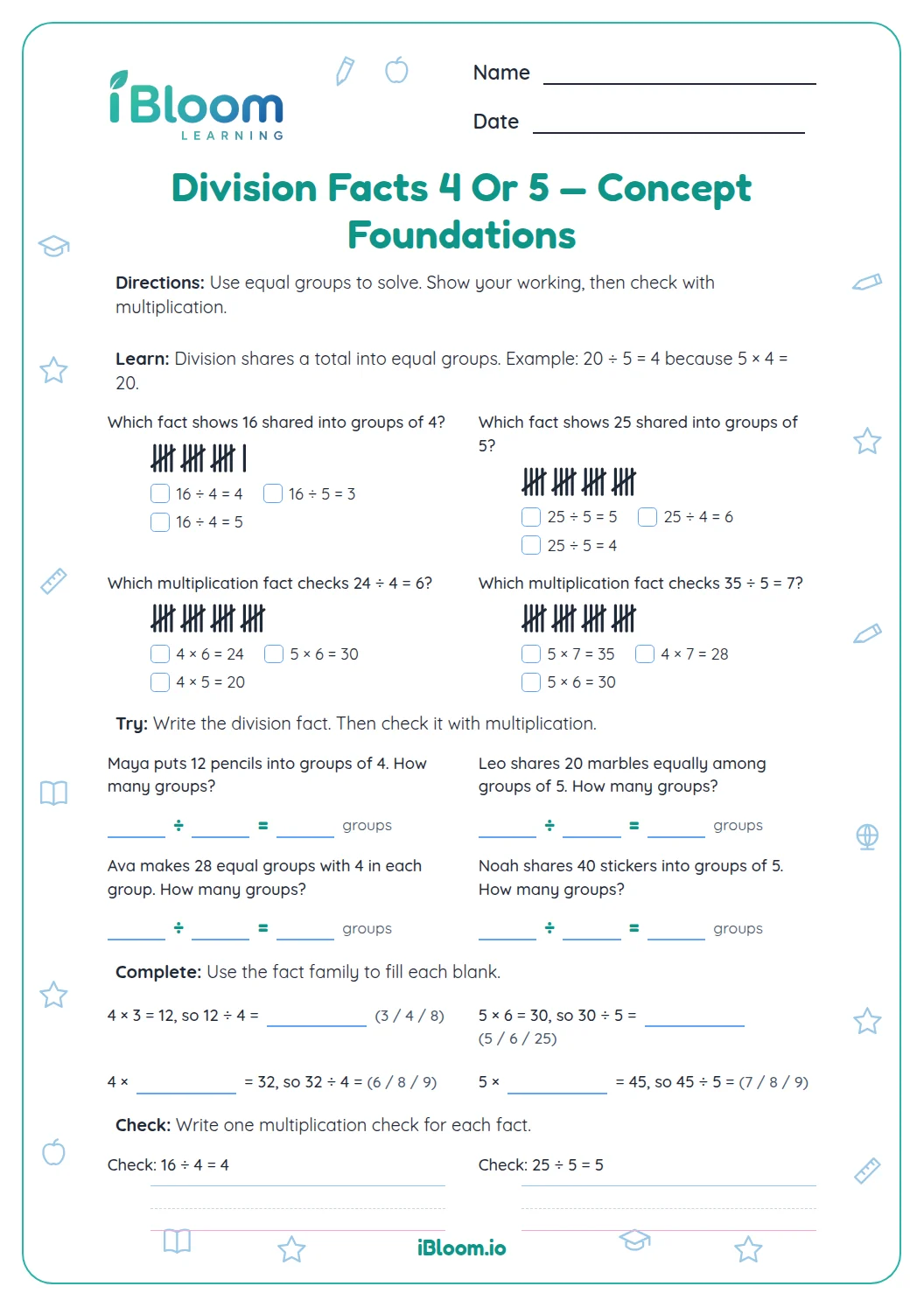
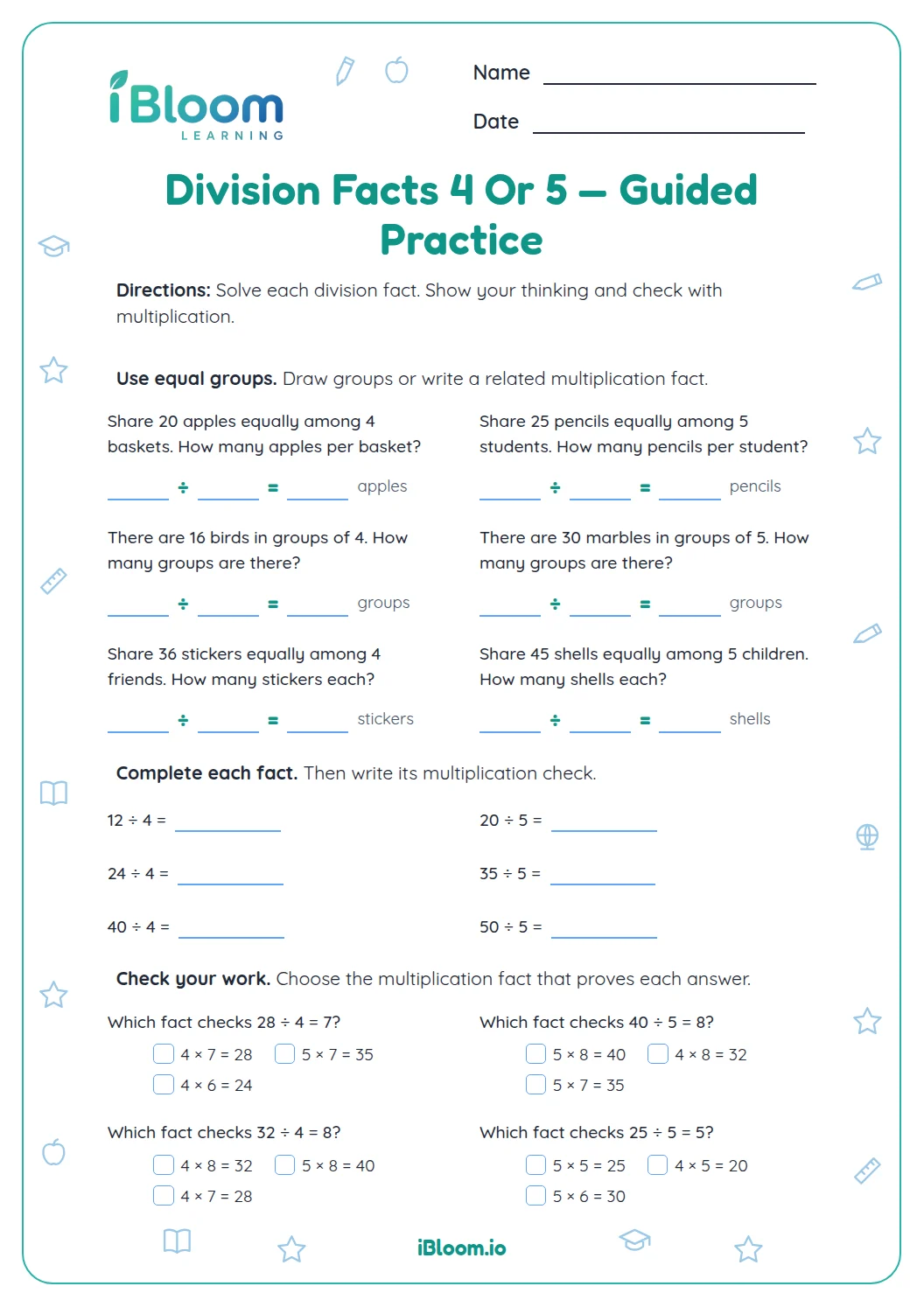
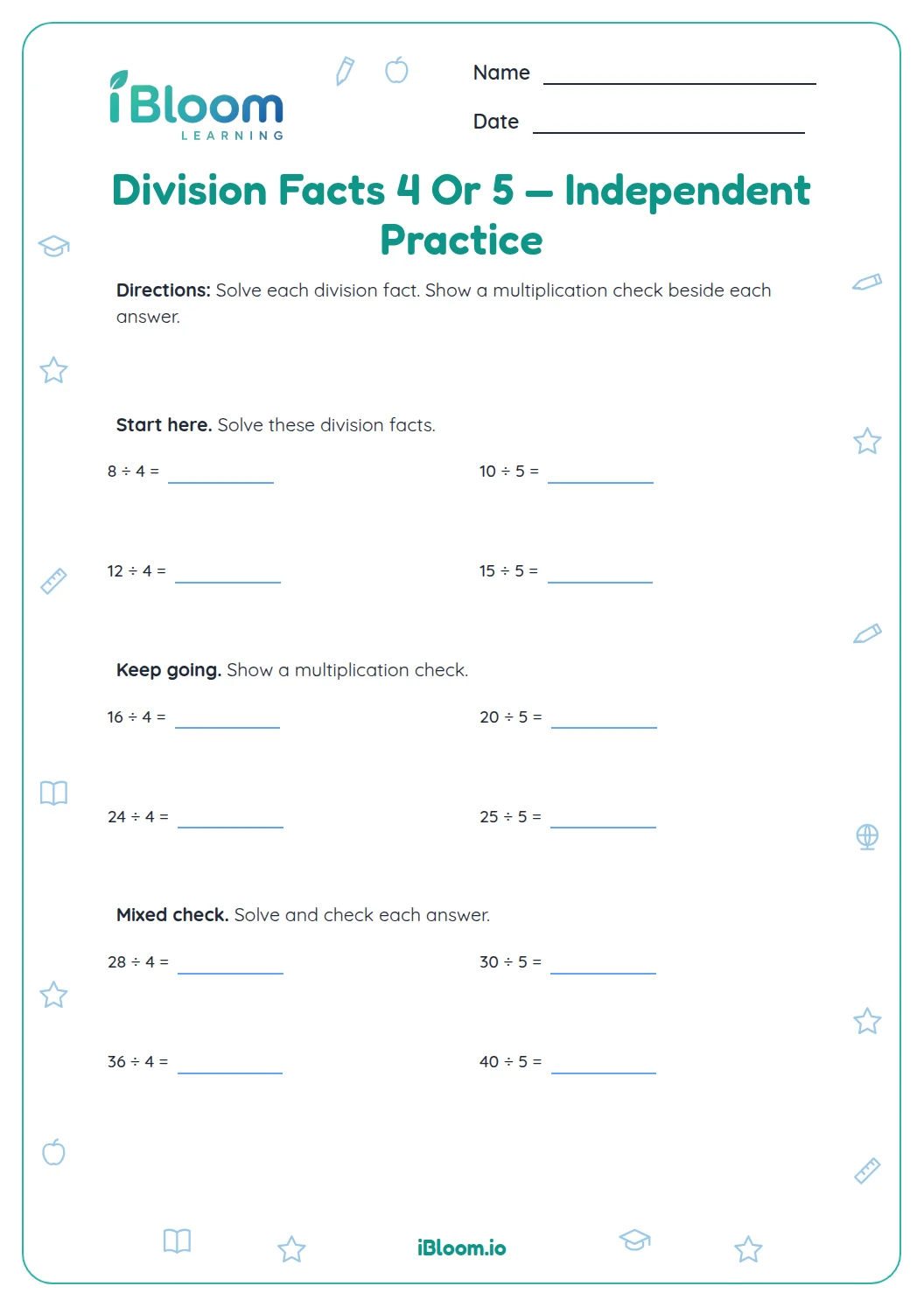
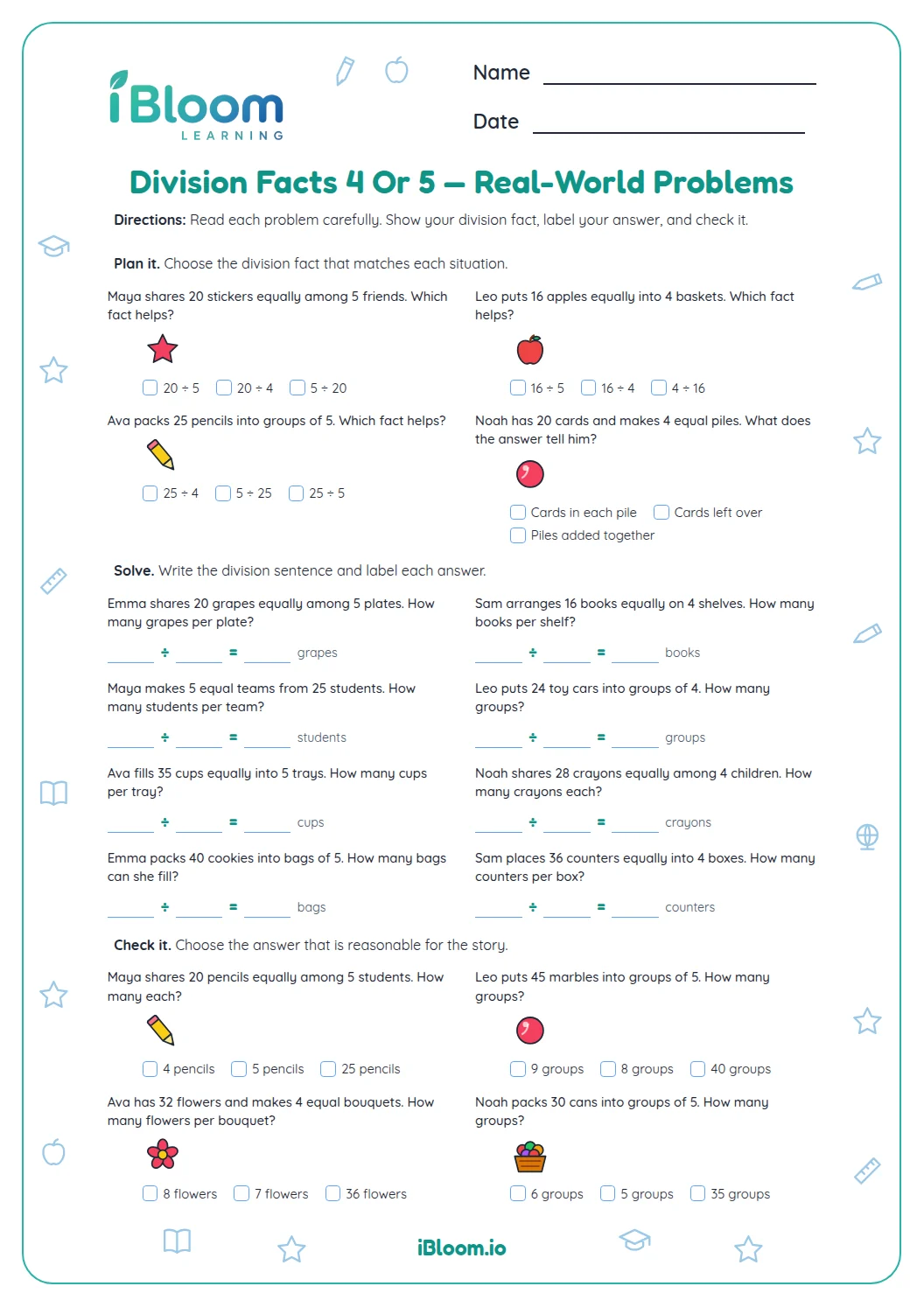
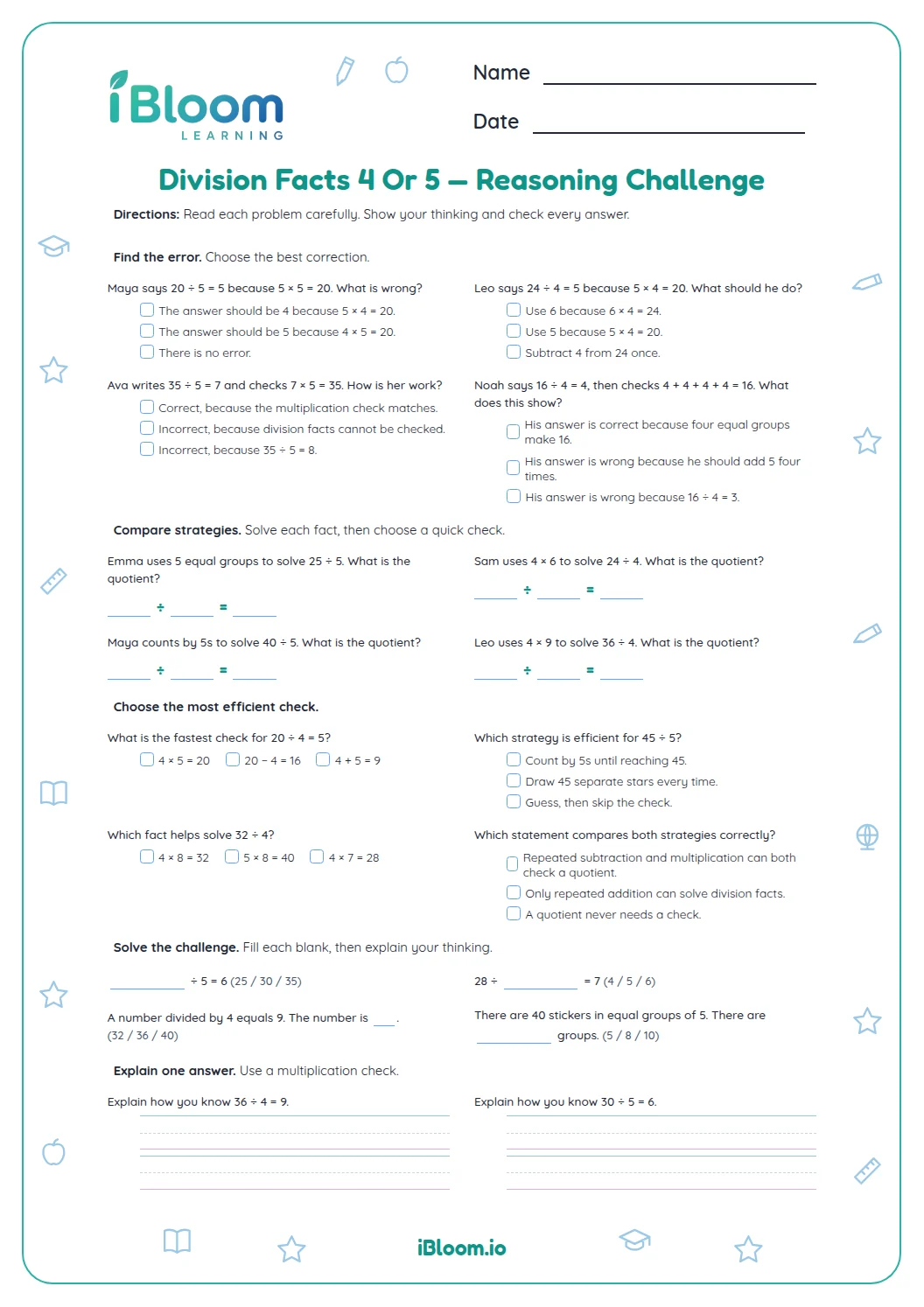
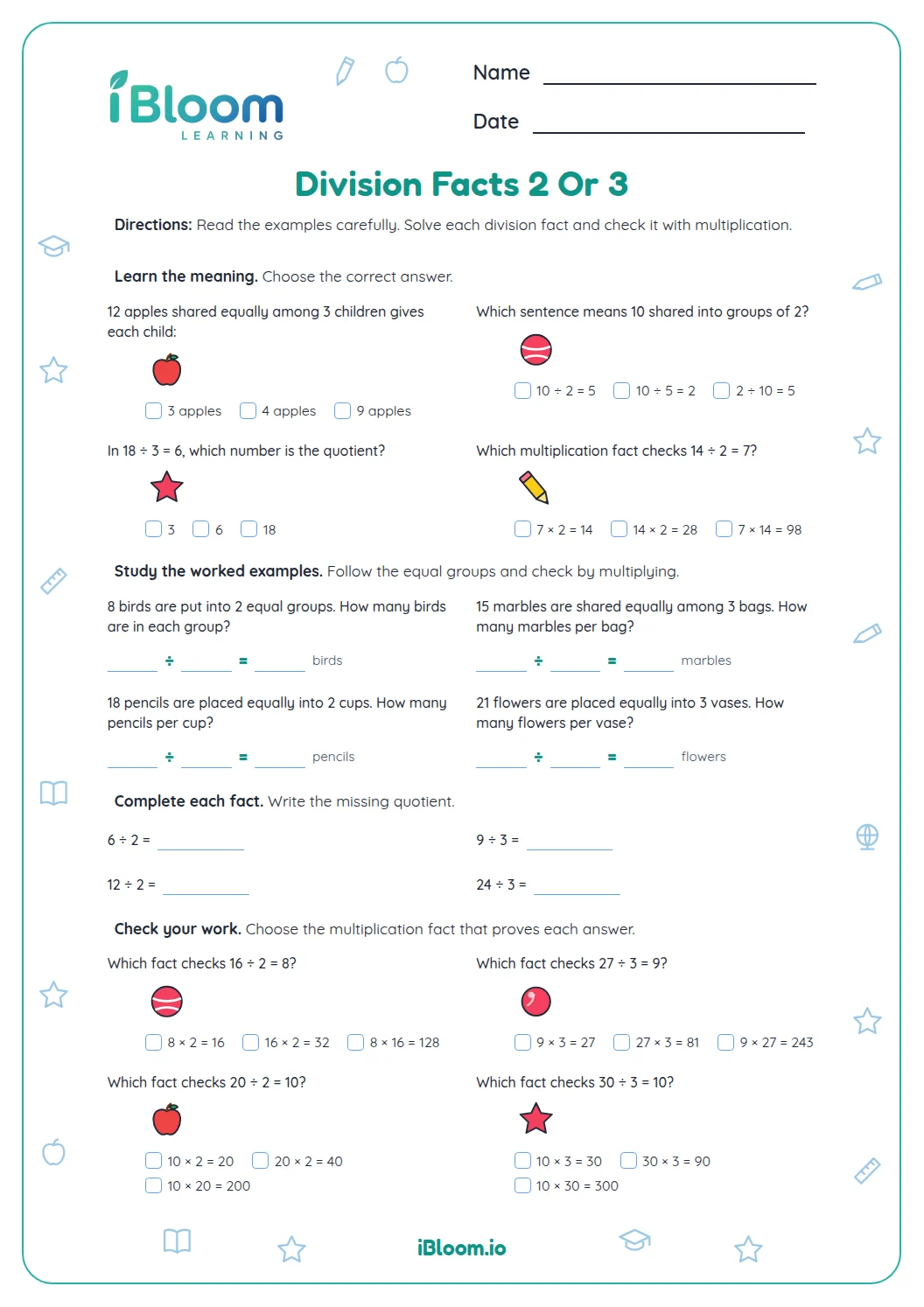
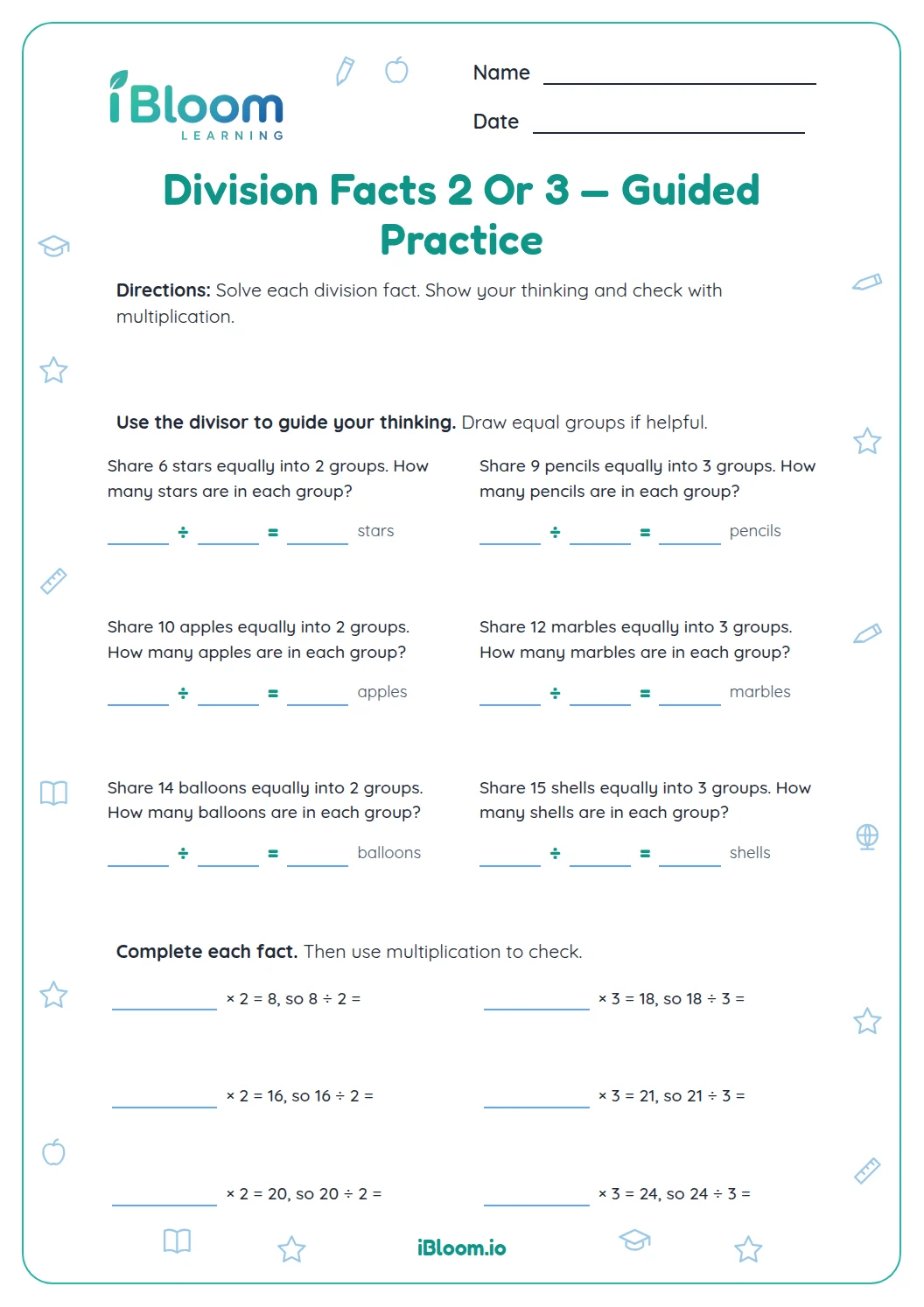
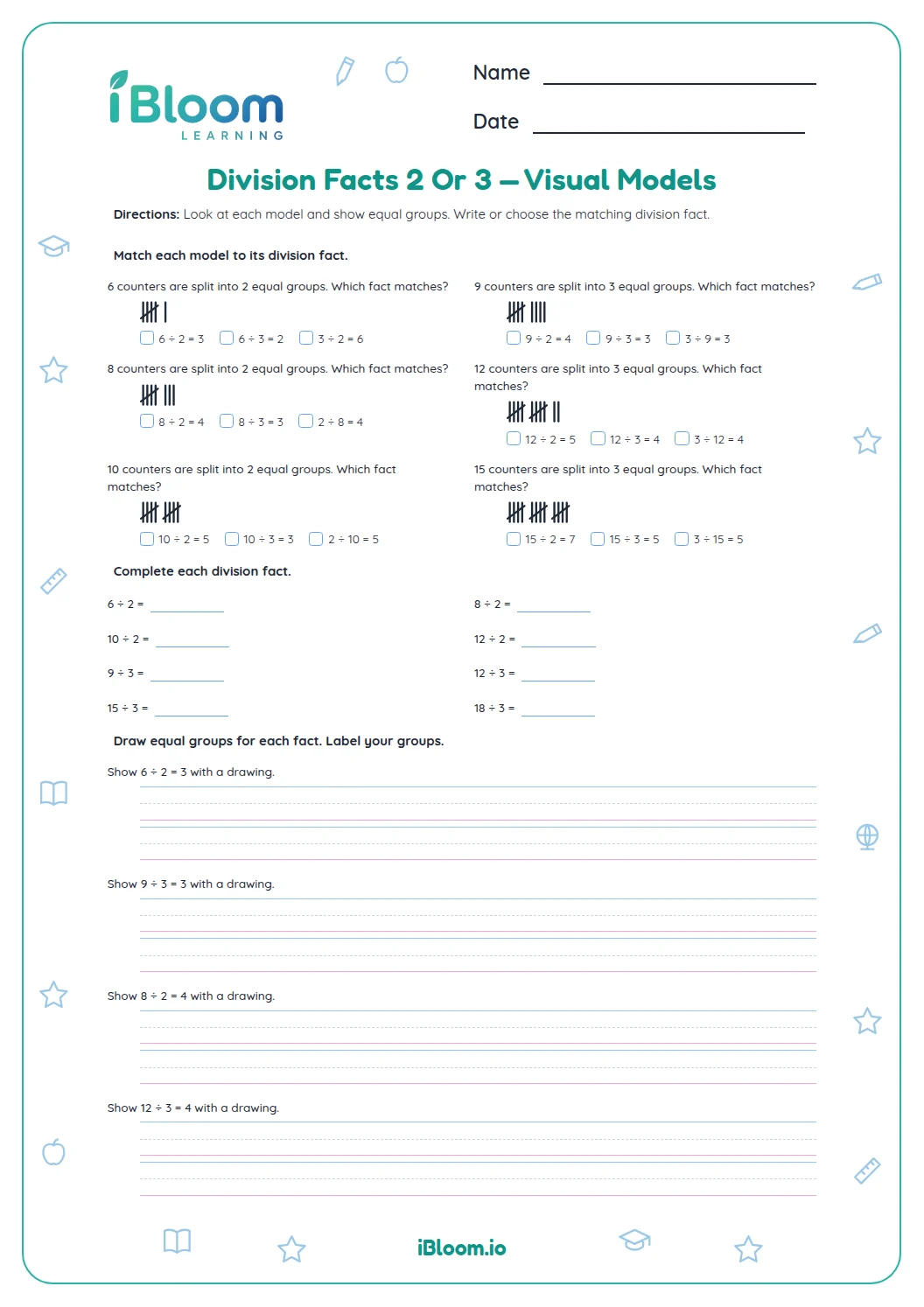
This Grade 3 worksheet practices division facts of 4 and 5 with eight dot arrays and seven equal-group stories. Students read rows and dots per row, then apply the same total ÷ group size relationship in short situations. The 15 questions move from visual models to independent fact solving, with a complete answer key.
Aligned to 3.OA.C.7
How can you read a division array?
Count the objects in one row or column and count how many equal groups there are. The total is the number of objects; the number of groups and the size of each group are the divisor and quotient.
- 120 counters in rows of 5 makes 4 rows, so 20 ÷ 5 = 4.
What does the quotient tell you?
Eight questions use dot arrays to make the total and equal rows visible. The prompts specify dots per row, so students divide by the group size to find the number of rows.
How can multiplication check a division fact?
The last seven questions use stickers, books, crayons, fruit, students, beads, and candy to practice equal sharing or grouping. Identify the total and the size of each group, then check the quotient with multiplication.
How to use this worksheet
- 1Identify the total number of dots.
- 2Read whether the question asks for rows or dots in each row.
- 3Count equal groups in the array.
- 4Write the division fact and quotient.
- 5Check by multiplying groups by dots per group.
Common mistakes and quick fixes
The mistake
Reporting the group size when asked for the number of groups.
The fix
Check whether the question asks “how many rows” or “how many in each row.”
The mistake
Counting only one row and calling it the total.
The fix
Use all rows to count the complete array.
The mistake
Choosing a quotient that does not multiply back to the total.
The fix
Multiply the divisor by the quotient to check.
Common Core alignment
The array practice builds fluency with multiplication and division within 100.
Use multiplication and division strategies to solve facts within 100.
On this sheet: Students use arrays and multiplication relationships to solve division facts with 4 and 5.
Show the official wordingHide the official wording
Fluently multiply and divide within 100, using strategies such as the relationship between multiplication and division (e.g., knowing that 8 × 5 = 40, one knows 40 ÷ 5 = 8) or properties of operations. By the end of Grade 3, know from memory all products of two one-digit numbers.
What to practice next
Make more practice
Further reading
Questions parents and teachers ask
Which divisors appear?
The worksheet practices division by 4 and division by 5. Eight questions include dot arrays, and seven short stories use equal groups. In the array prompts, the number of dots in each row is stated so students can write total ÷ group size = number of rows.
How many questions are included?
There are 15 questions in three parts: eight array readings and seven equal-group stories. The questions use divisors 4 and 5. The answer key lists the matching quotient or division fact in worksheet order, so students can check each item without guessing which quantity the prompt asks for.
What does the quotient represent?
For the eight dot arrays, the quotient gives the number of rows because the prompt names the dots in each row. In the equal-group stories, the quotient may describe groups or items in each group, depending on the wording. Read whether the story says “each” or asks how many groups.
How can a student check a quotient?
Multiply the quotient by the group size. The product should equal the starting total. For a 4-by-5 array, four rows of five make 20, so 20 ÷ 5 = 4. In the sticker story, check 4 × 7 = 28 to confirm the equal shares.
Can one array show more than one division fact?
Yes. A 4-by-5 array can show 20 ÷ 5 = 4 or 20 ÷ 4 = 5 if you choose different group sizes. The array questions here state the dots per row and ask for rows, which selects one equation. A story’s wording similarly identifies the unknown quantity.