




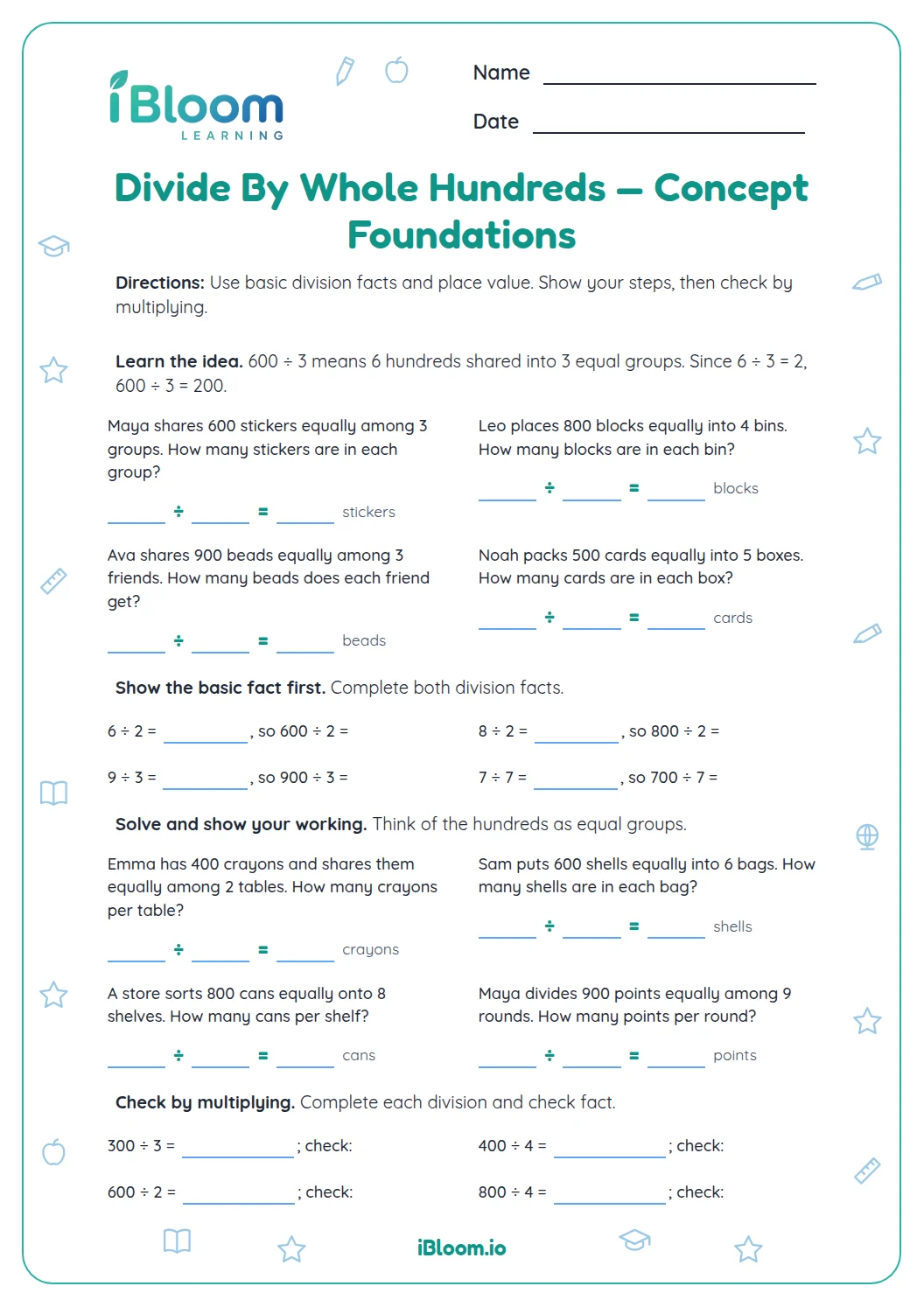


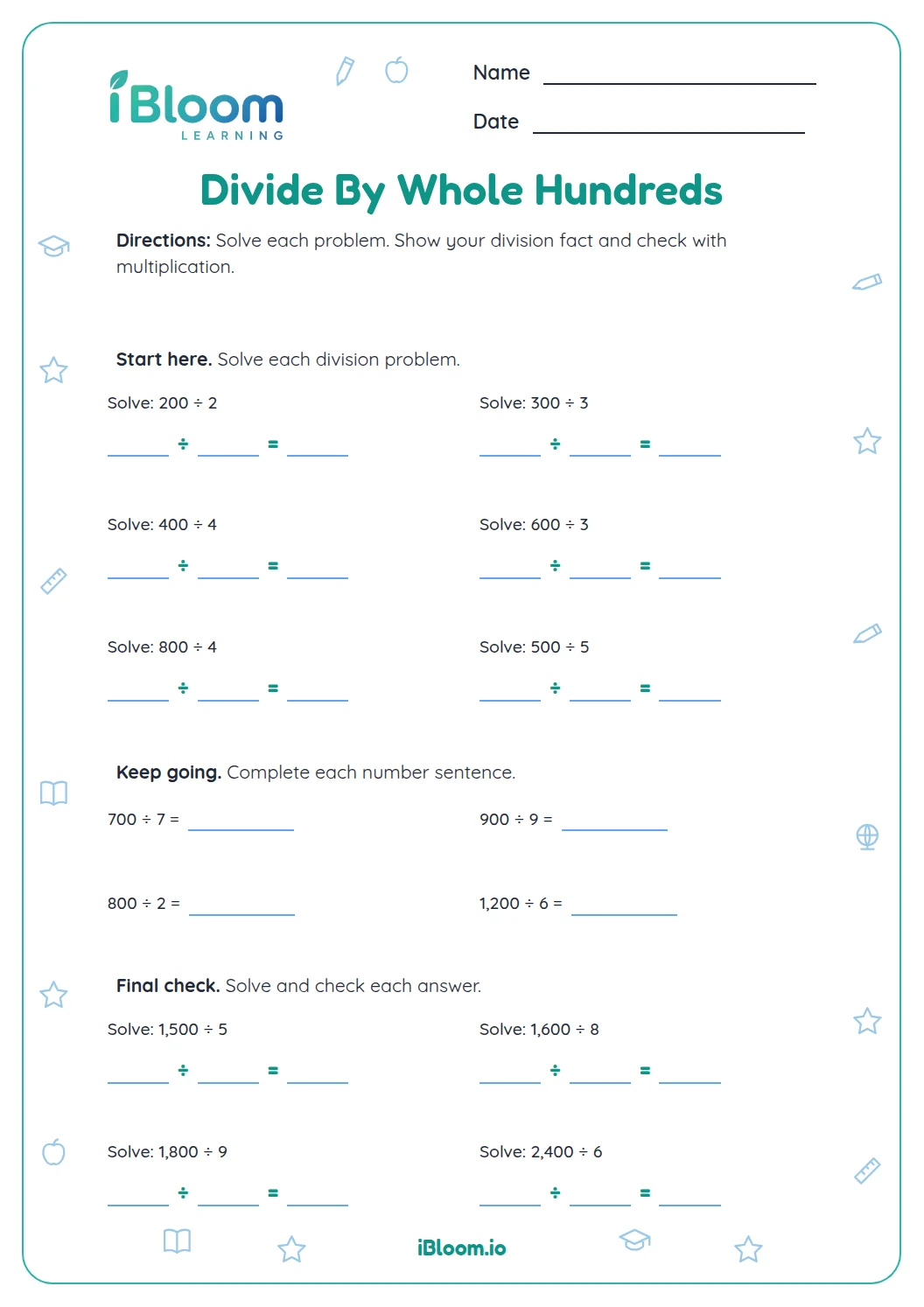
About this worksheet
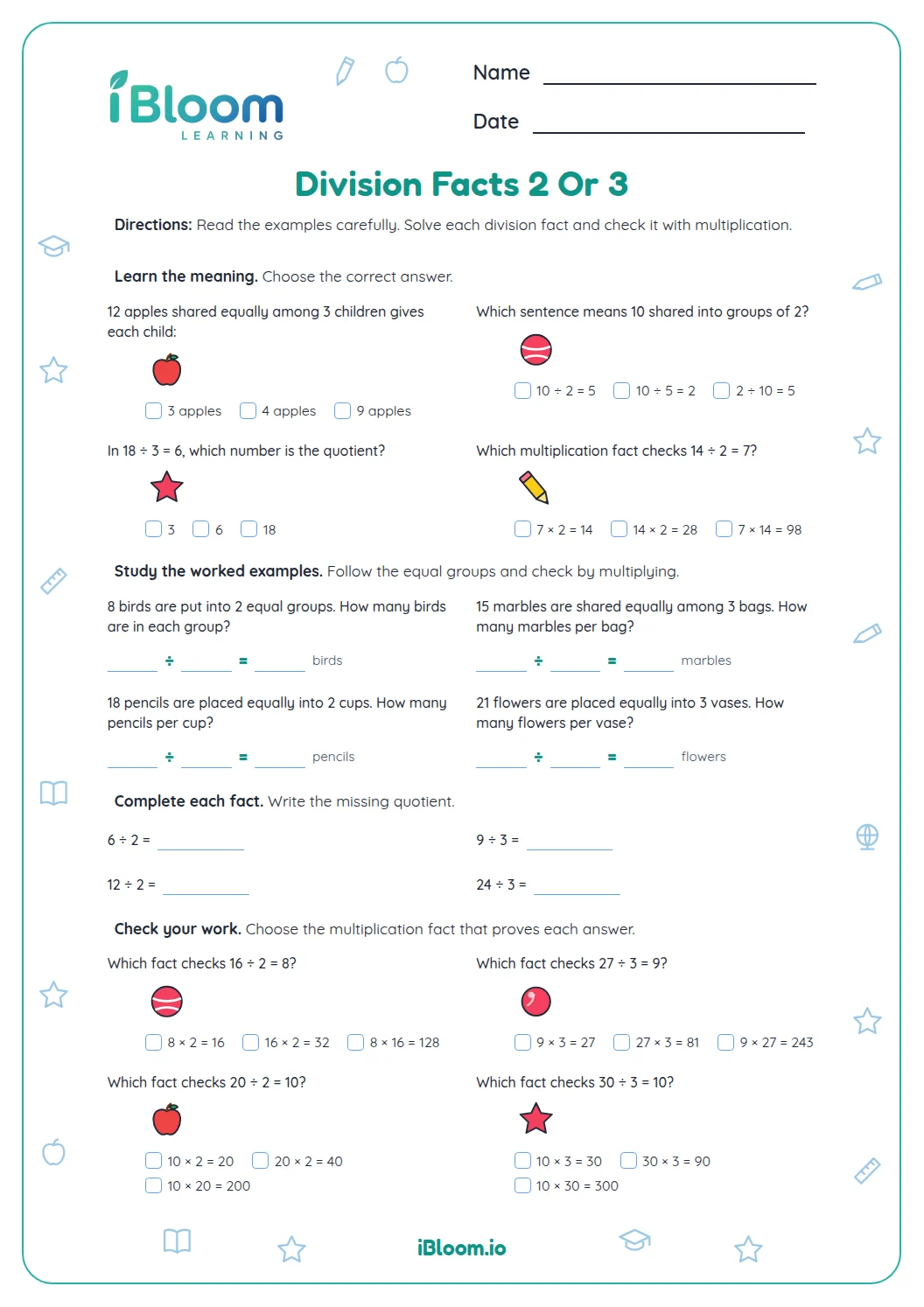
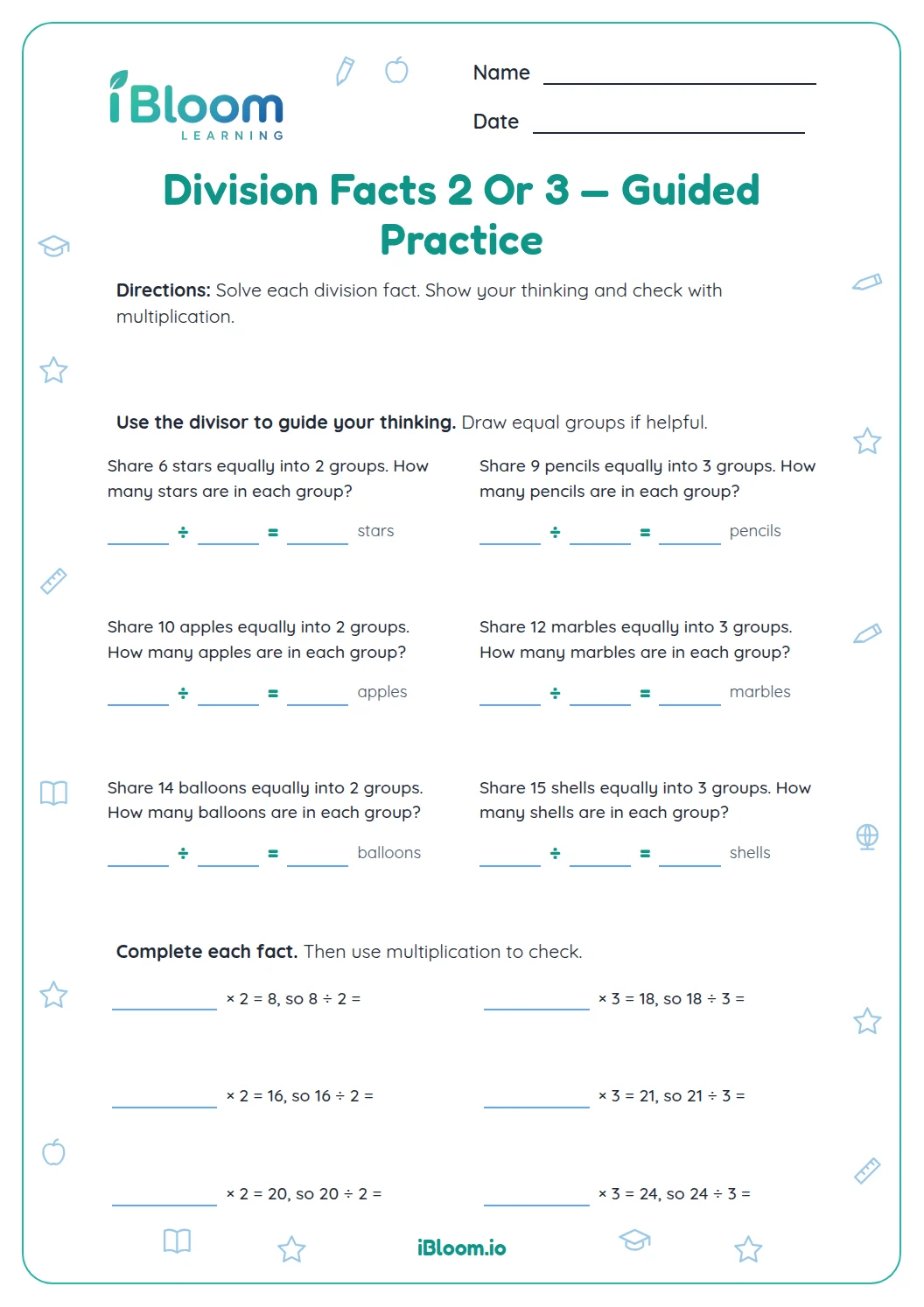
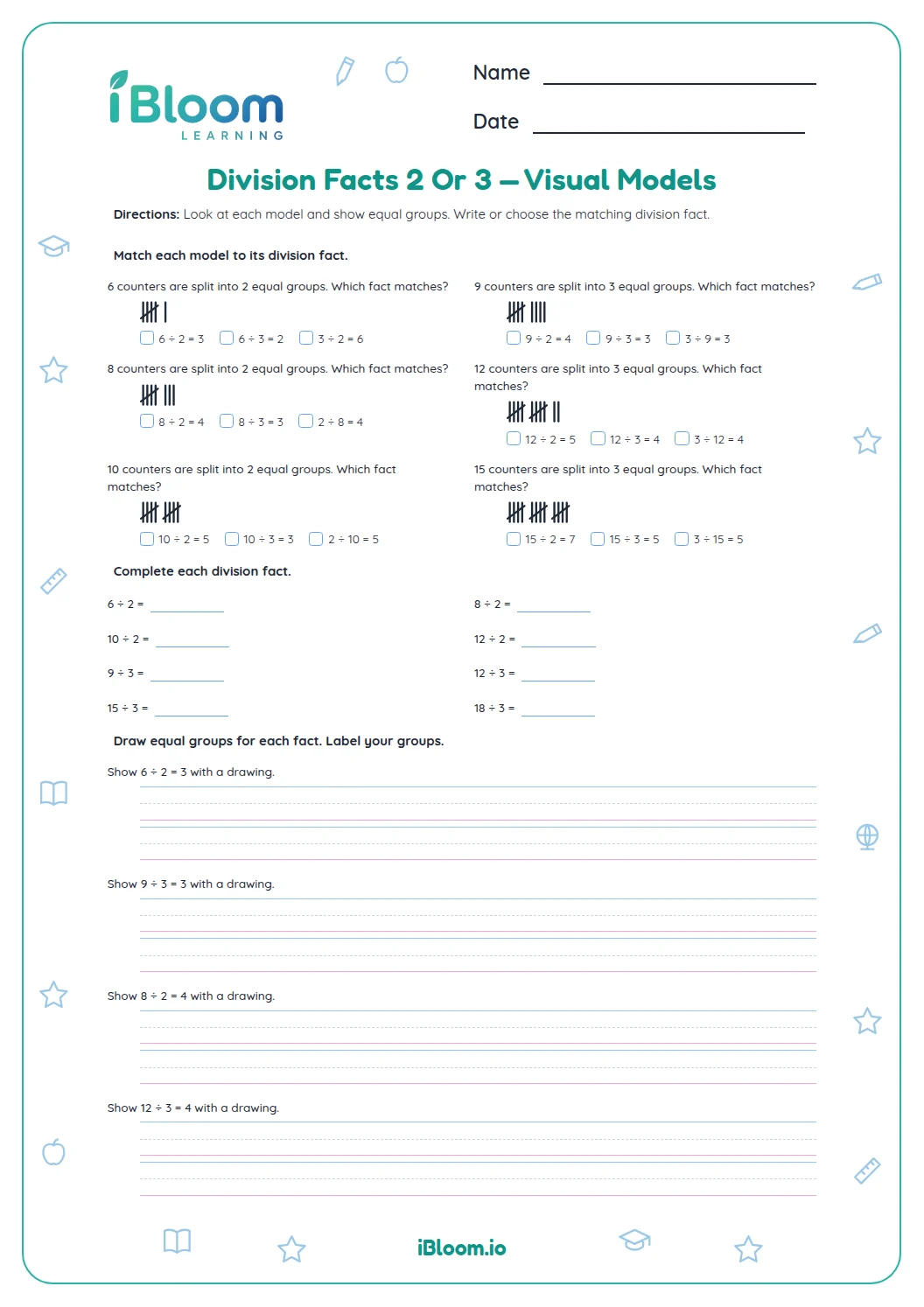
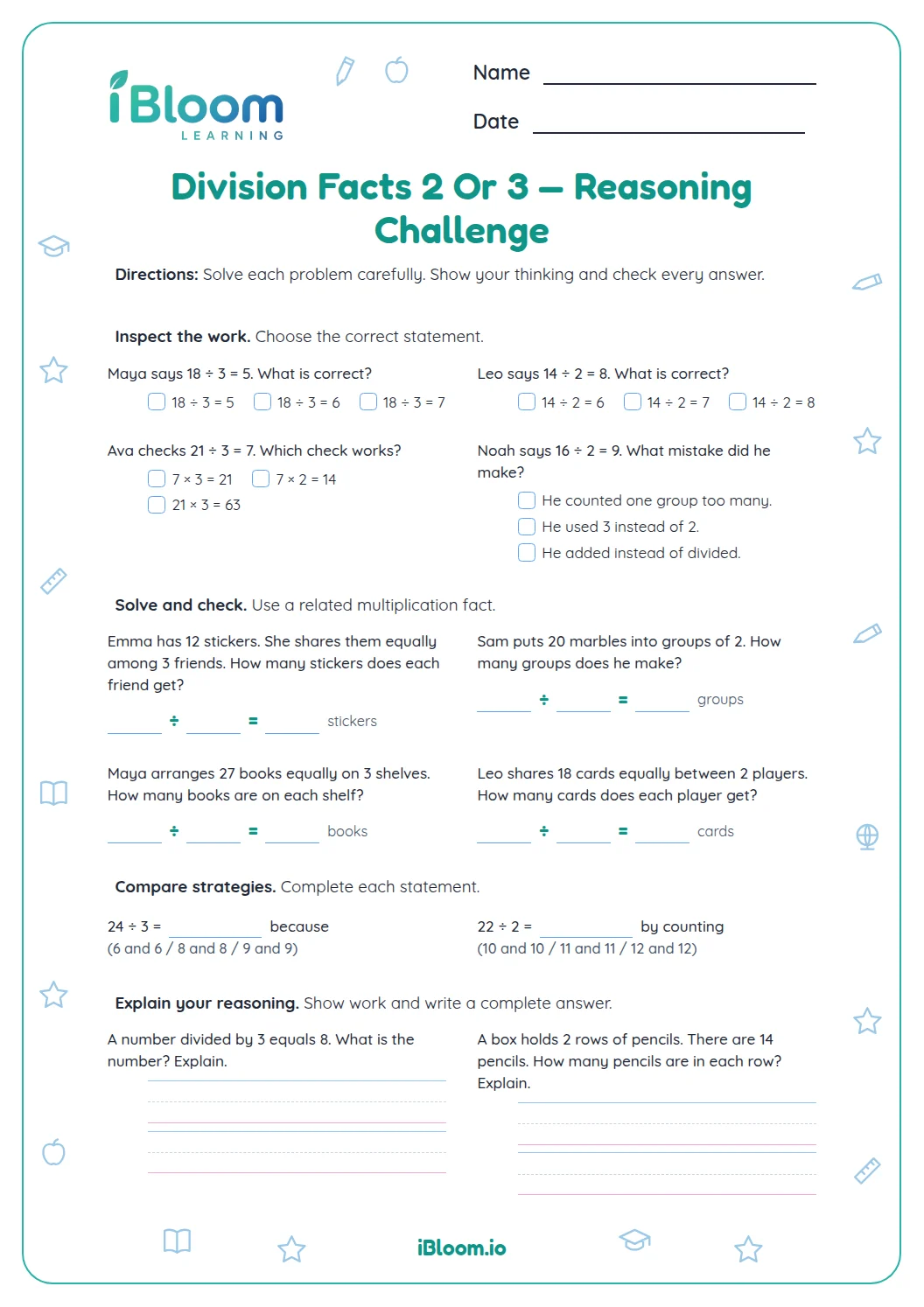
This free Grade 3 printable gives students 20 chances to divide by 2 or 3. Part A works through facts with 2, then facts with 3, and Part B asks students to model four equal-sharing stories with a division equation and quotient. A separate key shows each answer. It aligns with Common Core 3.OA.C.7.
Aligned to 3.OA.C.7
How do division facts connect to multiplication?
Division asks how many are in each equal group or how many groups can be made. Multiplication checks the quotient: if 18 ÷ 3 = 6, then 6 × 3 = 18. This page practices facts with 2 and 3.
How can students check each quotient?
Name the divisor, find the number that makes the dividend in a multiplication fact, then multiply to check. In 14 ÷ 2, ask “2 times what is 14?” Since 2 × 7 = 14, the quotient is 7.
- 114 ÷ 2 = ___
- 2Think: 2 × 7 = 14
- 3Answer: 7
What is on the two parts?
Part A has 16 equations with divisors 2 and 3, first with 2, then with 3. Part B has four equal-sharing situations about stickers, apples, blocks, and markers. Students can write a division sentence and quotient in the work space.
How should a student use the work space?
For each story, write the total divided by the number of groups. Then multiply the quotient by the divisor to see whether the total returns. The answer key gives the quotient with its matching unit.
How to use this division worksheet
- 1Review one multiplication fact for 2 and one for 3.
- 2Solve Part A in order, writing a quotient for every equation.
- 3Check each quotient by multiplying it by the divisor.
- 4In Part B, underline the total and the number of equal groups.
- 5Write a division sentence and label the quotient with its unit.
- 6Use the key to revisit any fact that did not check.
Division mistakes to watch for
The mistake
Using the divisor as the quotient, such as answering 2 for 14 ÷ 2.
The fix
Ask how many groups of 2 make 14; check that 7 × 2 equals 14.
The mistake
Dividing the number of groups by the total in a sharing story.
The fix
Write total ÷ number of groups before calculating.
The mistake
Leaving off what is being shared in a story answer.
The fix
Add the item name after the quotient, such as 8 stickers.
Common Core alignment
Build fluency with multiplication and division facts within 100.
On this sheet: The facts and equal-sharing stories use division facts with divisors 2 and 3.
Show the official wordingHide the official wording
Fluently multiply and divide within 100, using strategies such as the relationship between multiplication and division (e.g., knowing that 8 × 5 = 40, one knows 40 ÷ 5 = 8) or properties of operations. By the end of Grade 3, know from memory all products of two one-digit numbers.
What to practice next
Make more practice
Further reading
Questions parents and teachers ask
How can multiplication help with division facts?
Use the related multiplication fact to find and check the quotient. For 18 ÷ 3, ask what number times 3 equals 18. Since 6 × 3 = 18, the quotient is 6. Part A gives students practice making that connection across facts with 2 and 3.
What kinds of problems are on this printable?
Part A has 16 division equations with divisors 2 and 3. Part B has four equal-sharing situations about stickers, apples, blocks, and markers. The story questions include working space for a division sentence and a short answer with units.
Should students write a multiplication check?
Yes, multiplication is a quick way to see whether a quotient makes sense. If a student writes 24 ÷ 3 = 8, multiply 8 × 3 to see whether it returns 24. The check also helps catch a quotient that is one too high or low.
How should I help with an incorrect answer?
Ask the student to name the total and divisor, then turn the fact into a multiplication question. For a story, point out the total items and how many equal groups there are. Have the student solve again and check by multiplying.
Does the worksheet include an answer key?
Yes. The answer key is separate from the two worksheet pages. It lists the 16 fact answers and gives a labeled quotient for each of the four sharing stories, so an adult can check both the number and its unit.