



About this worksheet
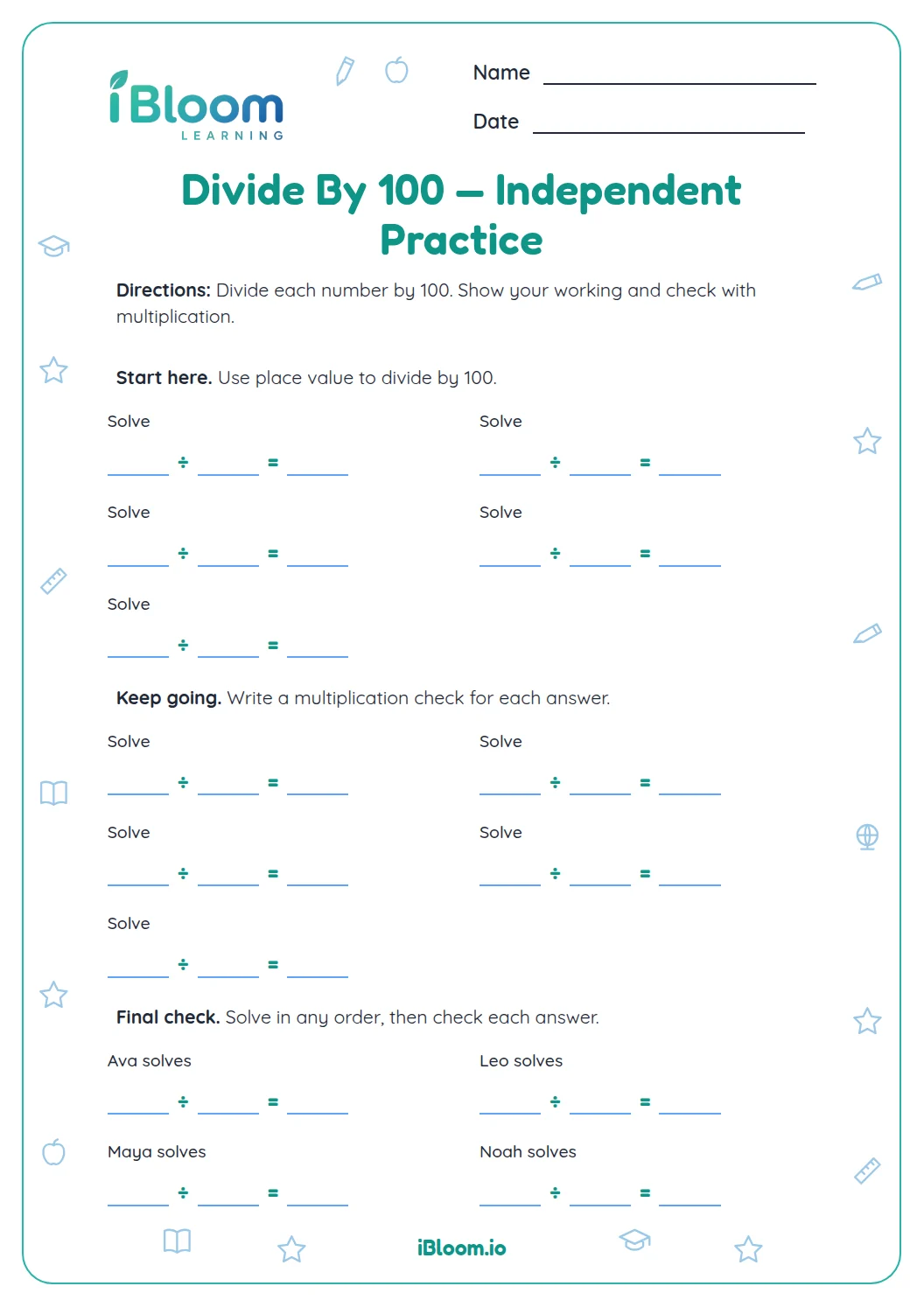
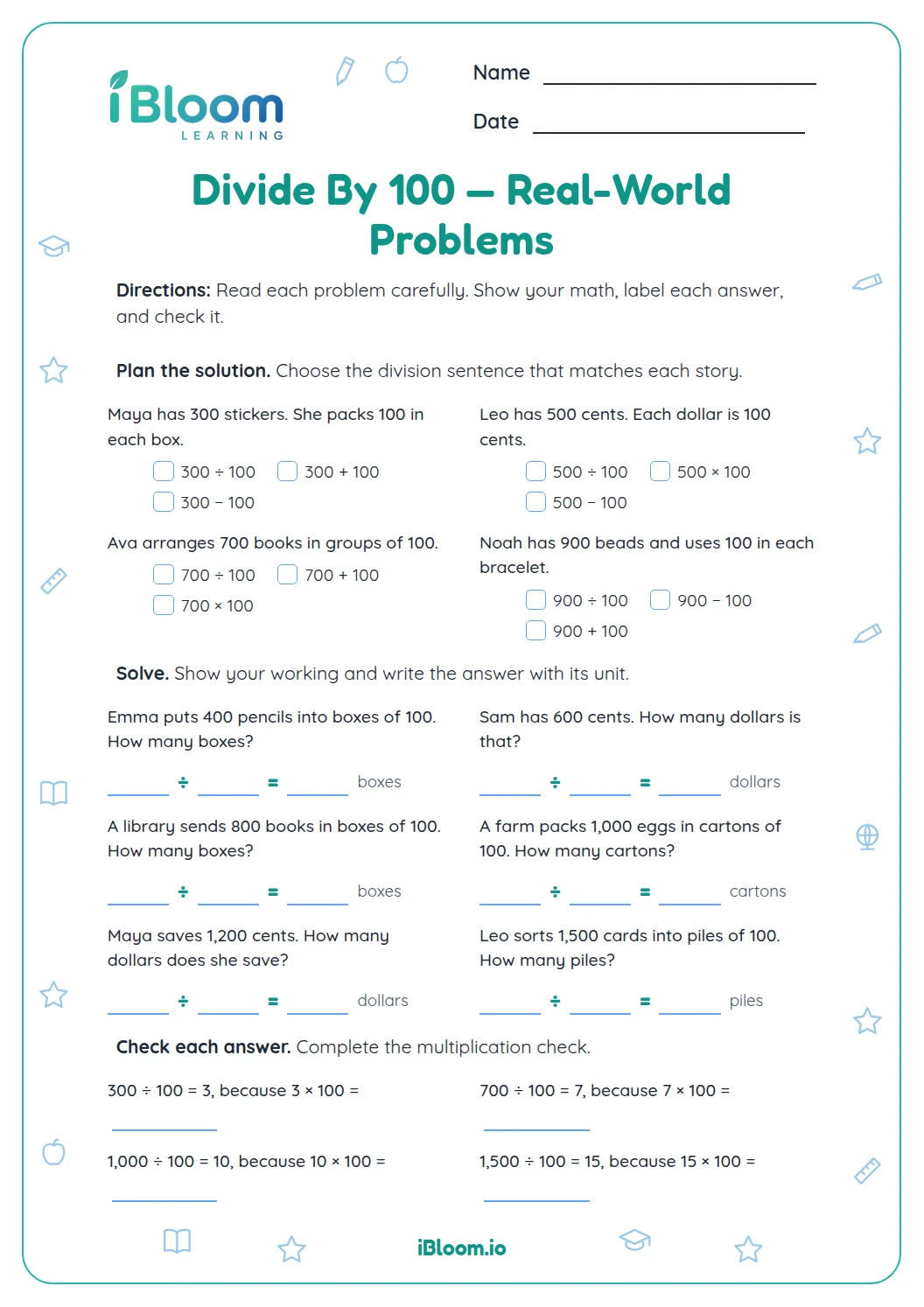
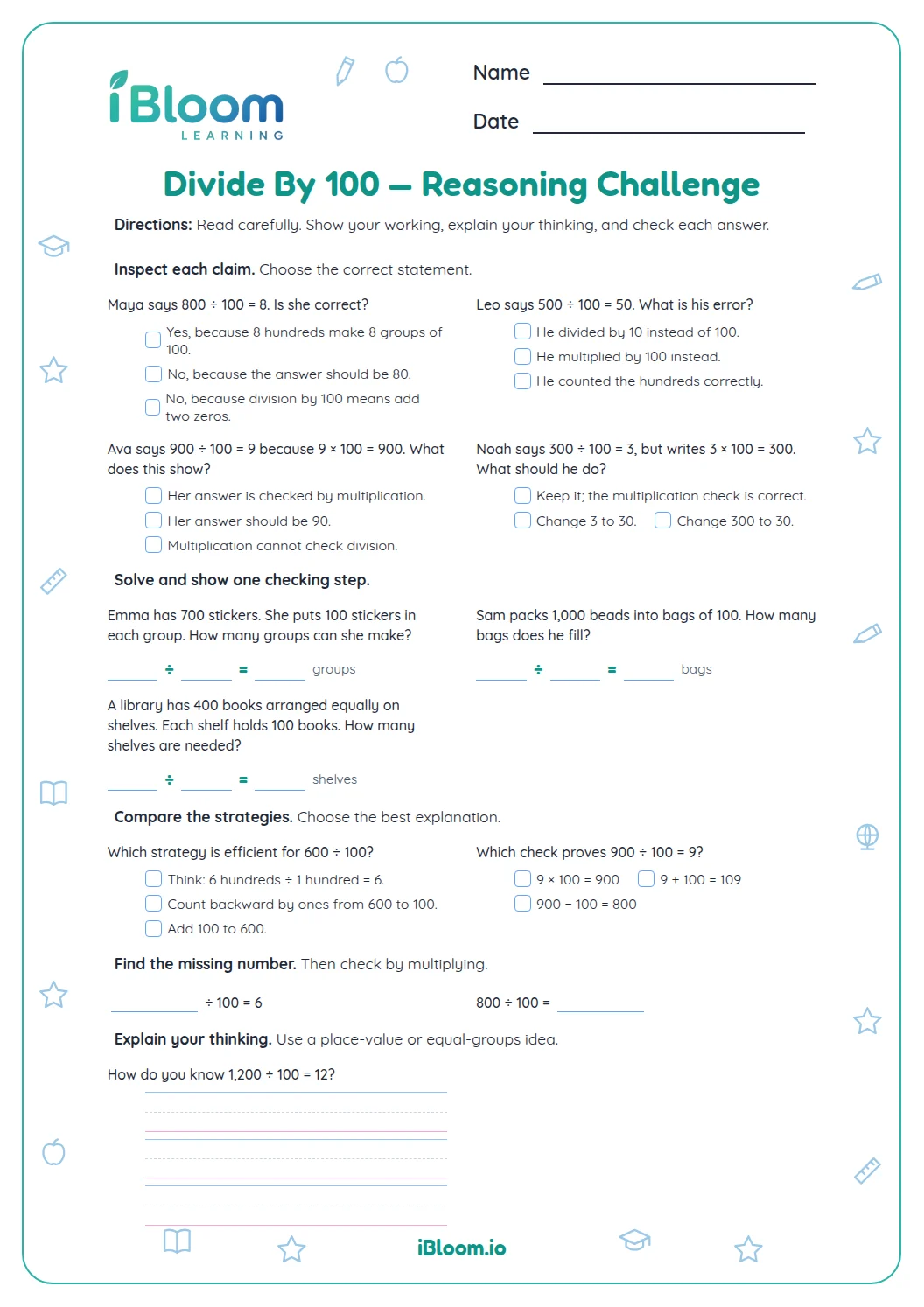
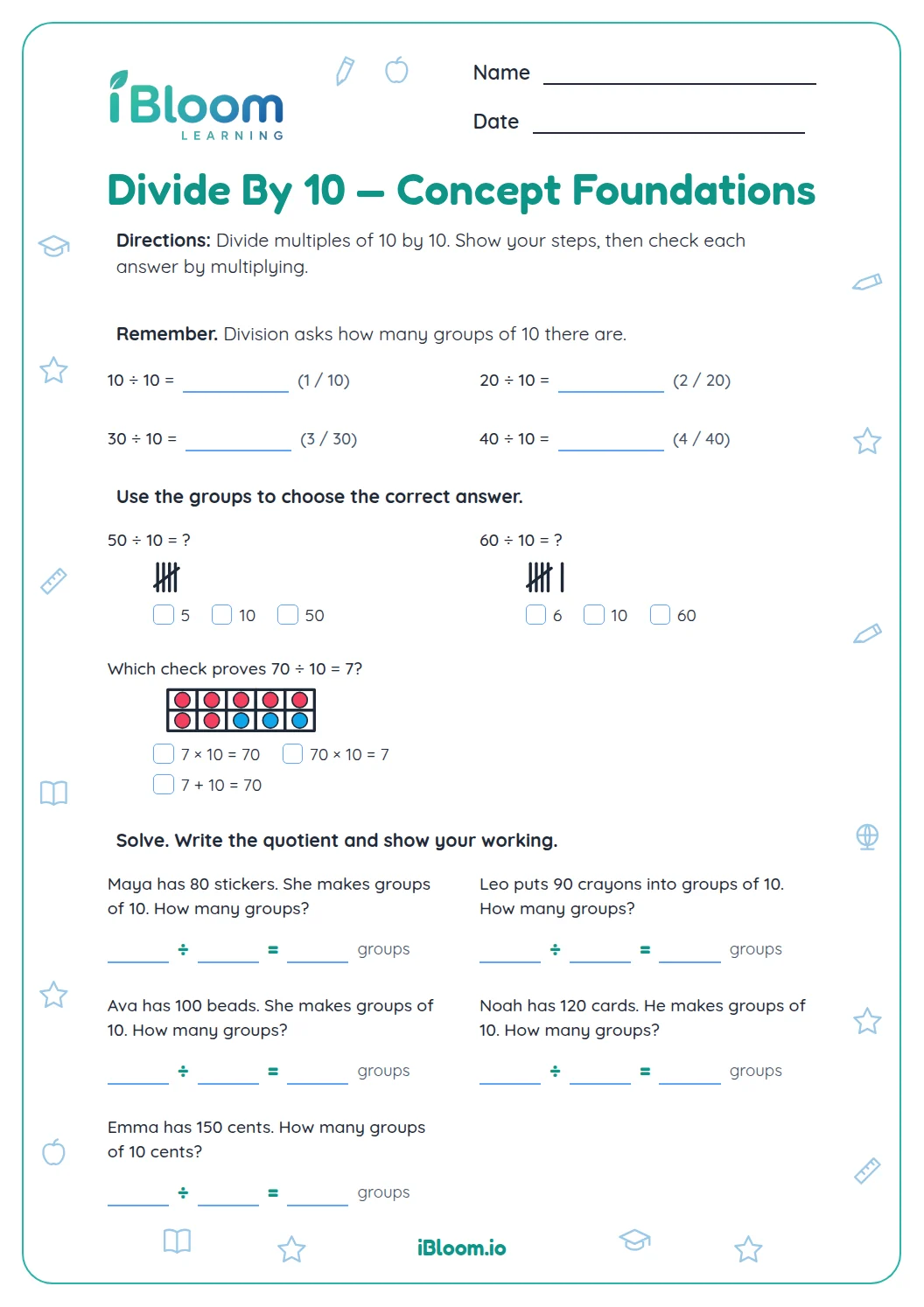
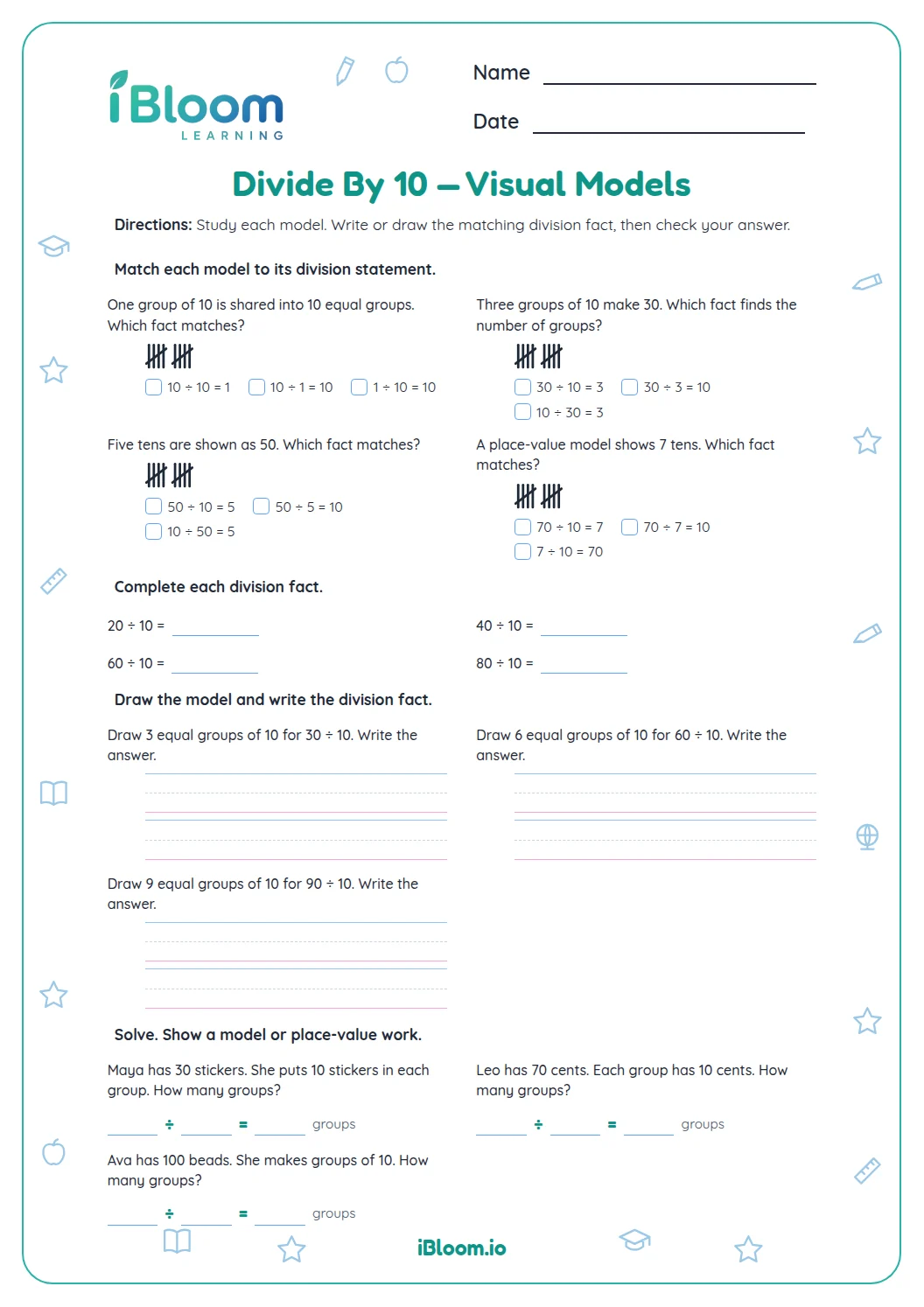
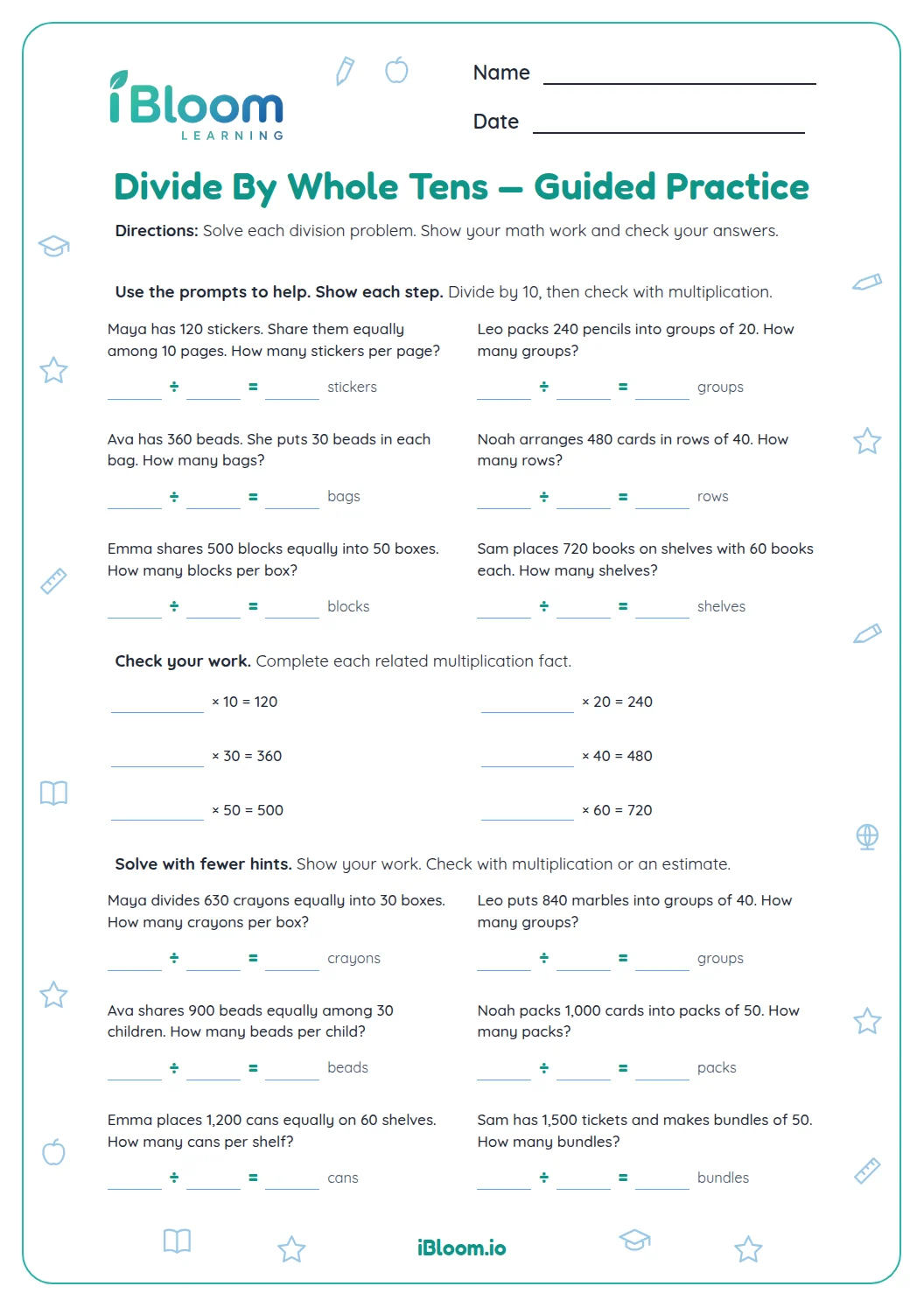
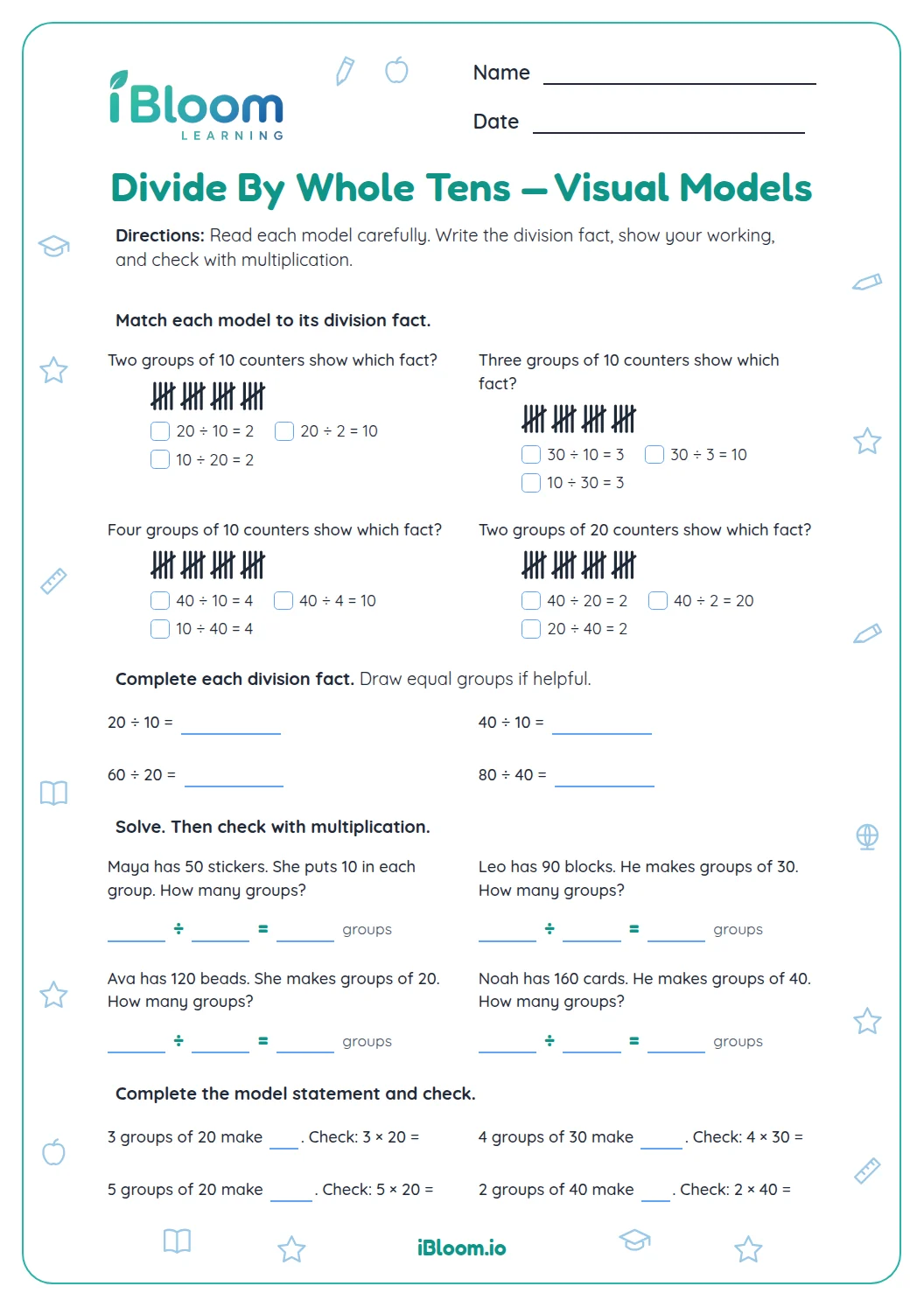
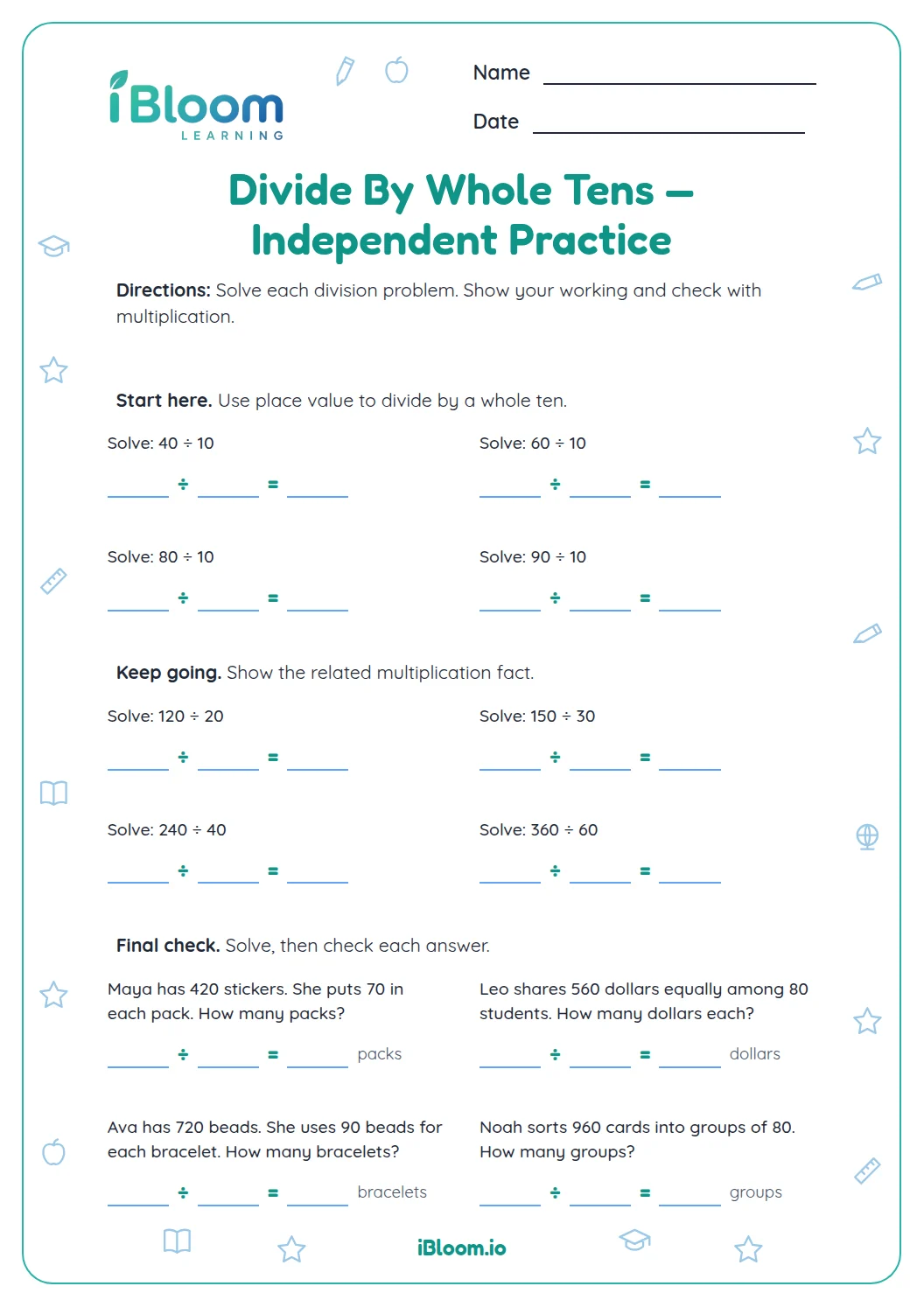
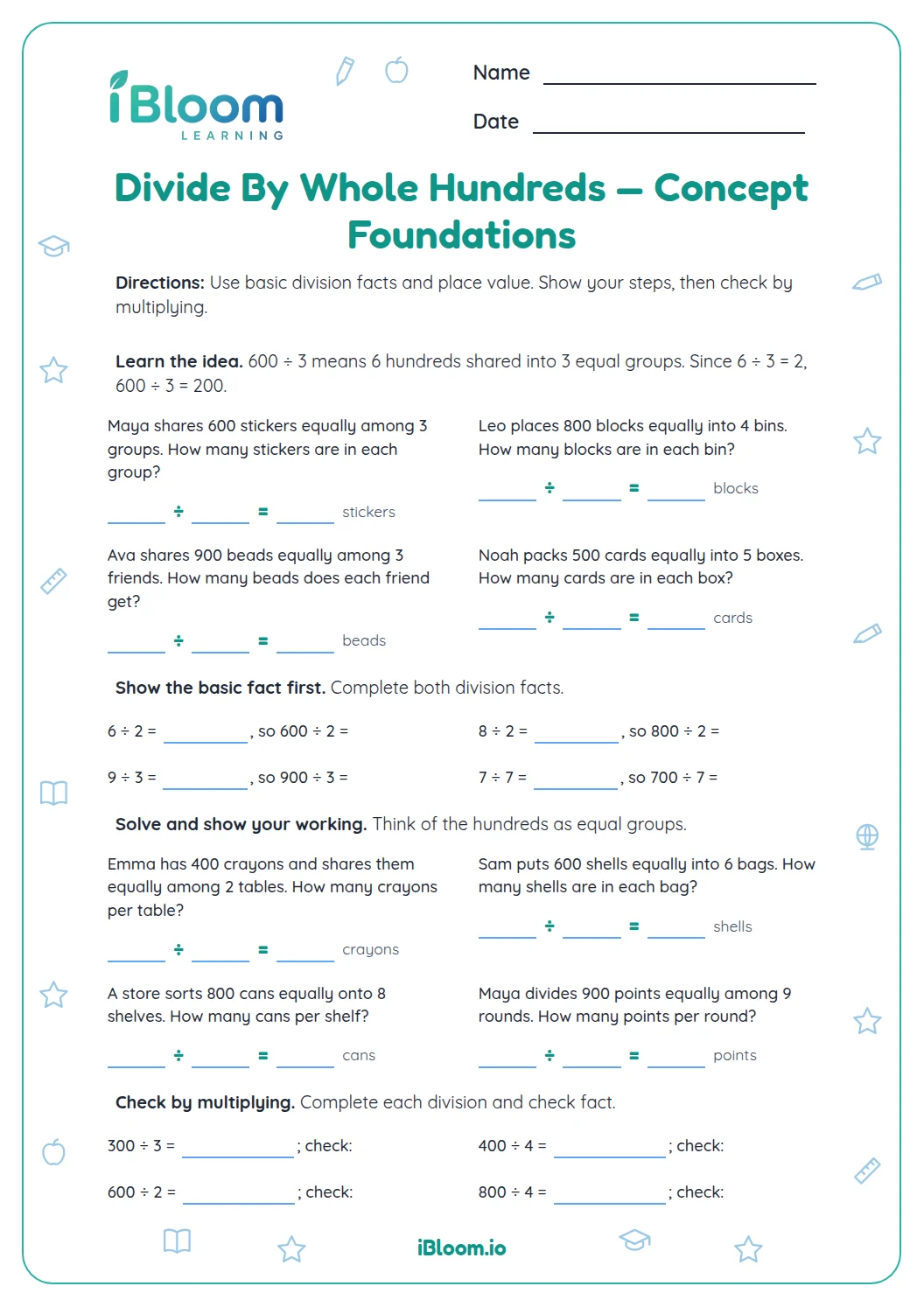
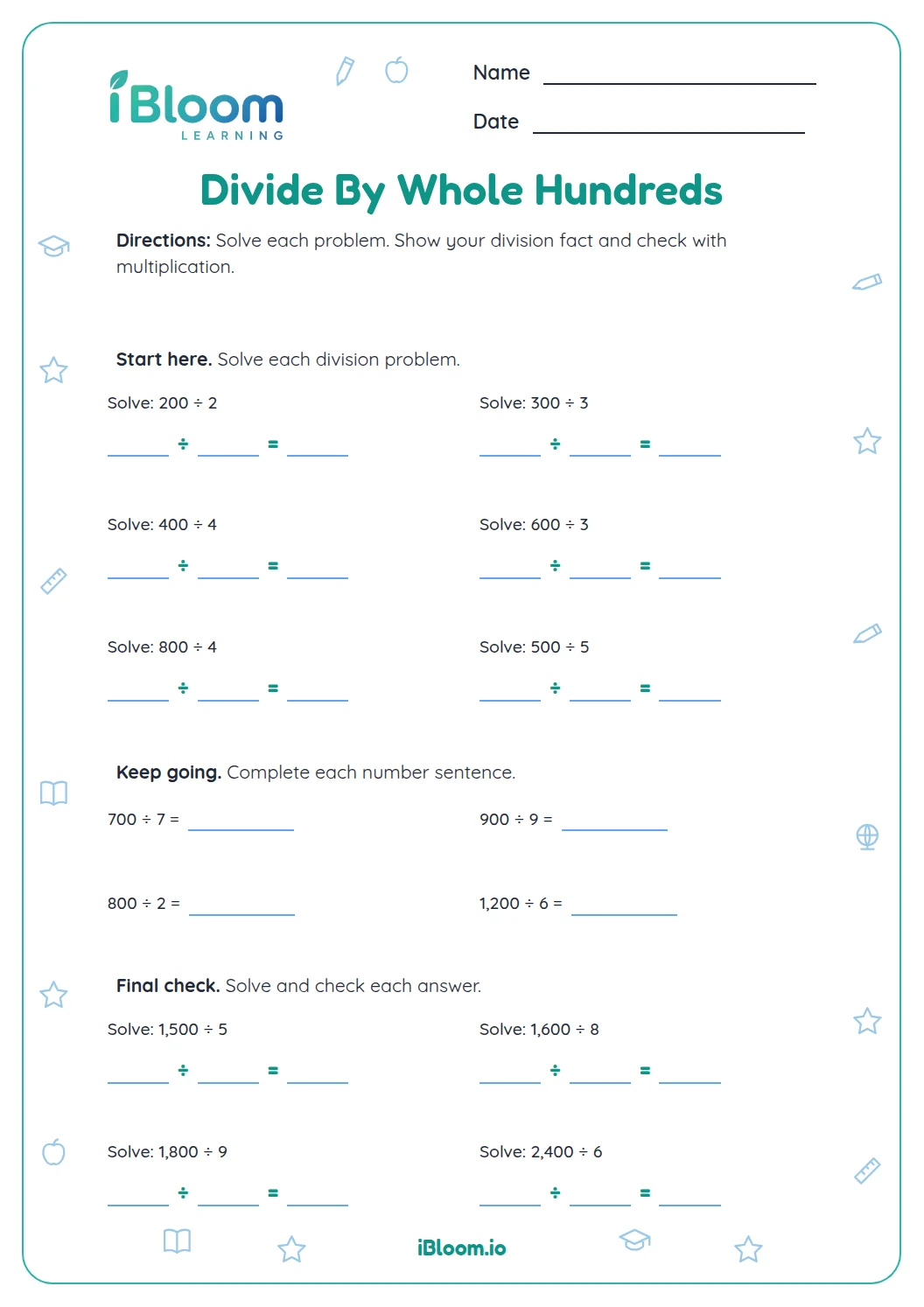
This printable teaches division by 100 as equal groups of 100 and uses multiplication to check each quotient. Students solve short bundling stories, correct a place-value error, and complete related division and multiplication facts. The questions build from examples to independent practice across two worksheet pages.
Aligned to 3.OA.A.2
What does division by 100 mean?
Division by 100 can ask how many groups of 100 fit in a total. In question 1, 1,000 counters make 10 groups of 100, so 1,000 ÷ 100 = 10.
- 11,000 counters ÷ 100 counters per group
- 2= 10 groups
How does multiplication check a quotient?
Multiply the quotient by 100. For 600 ÷ 100 = 6, the check is 6 × 100 = 600. The worksheet pairs division with related multiplication facts to make this connection visible.
How can place value help?
Estimate whether the quotient is sensible, then check by multiplying. Fifty groups of 100 make 5,000, while 500 groups would make 50,000.
How to use the worksheet
- 1Read the whole prompt before writing an answer.
- 2Use the method named in the part direction.
- 3Keep work lined up or organize it on the response lines.
- 4Use the answer key after attempting the page and revisit any missed step.
Common slips to check
The mistake
Writing 90 for 900 ÷ 100
The fix
Multiply 9 × 100; the product returns to 900.
The mistake
Mixing up number of groups and group size
The fix
Read whether the story gives 100 in each group or asks for the number of groups.
The mistake
Skipping the multiplication check
The fix
Use quotient × 100 to see whether the product matches the starting total.
Curriculum alignment
This worksheet practices a focused skill that supports grade-level learning.
Interpret division by 100 through equal groups and verify quotients with multiplication.
On this sheet: Interpret division by 100 through equal groups and verify quotients with multiplication.
Show the official wordingHide the official wording
Interpret whole-number quotients of whole numbers, e.g., interpret 56 ÷ 8 as the number of objects in each share when 56 objects are partitioned equally into 8 shares, or as a number of shares when 56 objects are partitioned into equal shares of 8 objects each.
What to practice next
Make more practice
Further reading
Questions parents and teachers ask
What does dividing by 100 ask?
It can ask how many groups of 100 fit in a total. For example, 1,000 counters make 10 groups of 100, so 1,000 ÷ 100 = 10. The stories and number sentences on this sheet use that groups-of-100 meaning. That check also helps catch a misplaced zero.
How can multiplication check a quotient?
Multiply the quotient by 100. If 700 ÷ 100 = 7, then 7 × 100 = 700 confirms the answer. The worksheet includes both division facts and missing-factor facts so students can connect the inverse operations. The first two stories use bundles so the divisor has a clear meaning.
Why does 900 divided by 100 equal 9?
Nine groups of 100 make 900. Multiplication checks the quotient: 9 × 100 = 900. The worksheet uses this relationship to help students connect the division fact with equal groups and confirm that the quotient has the correct place value.
How many questions are included?
This worksheet has 14 questions in three parts across two worksheet pages. It starts with equal-group stories, asks for a multiplication check, includes a place-value error to correct, and ends with division and related multiplication facts. Students can verify each result with the inverse multiplication fact.
What should students do if the quotient seems too large?
Multiply it by 100 and compare the product with the starting number. If the product is ten times too large, the quotient likely has an extra zero. The answer key lets students check the arithmetic after trying the inverse operation.