





About this worksheet
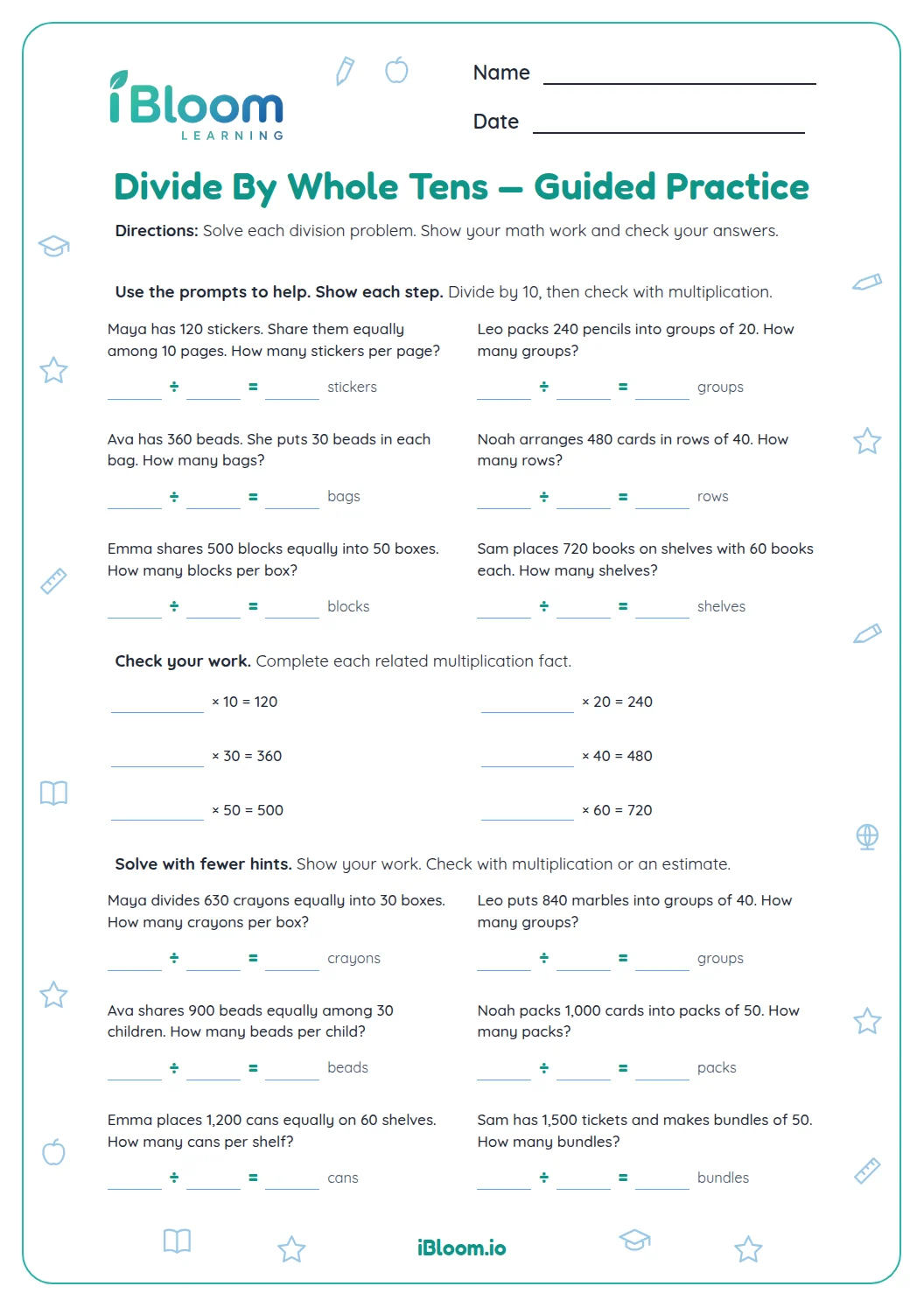
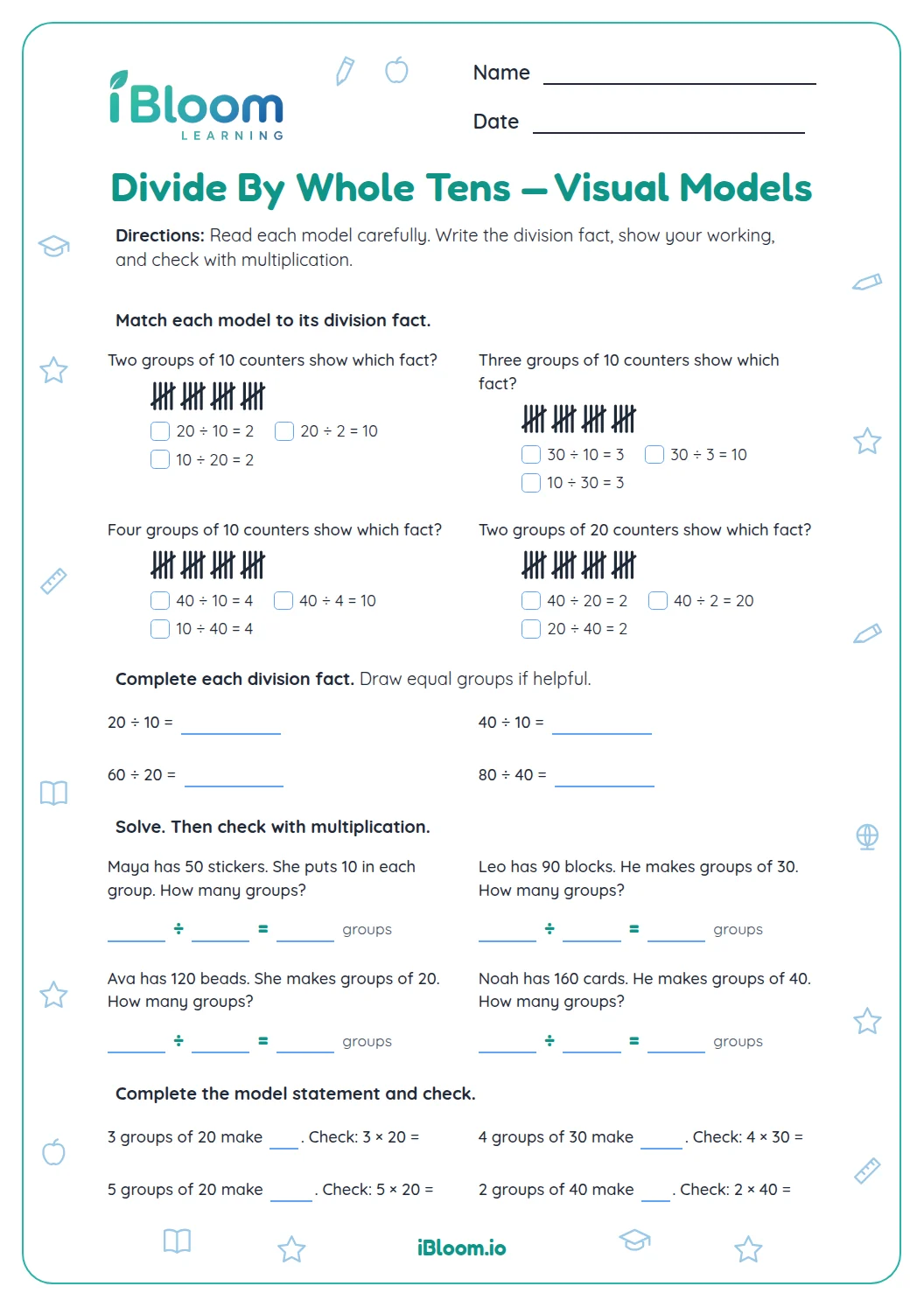
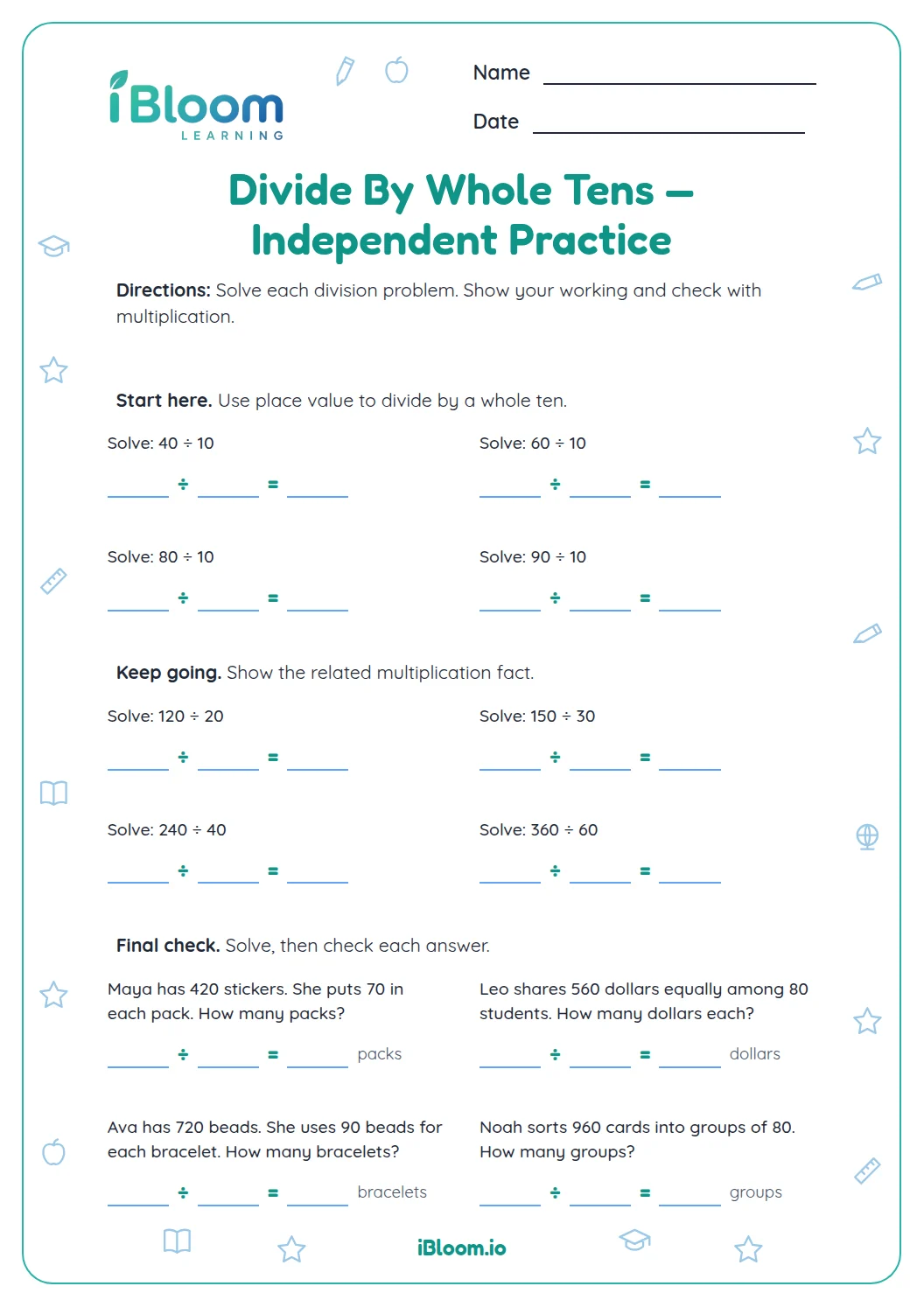
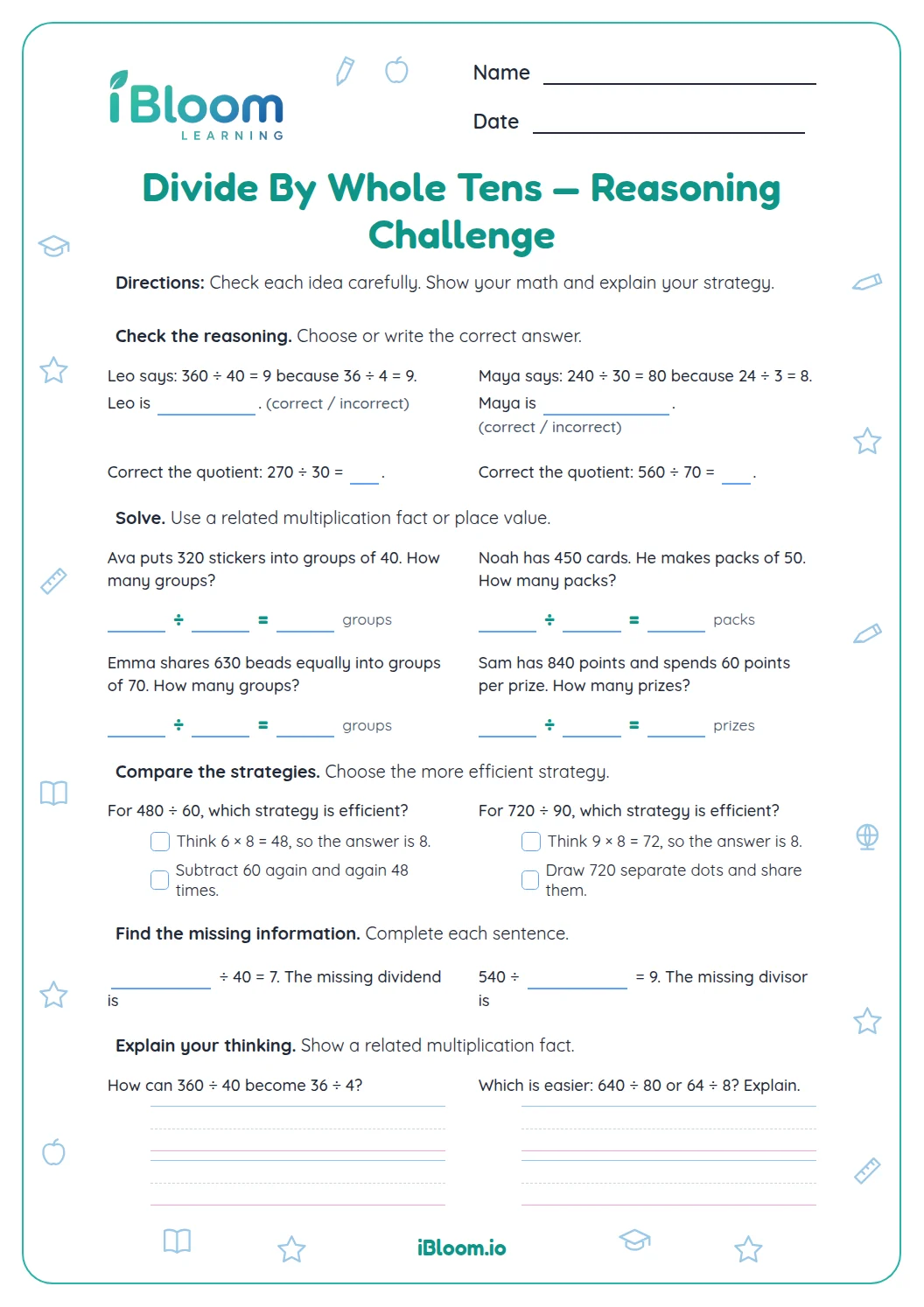
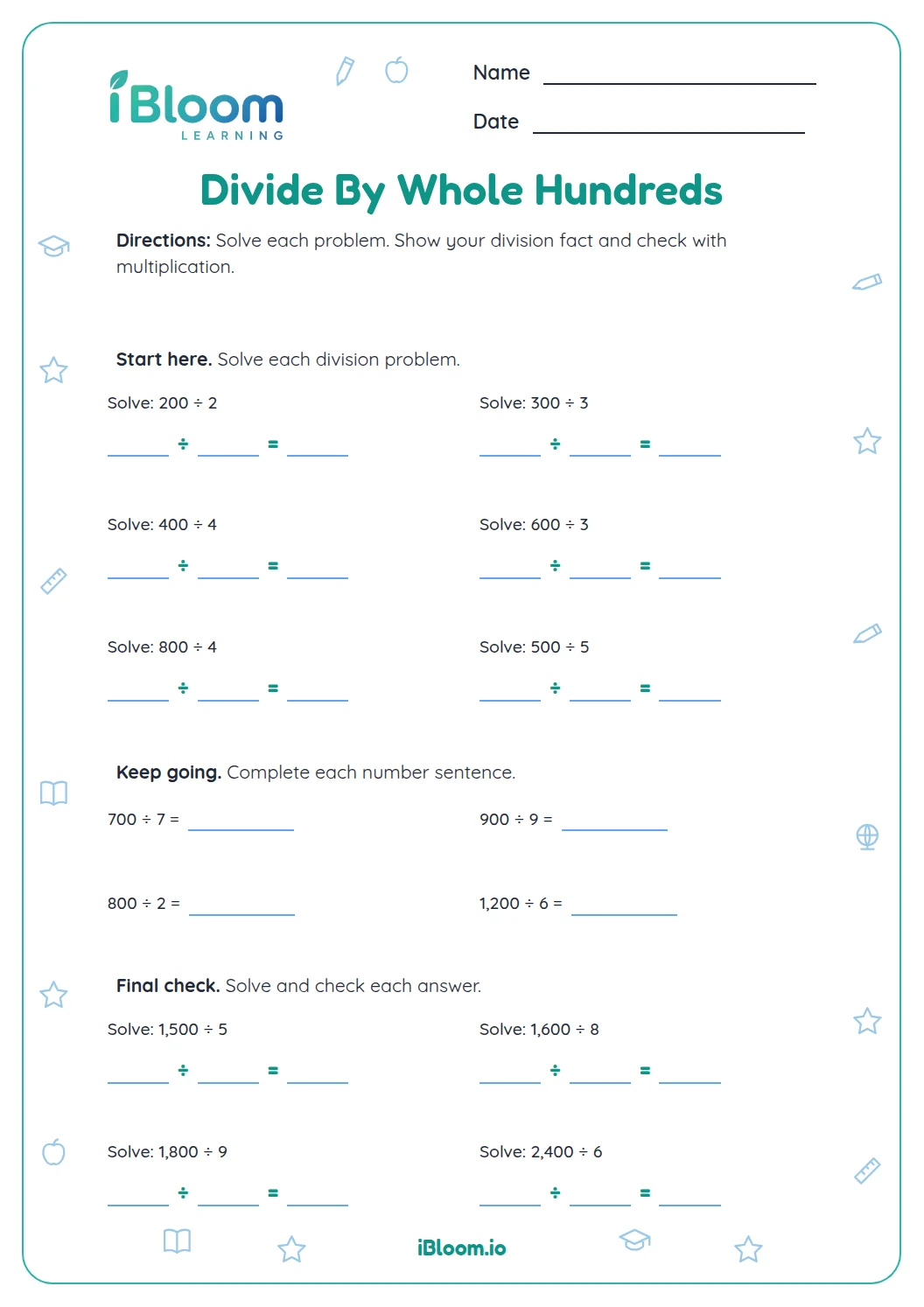
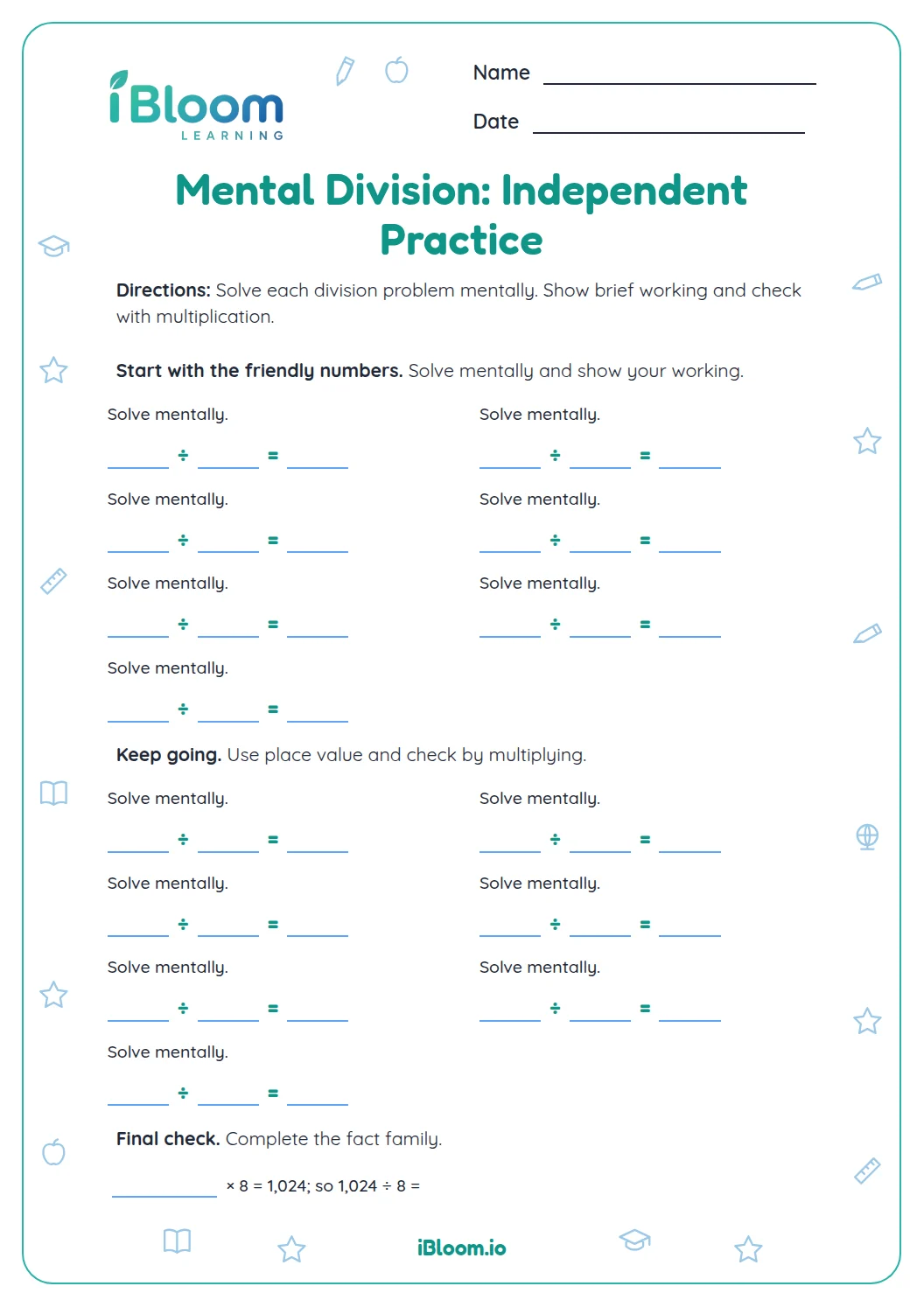
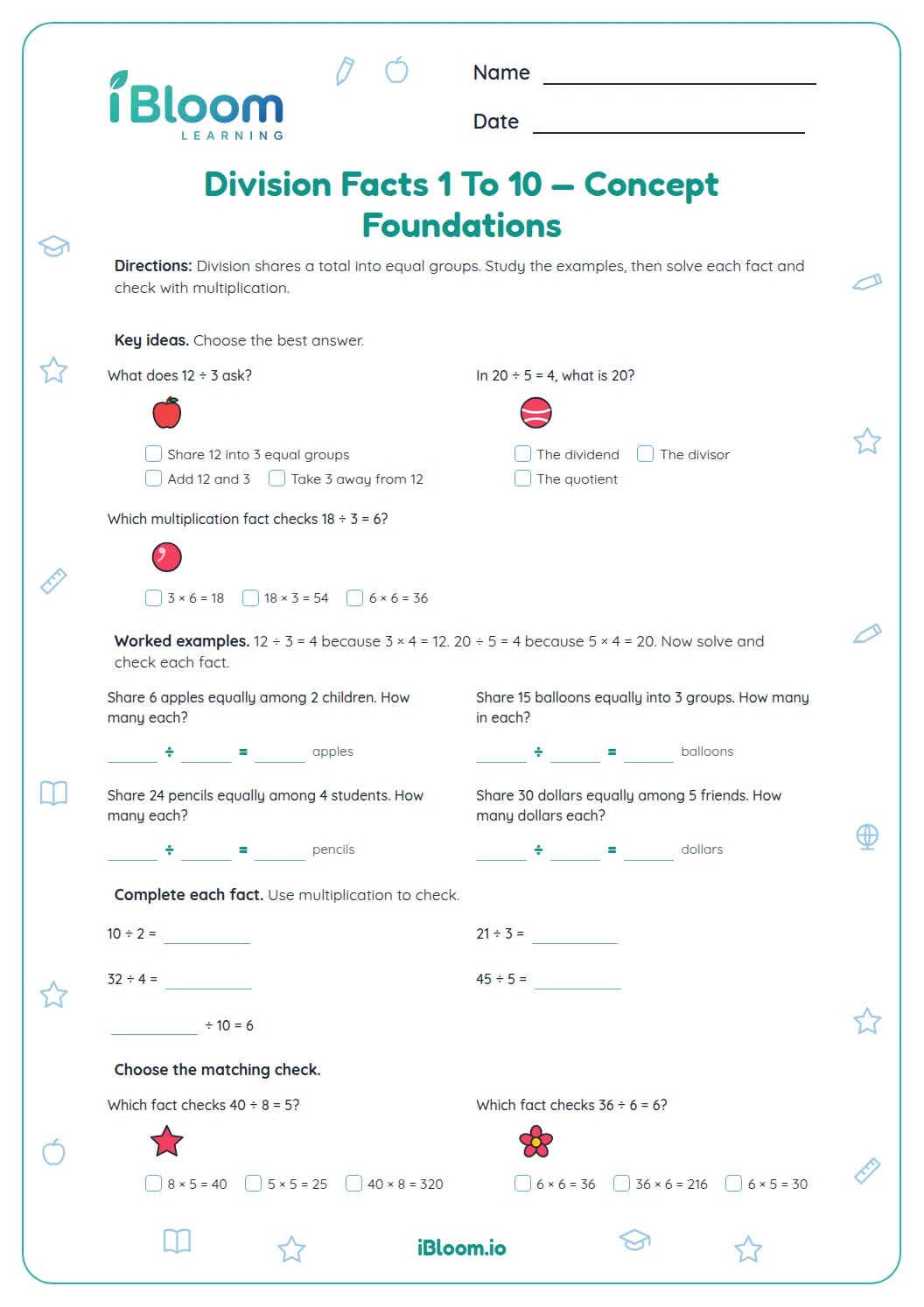
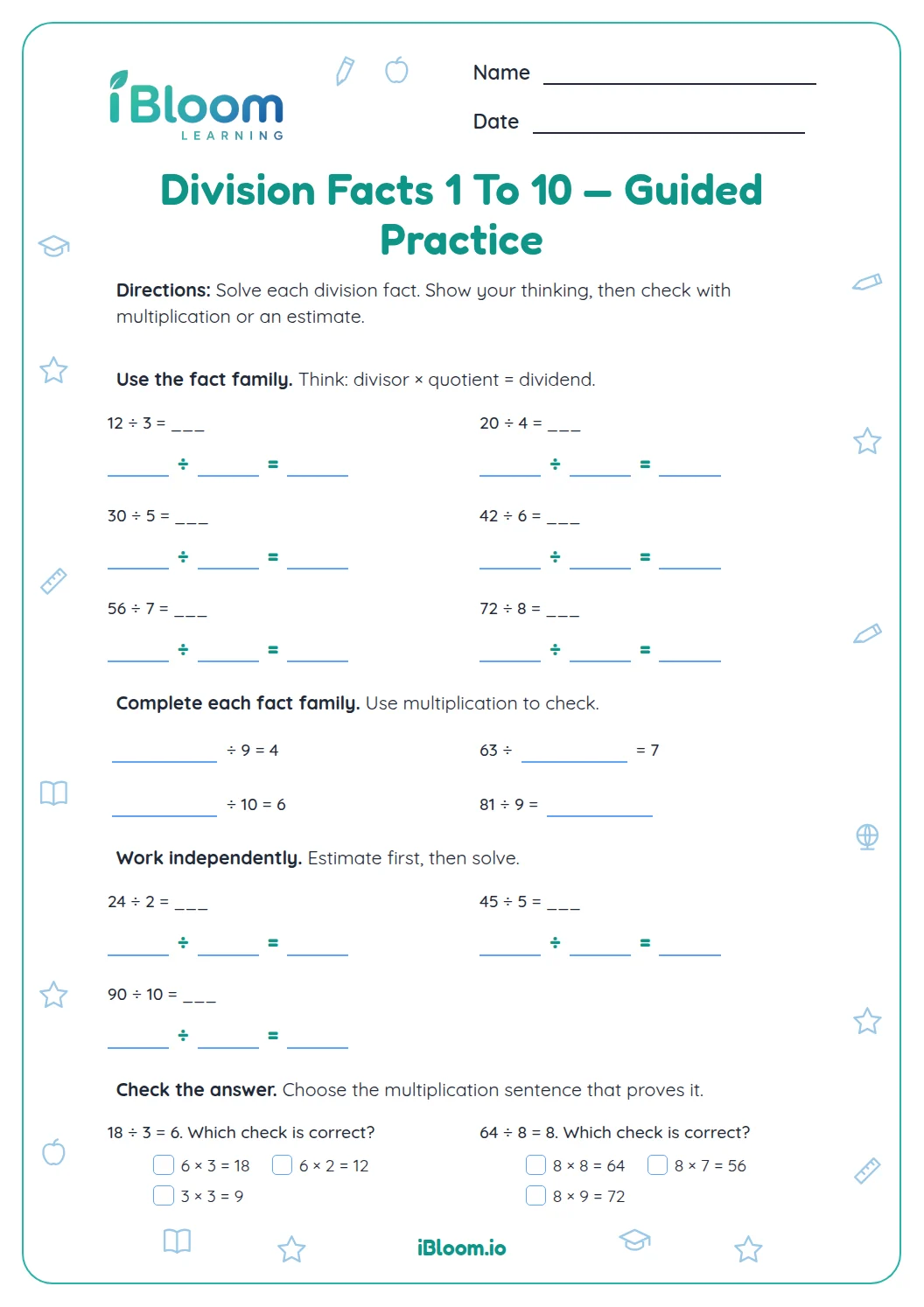
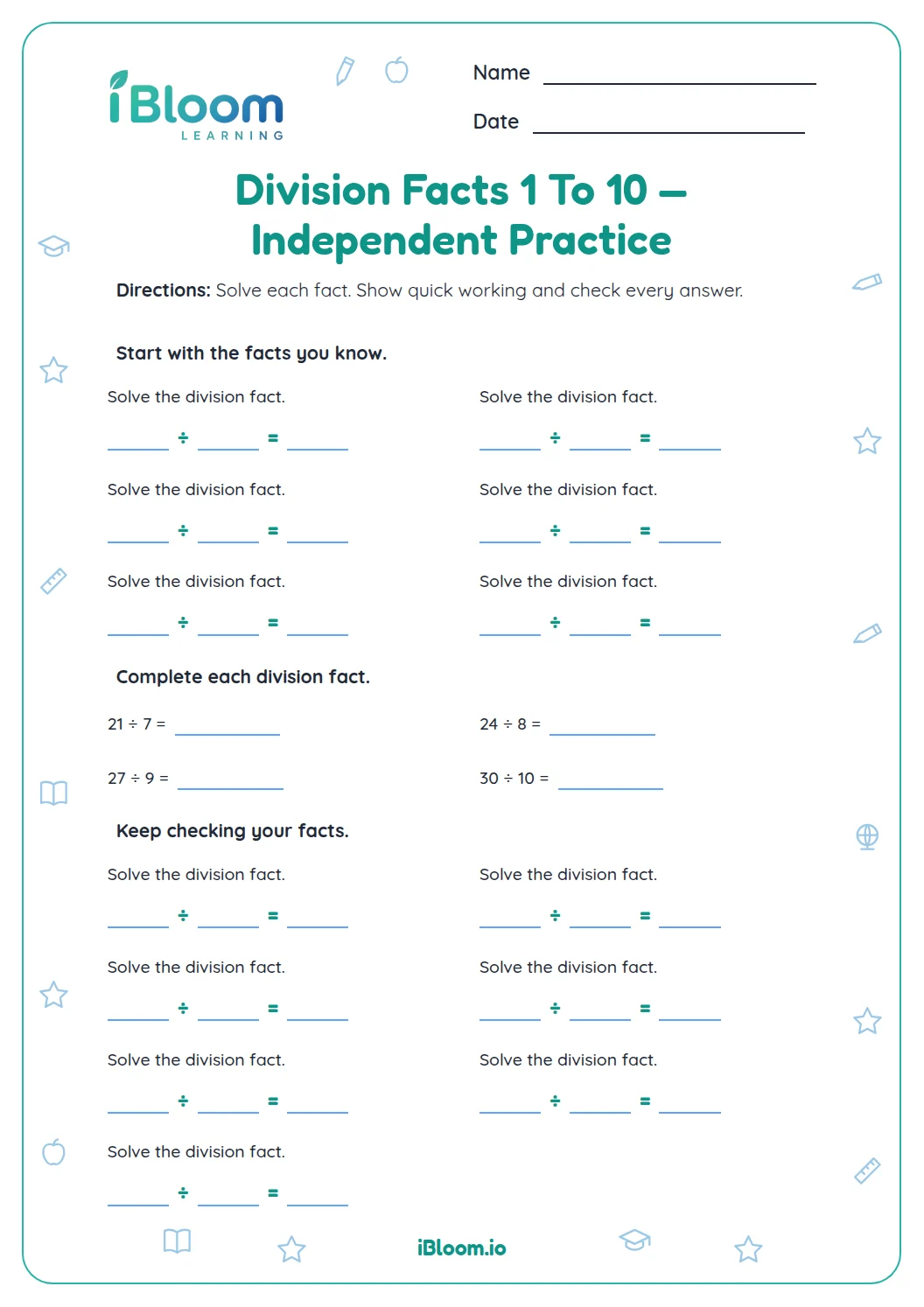
This Grade 3 printable focuses on division by whole tens, such as 60 ÷ 20. Students connect each equation to a related fact, find exact quotients, and apply the same reasoning in two short equal-group stories. There are 16 questions and a separate answer key for checking results.
Aligned to 5.NBT.B.6
How does a related fact help with tens?
For 60 ÷ 20, think of 6 tens divided into groups of 2 tens. The related fact is 6 ÷ 2 = 3.
- 160 ÷ 20
- 26 ÷ 2 = 3
How can you check a quotient?
Multiply the quotient by the divisor. For 60 ÷ 20 = 3, the check is 20 × 3 = 60.
How do equal-group stories use division?
Identify the total and the amount in each group. Divide the total by the group size to find the number of groups.
How to use this worksheet
- 1Remove one zero from both numbers to find a related fact.
- 2Divide the remaining numbers.
- 3Use the quotient with the original divisor.
- 4Check by multiplying divisor and quotient.
- 5For a story, divide the total by the group size.
Common mistakes and quick fixes
The mistake
Removing a zero from only one number.
The fix
Remove one zero from both the dividend and divisor.
The mistake
Using the wrong related fact.
The fix
Keep the order: dividend divided by divisor.
The mistake
Giving the group size instead of the group count.
The fix
Divide the total by the amount in each group.
Common Core alignment
Use place-value and multiplication relationships to divide by two-digit divisors.
On this sheet: division by whole tens practice on the worksheet.
Show the official wordingHide the official wording
Find whole-number quotients of whole numbers with up to four-digit dividends and two-digit divisors, using strategies based on place value, the properties of operations, and/or the relationship between multiplication and division. Illustrate and explain the calculation by using equations, rectangular arrays, and/or area models.
What to practice next
Make more practice
Further reading
Questions parents and teachers ask
What does dividing by whole tens mean?
The dividend and divisor are multiples of ten, such as 60 ÷ 20. Students can think of 6 tens divided into groups of 2 tens, which is the related fact 6 ÷ 2. This worksheet practices whole-tens equations and grouping stories.
How can I solve 80 divided by 20?
Think of 80 as 8 tens and 20 as 2 tens. The related fact is 8 ÷ 2, which equals 4. Multiply 20 by 4 to check that the product returns to 80. Multiplication confirms the result. This gives a quick multiplication check.
Why do the numbers have zeros?
The zeros show that the numbers represent whole tens. Removing one zero from both numbers reveals a related basic division fact while preserving the quotient. The worksheet asks students to use this connection and check answers with multiplication.
How many questions are included?
There are 16 questions: fourteen whole-tens division equations and two equal-group stories. The equations use exact quotients. In the story items, students write a division equation and give the number of groups. The answer key lists a quotient for every question.
What should students do in the story problems?
Find the total number of items and the number in each group. Write the total divided by the group size, then solve for the number of groups. The answer key gives the quotient so students can check both the equation and result.