


About this worksheet
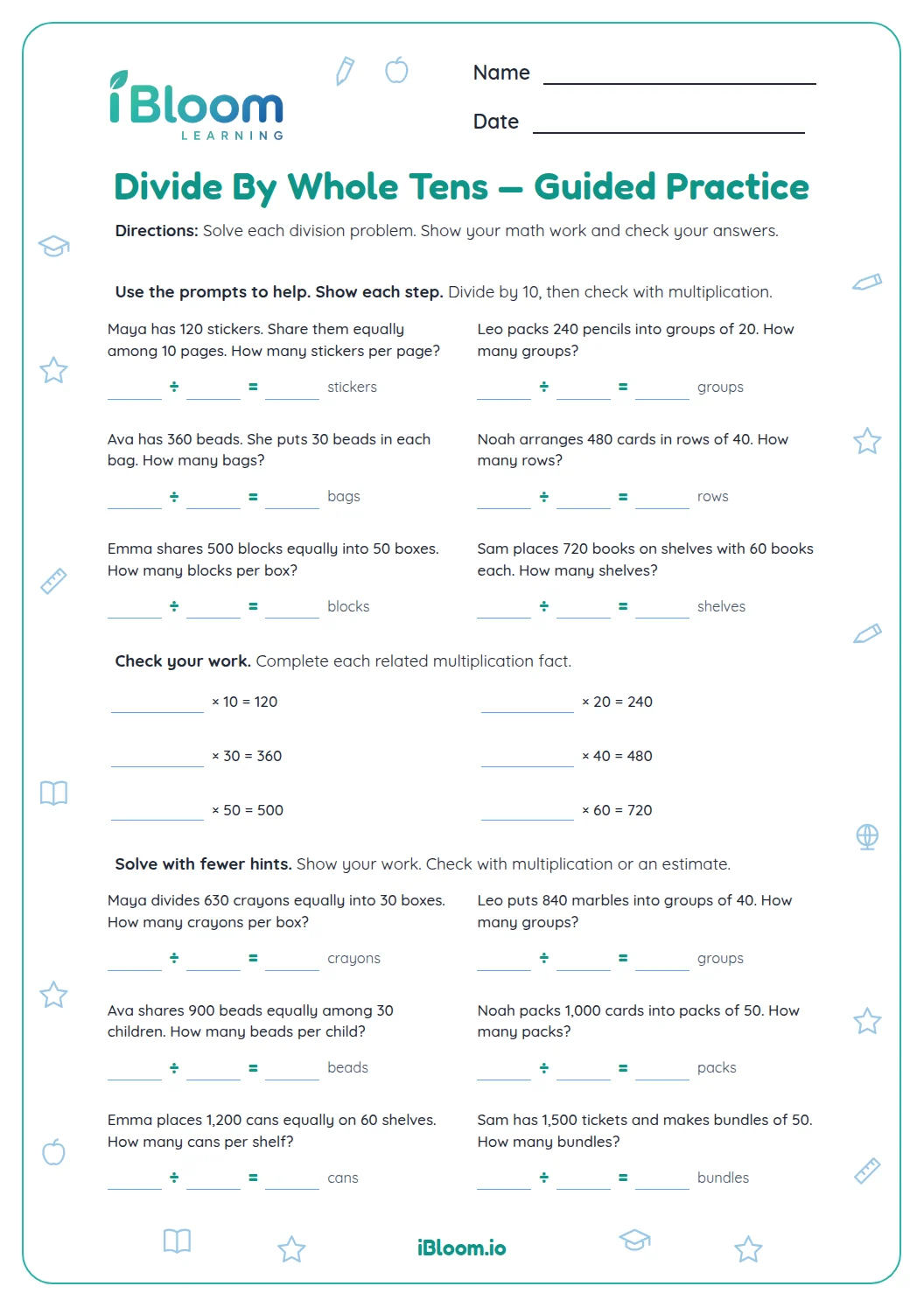
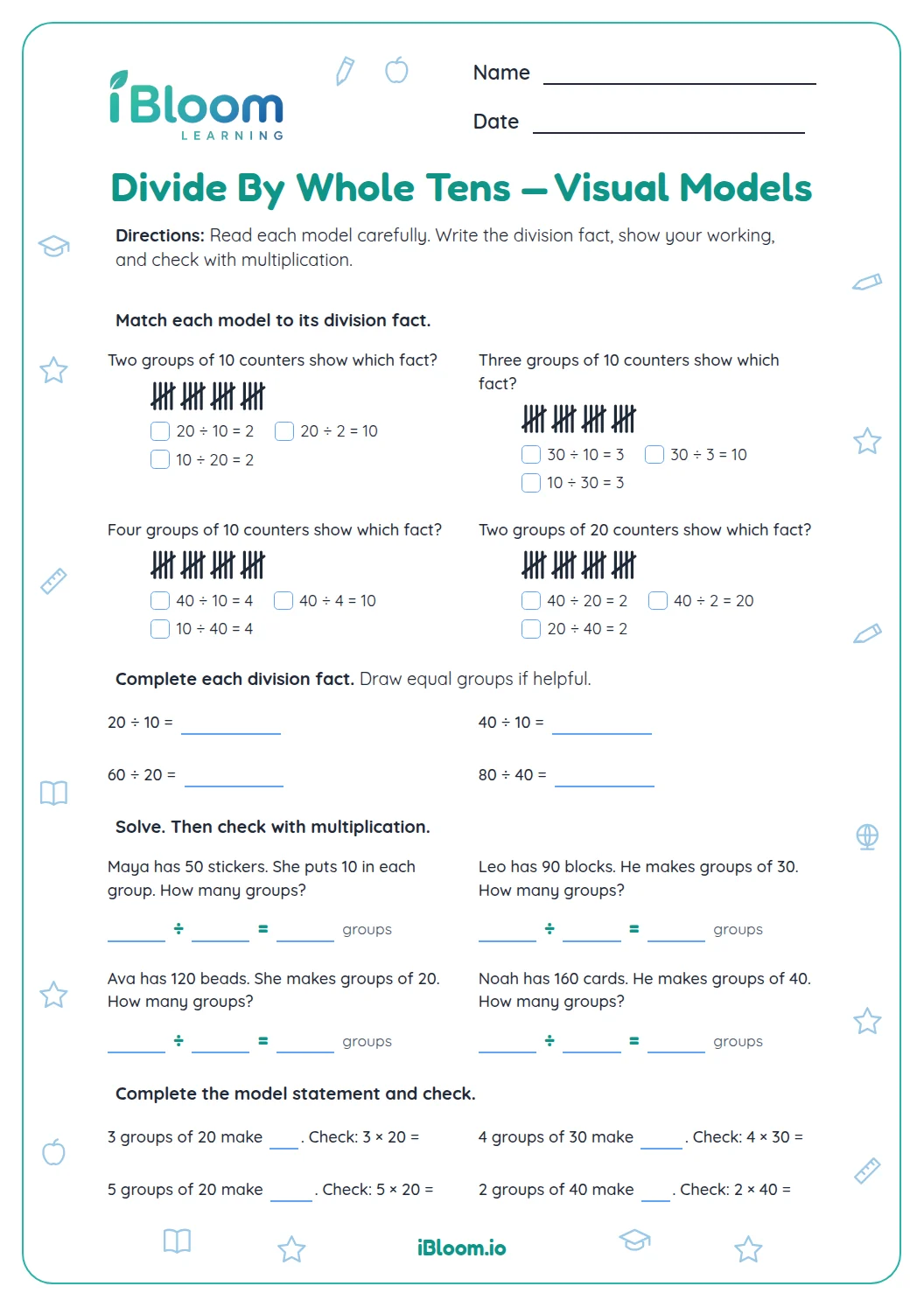
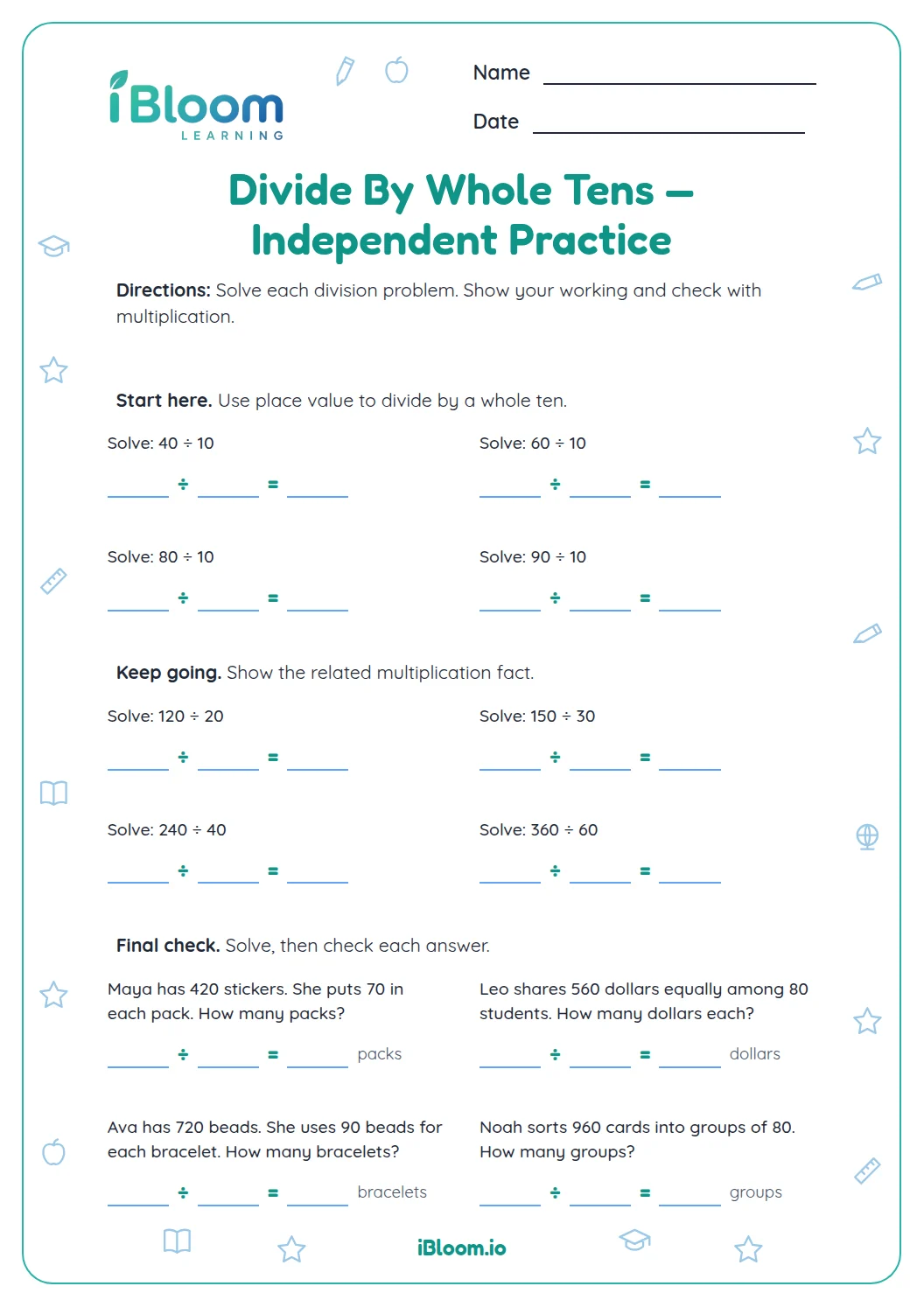
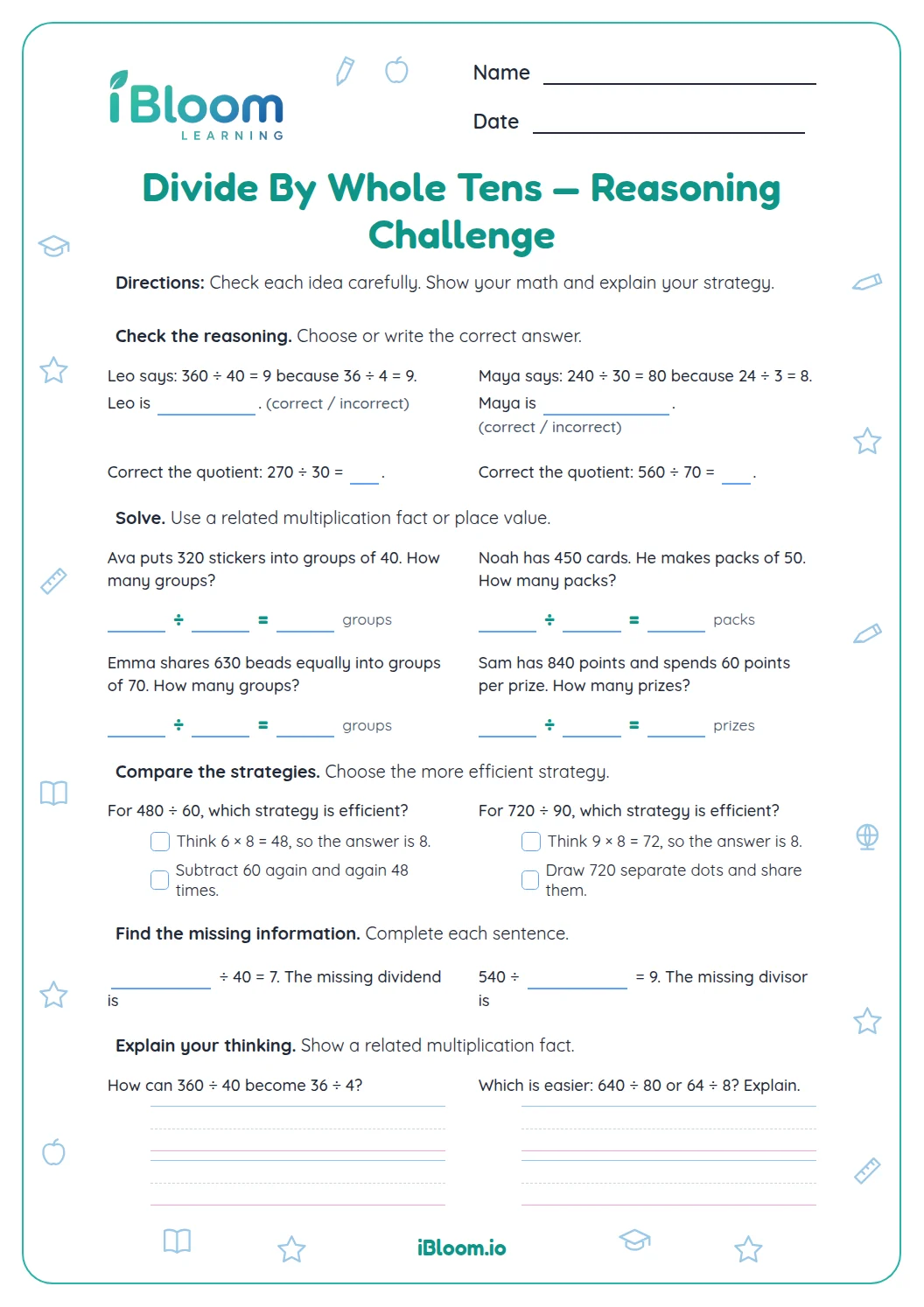
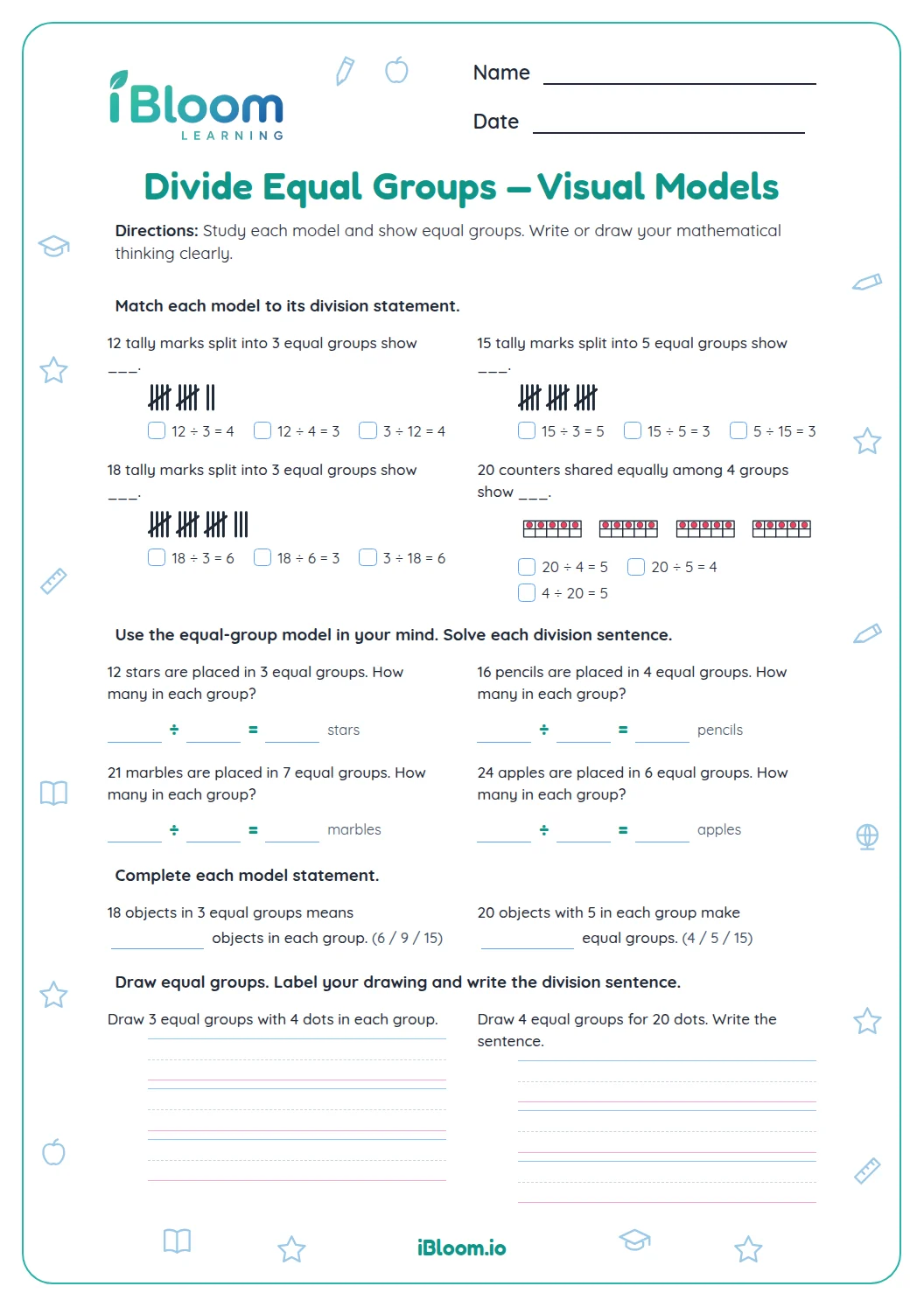
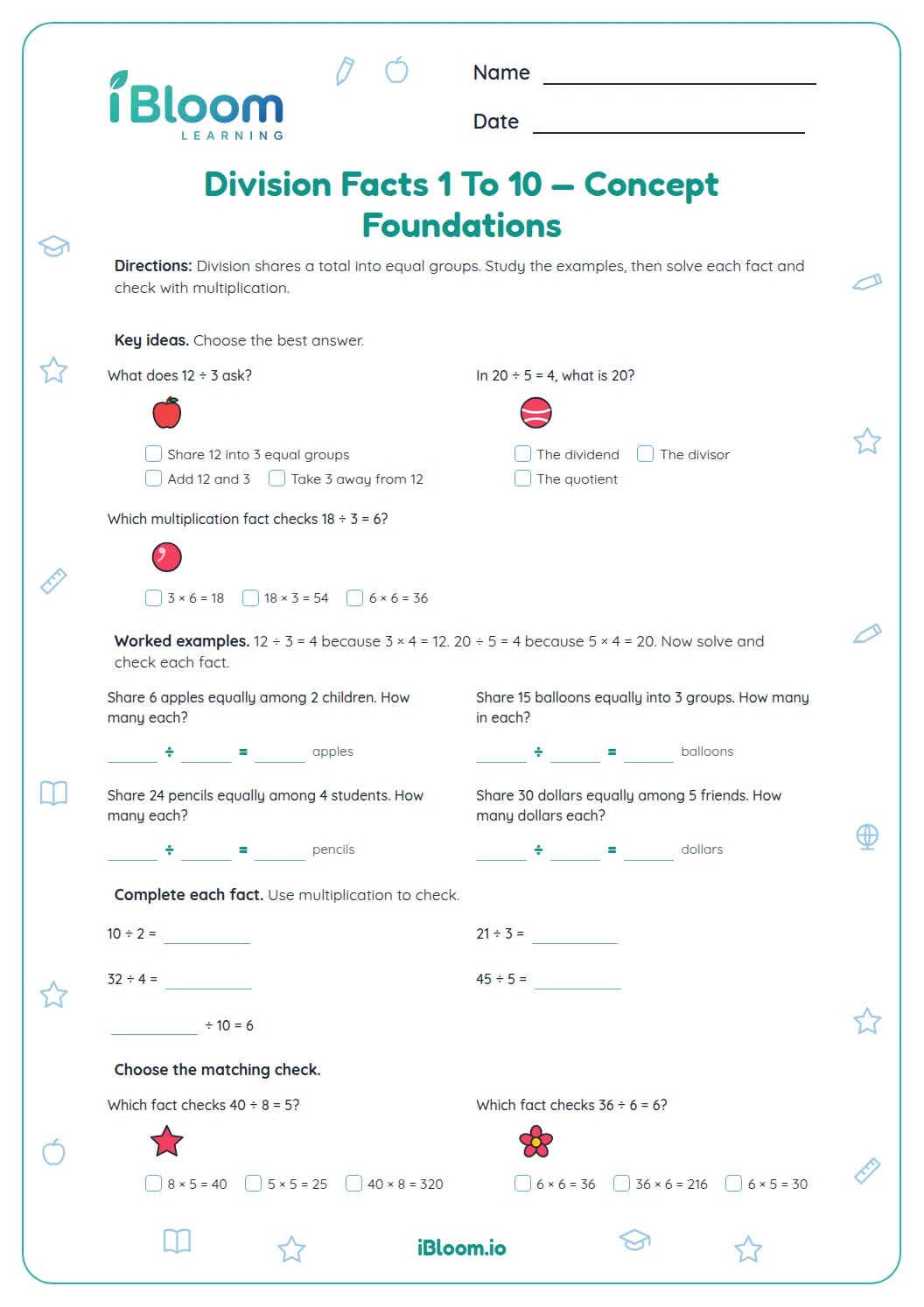
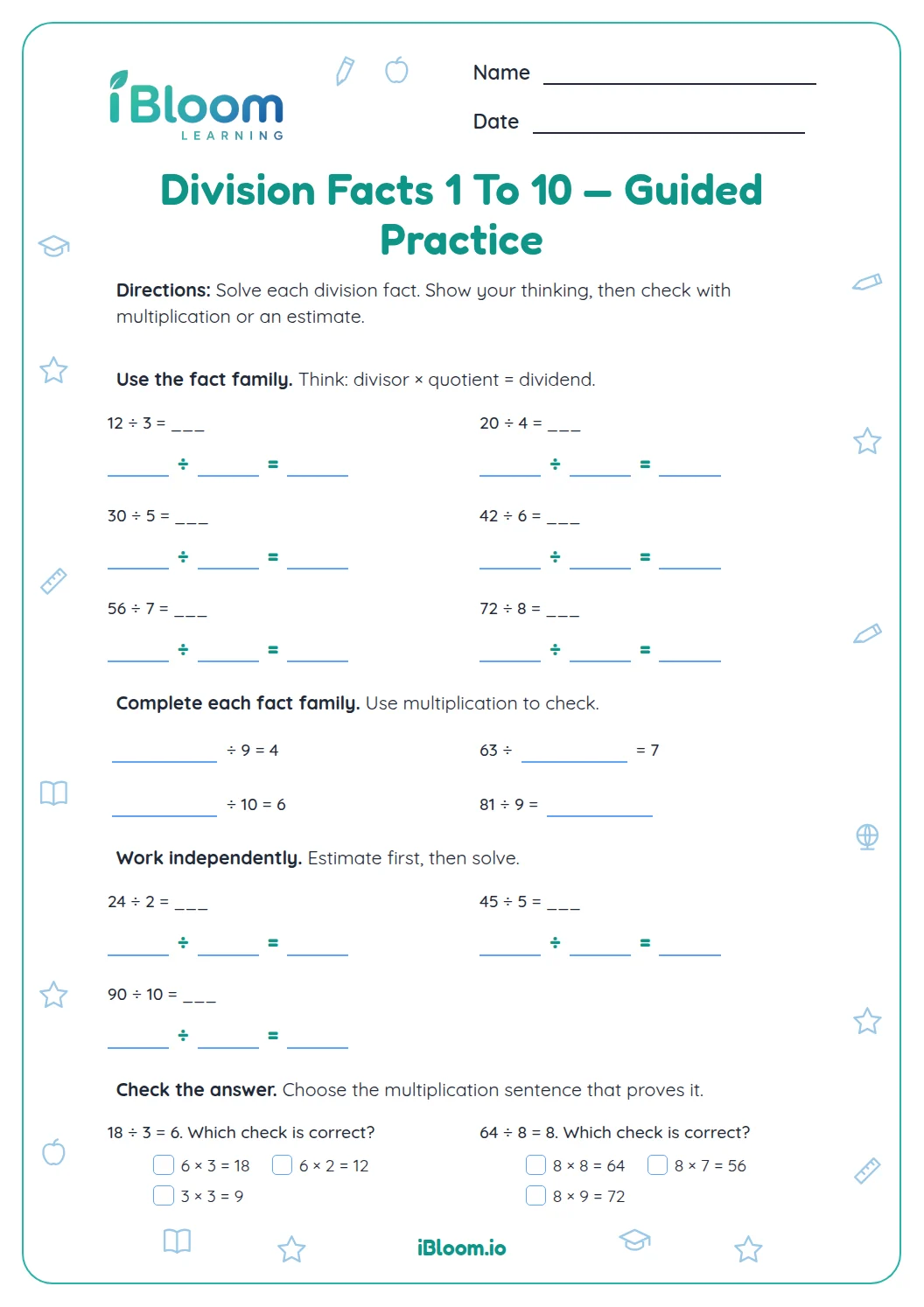
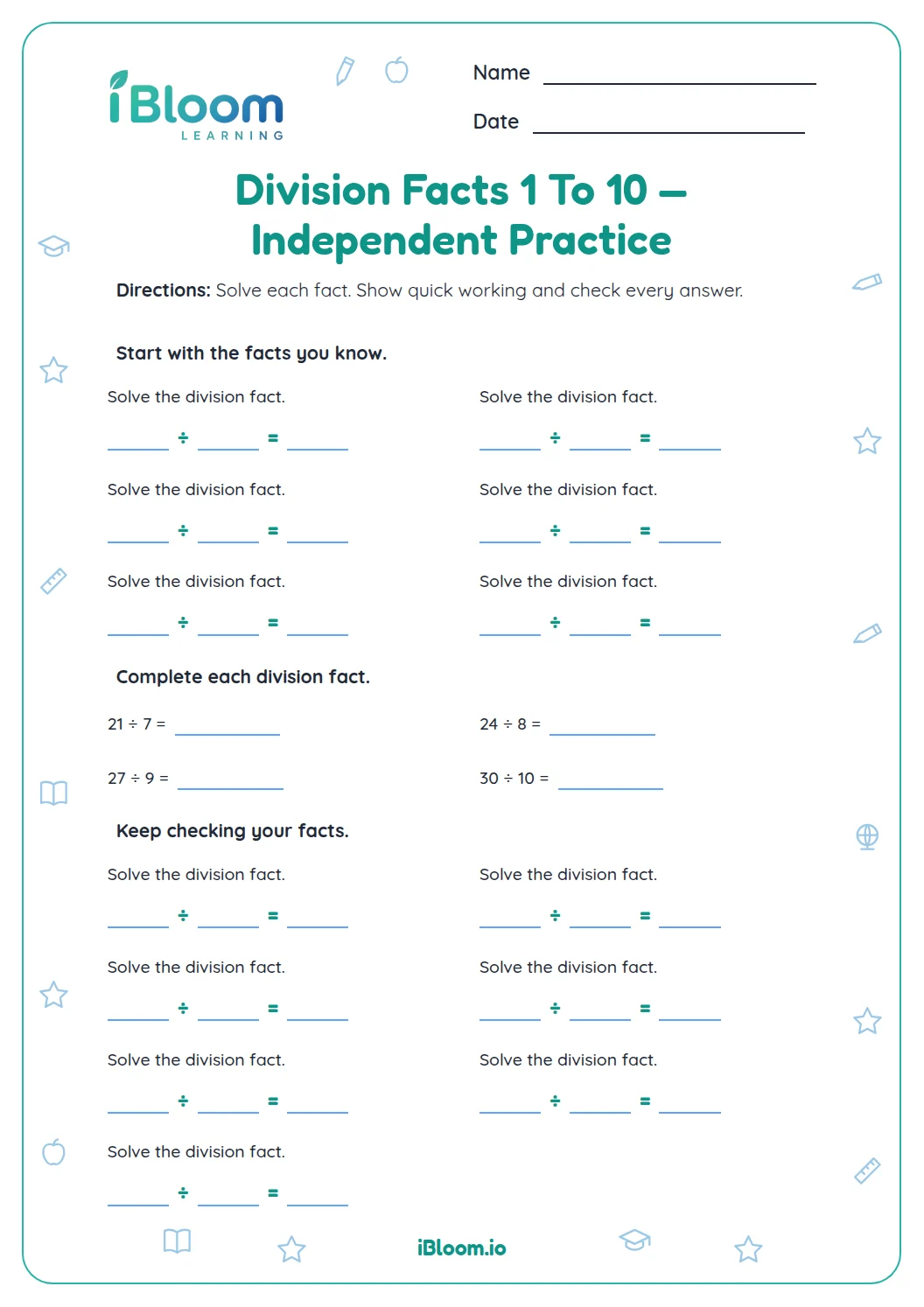
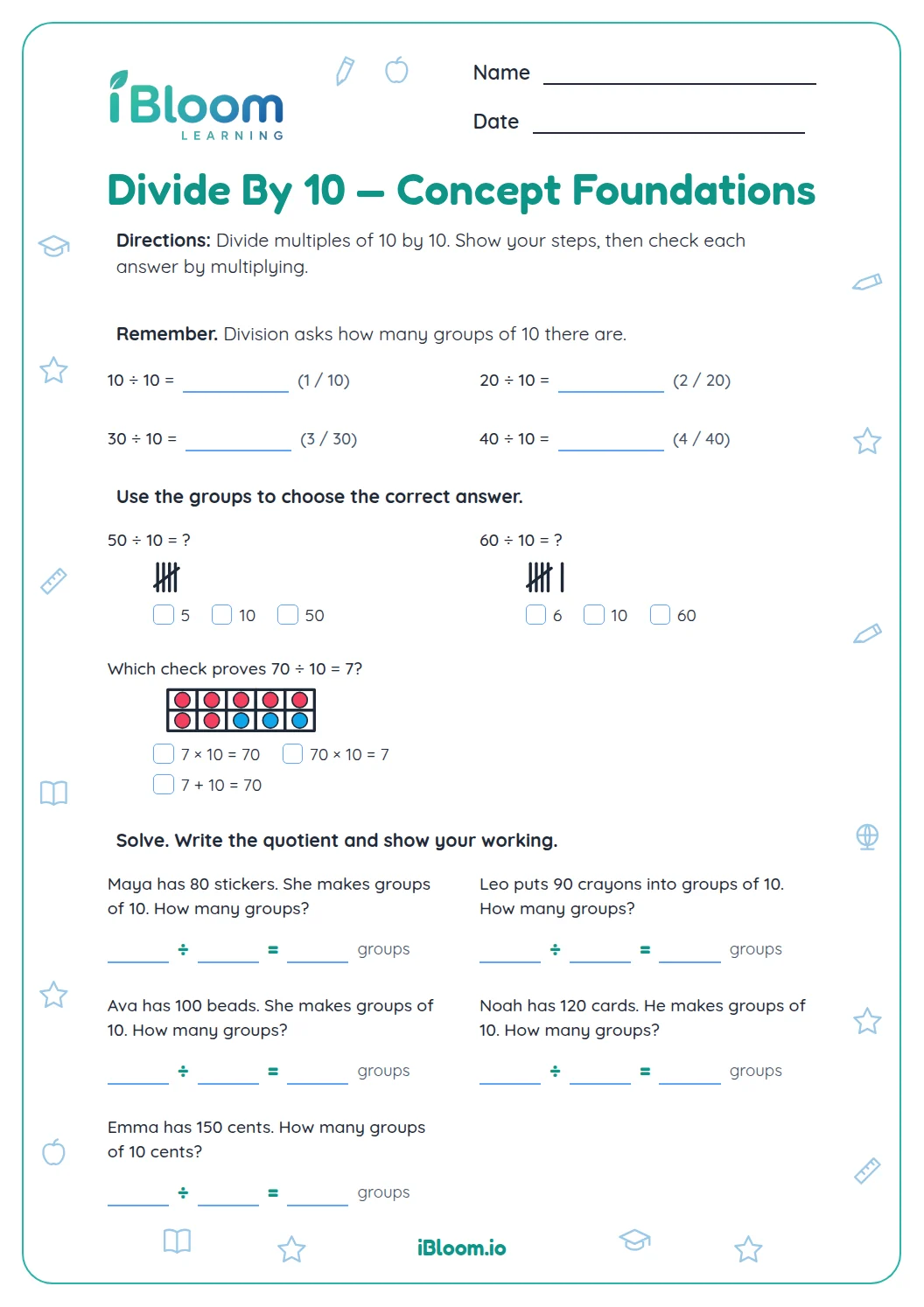
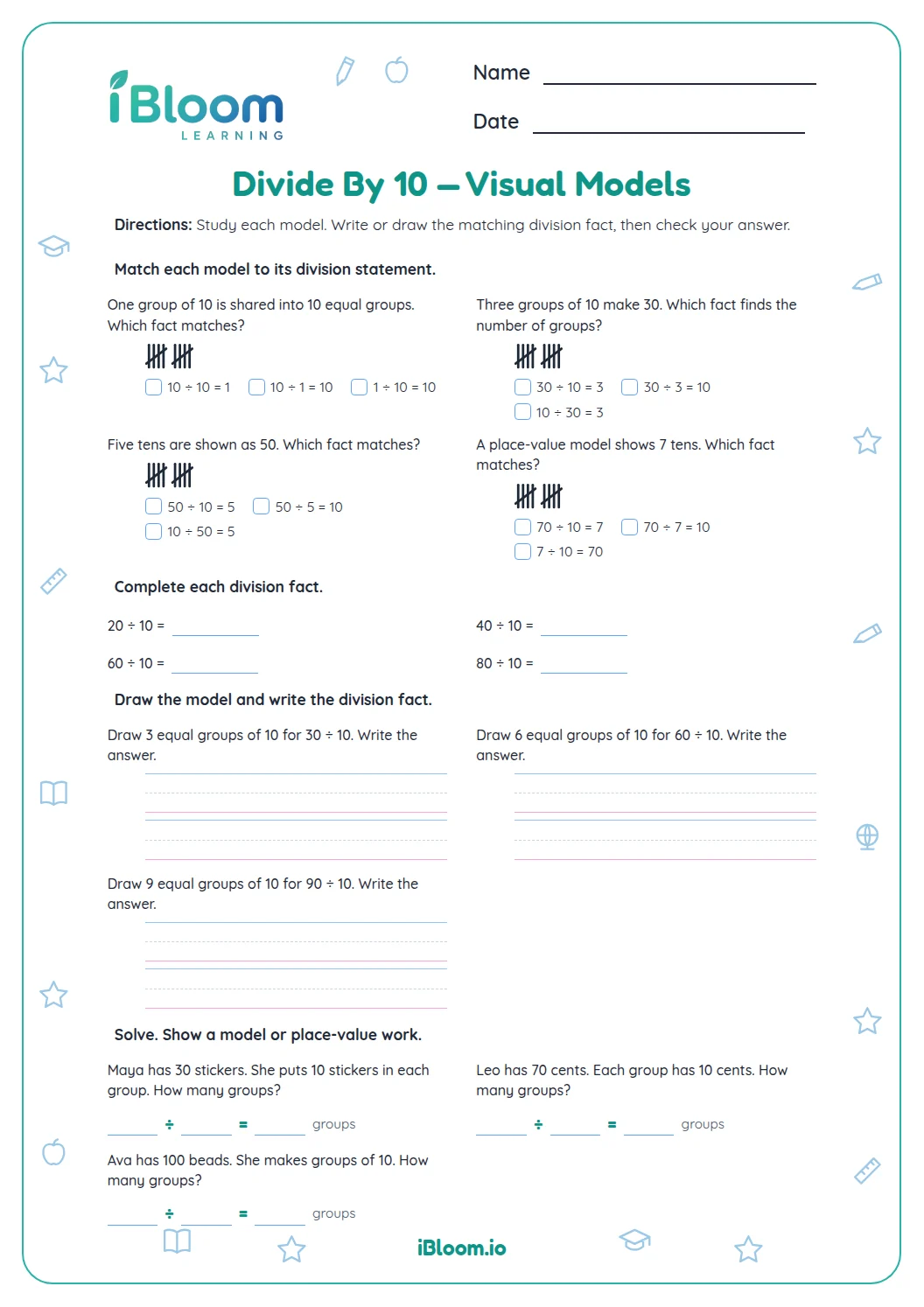
This Grade 3 printable gives learners 16 stories about sharing or packing equal groups with whole tens. Children write a division equation, solve for the number of groups or the amount in each group, and check with multiplication. The contexts include stickers, books, food, and classroom supplies. It practices CCSS 3.OA.A.3 and 3.OA.C.7.
Aligned to 3.OA.A.3 and 3.OA.C.7
How do equal-group division stories work?
A division story gives a total and describes equal groups. The question tells the learner which quantity is missing: the number in each group or the number of groups. Naming the unknown before calculating helps choose the correct equation.
- 180 beads, 20 beads in each bracelet
- 280 ÷ 20 = 4
- 3Check: 4 × 20 = 80
- 4There are 4 bracelets.
How can multiplication check a quotient?
Multiplication reverses the grouping: groups times objects in each group must equal the total. Keep the story unit attached to the quotient.
What does the worksheet include?
The 16 questions move from direct sharing and packing to mixed equal-group situations. Every prompt gives enough information to write one division equation.
How to use this worksheet
- 1Underline the total amount and the size or number of equal groups.
- 2Decide whether the unknown is the number in each group or the number of groups.
- 3Write a division equation using the numbers in the story.
- 4Use a multiplication fact to find and check the quotient.
Common mistakes and quick fixes
The mistake
Dividing the group size by the total.
The fix
Put the total first in the division equation, then check that groups times the group size returns to that total.
The mistake
Reporting the number of groups when the question asks for items in each group.
The fix
Name what the quotient counts before writing the unit, such as bags, books per shelf, or stickers per team.
The mistake
Leaving off the context unit.
The fix
Reread the final question and label the quotient with the thing being counted, such as 4 buses.
Common Core alignment
This worksheet gives focused practice with the listed grade-level skill.
Model equal-group and measurement stories with division equations.
On this sheet: Each story asks learners to represent and solve a division situation within 100.
Show the official wordingHide the official wording
Use multiplication and division within 100 to solve word problems in situations involving equal groups, arrays, and measurement quantities, e.g., by using drawings and equations with a symbol for the unknown number to represent the problem.
Use multiplication and division facts within 100 to find each quotient.
On this sheet: Every quotient is within 100, and learners check answers with multiplication.
Show the official wordingHide the official wording
Fluently multiply and divide within 100, using strategies such as the relationship between multiplication and division (e.g., knowing that 8 × 5 = 40, one knows 40 ÷ 5 = 8) or properties of operations. By the end of Grade 3, know from memory all products of two one-digit numbers.
What to practice next
Make more practice
Further reading
Questions parents and teachers ask
How should a child start a division story?
First identify the total and the size or number of equal groups. In the bracelet problem, 80 beads are used with 20 beads in each bracelet, so 80 ÷ 20 finds how many bracelets can be made. The question wording tells whether the quotient counts groups or items per group.
How can multiplication check a quotient?
Multiply the quotient by the group size and see whether the product returns to the total. For example, 80 ÷ 20 = 4 checks as 4 × 20 = 80. Several items ask learners to show this relationship, which can catch a quotient that does not fit the story.
What kinds of situations are on the sheet?
The 16 questions use equal sharing and packing, such as putting books on shelves, crayons in classrooms, and food in boxes. Each problem uses a whole-ten divisor and asks for one quantity, so the learner can write a single division equation and a labeled answer.
Does the printable include an answer key?
Yes. The separate answer key gives a quotient with its context unit for all 16 items. For example, a response may be 4 bracelets or 3 buses. Checking the unit helps confirm that the learner found the quantity the question actually asks for.
How long should I allow?
About 20 minutes is a reasonable starting point for 16 short stories. Learners who write equations and multiplication checks may need longer. An adult can pause after each part and ask what the quotient represents before moving on to the next group of problems.