


About this worksheet
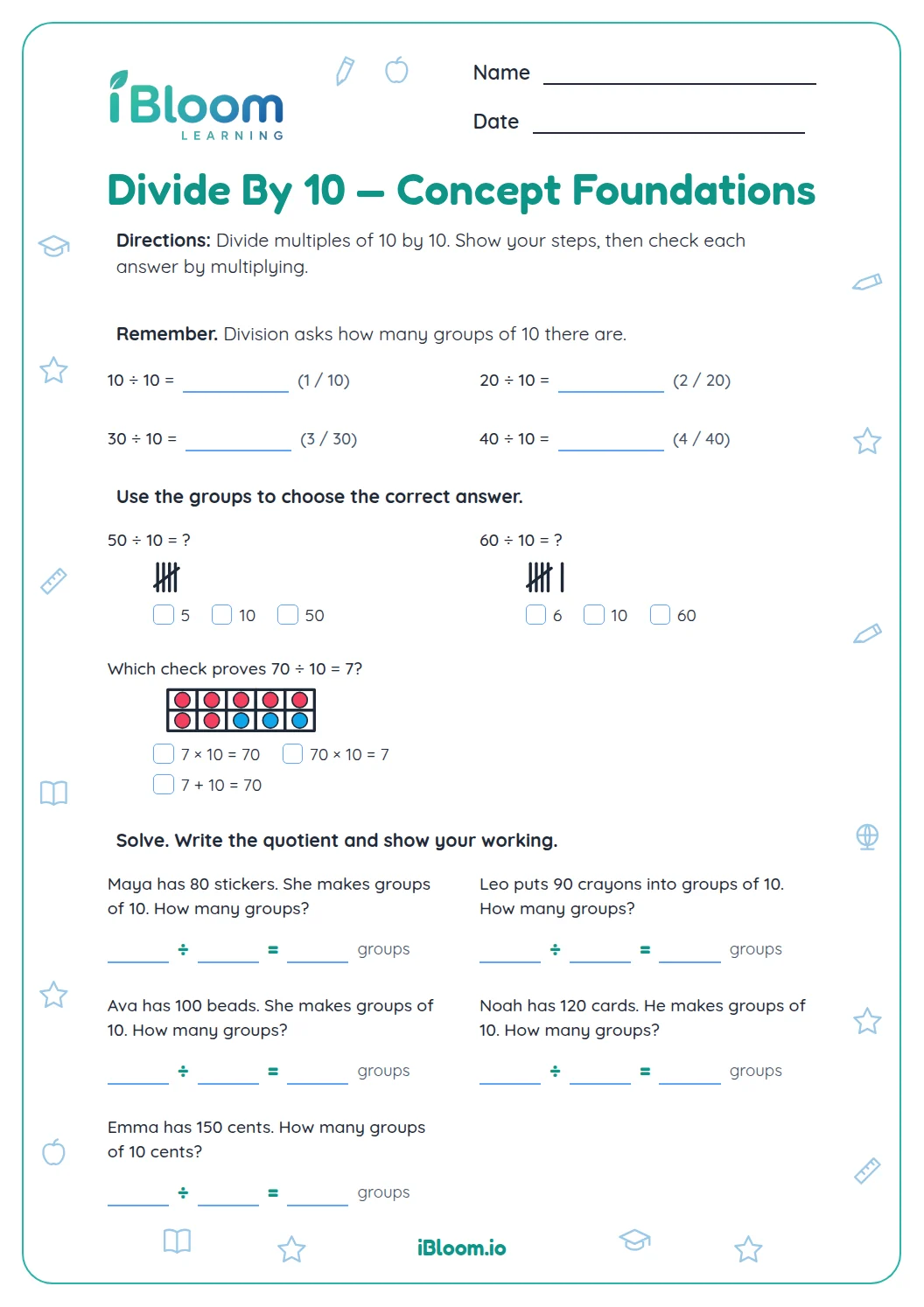
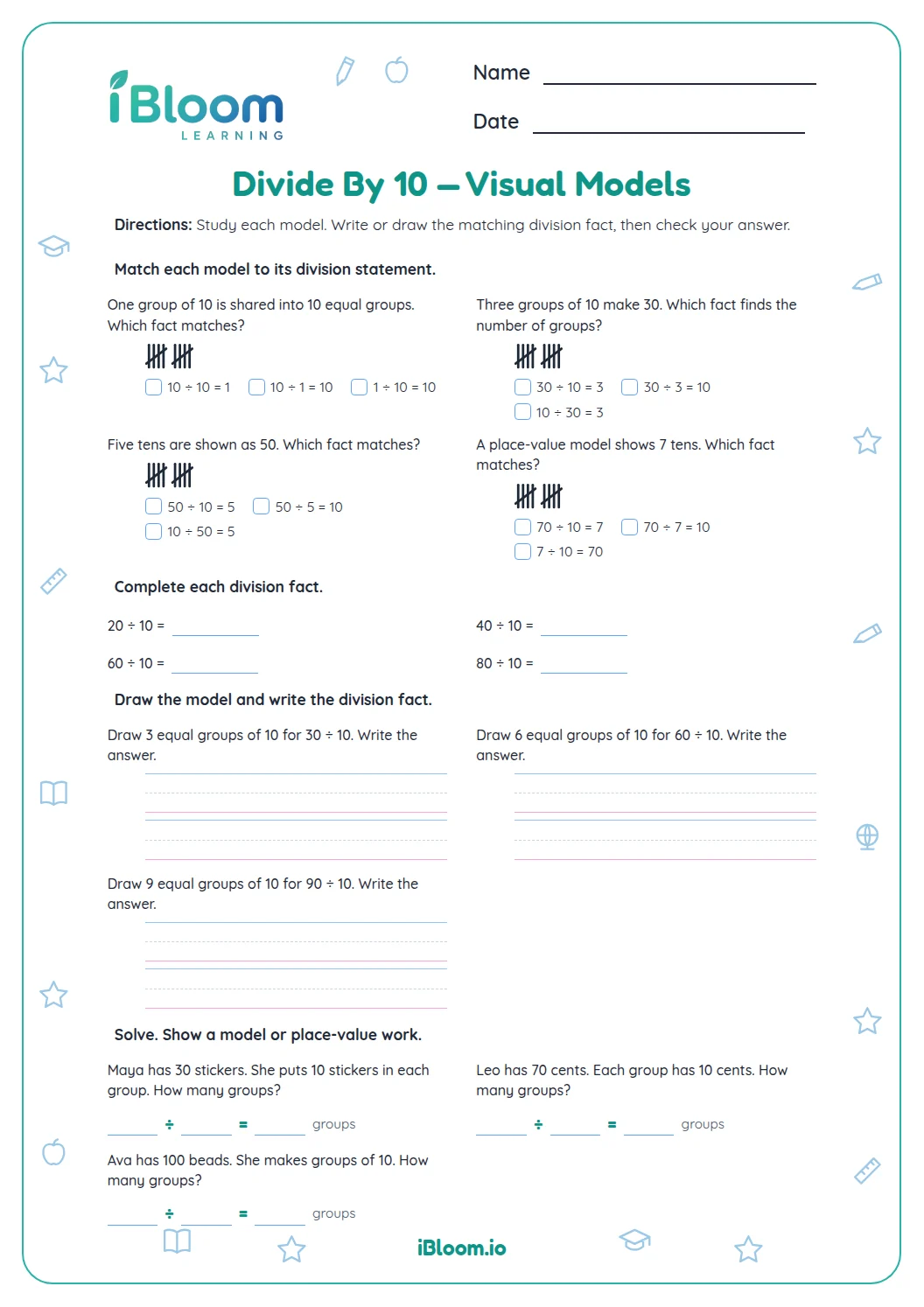
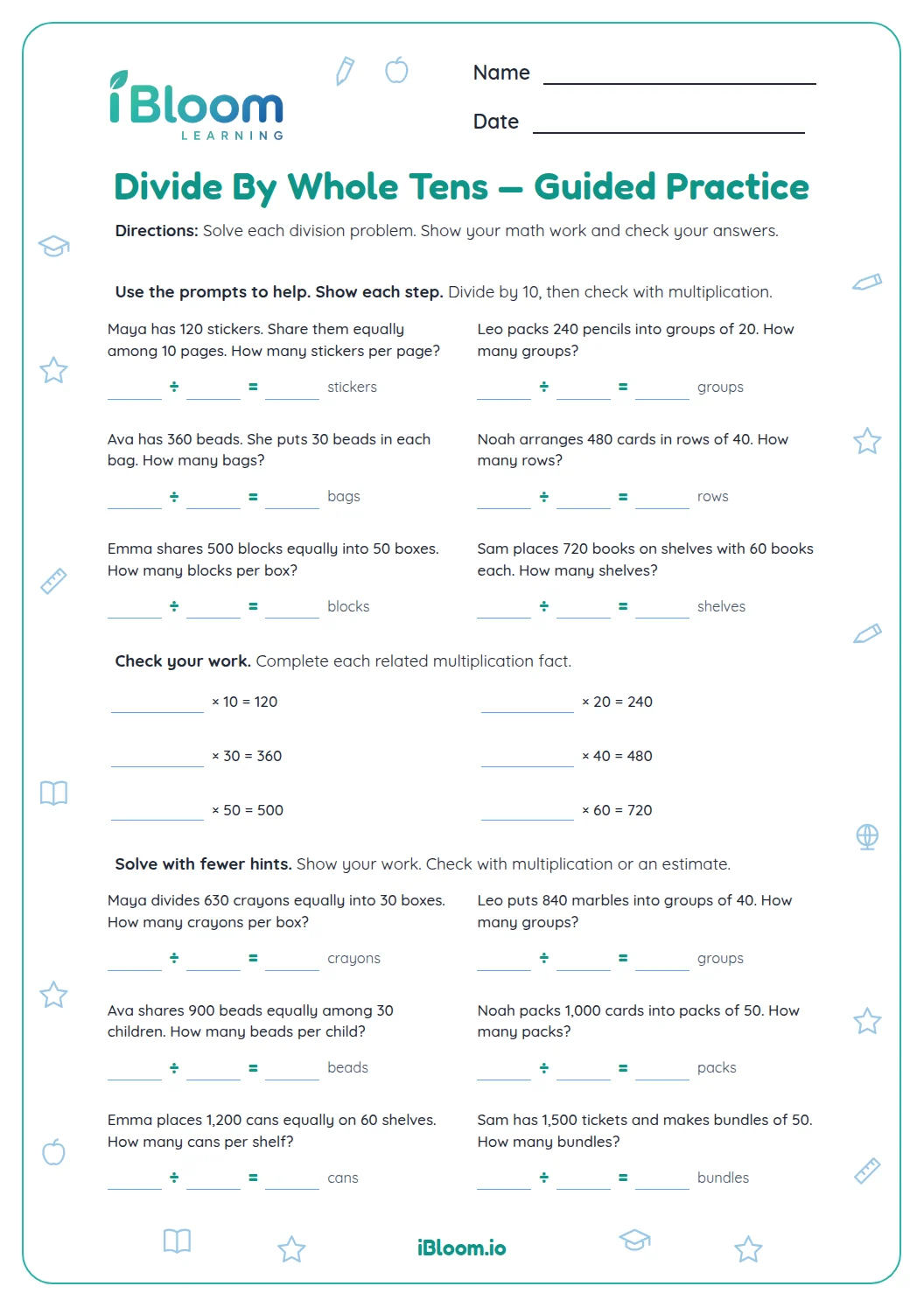
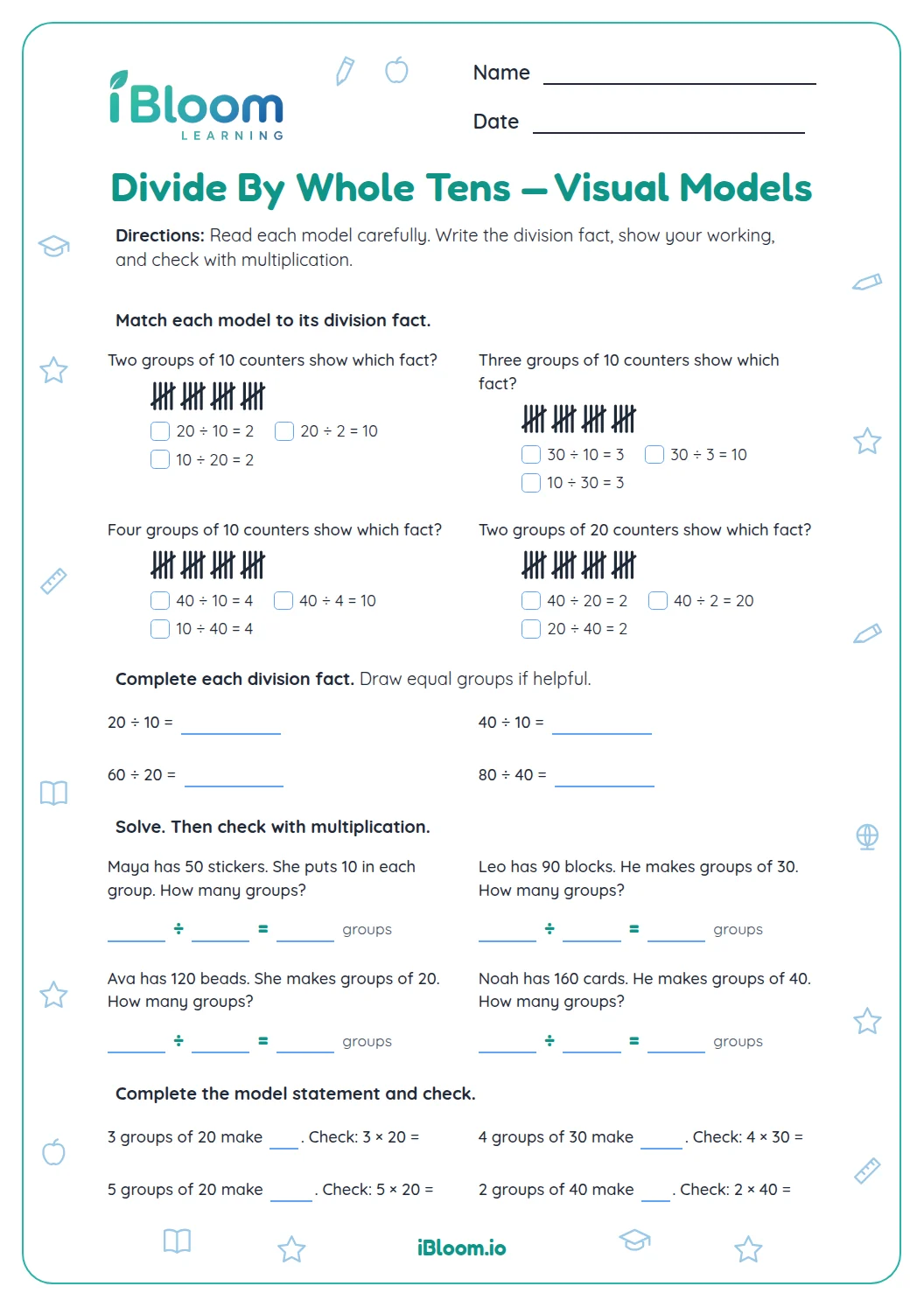
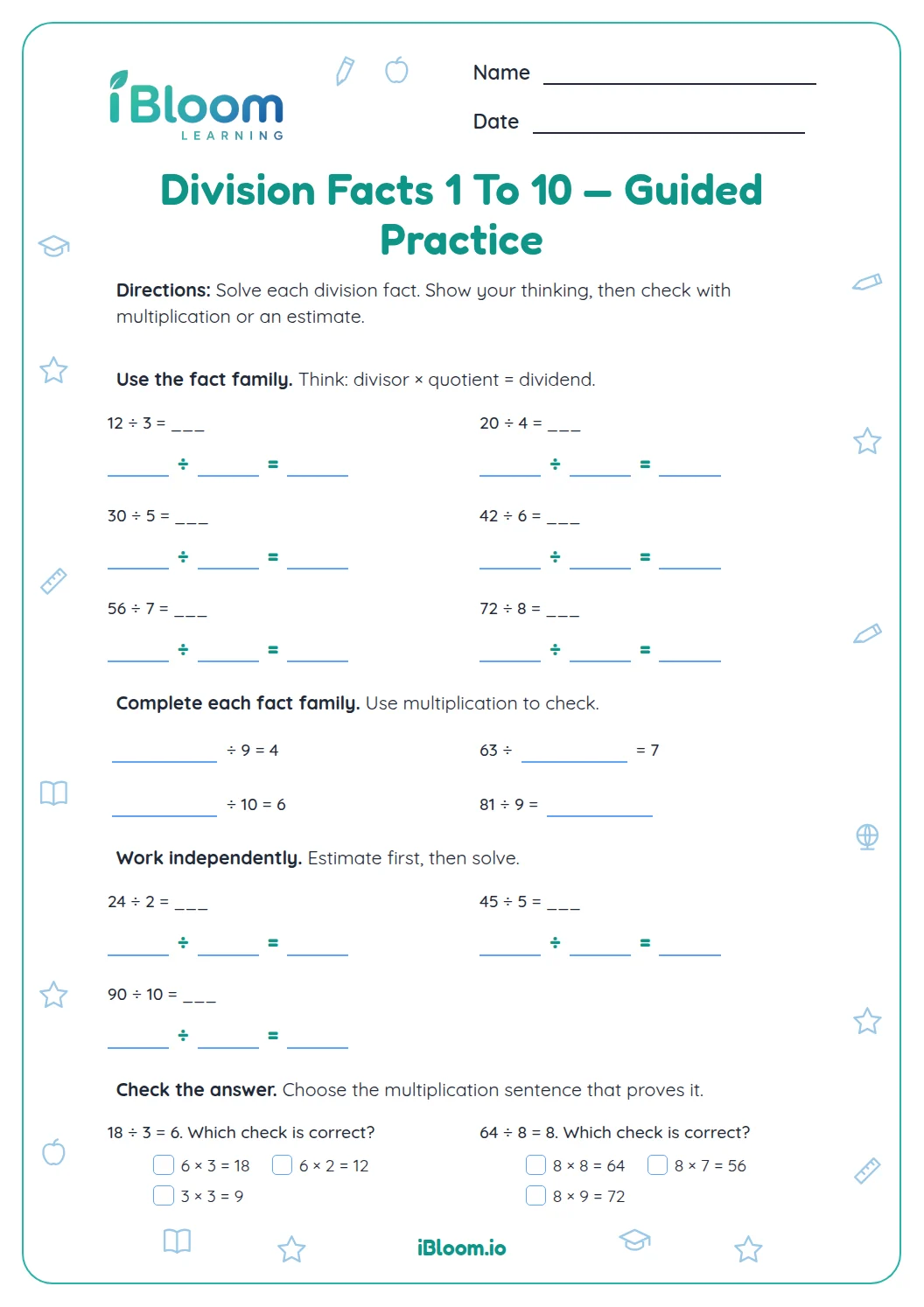
This Grade 3 guided-practice sheet focuses on division by 10. Children begin with equal-group stories, such as sharing 20 stickers among 10 children, then solve eight division facts. The story problems give meaning to the quotient, and the facts provide a second way to practice the same operation. It practices CCSS 3.OA.A.3.
Aligned to 3.OA.A.3
How do the stories show division by 10?
Each story divides a total into ten equal groups. In q1, 20 stickers shared among 10 children means 20 ÷ 10 = 2 stickers per child.
How do the number sentences connect?
The last eight questions use division facts with a divisor of 10. The quotient is the number that makes the related multiplication fact equal the dividend.
How can a student check a quotient?
Multiply the quotient by 10. The product should equal the starting total; for example, 2 × 10 = 20 checks the first story.
A simple way to work
- 1Find the total being shared.
- 2Count the 10 equal groups or recipients.
- 3Divide the total by 10 to find the amount in each group.
- 4Multiply the quotient by 10 to check the total.
Check these common slips
The mistake
Using 10 as the quotient because it is the divisor.
The fix
Ask how many items are in one of the ten groups.
The mistake
Reading the number of groups as the group size.
The fix
Keep the total and the number of groups distinct.
The mistake
Forgetting the story unit in the answer.
The fix
Name the stickers, pages, or other items in one group.
Curriculum alignment
The story and equation items model division as finding the size of equal groups.
Solve equal-group division stories within 100 using equations or drawings.
On this sheet: The worksheet questions directly practice this standard.
Show the official wordingHide the official wording
Use multiplication and division within 100 to solve word problems in situations involving equal groups, arrays, and measurement quantities, e.g., by using drawings and equations with a symbol for the unknown number to represent the problem.
What to practice next
Make more practice
Further reading
Questions parents and teachers ask
How many groups are in each story?
Each story has 10 equal groups, such as 10 children, bags, tables, or baskets. Divide the total by 10 to find how many objects belong in one group. The answer key includes a unit for each story result.
What are the two parts of the worksheet?
Part A has eight equal-group stories. Part B has eight division facts. All 16 questions divide a total by 10, so the second part lets children practice the same idea in number-sentence form. The worksheet keeps the divisor at ten in both sections.
How can a child check a division-by-10 answer?
Multiply the quotient by 10 and compare the product with the original total. For example, if 40 crayons are shared among 10 tables, 4 crayons at each table checks because 4 × 10 = 40. The same check works for each of the division facts on the page.
Does the worksheet include multiplication questions?
The printed equations ask for division by 10. Multiplication can be used as a check: the number in one group multiplied by 10 should make the total. This connects division with the related multiplication fact. Each printed number sentence keeps the divisor at ten.
What does the quotient mean in a story?
The quotient tells how many objects belong in each equal group. In the sticker story, 20 stickers are shared among 10 children, so 2 stickers go to each child. The answer key repeats the item unit to make the meaning clear.