





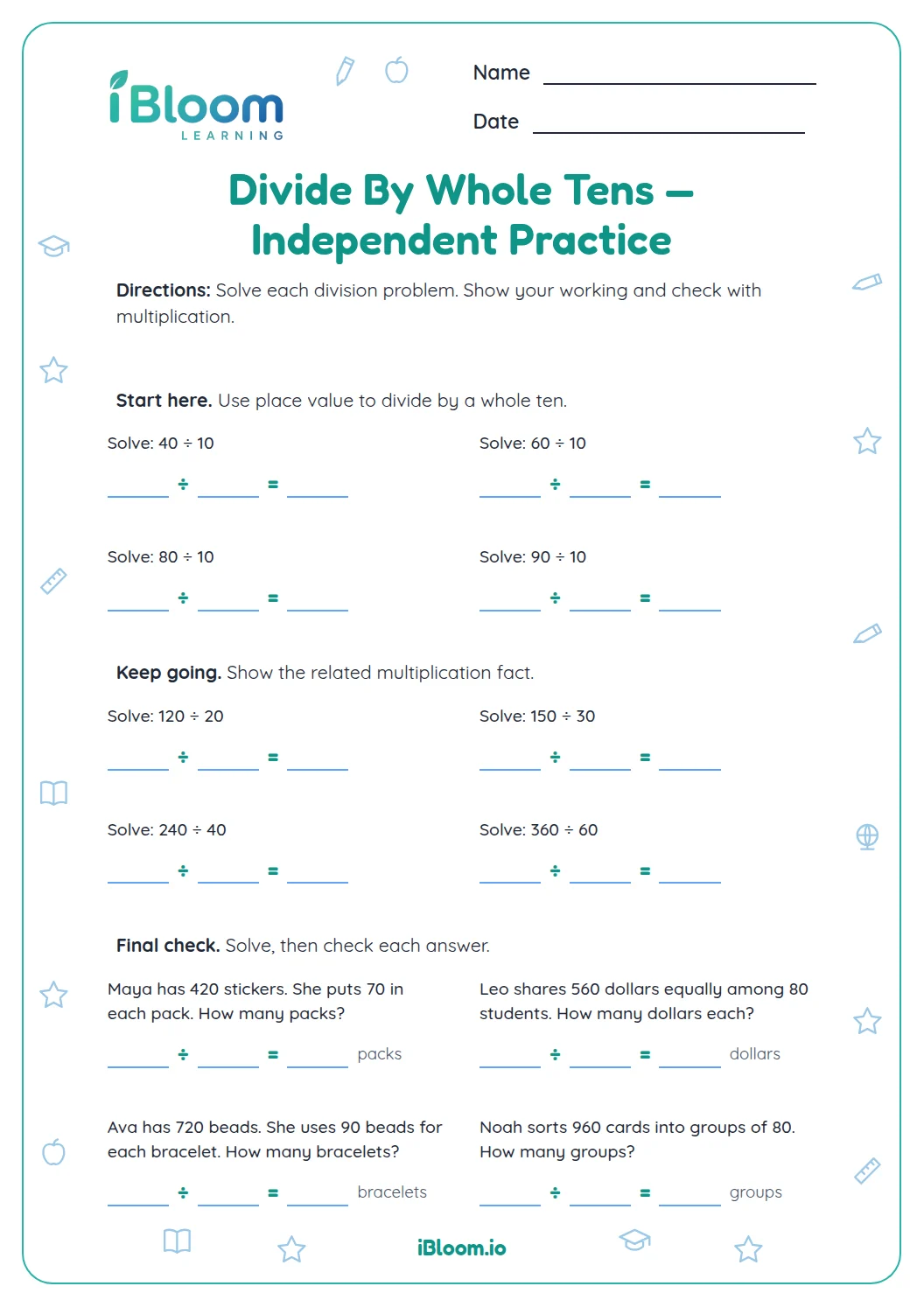
About this worksheet
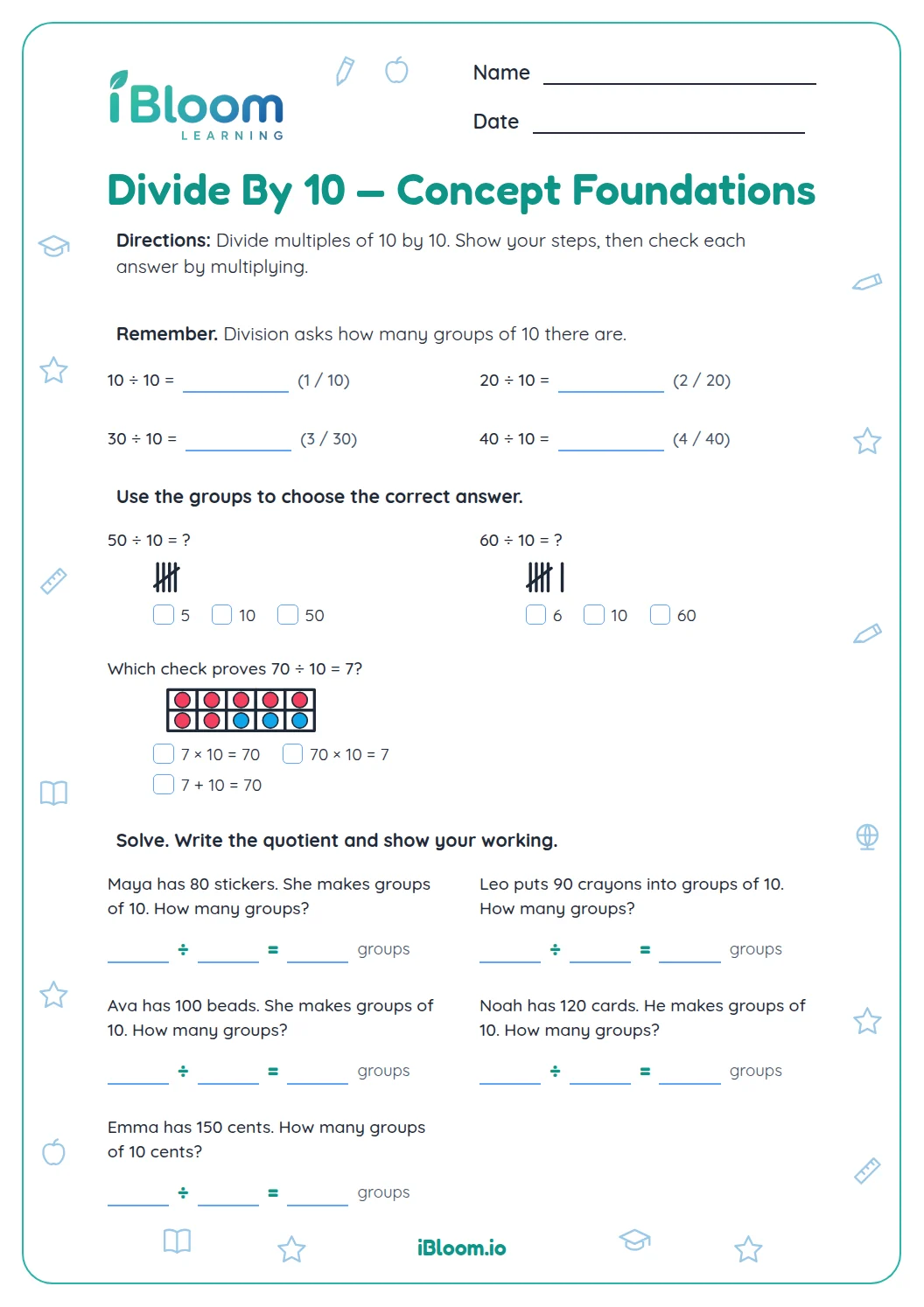
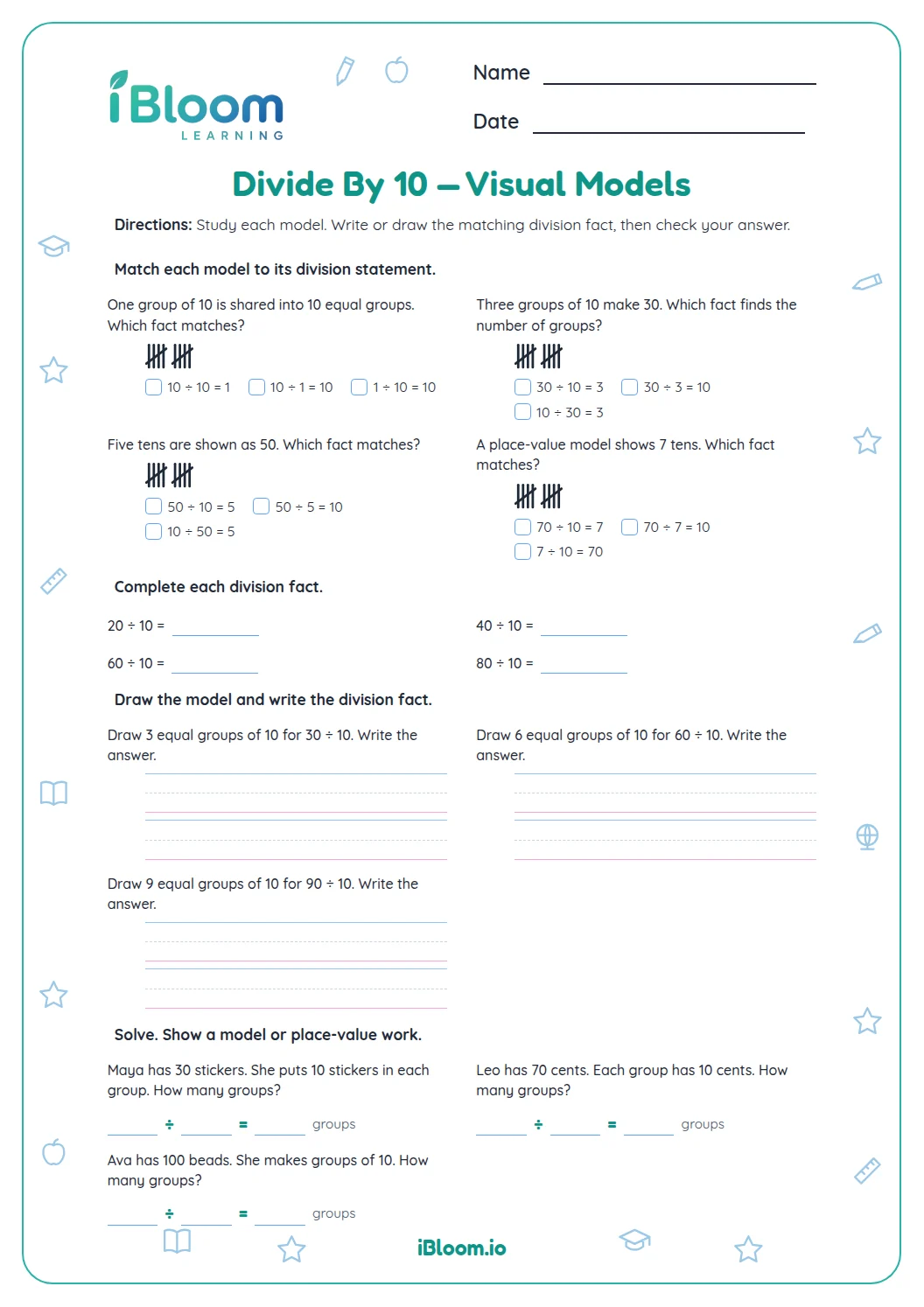
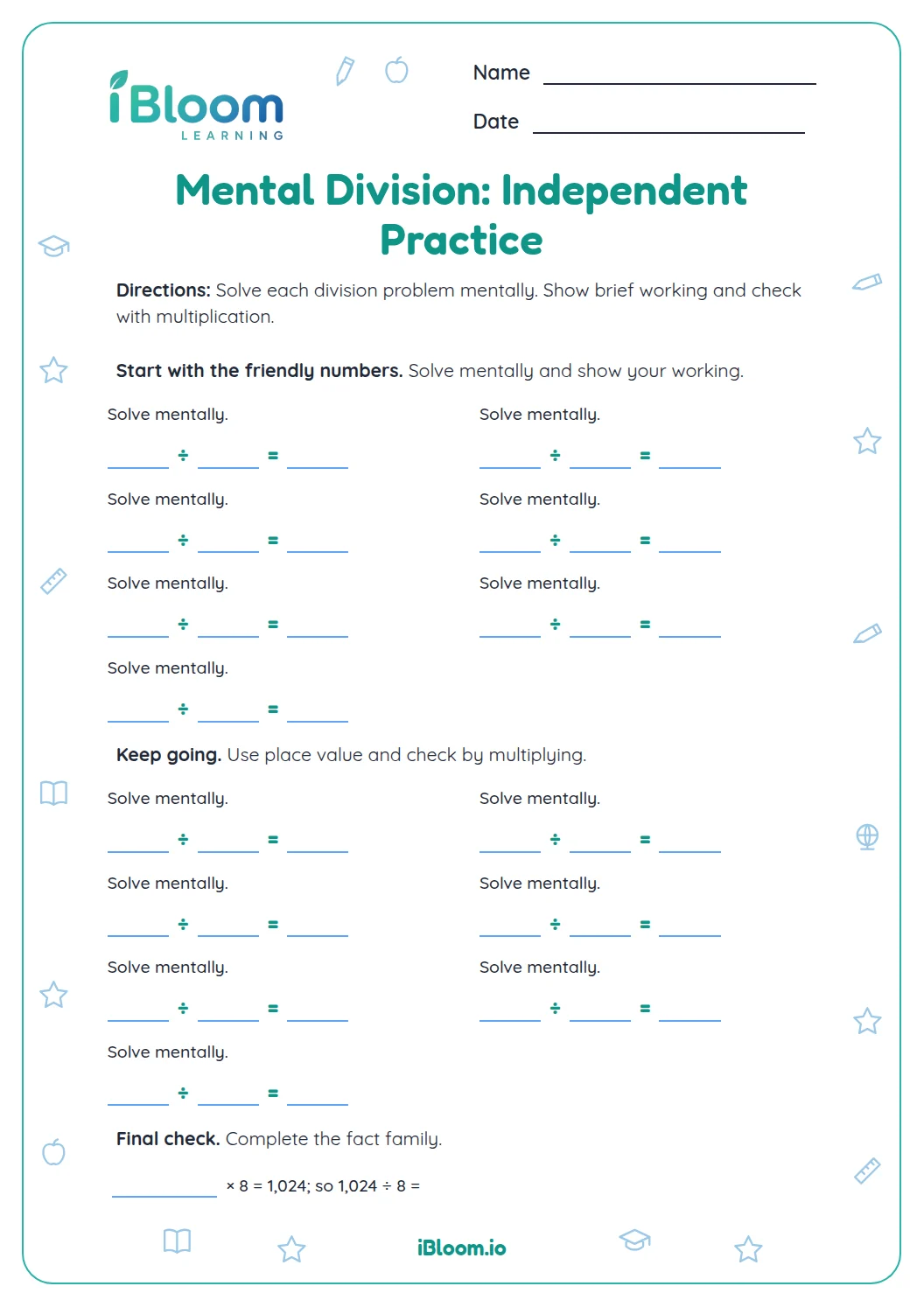
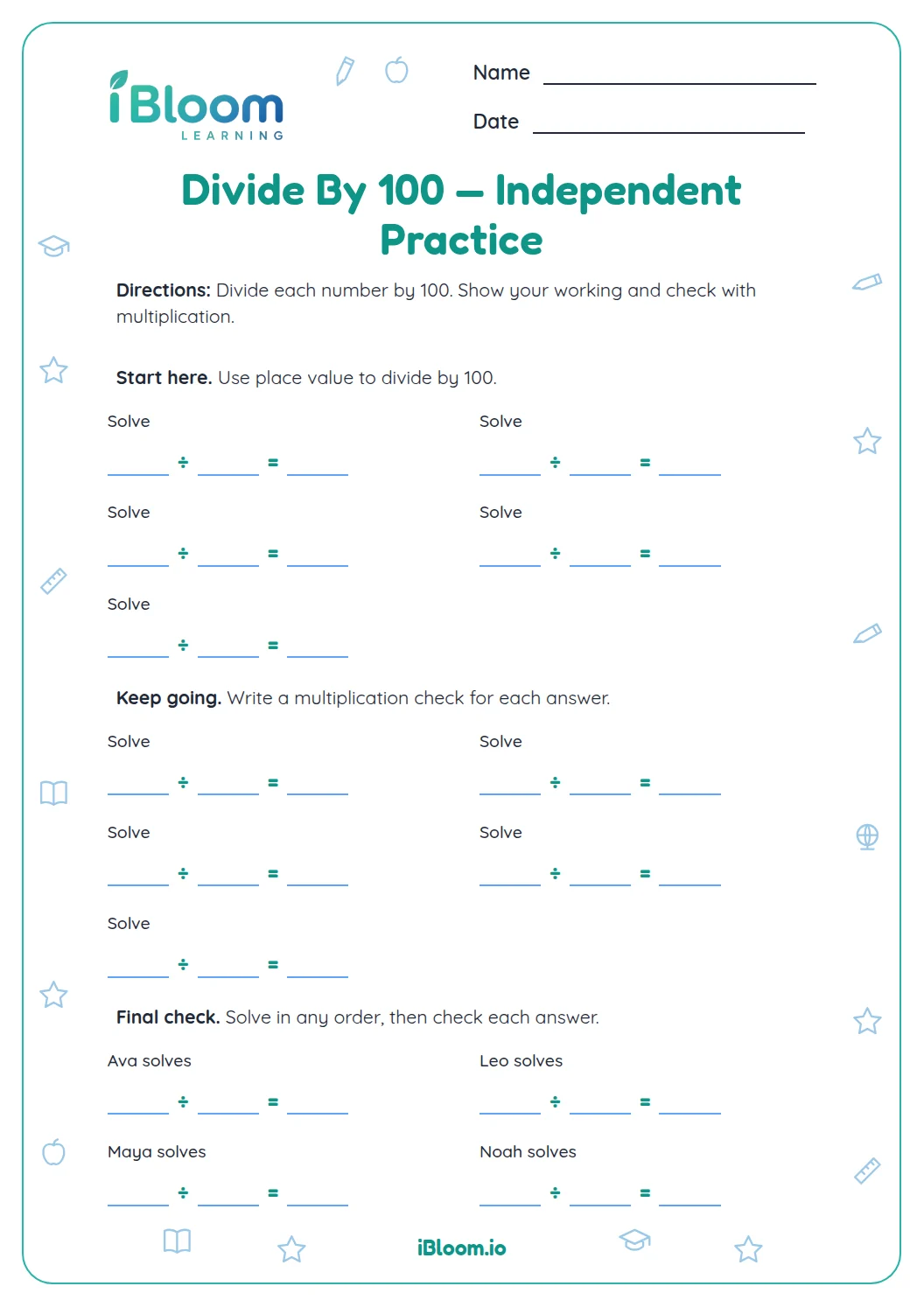
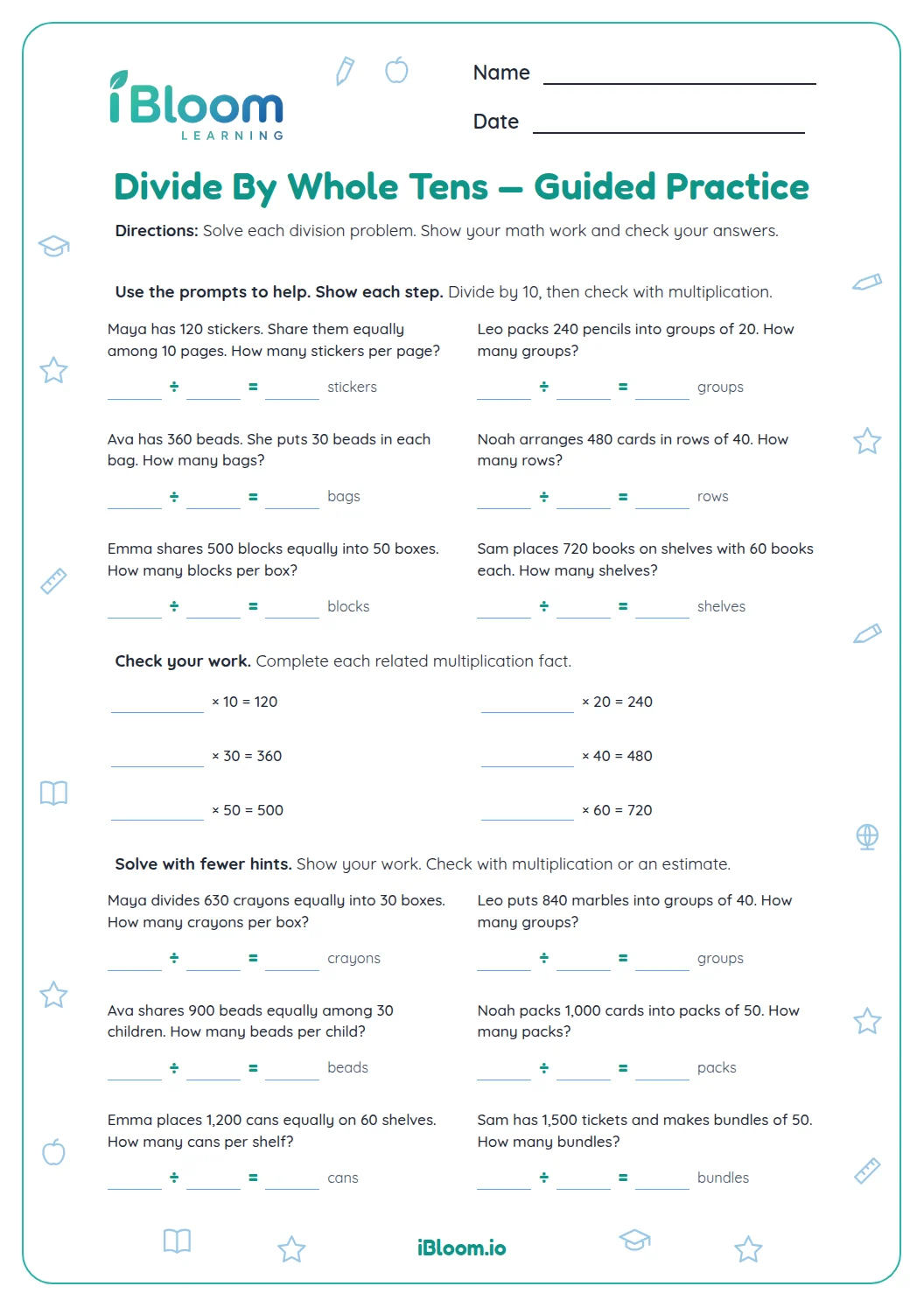
This free printable is for Grade 3 learners practicing division by 10 reasoning. It includes 14 questions across the worksheet’s different parts, followed by a separate answer key. The items move from guided recognition to applying the skill in short tasks. Use it for independent practice, a small group, or a quick review together.
Aligned to 3.OA.C.7
How does multiplication check division?
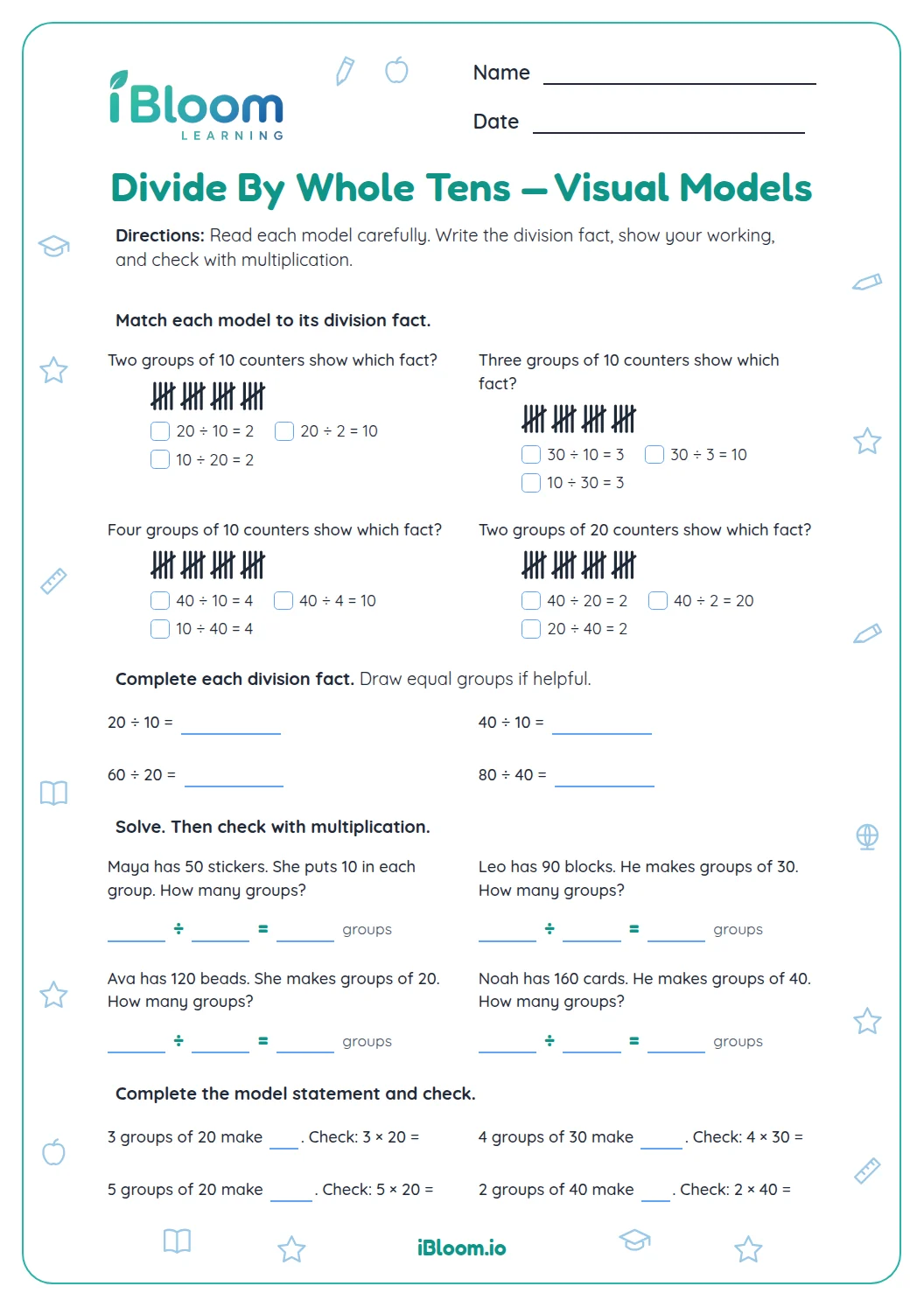
The first items pair division facts with multiplication facts, then ask learners to choose an equation that represents groups of ten. Every dividend stays within 100.
- 160 ÷ 10 = ___ → 6
How do groups of ten solve the story problems?
The word problems describe crayons, stickers, and cards. Write a division equation to find how many groups of ten fit, then use the related multiplication fact to check.
How can the answer key support review?
Ask the learner to check a quotient by multiplying it by 10. For a story problem, confirm that the number of groups matches the situation and the stated total.
How to use this worksheet
- 1Read the dividend and divisor.
- 2Think of how many groups of ten make the dividend.
- 3Write the quotient.
- 4Check by multiplying the quotient by 10.
- 5Use the equation to answer each story problem.
Common mistakes and quick fixes
The mistake
Subtracting 10 once instead of counting groups.
The fix
Ask how many groups of ten make the whole amount.
The mistake
Changing the divisor and dividend.
The fix
Keep the total first and divide it by 10.
The mistake
Giving a quotient without checking.
The fix
Multiply the quotient by 10 and compare it with the starting number.
Curriculum alignment
Use multiplication facts to reason about division facts within 100.
On this sheet: The questions connect division by 10 to equal groups and multiplication facts.
Show the official wordingHide the official wording
Fluently multiply and divide within 100, using strategies such as the relationship between multiplication and division (e.g., knowing that 8 × 5 = 40, one knows 40 ÷ 5 = 8) or properties of operations.
What to practice next
Make more practice
Further reading
Questions parents and teachers ask
What does divide by 10 mean in these questions?
It asks how many groups of 10 fit into the total. For example, 60 ÷ 10 = 6 because six groups of 10 make 60. The worksheet connects each division fact to equal groups or a multiplication fact. The separate answer key offers a quick way to review each response.
How many questions are on the worksheet?
There are 14 questions in four parts, followed by a separate answer key. Learners complete number sentences, choose equations, solve group problems, and connect division with multiplication. The separate answer key offers a quick way to review each response. Then compare with the answer key.
How can multiplication check a division answer?
Multiply the quotient by the divisor. If 70 ÷ 10 = 7, then 7 × 10 = 70 confirms the answer. Several items ask learners to use this related fact. The separate answer key offers a quick way to review each response.
Are the division totals appropriate for Grade 3 practice?
The worksheet uses dividends from 30 to 100, keeping the examples within 100. Learners work with groups of ten and related multiplication facts. The separate answer key offers a quick way to review each response. Then compare with the answer key.
What equation represents 40 crayons in groups of ten?
The equation is 40 ÷ 10 = 4, so four groups of 10 can be made. Multiplication checks the result: 4 × 10 = 40. The separate answer key offers a quick way to review each response. Then compare with the answer key.