




About this worksheet
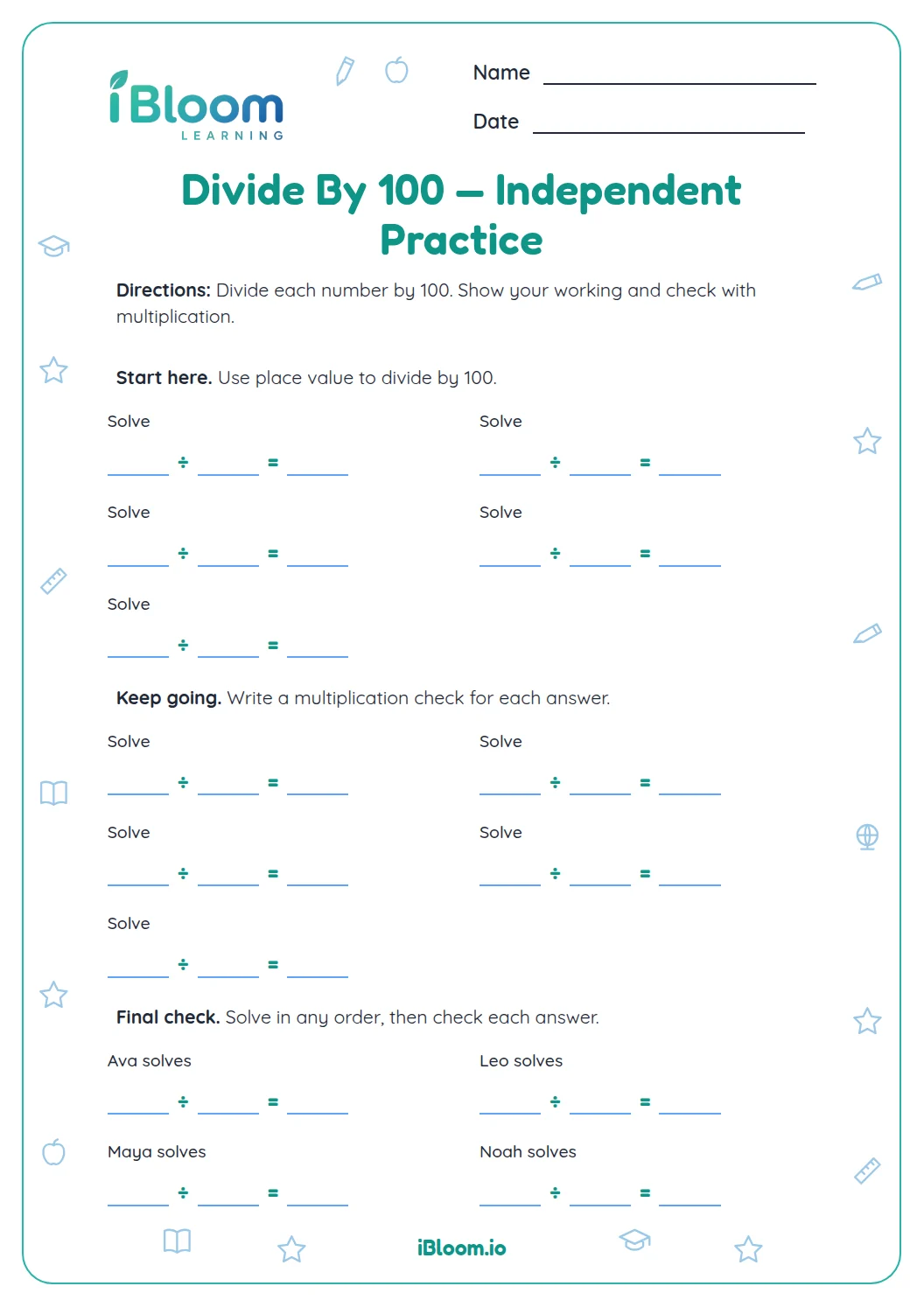
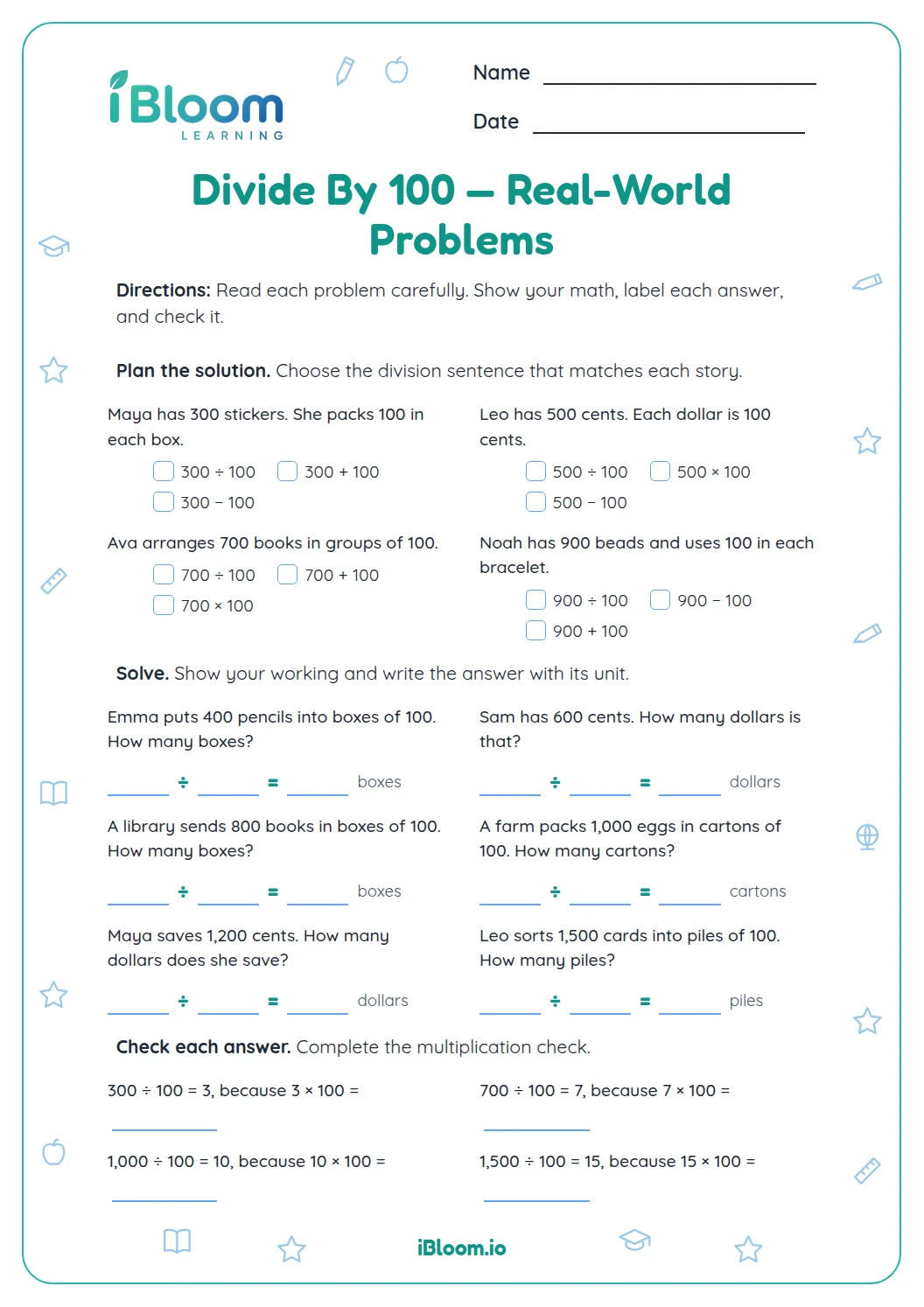
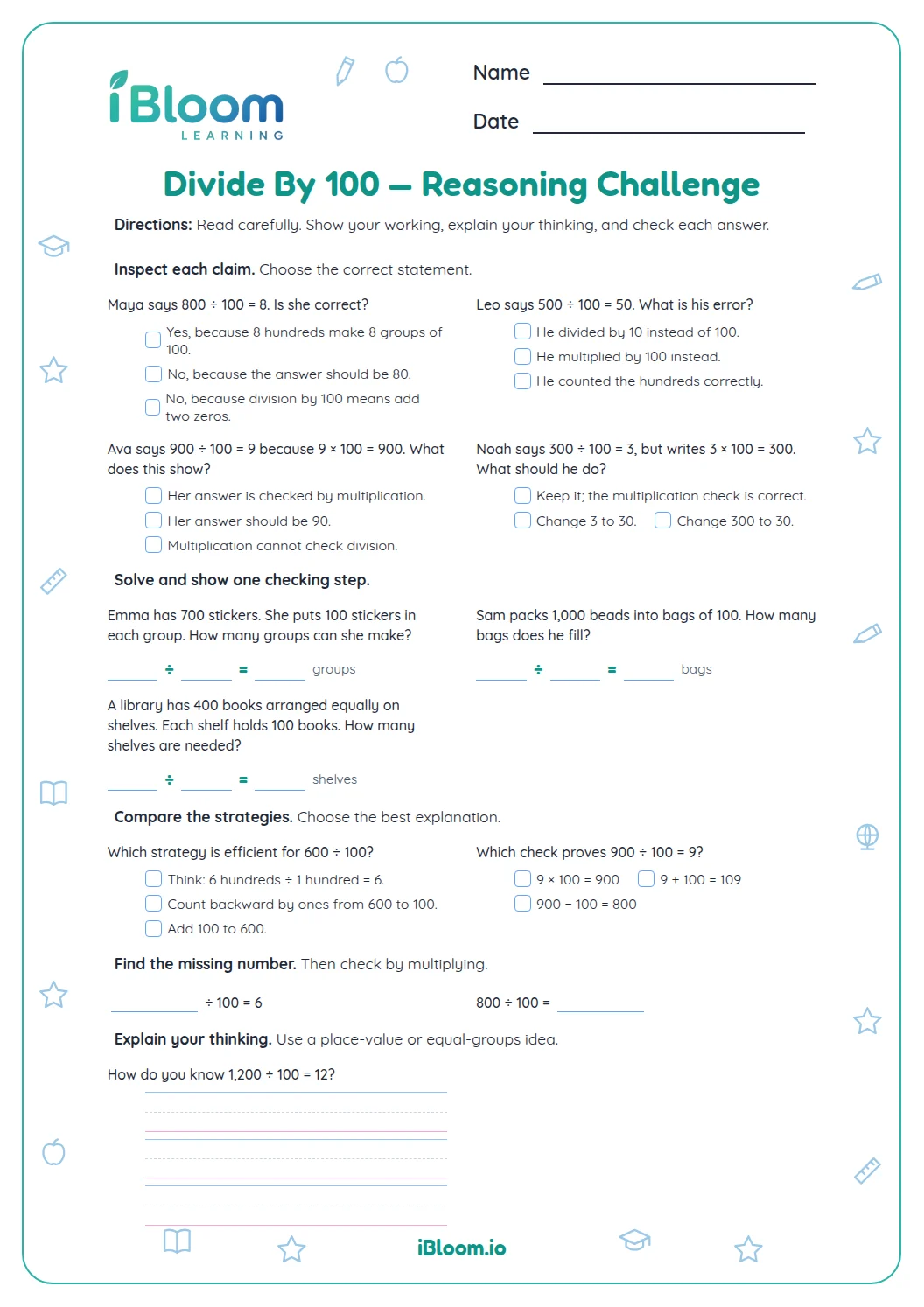
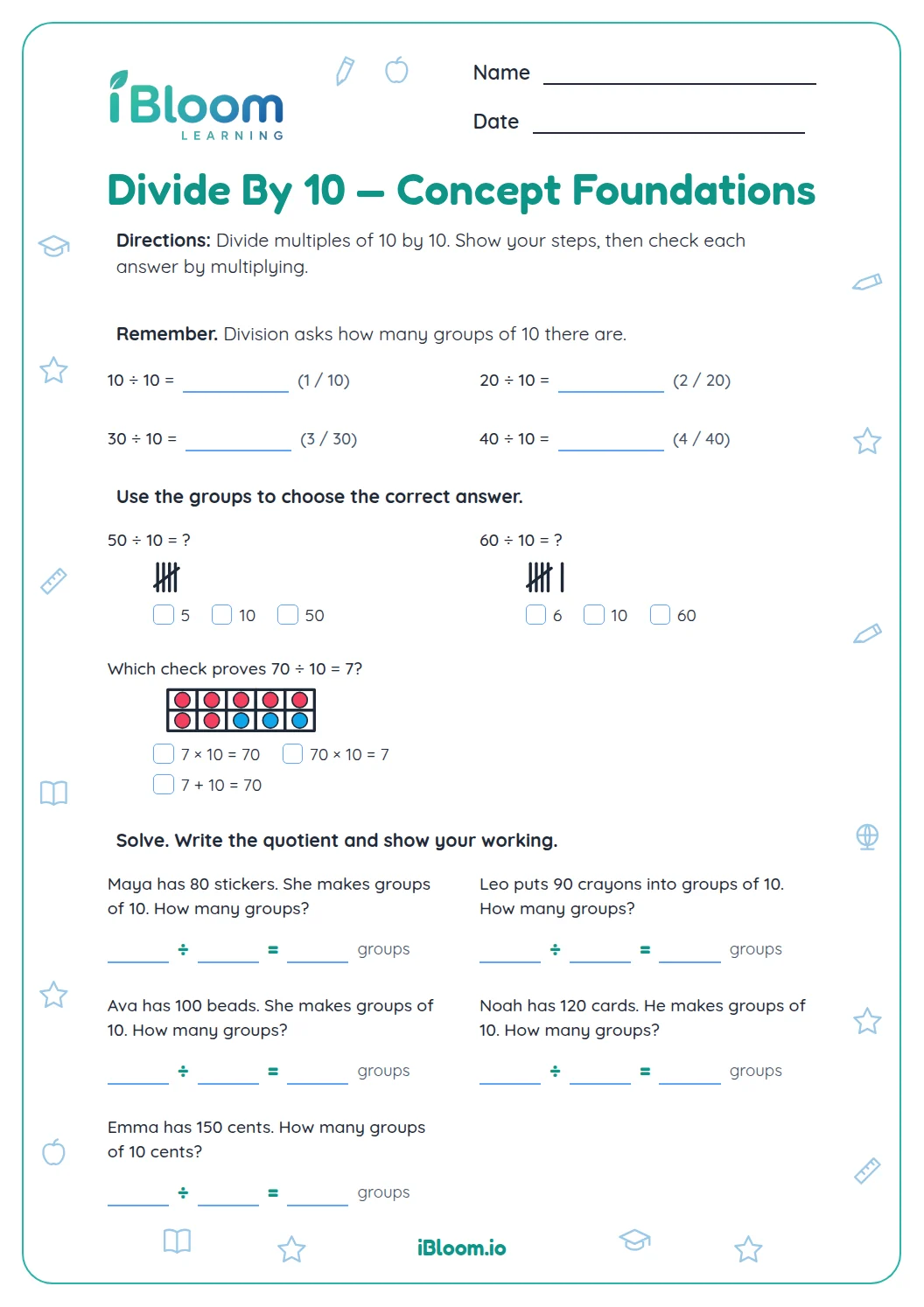
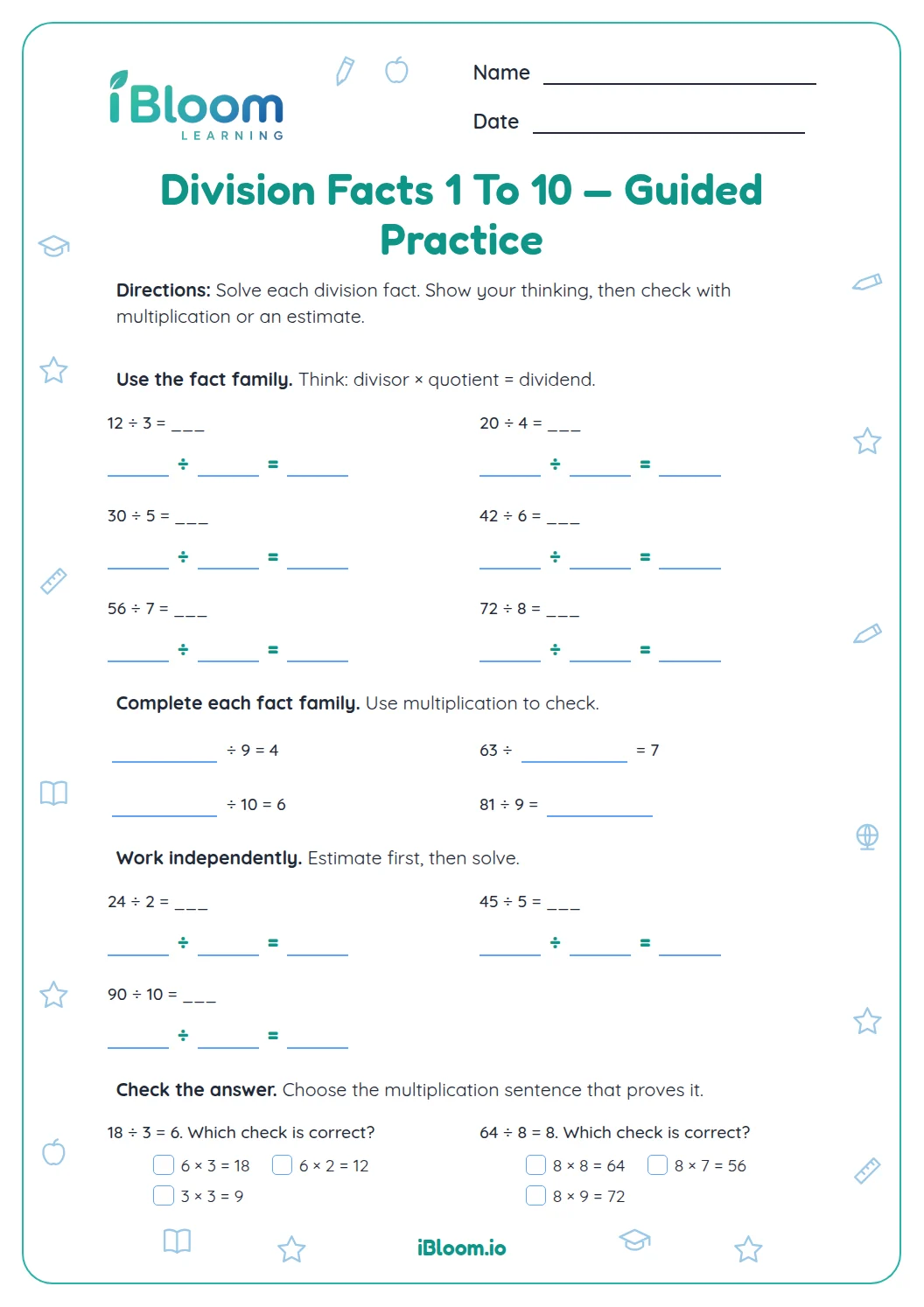
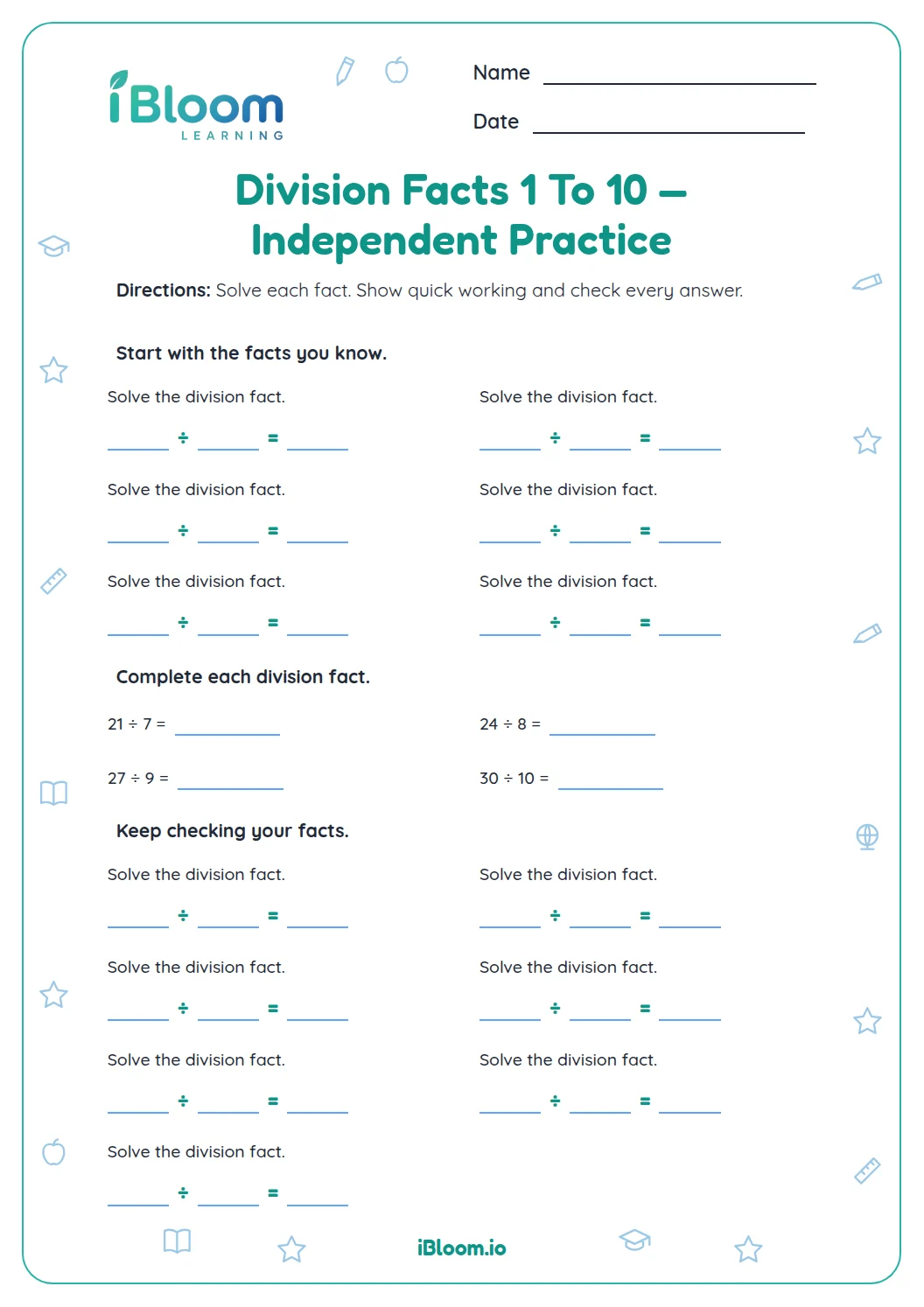
This printable practices dividing whole-number multiples of 100 by 100, the skill named in the Grade 3 worksheet title. Learners read hundred-block models, complete related multiplication and division facts, and solve equal-group stories. The separate key supports checking each quotient. The page connects division by 100 with CCSS 5.NBT.A.2.
Aligned to 5.NBT.A.2
How does a hundred-block model show division by 100?
Each large hundred block represents 100. Count the blocks to find how many groups of 100 make the total. In question 1, two hundred blocks represent 200, so 200 ÷ 100 = 2.
Multiplication checks the quotient: 2 × 100 = 200.
- 1200 ÷ 100 = ___
- 2Count two hundred blocks.
- 3Answer: 2; check 2 × 100 = 200.
How do the problems build from models to stories?
Part A uses block drawings for totals from 200 to 900. Part B connects division by 100 with related multiplication facts.
Part C puts the same equal-group idea into piles, bags, stacks, bundles, and seed trays.
How can a learner check a quotient?
Multiply the quotient by 100. If the product matches the starting total, the division fact is correct. In a story, name what the quotient counts, such as bags or trays.
How to use this worksheet
- 1Name each block as 100.
- 2Count the blocks to find the quotient.
- 3Complete missing values in Part B.
- 4For each story, identify the total and the group size.
- 5Multiply the quotient by 100 to check.
Common mistakes and quick fixes
The mistake
Treating the answer as the number of objects.
The fix
The question asks how many groups; 400 objects in groups of 100 make 4 groups.
The mistake
Dividing by 10 instead of 100.
The fix
Write 100 as the group size and check the quotient by multiplication.
The mistake
Leaving off the group meaning.
The fix
Answer with the number of bags, boxes, bundles, or stacks requested.
Curriculum alignment
This worksheet practices the following Common Core skill.
Use powers of 10 to explain patterns in place value and perform operations.
On this sheet: The sheet models dividing whole-number multiples of 100 by 100.
Show the official wordingHide the official wording
Explain patterns in the number of zeros of the product when multiplying a number by powers of 10, and explain patterns in the placement of the decimal point when a decimal is multiplied or divided by a power of 10.
What to practice next
Make more practice
Further reading
Questions parents and teachers ask
What does 700 ÷ 100 mean?
It asks how many groups of 100 make 700. Since seven hundreds equal 700, the quotient is 7. On this sheet, learners first count hundred blocks and then apply the same idea to number facts and equal-group stories. The matching equation is 7 × 100 = 700.
How do the blocks help with division?
Each large block stands for one hundred. Counting the blocks gives the number of groups of 100 in the total, so five blocks show that 500 ÷ 100 = 5. The model makes the group size visible before learners work with equations.
How can multiplication check a quotient?
Multiply the quotient by 100 and compare the product with the original total. For example, 8 × 100 = 800 checks 800 ÷ 100 = 8. Learners can use this check for the number facts and stories on the worksheet.
What does the answer count in a story problem?
The answer counts equal groups, such as piles, bags, stacks, bundles, or trays. Read the last sentence to see what group is being counted, then attach that label to the quotient when explaining the answer. For example, 800 buttons in bags of 100 makes 8 bags.
How many questions are on the printable?
There are 15 questions: five use hundred-block models, five ask for a missing value in a multiplication or division fact, and five use short grouping stories. The printable has three worksheet pages and a separate three-page answer key. The worksheet uses models, number sentences, and short stories to revisit the same group size.
Which standard is listed for this skill?
The page lists CCSS 5.NBT.A.2, which includes explaining patterns when multiplying or dividing by powers of 10. The worksheet focuses on whole-number multiples of 100 divided by 100, using models, facts, and equal-group contexts. Learners see this pattern in the models and stories.