



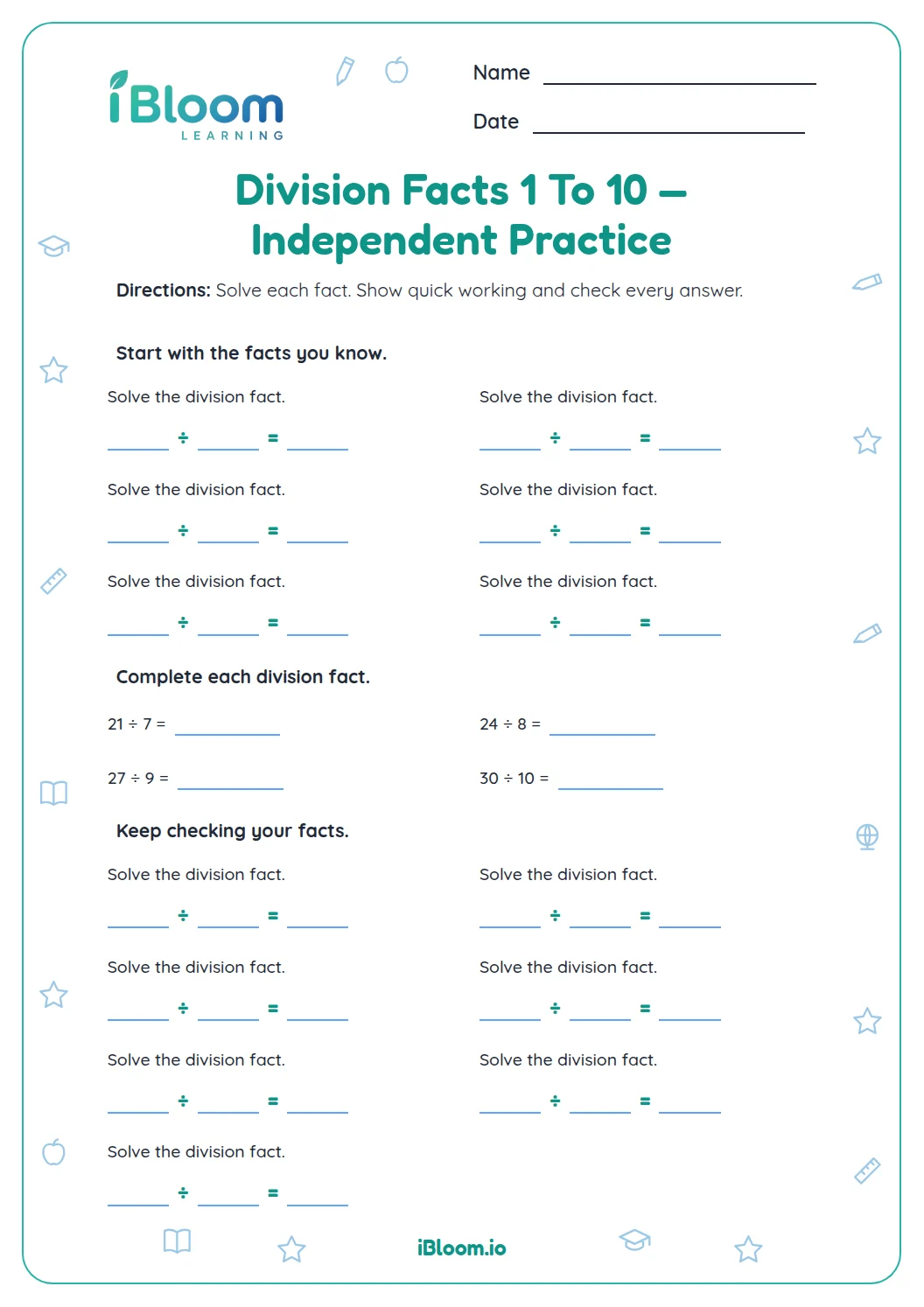
About this worksheet
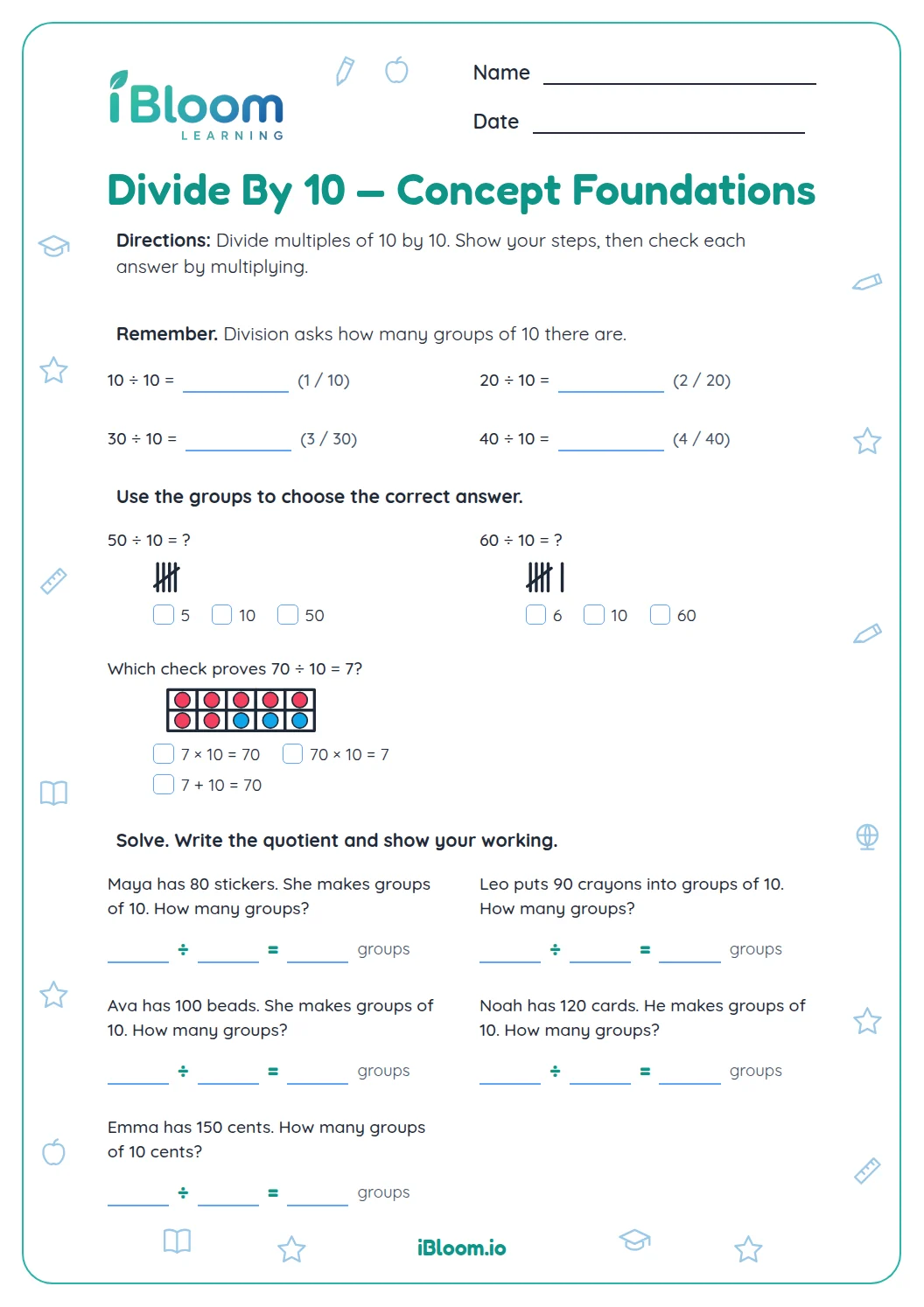
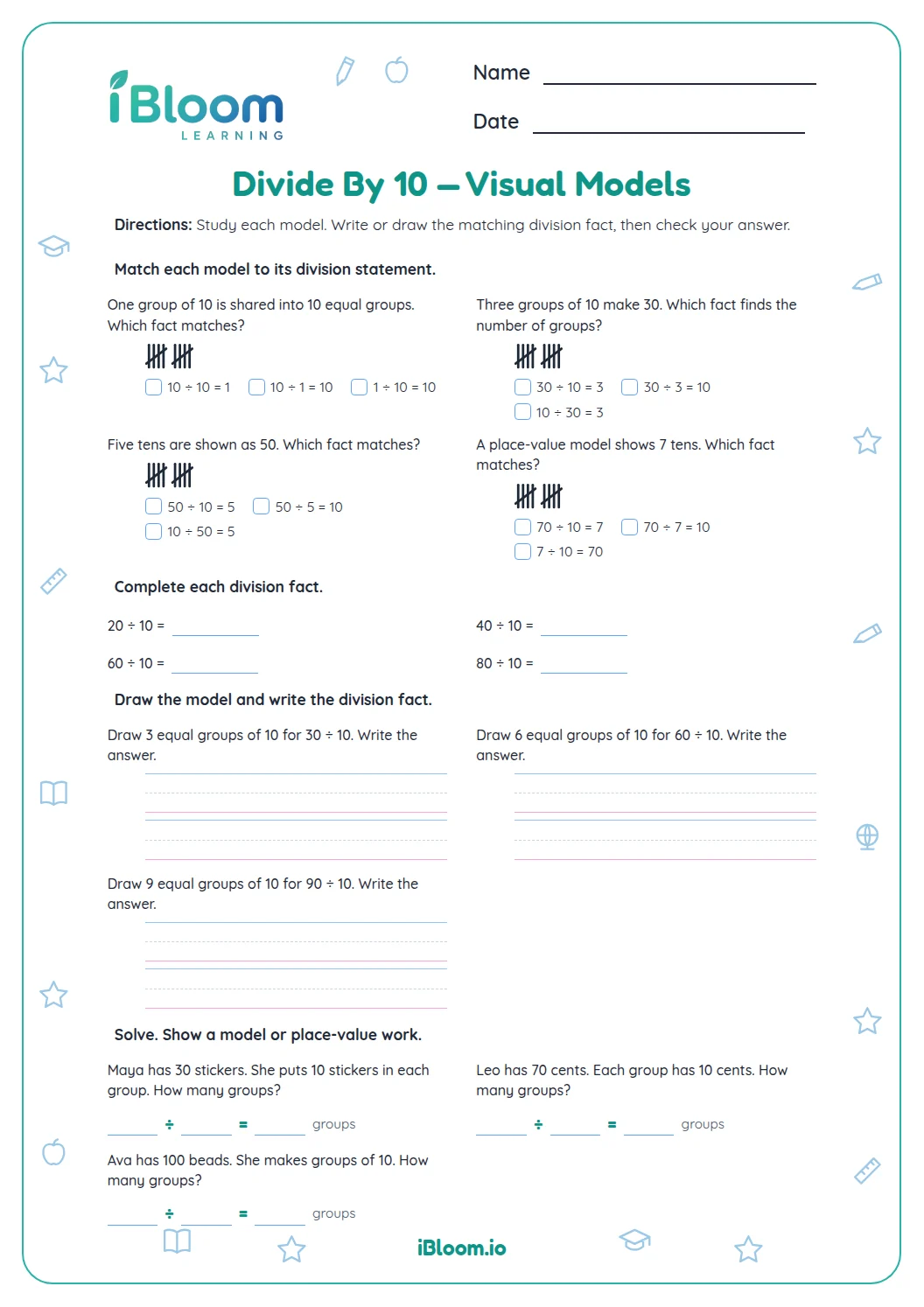
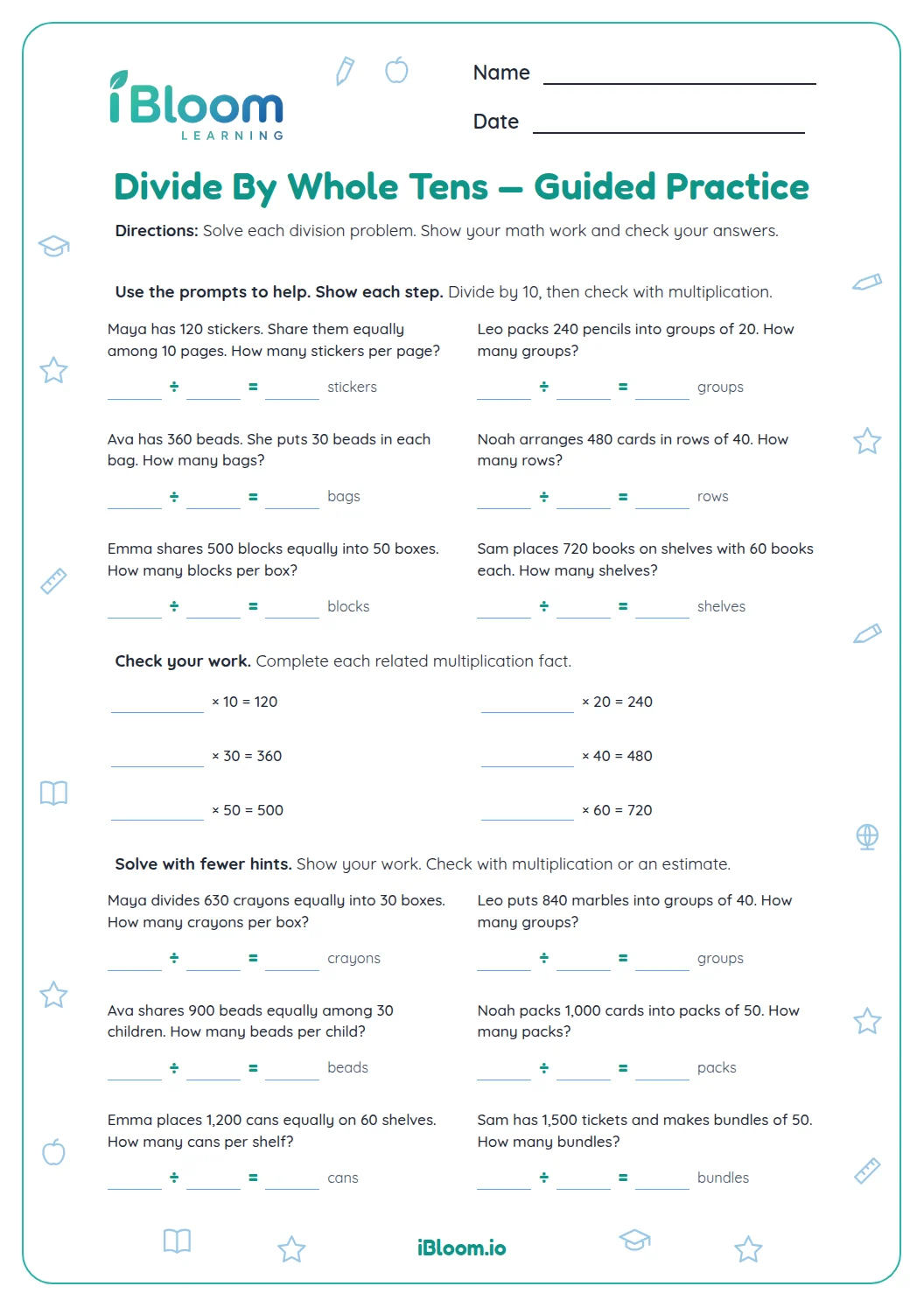
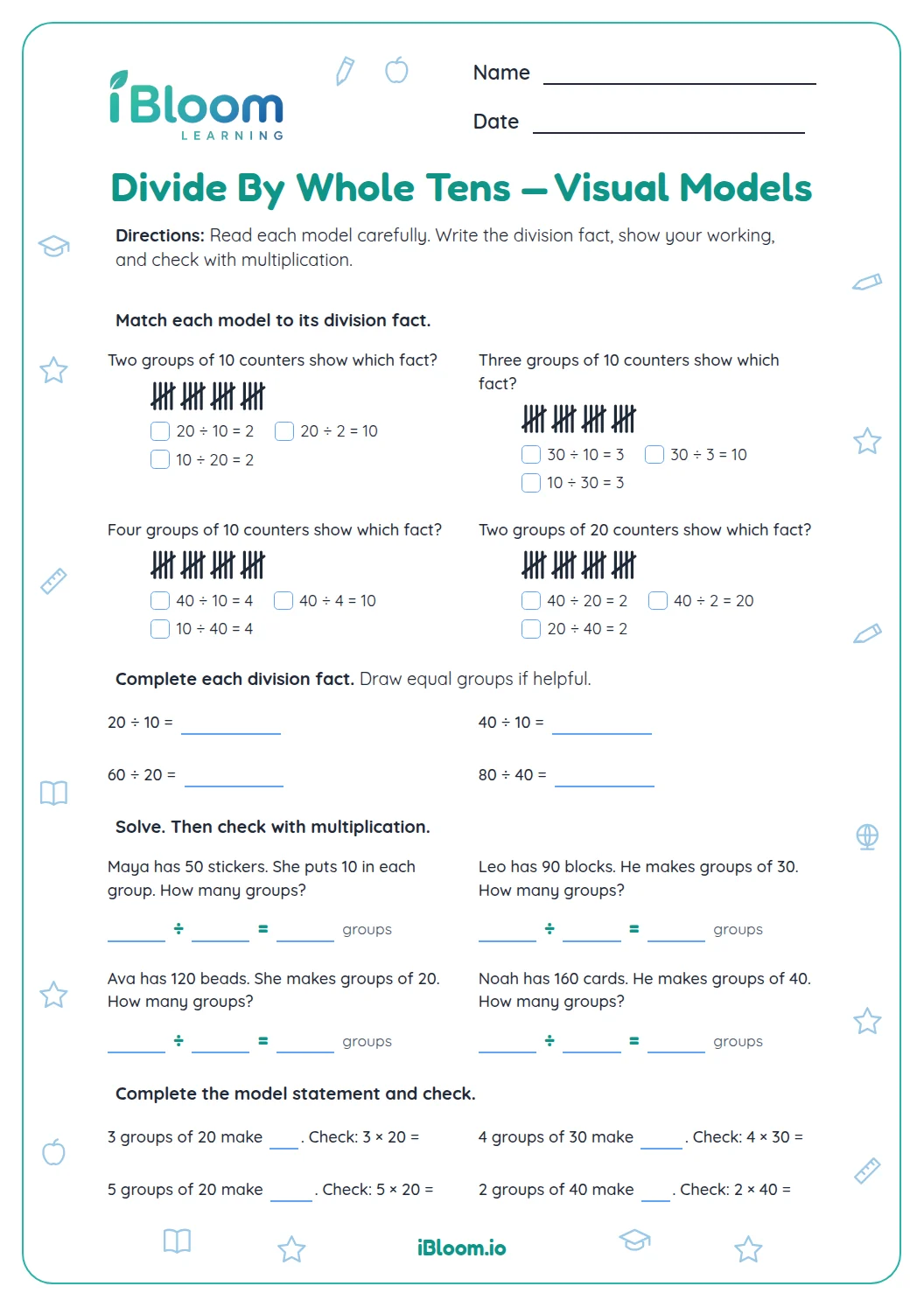
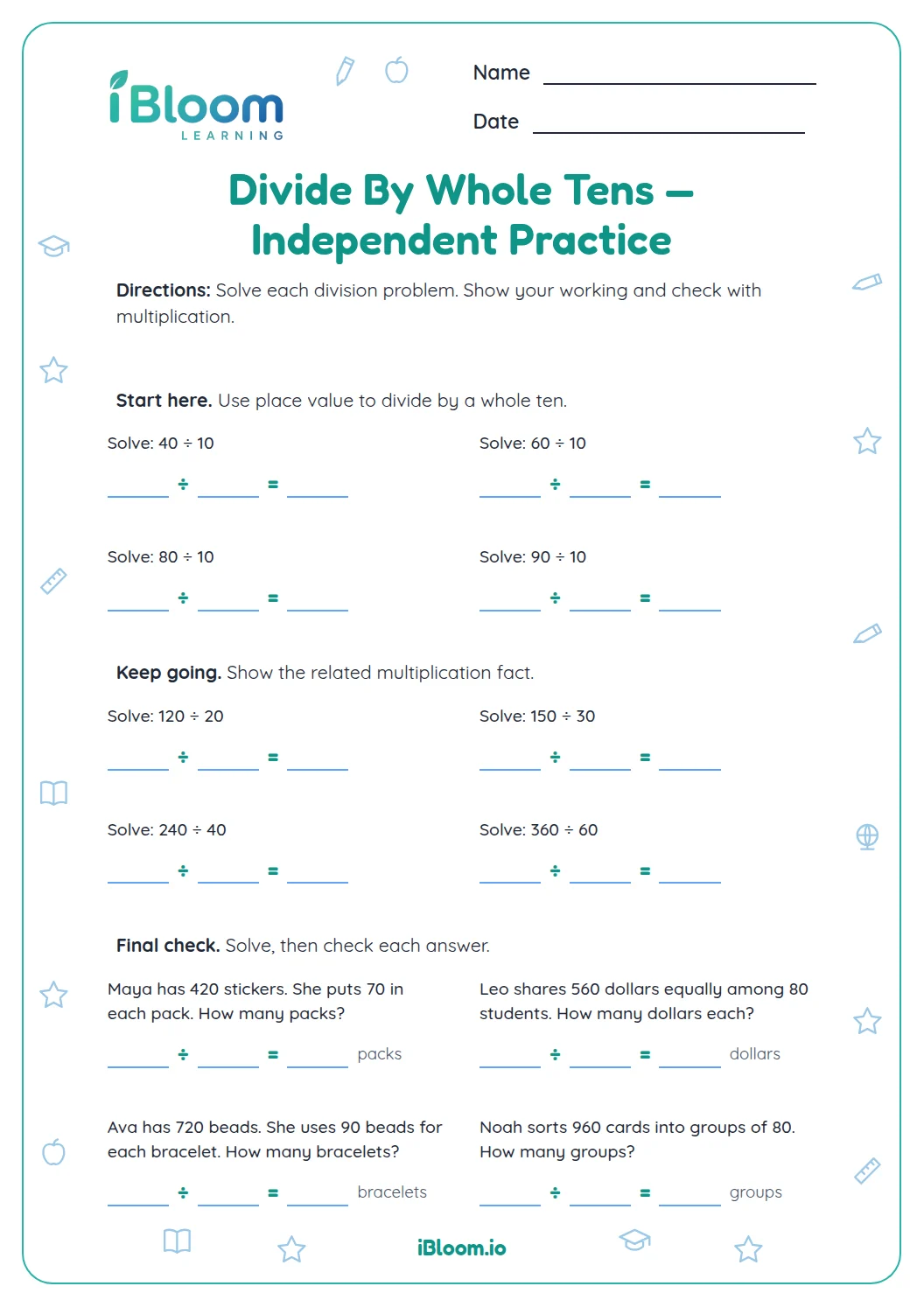
This Grade 3 worksheet builds independent practice dividing by 10. Learners solve six direct facts, use division in four equal-group stories, and find missing factors in six related multiplication facts. Every product and quotient is within 100, and the answer key gives each response with its unit when needed. It practices CCSS 3.OA.A.3 and 3.OA.C.7.
Aligned to 3.OA.A.3 and 3.OA.C.7
What patterns help with dividing by 10?
A quotient tells how many groups of ten fit in the total. Multiplication facts make the pattern easy to check: 8 groups of 10 make 80, so 80 ÷ 10 = 8.
- 150 cards shared among 10 friends
- 250 ÷ 10 = 5
- 3Check: 5 × 10 = 50
- 4Each friend gets 5 cards.
How do story problems use the fact?
Name what the quotient counts. It might be the number in each group, the number of groups, or a measurement in each equal piece.
What questions are included?
Six facts lead into stories and related multiplication problems. All 16 items focus on dividing by ten or interpreting groups of ten.
How to use this worksheet
- 1Read the total and identify the ten equal groups.
- 2Write the division sentence with the total first.
- 3Find the number that multiplied by 10 gives the total.
- 4Check the quotient with multiplication.
- 5Include the unit when the story asks for one.
Common mistakes and quick fixes
The mistake
Writing 10 as the quotient every time.
The fix
Ask how many groups of ten make the total, then check by multiplying your quotient by 10.
The mistake
Confusing ten groups with ten objects in each group.
The fix
Underline whether the story gives the number of groups or the amount in each group before choosing the quotient.
The mistake
Treating a missing factor as the product.
The fix
In ___ × 10 = 80, find the number that makes 80 when multiplied by ten: 8.
Common Core alignment
This worksheet gives focused practice with the listed grade-level skill.
Represent equal-group and measurement stories with division equations.
On this sheet: The story questions represent equal-group situations with division equations.
Show the official wordingHide the official wording
Use multiplication and division within 100 to solve word problems in situations involving equal groups, arrays, and measurement quantities, e.g., by using drawings and equations with a symbol for the unknown number to represent the problem.
Use related multiplication facts to find and check division by ten.
On this sheet: The facts and related multiplication questions all use products and quotients within 100.
Show the official wordingHide the official wording
Fluently multiply and divide within 100, using strategies such as the relationship between multiplication and division (e.g., knowing that 8 × 5 = 40, one knows 40 ÷ 5 = 8) or properties of operations. By the end of Grade 3, know from memory all products of two one-digit numbers.
What to practice next
Make more practice
Further reading
Questions parents and teachers ask
What does divide by 10 mean on this sheet?
The division questions ask how many groups of ten fit in a total or how many objects are in each of ten equal groups. For example, 70 ÷ 10 = 7 because seven groups of ten make 70. Later items use multiplication to show the same relationship.
How can multiplication help check division?
Use the related fact: quotient times 10 should equal the starting total. If 90 ÷ 10 is 9, then 9 × 10 = 90. The final part asks learners to find missing factors, giving them direct practice with this multiplication and division connection.
What kinds of questions are included?
There are six direct division facts, four equal-group stories, and six missing-factor multiplication facts. The story contexts include counters, cards, a book, and marbles. Every product and quotient stays within 100, and the story answers name what is being counted.
Does the worksheet include an answer key?
Yes. A separate key lists the answer for all 16 items and includes units for the story problems, such as pages or marbles. Learners can use the multiplication relationship to check a quotient or explain how they found a missing factor.
How much time should I allow?
About 20 minutes is a useful estimate for the 16 questions. Direct facts are brief, while stories take time to interpret and write as equations. Encourage the learner to identify the total and the ten equal groups before calculating. This gives one more specific example.