

About this worksheet
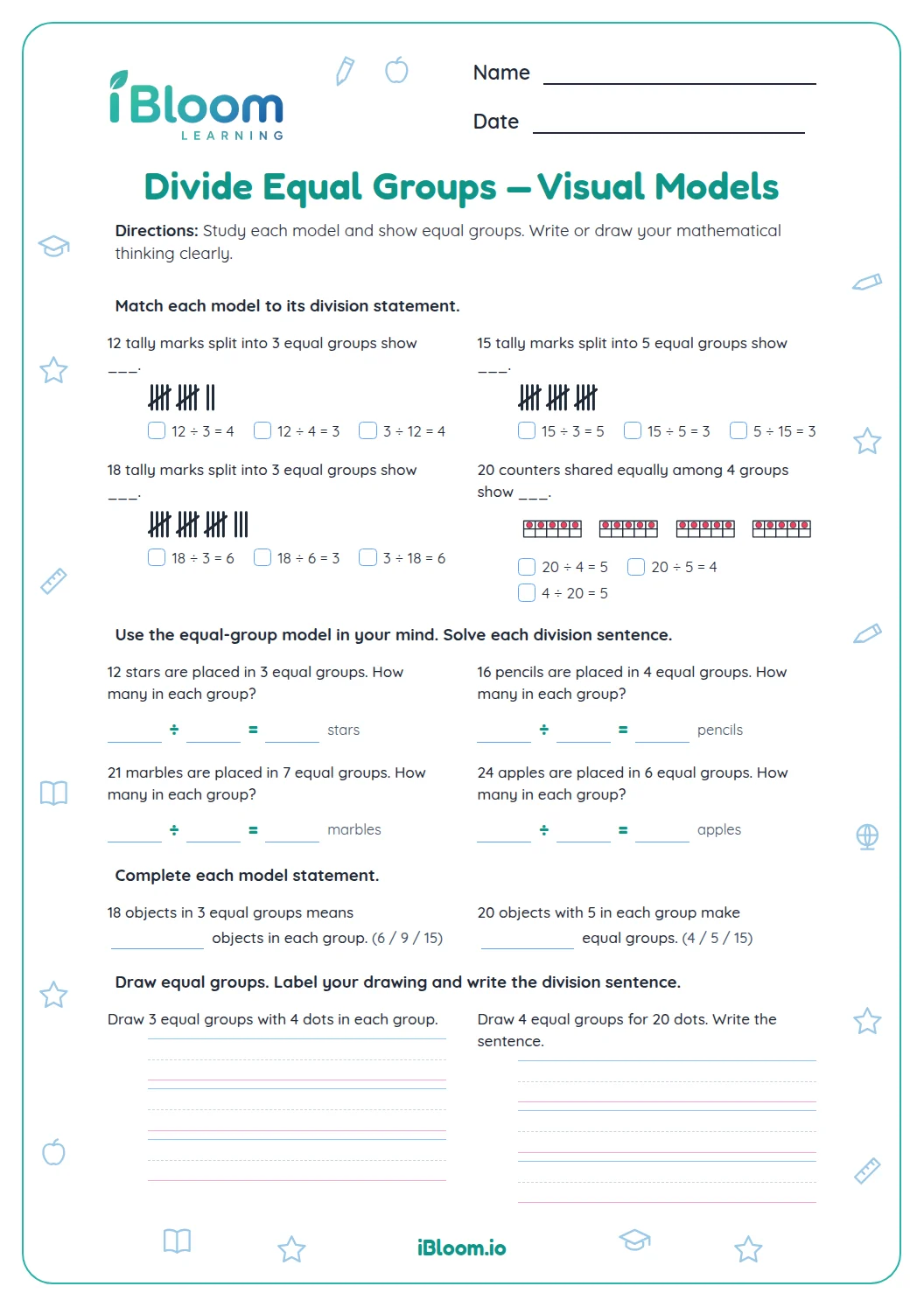
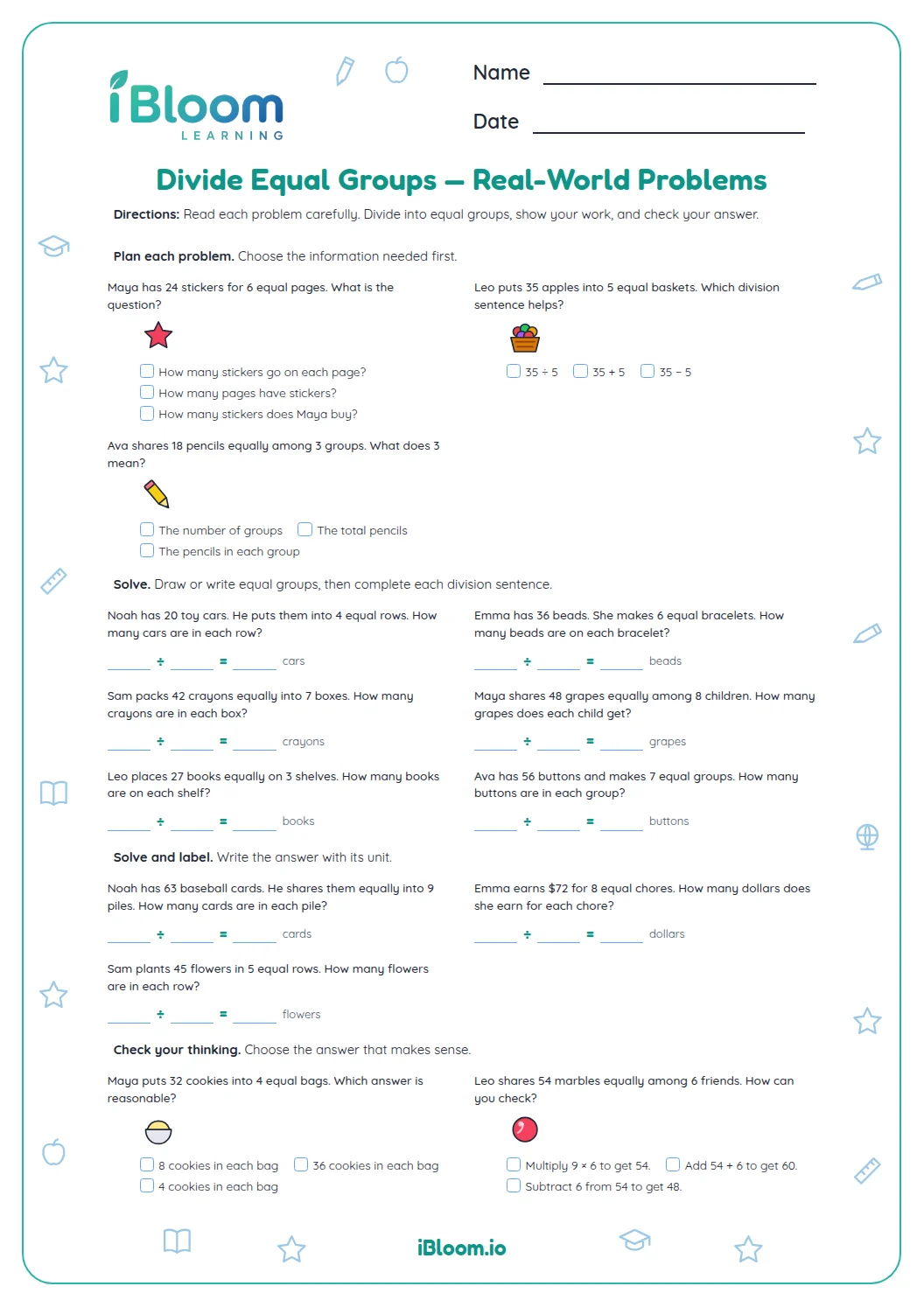
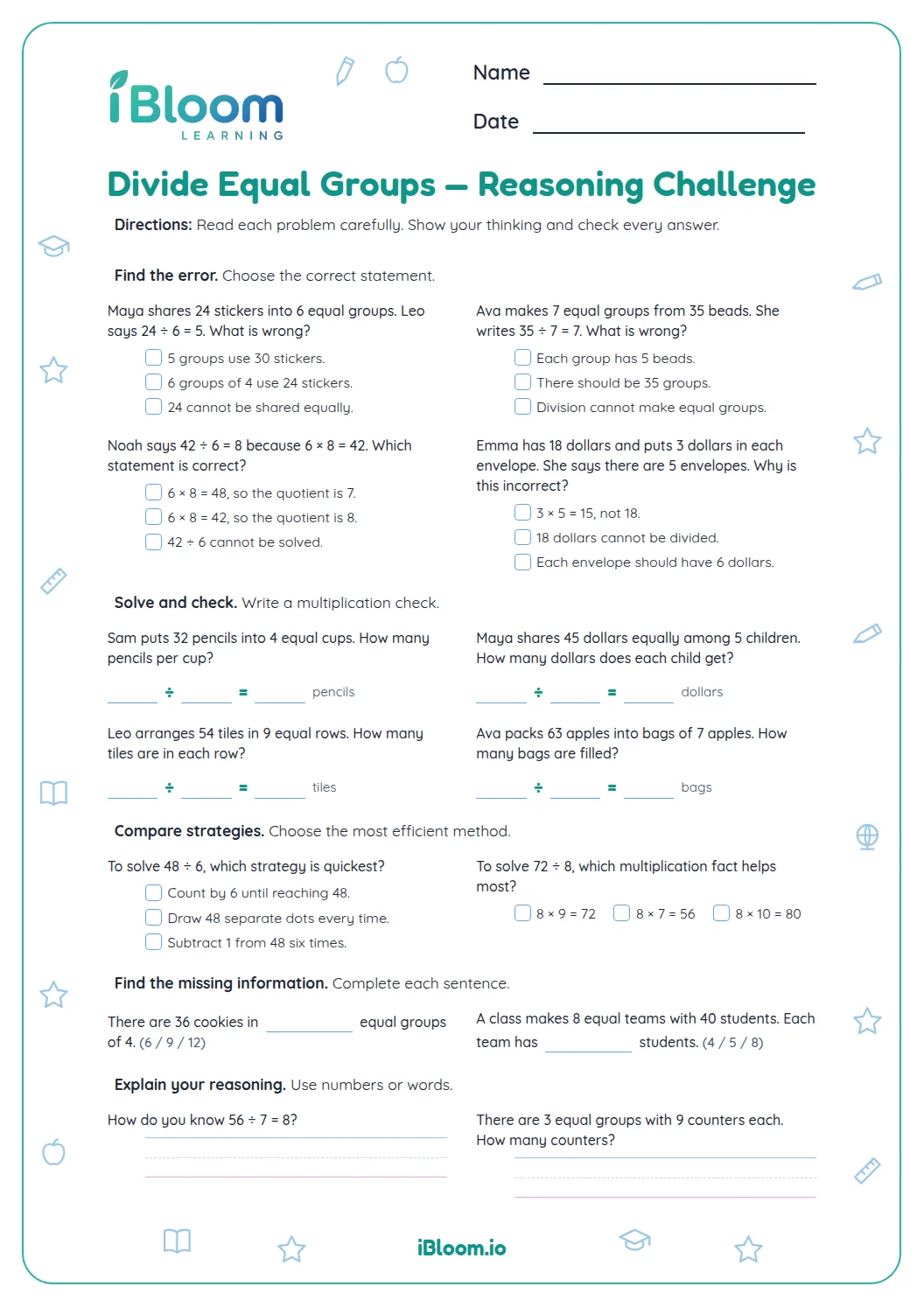
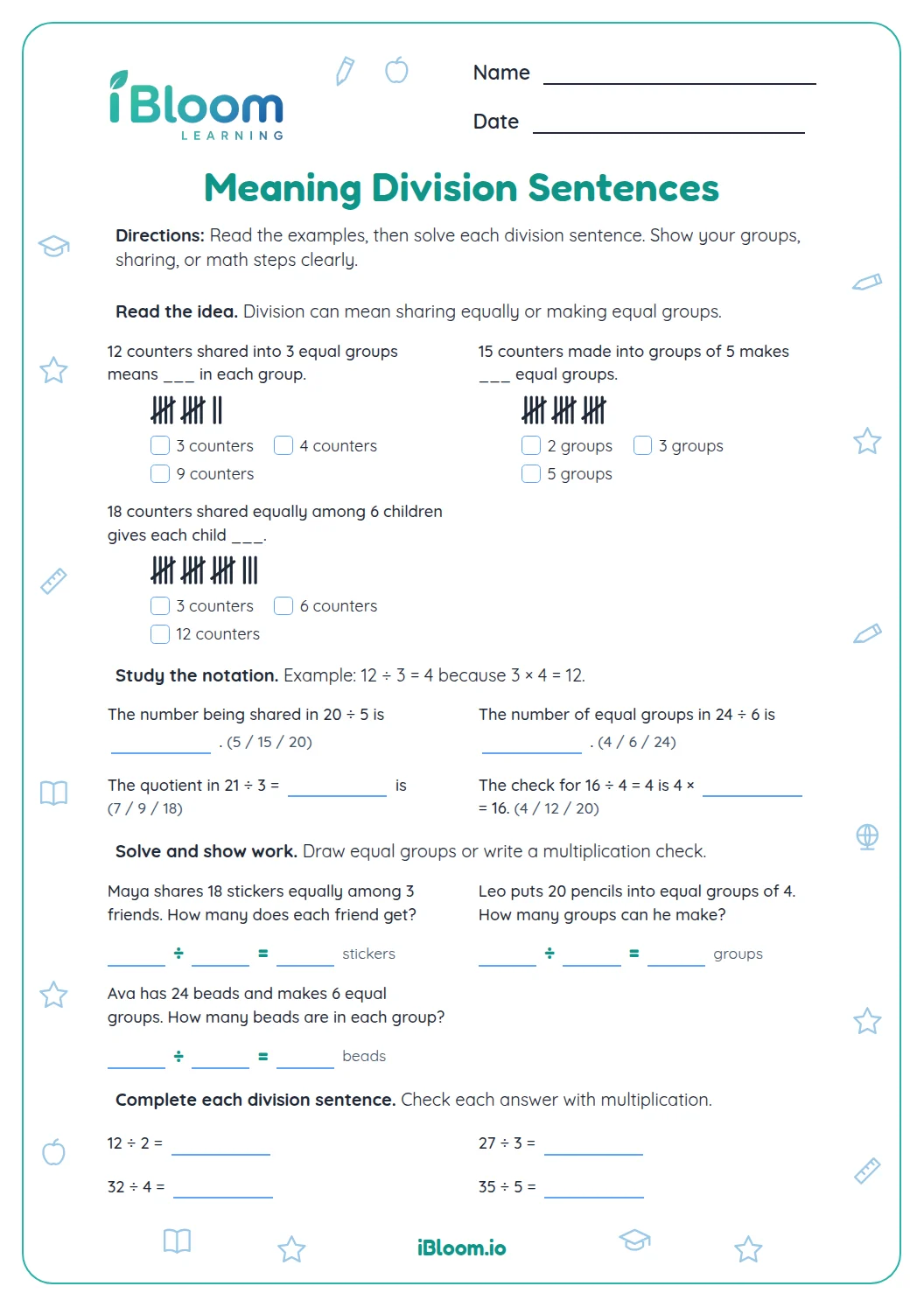
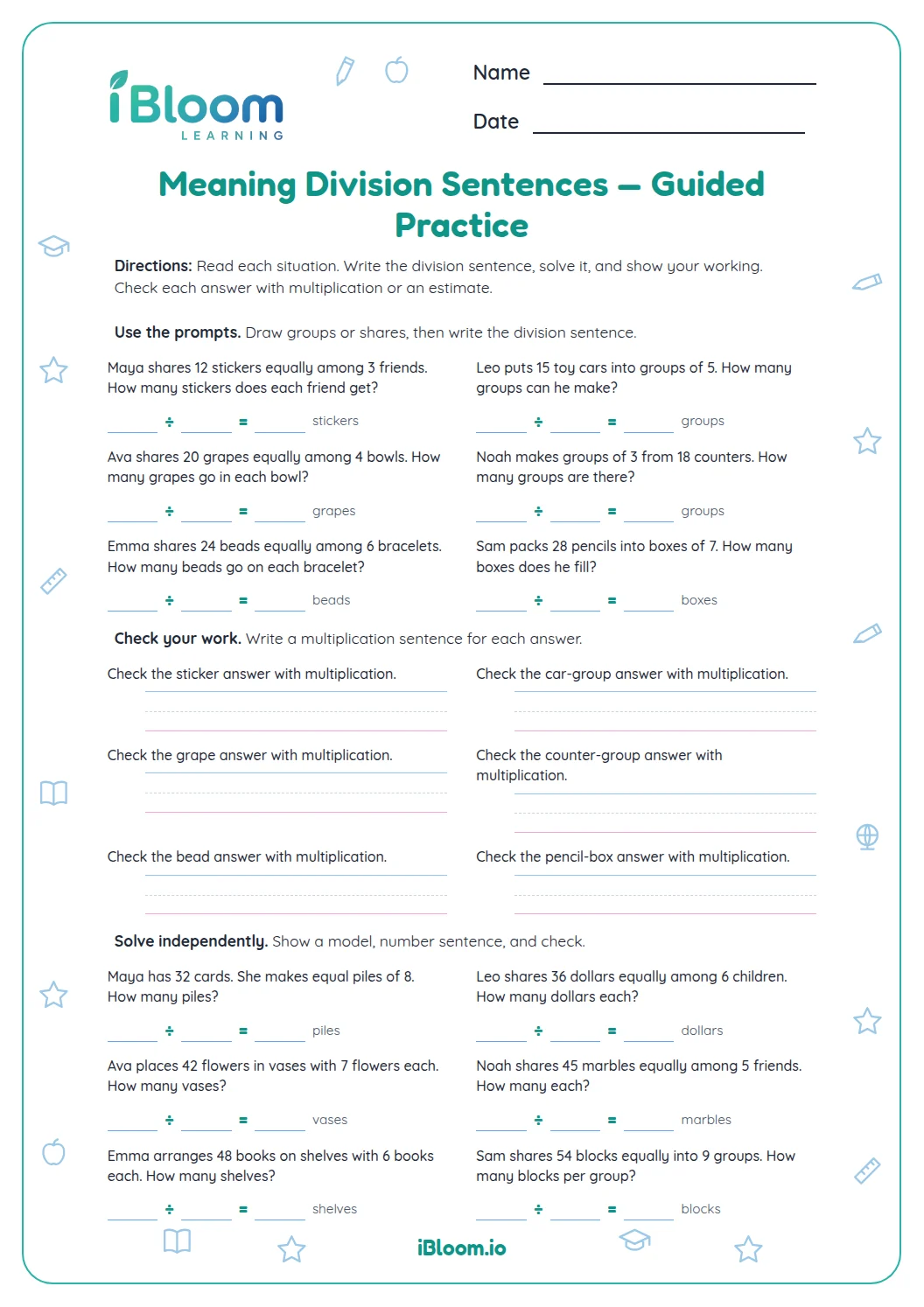
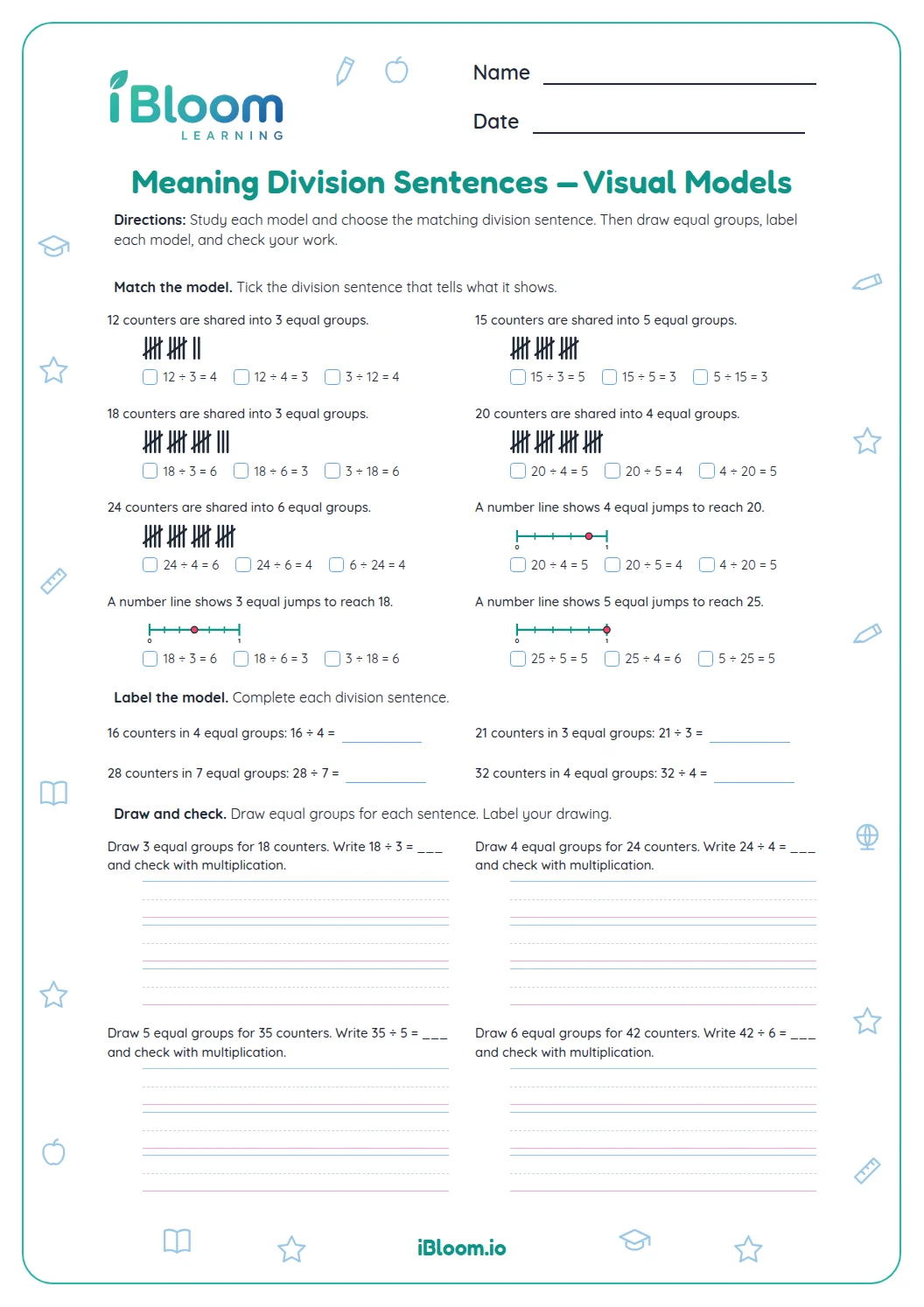
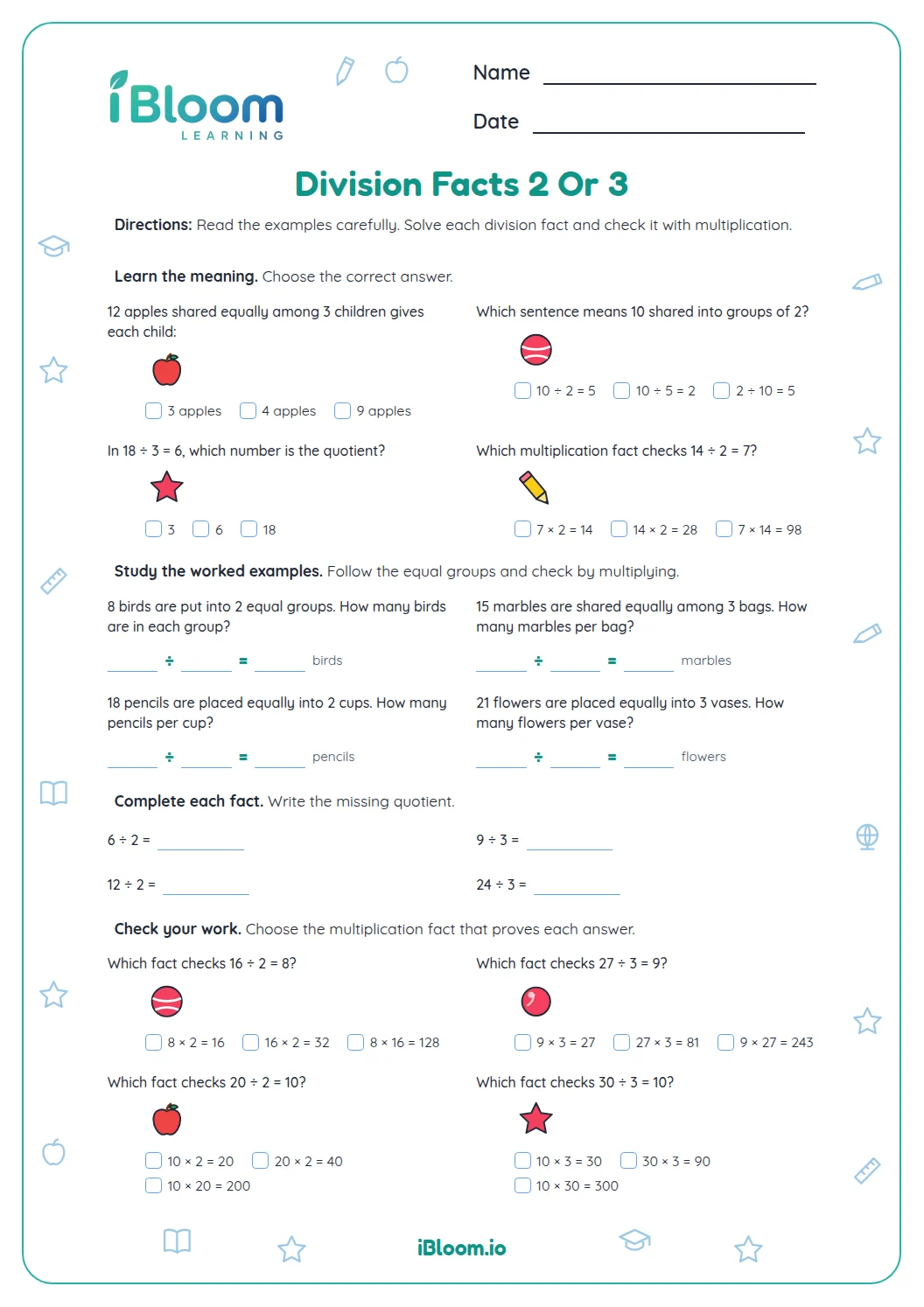
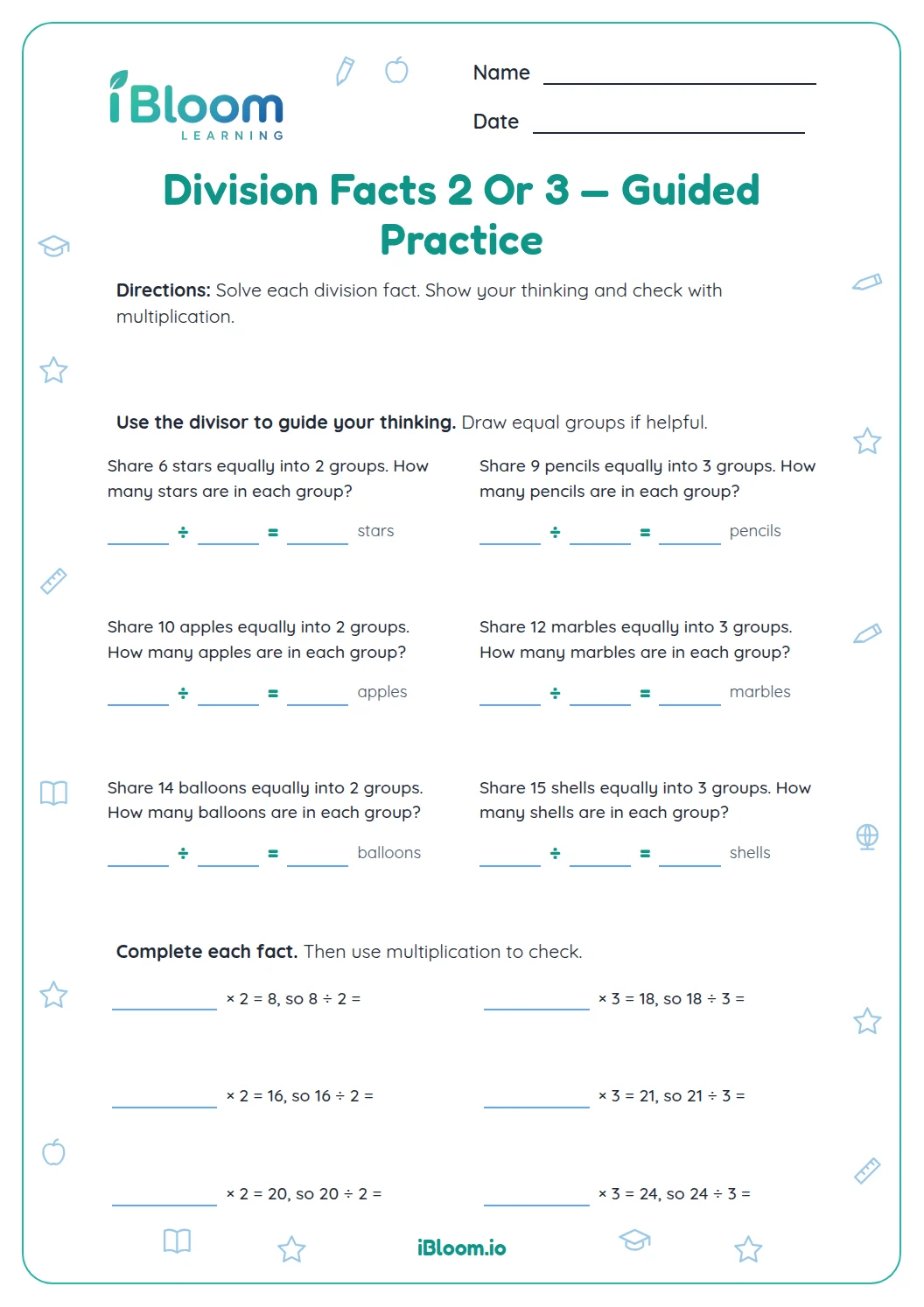
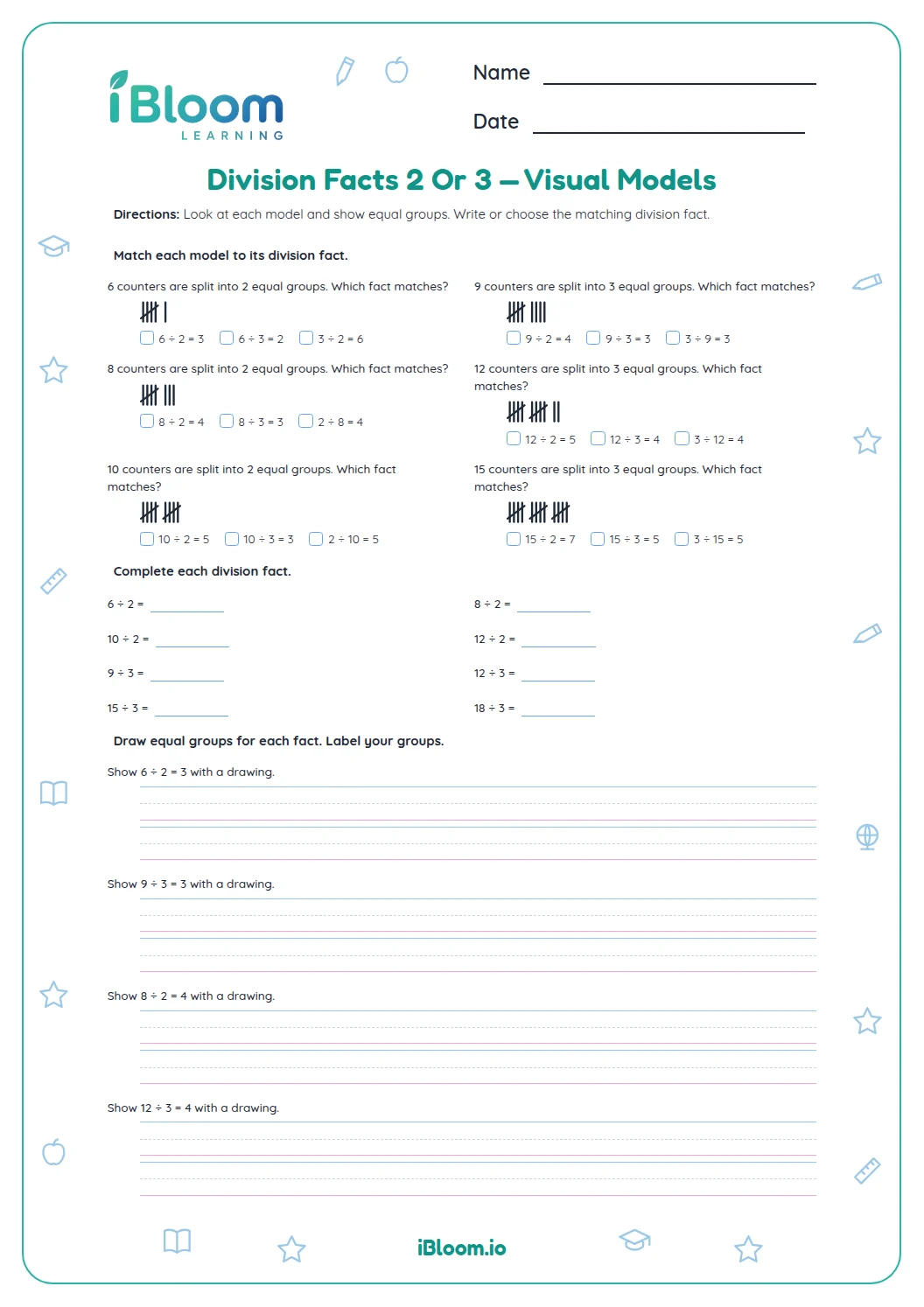
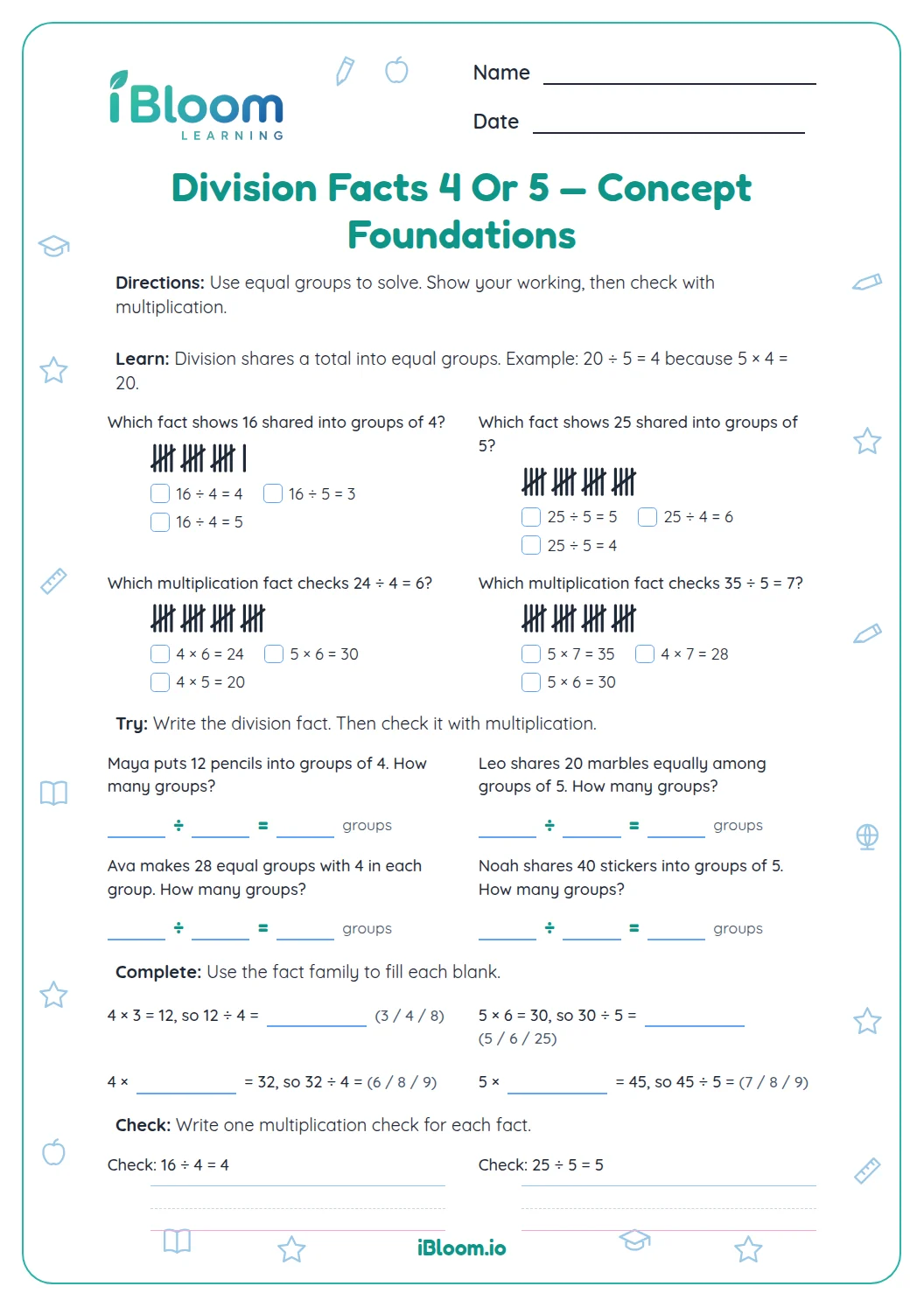
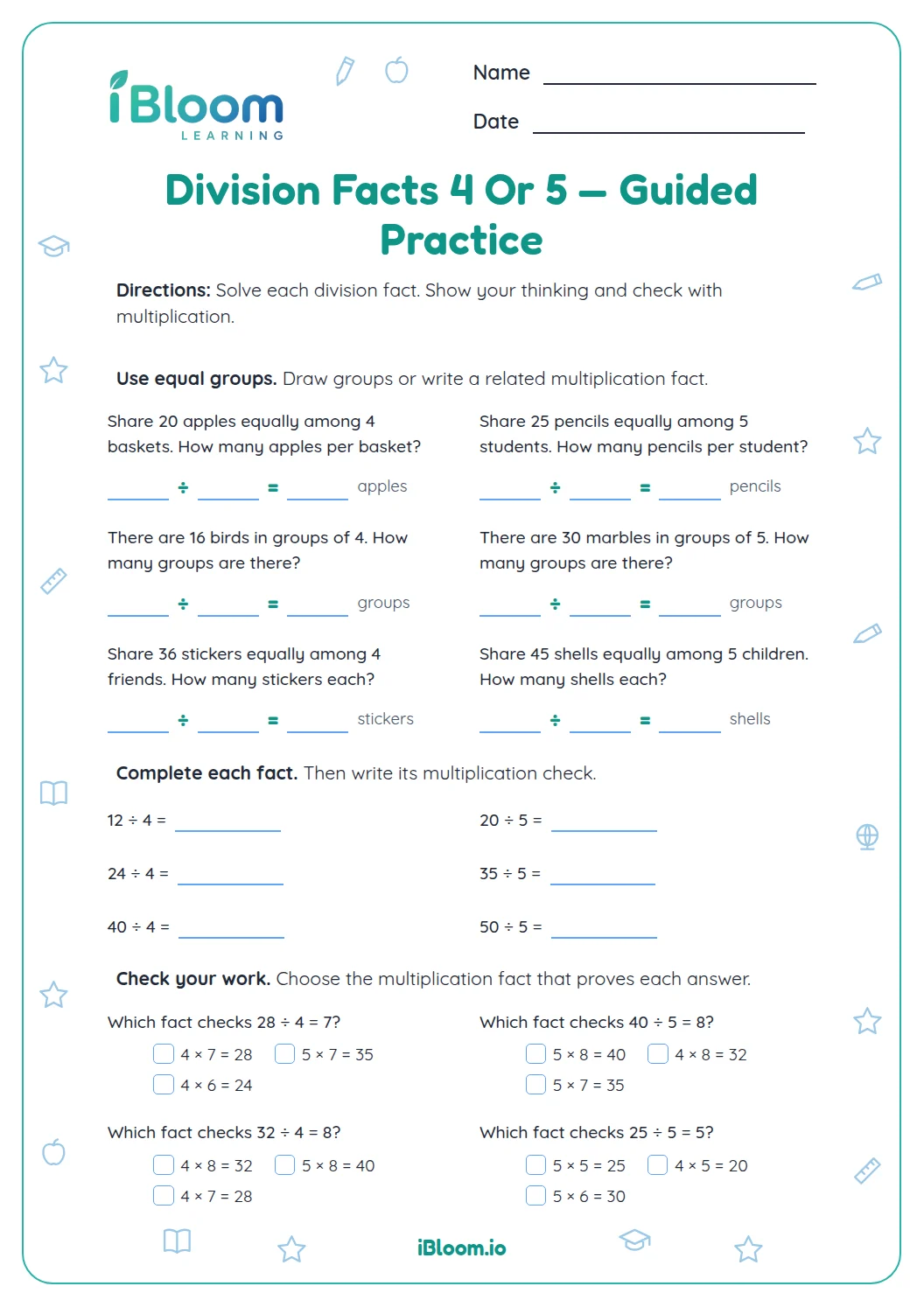
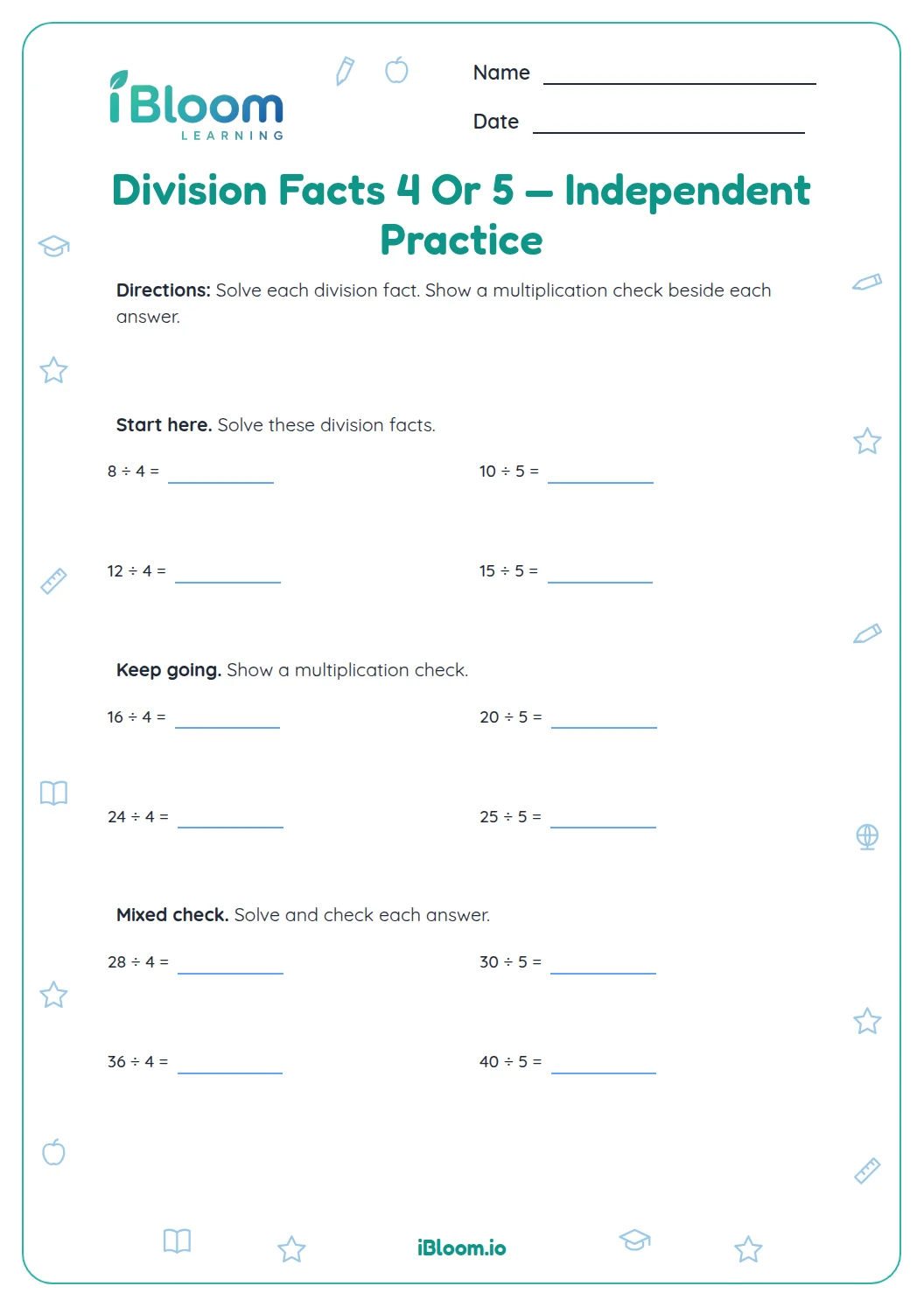
This free printable Grade 3 division worksheet develops the meaning of equal groups through fourteen questions. Children begin with three dot arrays, treating each row as one group. They complete three short division sentences, explain what four quotients count, and solve four sharing or grouping stories. Some questions give the number of groups and ask how many belong in each; others give the group size and ask how many groups can be made. The practice supports Common Core 3.OA.A.2 and 3.OA.A.3. A separate answer key supplies the quotients with labels that distinguish objects per group from numbers of groups.
Aligned to 3.OA.A.2 and 3.OA.A.3
What makes the groups equal?
Equal groups have the same number of objects in each group. In Part A, every horizontal row is one group. Count the rows to find the number of groups and count across one row to find the group size.
The first array contains 12 dots arranged in 3 rows of 4. The total is 12, the group count is 3, and the size of each group is 4. Two more arrays let children apply the same way of reading rows and groups.
- 1Total: 12 dots
- 2Number of groups: 3 rows
- 3Dots in each group: 4
- 412 ÷ 3 = 4 dots per row
- 5Check: 3 × 4 = 12 dots
Why can a division answer name objects or groups?
If 12 counters are shared among 3 children, 12 ÷ 3 tells how many counters each child gets. If 12 counters are placed 3 in each cup, the same equation tells how many cups are needed. The numbers match, but the meaning of the answer changes.
Part B asks children to label what each quotient counts, such as “4 counters each” or “4 cups.” Part A connects division sentences to the group size or number of groups. Part C applies these ideas in longer stories with room to write equations.
How can children solve the four stories?
Part C gives a working grid for the crayon story. Part D has three more stories with a line for the division sentence and labeled result. The contexts are teams, jars, and stickers; each total makes equal groups with no leftovers.
Ask whether the story gives the number of groups or the number in each group. Then use multiplication to check that the group count times the group size recreates the starting total.
How to use this worksheet
- 1Use 12 counters to make 3 equal rows and name the total, rows, and counters per row.
- 2Complete Part A arrays and short division sentences, treating each row as one group.
- 3In Part B, say what the quotient counts and include the correct label.
- 4For each Part C and Part D story, write a division sentence and label the result.
- 5Check each result by multiplying the number of groups by the size of each group.
Mistakes to check together
The mistake
Answering 3 for 12 dots divided among 3 rows.
The fix
The 3 already tells the number of rows. Count 4 dots across one row to find the missing group size.
The mistake
Calling 4 the number of counters per cup when 3 per cup is given.
The fix
The group size is already 3. In 12 ÷ 3 = 4, the missing amount is 4 cups.
The mistake
Making groups of different sizes to use up the objects.
The fix
Move objects until every group has the same size, then check the total again.
Common Core alignment
Interpret a quotient as the size of each group or the number of equal groups.
On this sheet: Arrays and meaning choices distinguish the two interpretations of a quotient.
Show the official wordingHide the official wording
Interpret whole-number quotients of whole numbers, e.g., interpret 56 ÷ 8 as the number of objects in each share when 56 objects are partitioned equally into 8 shares, or as a number of shares when 56 objects are partitioned into equal shares of 8 objects each. For example, describe a context in which a number of shares or a number of groups can be expressed as 56 ÷ 8.
Solve equal-sharing and grouping stories using division equations.
On this sheet: Part C has four equal-group word problems with totals within 100.
Show the official wordingHide the official wording
Use multiplication and division within 100 to solve word problems in situations involving equal groups, arrays, and measurement quantities, e.g., by using drawings and equations with a symbol for the unknown number to represent the problem.
What to practice next
Make more practice
Further reading
Questions parents and teachers ask
Do the dot rows count as equal groups?
Yes, each horizontal row is one equal group in Part A. Every row in an array has the same number of dots. Children count rows when they need the number of groups and count across one row when they need the size of a group.
Why do two stories both use 12 divided by 3?
The two stories show that the same equation can answer different questions. Sharing 12 counters among 3 children gives 4 counters each. Putting 12 counters into cups with 3 in each gives 4 cups. The quotient is 4 in both cases, but its label changes.
Should my child already know multiplication facts?
Known multiplication facts can help, but children can begin by counting the dot rows or using counters. For 12 divided by 3, they can build three equal groups and count four in each. Then connect the model to 3 times 4 equals 12 as a check.
Are any objects left over in these problems?
No, each problem uses a total that divides into equal groups exactly. For example, 18 beads placed 3 in each jar fill 6 jars. After solving, multiply the number of groups by the number in each group to confirm that every object has been included.
What should appear in the working space?
Write a division sentence and label what the quotient counts. For the crayon story, use the working grid to show 20 ÷ 4 = 5, then write “5 crayons each” in the answer box. The other stories have a line where the equation and label can fit together.