



About this worksheet
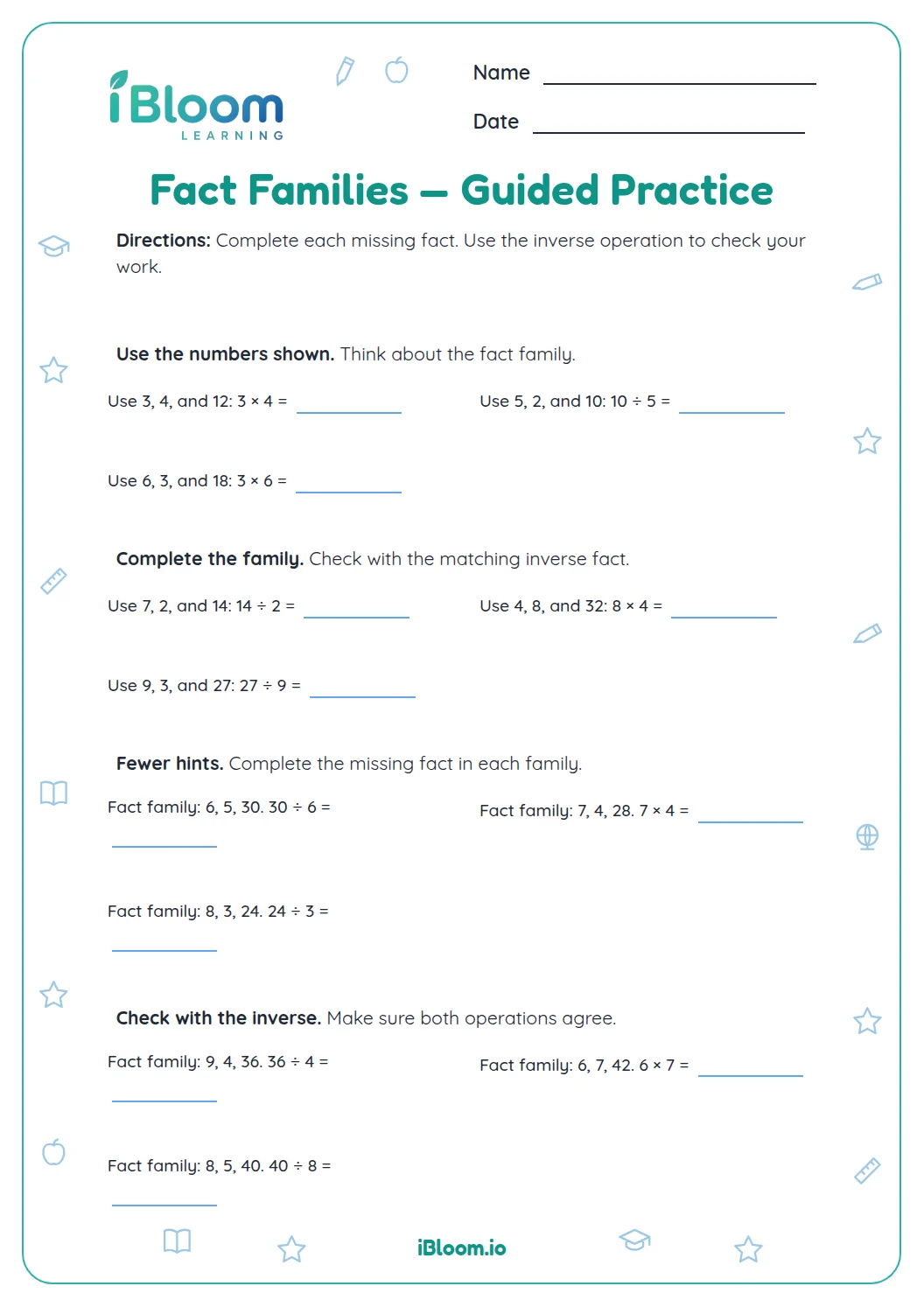
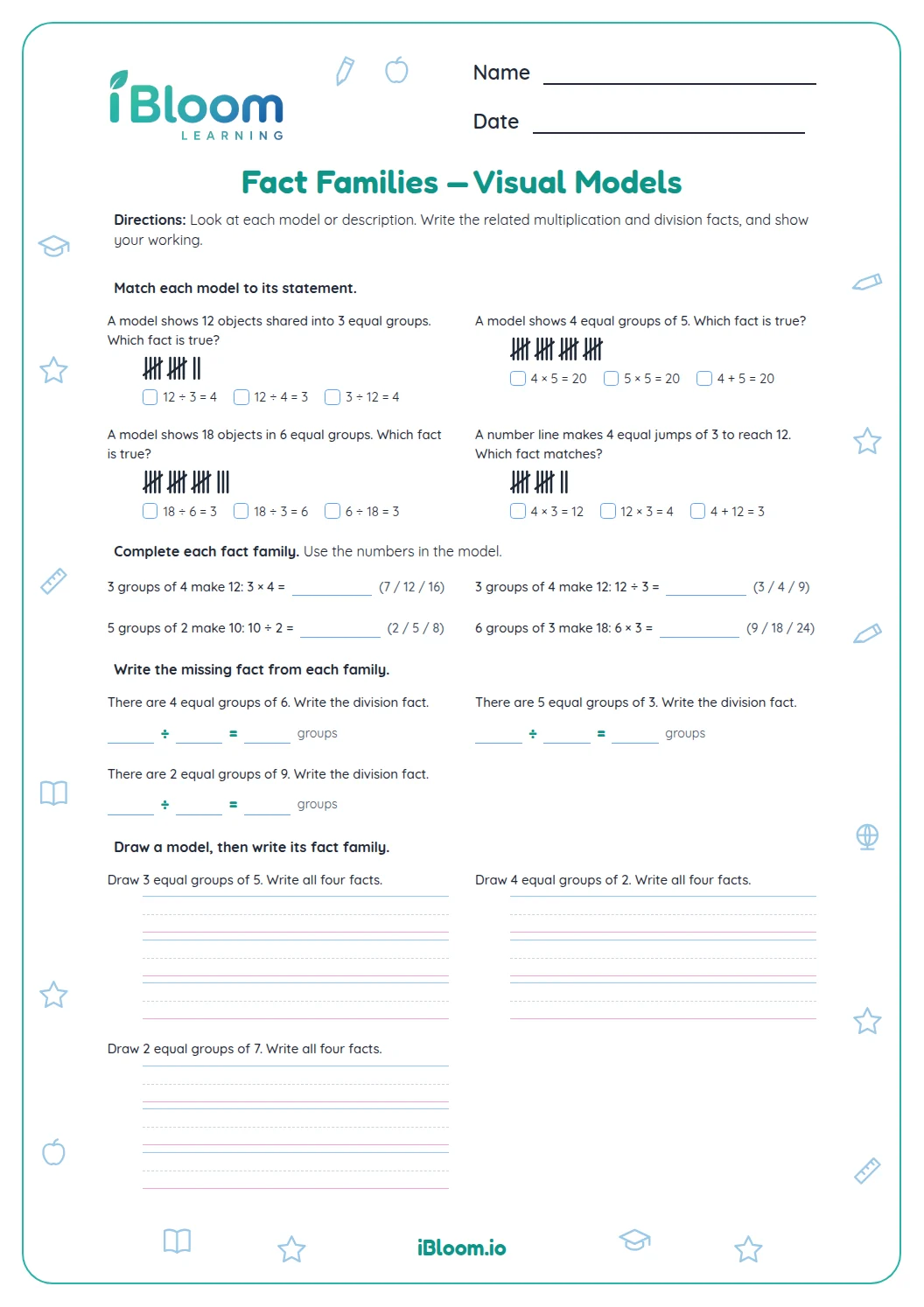
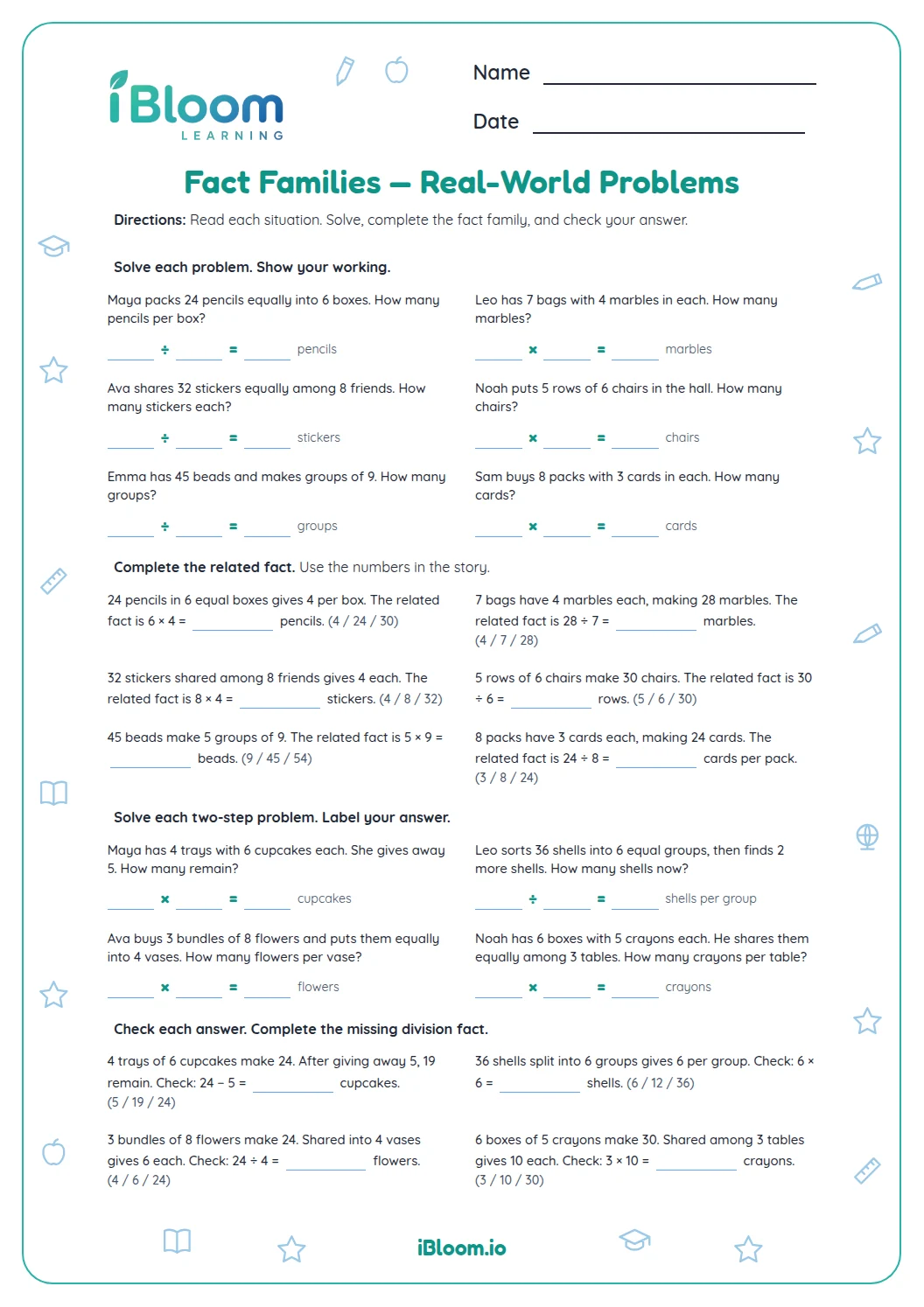
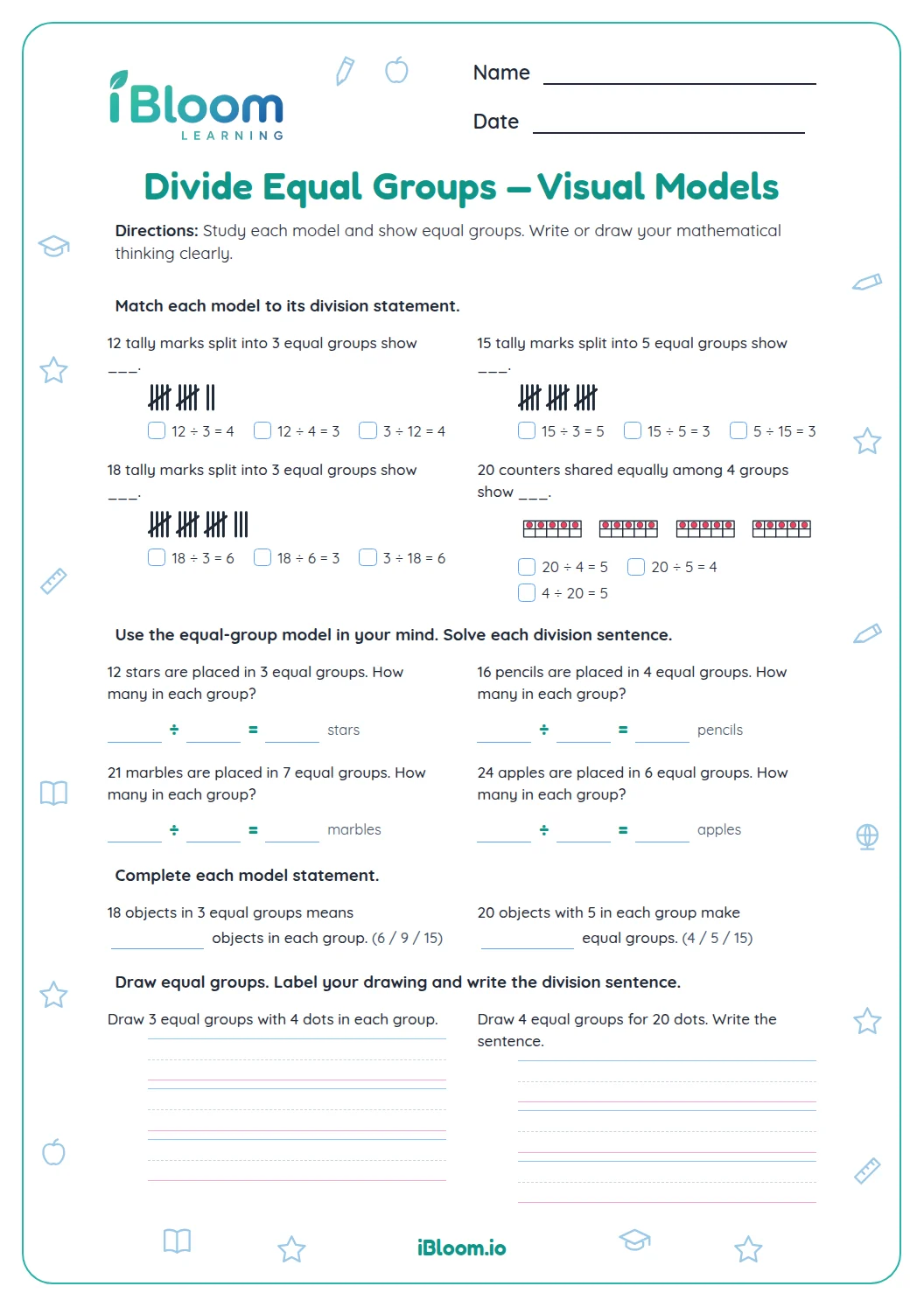
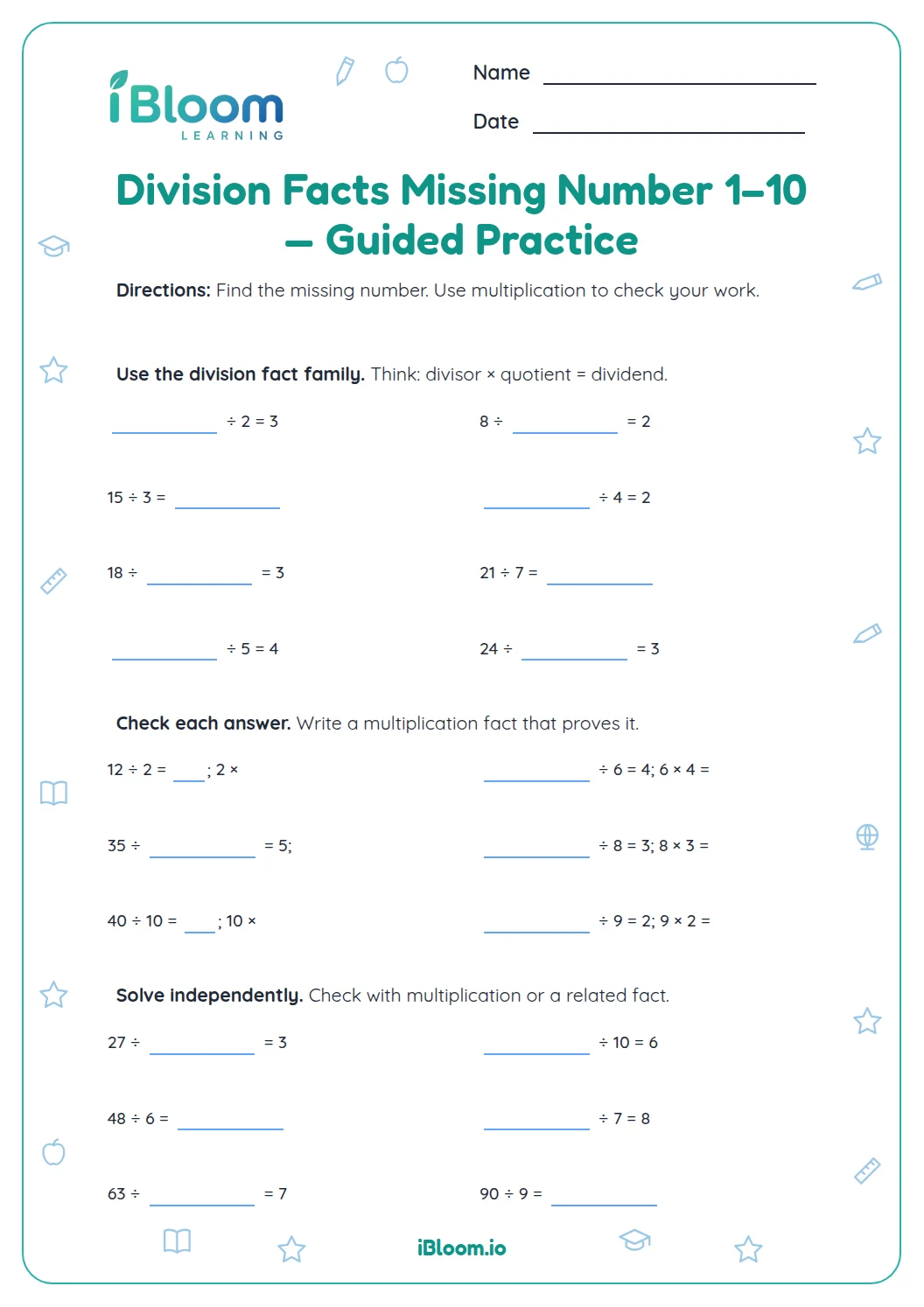
This free Grade 3 worksheet gives students independent practice with multiplication and division fact families. Part A completes eight related facts in two families. Part B mixes four missing-factor and missing-divisor equations. Part C asks students to write all four facts for each of two number sets. Every family uses whole-number facts within 100. The sheet practices CCSS 3.OA.B.6 by treating division as a search for a missing factor, and a separate key includes both complete families.
Aligned to 3.OA.B.6
What belongs in one multiplication and division family?
For two different factors, write two multiplication facts by switching the factors. Then write two division facts, each starting with their product. Part C asks for all four facts without supplying blanks.
- 1Numbers: 4, 7, 28
- 24 × 7 = 28; 7 × 4 = 28
- 328 ÷ 4 = 7; 28 ÷ 7 = 4
What changes when the blank moves?
In 42 ÷ ___ = 6, the missing number is the divisor. Ask which number multiplied by 6 gives 42. The answer is 7, just as it is in 6 × ___ = 42.
Part B also includes 8 × ___ = 72 and 72 ÷ ___ = 8. Reading the entire equation helps students see that both blanks stand for 9.
How should students use this as independent practice?
Read the directions once, then let students finish without seeing the answer key. Part A keeps each family together, Part B moves the blank between a factor and a divisor, and Part C removes the equation frames.
When checking Part C, accept any order for the four equations. All three given numbers must appear in each equation, and each distinct fact must appear once.
How to use this worksheet
- 1Review the meaning of factor, product, and dividend before handing out the sheet.
- 2Let the student complete the eight Part A equations independently.
- 3For Part B, ask the student to reread each completed equation before moving on.
- 4In Part C, have the student write two multiplication facts and two division facts for each number set.
- 5Check the key after completion and revisit any missed division fact through multiplication.
Mistakes to check together
The mistake
Writing 4 ÷ 28 = 7 after seeing 4 × 7 = 28.
The fix
Start each division fact with the product, 28.
The mistake
Putting 6 in both blanks of 6 × ___ = 42 and 42 ÷ ___ = 6.
The fix
Ask which factor combines with 6 to make 42; it is 7.
The mistake
Writing the same multiplication fact twice in Part C.
The fix
Switch the factors for the second multiplication fact. For division, keep the product first and exchange the divisor and quotient.
Common Core alignment
Use multiplication facts to find missing factors in division equations.
On this sheet: Students complete linked multiplication and division equations and write two complete fact families.
Show the official wordingHide the official wording
Understand division as an unknown-factor problem. For example, find 32 ÷ 8 by finding the number that makes 32 when multiplied by 8.
What to practice next
Make more practice
Further reading
Questions parents and teachers ask
How many facts will my child complete?
There are fourteen numbered questions. Twelve ask for one missing number, and the final two ask for a complete four-fact family. That means students finish twelve supplied equations and write eight more equations themselves. The answer key lists all four facts for each of the final number sets.
Should my child use counters for independent practice?
Try the sheet without counters first if your child has already learned these facts. If a division equation stalls the work, use counters afterward to build equal groups. Then name the matching multiplication fact and return to the equation so the connection is explicit.
Does the order of the four facts matter?
No. In Part C, any order is acceptable as long as all four distinct equations are correct. For 4, 7, and 28, students need two multiplication facts with switched factors and two division facts beginning with 28. Compare the equations themselves, not their order on the key.
Why are some blanks after the division sign?
Those blanks ask for a missing divisor, which encourages students to use the whole fact family. In 42 ÷ ___ = 6, think “six groups of what make forty-two?” The missing divisor is 7. Substituting it back gives 42 ÷ 7 = 6.
What is a useful follow-up after checking?
Choose one family that caused a mistake and say its four facts aloud together. Then cover the key and have your child write that family again on scrap paper. If the equations are correct, try a new family using the linked multiplication and division families generator.