



About this worksheet
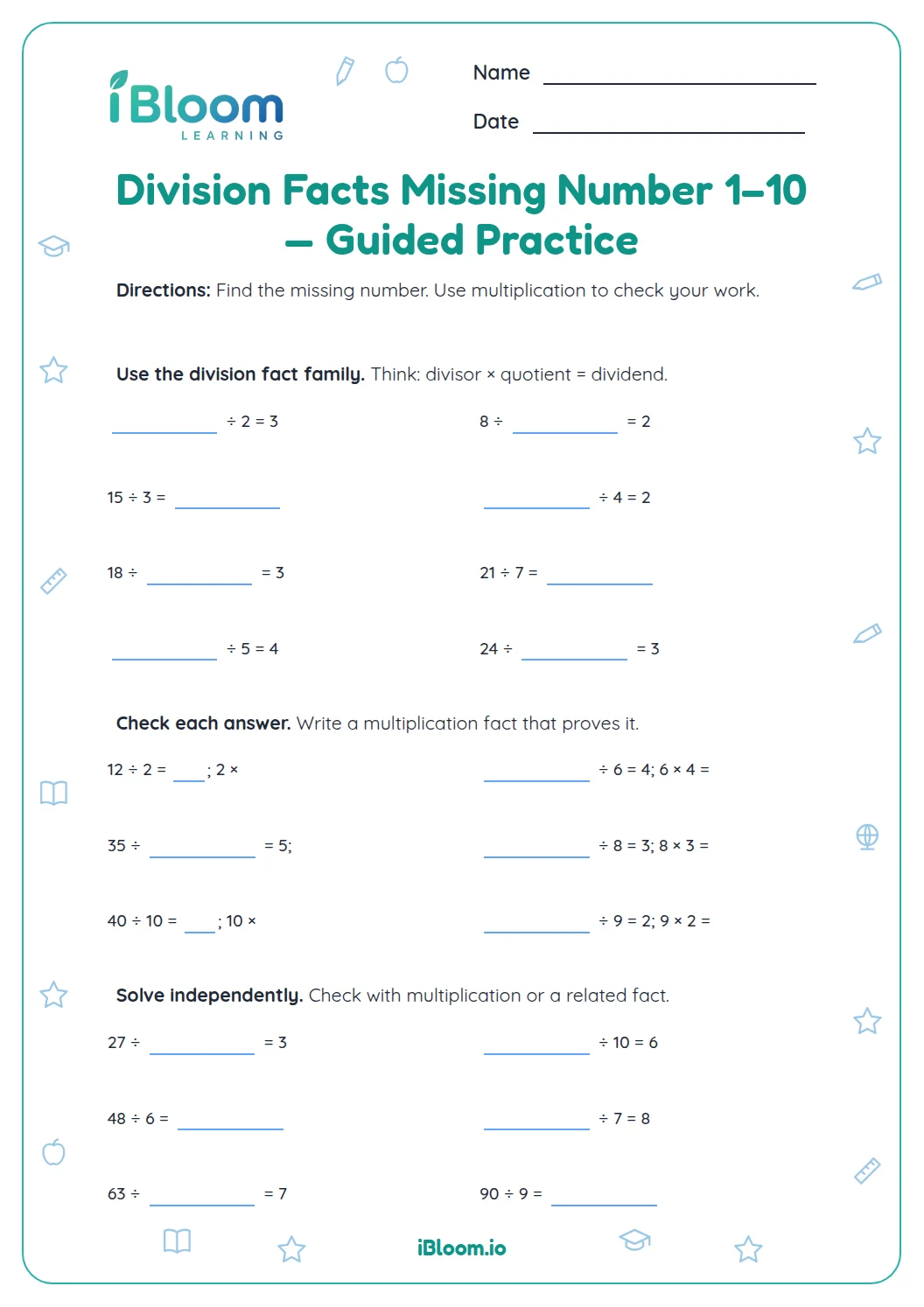
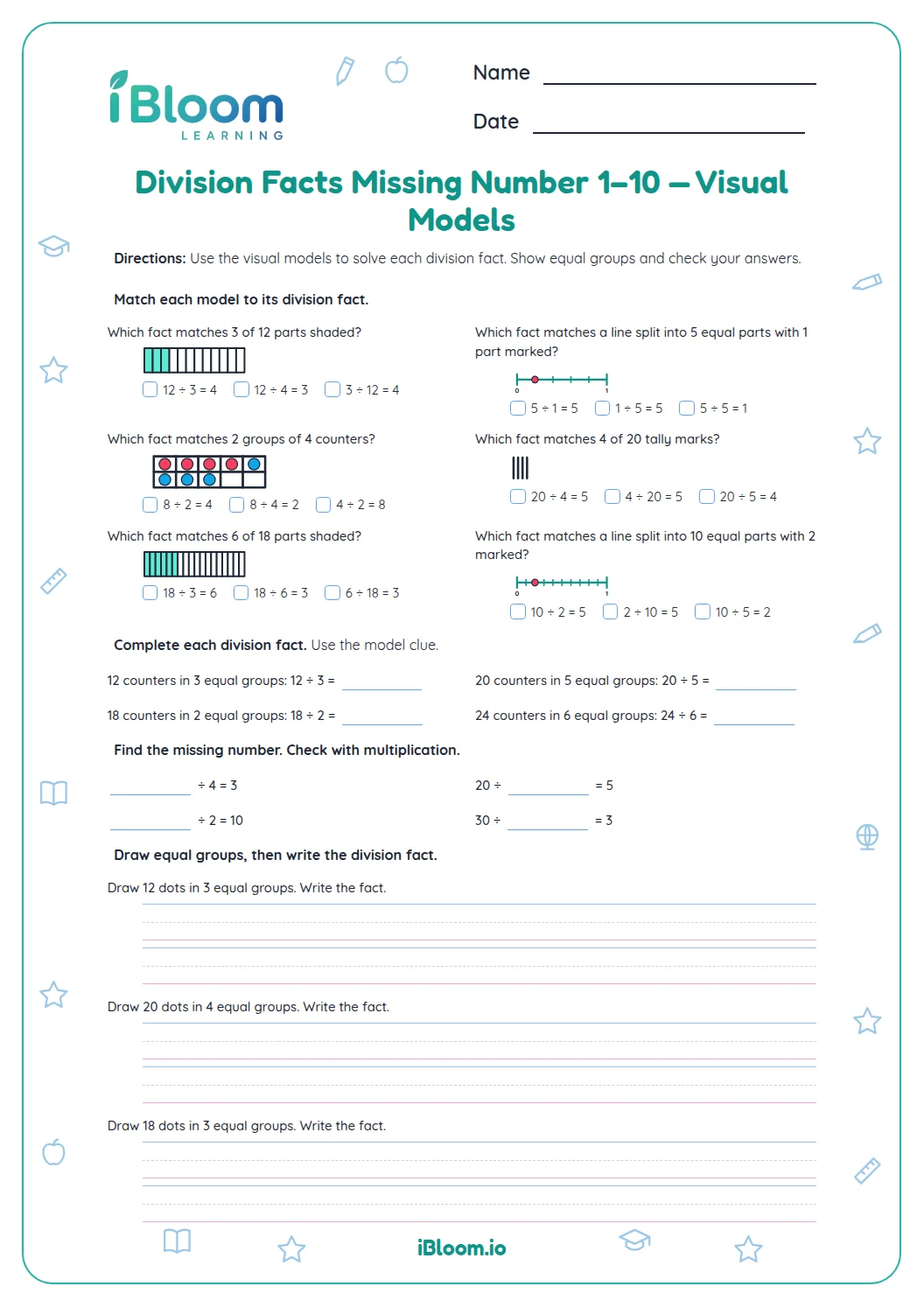
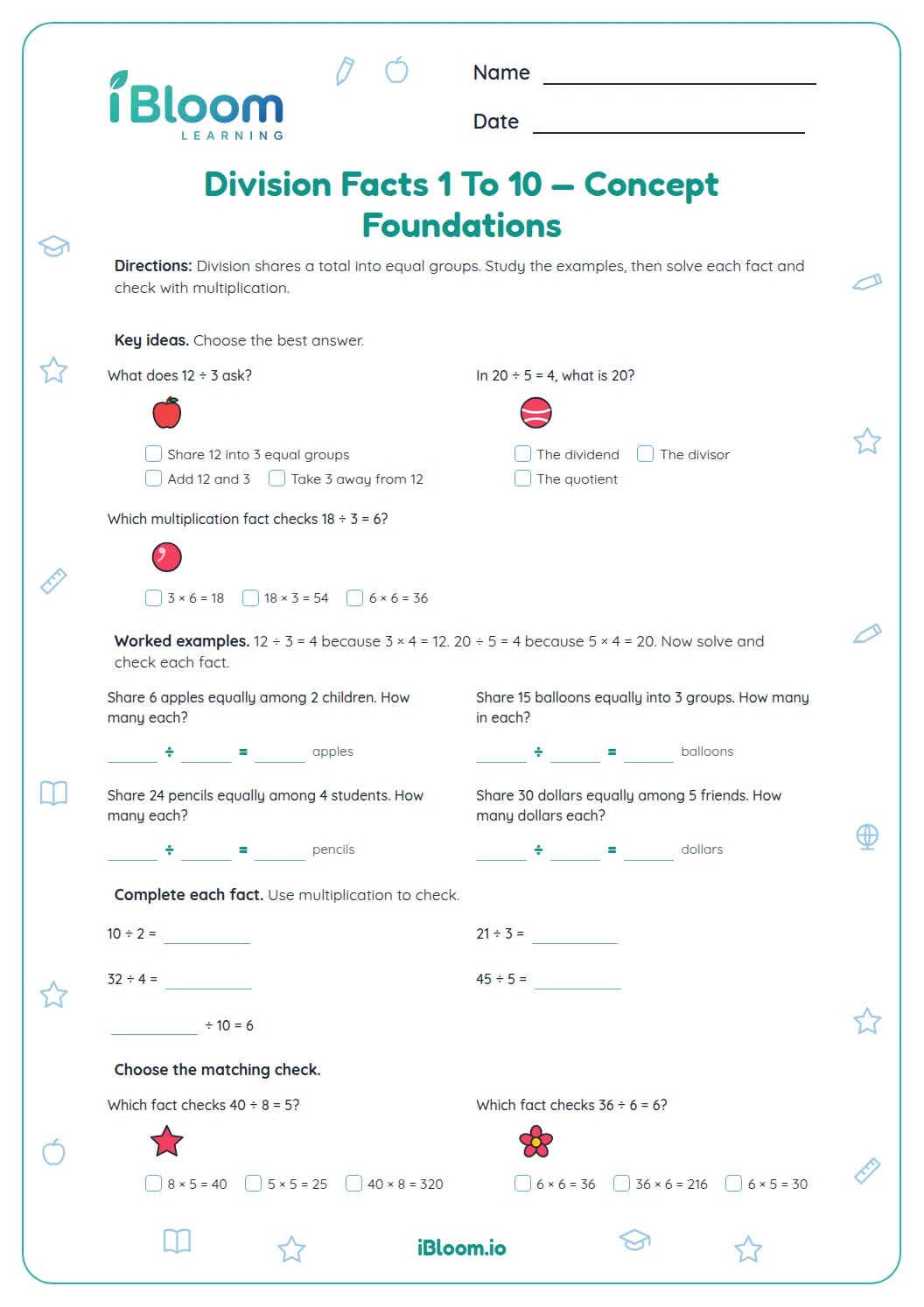
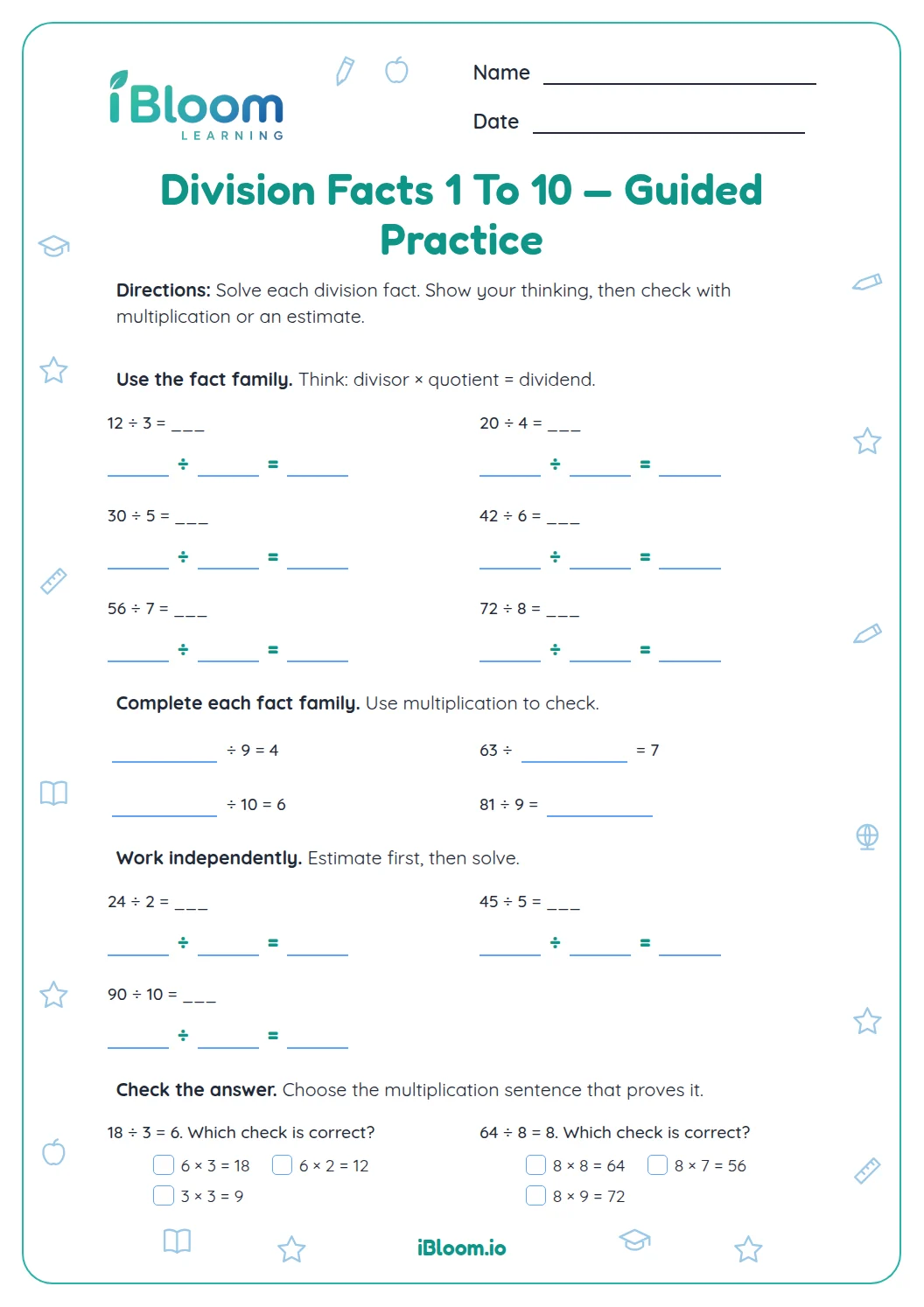
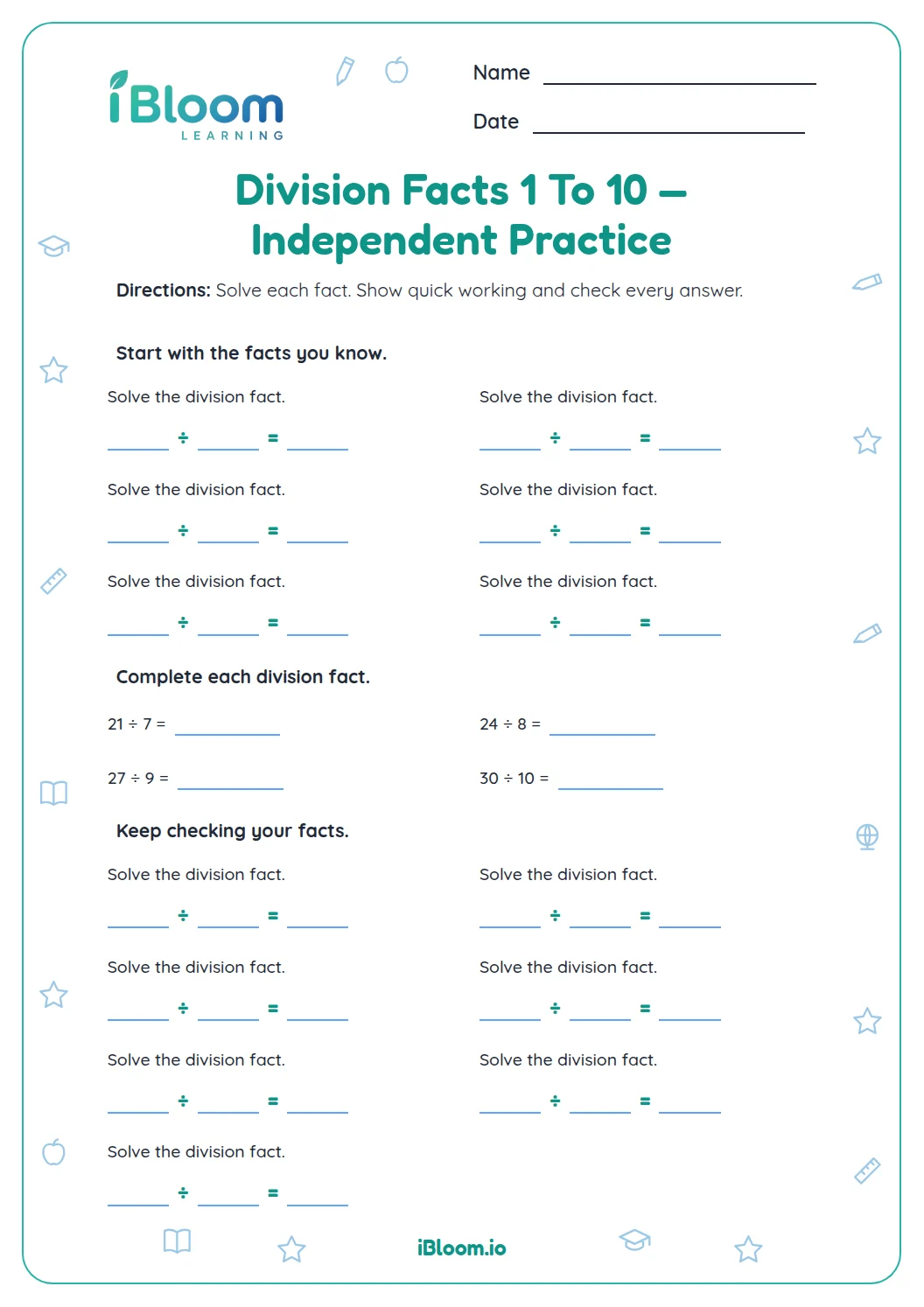
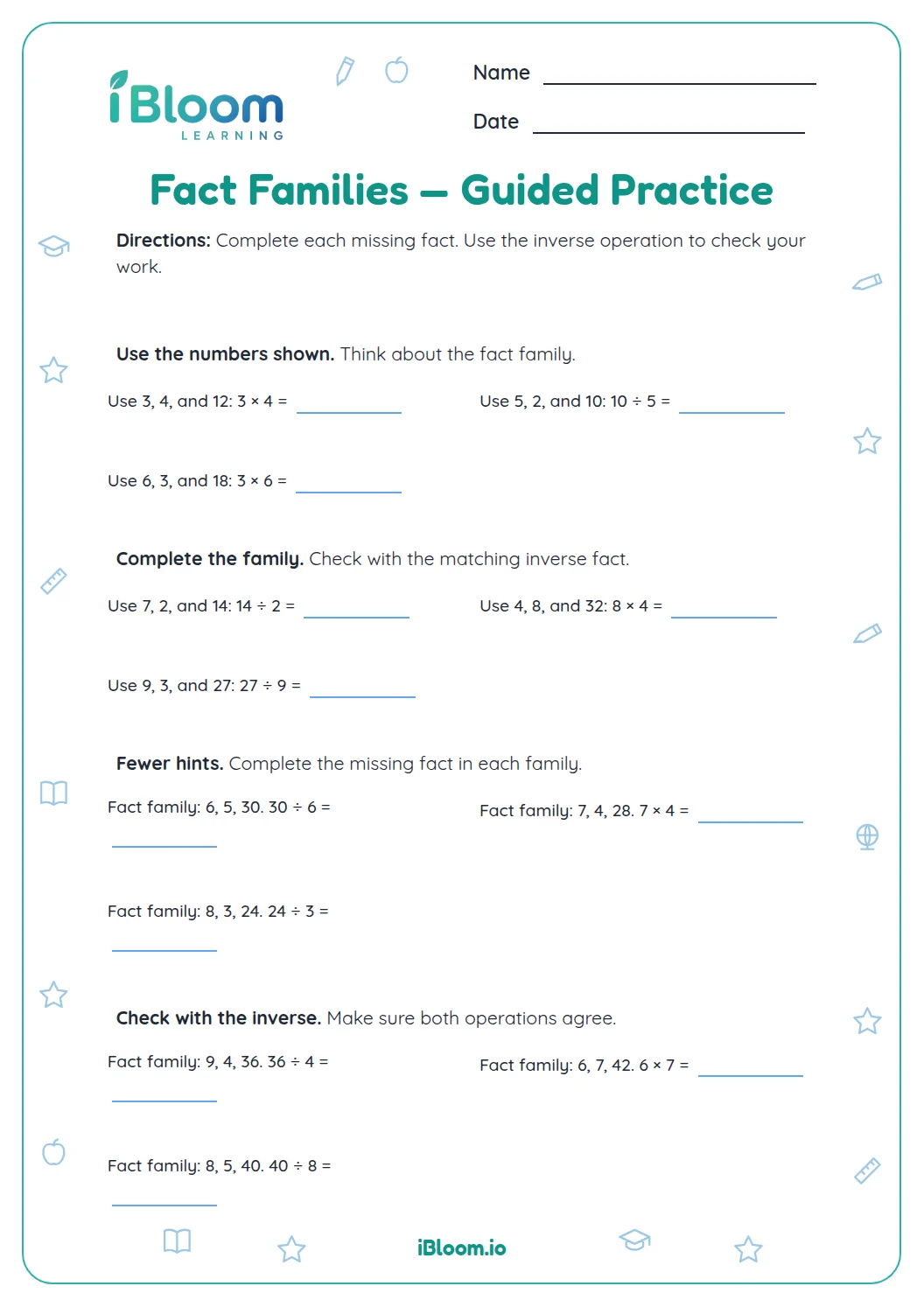
This free printable Grade 3 math worksheet practices division facts with a missing quotient, divisor, or dividend, then uses related multiplication facts to find missing factors. It contains 16 problems in four parts: quotient facts, missing division parts, mixed division checks, and multiplication checks. The missing answers include every number from 1 through 10. A separate answer key lists each result.
Aligned to 3.OA.B.6 and 3.OA.C.7
How does multiplication help find a missing number?
Division and multiplication are inverse operations. If 24 ÷ ___ = 4, ask what number times 4 equals 24. Since 6 × 4 = 24, the missing divisor is 6.
The sheet begins with quotients, then moves to missing divisors and dividends, followed by mixed checks and related multiplication facts.
- 124 ÷ ___ = 4
- 2Think: 4 × ? = 24
- 34 × 6 = 24
- 4So 24 ÷ 6 = 4
What will children practice on the page?
Part A finds quotients; Part B finds missing divisors or dividends; Part C mixes division facts; Part D uses related multiplication facts. Across the page, the missing values include 1 through 10.
How can the answer key help?
The key lists each missing number. For a division item, multiply the quotient by the divisor to check that the dividend is correct.
How to use this worksheet
- 1Read the division sign and identify what is missing.
- 2If a quotient is missing, divide the total into equal groups.
- 3If a divisor is missing, ask what factor times the quotient makes the dividend.
- 4If the dividend is missing, multiply the divisor by the quotient.
- 5Check with multiplication before using the key.
Common mistakes and quick fixes
The mistake
Using subtraction to guess a divisor.
The fix
Rewrite the fact as divisor × quotient = dividend, then find the missing factor.
The mistake
Swapping divisor and quotient without checking.
The fix
Multiply your answer by the stated divisor and see whether you get the dividend.
The mistake
Writing a product where the quotient belongs.
The fix
Read left to right and name the missing position before solving.
Common Core alignment
The questions below practice the stated Common Core skill.
Use a related multiplication fact to find an unknown factor in a division fact.
On this sheet: Every missing divisor or dividend is found by using the matching multiplication fact.
Show the official wordingHide the official wording
Understand division as an unknown-factor problem. For example, find 32 ÷ 8 by finding the number that makes 32 when multiplied by 8.
Solve multiplication and division facts within 100, including missing-number facts.
On this sheet: The worksheet practices related multiplication and division facts within 100.
Show the official wordingHide the official wording
Fluently multiply and divide within 100, using strategies such as the relationship between multiplication and division (e.g., knowing that 8 × 5 = 40, one knows 40 ÷ 5 = 8) or properties of operations. By the end of Grade 3, know from memory all products of two one-digit numbers.
What to practice next
Make more practice
Further reading
Questions parents and teachers ask
What is a missing-number division fact?
It is a division equation with one number left blank. The blank can be the quotient, divisor, or dividend. This worksheet also includes multiplication equations with a missing factor, so children can use the inverse relationship to solve and check the unknown.
How do you solve 24 ÷ ___ = 4?
Ask what number multiplied by 4 equals 24. Since 6 × 4 = 24, the missing divisor is 6. Multiplying the answer by the quotient checks that the original dividend is correct and confirms that the division fact is exact.
What is practiced in the four parts?
Part A asks children to find quotients. Part B has a missing divisor or dividend, Part C mixes division facts, and Part D uses related multiplication facts. The question types move from direct division to using multiplication as a check and as a way to find a factor.
Does the worksheet include every missing number from 1 to 10?
Yes. The missing answers across the division and multiplication equations include each whole number from 1 through 10. All division facts have exact whole-number answers, so children do not need to work with remainders on this practice sheet. They can check each blank by reversing the operation.
How can my child check each answer?
For division, multiply the quotient by the divisor and see whether the product is the dividend. For a missing dividend, multiply the known divisor and quotient. For a multiplication item, multiply the completed factors and compare the product with the number printed in the equation.
Does the worksheet come with an answer key?
Yes. The separate answer key lists the missing number for all 16 problems. Invite your child to check a few answers with multiplication before using the key; that makes the inverse relationship visible and can reveal whether a fact needs another look.