


About this worksheet
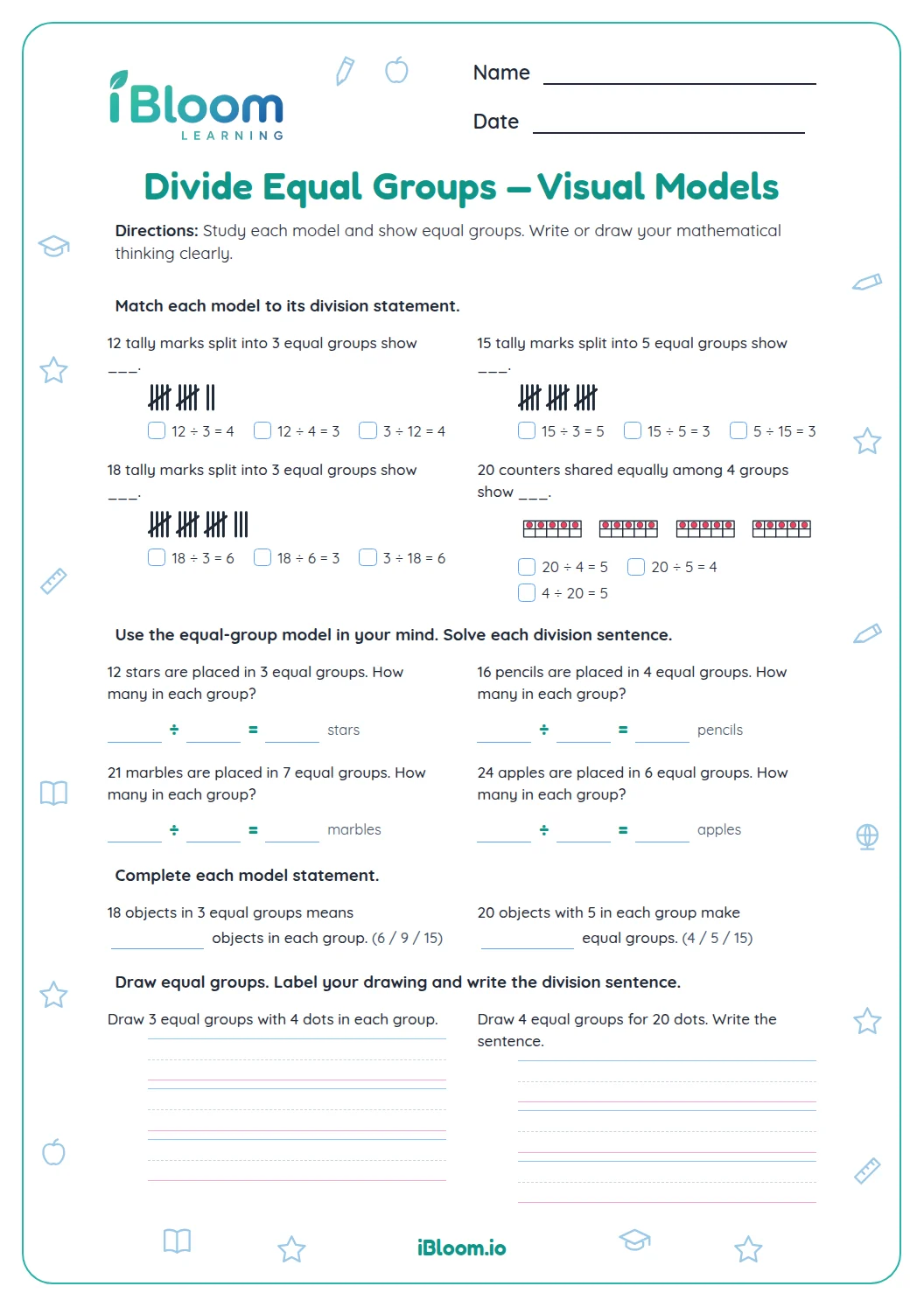
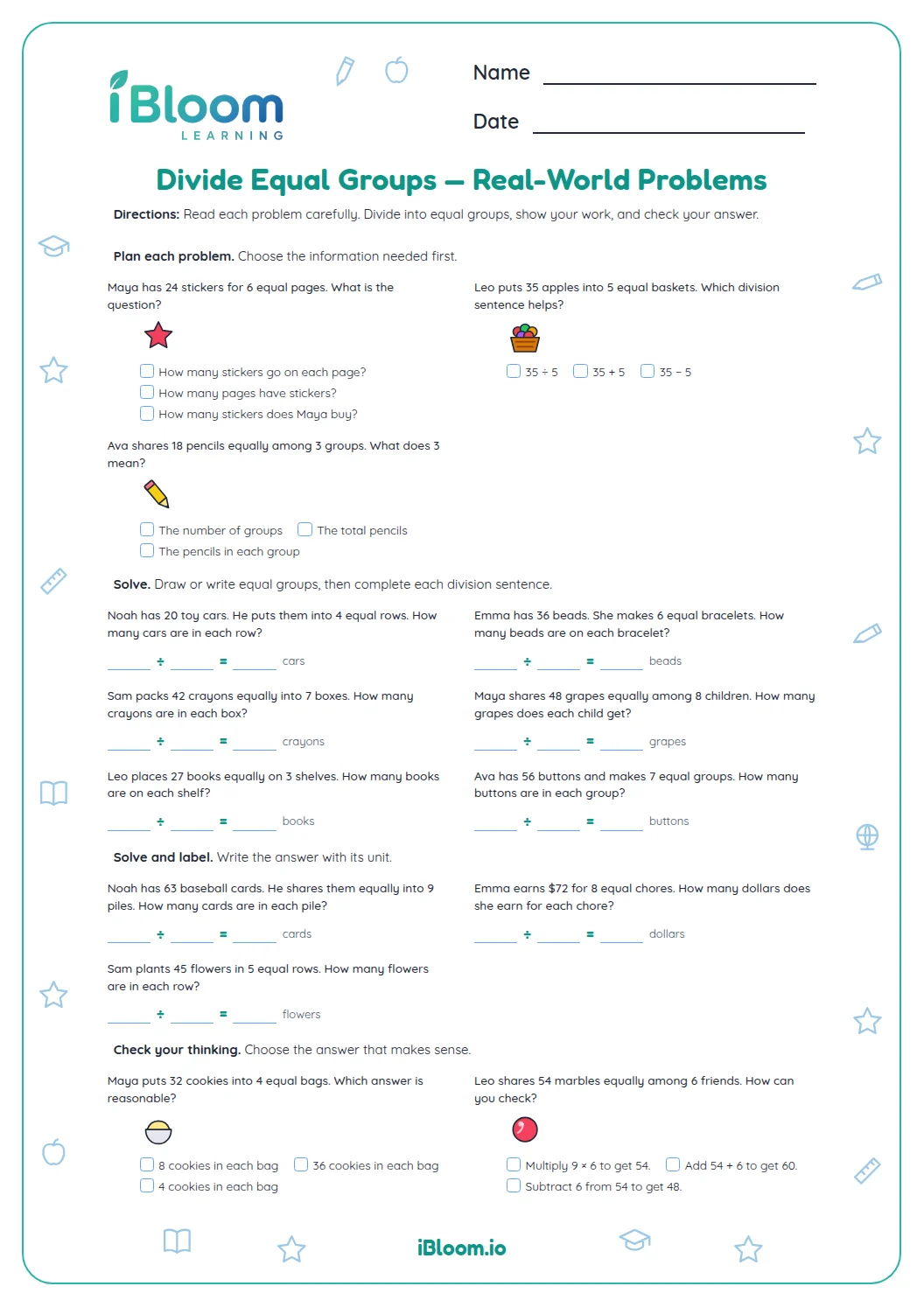
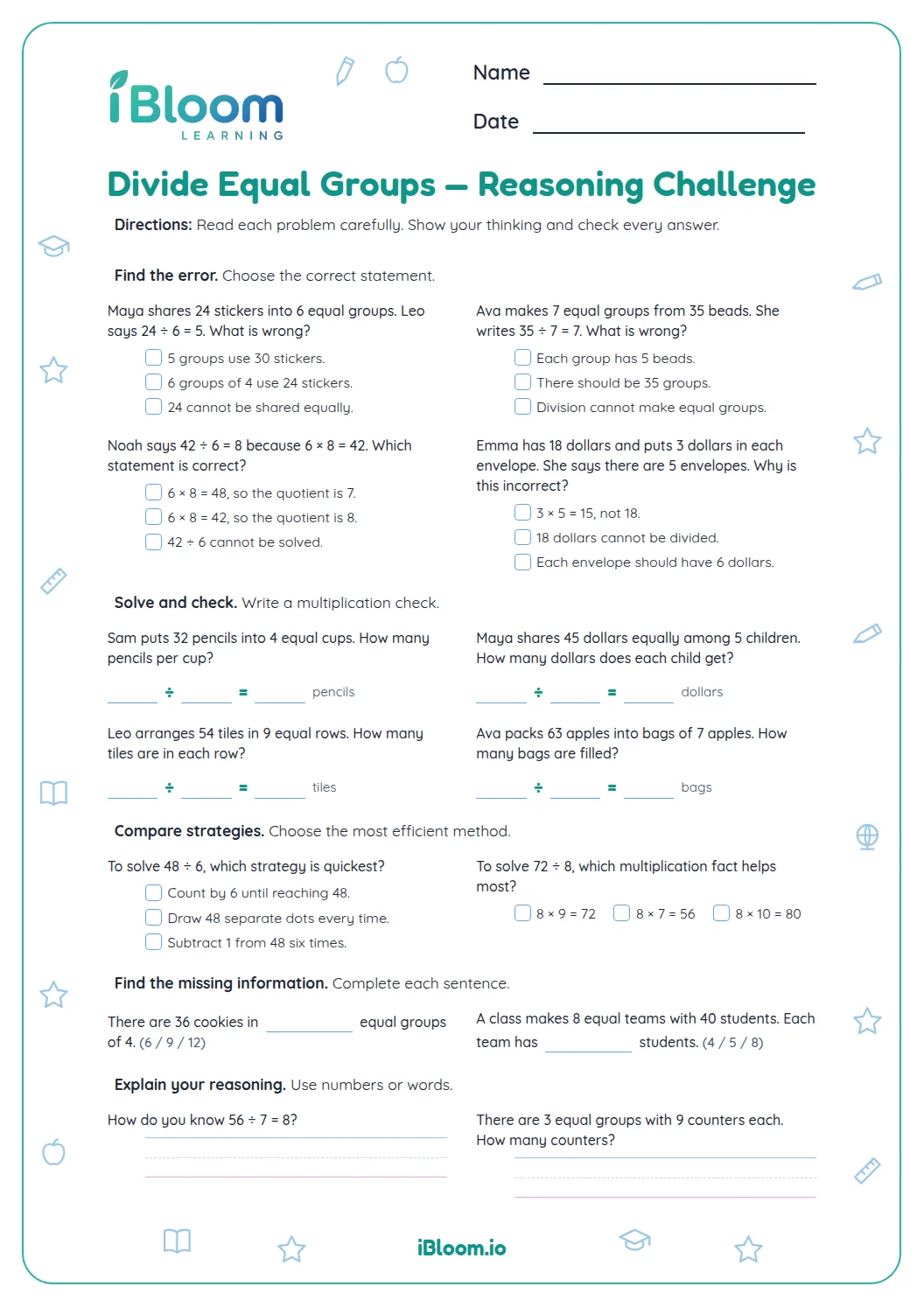
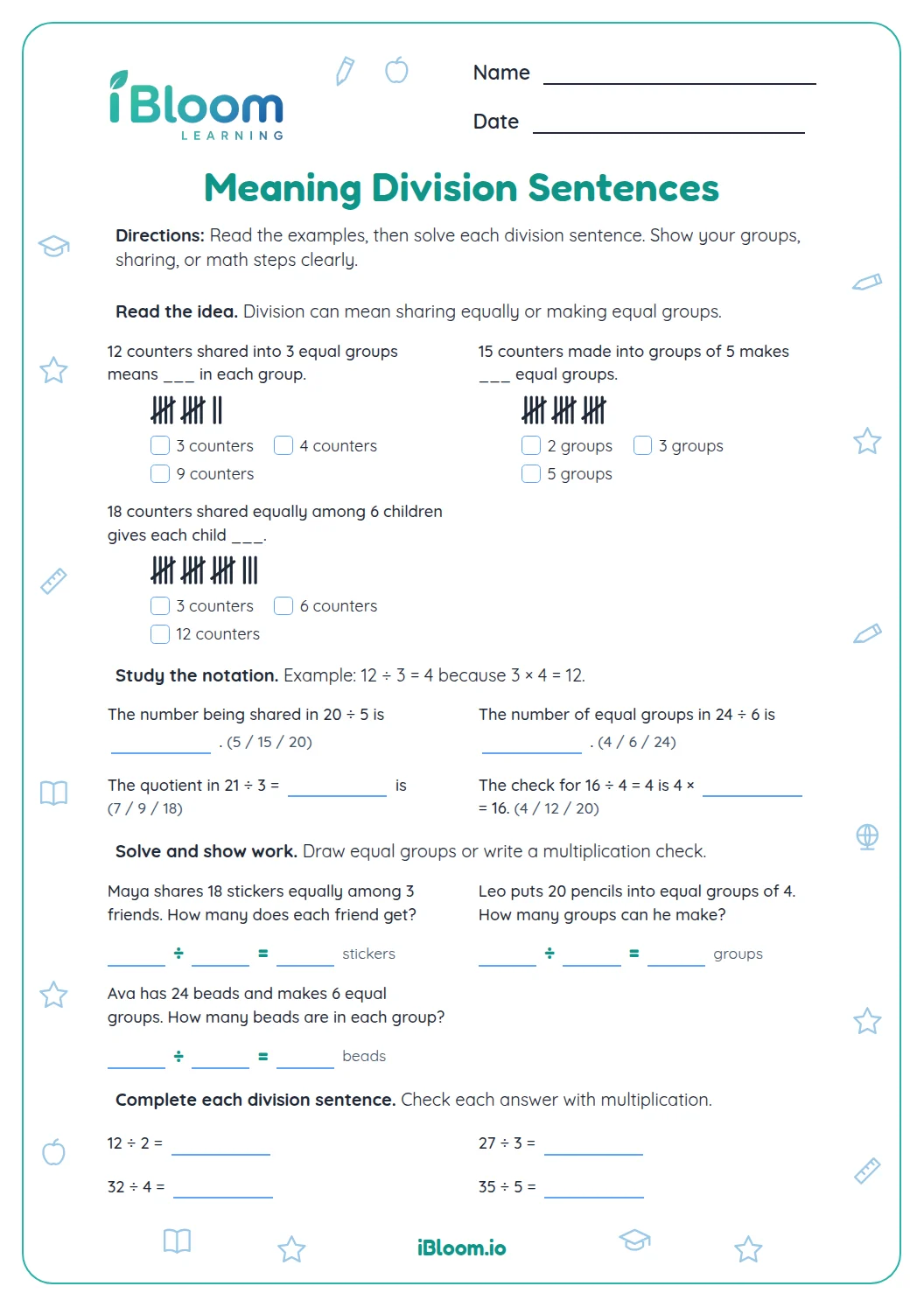
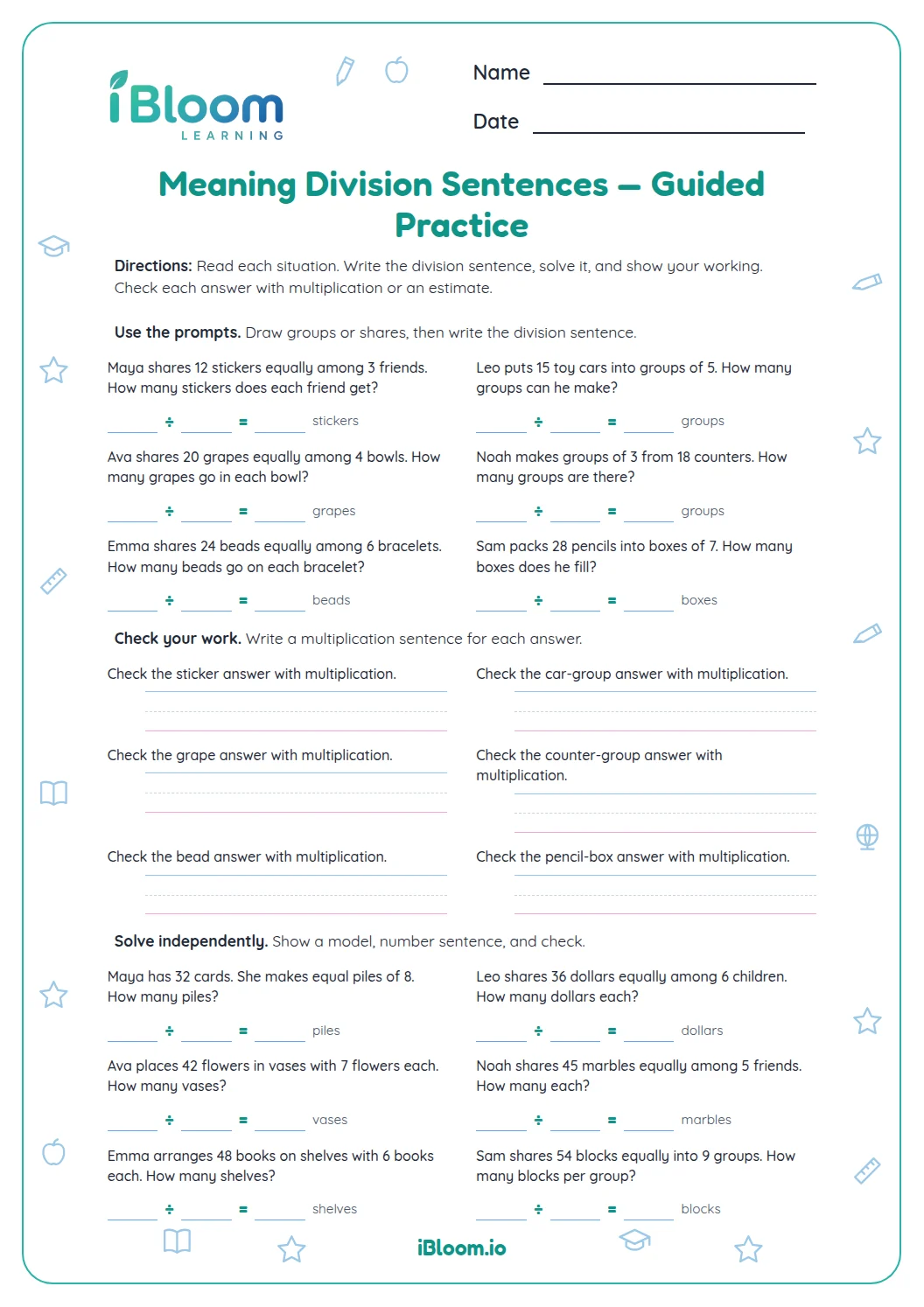
This Grade 3 division worksheet guides learners from equal-sharing stories to independent equal-group questions and multiplication checks. Children write equations for the sharing situations, find how many objects belong in each group, and connect division to a related multiplication fact. The 16 problems practice interpreting whole-number quotients as equal shares, aligned with CCSS 3.OA.A.2. A separate answer key supports checking.
Aligned to 3.OA.A.2
How do equal groups show division?
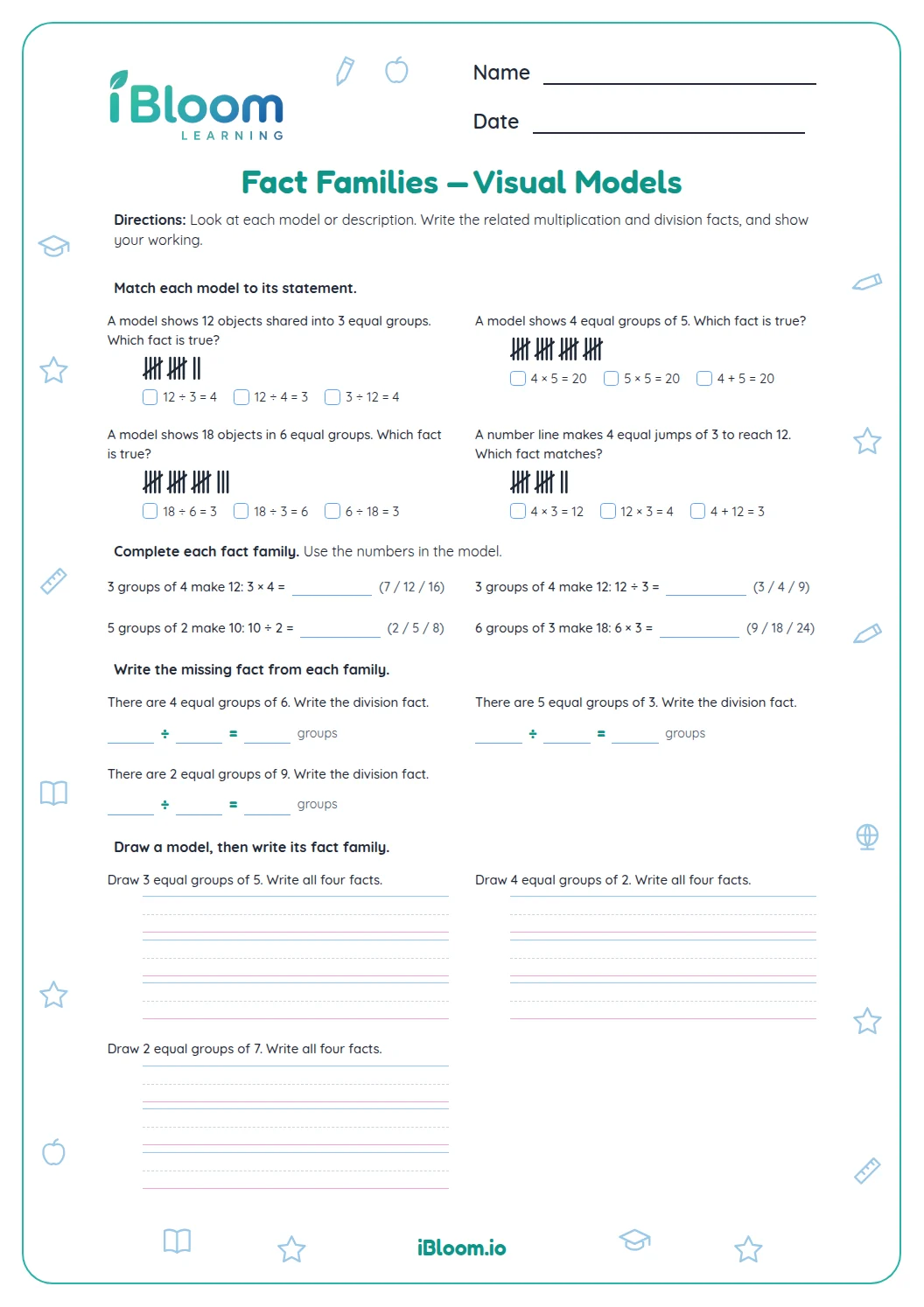
Division can describe sharing a total equally or counting equal-size groups. In the first story, 12 apples shared among 3 baskets means 12 ÷ 3 = 4 apples in each basket.
For question 1, divide the 12 apples into 3 equal groups. Each group gets 4.
- 112 apples shared into 3 equal groups
- 212 ÷ 3 = 4
- 3There are 4 apples in each basket.
How can multiplication check a division fact?
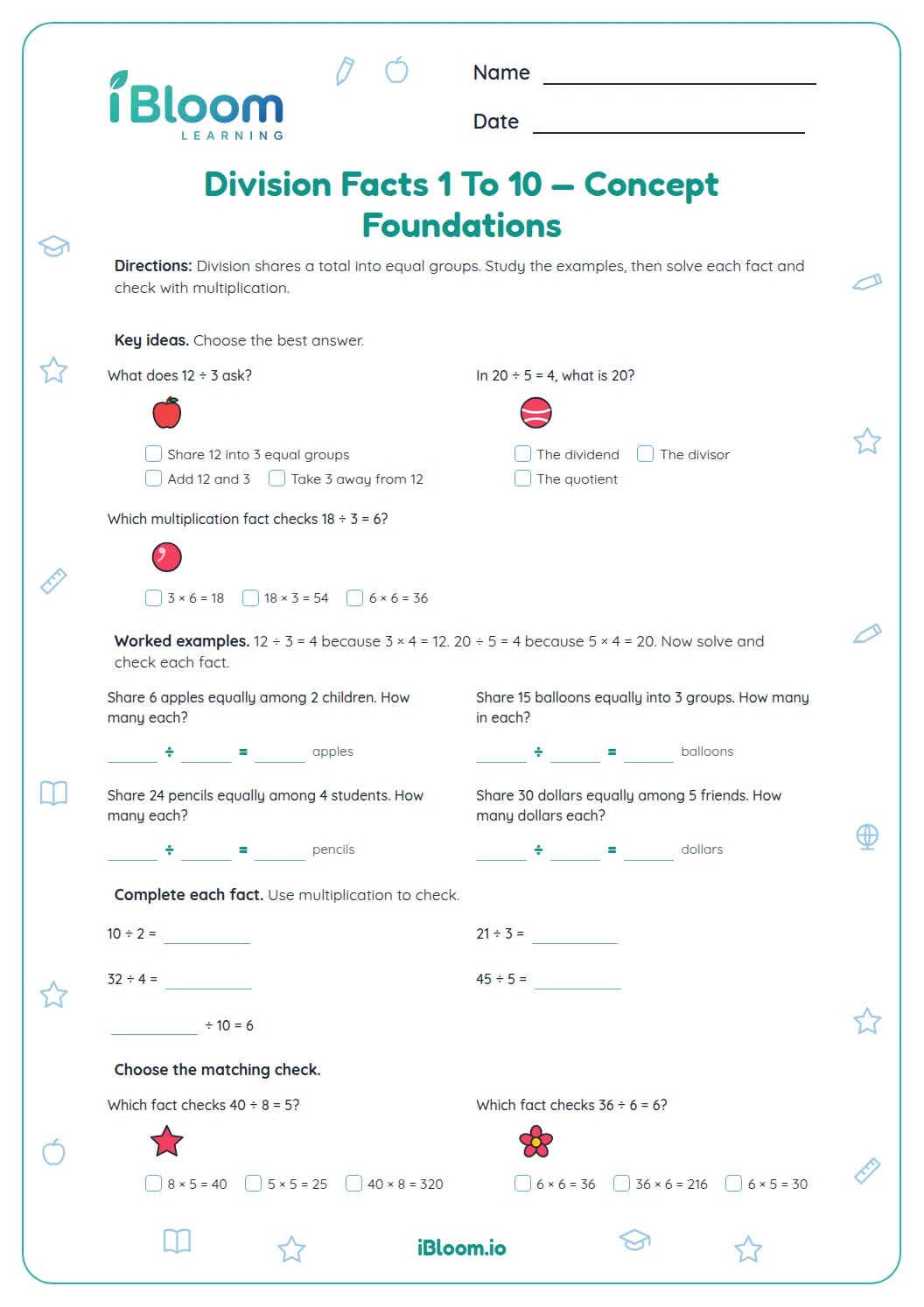
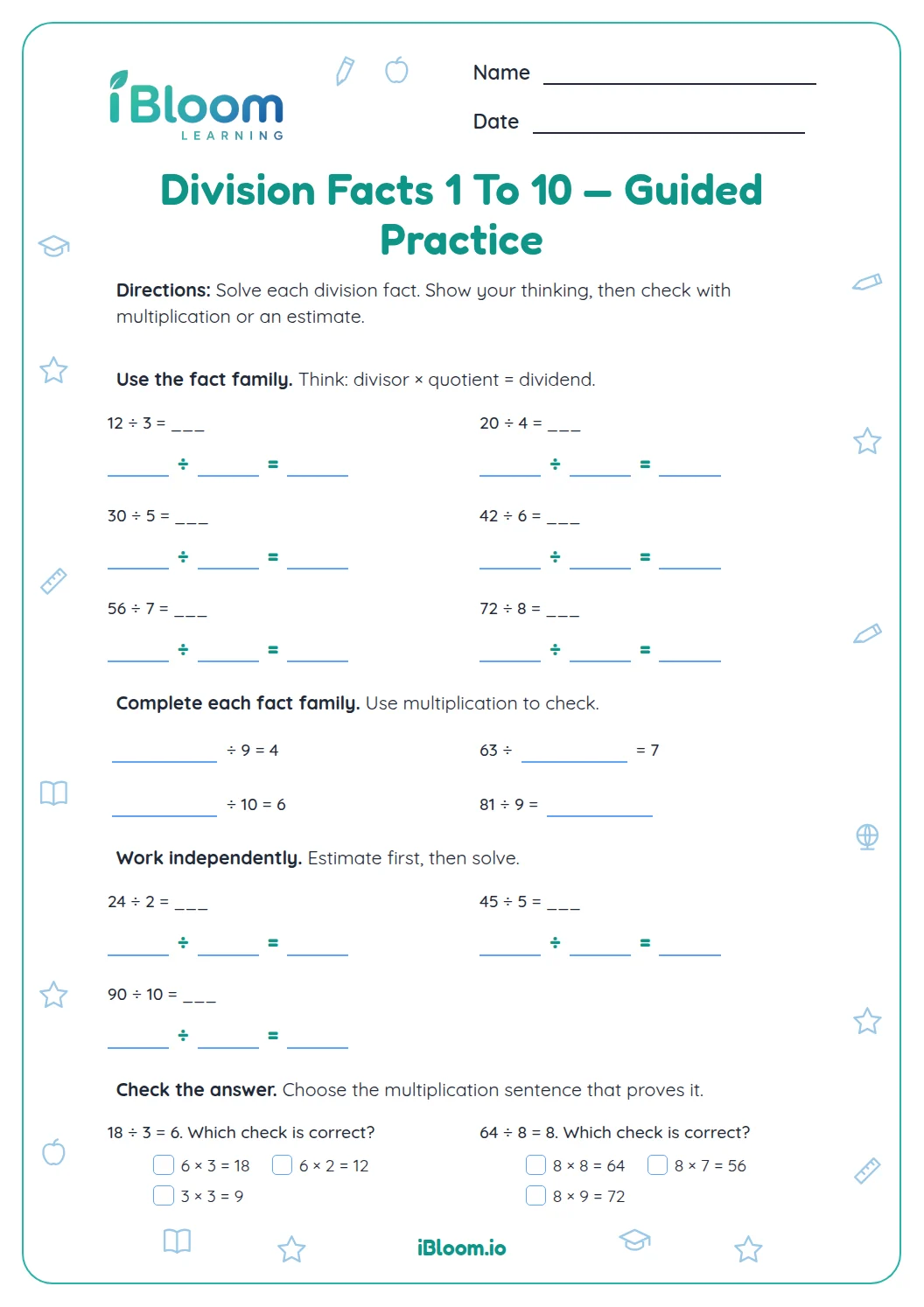
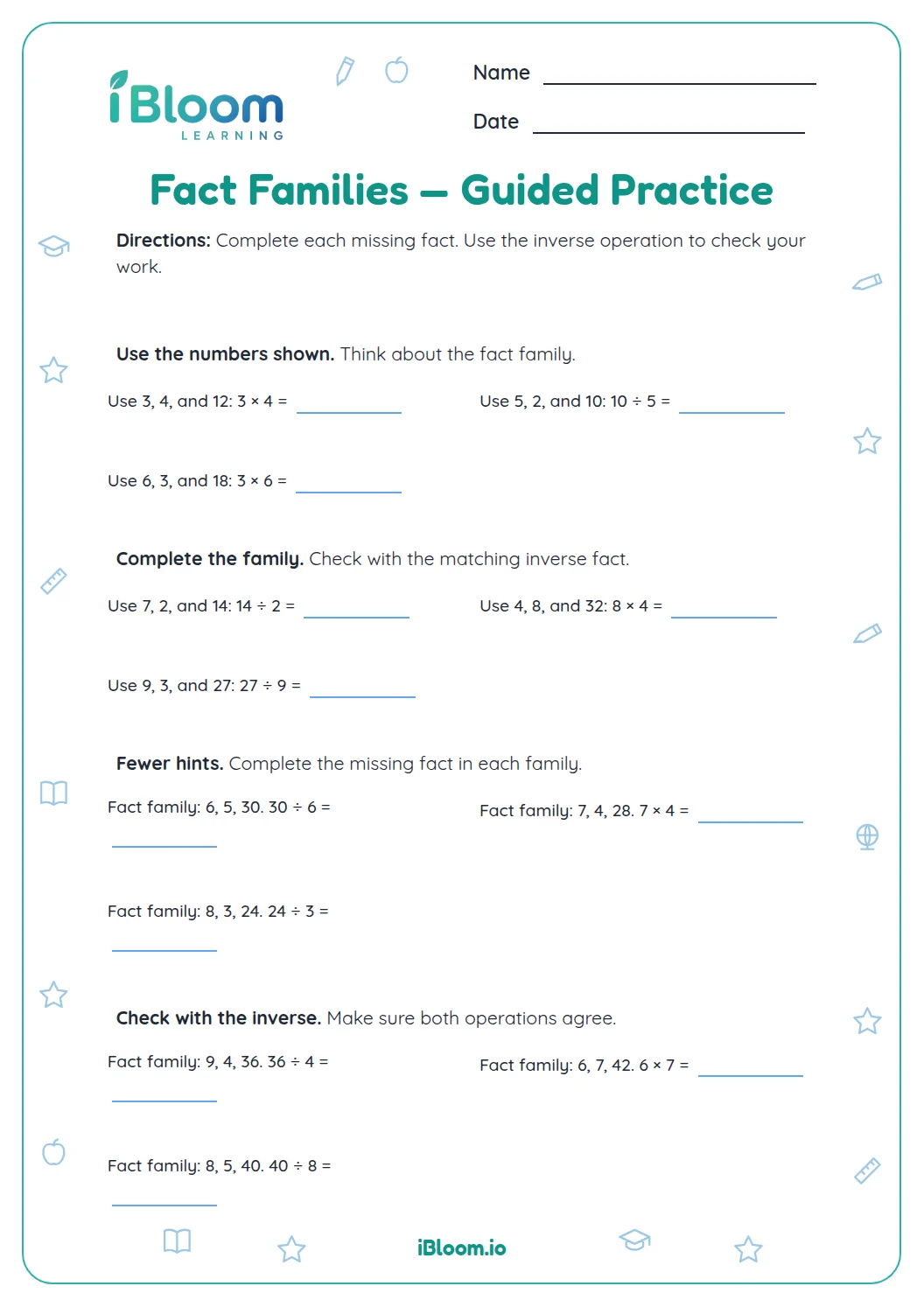
Multiplication reverses equal sharing. For 18 ÷ 3 = 6, check that 3 × 6 equals 18. If the product matches the starting total, the quotient fits.
What practice is on the page?
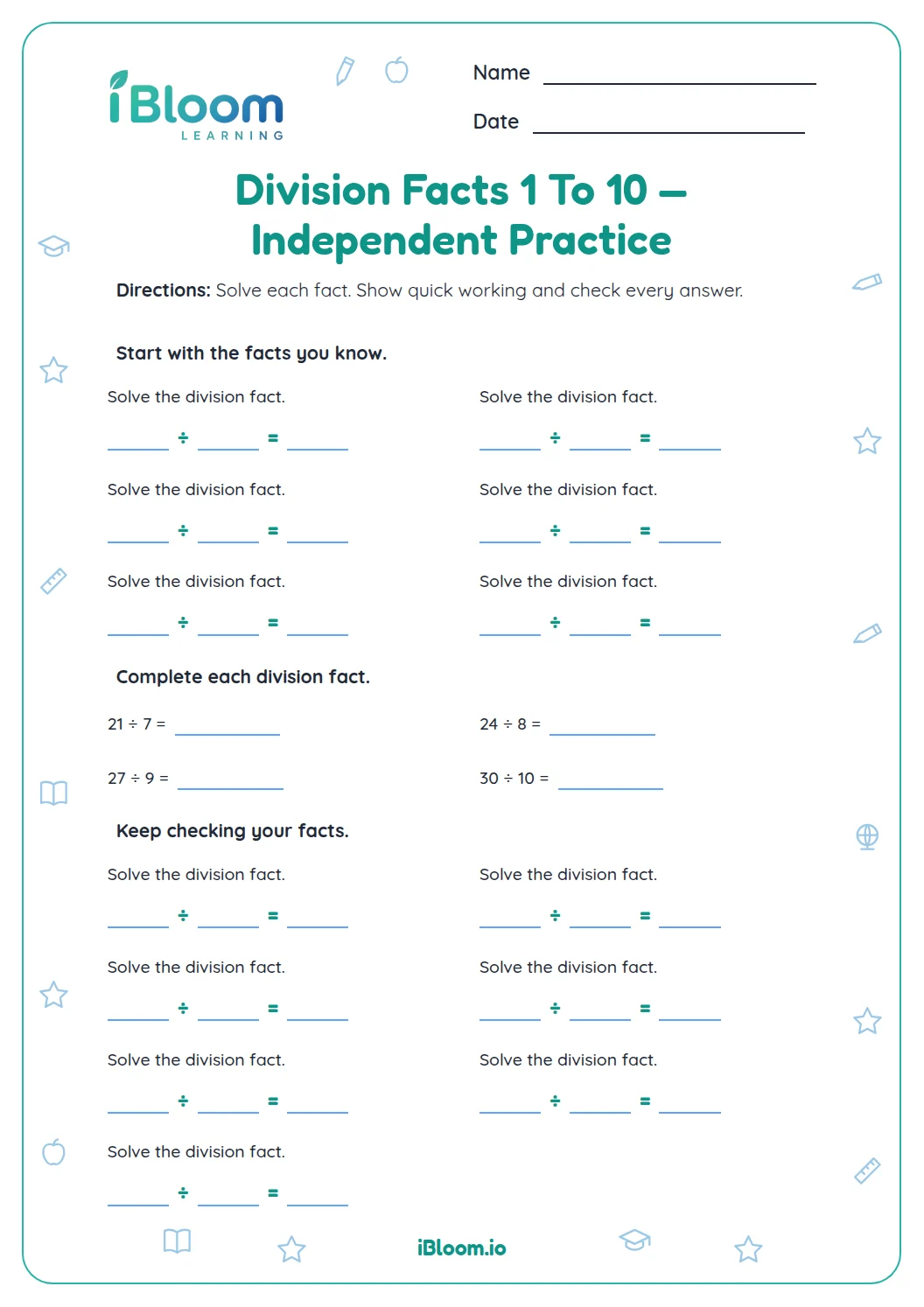
Four guided sharing stories lead into eight compact division equations, followed by four multiple-choice questions about division and multiplication facts. All totals and group sizes stay within Grade 3 fact practice.
How to use this worksheet
- 1Read who is sharing and how many groups there are.
- 2Write the total divided by the number of groups.
- 3Find how many objects belong in one group.
- 4Check by multiplying group size by number of groups.
- 5Use the key to review any equation that does not match the story.
Common slips and helpful fixes
The mistake
Dividing the number of groups by the total
The fix
Start with the total number of objects, then divide by how many groups.
The mistake
Making groups with different sizes
The fix
Check that each group contains the same number.
The mistake
Choosing a product that does not match the total
The fix
Multiply the number in one group by the number of groups and compare with the total.
Common Core alignment
This worksheet connects equal sharing stories with whole-number division.
Interpret whole-number quotients as equal sharing or equal groups.
On this sheet: The word problems model totals partitioned into equal groups and ask for the number in each group.
Show the official wordingHide the official wording
Interpret whole-number quotients of whole numbers, e.g., interpret 56 ÷ 8 as the number of objects in each share when 56 objects are partitioned equally into 8 shares, or as a number of shares when 56 objects are partitioned into equal shares of 8 objects each.
What to practice next
Make more practice
Further reading
Questions parents and teachers ask
What does divide into equal groups mean?
It means sharing a total so every group receives the same number. For example, 12 apples shared among 3 baskets gives 4 apples in each basket because 3 groups of 4 make 12. The adult can ask the learner to point to the related item and explain the answer in their own words.
How many problems are included?
There are 16 problems: six sharing stories with room to write equations, six more equal-group problems, and four multiple-choice fact checks. The separate answer key lists each result. An adult can invite the learner to explain one answer aloud and point back to the matching prompt. This makes it easy to check the strategy as well as the final response.
What is a good way to check division?
Multiply the number in each group by the number of groups. If that product equals the original total, the division answer is correct. An adult can invite the learner to explain one answer aloud and point back to the matching prompt. This makes it easy to check the strategy as well as the final response.
Can children draw groups to solve?
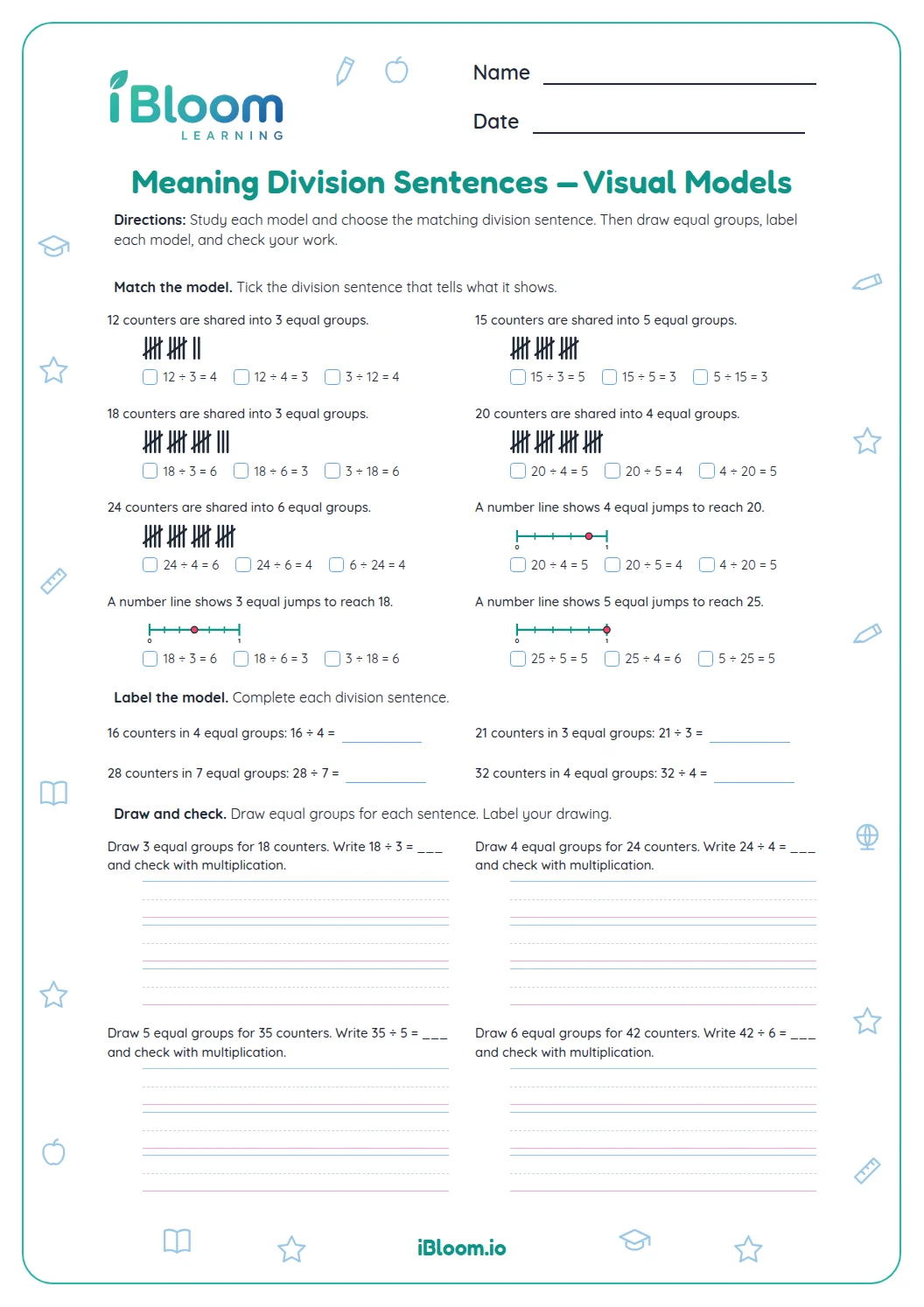
Yes. Children may sketch equal groups in the working space, then write the related division equation. The drawing helps connect the story to the number sentence. An adult can invite the learner to explain one answer aloud and point back to the matching prompt. This makes it easy to check the strategy as well as the final response.
What numbers are used?
The sheet uses equal sharing totals from 12 to 32 and divisors from 3 to 7. Every problem has a whole-number quotient so children can focus on equal groups. The adult can ask the learner to point to the related item and explain the answer in their own words.
How long should this practice take?
Allow about 20 minutes for reading the stories, writing equations, and checking selected facts with multiplication. Children may use small sketches or counters for the first few items. An adult can invite the learner to explain one answer aloud and point back to the matching prompt. This makes it easy to check the strategy as well as the final response.