


About this worksheet
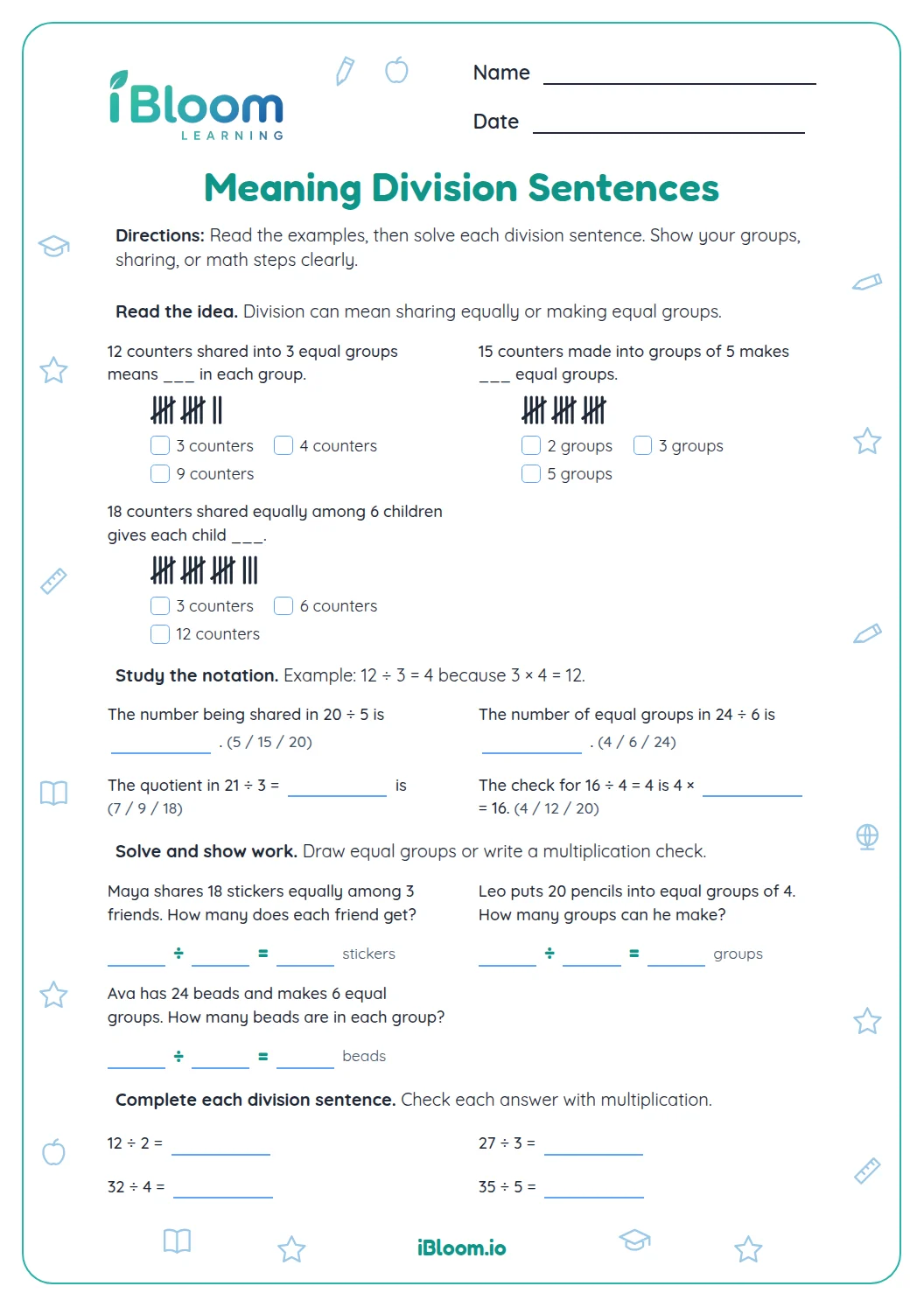
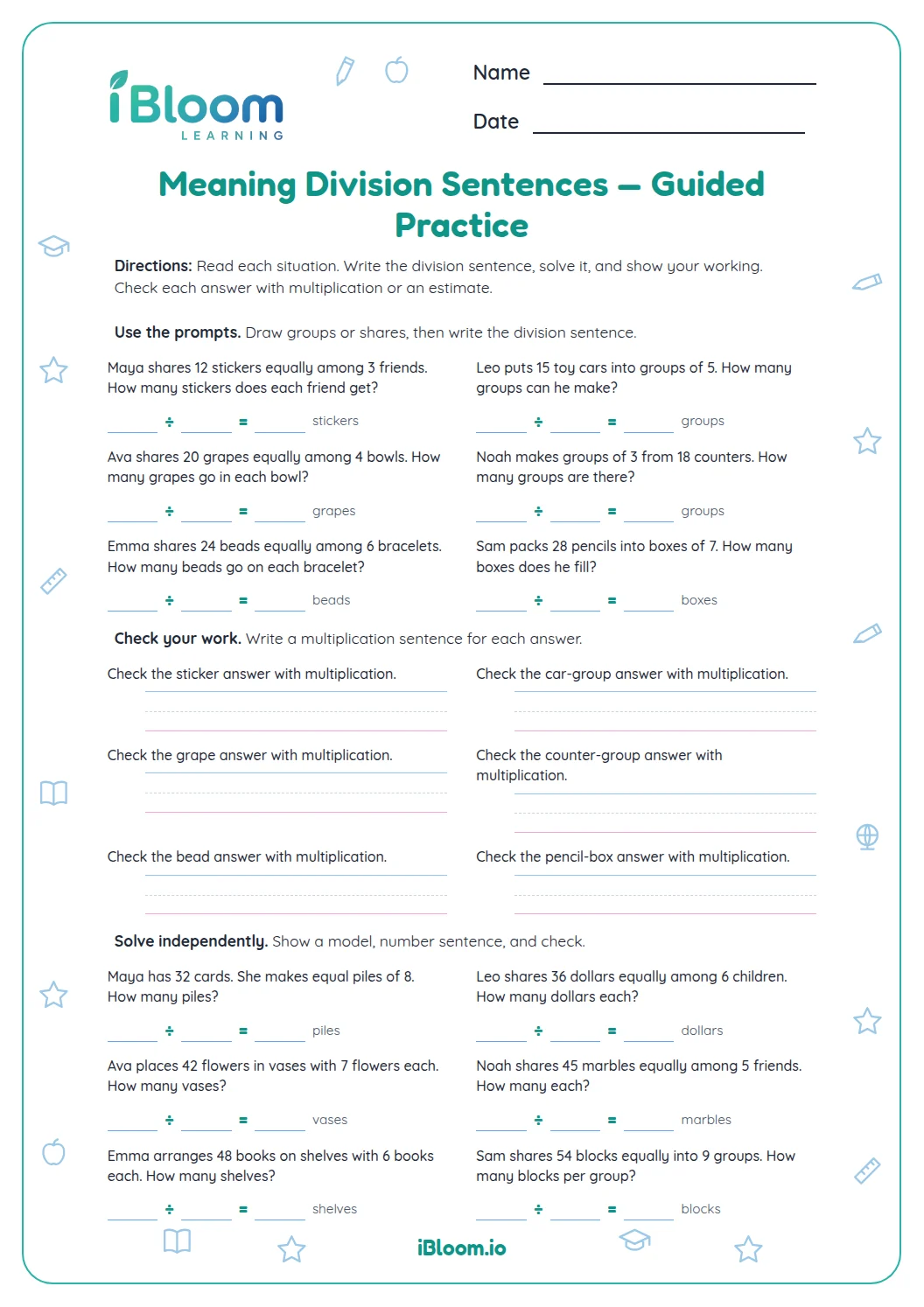
These Grade 3 problems connect division sentences to equal sharing and equal groups. Learners identify what the quotient means, complete missing numbers, and solve everyday situations.
Aligned to 3.OA.A.2
What does a division sentence tell you?
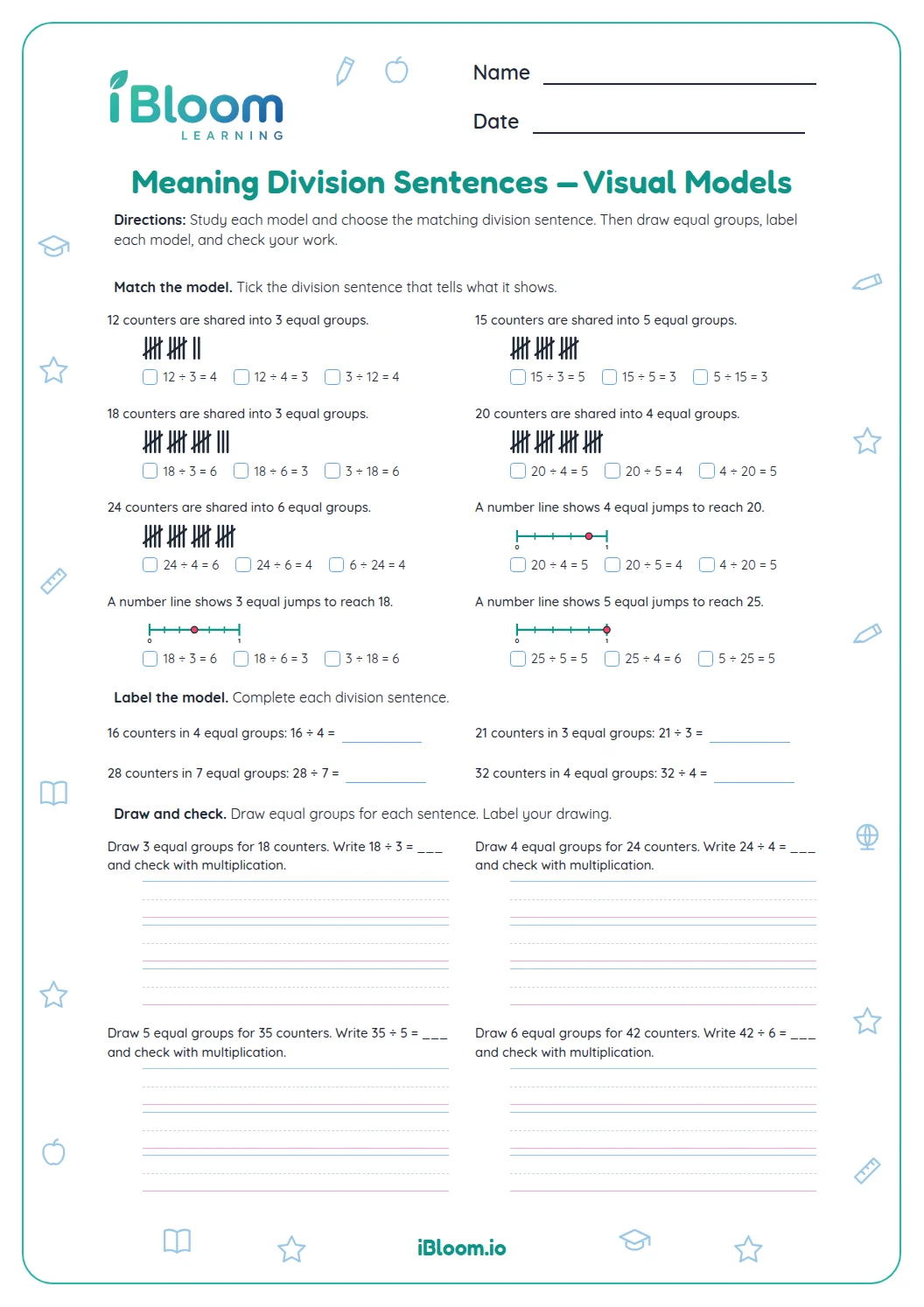
In 24 ÷ 6 = 4, the 24 is the total. If 6 children share it, each child gets 4. If groups contain 6 items, the quotient instead counts the groups.
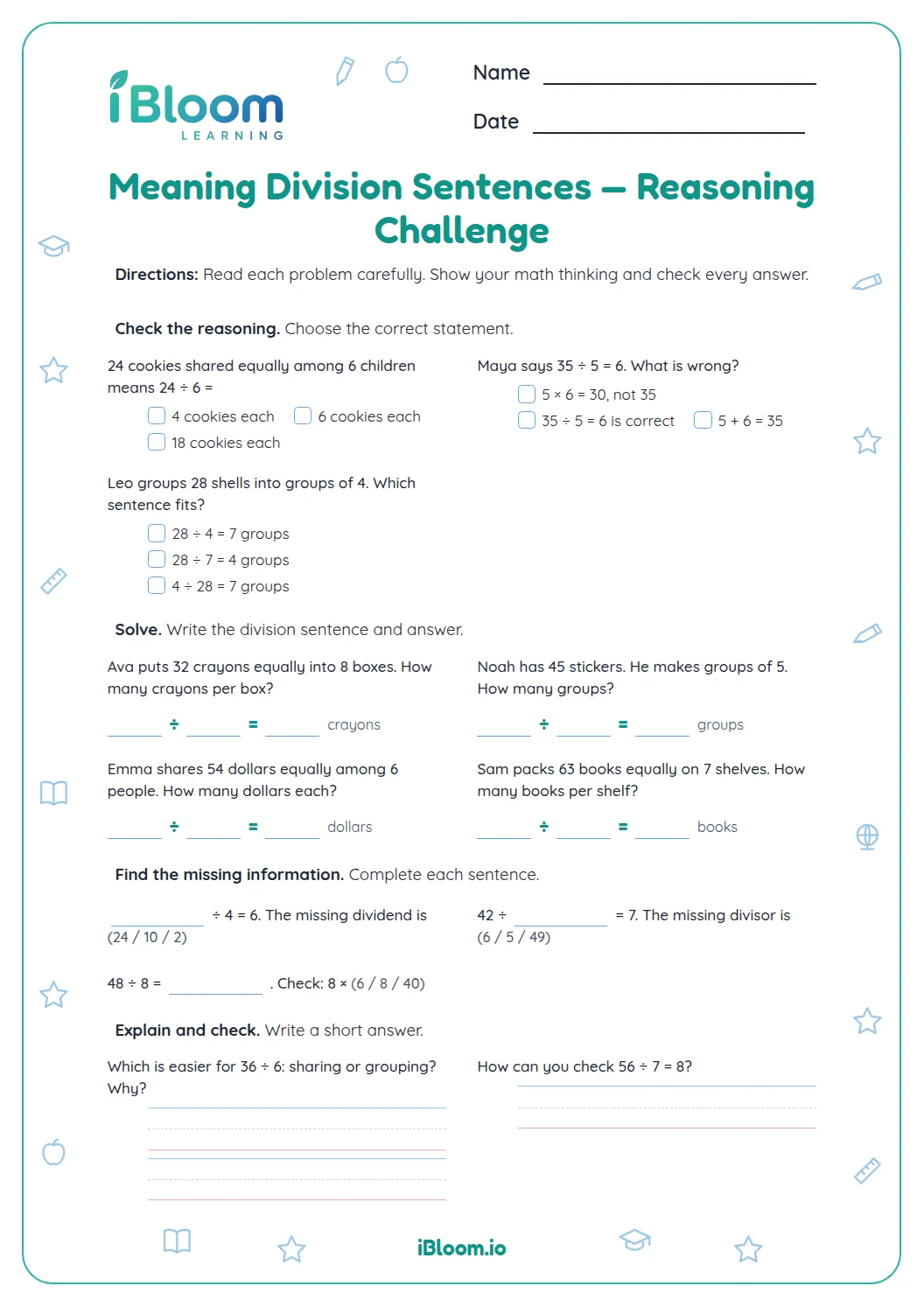
Part A uses full situations, Part B matches stories to equations, and Part C includes missing numbers and problems where children explain what the quotient means.
What will learners practice?
The practice uses equal groups and sharing with whole-number quotients within 100, in line with Grade 3 division work.
- Part A: Interpret division in situations
- Part B: Match stories to equations
- Part C: Complete division facts
- Part D: Solve sharing and grouping stories
How to use this worksheet
- 1Underline the total and identify whether the situation gives the number of groups or the size of each group.
- 2Write total ÷ known number = unknown number.
- 3Add a label to each word-problem answer.
Common mistakes and quick fixes
The mistake
Dividing the group count by the total.
The fix
Start with the total number of objects as the dividend.
The mistake
Giving a quotient without saying what it counts.
The fix
Label it as items per group or number of groups.
Common Core alignment
This worksheet practices the following Common Core skill.
Interpret whole-number quotients in equal-sharing and grouping situations.
On this sheet: Stories require learners to connect each quotient to equal sharing or the number of equal groups.
Show the official wordingHide the official wording
Interpret whole-number quotients of whole numbers.
What to practice next
Make more practice
Further reading
Questions parents and teachers ask
What does the quotient mean?
A quotient can tell how many objects are in each equal share or how many equal groups can be made. Read the story to decide which meaning fits. For example, 24 shared among 6 children gives 4 items per child; groups of 6 from 24 make 4 groups.
How do I write a division sentence?
Start with the total number of objects. Divide it by the known number of equal groups or the number in each group. The quotient is the unknown amount. Add a label in a story problem so it is clear whether the answer counts groups or objects in each group.
What does 40 divided by 5 equal?
40 ÷ 5 = 8. If 40 cards are shared equally by 5 players, each player gets 8 cards. If cards are put into groups of 5, there are 8 groups. The same division fact can describe sharing or grouping; the story tells which interpretation to use.
What is included in the answer key?
The separate key gives each quotient and a unit for the story problems. For written explanations, it provides sample wording that connects the number sentence to the situation. Other correct explanations are acceptable when they correctly identify the total, groups, and meaning of the quotient.
How can I tell whether the quotient counts groups or items per group?
Read what the situation already tells you. If the number of groups is known, the quotient gives the number in each group. If the number in each group is known, the quotient gives the number of groups. The worksheet uses both forms so students can name what each answer represents.