



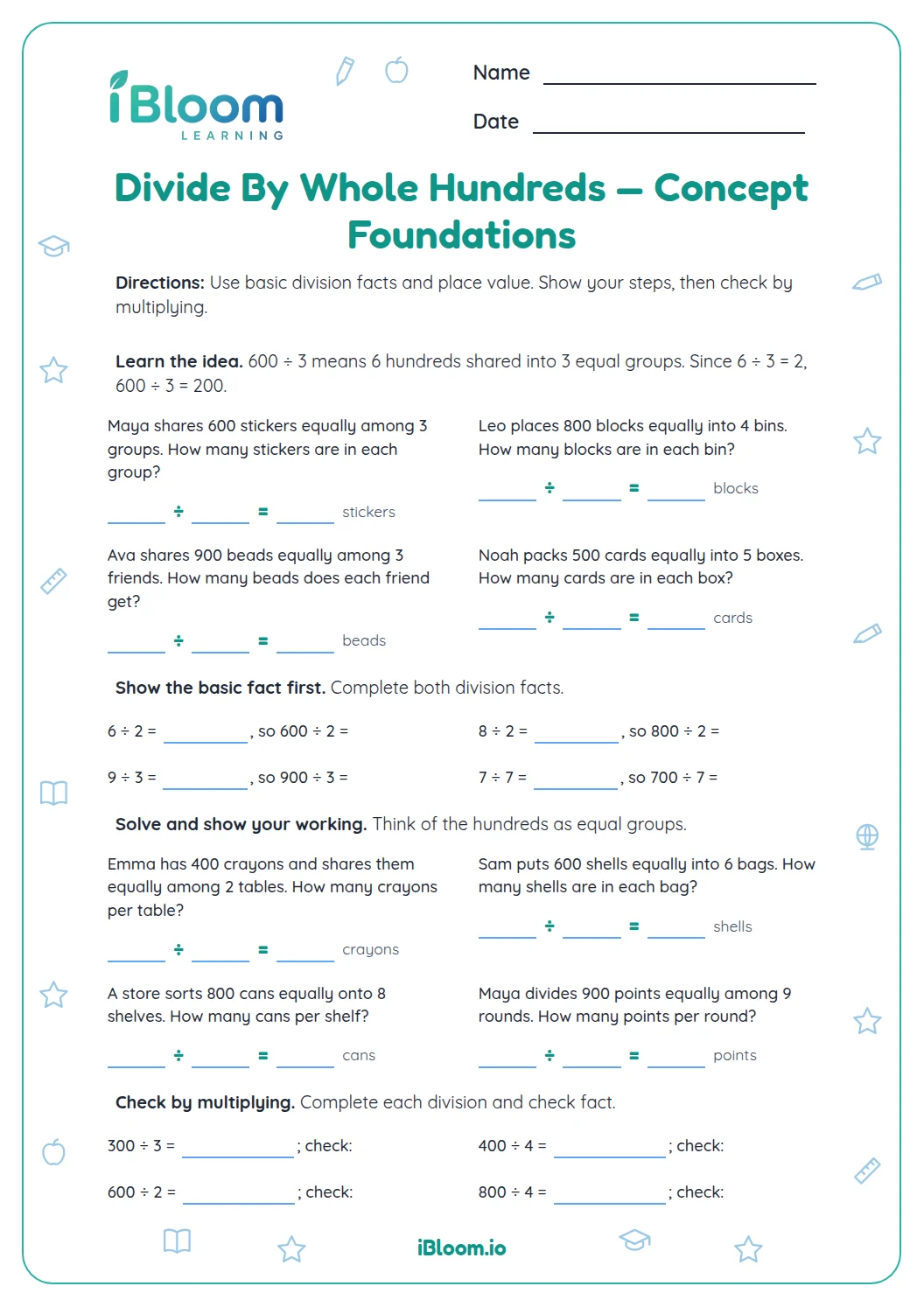


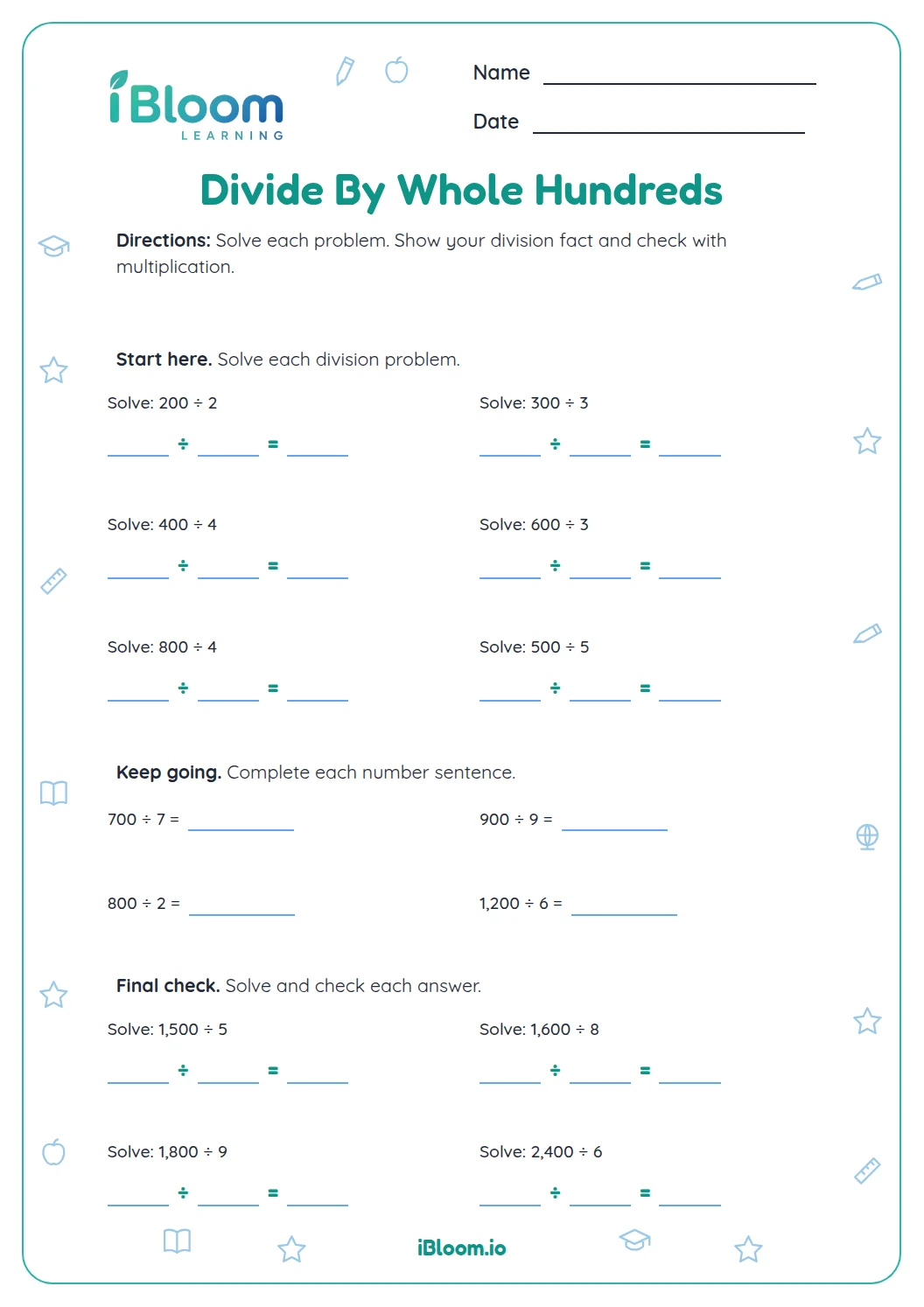
About this worksheet
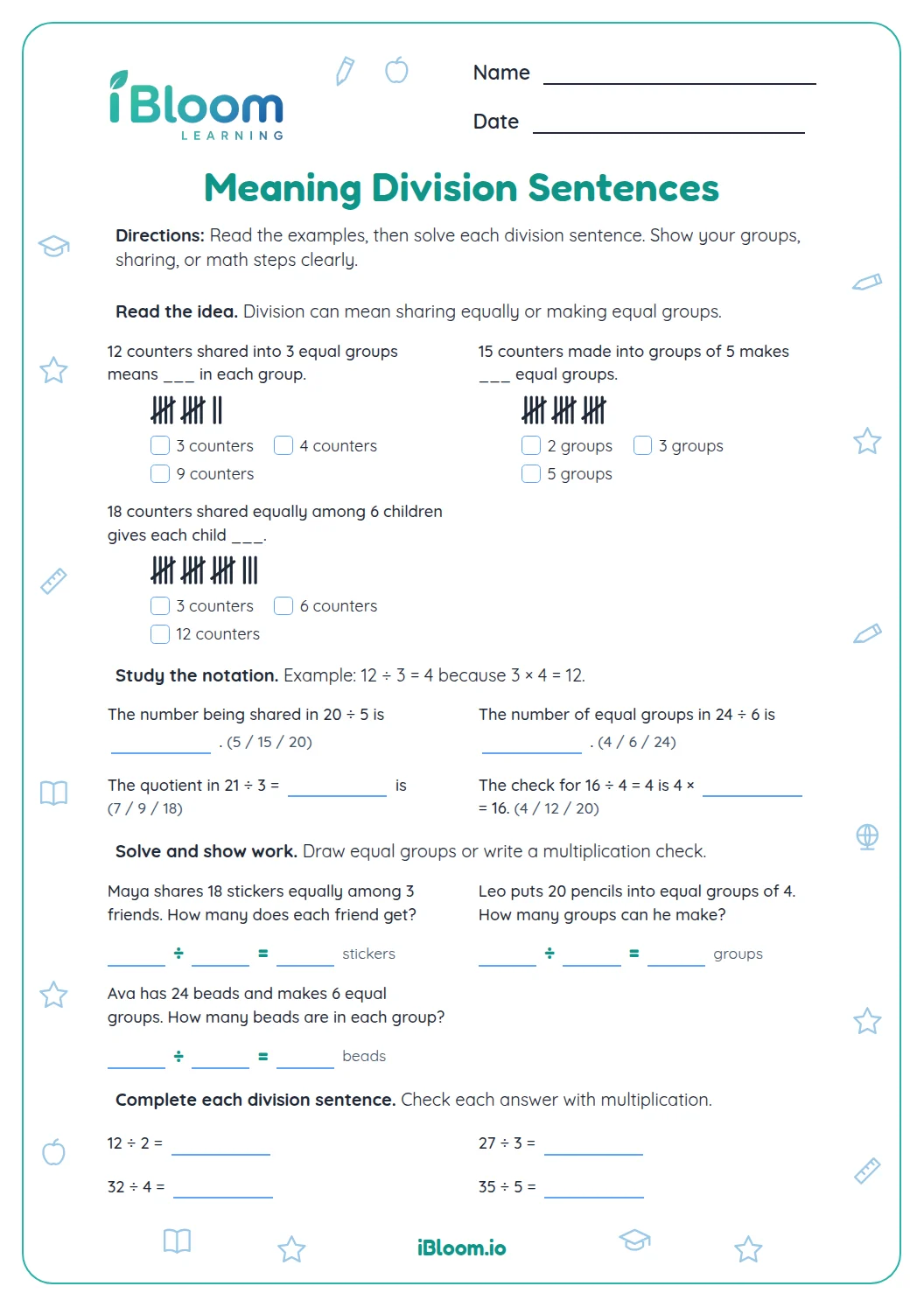
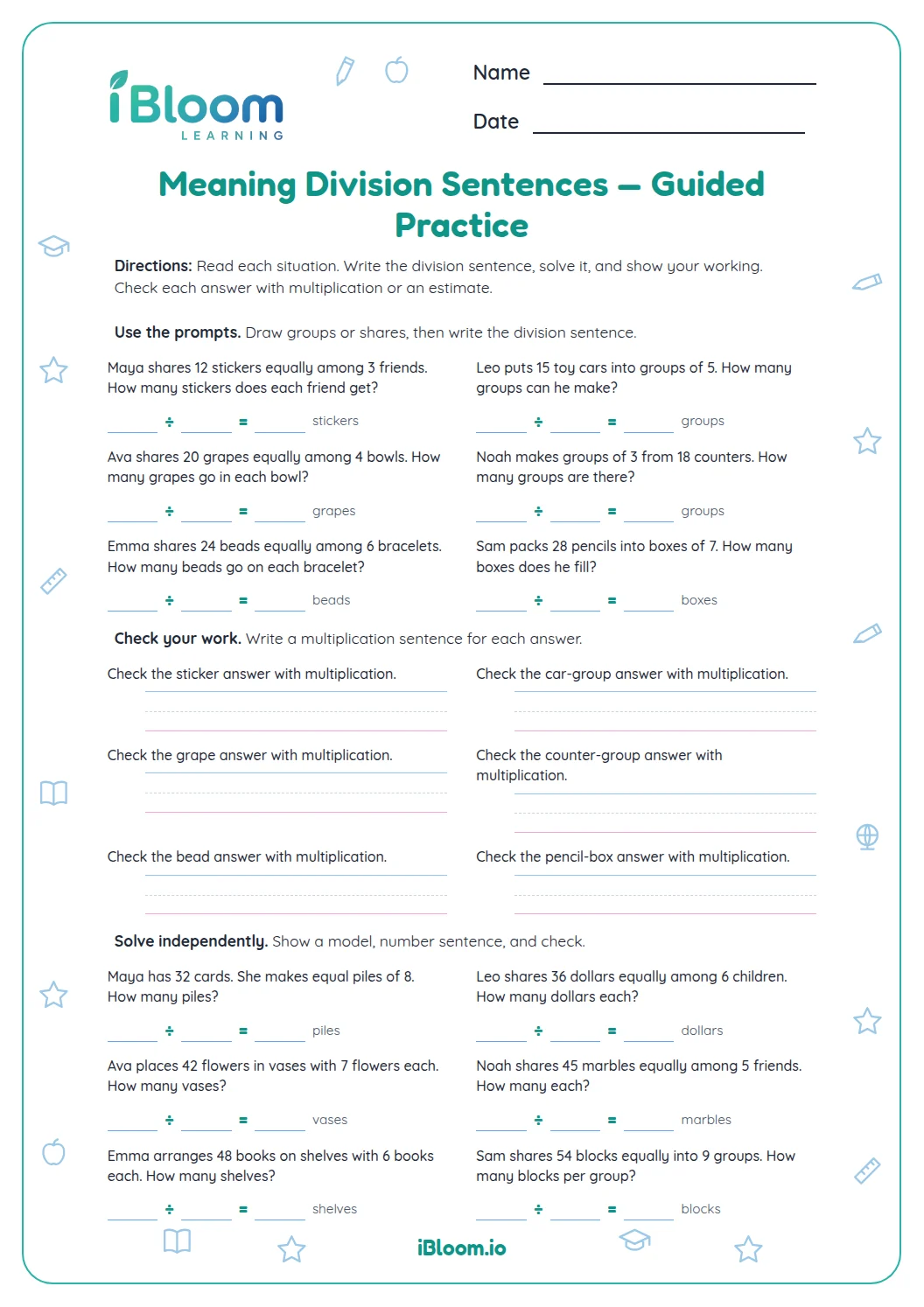
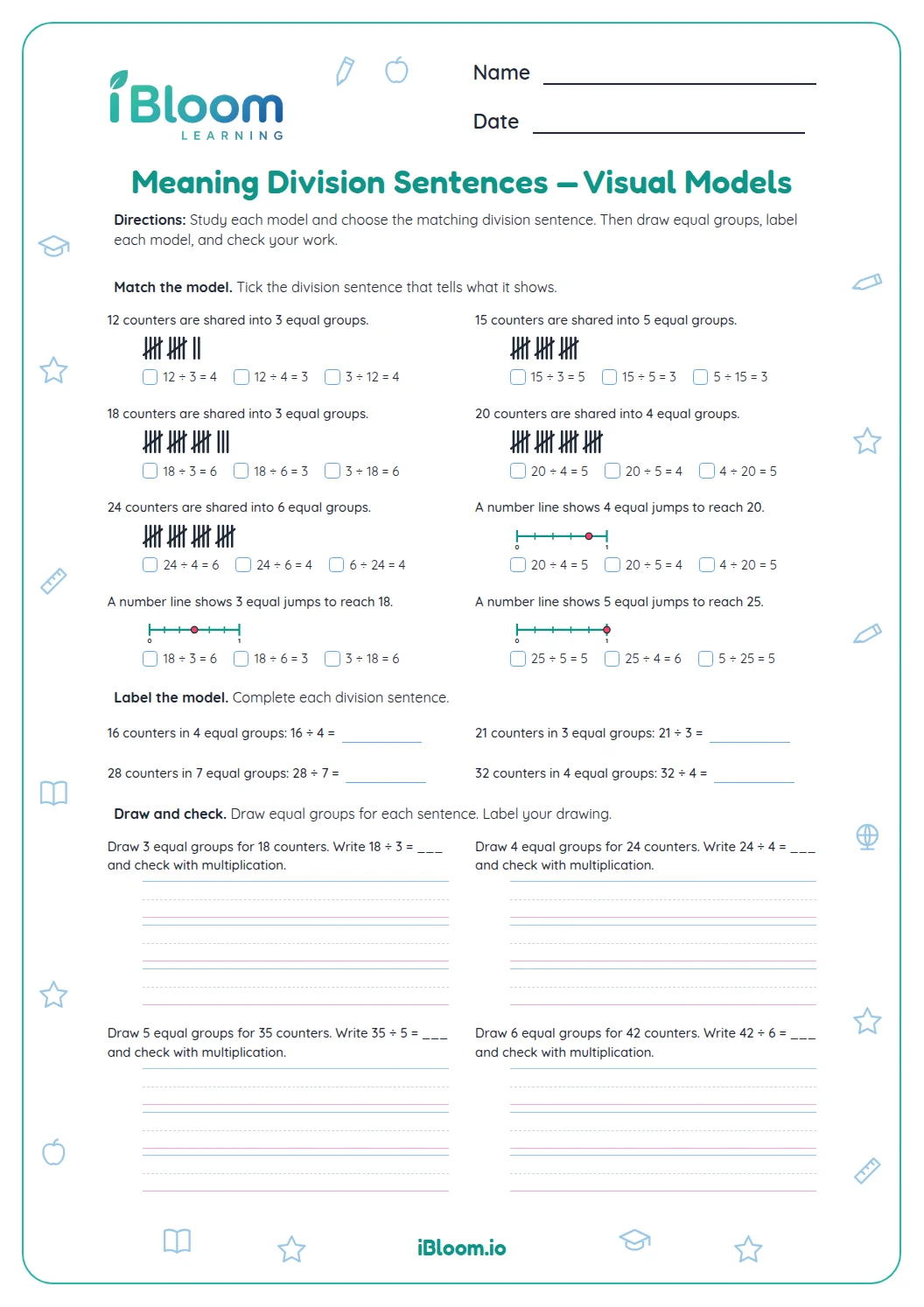
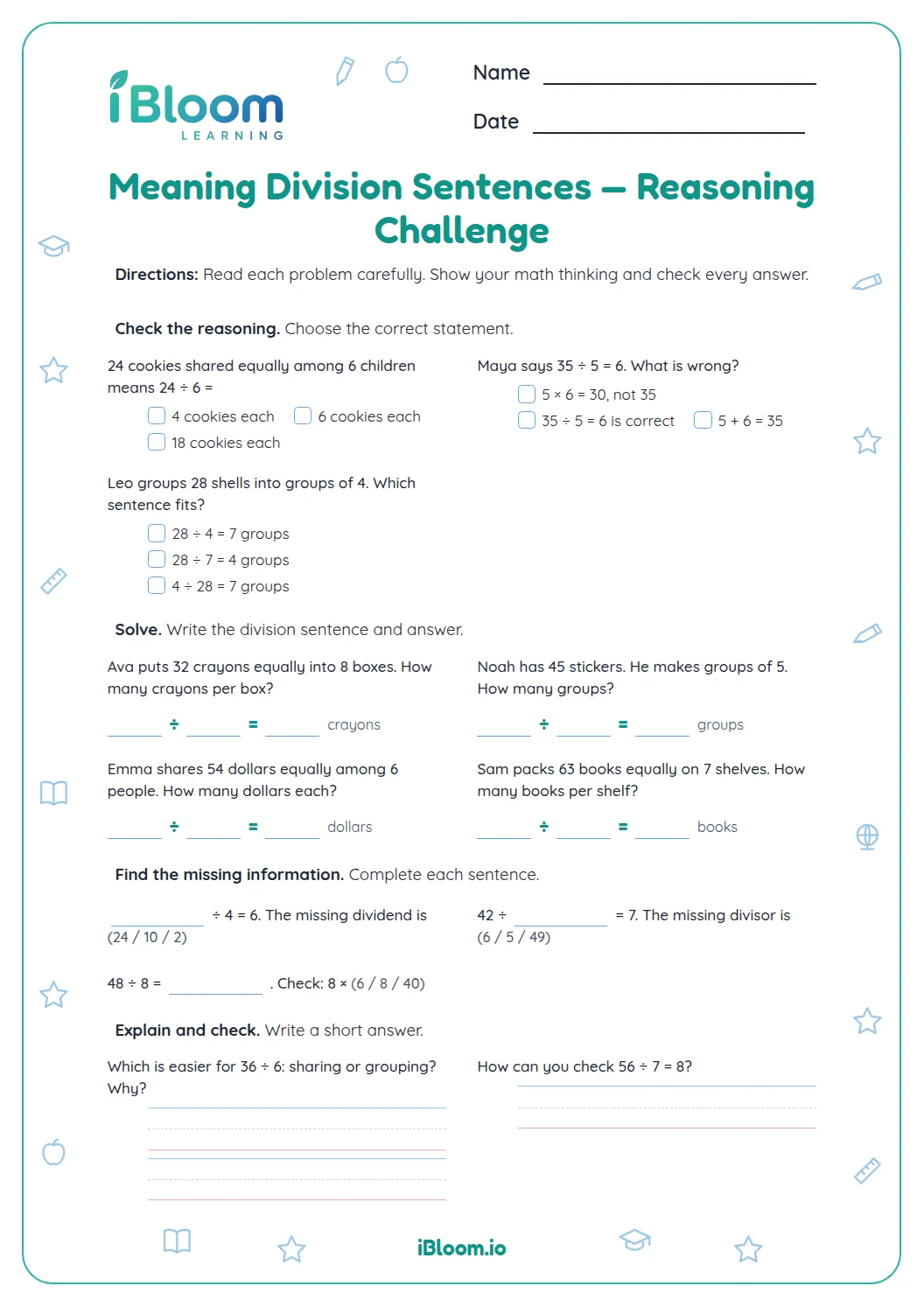
This free printable Grade 3 math worksheet connects division to equal sharing and equal groups. Students read 16 short stories, write a division sentence in the provided workspace, solve it, and label the quotient with its unit. The answer key shows a matching equation and answer for every story. The work practices CCSS 3.OA.A.3, solving word problems involving equal groups with equations.
Aligned to 3.OA.A.3
How do you divide a total into equal shares?
For a sharing story, divide the total by the number of groups to find the amount in each group. Question 1 shares 24 tennis balls among 6 teams, so 24 ÷ 6 = 4 balls per team.
- 1Total: 24 tennis balls.
- 2Number of equal teams: 6.
- 324 ÷ 6 = 4 tennis balls per team.
How do you count equal groups?
For a grouping story, divide the total by the amount in each group to find the number of groups. In question 9, 32 campers form teams of 4, so 32 ÷ 4 = 8 teams.
How can you check a division sentence?
Multiply the quotient by the divisor. The product should equal the original total. Include the unit in the final answer so it names what the quotient counts.
How to use this worksheet
- 1Read the story and identify the total.
- 2Decide whether the unknown is the size of a share or the number of groups.
- 3Write the total ÷ known group amount or number of groups.
- 4Solve the division sentence and label the quotient.
- 5Multiply to check that the quotient and divisor rebuild the total.
Common mistakes and quick fixes
The mistake
Dividing by the total instead of the number of groups or group size.
The fix
Circle the total and underline the known group amount before writing the equation.
The mistake
Confusing the number in each group with the number of groups.
The fix
Ask whether the story gives the groups or the amount in each group.
The mistake
Leaving the unit off the quotient.
The fix
Name what the answer counts, such as balls, teams, or cartons.
Curriculum alignment
This worksheet practices the skill described in the standard below.
Solve equal-group and equal-sharing word problems using division.
On this sheet: Students represent equal-sharing and equal-grouping word problems with division equations.
Show the official wordingHide the official wording
Use multiplication and division within 100 to solve word problems in situations involving equal groups, arrays, and measurement quantities, e.g., by using drawings and equations with a symbol for the unknown number to represent the problem.
What to practice next
Further reading
Questions parents and teachers ask
How many division problems are included?
The worksheet has 16 word problems: eight equal-sharing stories and eight equal-grouping stories. Students write a division sentence and solve each problem in the workspace, then check with the separate answer key. Ask the student to point out the total and explain what the quotient counts in the story.
What does equal sharing mean?
Equal sharing starts with a total and a known number of groups, then finds how many items belong in each group. For example, 24 balls shared among 6 teams gives 4 balls per team. Ask the student to point out the total and explain what the quotient counts in the story.
What does making equal groups mean?
Making equal groups starts with a total and a known group size, then finds how many groups can be made. For example, 32 campers arranged in teams of 4 make 8 teams. Ask the student to point out the total and explain what the quotient counts in the story.
Does the answer key show equations?
Yes. The key gives a division sentence and a labeled quotient for all 16 stories. Students can check both the equation and the unit to see whether the answer matches what the problem asks. Ask the student to point out the total and explain what the quotient counts in the story.
How can a child check a quotient?
Multiply the quotient by the divisor. The product should equal the total in the story. For 24 ÷ 6 = 4, check 4 × 6 = 24, then label the answer as 4 balls per team. Ask the student to point out the total and explain what the quotient counts in the story.