






About this worksheet
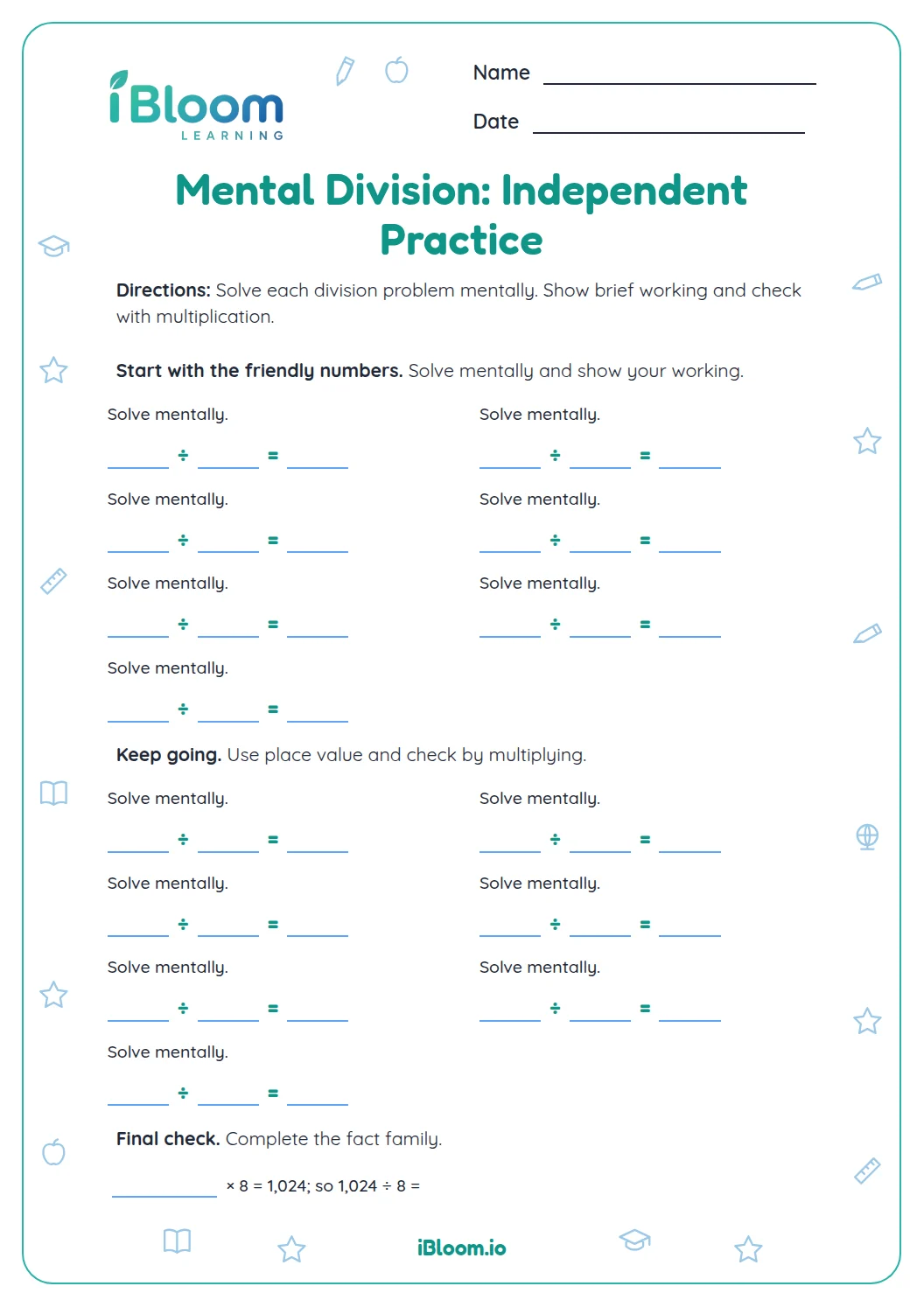
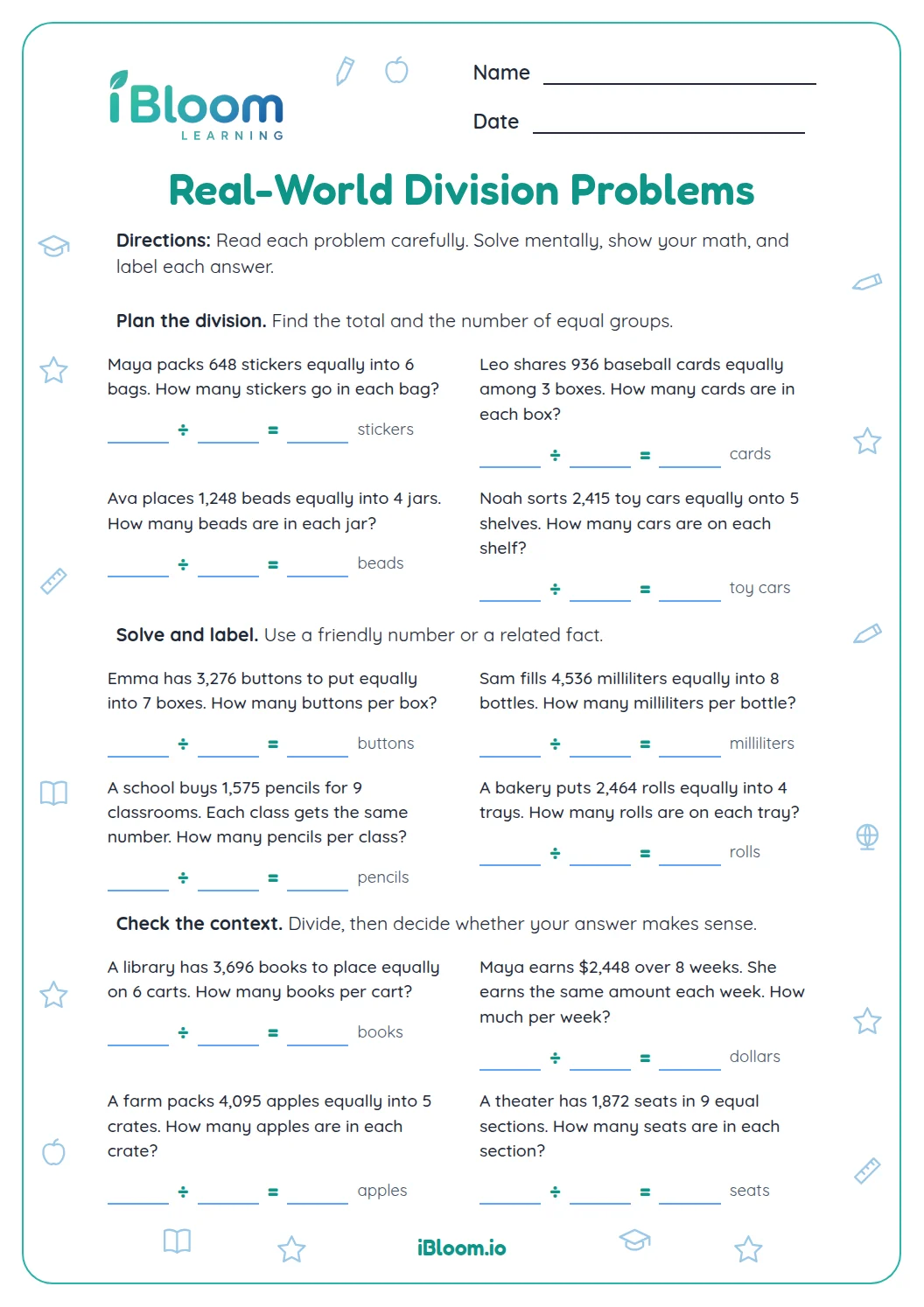
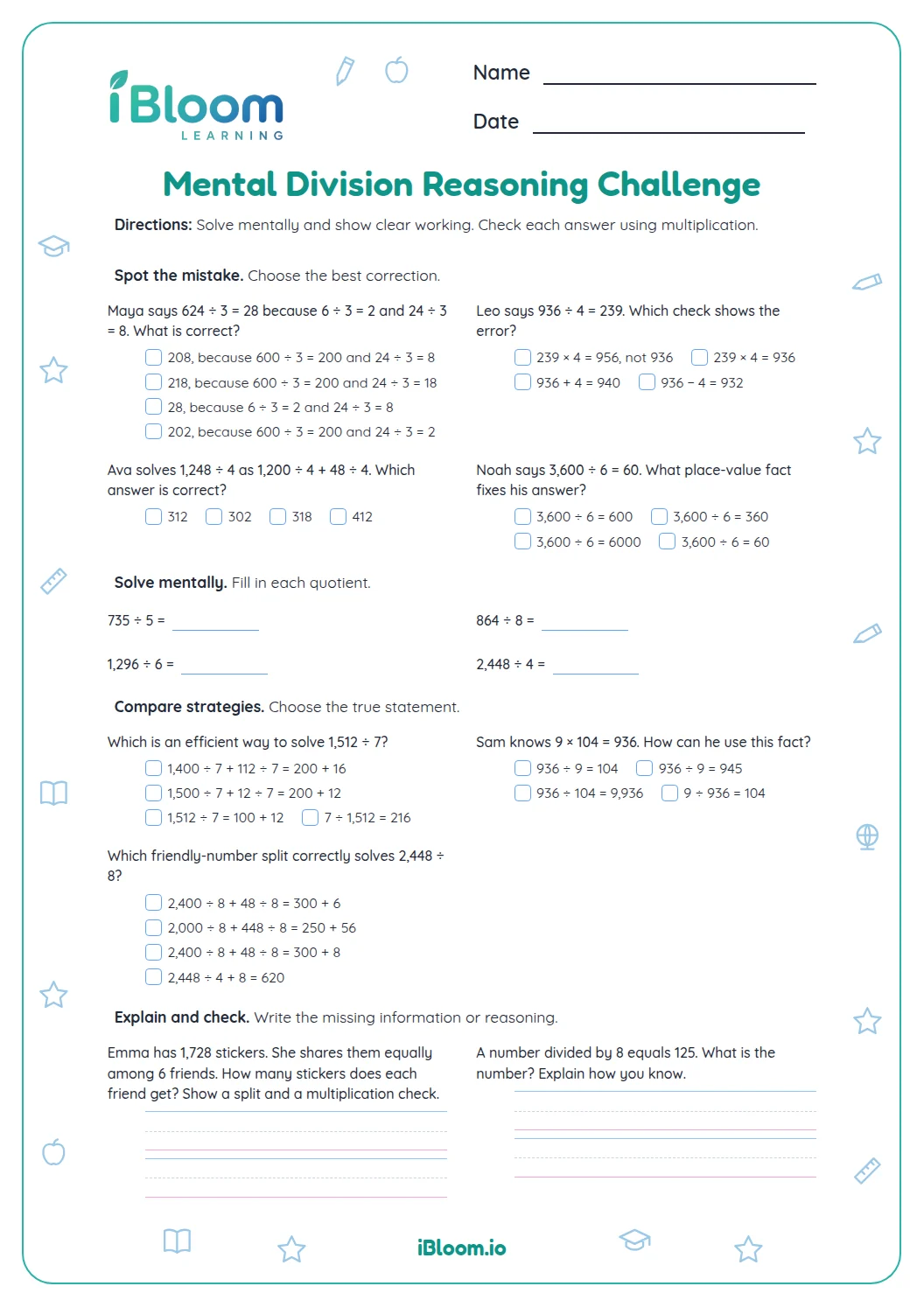
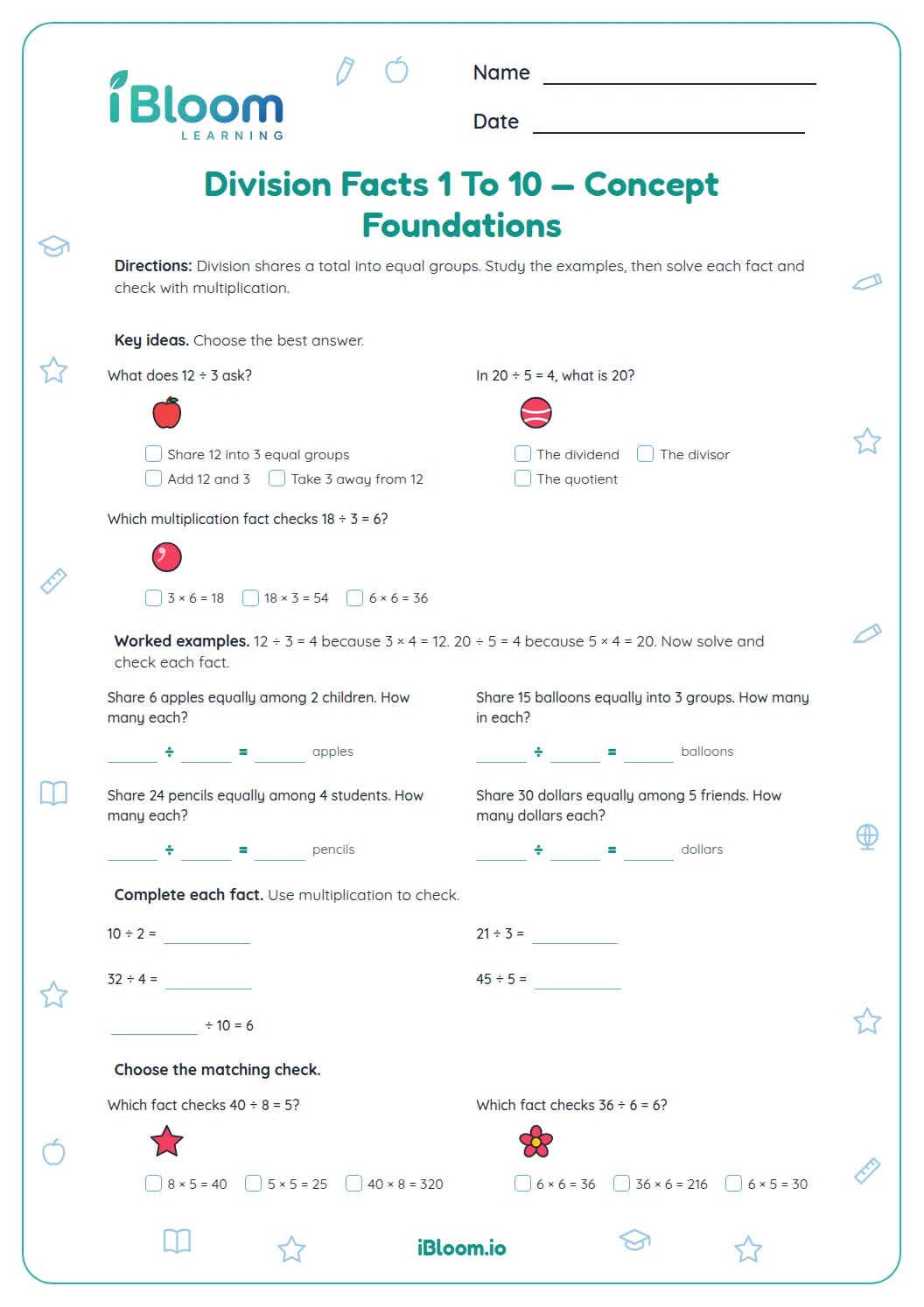
This Grade 4 printable practices mental division with three- and four-digit dividends and one-digit divisors. Students use place-value parts and related multiplication facts to find exact quotients across 16 questions. The answer key lists each quotient so students can check their calculations.
Aligned to 4.NBT.B.6
How can place-value parts help?
Split a dividend into parts that divide evenly by the divisor. For 864 ÷ 4, use 800 ÷ 4 and 64 ÷ 4, then add 200 + 16.
- 1800 ÷ 4 = 200
- 264 ÷ 4 = 16
- 3200 + 16 = 216
How does a related fact help?
Use multiplication facts to divide each friendly part. The divisor and quotient should multiply back to the dividend.
How can you check a quotient?
Multiply the quotient by the divisor. If the product is the original dividend, the division answer is correct.
How to use this worksheet
- 1Estimate the size of the quotient.
- 2Split the dividend into parts divisible by the divisor.
- 3Divide each part using a known fact.
- 4Add the partial quotients.
- 5Multiply to check the answer.
Common mistakes and quick fixes
The mistake
Dividing only the first digit and ignoring place value.
The fix
Split the whole dividend into place-value parts first.
The mistake
Forgetting a partial quotient.
The fix
List the quotient for each part, then add them.
The mistake
Checking with addition instead of multiplication.
The fix
Multiply the quotient by the divisor and compare with the dividend.
Common Core alignment
Use place-value and multiplication relationships to find quotients and remainders.
On this sheet: mental division of 3- and 4-digit numbers practice on the worksheet.
Show the official wordingHide the official wording
Find whole-number quotients and remainders with up to four-digit dividends and one-digit divisors, using strategies based on place value, the properties of operations, and/or the relationship between multiplication and division. Illustrate and explain the calculation by using equations, rectangular arrays, and/or area models.
What to practice next
Make more practice
Further reading
Questions parents and teachers ask
What does mental division mean here?
Mental division means using number relationships and place value instead of relying only on a written long-division layout. This worksheet uses exact quotients with three- and four-digit dividends divided by one-digit numbers. Students may jot supporting steps as they work.
How can I solve 864 divided by 4?
Break 864 into 800 and 64. Divide each part by 4 to get 200 and 16, then add the partial quotients for 216. Question 1 uses this strategy, and the answer key confirms the final quotient. The key gives 216 for this example.
What does the answer key include?
The key lists the quotient for each of the 16 division questions. Students can also multiply each quotient by the divisor to check the original dividend. This gives a quick way to spot a place-value or multiplication fact error.
Are all answers whole numbers?
Yes. Each dividend on the worksheet is an exact multiple of its one-digit divisor, so every quotient is a whole number. Students can use multiplication to verify each response and see whether the product matches the dividend. Each answer can be checked with multiplication.
Which grade is this worksheet for?
The sheet is labeled Grade 4 and practices division of multi-digit whole numbers by one-digit divisors. Its questions use three- and four-digit dividends, and the page alignment identifies the division standard used for this work. The worksheet and key use this grade label.