





About this worksheet
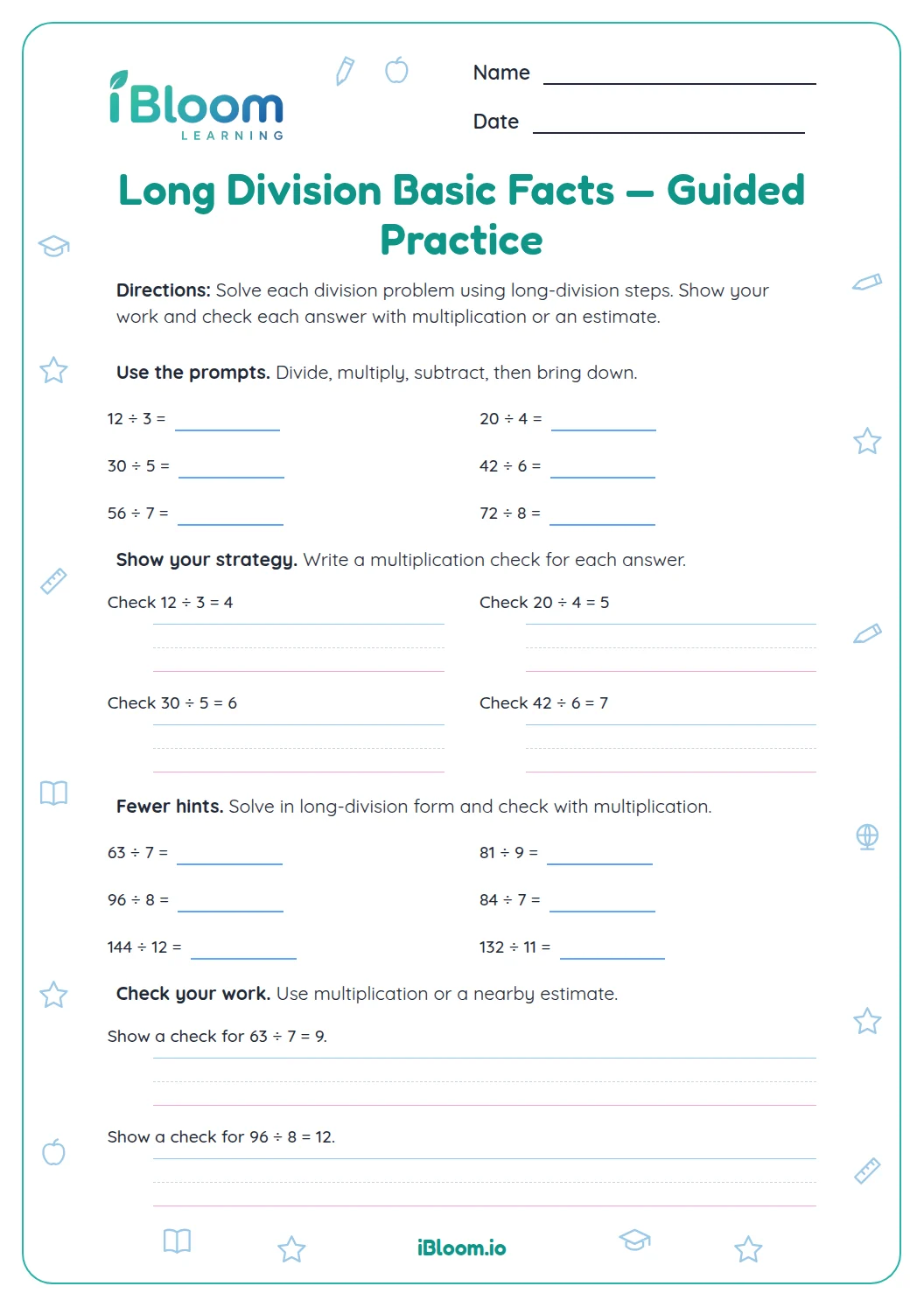
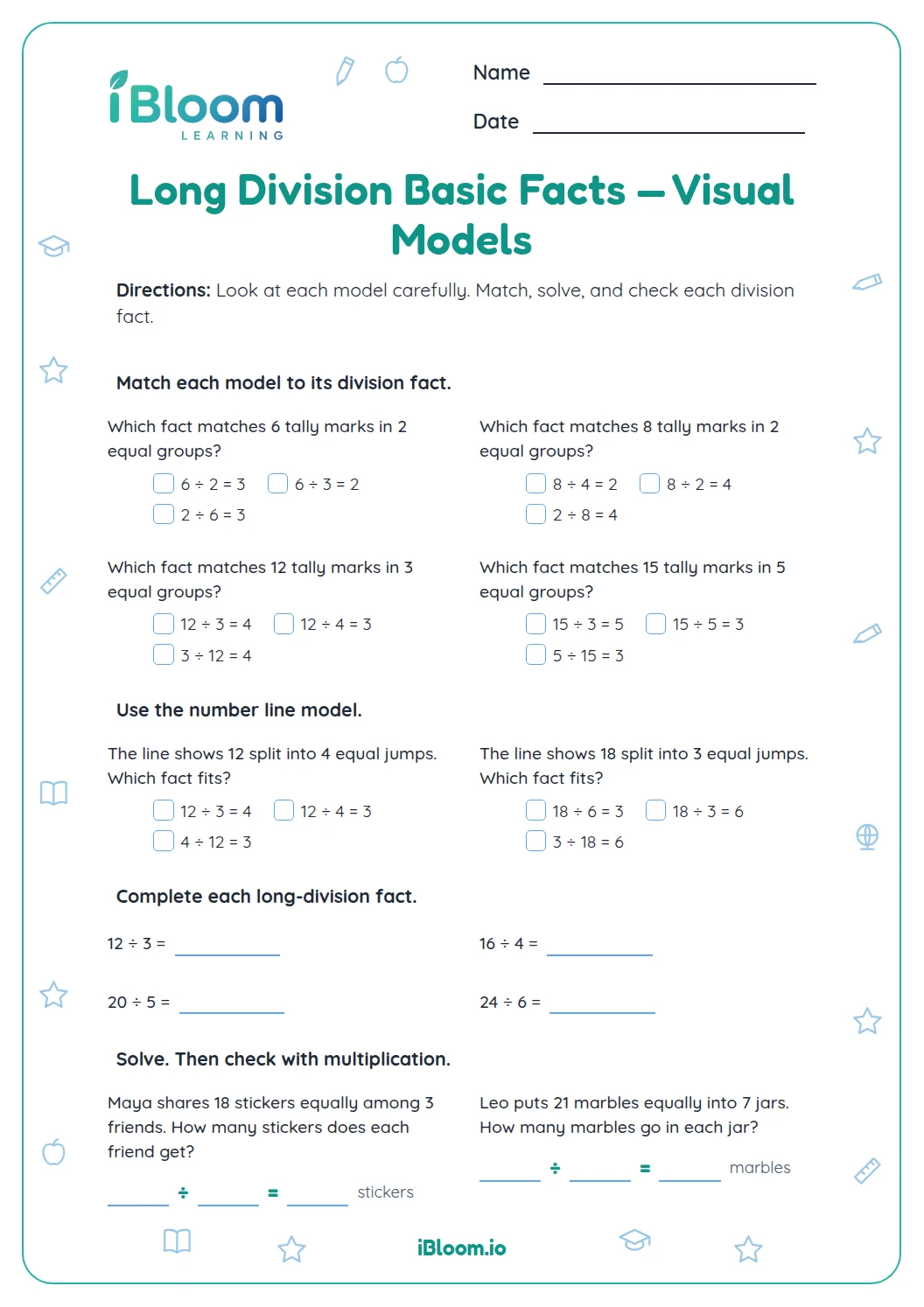
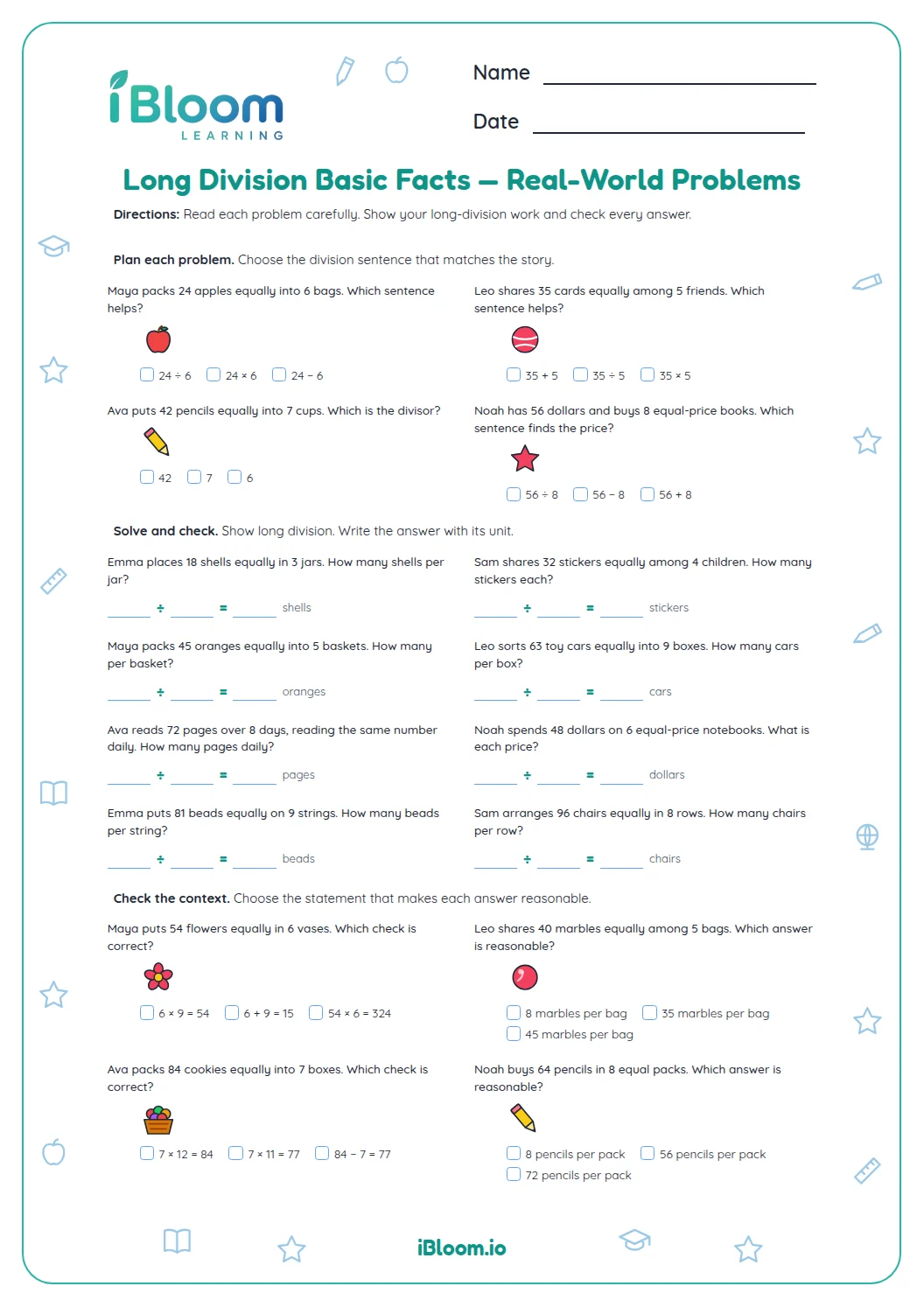
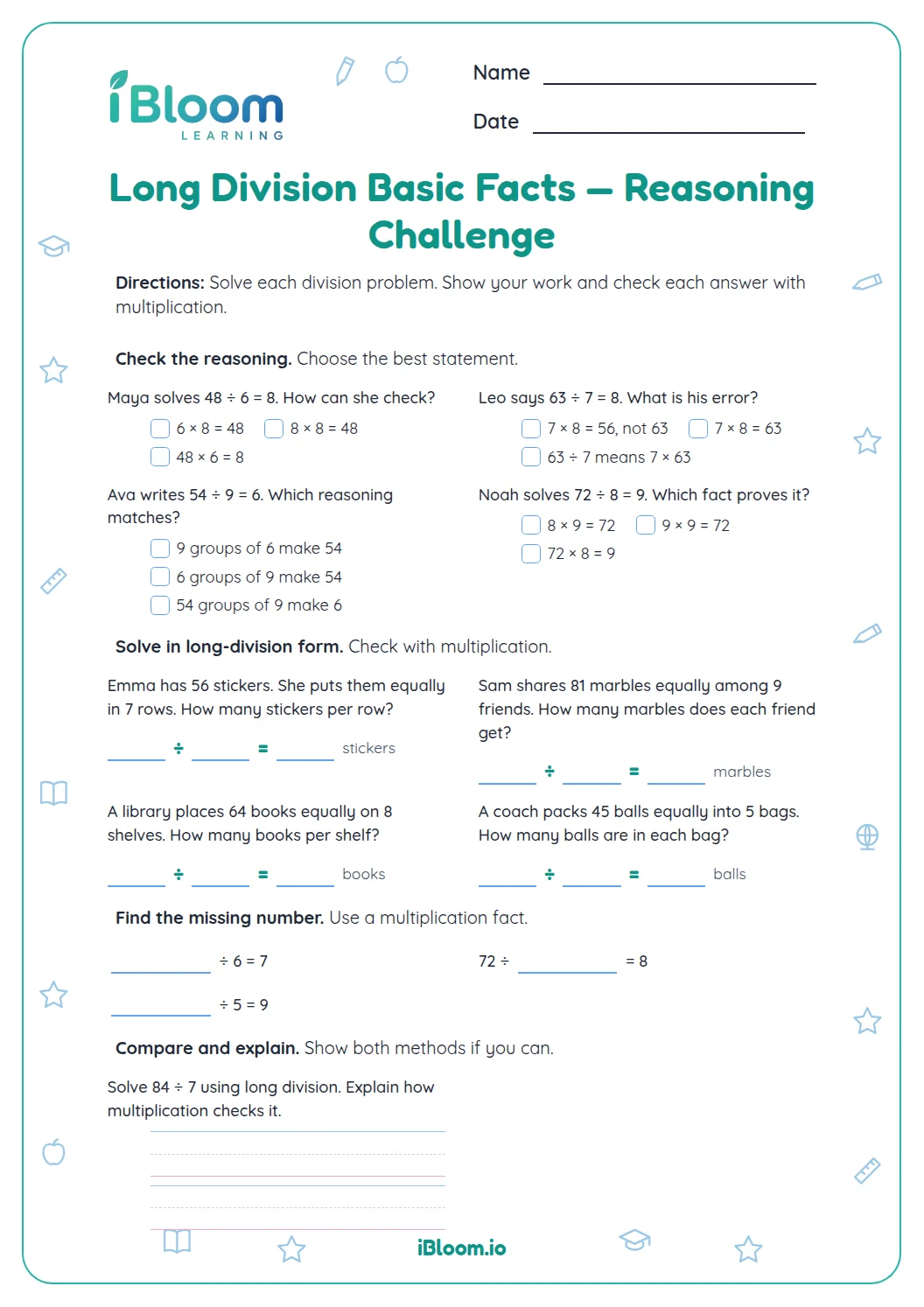
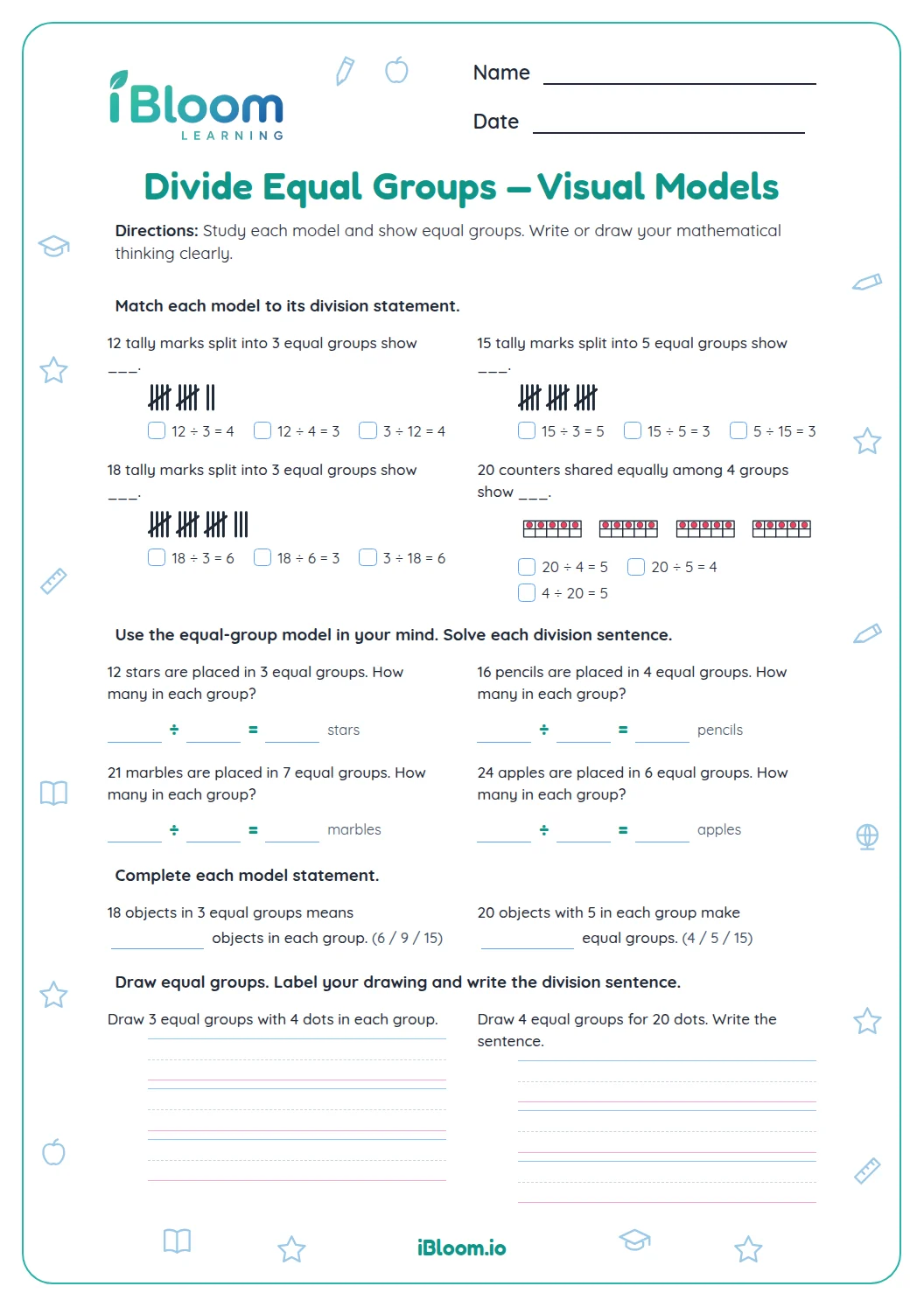
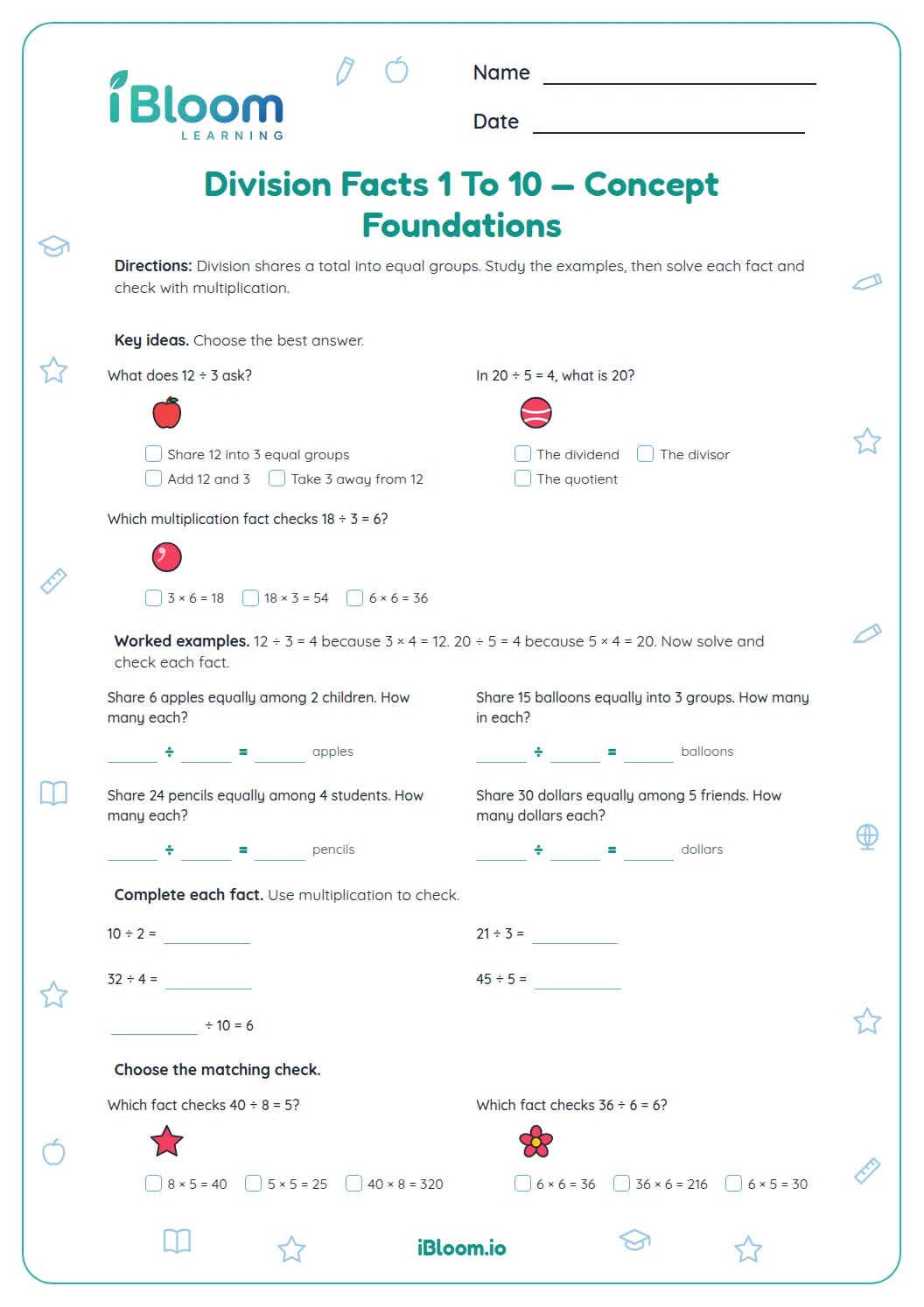
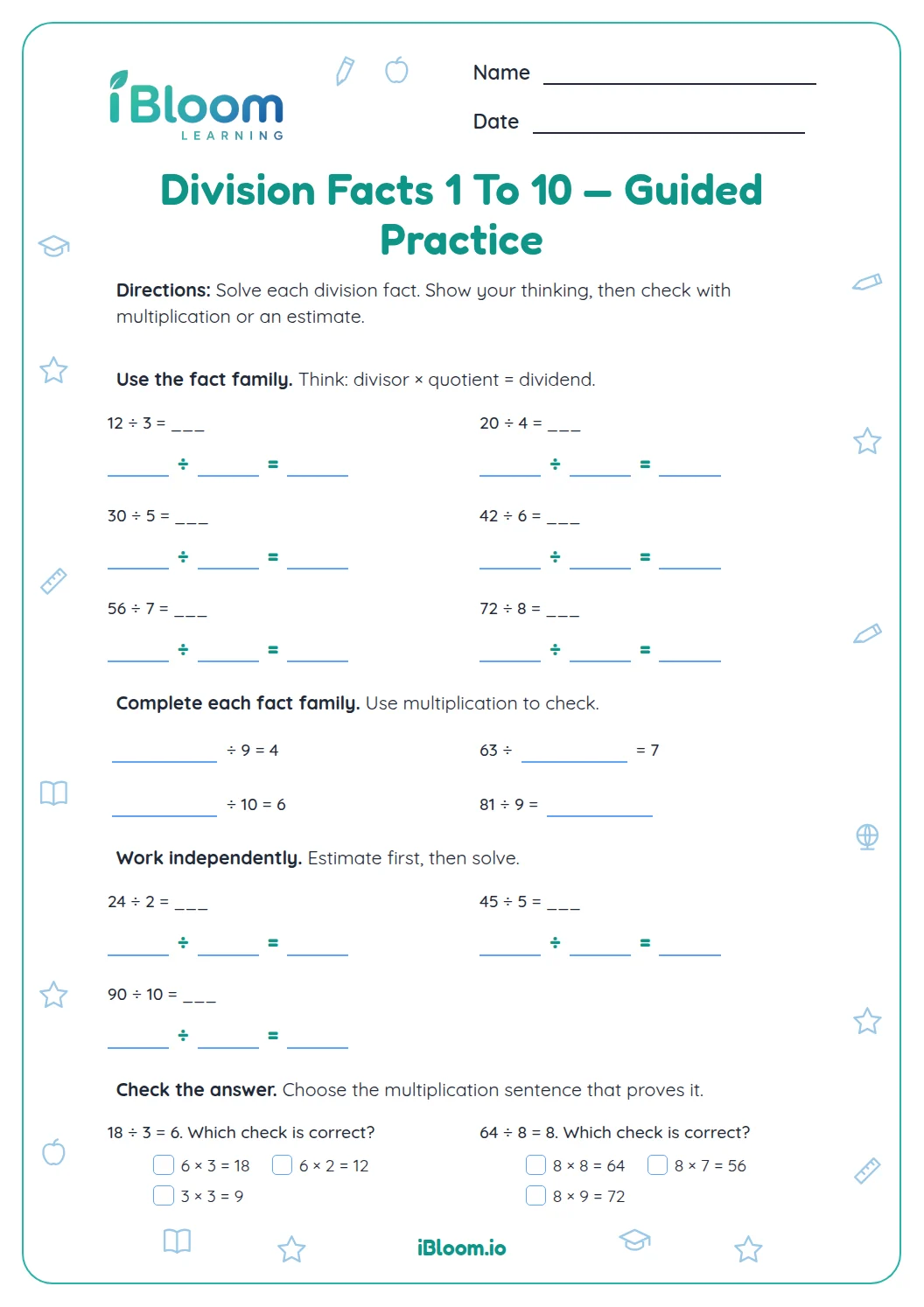
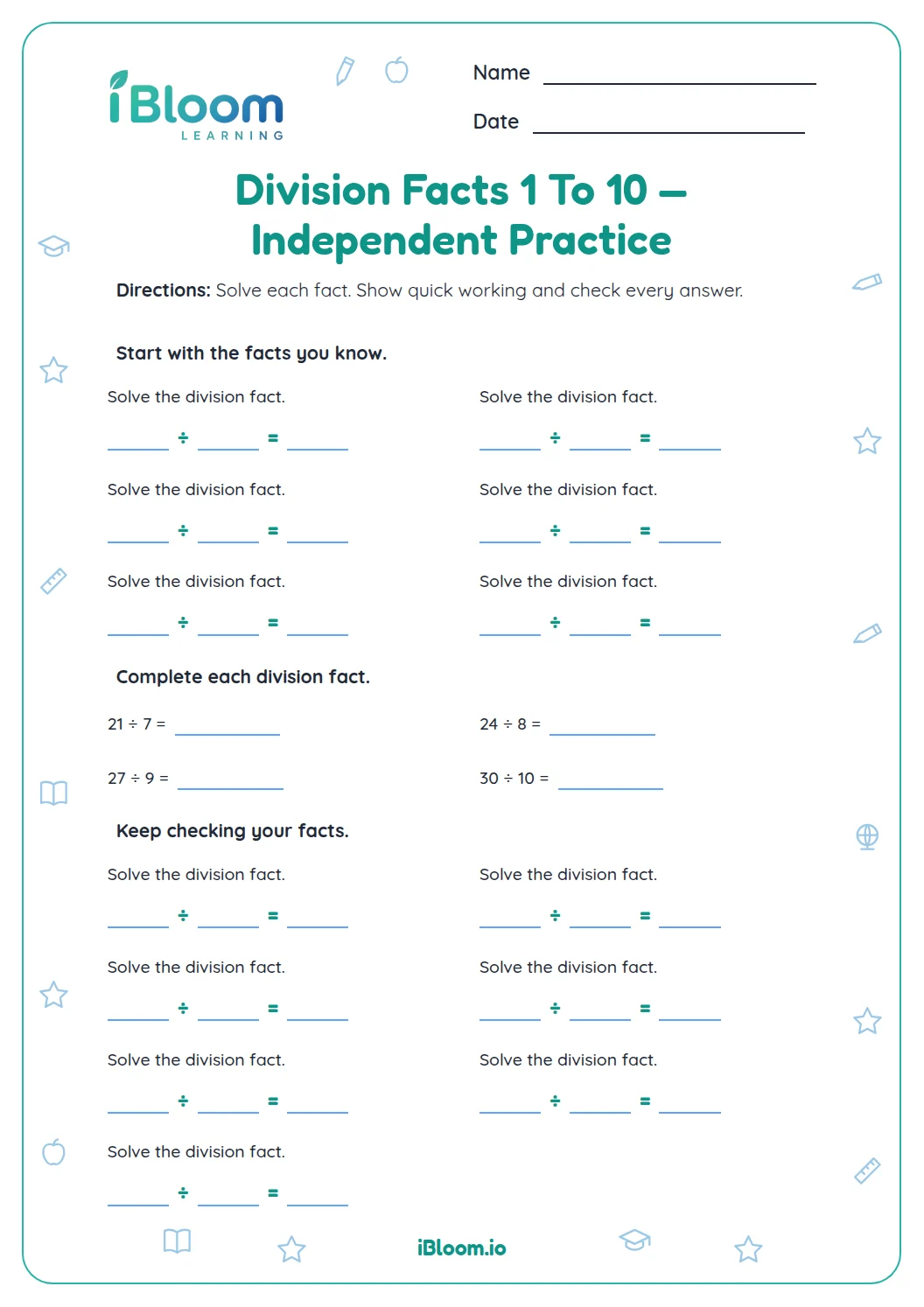
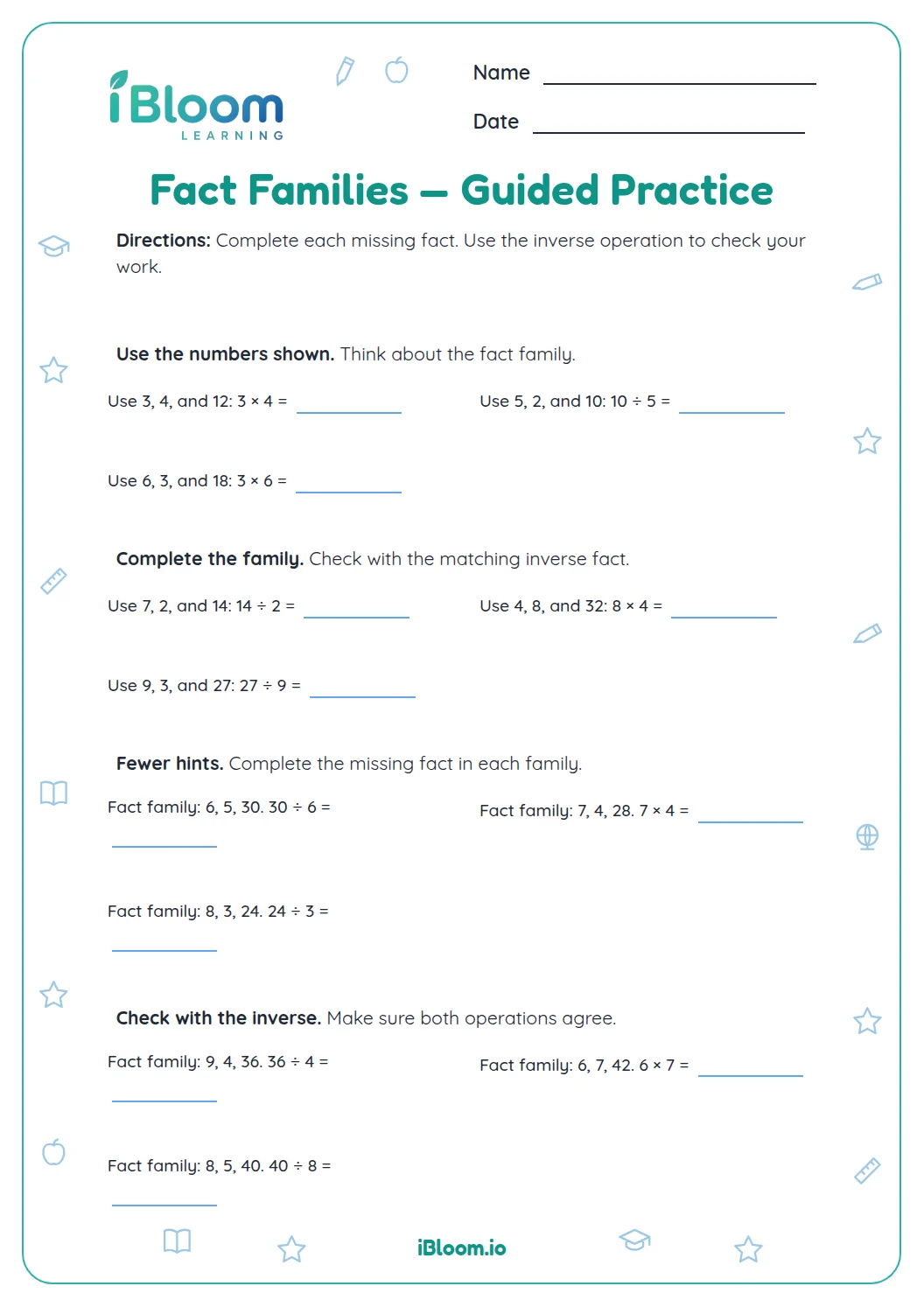
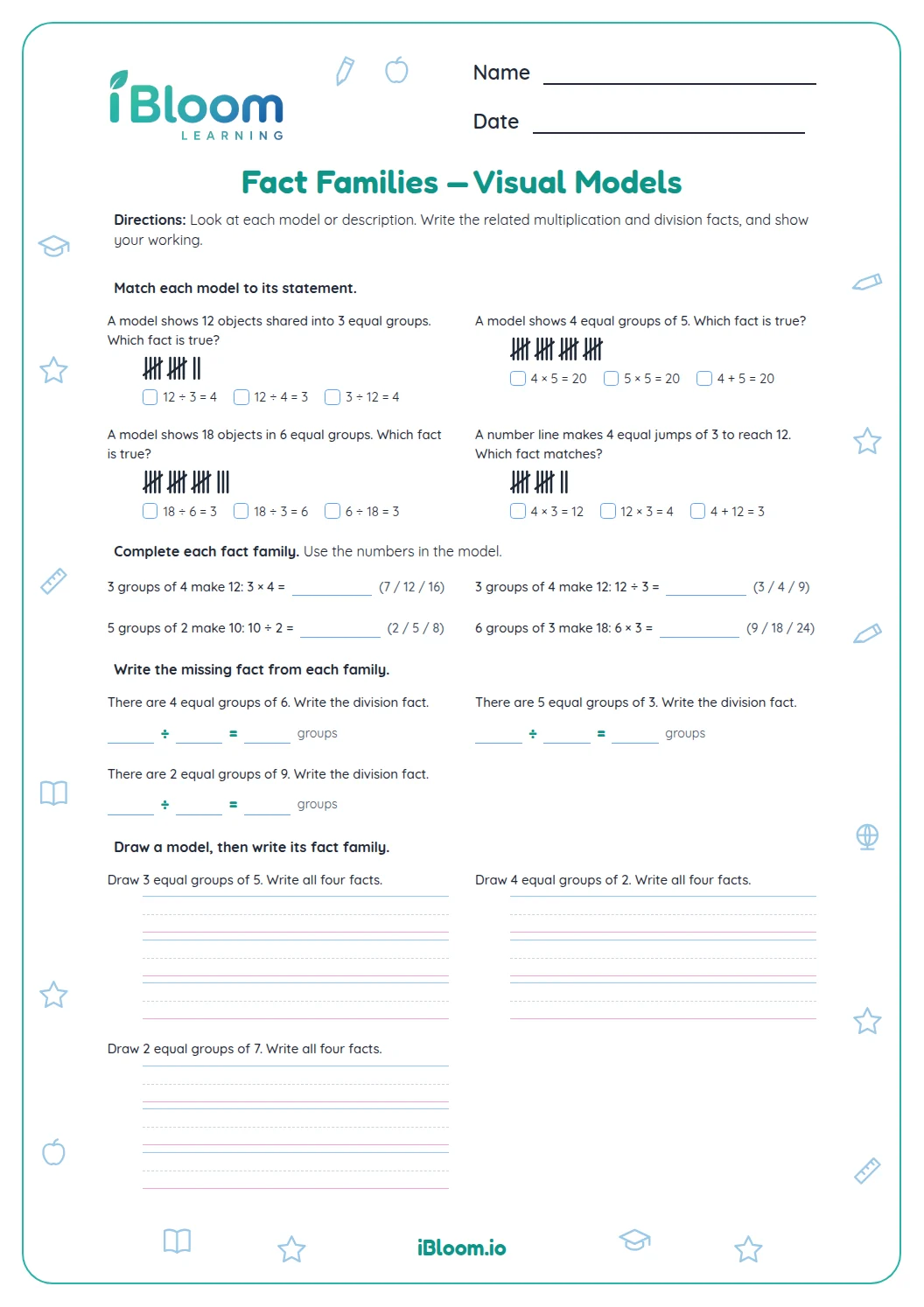
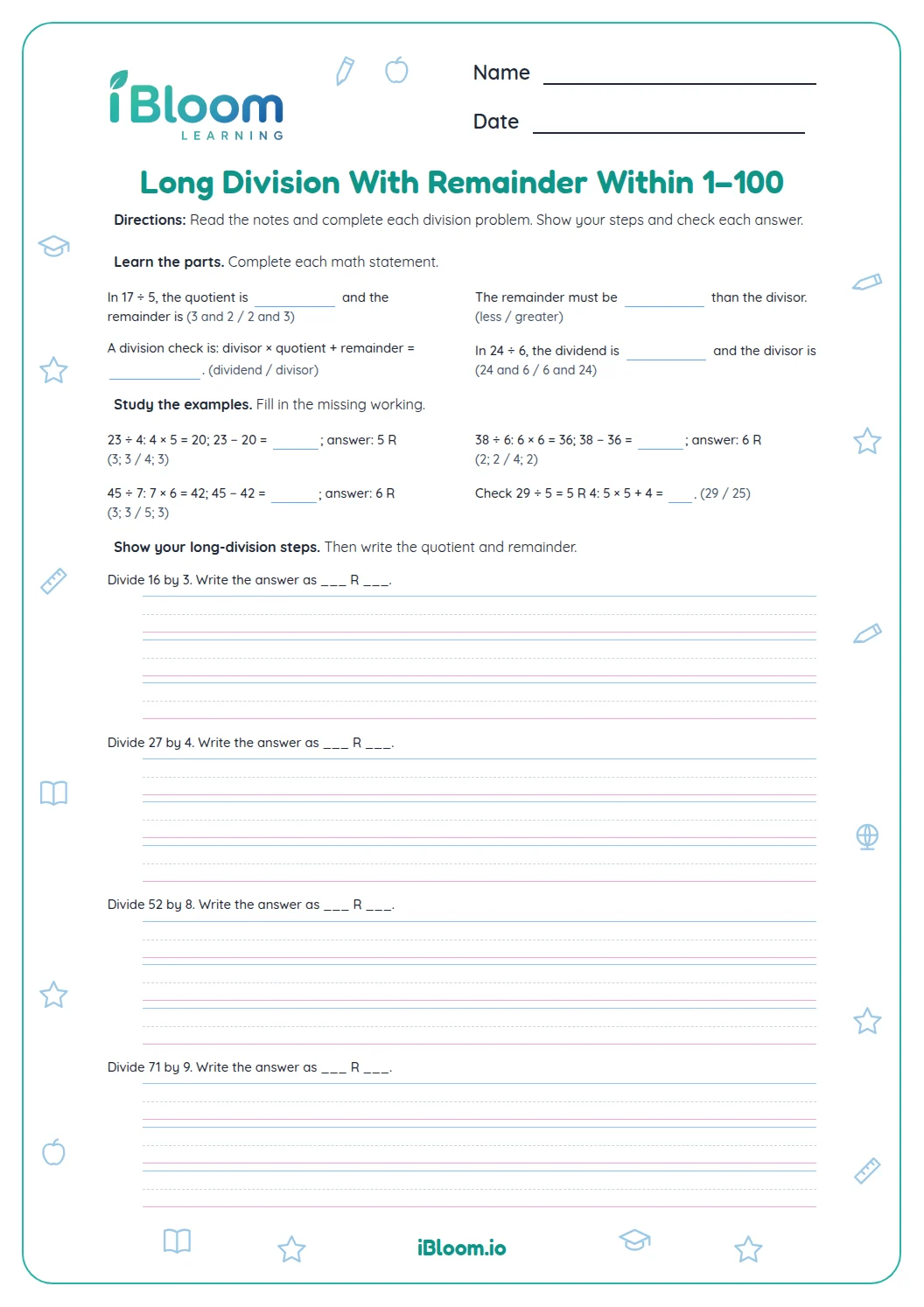
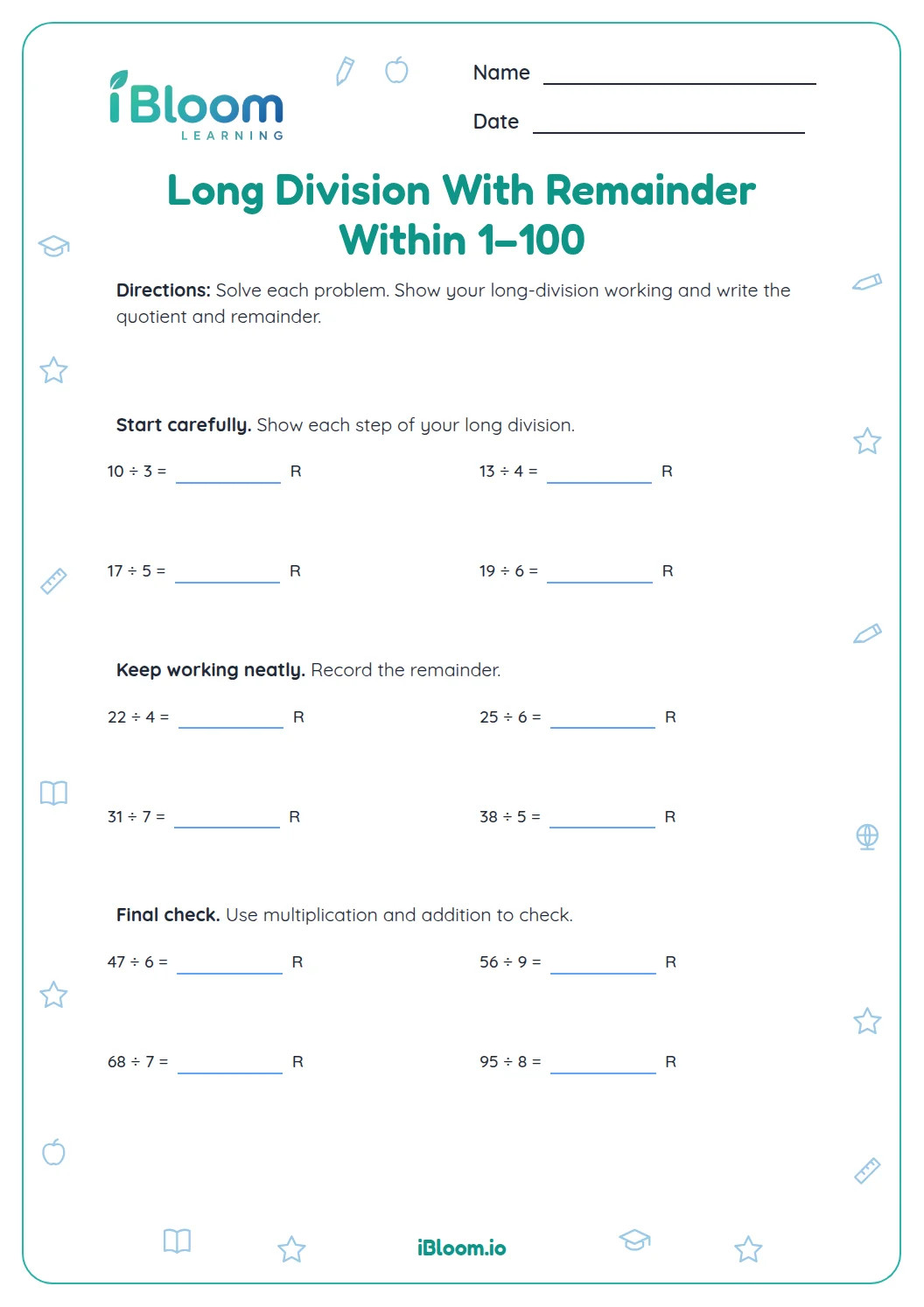
This Grade 3 worksheet builds the ideas children use before working through a written division algorithm: equal sharing, equal groups, and the multiplication fact that checks a quotient. Part A starts with simple models and fact choices. Parts B and C use missing factors and everyday equal-group stories, with space to show a related fact. It includes a separate answer key.
Aligned to 3.OA.A.2 and 3.OA.B.6
What does division tell us?
Division can answer two related questions: how many are in each equal share, or how many equal groups can be made. For example, 18 ÷ 3 asks how many groups of 3 fit in 18; the answer is 6.
How does multiplication help with division?
Multiplication and division undo each other. If 6 × 7 = 42, then 42 ÷ 6 = 7 and 42 ÷ 7 = 6. Remembering a multiplication fact makes the quotient easier to find.
- 142 ÷ 6 = ?
- 2Think: 6 × ? = 42
- 36 × 7 = 42
- 4So 42 ÷ 6 = 7.
What is practiced in each part?
Part A connects group models and equations. Part B applies facts and missing factors. Part C asks children to solve short stories and record a fact that checks the answer.
A simple routine for each problem
- 1Read whether the problem asks for groups or items in each group.
- 2Write the total and the number of equal groups.
- 3Think of a multiplication fact with those two numbers.
- 4Use the missing factor as the quotient.
- 5Check by multiplying the quotient by the group size.
Common division slips
The mistake
Mixing up the number of groups with the number in each group.
The fix
Draw or describe the equal groups before writing the quotient.
The mistake
Choosing a product that is close but not equal to the dividend.
The fix
Multiply the proposed quotient by the divisor to check the total.
The mistake
Using subtraction as the operation just because the numbers are large.
The fix
Look for equal shares or equal groups; those clues signal division.
Common Core alignment
The questions connect equal groups, multiplication facts, and division quotients.
Interpret division as equal sharing or making equal groups.
On this sheet: Equal-group stories ask what the quotient counts.
Show the official wordingHide the official wording
Interpret whole-number quotients of whole numbers, e.g., interpret 56 ÷ 8 as the number of objects in each share when 56 objects are partitioned equally into 8 shares, or as a number of shares when 56 objects are partitioned into equal shares of 8 objects each.
Use the inverse relationship to solve division problems.
On this sheet: Missing-factor questions and related facts connect multiplication to division.
Show the official wordingHide the official wording
Understand division as an unknown-factor problem. For example, find 32 ÷ 8 by finding the number that makes 32 when multiplied by 8.
What to practice next
Make more practice
Further reading
Questions parents and teachers ask
Why does a division worksheet use multiplication?
Multiplication checks division because the two operations are related. If a quotient is 7 and the divisor is 6, multiplying 7 by 6 should return the starting total, 42. This gives children a quick way to see whether their answer makes sense.
What is the difference between sharing and grouping?
Sharing starts with a total and a number of people or groups, then finds how many each gets. Grouping starts with a total and the size of each group, then finds how many groups can be made. Both situations use division but ask different questions.
What should my child do if a fact is hard to remember?
Use a small drawing, skip-count by the divisor, or build the matching multiplication fact. For 42 ÷ 6, count sixes until reaching 42; the number of counts is the quotient. Then multiply the quotient by 6 to confirm it returns 42.
Does every question use the long-division layout?
The sheet emphasizes the ideas behind division facts, equal groups, and related multiplication. The story problems provide room to record the supporting equation and answer. These foundations help students understand what a written division method is finding. The purpose is to understand the quotient and its relationship to multiplication.
How can I check the answer key?
For each quotient, multiply it by the divisor. The product should equal the dividend. In a story, also check that the unit describes the thing being shared or grouped. The key lists the expected quotient and short story answer for each item.