





About this worksheet
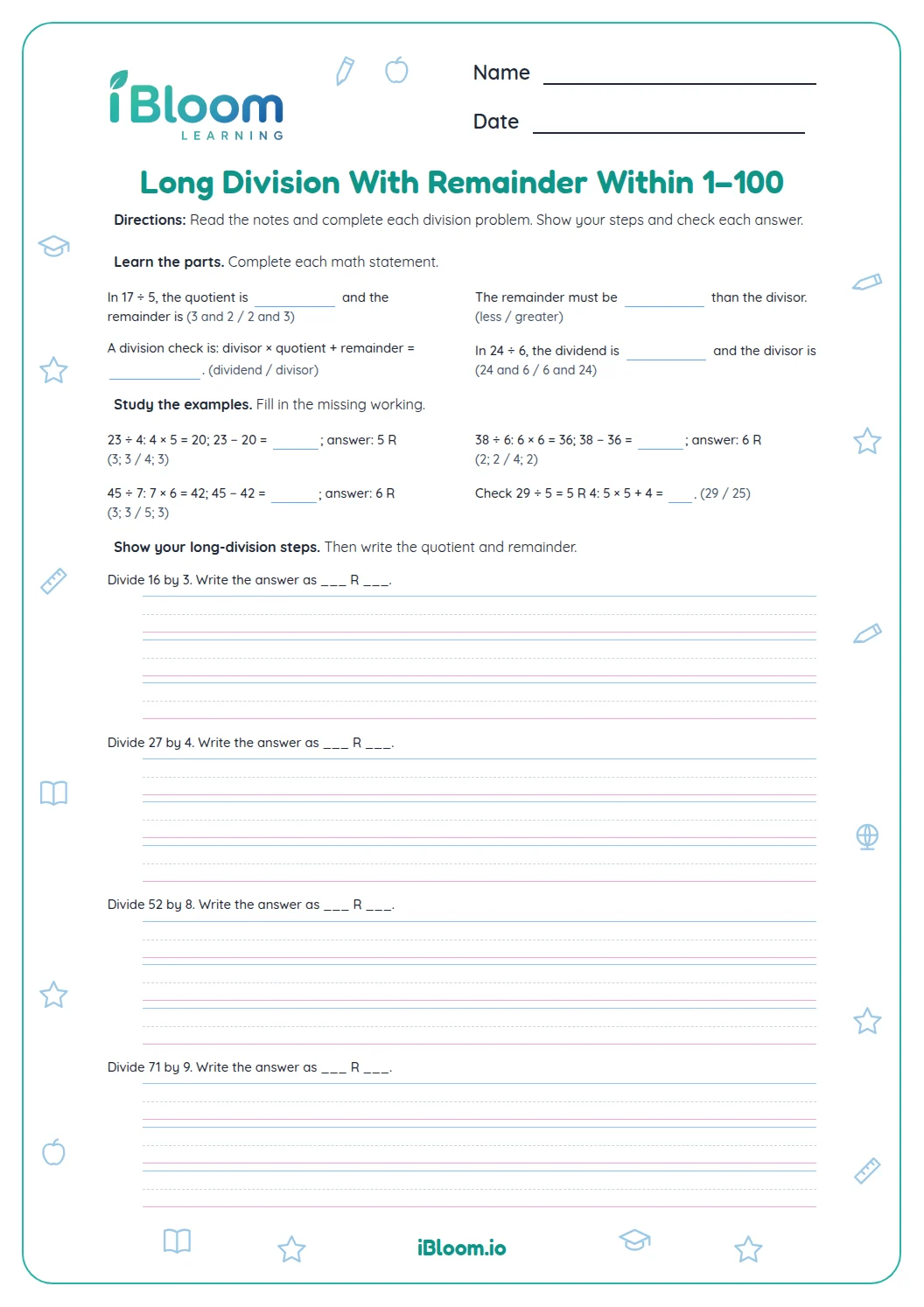
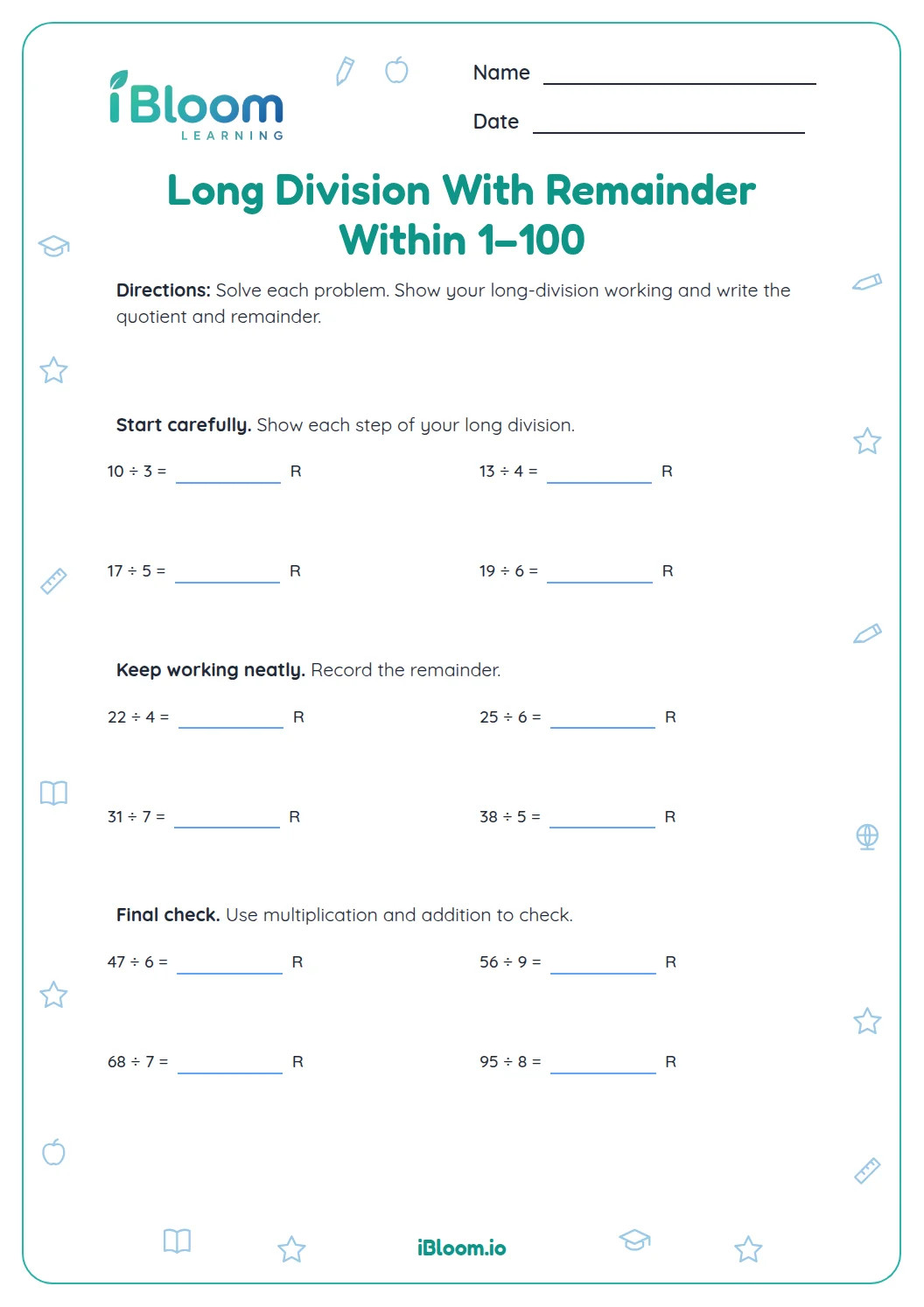
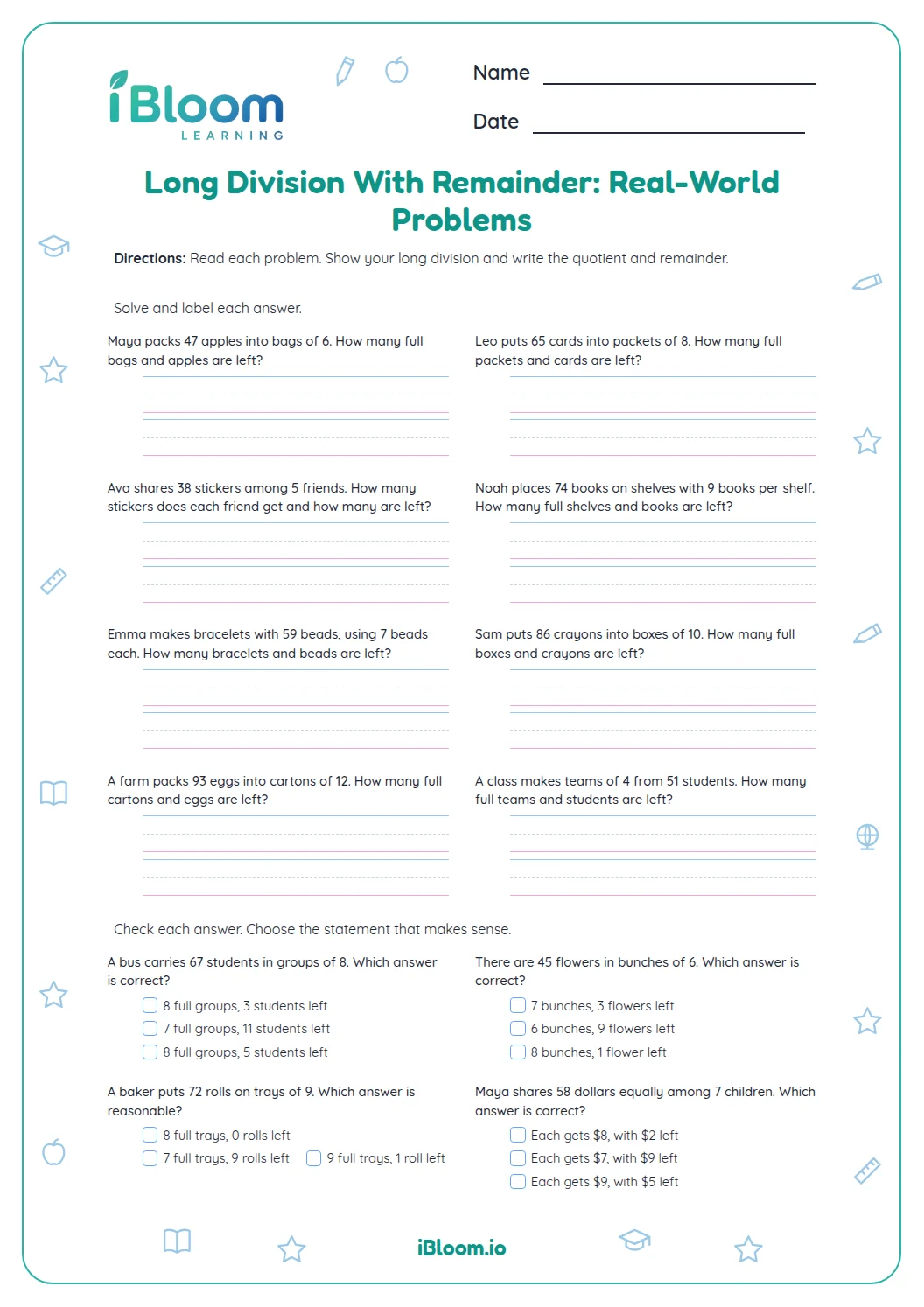
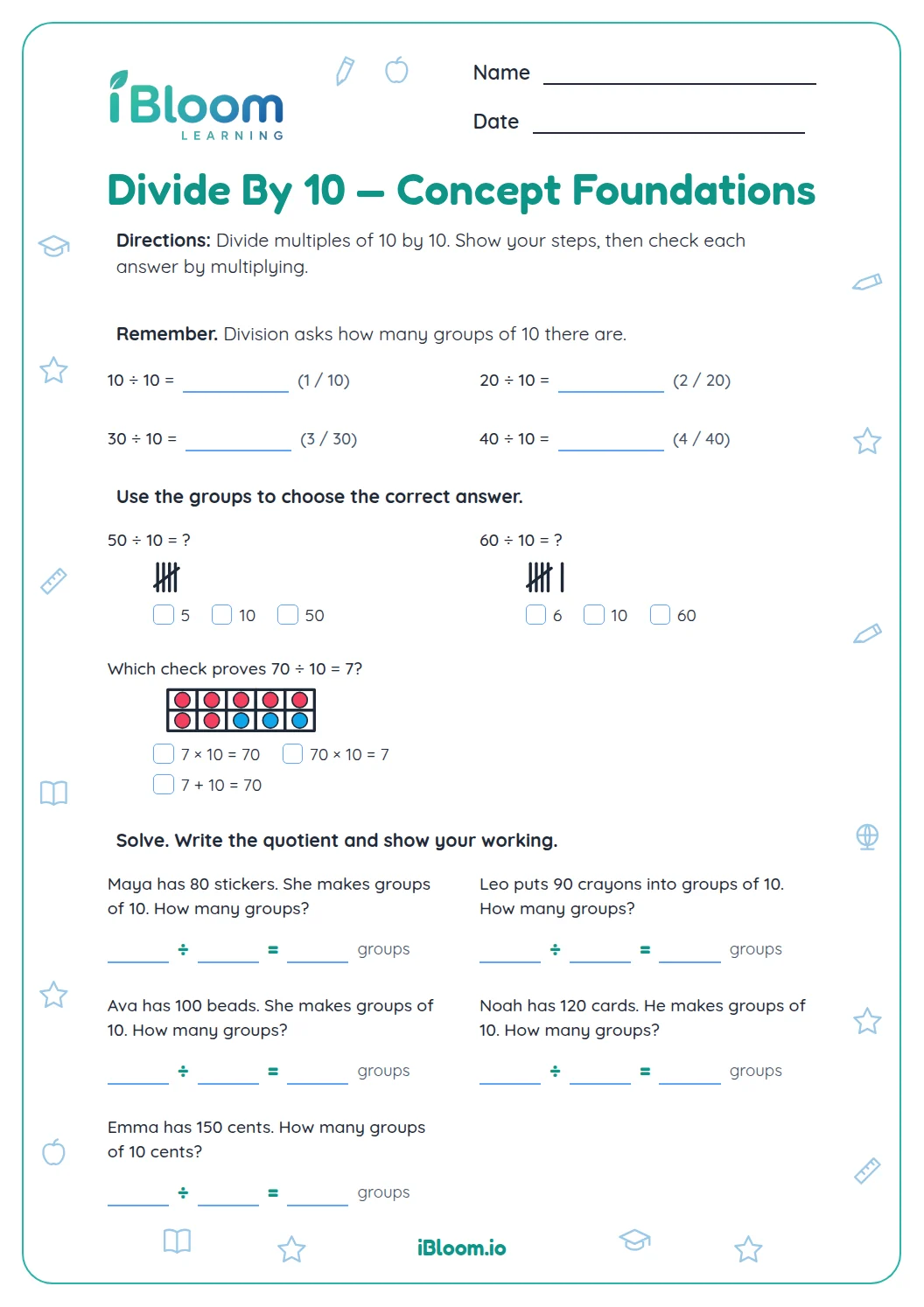
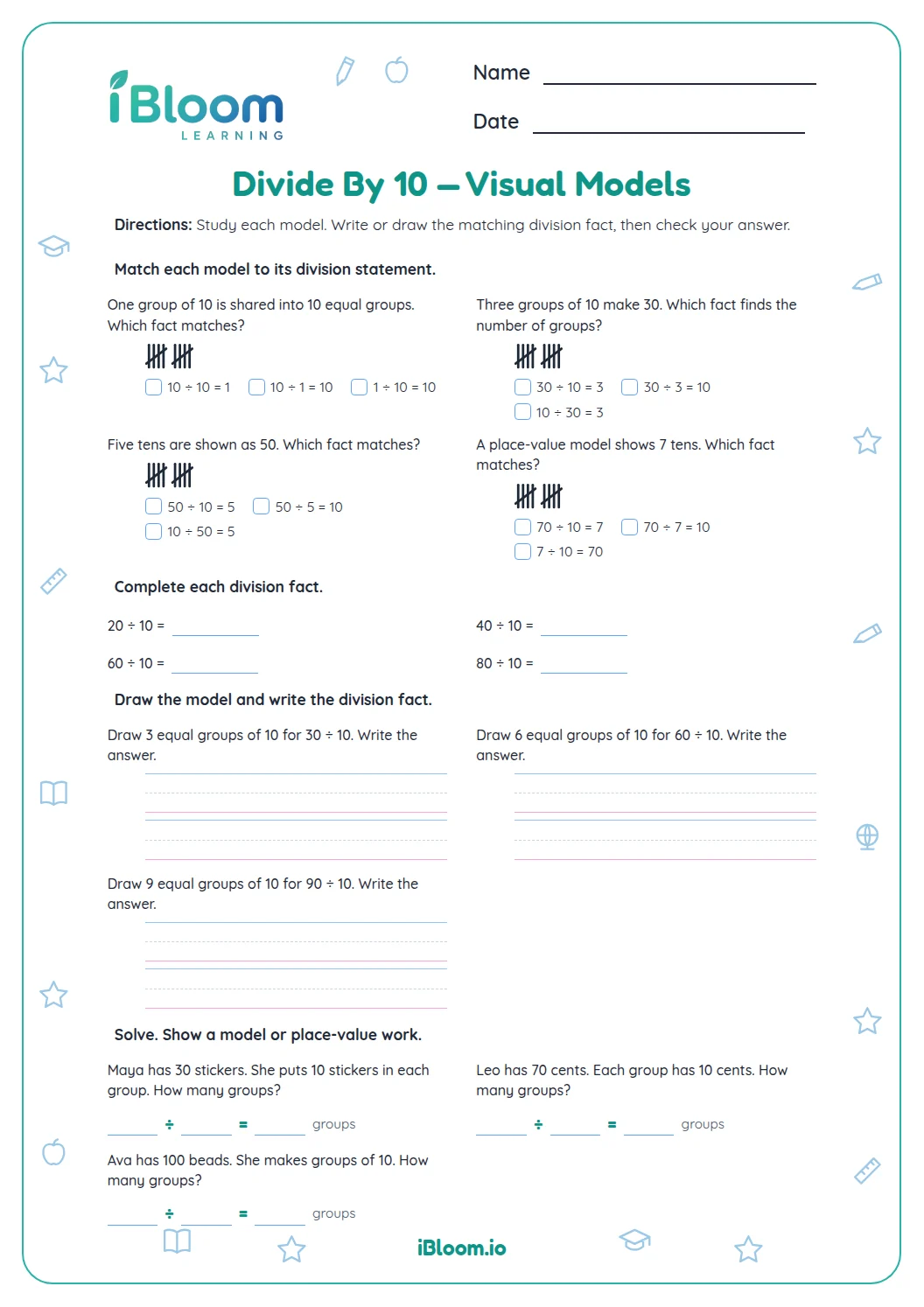
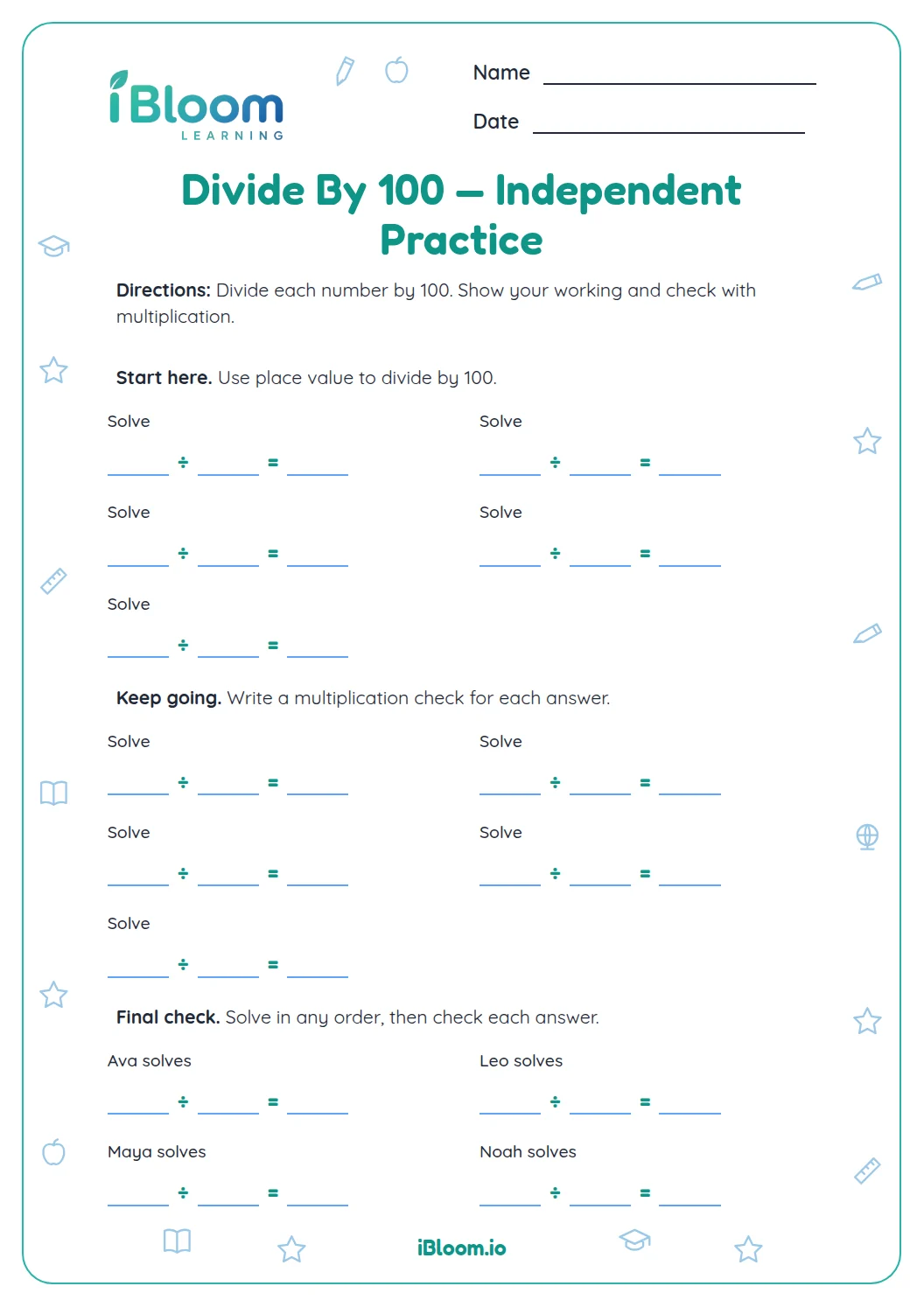
This Grade 3 guided practice sheet starts with division facts that have remainders, moves to less-scaffolded problems, and ends with three sharing or grouping stories. Students record each quotient and remainder and can check by multiplying the divisor by the quotient, then adding the remainder. The answer key lists both values in order.
Aligned to 3.OA.A.2
How can long division find a remainder?
Find the largest multiple of the divisor that does not exceed the dividend. The quotient counts those groups; subtract their product to find what remains.
- 147 ÷ 5 = 9 R 2
- 2Check: 5 × 9 + 2 = 47
How can multiplication check the result?
Use divisor × quotient + remainder = dividend. Also check that the remainder is less than the divisor.
How does division describe sharing?
In a sharing story, the quotient can mean the amount each person receives. In a grouping story, it can mean how many full bags or groups are made; the remainder describes what is left.
How to use this worksheet
- 1Read the direction for each part before starting.
- 2Work through division problems in order and write enough steps to check the result.
- 3Compare each response with the answer key and redo any missed item.
- 4Ask the learner to explain one strategy aloud.
Common mistakes and quick fixes
The mistake
Rushing past a sign or key detail in a division problem.
The fix
Read the prompt again, identify the needed division step, and check the result.
The mistake
Using a correct method but making a small computation error in division.
The fix
Read the prompt again, identify the needed division step, and check the result.
The mistake
Writing an answer without checking it against the original question.
The fix
Read the prompt again, identify the needed division step, and check the result.
Common Core alignment
Students interpret division as equal sharing and determine the size of each share.
Interpret division stories as equal shares and find the number in each share.
On this sheet: The sharing stories ask students to find how many objects each person receives and how many remain.
Show the official wordingHide the official wording
Interpret whole-number quotients of whole numbers, e.g., interpret 56 ÷ 8 as the number of objects in each share when 56 objects are partitioned equally into 8 shares.
What to practice next
Make more practice
Further reading
Questions parents and teachers ask
What do quotient and remainder mean?
The quotient tells how many full groups or shares can be made. The remainder tells how many objects are left after making those groups. For 47 ÷ 5, nine groups of five use 45 objects, leaving 2; the remainder is less than the divisor.
How can students check a remainder answer?
Multiply the divisor by the quotient and add the remainder. The total should match the dividend, and the remainder must be smaller than the divisor. For 47 ÷ 5 = 9 R 2, 5 × 9 + 2 = 47.
Why do the story problems ask for both numbers?
A sharing or grouping situation can leave objects after making full equal groups. The quotient answers how many each person receives or how many full bags can be made; the remainder tells what is left. For example, 95 apples make 15 full bags of 6 with 5 apples remaining.
Is the remainder always smaller than the divisor?
Yes. If the remainder were as large as the divisor, one more full group could be made. For example, 95 apples packed six per bag makes 15 full bags with 5 left, and 5 is less than 6.
How many problems are included?
There are 15 problems across two worksheet pages. The first 12 ask for a quotient and remainder, and the final three put division into sharing or grouping situations. The key lists the quotient first and the remainder second for each response.
What should students do when the remainder is zero?
When the remainder is zero, record a quotient with no objects left, often written R 0. Check by multiplying the quotient by the divisor; their product should equal the dividend exactly. This confirms that the full dividend was divided into equal groups.