







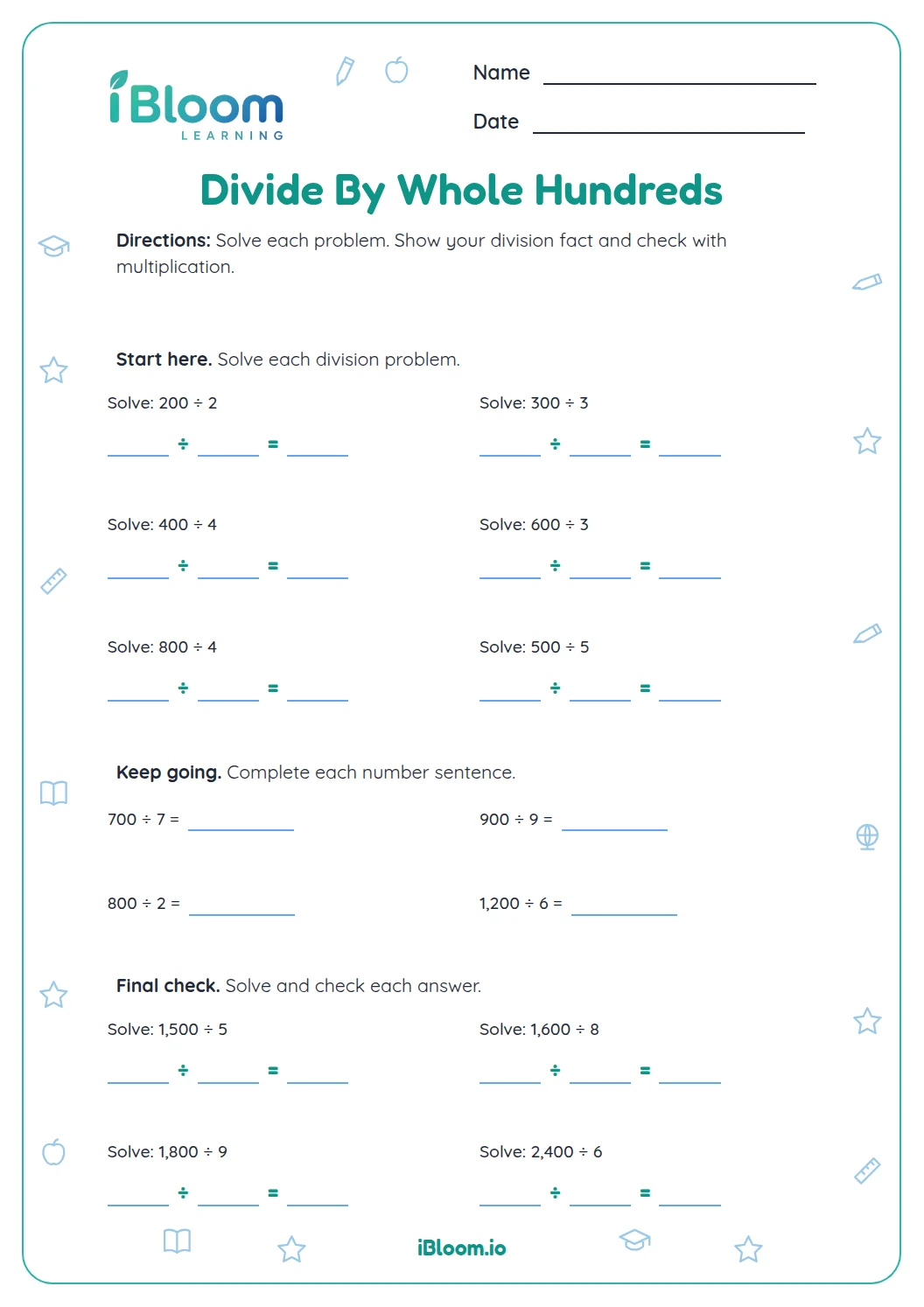
About this worksheet
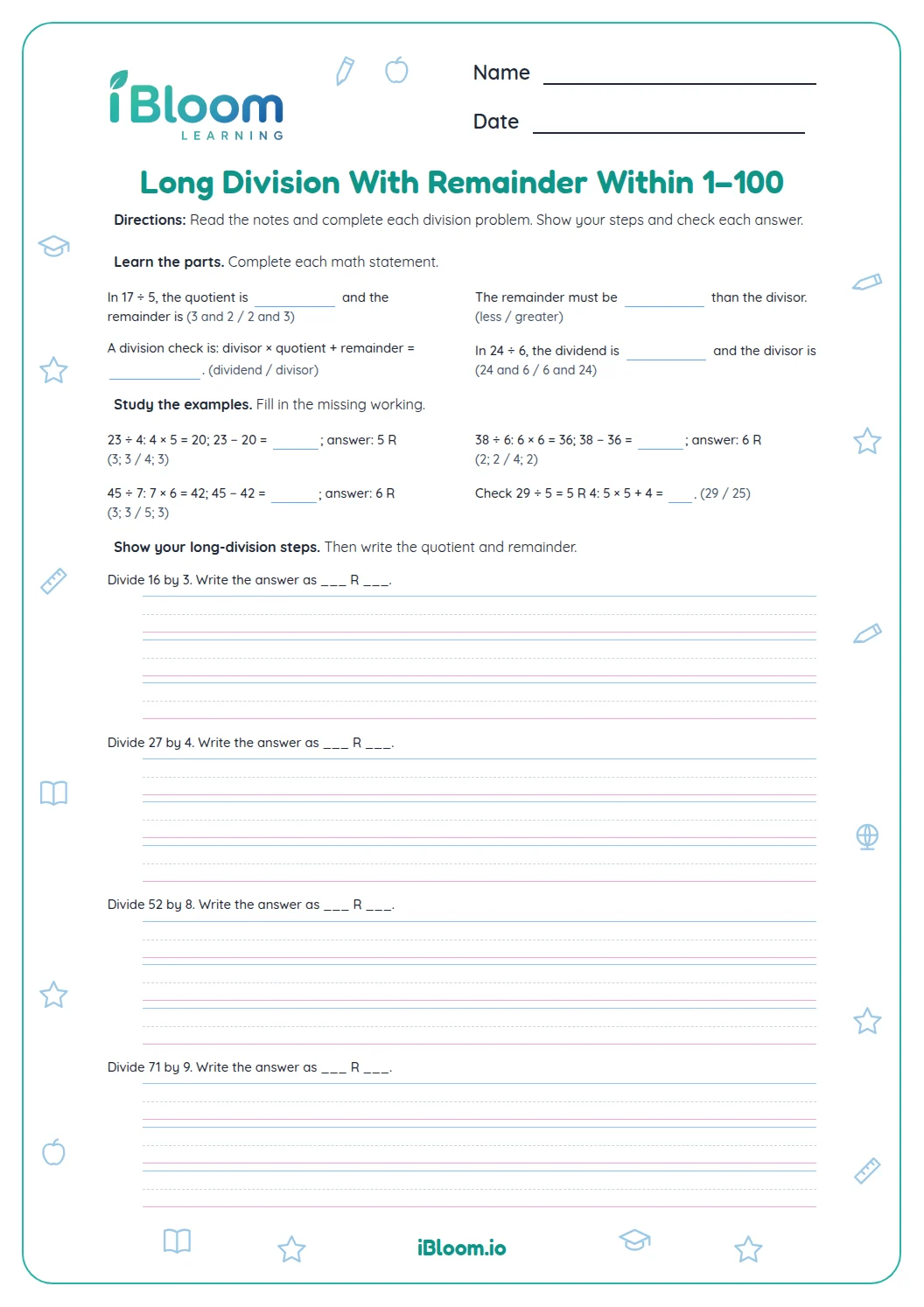
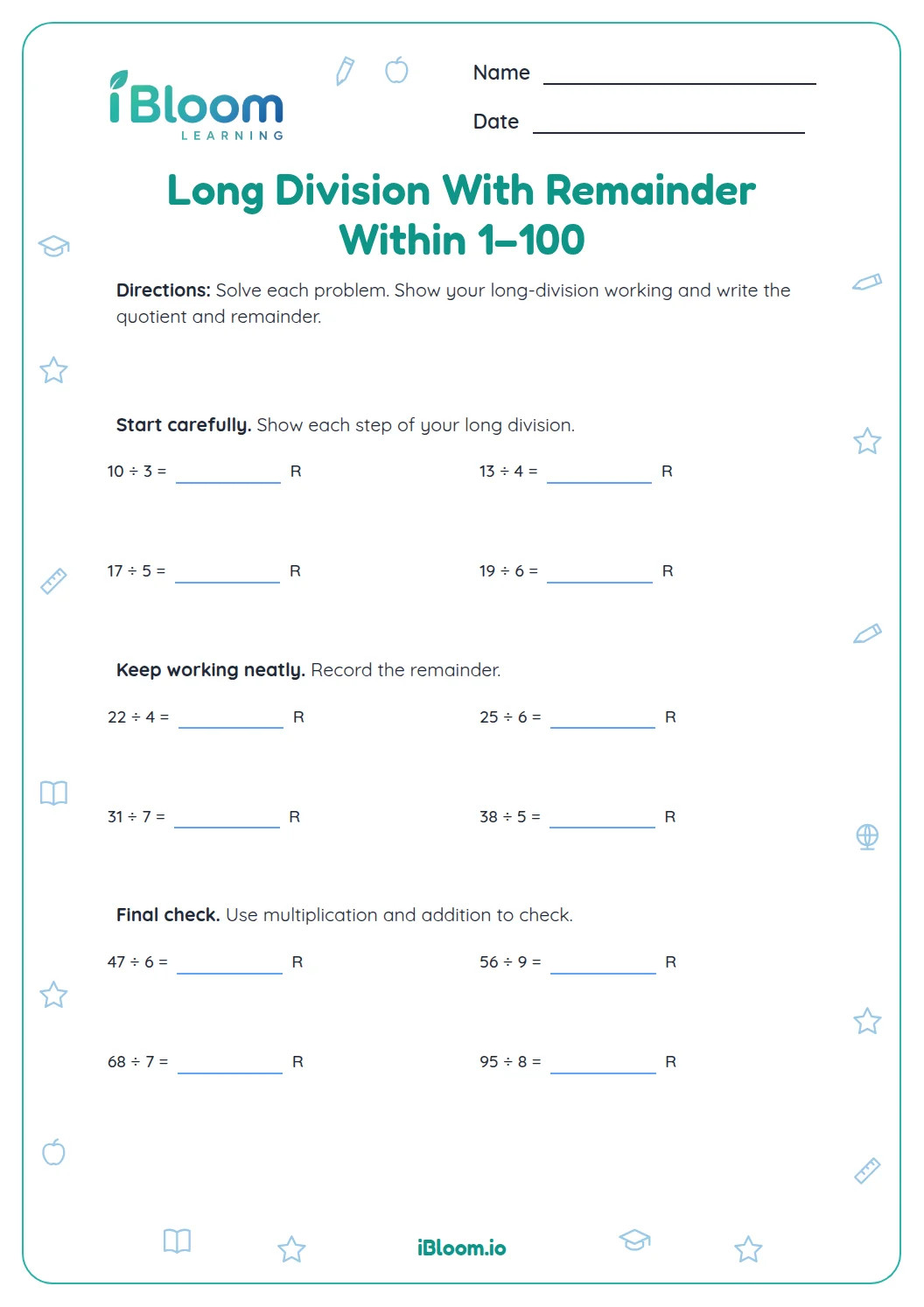
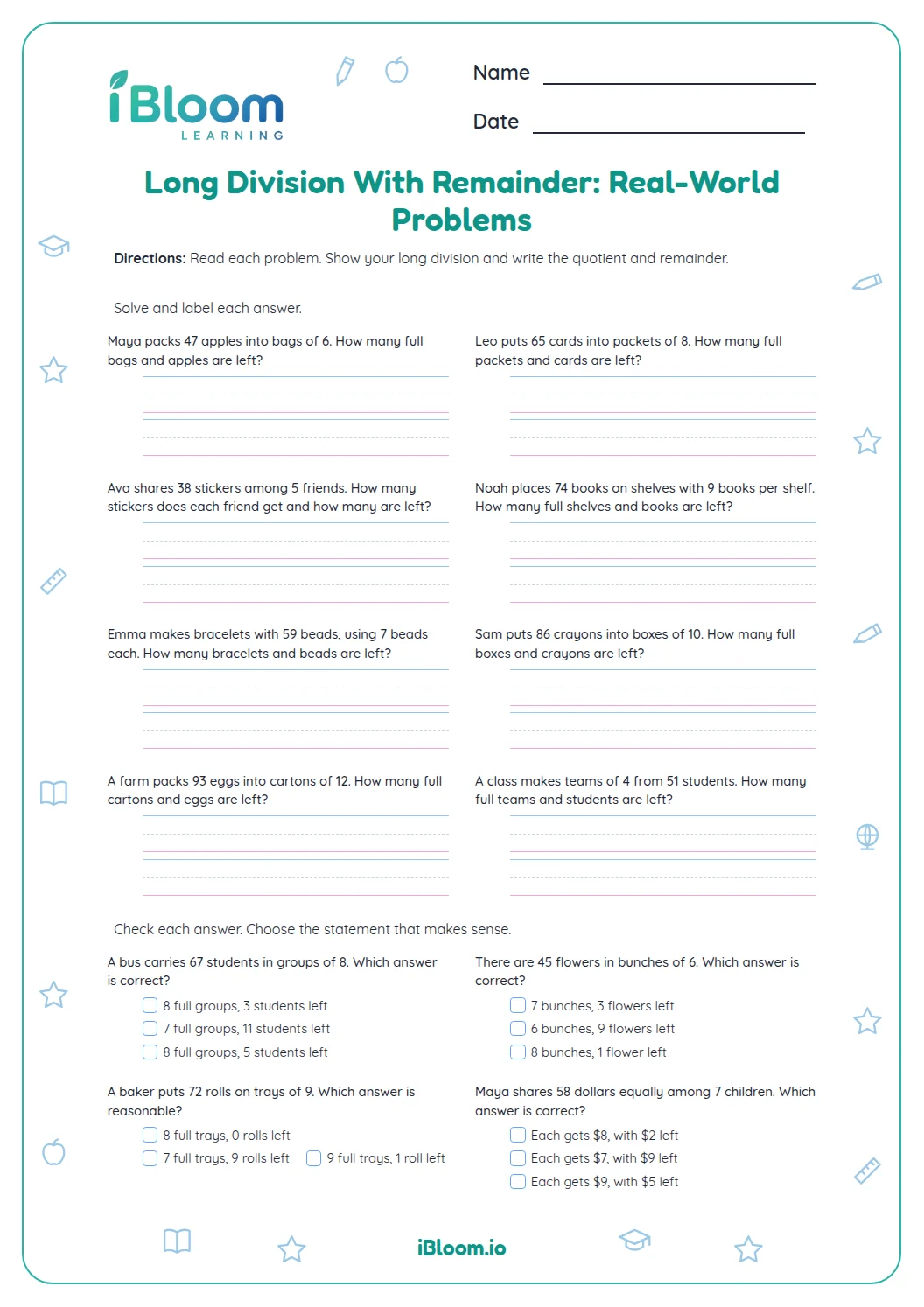
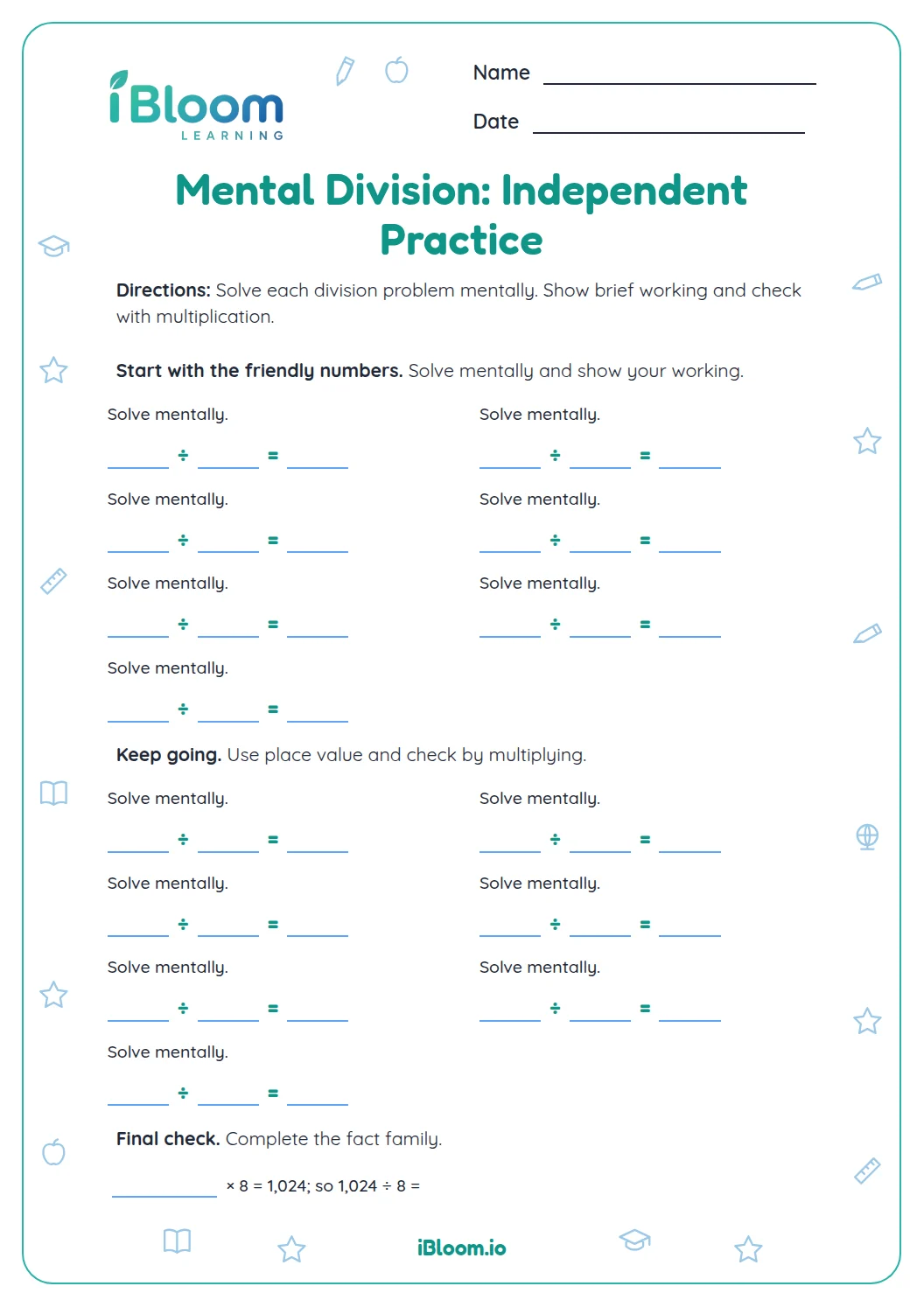
This Grade 3 worksheet practices division with remainders for dividends from 1 to 100. Children find quotients and remainders, check results with multiplication, and correct examples where the remainder is too large. The work builds fluency with multiplication and division facts within 100, as described in Common Core 3.OA.C.7. The answer key shows the quotient and remainder or a corrected statement.
Aligned to 3.OA.C.7
How do you find a quotient and remainder?
Find the largest multiple of the divisor that does not pass the dividend. The leftover amount is the remainder.
How can multiplication check the result?
Multiply divisor by quotient and add the remainder. That total should equal the original dividend.
- 147 ÷ 5 = 9 R 2
- 2Check: 5 × 9 + 2 = 47.
- 3Because 2 is less than 5, the remainder is in range.
What makes a remainder reasonable?
A remainder is always less than the divisor. If it is equal to or larger than the divisor, another group can be formed.
How to use this worksheet
- 1Estimate how many groups the divisor makes.
- 2Use a multiplication fact to find the closest product below the dividend.
- 3Subtract to find what remains.
- 4Check with divisor × quotient + remainder.
- 5Confirm the remainder is smaller than the divisor.
Common mistakes and quick fixes
The mistake
Stopping at a nearby multiple that is too small.
The fix
Use the greatest multiple of the divisor that does not exceed the dividend.
The mistake
Leaving a remainder equal to the divisor.
The fix
Make one more group and reduce the remainder.
The mistake
Forgetting to add the remainder when checking.
The fix
Multiply first, then add the leftover amount.
Common Core alignment
Children use multiplication facts to find quotients and verify division results.
Use multiplication and division strategies to solve division facts within 100.
On this sheet: Children use multiplication facts to find quotients and verify division with remainders.
Show the official wordingHide the official wording
Fluently multiply and divide within 100, using strategies such as the relationship between multiplication and division (e.g., knowing that 8 × 5 = 40, one knows 40 ÷ 5 = 8) or properties of operations. By the end of Grade 3, know from memory all products of two one-digit numbers.
What to practice next
Make more practice
Further reading
Questions parents and teachers ask
How do you check division with a remainder?
Multiply the divisor by the quotient and add the remainder. That sum should equal the dividend, and the remainder should be smaller than the divisor; for example, 5 × 9 + 2 = 47. The problems use whole-number division and multiplication facts familiar in Grade 3.
What is included on this worksheet?
There are 16 questions: eight division computations, two sharing situations, a multiplication check, and remainder reasoning. The written problems leave room for students to show their calculations. The problems use whole-number division and multiplication facts familiar in Grade 3.
Are all dividends within 100?
Yes. The dividend in each computation and sharing situation is 100 or less. Students use multiplication facts and division reasoning to find each quotient and remainder. The problems use whole-number division and multiplication facts familiar in Grade 3.
What does R mean?
R stands for remainder, the amount left after making as many equal groups as possible. In 47 ÷ 5 = 9 R 2, nine groups of five use 45, with two left over. The problems use whole-number division and multiplication facts familiar in Grade 3.
What if a student gets a remainder larger than the divisor?
The quotient may be too small. Make another full group, then subtract that group from the remainder; the final remainder must be less than the divisor. The problems use whole-number division and multiplication facts familiar in Grade 3.