


About this worksheet
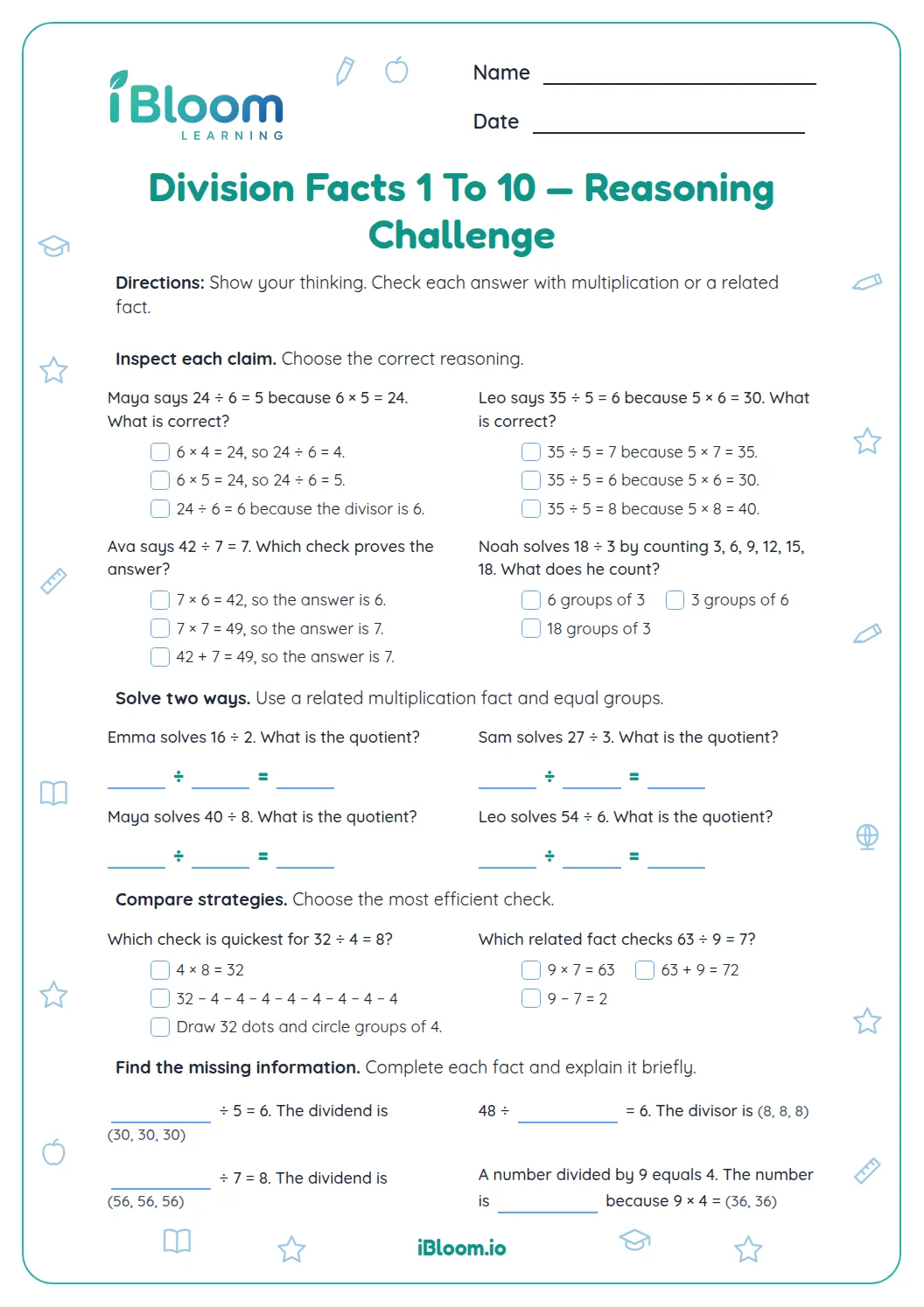
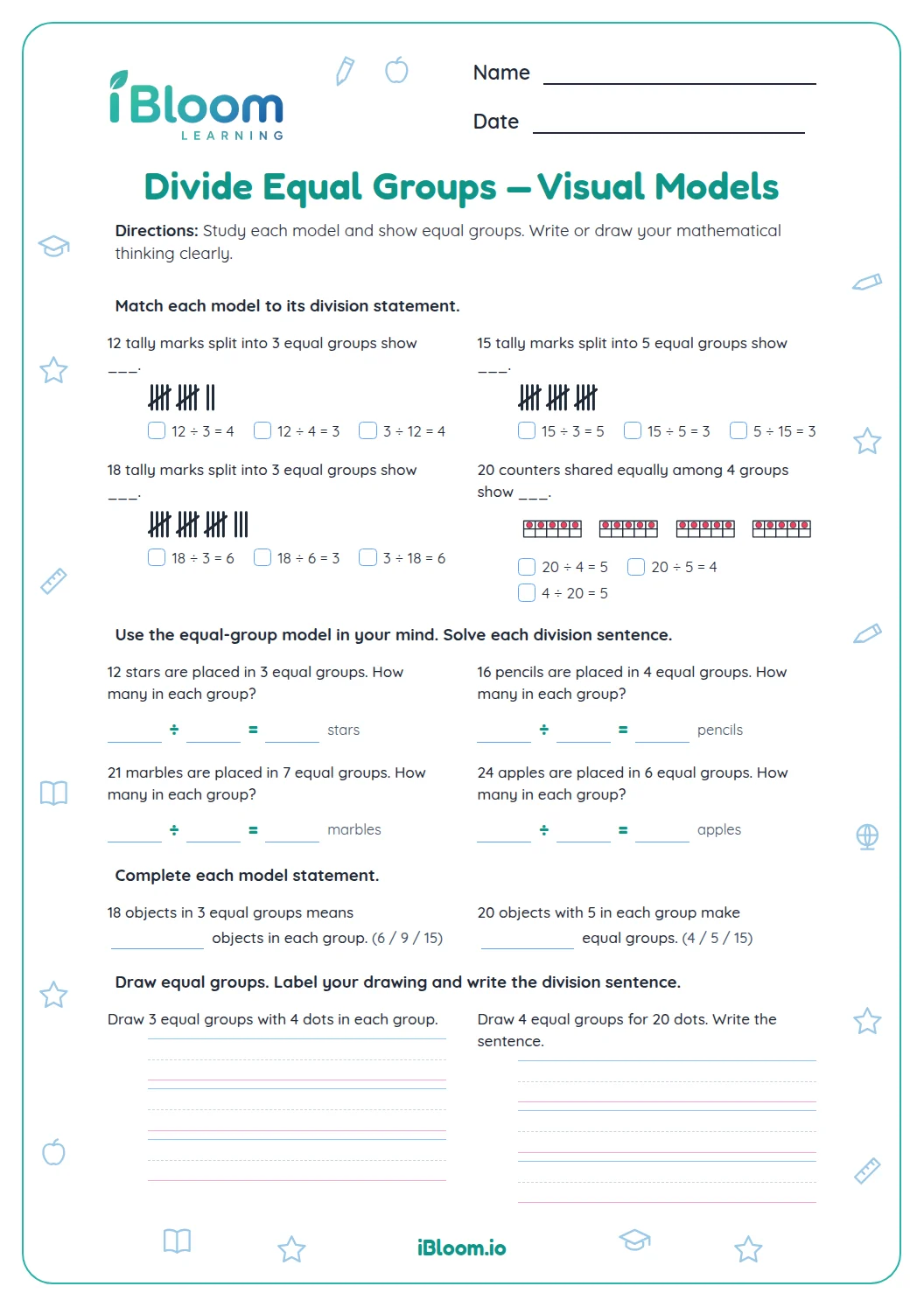
This Grade 3 worksheet connects division facts to equal groups. Children read ten arrays, with divisors from 2 through 10, then solve four sharing stories. Each array makes the total and equal groups visible; the separate key gives every quotient.
Aligned to 3.OA.A.2 and 3.OA.C.7
What does the quotient tell us?
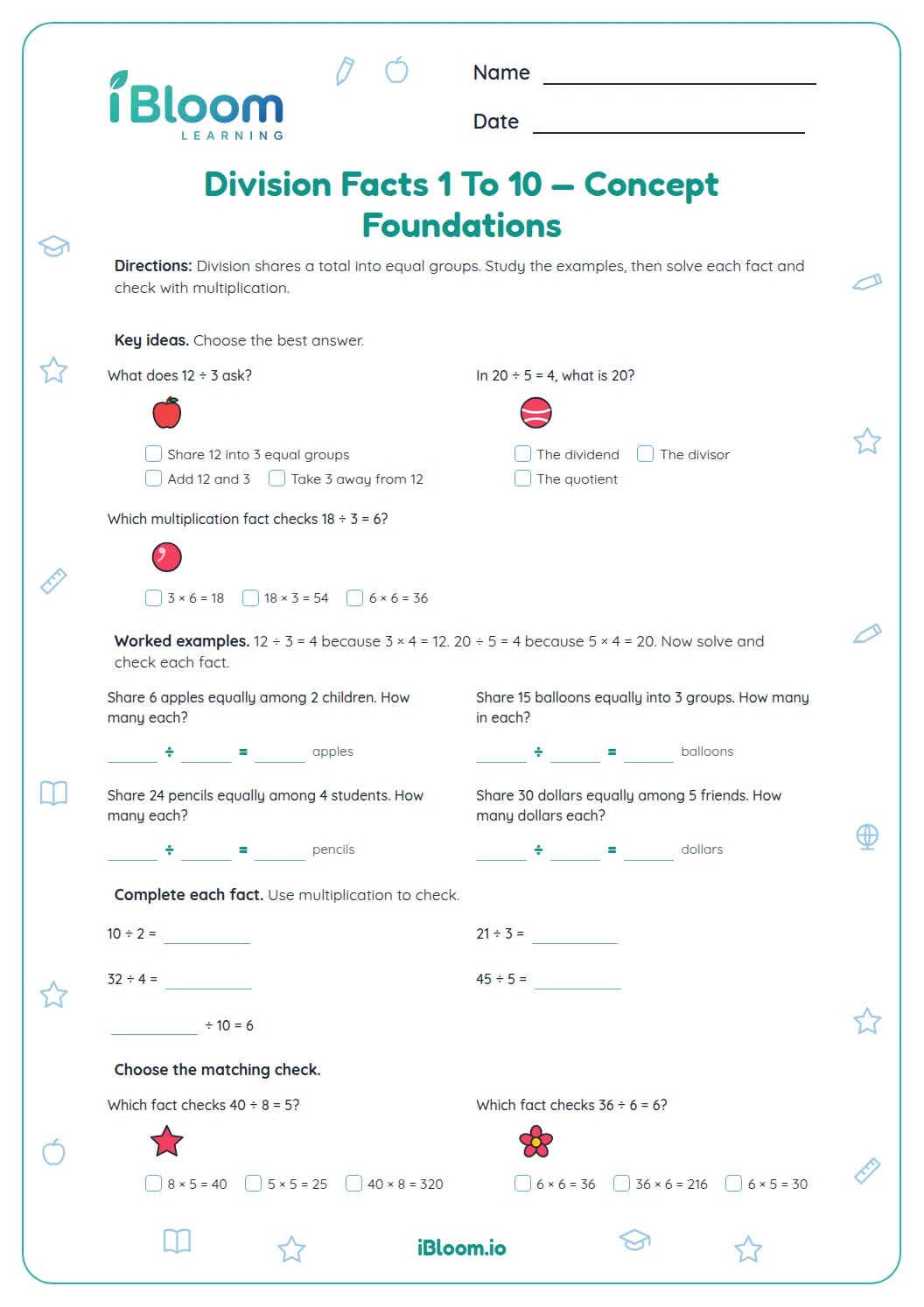
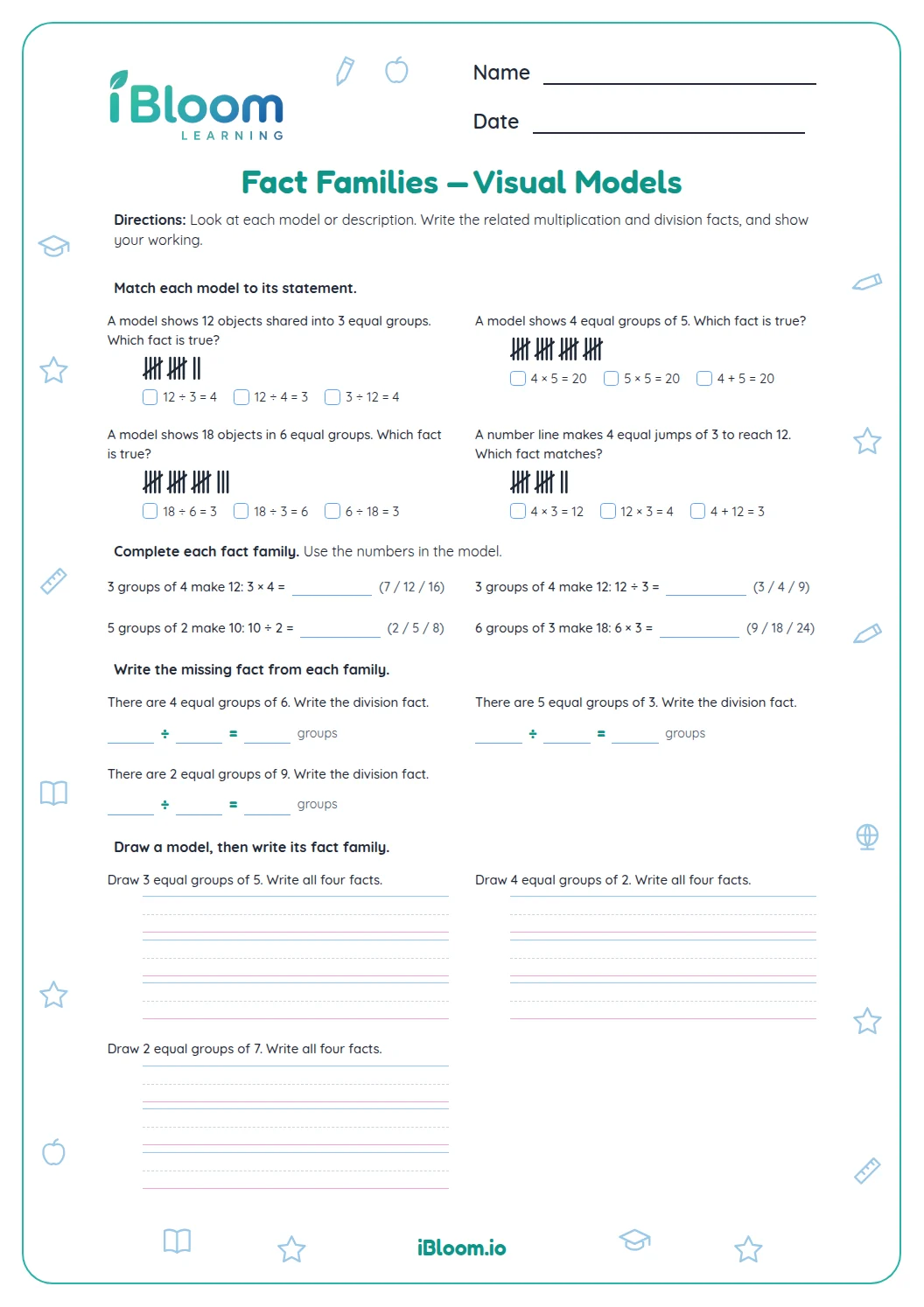
Division can split a total into equal groups. In 12 ÷ 3, the 12 is shared among 3 groups, so each group has 4. A model helps children see both the total and the number of groups.
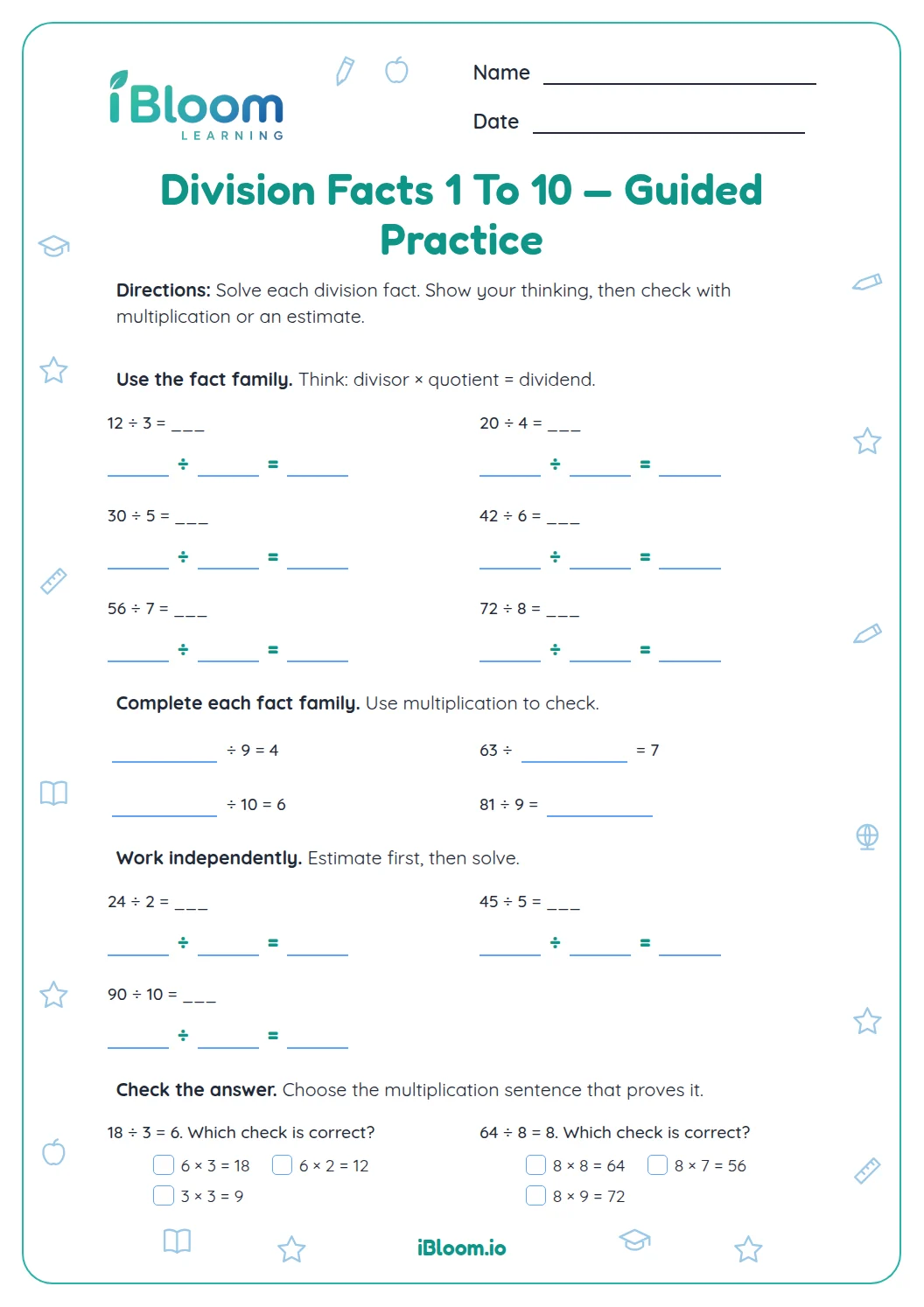
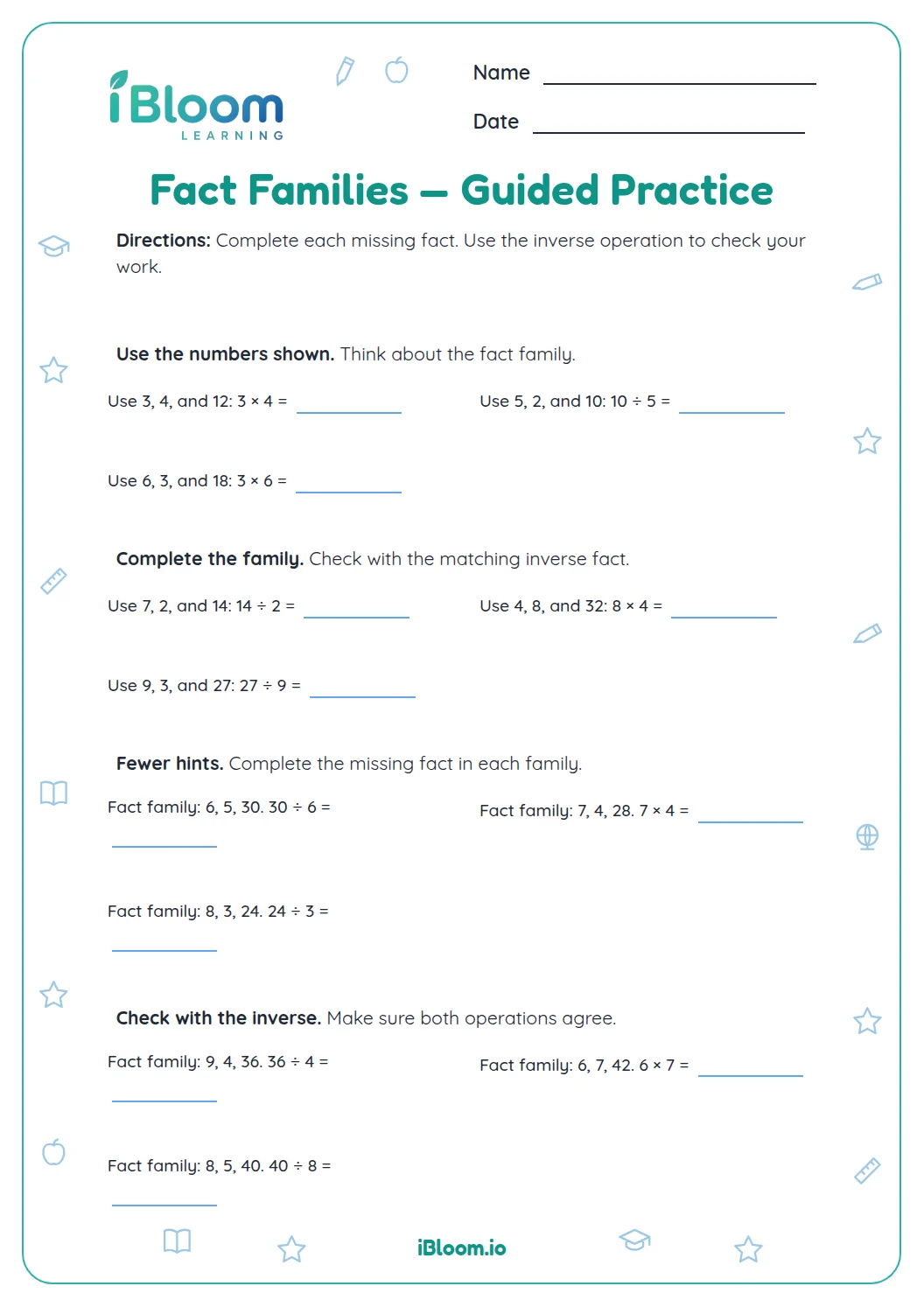
A division fact is connected to multiplication: if 3 × 4 = 12, then 12 ÷ 3 = 4. This relationship is a useful way to check an answer.
How does this sheet move from models to facts?
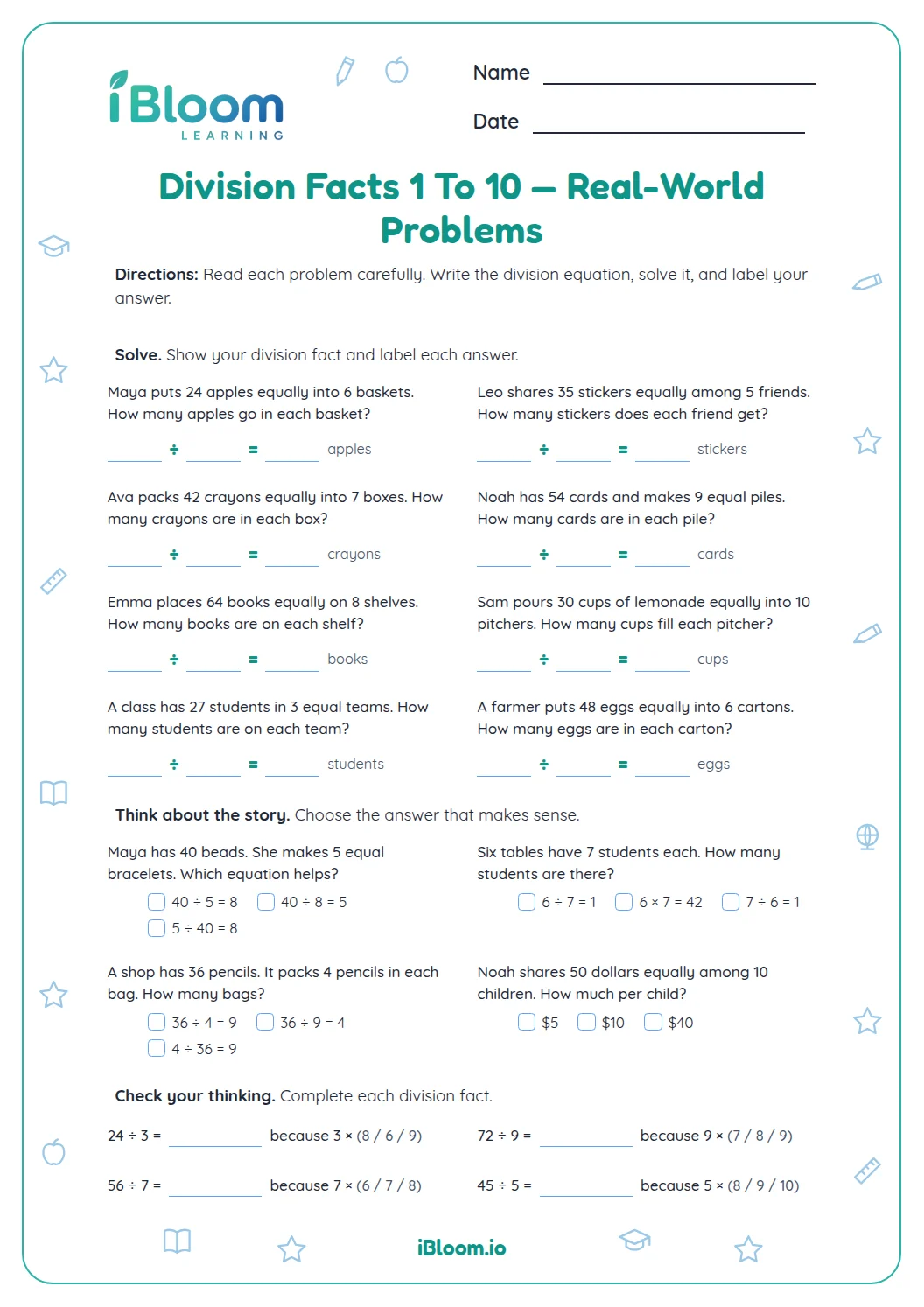
The first part pairs models with equal-group stories. The second part mixes facts with everyday grouping situations. Children can draw a quick equal-groups sketch when a fact is not yet automatic.
How to use this worksheet
- 1Look at the model and count the total objects.
- 2Check how many equal groups there are.
- 3Find the number in one group and write the quotient.
- 4Use multiplication to check a division fact.
- 5Try the short situations independently, then check the key.
Common mistakes and quick fixes
The mistake
Using the number of groups as the group size.
The fix
Count the rows for groups, then count across one row for its size.
The mistake
Dividing by the total number of objects.
The fix
Use the stated number of equal groups as the divisor.
The mistake
Rushing past a zero or a repeated letter pattern.
The fix
Read the completed answer carefully and check each place or letter.
The mistake
Rushing past a zero or a repeated letter pattern.
The fix
Read the completed answer carefully and check each place or letter.
Common Core alignment
This worksheet connects division to equal groups and multiplication facts.
Interpret whole-number quotients as equal groups.
On this sheet: The arrays and stories interpret division as the size of each equal group.
Show the official wordingHide the official wording
Interpret whole-number quotients of whole numbers, e.g., interpret 56 ÷ 8 as the number of objects in each share when 56 objects are partitioned equally into 8 shares.
Fluently multiply and divide within 100.
On this sheet: The worksheet practices division facts within 100 using equal-group arrays and related multiplication facts.
Show the official wordingHide the official wording
Fluently multiply and divide within 100, using strategies such as the relationship between multiplication and division (e.g., knowing that 8 × 5 = 40, one knows 40 ÷ 5 = 8) or properties of operations.
What to practice next
Make more practice
Further reading
Questions parents and teachers ask
What does a division model show?
Each small picture represents one counter in a single equal group. The question gives the total and number of groups; children count the pictured group to find the quotient. For example, a model with four counters can represent 12 counters divided into 3 equal groups.
Which facts does the worksheet practice?
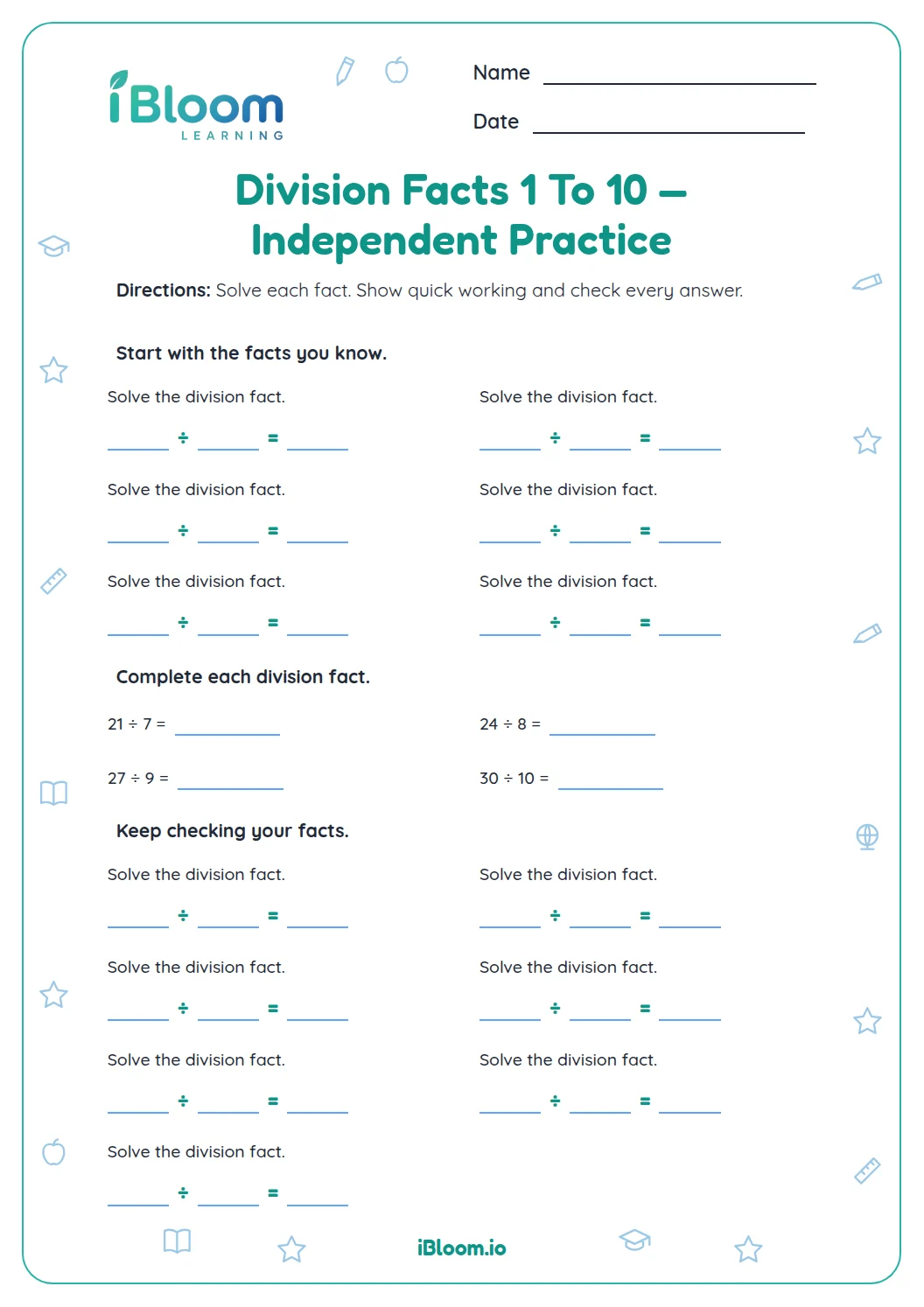
Eight pictured group models cover divisors 1 through 8. Two more number sentences practice divisors 9 and 10, and four short sharing situations apply division to equal groups. All quotients are whole numbers, and the facts stay within 100. The final two facts use divisors 9 and 10.
Is an answer key included?
Yes. The separate key gives the quotient for each pictured group, number sentence, and sharing story. For a model, use the total and number of equal groups in the question, then check that the pictured group has the same number of counters as the quotient.
How can multiplication check a quotient?
Multiply the number of groups by the amount in each group. If 30 objects are split into 5 equal groups, 5 × 6 = 30 confirms that 30 ÷ 5 = 6. Invite your child to explain one answer aloud, then use the separate key to check the result.
How long does this worksheet take?
Plan for about 20 minutes. Children count eight pictured groups, complete two more division facts, and solve four sharing stories. If a fact is unfamiliar, they can count the pictured group or use a related multiplication fact before checking the key.