





About this worksheet
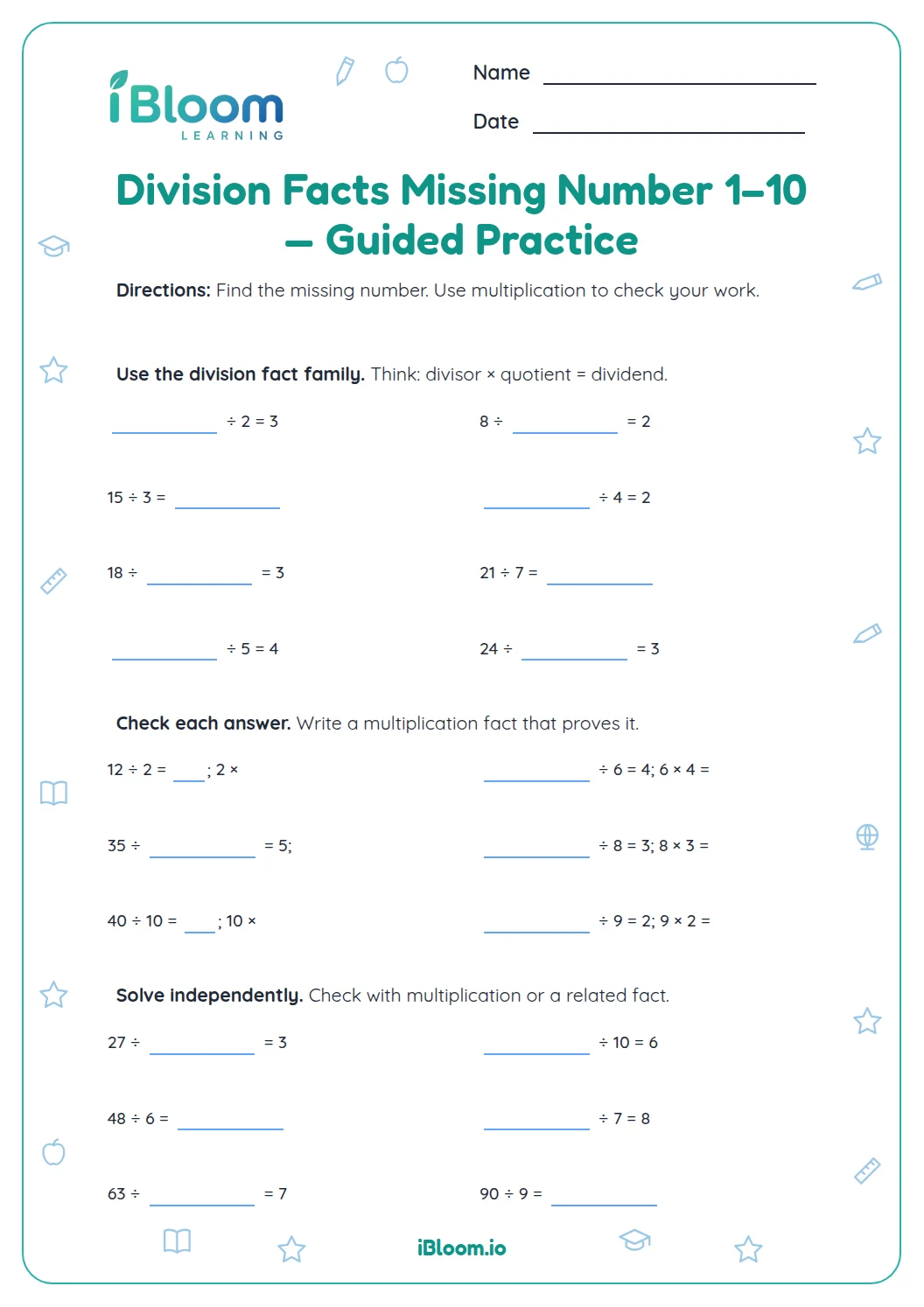
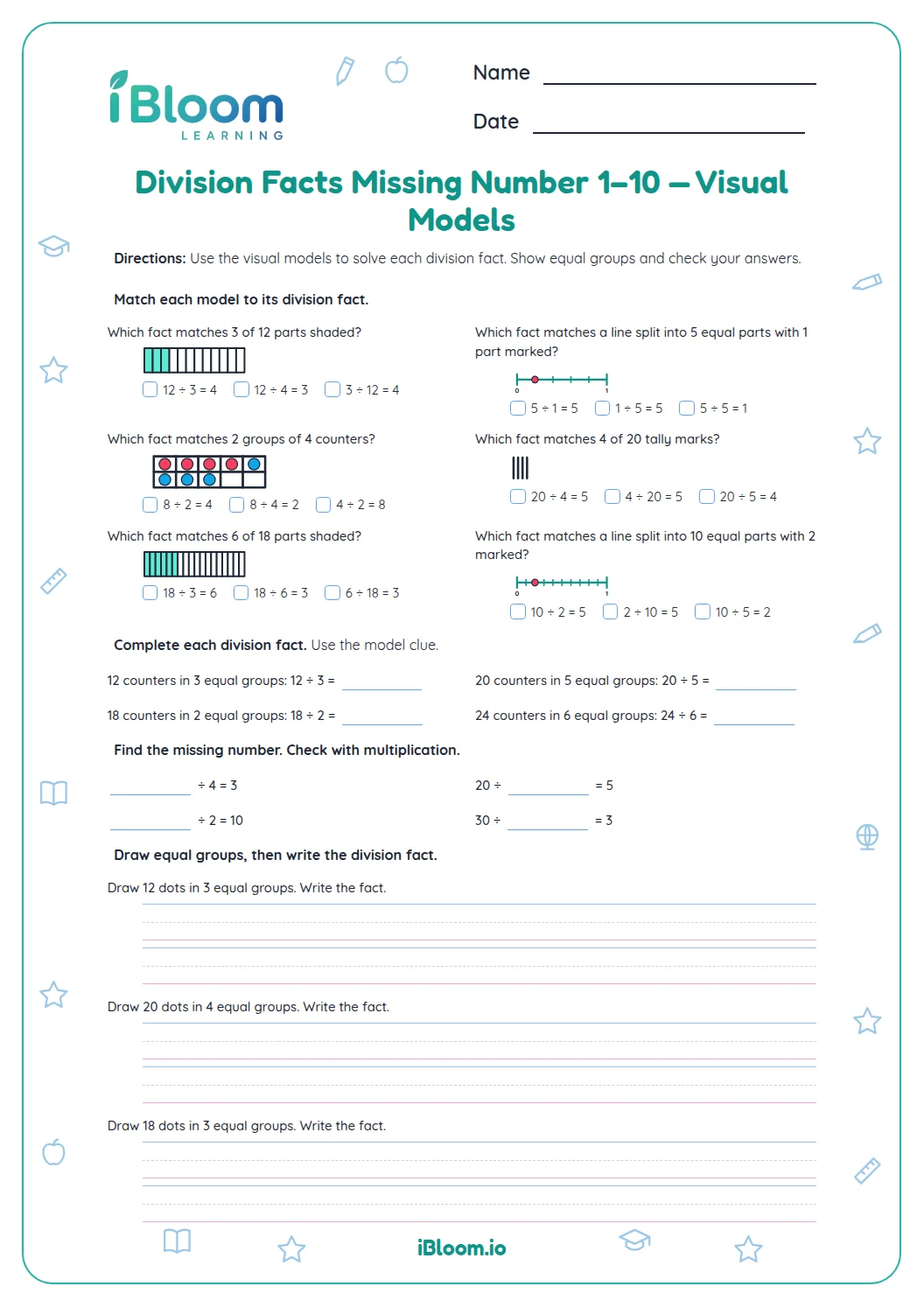
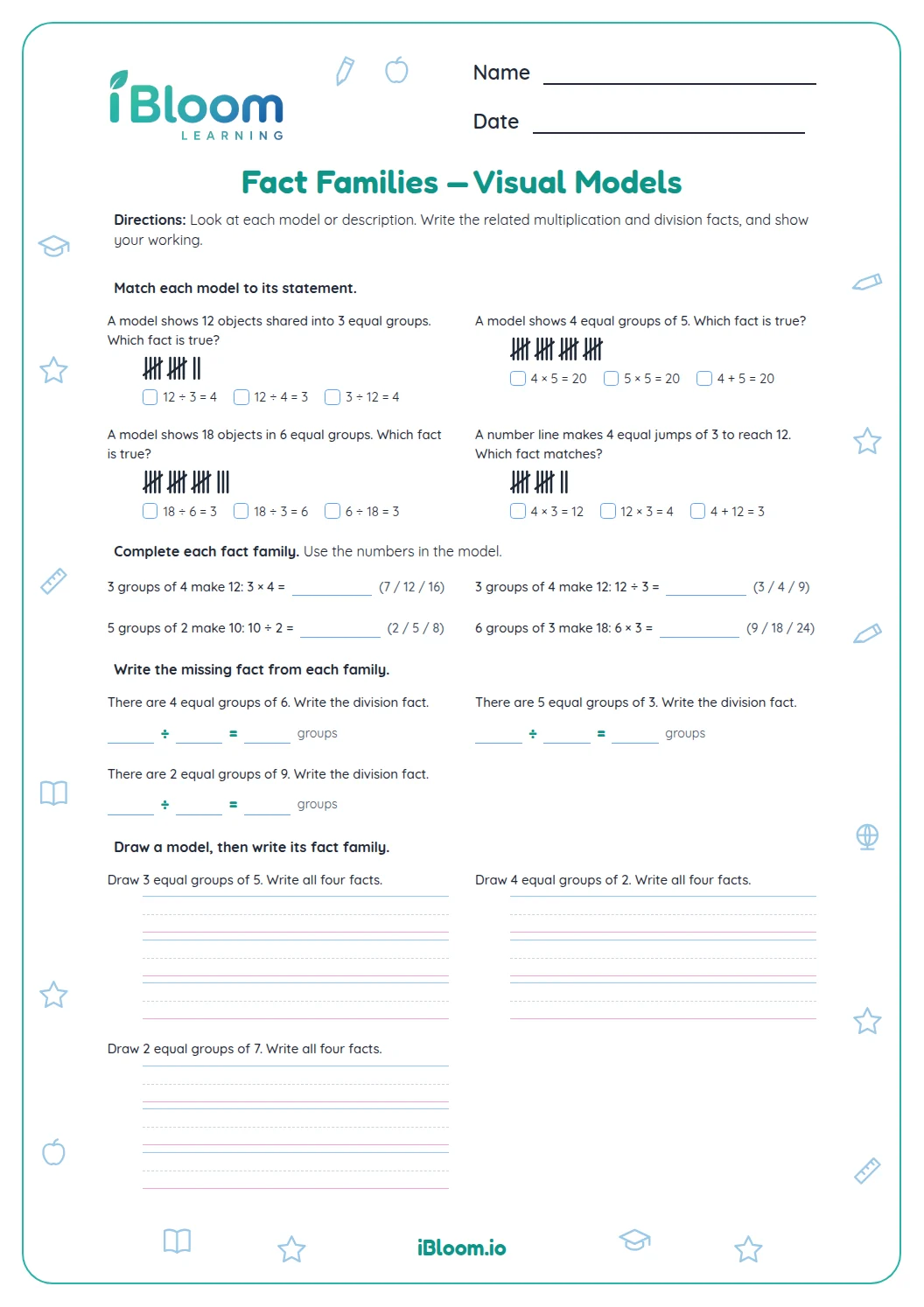
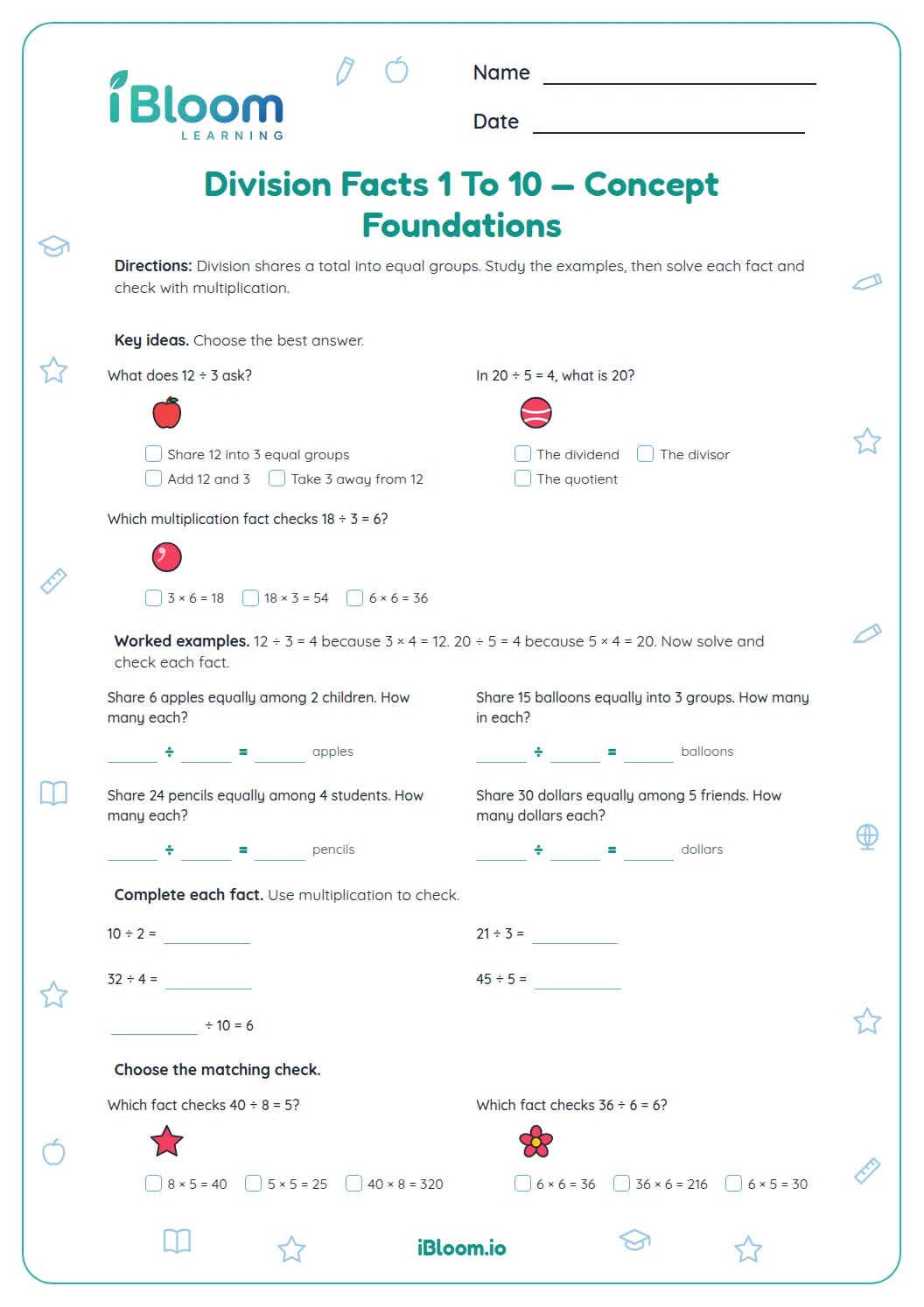
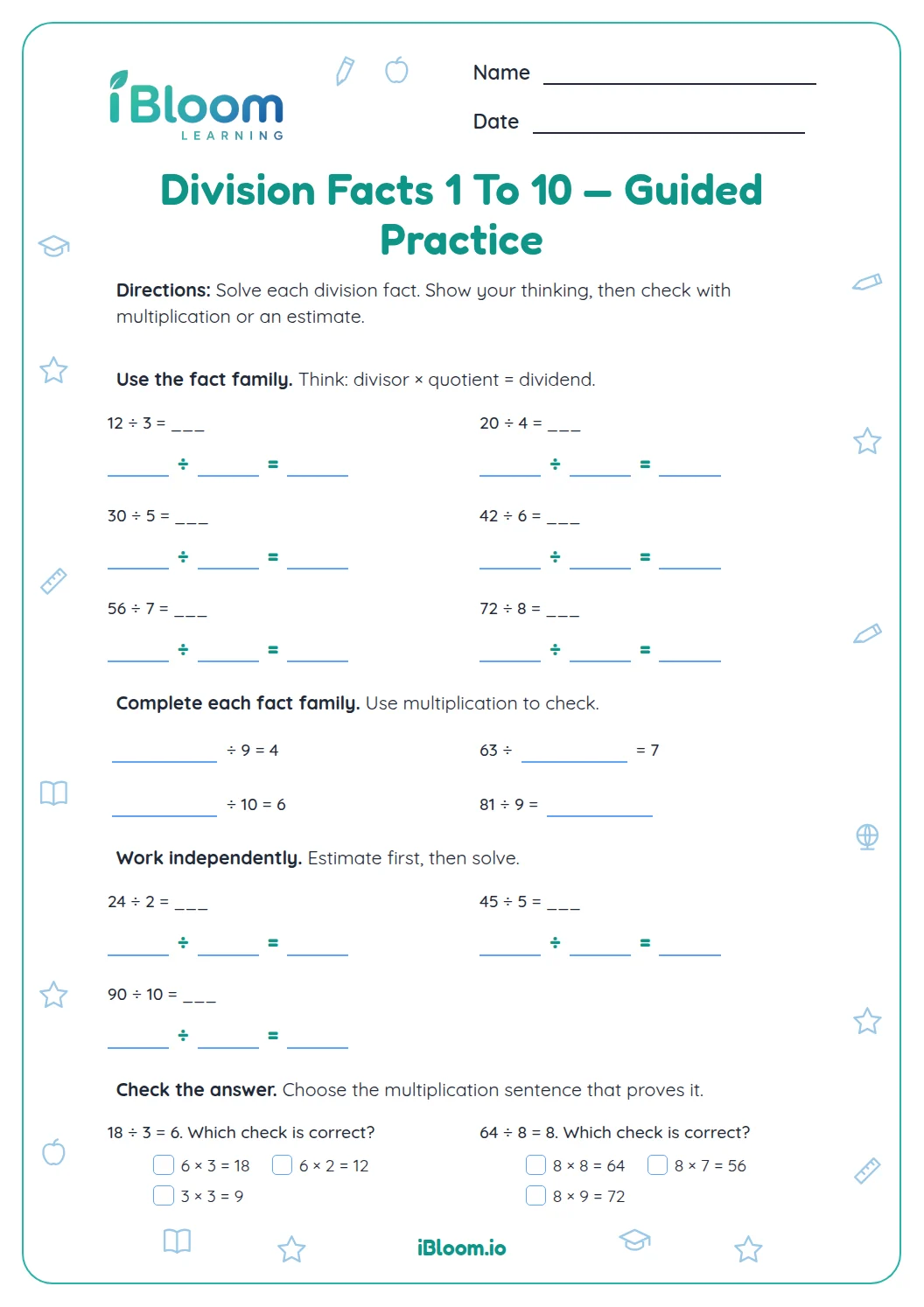
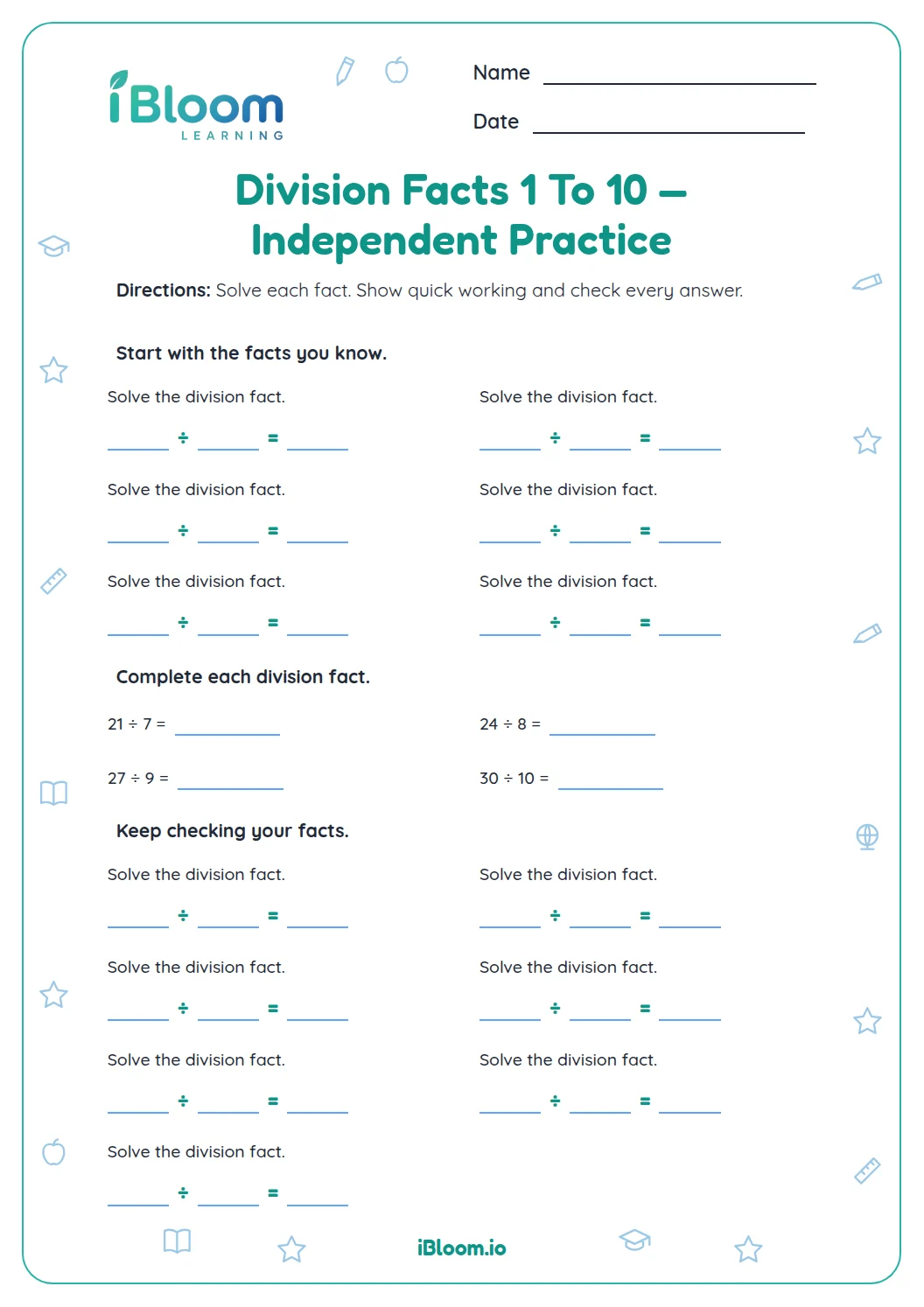
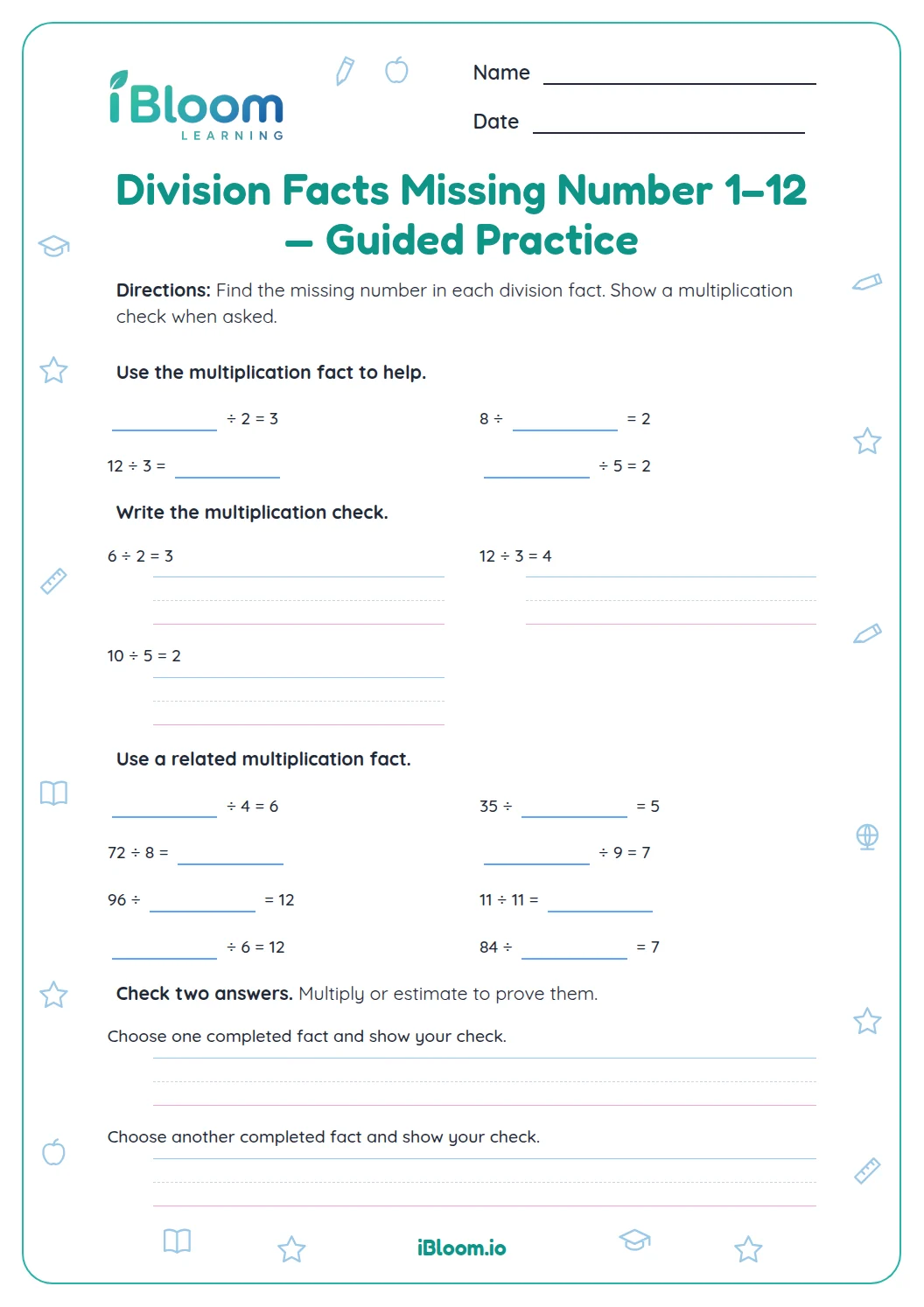
This free printable Grade 3 worksheet builds missing-number division through multiplication facts. Part A asks students to choose a multiplication equation that checks a division fact. Part B gives ten division equations with blanks in different positions, using divisors from 1 through 10. Part C asks students to find a missing number and write a multiplication check. These tasks practice Common Core 3.OA.A.4 and 3.OA.B.6: solving for an unknown whole number and understanding division as an unknown-factor problem. A separate answer key shows the numbers, correct choices, and checking equations.
Aligned to 3.OA.A.4 and 3.OA.B.6
Why does multiplication help with division?
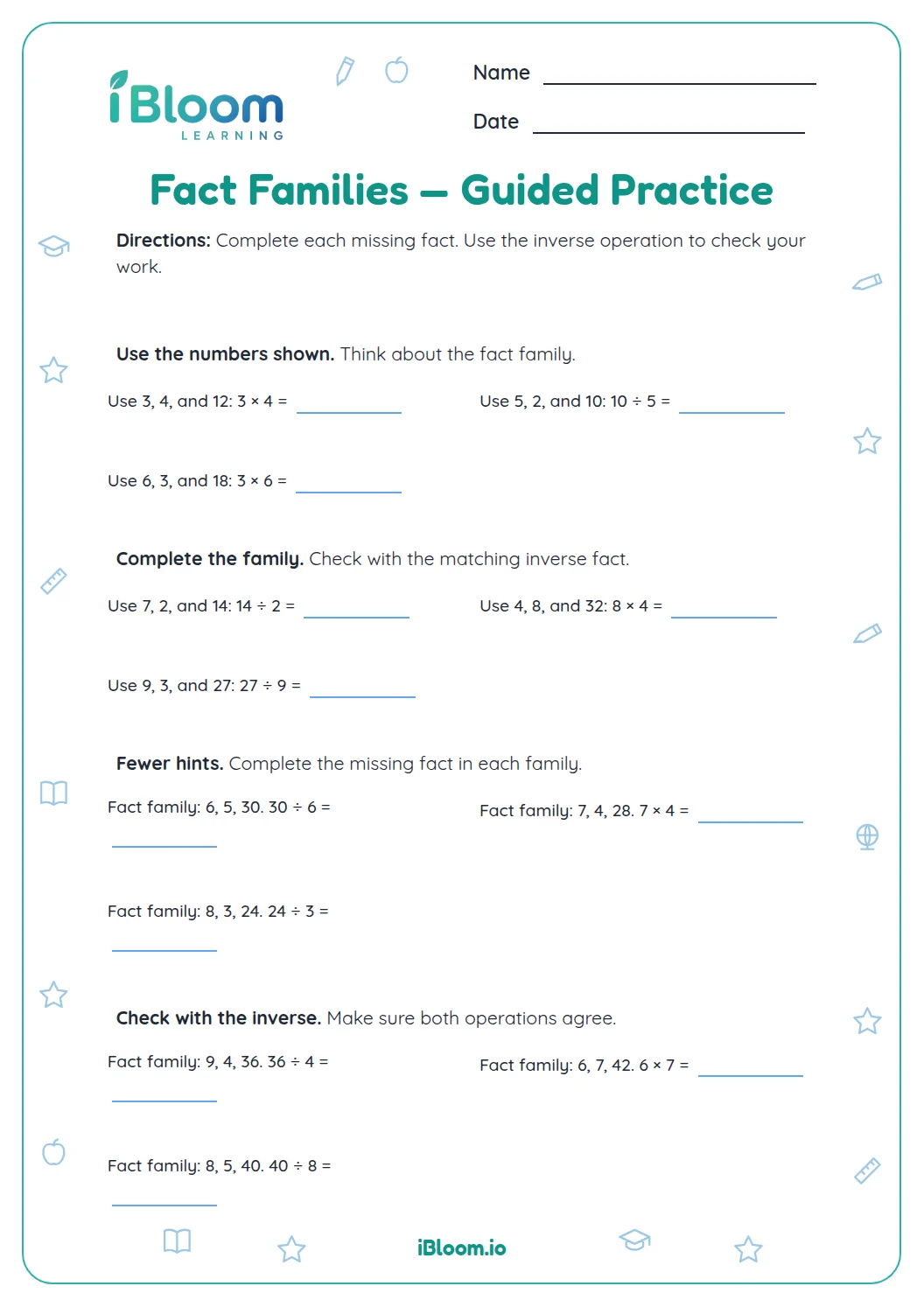
A division fact names a total, a group size, and a number of equal groups. Multiplication joins the two factors to make that total. Knowing 3 × 4 = 12 lets a child check both 12 ÷ 3 = 4 and 12 ÷ 4 = 3.
Part A makes the checking equation the answer. Each wrong choice changes a factor and gives a different total, so students need to check all three numbers against the division fact.
How does the blank’s position change the question?
A missing dividend asks for the total, so multiply the known divisor and quotient. A missing divisor or quotient asks for a factor of the known total. Read the equation before deciding what to calculate.
- 1Question 10: 18 ÷ ___ = 3
- 2Ask: What number × 3 = 18?
- 36 × 3 = 18, so the missing number is 6.
What should students write in the final part?
Part C asks for a missing number and a multiplication equation that verifies it. For 36 ÷ 6, students write 6 and check 6 × 6 = 36. For 40 ÷ ___ = 8, they write 5 and check 5 × 8 = 40.
Use these two answers to see whether the child understands the blank’s job. A correct multiplication check must use the same three numbers as the division fact.
How to use this worksheet
- 1Say a known multiplication fact and its two related division facts.
- 2Read Part A together and choose the equation that reproduces the total.
- 3In Part B, identify whether the total or a factor is missing.
- 4Substitute each answer back into the division equation.
- 5Finish Part C with complete multiplication checks and compare them with the key.
Mistakes to check together
The mistake
Dividing again when the missing number is the dividend.
The fix
For ___ ÷ 2 = 6, find the total with 2 × 6 = 12.
The mistake
Writing 3 for 18 ÷ ___ = 3.
The fix
Test the proposed answer: 18 ÷ 3 is 6. The divisor must be 6.
The mistake
Checking division by subtracting only once.
The fix
A full check multiplies the divisor and quotient to rebuild the dividend.
Common Core alignment
Find the missing dividend, divisor, or quotient in a division equation.
On this sheet: Part B places unknowns in all three positions of division equations.
Show the official wordingHide the official wording
Determine the unknown whole number in a multiplication or division equation relating three whole numbers. For example, determine the unknown number that makes the equation true in each of the equations 8 × ? = 48, 5 = _ ÷ 3, 6 × 6 = ?
Use a related multiplication fact to solve and check division.
On this sheet: Parts A and C connect each division equation with a multiplication check.
Show the official wordingHide the official wording
Understand division as an unknown-factor problem. For example, find 32 ÷ 8 by finding the number that makes 32 when multiplied by 8.
What to practice next
Make more practice
Further reading
Questions parents and teachers ask
Does 1–10 mean every answer is at most ten?
No; it describes the division fact range. Part B uses each divisor from 1 through 10, while dividends can be larger. For example, the missing number in ___ ÷ 2 = 6 is 12. Factors and quotients stay within the familiar facts through ten.
Which number is the dividend?
The dividend is the total being divided, written before the division sign. In 18 ÷ 6 = 3, it is 18. When that first number is missing, as in ___ ÷ 2 = 6, multiply the two known factors to recover the total.
Why choose a multiplication equation first?
Choosing a check makes the relationship between operations explicit before students fill blanks. For 12 ÷ 3 = 4, the matching check is 3 × 4 = 12. Read all three numbers together and ask whether multiplying the divisor and quotient really returns the dividend.
Can my child use counters?
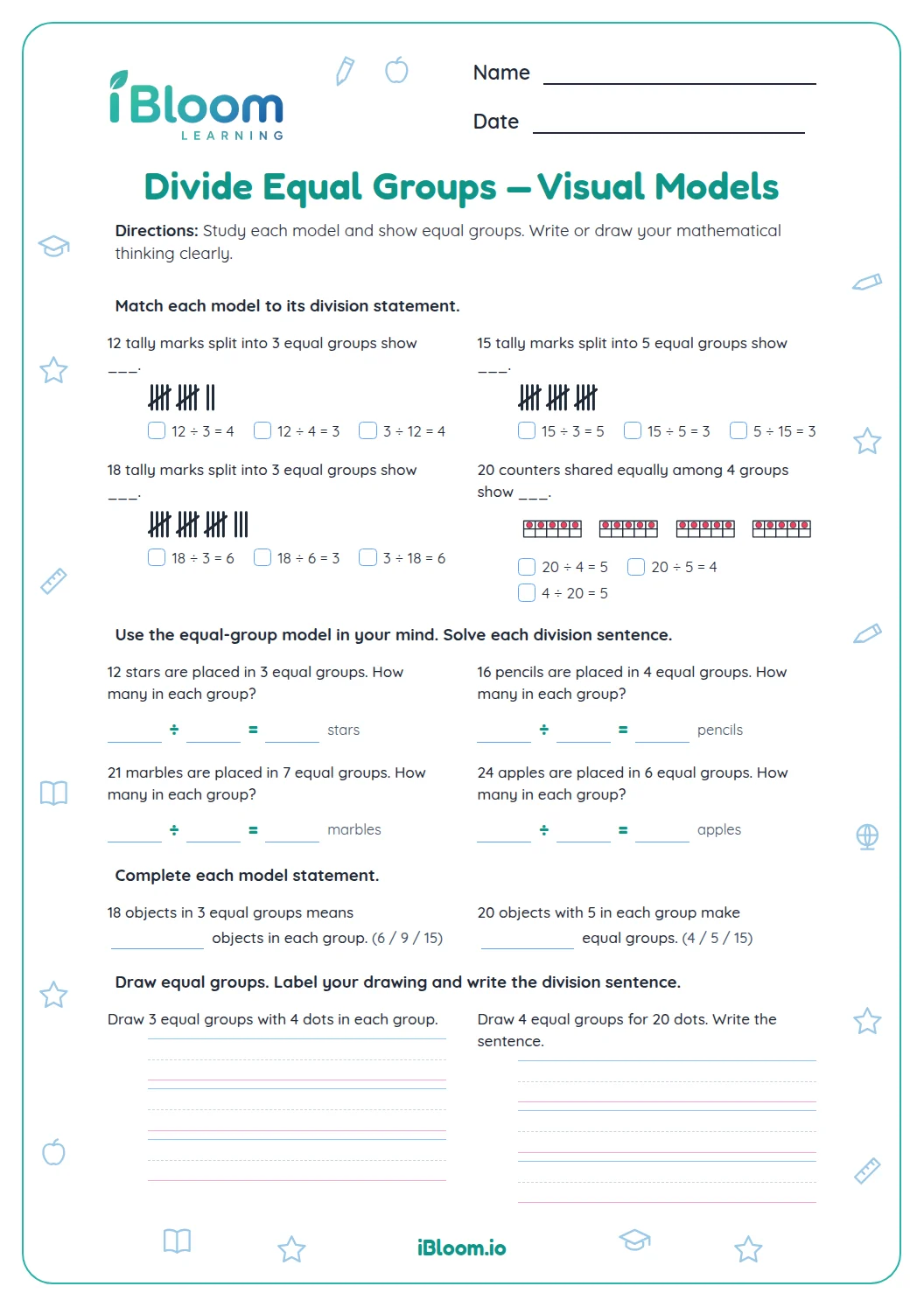
Yes; counters can make the equal groups easier to see. For 18 ÷ ___ = 3, share 18 counters into three equal groups and count six in each group. Then connect the model to 6 × 3 = 18 and return to the printed equation.
What does the answer key show for written checks?
It shows both the missing number and a multiplication equation. For the final question, the answer is 5, checked by 5 × 8 = 40. Accept 8 × 5 = 40 as well, since reversing the factors still verifies the same total and division fact.