






About this worksheet
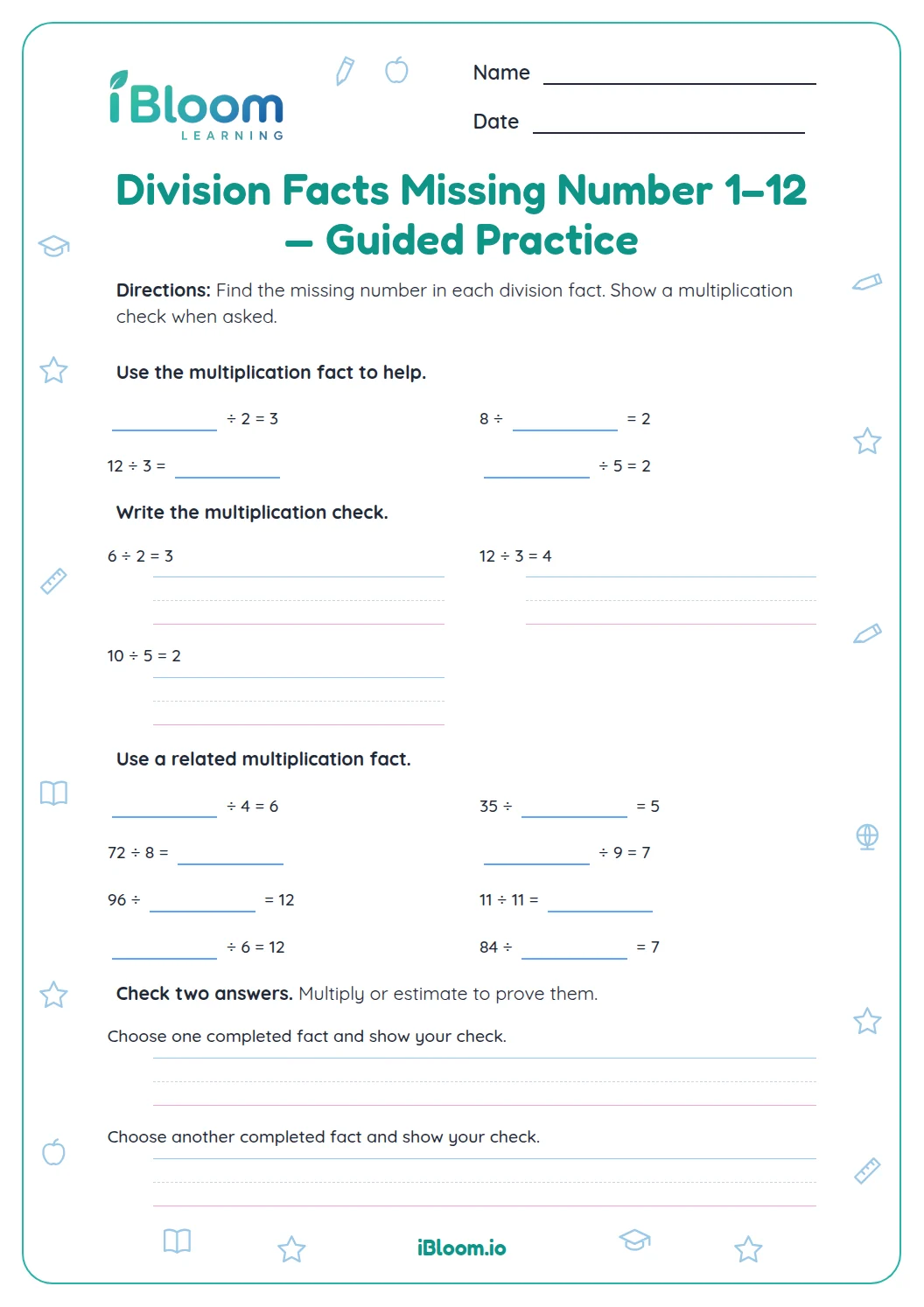
This printable Grade 3 math worksheet practices division facts with missing quotients from divisors 1 through 12. Students use equal-group arrays for the first eight facts, then solve six facts and check with multiplication. It has 14 questions across two worksheet pages and a separate two-page answer key. The practice supports CCSS 3.OA.C.7.
Aligned to 3.OA.C.7
How do the arrays model division?
The first eight questions pair a division fact with an array of equal groups. The number of rows shows the divisor, and the number in each row gives the quotient.
The final six questions extend fact practice to divisors 9 through 12 and revisit familiar facts. Students can multiply the divisor by the quotient to check each dividend.
- 1Complete: 8 ÷ 2 = ___.
- 2Two groups of four make 8, so the quotient is 4.
How can an adult support practice?
For the first part, have the student count the rows and dots in each array. In the second part, ask which multiplication fact confirms the quotient.
How should students check their work?
Use the separate key after finishing each part. Correct a missed item, then explain what feature makes the corrected answer fit.
How to use this worksheet
- 1Read the sheet directions together.
- 2Complete the first item as a model.
- 3Work through each part in order.
- 4Pause to explain a clue or strategy.
- 5Check answers with the key and correct any missed items.
Common mistakes and quick fixes
The mistake
Writing the number in each group as the divisor.
The fix
Use the number of groups as the divisor and count items per group for the quotient.
The mistake
Using the dividend as the missing quotient.
The fix
Check that divisor × quotient equals the dividend.
The mistake
Skipping a fact family check.
The fix
Multiply the divisor by the answer and compare with the dividend.
Common Core alignment
This Grade 3 worksheet connects equal groups and division facts within 100.
Use multiplication and division relationships to solve facts within 100.
On this sheet: Students use equal jumps and division facts within 100, then check each quotient with multiplication.
Show the official wordingHide the official wording
Fluently multiply and divide within 100, using strategies such as the relationship between multiplication and division (e.g., knowing that 8 × 5 = 40, one knows 40 ÷ 5 = 8) or properties of operations. By the end of Grade 3, know from memory all products of two one-digit numbers.
What to practice next
Make more practice
Further reading
Questions parents and teachers ask
What do the array rows represent?
Each row shows one equal group, and the number of rows matches the divisor. Counting the dots in each row gives the quotient. For 8 ÷ 2, two rows of four make 8, so the quotient is 4.
Which divisors appear?
The worksheet includes division facts with divisors 1 through 12. The first eight questions have array models for divisors 1 through 8; the remaining facts practice divisors 9, 10, 11, and 12, along with review. The answer key lists every quotient.
How can students check each quotient?
Multiply the divisor by the quotient. The product should equal the dividend. For example, if 30 ÷ 3 = 10, then 3 × 10 = 30. This check works for the modeled questions and the independent facts on the second part of the worksheet.
Do all questions have a model?
The first eight facts include arrays of equal groups. The final six are written division facts, giving students a chance to use the same relationship without a drawing beside every problem. They can check each answer by multiplying the divisor and quotient.
How many questions and pages are included?
There are 14 missing-quotient questions in two parts across two worksheet pages. A separate answer key takes two pages. The first part uses arrays, and the second part asks students to solve and check division facts within the same fact range.