








About this worksheet
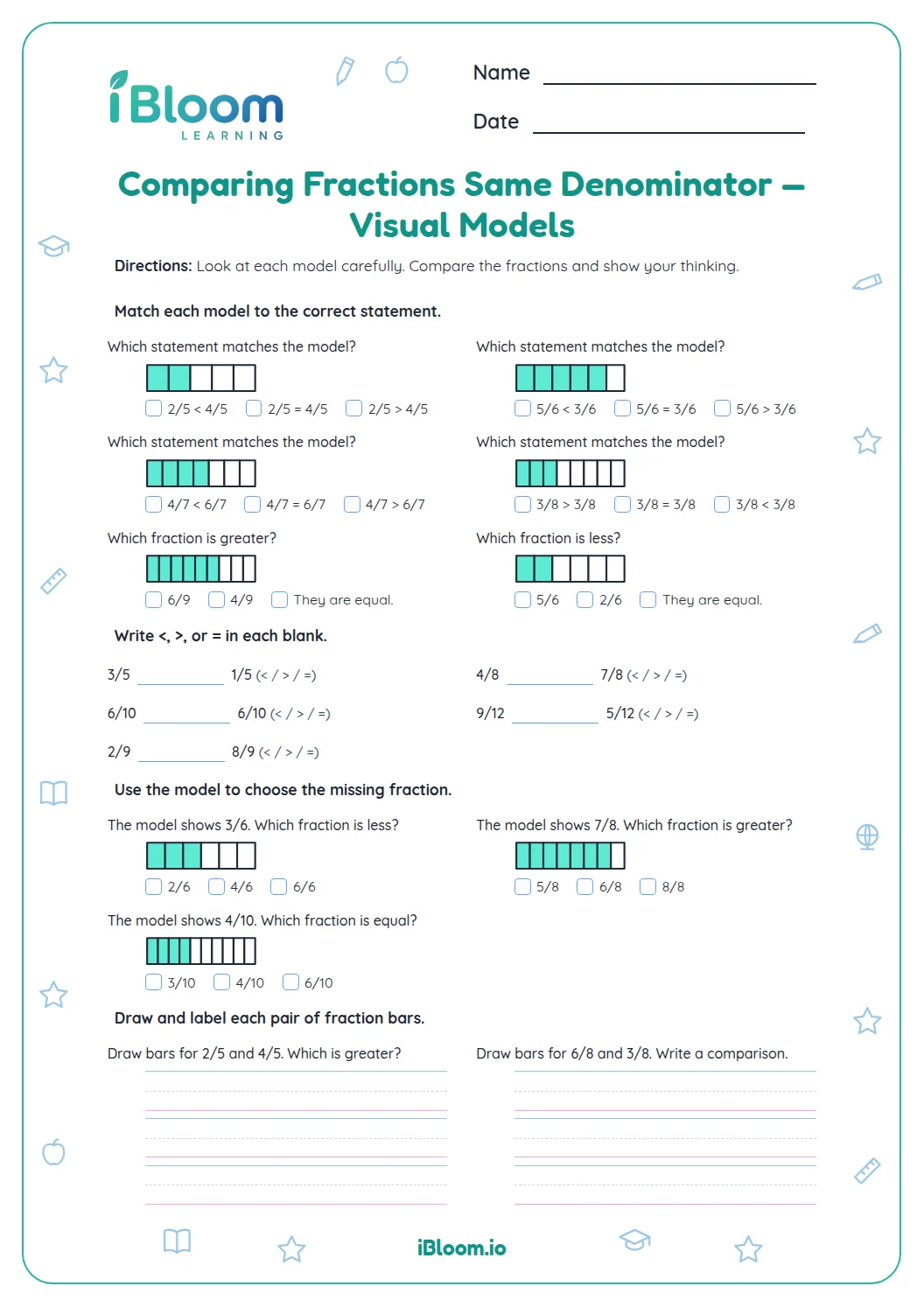
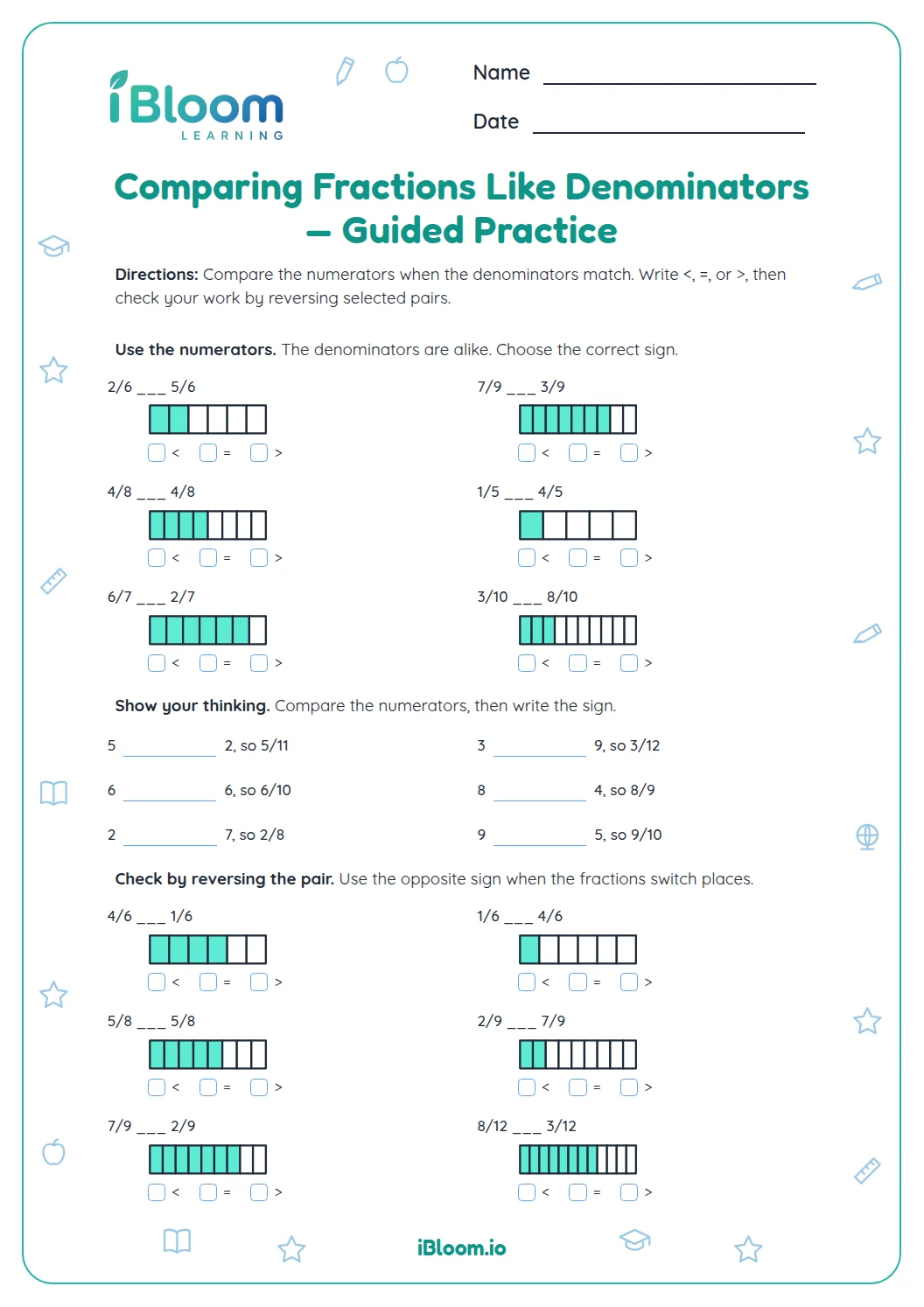
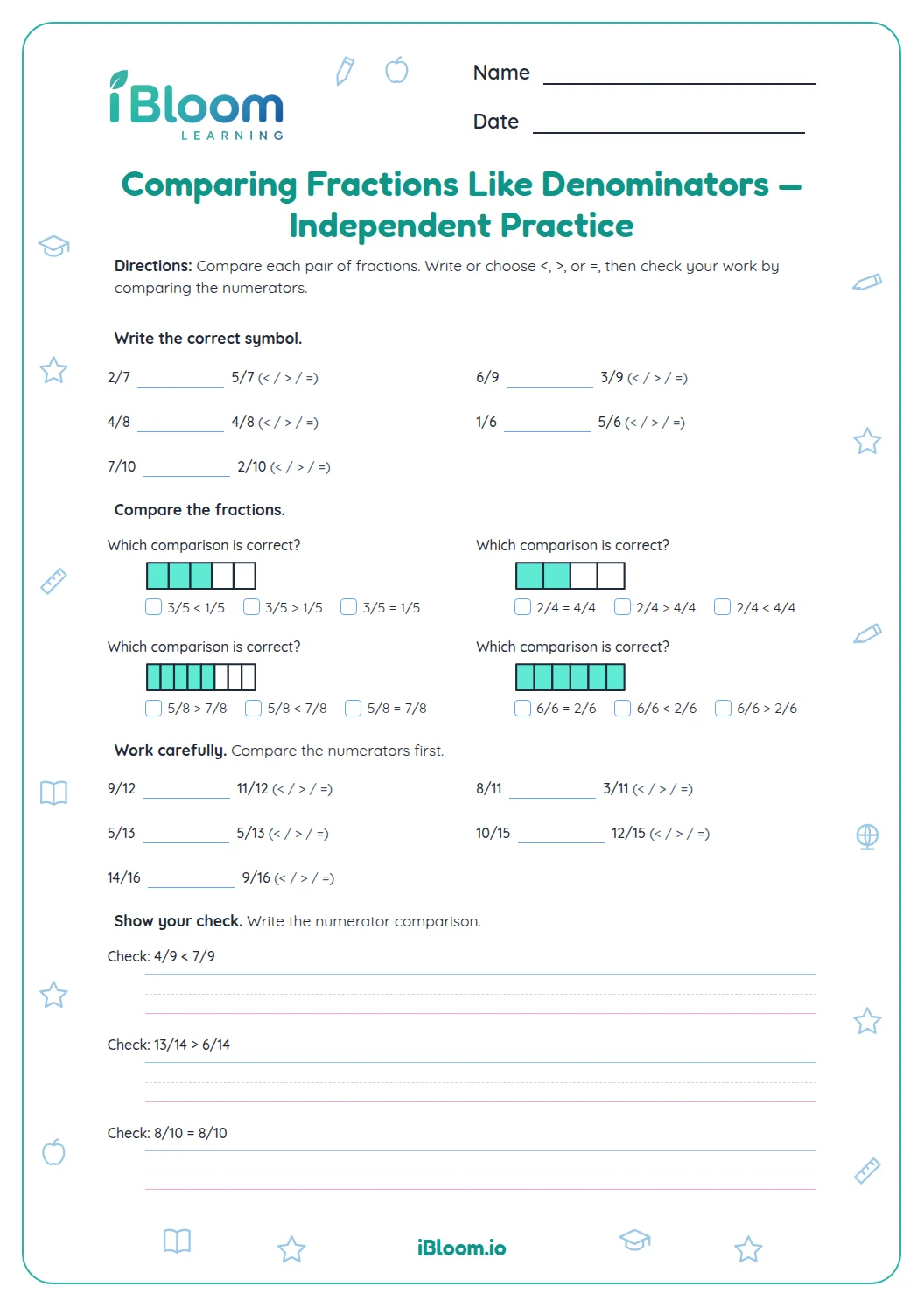
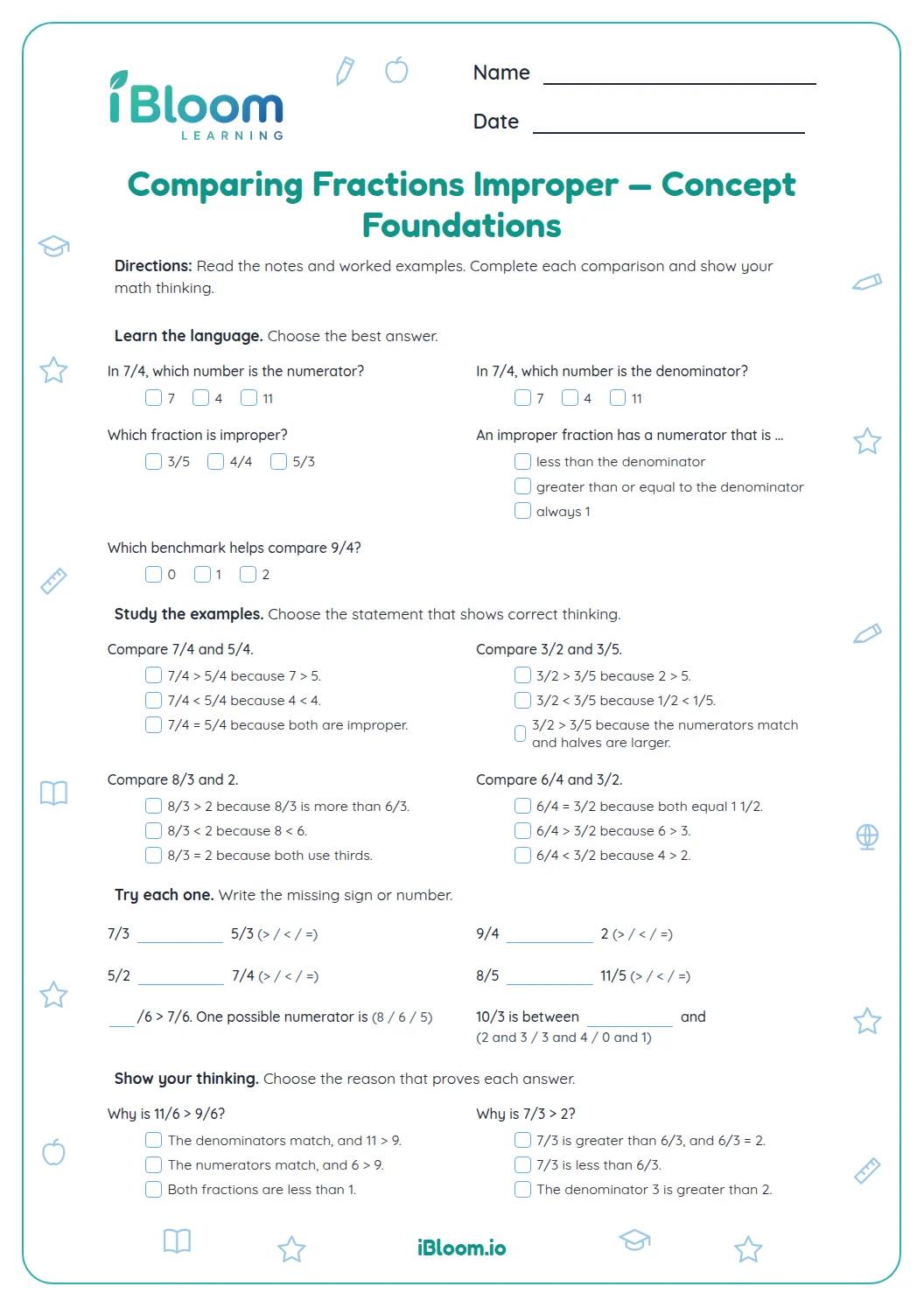
This Grade 3 printable turns same-denominator fraction comparisons into short real-world stories. Students decide which amount is greater, less, or equal and record comparisons with <, >, or =. The page contains 14 questions in three parts and a complete answer key. It practices Common Core 3.NF.A.3.d.
Aligned to 3.NF.A.3.d
What matters when denominators match?
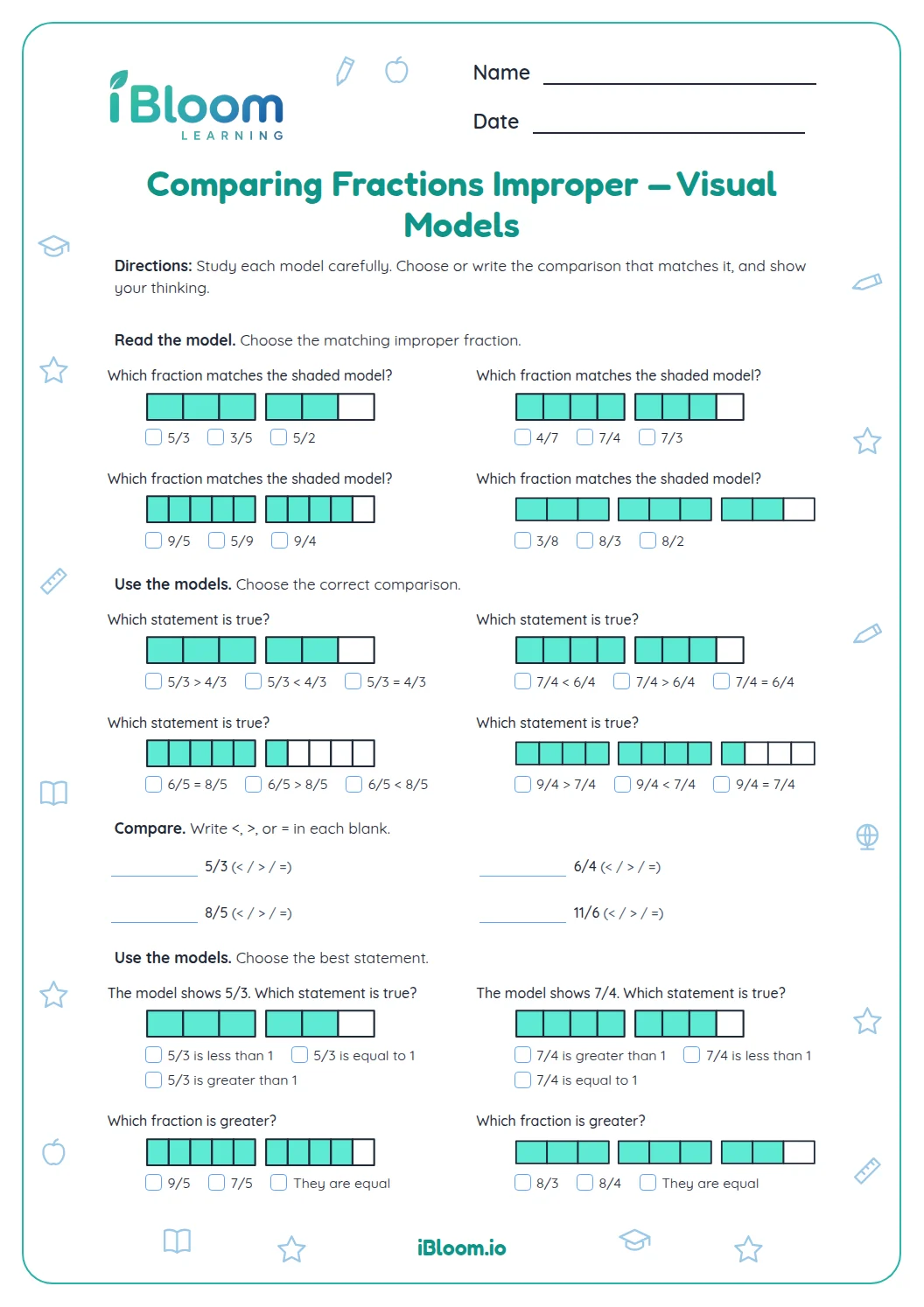
The denominator tells how many equal parts make one whole. If two fractions describe the same-size whole and have the same denominator, their parts are the same size. Compare how many parts each fraction has.
- 13/8 is less than 5/8
- 2Luis ate more of the same-size bar.
How do I record a comparison?
Write the fractions in the order named, then place <, >, or = between them. For 2/8 and 6/8, the comparison is 2/8 < 6/8 because two parts are fewer than six parts.
- 12/8 < 6/8
- 2The wholes match and 2 < 6.
How do I solve a fraction story?
Check that the wholes are equal before comparing. Then use the numerators to decide which fraction is greater, less, or equal. Record the relationship with <, >, or =.
How to use this worksheet
- 1Check that both fractions refer to the same size whole.
- 2Read the denominator to identify the equal part size.
- 3Compare numerators to decide greater, less, or equal.
- 4Use <, >, or = when a symbol is requested.
- 5For “how much more,” subtract the numerators and keep the denominator.
Common mistakes and quick fixes
The mistake
Comparing only denominator size
The fix
With matching denominators, compare the numerators because each part has the same size.
The mistake
Comparing fractions from different-size wholes
The fix
Use the same-size whole stated in the story before comparing.
The mistake
Changing the denominator when finding a difference
The fix
Subtract the counts of equal parts and keep the shared denominator.
Common Core alignment
This worksheet practices a named Common Core math skill through its problems and worked example.
Compare same-denominator fractions for the same whole and record <, =, or >.
On this sheet: Compare same-denominator fractions for the same whole and record <, =, or >.
Show the official wordingHide the official wording
Compare two fractions with the same numerator or the same denominator by reasoning about their size. Recognize that comparisons are valid only when the two fractions refer to the same whole. Record the results of comparisons with the symbols >, =, or <, and justify the conclusions, e.g., by using a visual fraction model.
What to practice next
Make more practice
Further reading
Questions parents and teachers ask
Why must the wholes be the same size?
A fraction describes part of a whole, so compare fractions only when the wholes are the same size. These stories name equal-size bars, books, jugs, or other wholes so the parts can be compared fairly. The separate answer key gives each result so students can check their own work.
What does the denominator tell us?
The denominator tells how many equal parts make one whole. In five eighths, the whole is divided into eight equal pieces and the numerator counts how many pieces are being described. Matching denominators mean matching piece sizes. The separate answer key gives each result so students can check their own work.
What is the easiest way to compare 3/8 and 5/8?
Because both fractions have denominator 8 and refer to an equal-size whole, each piece has the same size. Five pieces are more than three pieces, so the fraction with five eighths is greater than the fraction with three eighths. The separate answer key gives each result so students can check their own work.
How do I find how much more one fraction is?
When denominators match, subtract the numerators and keep the denominator. For instance, five eighths minus two eighths leaves three eighths. The answer describes the difference in equal parts of the same whole. The separate answer key gives each result so students can check their own work.
When should I use the equals sign?
Use the equals sign when two fractions describe the same amount. Identical fractions such as six eighths and six eighths are equal when they describe the same-size whole. Make sure both sides refer to comparable wholes. The separate answer key gives each result so students can check their own work.