





About this worksheet
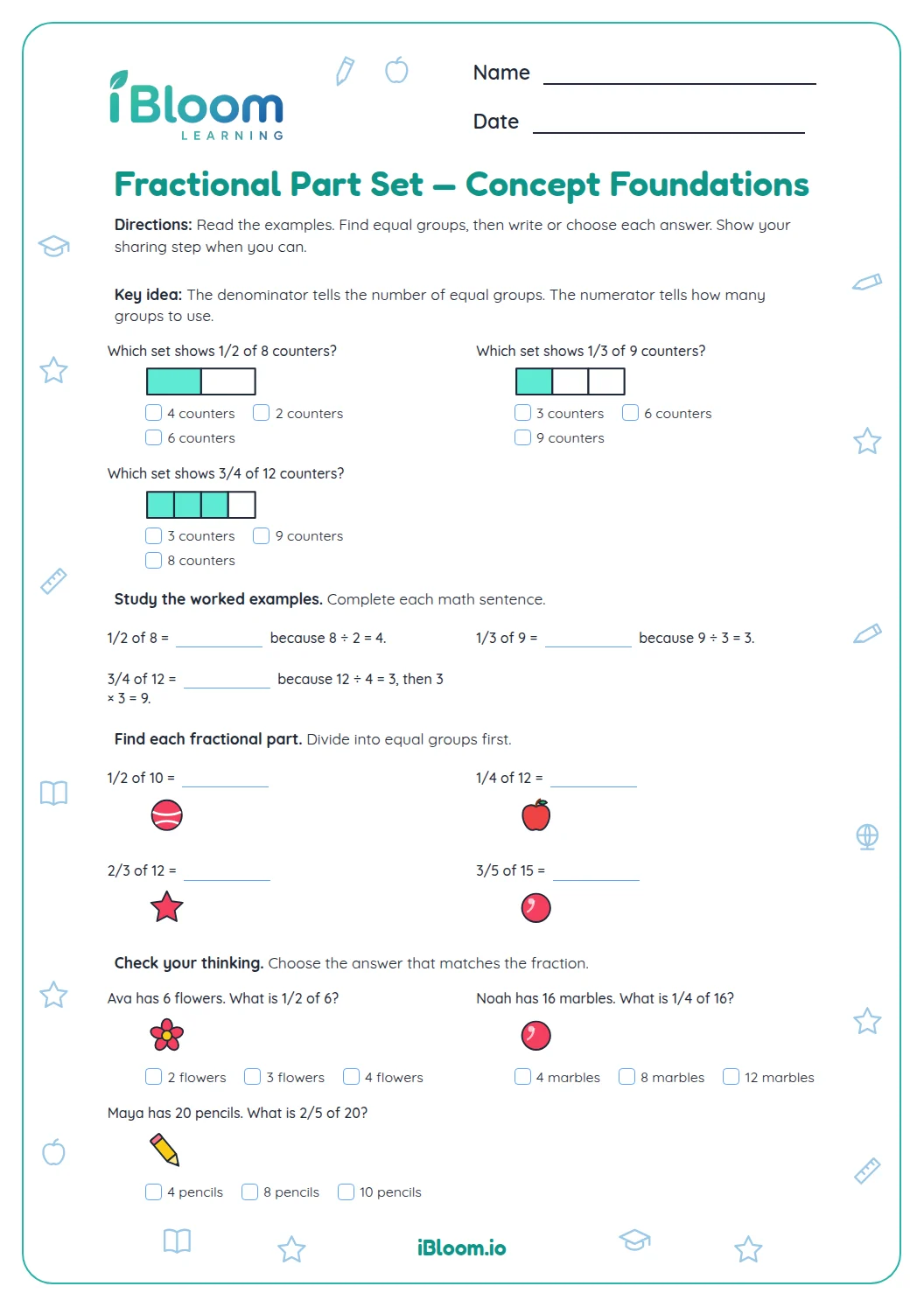
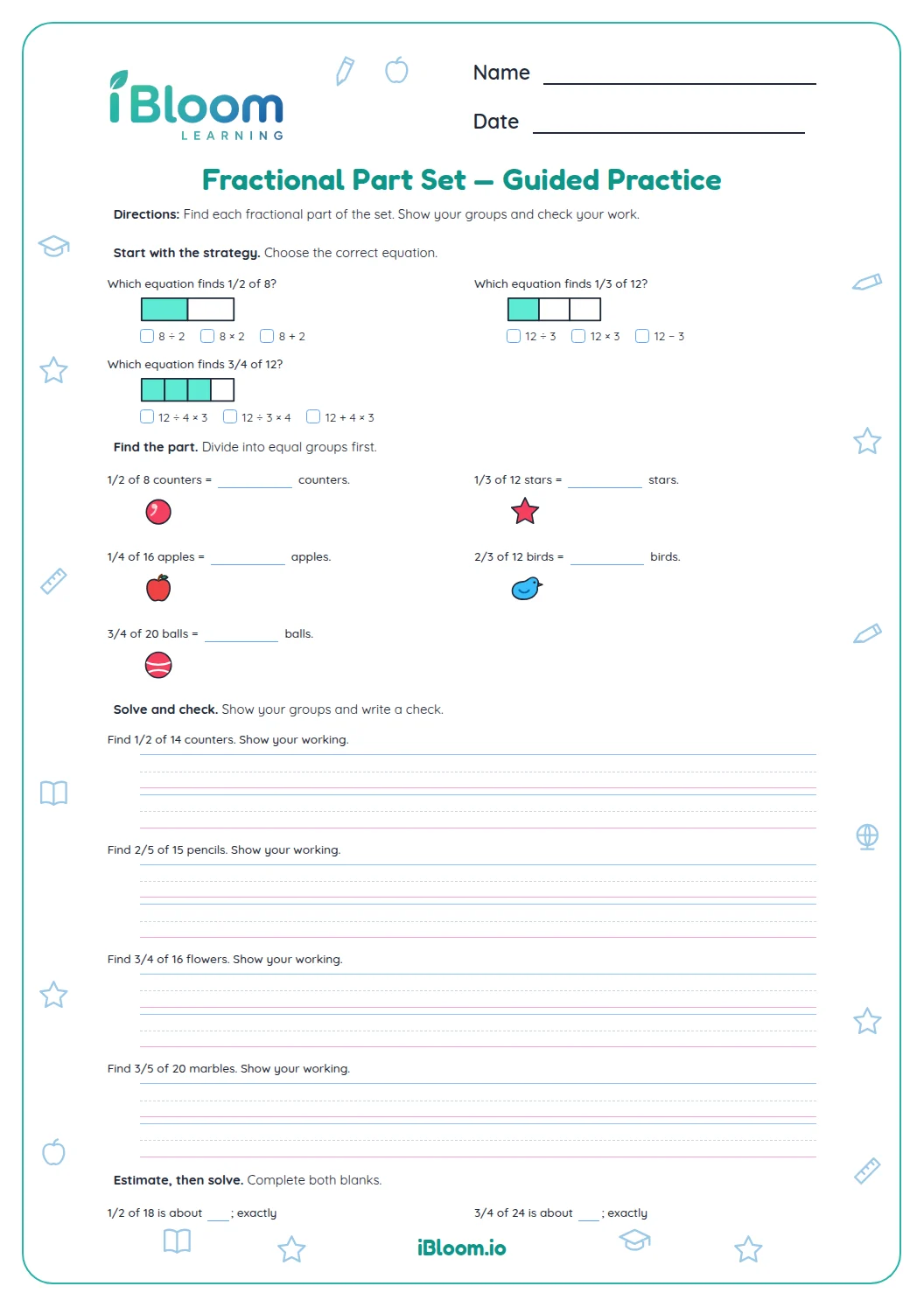
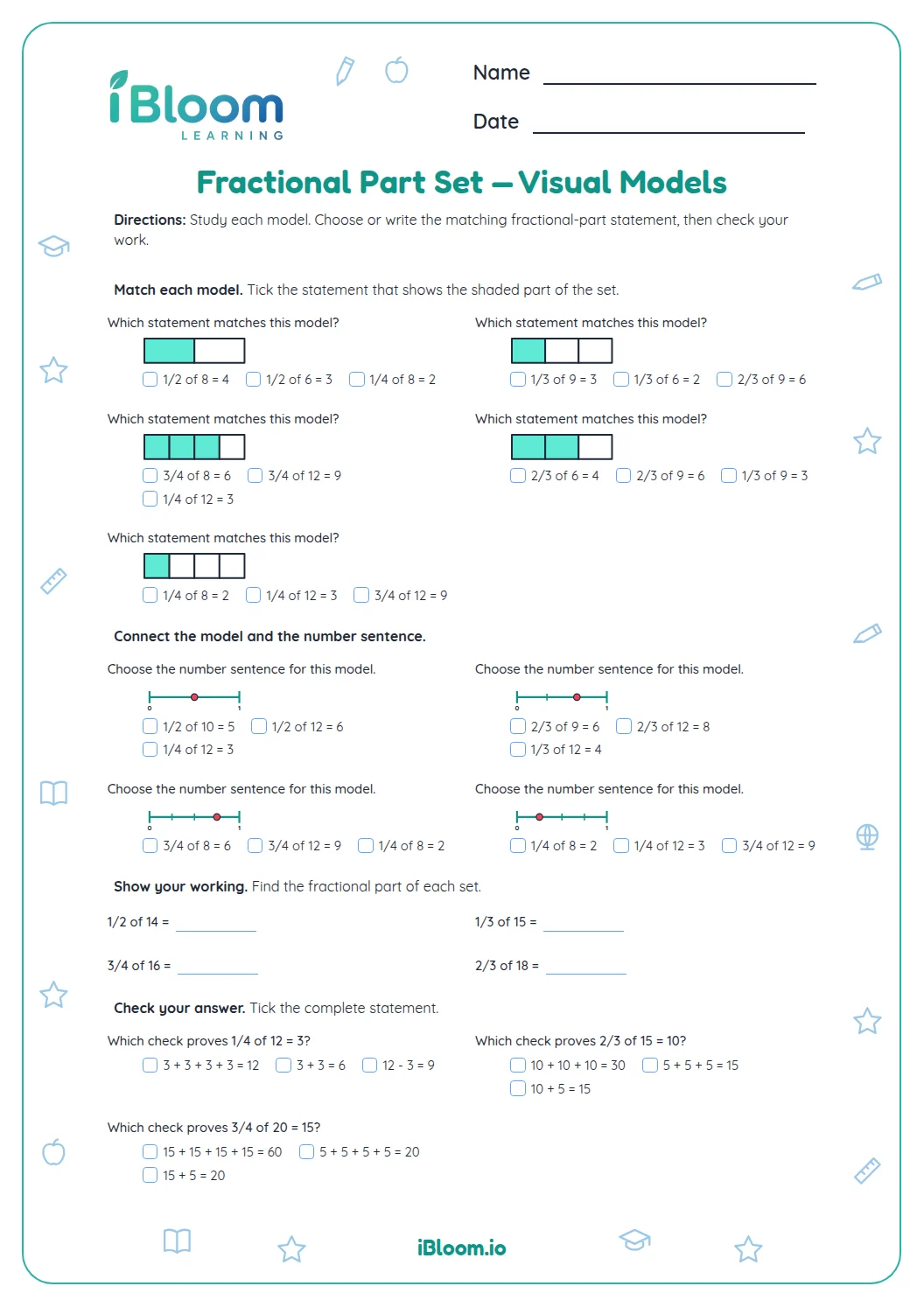
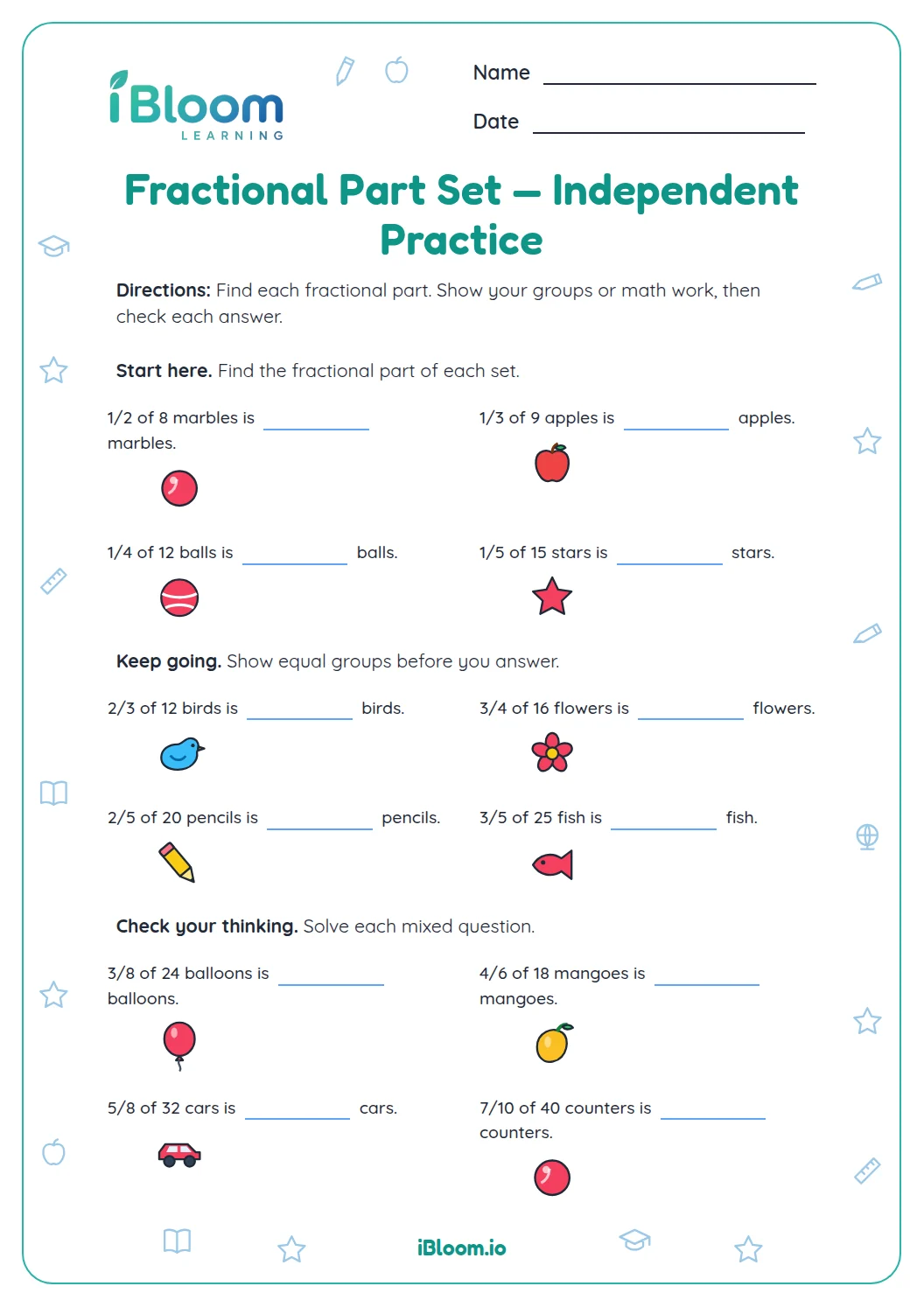
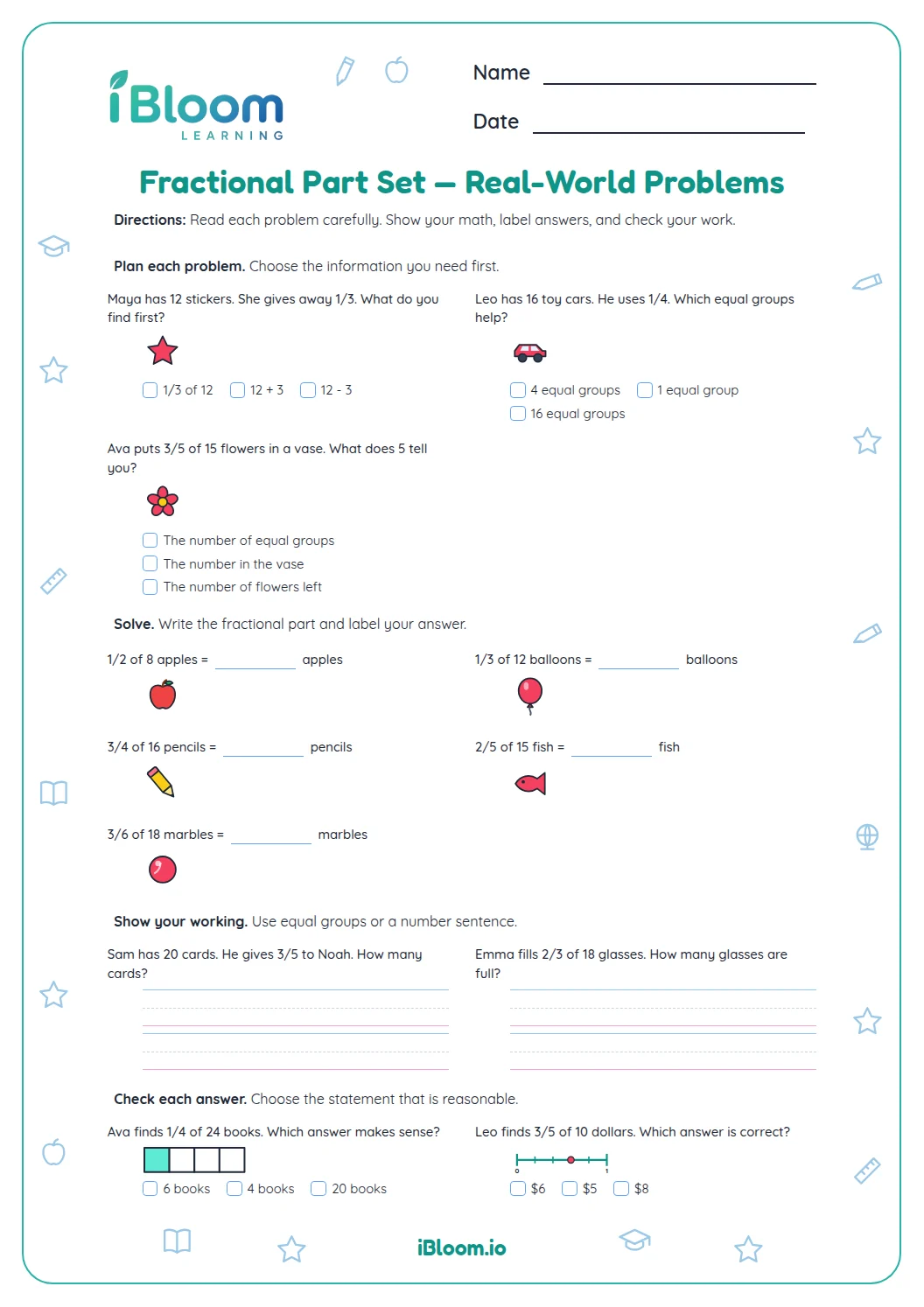
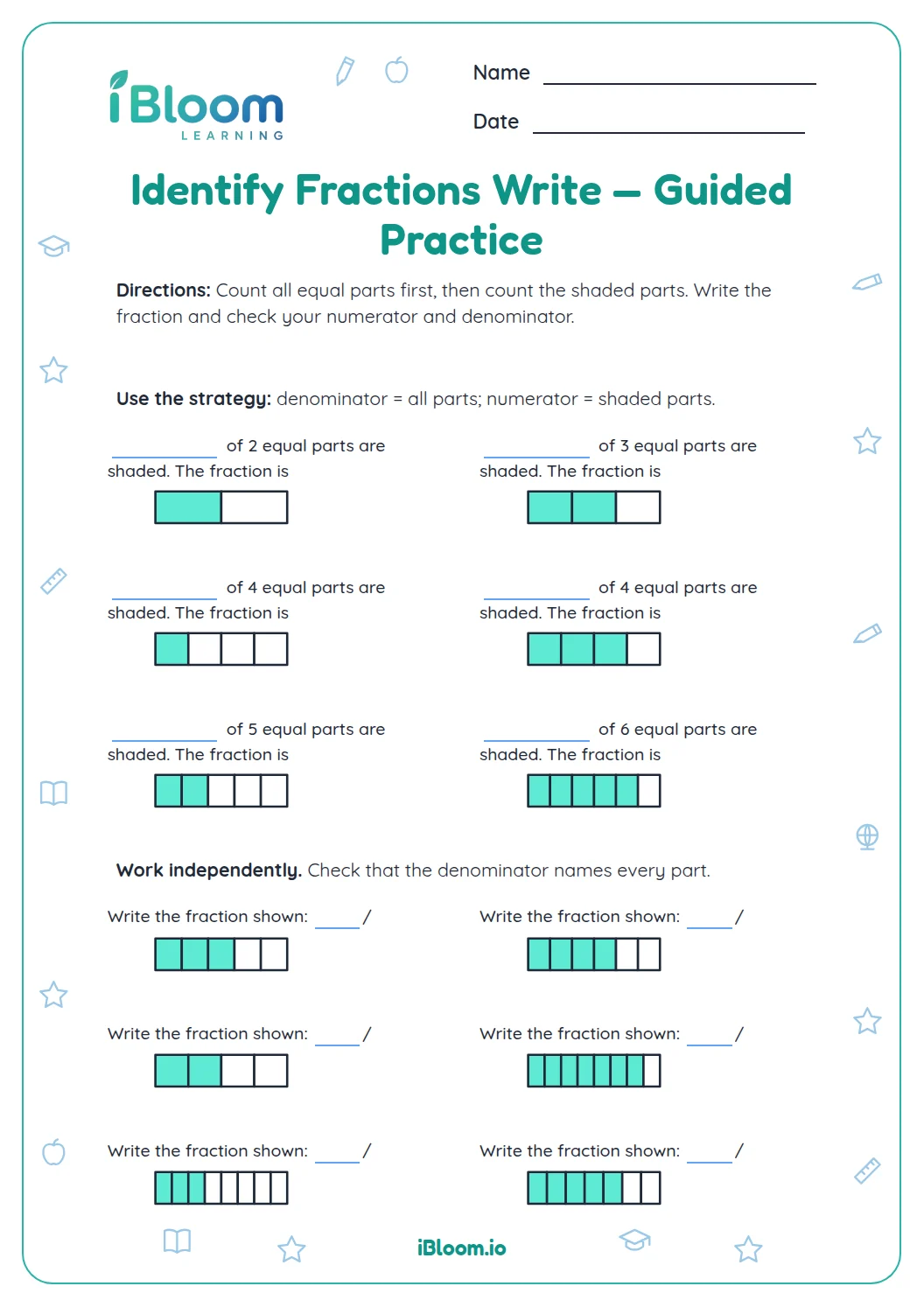
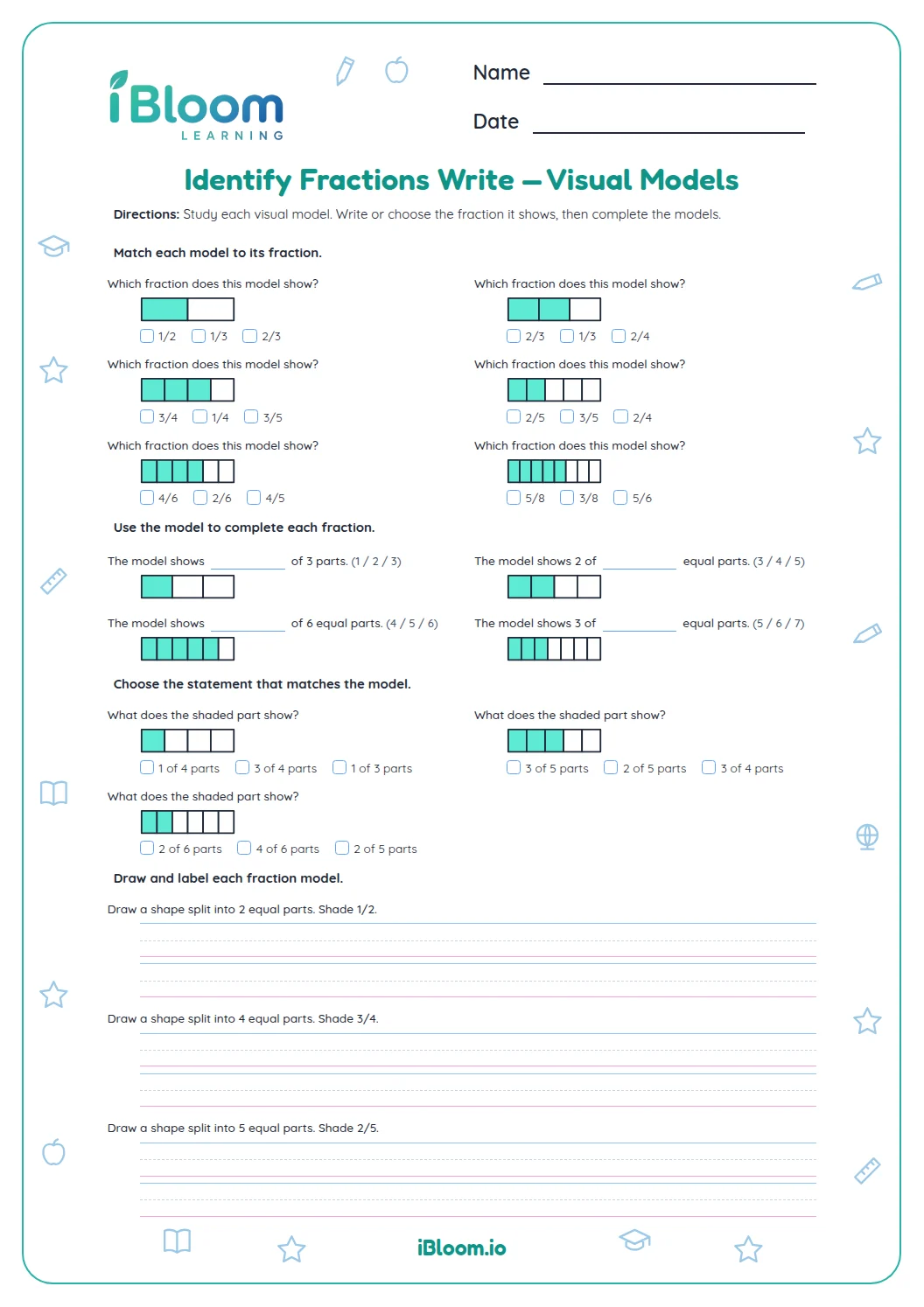
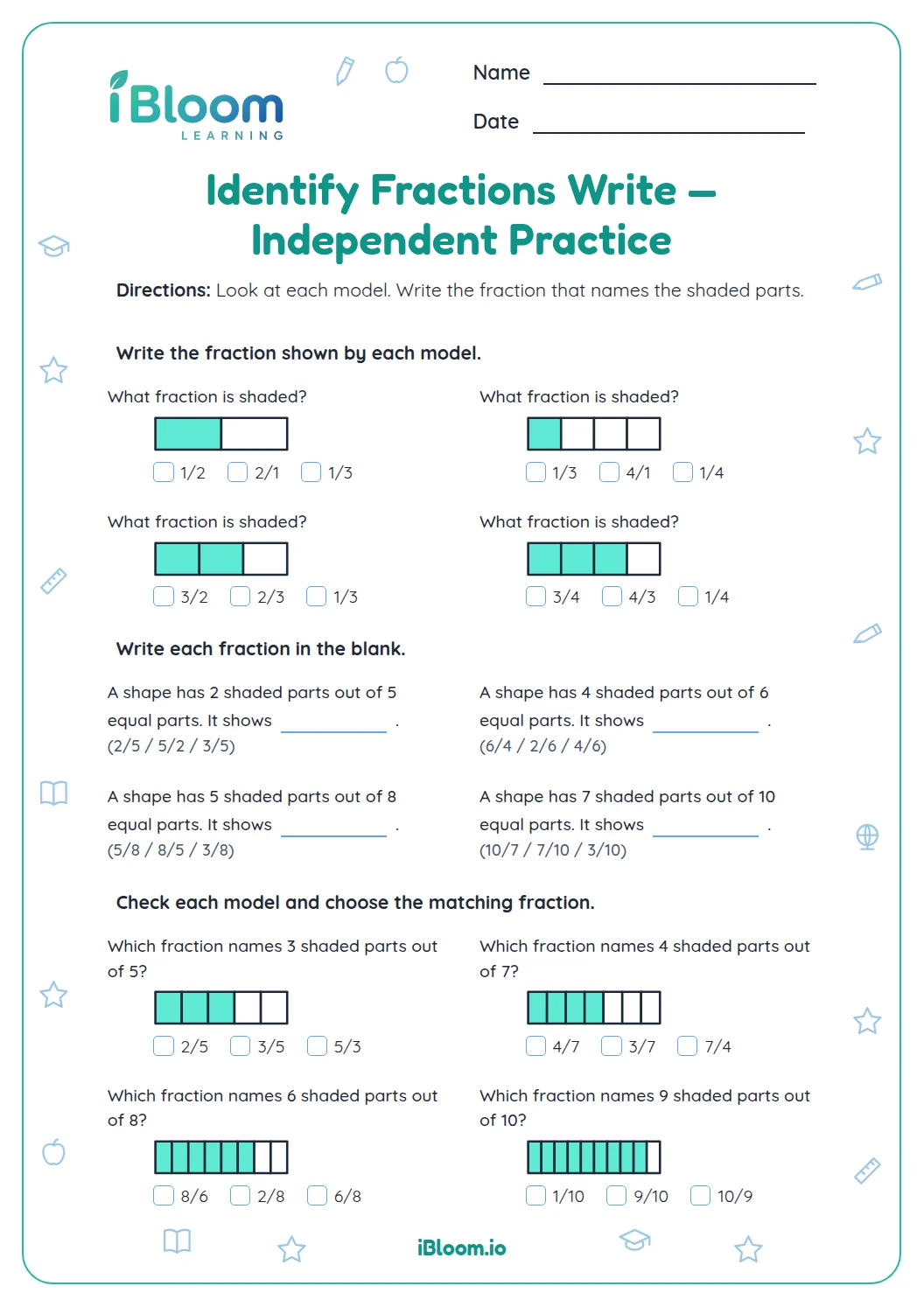
This Grade 3 fractions worksheet practices finding a fraction of a set and explaining the equal-group reasoning. Children work with pictured counters, calculate fractions such as 2/3 of 15, and solve short set problems. The tasks connect the numerator to the number of equal groups counted and the denominator to the number of groups in the whole, aligning with Common Core 3.NF.A.1. A separate answer key lists the correct numerical answers.
Aligned to 3.NF.A.1
What does the denominator tell us about a set?
The denominator tells how many equal groups make the whole set. With 12 counters and a denominator of 3, split the counters into 3 groups of 4.
How does the numerator help find the answer?
The numerator tells how many of those equal groups to count. For 2/3 of 15, split 15 into 3 groups of 5, then count 2 groups: 10.
- 1Find 3/4 of 20.
- 220 ÷ 4 = 5 in one group.
- 3Count 3 groups: 5 + 5 + 5 = 15.
- 4Answer: 15 objects.
How can a child check a fraction answer?
Multiply the number in one group by the number of groups selected. The answer should not be larger than the whole set when the fraction is less than one.
How do reasoning questions help?
A reasoning question asks children to diagnose a step or compare two parts of the same-sized whole. Naming the group size makes the explanation clear.
How to use this worksheet
- 1Read the total number of objects and the fraction.
- 2Use the denominator to divide the set into equal groups.
- 3Use the numerator to count the selected groups.
- 4Write the quantity and include units in word problems.
- 5For a claim, check each equal group before judging the answer.
Common mistakes and quick fixes
The mistake
Using the numerator as the number of groups in the whole.
The fix
Start with the denominator and split the whole into that many equal groups.
The mistake
Counting just one group when the numerator is greater than 1.
The fix
After finding one group, count the number of groups named by the numerator.
The mistake
Making groups with different numbers of objects.
The fix
Check that every group has the same number before counting selected groups.
Common Core alignment
Build a fraction by counting parts of size 1/b in equal partitions.
On this sheet: Each problem partitions a set into equal groups and identifies a specified number of those groups.
Show the official wordingHide the official wording
Understand a fraction 1/b as the quantity formed by 1 part when a whole is partitioned into b equal parts; understand a fraction a/b as the quantity formed by a parts of size 1/b.
What to practice next
Make more practice
Further reading
Questions parents and teachers ask
What does the denominator tell us in these problems?
The denominator tells how many equal groups make the whole set. For example, to find one third of 12 counters, split 12 into three equal groups of four before counting the selected groups. Ask learners to point out the sentence clue and reread their answer in context.
How do you find two thirds of 15?
Split 15 into three equal groups, so each group has 5. Count two groups: 5 + 5 = 10. The worksheet uses this same equal-group idea with several numerators and denominators. Ask learners to point out the sentence clue and reread their answer in context.
Why must the groups be equal?
A fraction describes equal parts of one whole. If groups contain different numbers of objects, counting some groups does not represent the fraction named. Check that each group has the same number before counting selected groups. Ask learners to point out the sentence clue and reread their answer in context.
Can children use counters at home?
Yes. Small objects such as buttons or cereal pieces can model a set. Have the child arrange the total into the number of equal groups named by the denominator, then count the groups named by the numerator. Ask learners to point out the sentence clue and reread their answer in context.
What does the answer key show?
The key gives the answer for each fraction-of-a-set problem. For the reasoning items, use the equal-group method to explain why the answer fits, such as checking how many objects belong in one fourth before counting three fourths. Ask learners to point out the sentence clue and reread their answer in context.