





About this worksheet
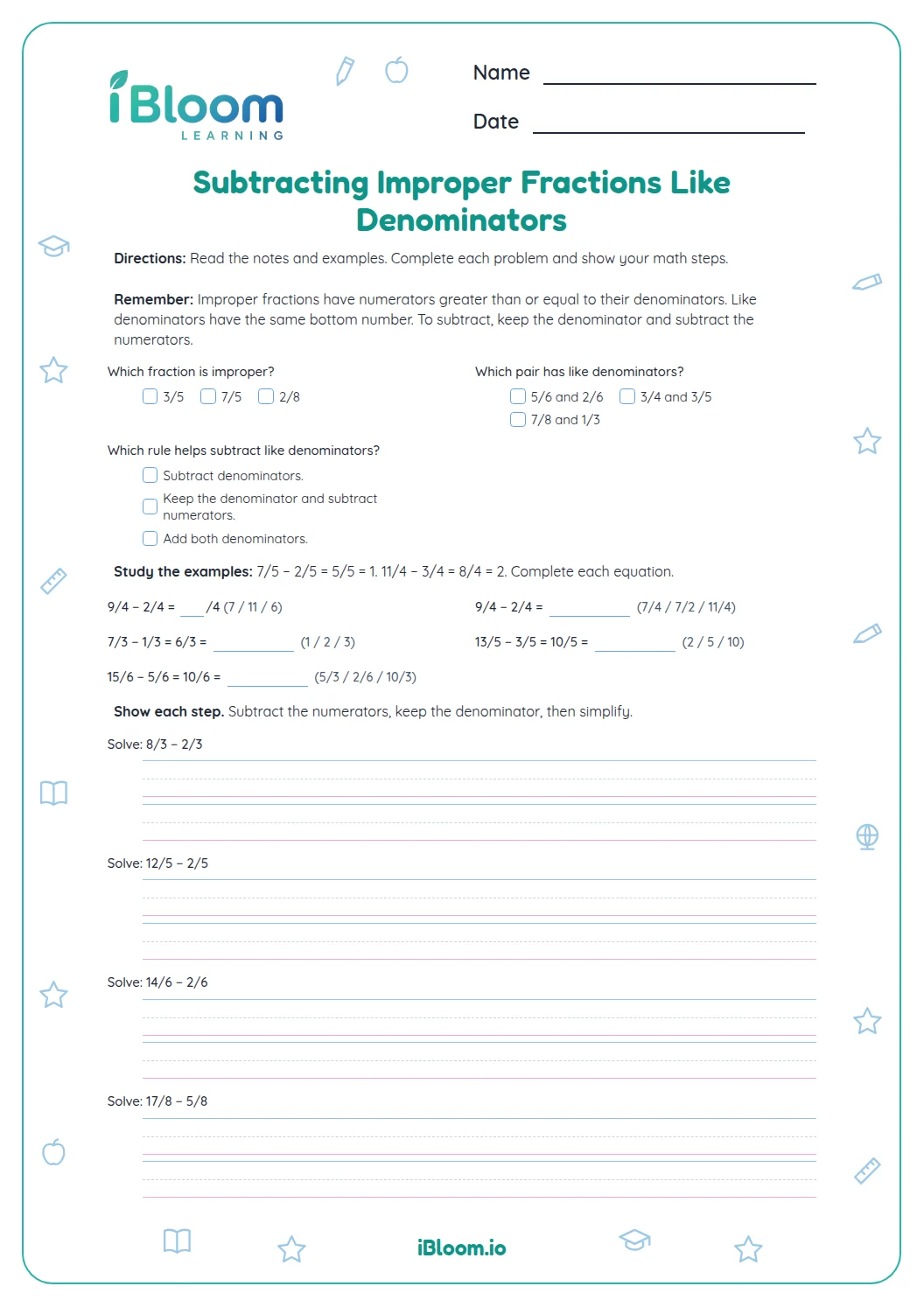
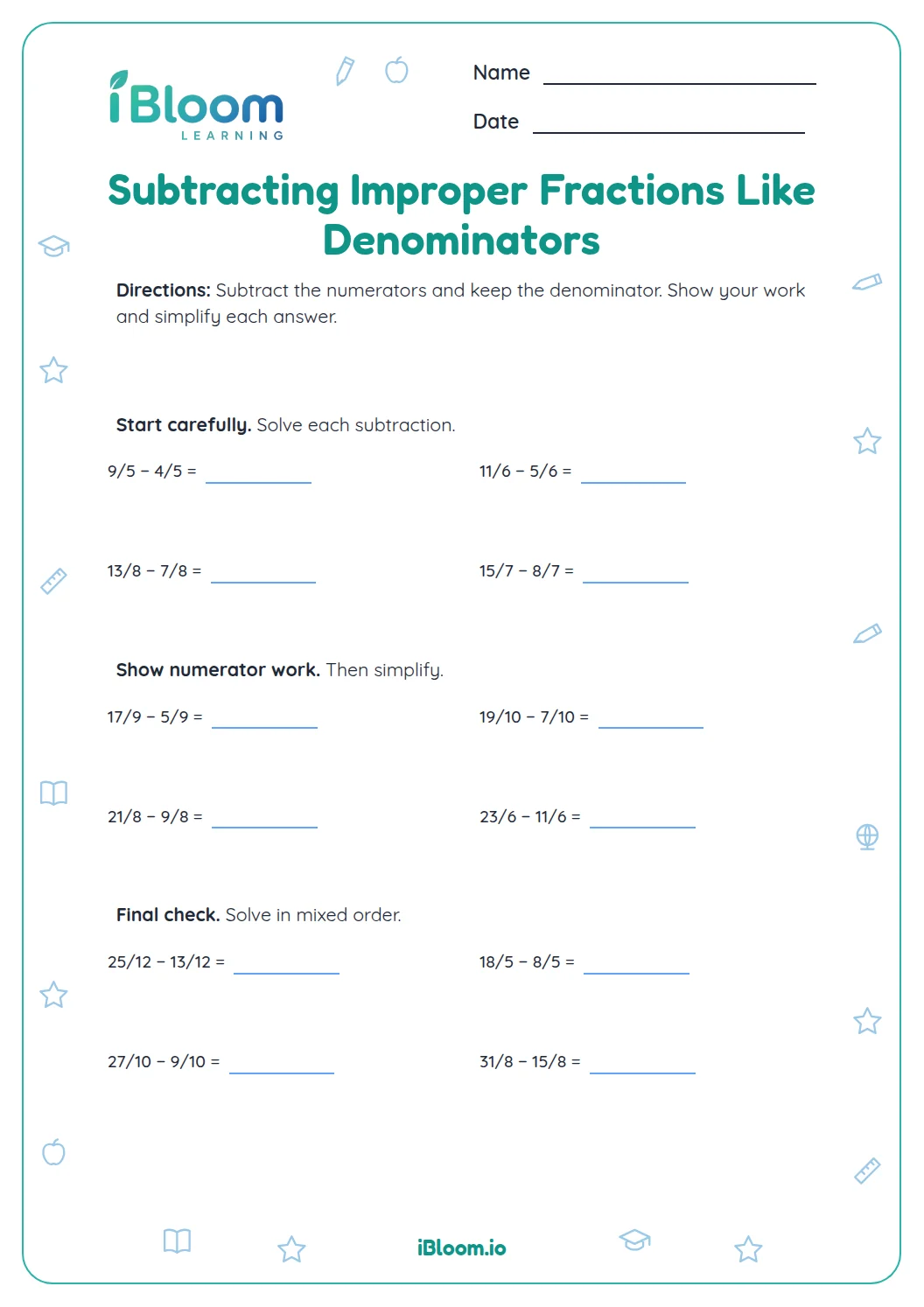
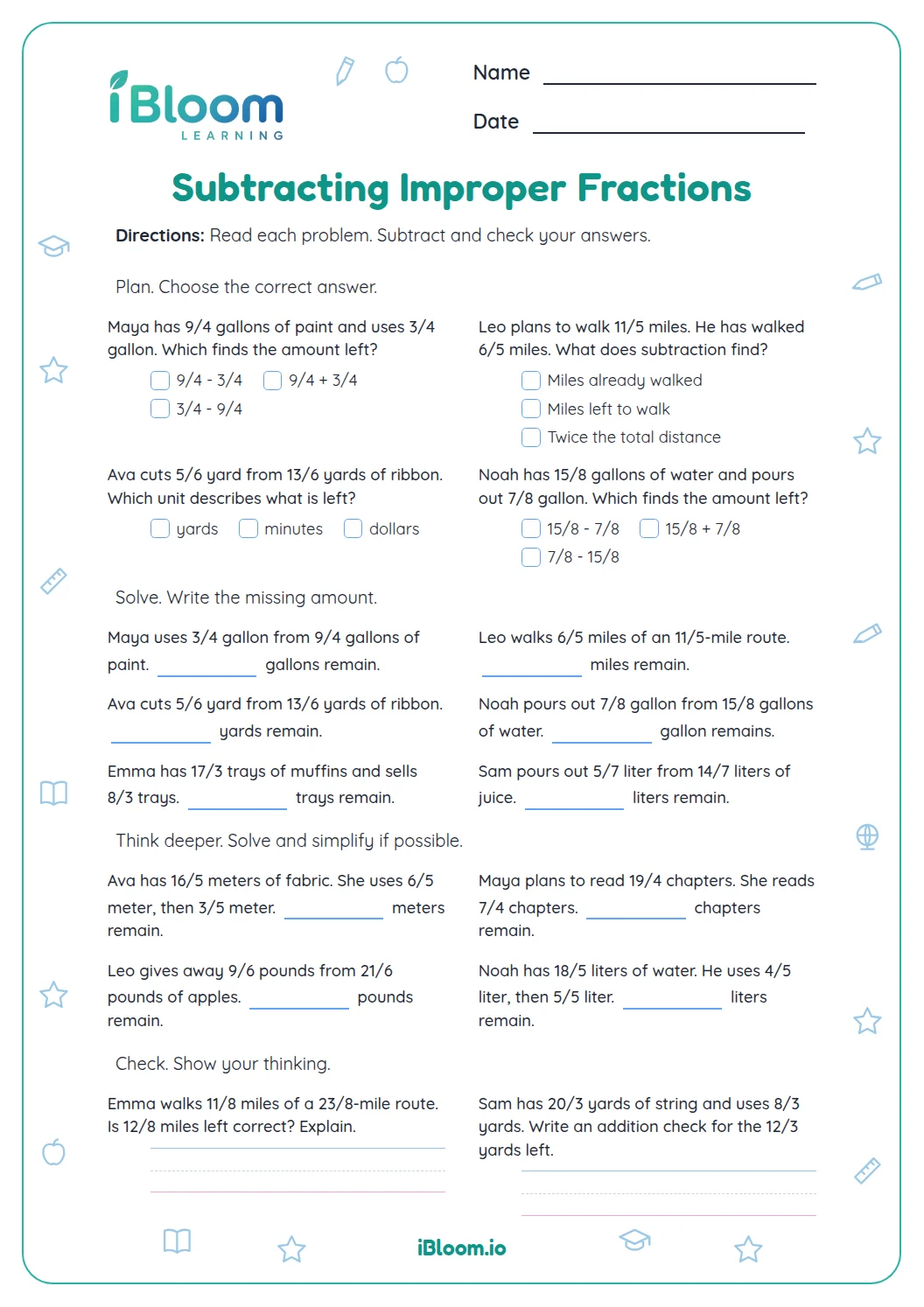
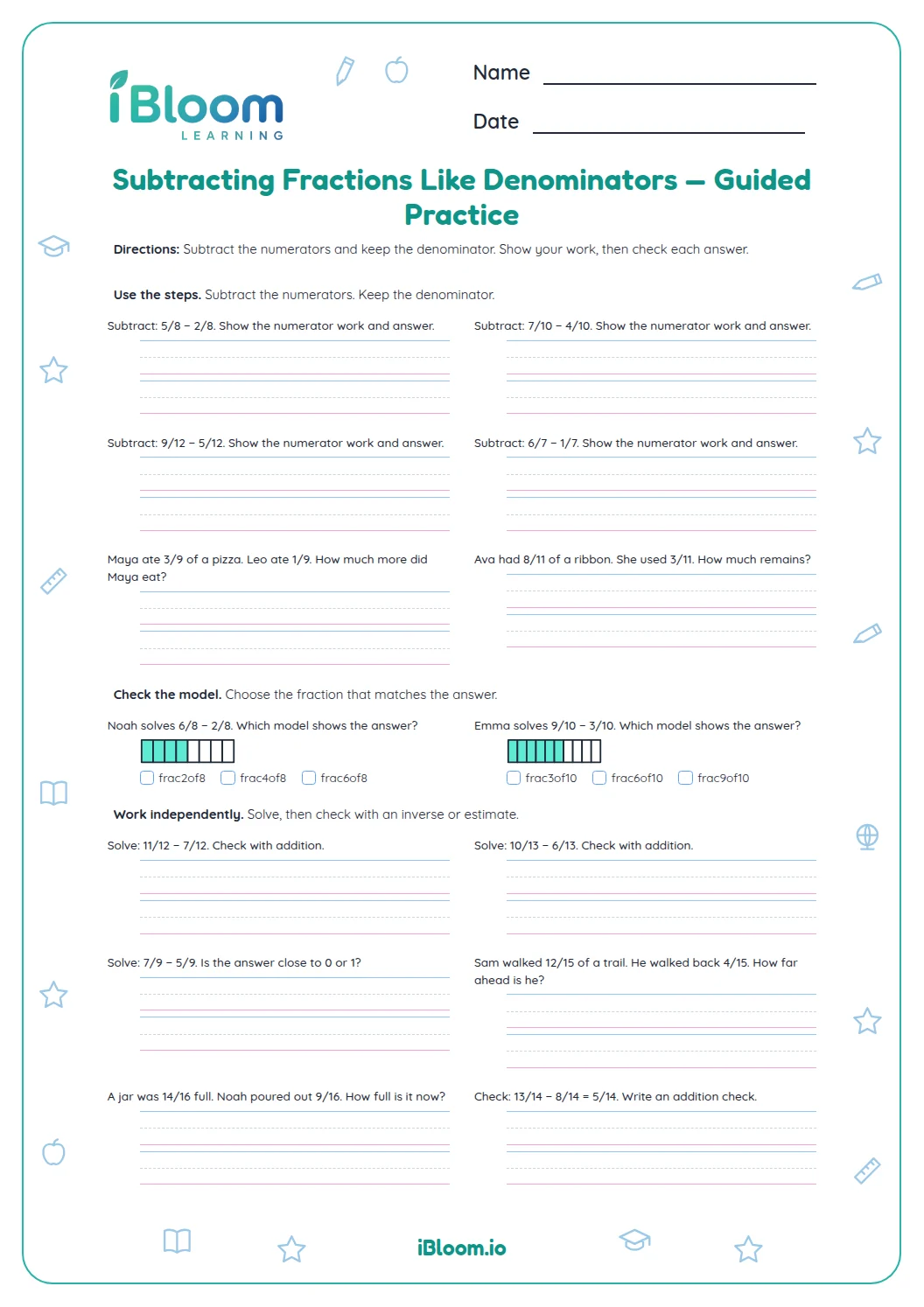
This free printable worksheet helps Grade 3 students subtract improper fractions that have the same denominator, using drawn models to see what is happening. In Part A, children count the shaded pieces in bars and circles to name fractions like 7/4 and 8/3. In Part B, they cross out pieces on a model to solve problems like 7/4 − 2/4. In Part C, they find four missing numerators, and in Part D they solve two word problems about ribbon and cornbread. It practices Common Core 4.NF.B.3.a and 4.NF.B.3.d, and a separate answer key is included.
Aligned to 4.NF.B.3.a and 4.NF.B.3.d
How do you read a fraction model that is bigger than 1?
Each shape is one whole cut into equal pieces. When the shaded amount is more than one whole, extra shapes are shaded in full. Count every shaded piece across all the shapes: that count is the numerator, and the number of pieces in one whole is the denominator.
In question 1, one full bar has 4 pieces and the next bar has 3 shaded. That is 4 + 3 = 7 pieces, so the model shows 7/4.
How do you subtract by crossing out pieces?
Subtracting a fraction means taking pieces away. Because every piece is the same size, children can just cross them out and count what is left. The unit does not change: fourths stay fourths.
Question 5 is the one to watch. Starting from 7/5, taking away 3/5 leaves 4/5, less than one whole. Children see that the answer can drop below 1 even though the problem began above it.
- 1The model shows 7/4: one full bar and 3 more fourths.
- 2Cross out 2 pieces (2/4).
- 3Count what is left: 5 pieces, each 1/4.
- 47/4 − 2/4 = 5/4
How do you find a missing numerator?
Part C hides one number. In 9/4 − ___/4 = 5/4, children can think “9 pieces, 5 left, so I took away 4,” or add back: 5 + 4 = 9. Both ideas use the fact that subtraction and addition undo each other.
Question 8 hides the starting number instead (___/6 − 5/6 = 7/6). Here the pieces taken away must be added back to the pieces that are left: 7 + 5 = 12. Question 10 asks how much was taken from 12/5 to leave only 4/5: 12 − 4 = 8 fifths.
What is on this worksheet?
Twelve questions on two pages, in four parts. Denominators are thirds, fourths, fifths, sixths and eighths. Every problem starts from more than one whole, and some answers, like 4/5 and 7/8, end up less than one.
- Part A, Name the model: two drawn models to write as improper fractions
- Part B, Take some away: four models with a subtraction to complete
- Part C, Find the missing piece: four missing numerators, two of them the starting number
- Part D, Word problems: ribbon and cornbread, with space to write a number sentence
- Answer key on separate pages
How to use this worksheet at home or in class
- 1Warm up with paper strips: cut three strips into fourths, lay out 7 pieces and say “seven fourths.” Take 2 pieces away and say what is left.
- 2Do question 1 together. Ask your child to count the shaded pieces out loud and to say what each piece is called.
- 3Let your child finish Part A, then move to Part B and have them actually cross out the pieces on each model before writing the answer.
- 4In Part C, ask your child to explain whether they took away pieces or added them back.
- 5For the word problems, ask for the number sentence first, like 9/6 − 4/6 = ___, then solve it.
- 6Check with the answer key and redo any missed question with the paper strips.
Common mistakes and quick fixes
The mistake
Subtracting the denominators too, as in 7/4 − 2/4 = 5/0 or 5/2.
The fix
The denominator names the size of each piece, and the pieces stay the same size. Say “7 fourths take away 2 fourths is 5 fourths” so the word fourths never changes.
The mistake
Counting only the shaded pieces in the last shape, so the model in question 1 looks like 3/4.
The fix
Count every shaded piece in every shape. A full bar of 4 pieces counts as 4, and the 3 shaded pieces in the next bar make 7 in all.
The mistake
Adding instead of subtracting to find the missing number in 9/4 − ___/4 = 5/4, and writing 14.
The fix
Ask “is the missing number bigger or smaller than 9?” The pieces taken away must be fewer than the pieces you started with. Check by adding back: 5 + 4 = 9.
Common Core alignment
Most US states use the Common Core math standards or a close state version. These two fraction standards match what the sheet practices.
Subtract fractions as taking away parts of the same whole.
On this sheet: Parts A and B show pieces of one whole and take some away.
Show the official wordingHide the official wording
Understand addition and subtraction of fractions as joining and separating parts referring to the same whole.
Solve word problems about fractions using models and equations.
On this sheet: Part D gives two like-denominator word problems for a number sentence.
Show the official wordingHide the official wording
Solve word problems involving addition and subtraction of fractions referring to the same whole and having like denominators, e.g., by using visual fraction models and equations to represent the problem.
What to practice next
Make more practice
Further reading
Questions parents and teachers ask
What is an improper fraction?
An improper fraction has a numerator that is equal to or bigger than its denominator, such as 7/4 or 11/6. It shows an amount of one whole or more. On this sheet each one is drawn as full shapes plus part of another shape, so children can see that 7/4 is one whole and 3 more fourths.
What is 7/4 − 2/4?
The answer is 5/4. Seven fourths take away two fourths leaves five fourths. Only the numerators are subtracted, because the fourths are the same size. This is question 3 on the worksheet, where children cross out 2 pieces on the model and count the 5 that are left.
Does my child have to turn answers into mixed numbers?
No. The answer key lists each answer as a fraction with the same denominator as the problem, such as 5/4 and 4/3. A mixed number is the same amount, so 1 1/4 for question 3 is also correct. You can ask your child to write both forms as a challenge.
Why does question 5 end with a fraction less than 1?
Starting from 7/5 and taking away 3/5 leaves 4/5, which is less than one whole. Because 7/5 is more than 1, it can seem odd that the answer is not. The model shows why: crossing out 3 of the 7 shaded pieces leaves 4 pieces, which is not enough to fill one whole shape.
How can I check a missing numerator?
Add the missing number back to check. In 9/4 − ___/4 = 5/4, the missing number is 4 because 5/4 + 4/4 = 9/4. The same idea works for the hidden starting number in question 8: 7/6 + 5/6 = 12/6, so the missing number is 12.
Is there an answer key for this worksheet?
Yes. A separate two-page answer key shows every fraction, missing numerator and word problem answer. Print the worksheet on its own and keep the key for checking, or download both as a free PDF from this page. Word problem answers keep their unit, such as 5/6 yd.