







About this worksheet
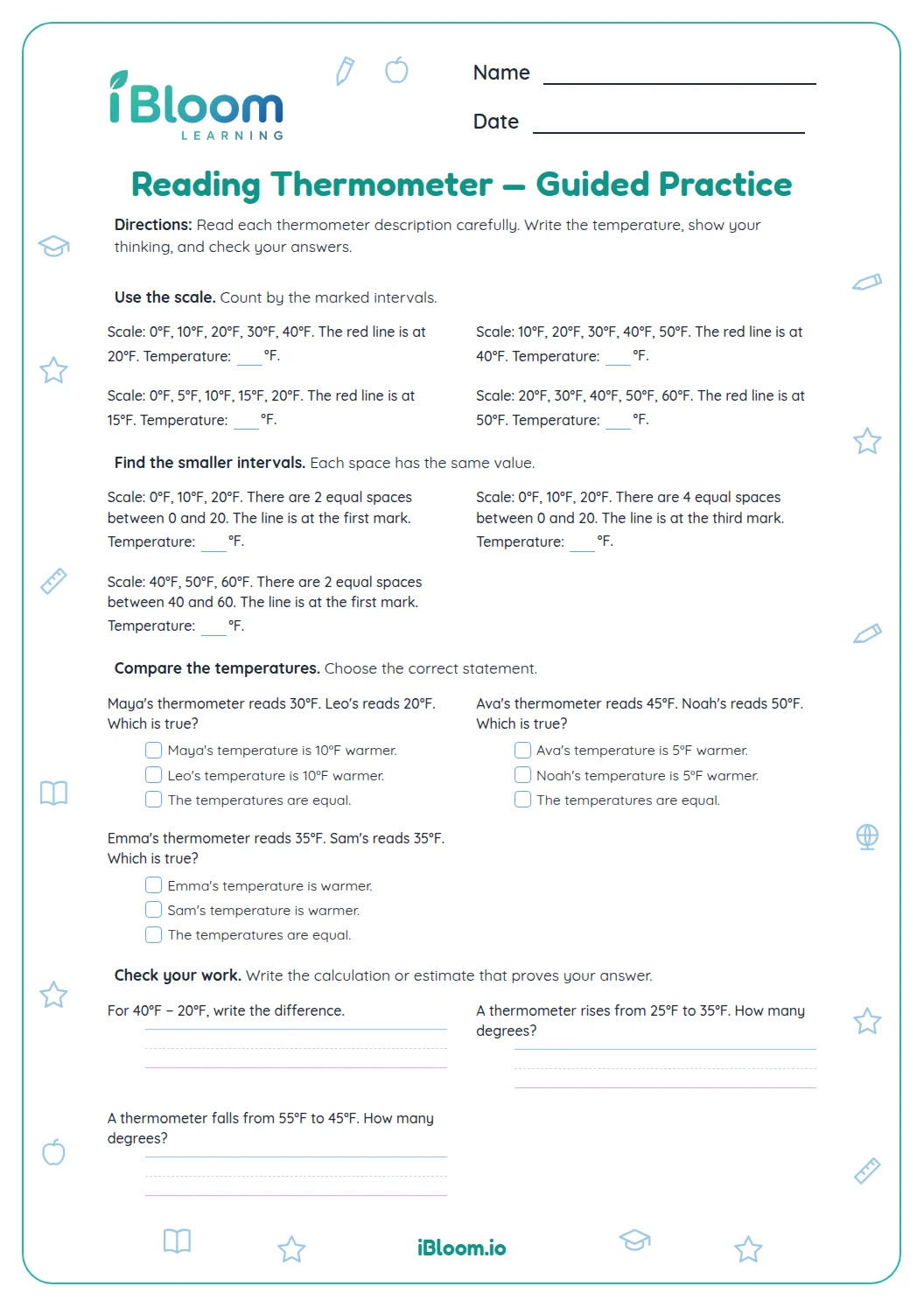
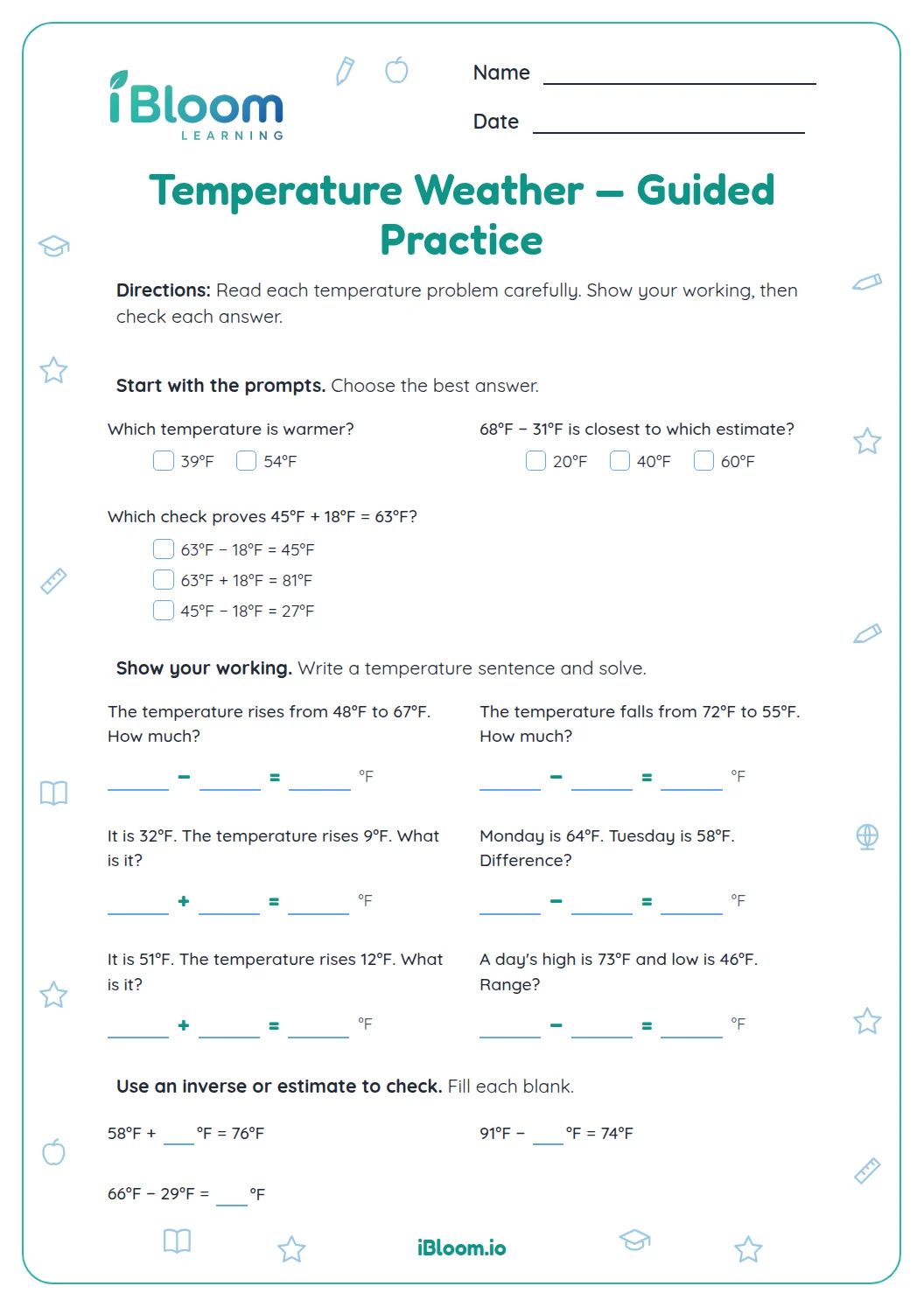
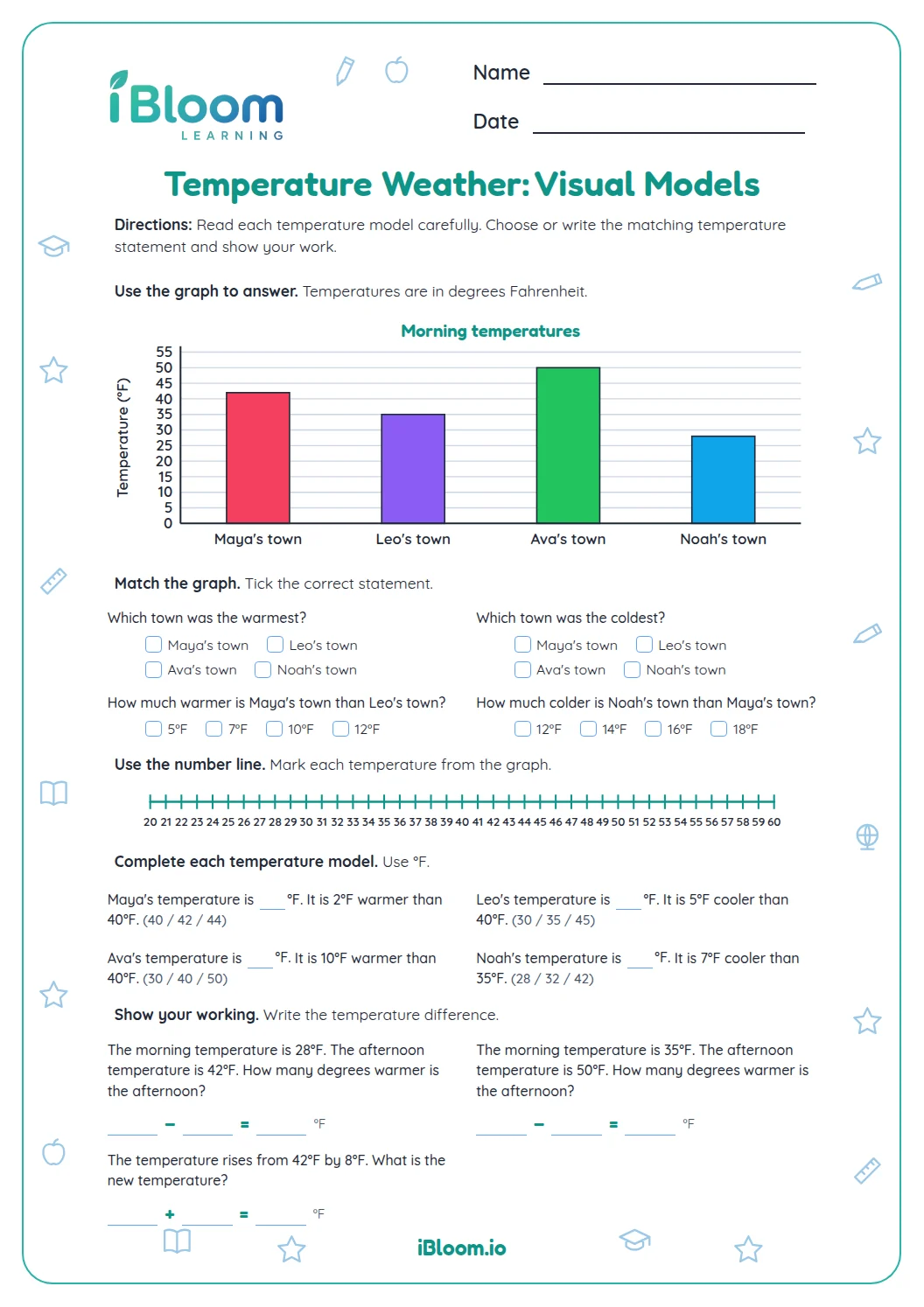
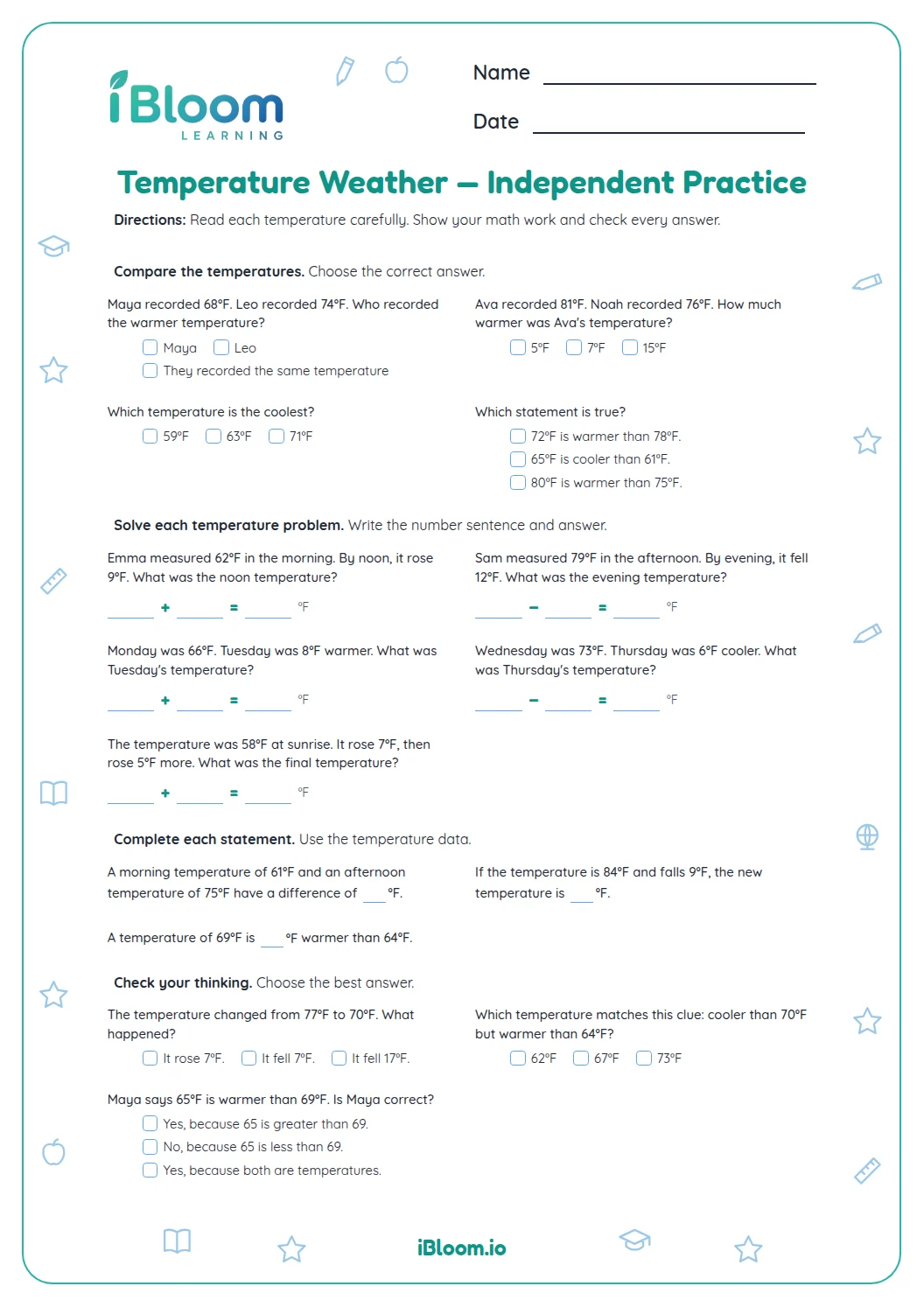
This Grade 3 worksheet introduces temperature readings with a one-degree number-line scale as a clear stand-in for thermometer markings. Students identify Fahrenheit readings, compare warmer and cooler temperatures, and find simple changes. The answer key gives each reading, comparison, or change.
How do you read a one-degree temperature scale?
The marked scale uses one-degree intervals. Begin at the labeled endpoint and count the spaces to point A, including spaces to the left of zero when the value is negative.
In question 1, point A is four intervals to the right of −10°F, so it reads −4°F.
- 1Point A starts at −10°F.
- 2Count six one-degree intervals to the right.
- 3Point A is at −4°F.
How can you compare warmer and colder temperatures?
The comparison questions ask which of two Fahrenheit values is warmer or colder. On a number line, the greater value lies farther right, including when both temperatures are below zero.
How can you find or describe a temperature change?
For a change, subtract the earlier reading from the later reading. From 12°F to 19°F is a rise of 7 degrees. Other items ask whether a reading became warmer or cooler.
- 119°F − 12°F = 7°F
- 2The temperature rose by 7 degrees.
What do the unit and intervals tell you?
The readings use degrees Fahrenheit, written °F. One space between neighboring marks represents one degree, which helps readers count a scale accurately.
How to use this worksheet
- 1Find the labeled value at an end of the scale.
- 2Count each interval to the lettered point.
- 3Write the temperature with °F.
- 4Compare values to decide which is warmer or colder.
- 5Subtract the earlier reading from the later reading to find a change.
Common mistakes and quick fixes
The mistake
Counting a tick mark as a degree instead of counting spaces.
The fix
Count the intervals between values; the first space after 0 is one degree.
The mistake
Thinking −2°F is colder than −7°F because 2 is smaller than 7.
The fix
On the number line, −2 is farther right and is warmer than −7.
The mistake
Giving 19°F as the change from 12°F to 19°F.
The fix
Subtract the readings: the temperature rose by 7 degrees.
What to practice next
Make more practice
Questions parents and teachers ask
What does one interval mean on this worksheet?
Each space from one tick to the next is one degree Fahrenheit. On question 1, point A lies at −4°F on a scale whose labeled ends are −10 and 0. Count spaces from an endpoint rather than counting the tick marks themselves.
How do I tell which temperature is warmer?
Compare the values: the greater number is warmer. For example, 4°F is warmer than −1°F because 4 lies farther right on a number line. This rule also works for two negative temperatures; −2°F is warmer than −7°F. Look farther right.
Why are some temperatures negative?
A negative Fahrenheit value is below 0°F. The first four scales include values on both sides of zero so children can practice counting intervals in either direction. The comparison questions then ask which reading is warmer or colder using those values.
What is different about the worksheet scale drawing?
The worksheet uses number lines marked in one-degree intervals as a stand-in for thermometer markings. Students still read a labeled temperature scale, compare values, and find changes. The drawing lets them count intervals clearly while practicing the same temperature-reading idea.
How many questions are on the worksheet?
There are 14 questions in three parts: six scale and value questions, four temperature comparisons, and four changes or interpretations. The worksheet has a separate answer key with the matching values and temperature descriptions. The questions combine scale reading with practical Fahrenheit reasoning.